

- Industry Size (2026)
- USD 322.5 Mn
- Forecast (2036)
- USD 525.5 Mn
- CAGR (2026 to 2036)
- 5.0%
Agar Market Size, Market Forecast and Outlook By FMI
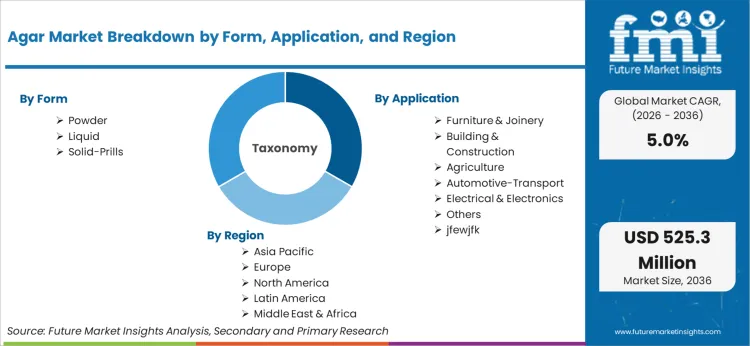
In 2025, the agar market was valued at USD 307.1 million. Based on Future Market Insights’ analysis, demand is estimated to grow to USD 322.5 million in 2026 and USD 525.5 million by 2036. FMI projects a CAGR of 5.0% during the forecast period.
Procurement teams face a "quality gate" where reliable, traceable supply chains command premiums over spot-market commodity batches. As biopharmaceutical demand for high-purity agarose matrices grows to support novel therapies, suppliers are upgrading refining capacities to meet Good Manufacturing Practice (GMP) standards. This bifurcation forces food manufacturers to lock in long-term contracts for standardized powders to avoid being priced out by the higher-margin biotech sector, creating a two-tier market dynamic.
Summary of Agar Market
- Agar Market Definition
- Industry covers the extraction and trade of red seaweed-derived hydrocolloids used for gelling and stabilization.
- Demand Drivers in the Market
- Plant-based food expansion drives need for non-animal gelatin substitutes.
- Biopharmaceutical R&D increases consumption of high-purity agarose resins.
- Sustainable packaging innovation creates new industrial use cases for seaweed polymers.
- Key Segments Analyzed in the FMI Report
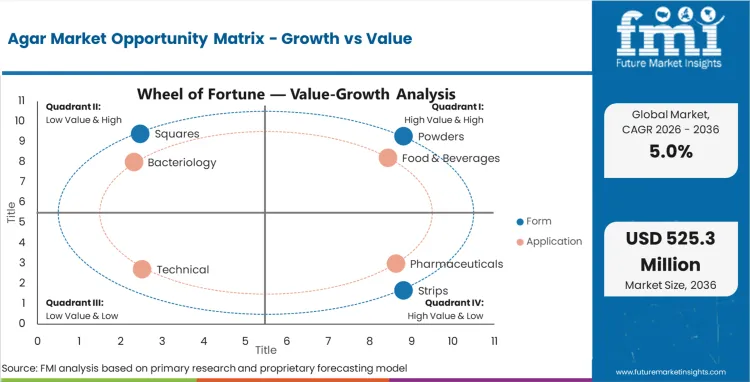
- Form: Powders dominate with 56% share due to ease of industrial dosing.
- Application: Food & Beverages leads at 35%, supported by clean-label trends.
- Geography: High-growth Asia Pacific versus high-value North American and European markets.
- Analyst Opinion at FMI
- Nandini Roy Choudhury, Principal Consultant for Food & Beverage, opines, "In the updated version of the Agar Market Report for 2026 to 2036, CXOs will find insights into key regulatory bans on plastic packaging that pose long-term opportunities for seaweed-based alternatives. Besides this, my findings point at feedstock price spikes directly impacting thin manufacturing margins and shelf-life limitations of raw biomass could restrict global export."
- Strategic Implications/Executive Takeaways
- Shift focus from commodity volume to certified bacteriological and pharmaceutical grades.
- Treat agar supply security as a critical risk; diversify sourcing beyond single-origin Gracilaria.
- Prioritize R&D in extraction efficiency to mitigate raw material cost volatility.
- Methodology
- Validated through first-hand corporate production and capacity data.
- Zero reliance on speculative third-party market research reports.
- Based on verifiable industrial benchmarks and verified sources.
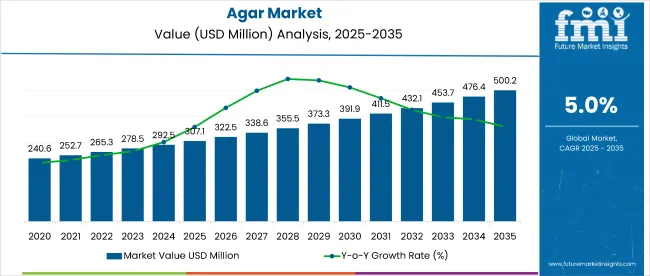
Nick Hampton, CEO of Tate & Lyle, noted regarding the industry's structural resilience, “Today, as we complete the combination with CP Kelco, we begin a new chapter in Tate & Lyle’s long and rich history.” [1] For buyers, this signals an era of supplier consolidation where access to hydrocolloid portfolios becomes a strategic advantage, reducing formulation risks but potentially limiting negotiation leverage for smaller players.
Geographic divergence is evident, with India (5.5% CAGR) and the UK (5.2% CAGR) leading growth through distinct mechanisms of production scaling and sustainable innovation respectively. China (5.0% CAGR) and Brazil (5.0% CAGR) follow, leveraging large domestic processing bases, while mature markets like the US (4.8%) and Germany (4.6%) focus on high-value pharmaceutical applications and premium food reformulation.
Agar Market Definition
Agar is a hydrophilic colloid extracted from marine red algae (Rhodophyta), specifically species such as Gelidium and Gracilaria. It functions as a premium gelling agent, stabilizer, and thickener characterized by its high hysteresis, the difference between its melting and gelling temperatures. Distinct from other hydrocolloids, agar forms firm, brittle gels at low concentrations and is essential in microbiology as a culture medium and in food processing for texture modification.
Agar Market Inclusions
Coverage encompasses all commercial grades of agar, including food-grade powders used in bakery and confectionery, bacteriological-grade agar for culture media, and high-purity agarose for electrophoresis and chromatography. The report analyzes usage across key formats such as strips, squares, and milled powders. Applications range from plant-based meat analogs and dairy alternatives to tissue culture and industrial casting.
Agar Market Exclusions
The report excludes raw seaweed biomass that has not undergone extraction processing. Non-red seaweed hydrocolloids such as alginates or carrageenan are omitted unless they form part of a blended system where agar is the primary functional agent. Synthetically derived gelling agents and lower-grade unprocessed sea moss sold for direct consumption are also outside the scope.
Agar Market Research Methodology
- Primary Research: Interviews were conducted with seaweed processors, hydrocolloid traders, biopharma procurement managers, and food scientists.
- Desk Research: Production data from FAO fisheries reports, trade association export logs, and corporate financial filings supported volume benchmarking.
- Market-Sizing and Forecasting: A hybrid top-down and bottom-up model was developed.
- Data Validation and Update Cycle: Outputs undergo anomaly screening, variance checks across production and trade datasets, and structured peer review prior to release.
Segmental Analysis
Agar Market Analysis by Form
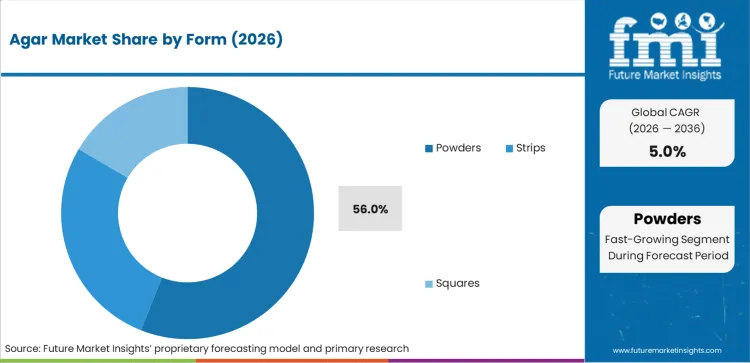
Powders represent the dominant format, projected to hold a 56% market share in 2026. Industrial buyers favor milled powders for their rapid solubility and precise dosage control in automated production lines, unlike strips or squares which require pre-soaking and manual handling. As per FMI's projection, the shift toward high-speed manufacturing in the gelatin substitute sector reinforces this preference, as powders integrate seamlessly into continuous mixing systems for dairy and bakery applications.
- Processing efficiency: Manufacturers adopt fine-mesh powders because they reduce hydration time and energy costs during large-scale food processing. This preference is supported by the global plant-based food category reaching USD 28.6 billion in 2024, where efficient texturizing agents are critical for margin maintenance. [2]
- Logistics optimization: Traders prioritize high-density powders over bulky strips to maximize shipping container utilization and reduce freight costs per unit. Growth is anchored in the expansion of global seaweed aquaculture, which reached 36.5 million tonnes wet weight in 2022, necessitating efficient downstream processing formats. [3]
- Application versatility: R&D teams utilize standardized powder grades to create consistent texture profiles in reformulated products, minimizing batch-to-batch variation. Adoption accelerates where texture modifying agents are needed to replicate animal-based mouthfeel in vegan confectionery and desserts. [2]
Agar Market Analysis by Application
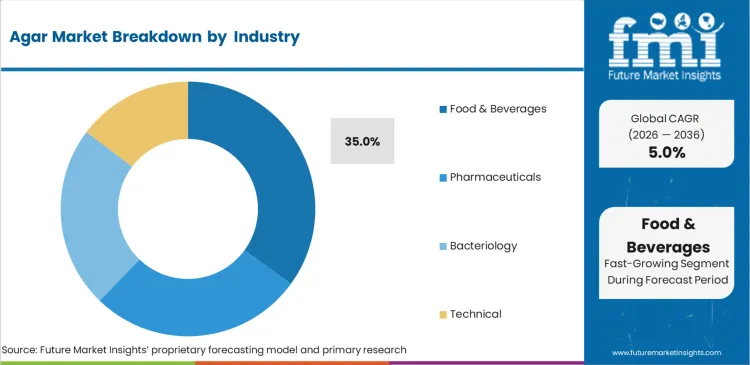
Food & Beverages constitutes the largest application segment, capturing 35% of the market value in 2026. This leadership is driven by the accelerating demand for vegan and clean-label ingredients, where agar serves as a plant-based alternative to gelatin in gummies, yogurts, and thickeners. According to FMI's estimates, the segment is expanding beyond traditional Asian desserts into Western bakery and confectionery markets, fueled by consumer awareness of sustainable marine ingredients.
- Plant-based shift: Brands reformulate products to remove animal-derived gelatin, utilizing agar’s superior gelling properties to meet vegetarian certification standards. Demand is reinforced by the USA retail plant-based food market hitting USD 8.1 billion in 2024, creating a substantial pull for compliant hydrocolloids. [2]
- Clean label: Consumers scrutinize ingredient lists for recognizable additives, prompting manufacturers to replace synthetic thickeners with natural seaweed extracts. This trajectory is supported by the global seaweed market's valuation of approximately USD 17 billion, reflecting broad acceptance of algae-based ingredients. [3]
- Texture innovation: Confectioners leverage agar’s high melting point to create heat-stable gummies and jellies that withstand supply chains in warmer climates. Growth tracks the innovation in functional snacks where stability and texture retention are paramount for retail shelf life. [2]
Agar Market Drivers, Restraints, and Opportunities
The exponential rise of the plant-based economy is a primary driver, with retail sales of plant-based categories totaling USD 28.6 billion globally in 2024. [2] As consumers increasingly reject animal-derived ingredients, food manufacturers are compelled to adopt agar as a functional substitute for gelatin. This shift is not merely ethical but functional; agar offers unique thermal stability that allows products to remain solid in warm conditions, a critical advantage for global distribution. Consequently, procurement of food grade carrageenan and agar blends has surged to meet these reformulation needs.
However, the industry is restrained by raw material volatility and cultivation limits. Global aquaculture production of algae was reported at 37.8 million tonnes in 2022, yet the availability of high-quality Gelidium and Gracilaria for agar extraction remains susceptible to climate change and ocean temperature fluctuations. [4] This supply-side constraint creates price instability; for instance, seaweed seed economics in India show a stark gap between seed cost and market value, impacting farmer incentives. [5] Such unpredictability forces processors to hold high inventory levels, tying up working capital and squeezing margins.
- Biopharma Resin Expansion: Increasing demand for monoclonal antibodies drives the need for high-purity agarose purification matrices. This opportunity is exemplified by Agarose Bead Technologies (ABT) boosting its capacity to 100,000 liters/year in September 2024 to support life-saving therapy development. [6]
- Sustainable Packaging: Seaweed-based biodegradable packaging offers a massive new industrial outlet for agar derivatives. Notpla's partnership with Levy UK & Ireland to deploy 75 million packaging items showcases the commercial viability of replacing single-use plastics with marine polymers. [7]
- Biofuel Feedstock: converting seaweed biomass into renewable energy presents a long-term volume opportunity beyond food and pharma. The partnership between HPCL and Sea6 Energy in December 2024 to develop seaweed-to-fuel technology highlights the sector's potential contribution to energy transition goals. [8]
Regional Analysis
Based on the regional analysis, the agar market is segmented into North America, Latin America, Europe, East Asia, South Asia, Oceania and Middle East & Africa across 40+ countries. The full report also offers market attractiveness analysis based on regional trends.
.webp "Top Country Growth Comparison Agar Market Cagr (2026 2036)")
| Country | CAGR (2026 to 2036) |
|---|---|
| India | 5.5% |
| United Kingdom | 5.2% |
| China | 5.0% |
| Brazil | 5.0% |
| United States | 4.8% |
| Germany | 4.6% |
Source: Future Market Insights (FMI) analysis, based on proprietary forecasting model and primary research
Asia Pacific Agar Market Analysis
Asia Pacific controls the global supply chain, leveraging massive commercial seaweed cultivation infrastructure to dominate production volumes. Global aquaculture production of aquatic animals and algae reached 223.2 million tonnes in 2022, with the vast majority centered in this region. [4] FMI analysts opine that the region is pivoting from raw material export to value-added processing, with governments implementing aggressive targets to capture downstream margin. The focus is shifting toward refining capabilities that can produce bacteriological and pharmaceutical-grade agar for export.
- China: The China agar sector is poised to expand at 5.0% CAGR during 2026 to 2036 because scale advantages in processing infrastructure allow for cost-competitive production of food-grade powders. This demand is reinforced by the total global farmed seaweed volume reaching 35.2 million tons live, providing a consistent feedstock base for domestic industry. [9]
- India: Growth in agar production across India is estimated at 5.5% CAGR through 2036, driven by the government's target to scale seaweed production to 1.12 million tonnes by 2030 to reduce import dependence. Adoption accelerates where initiatives like the training of 5,000 fishermen in Tamil Nadu and Gujarat create a formalized supply chain for Kappaphycus and Gracilaria. [10]
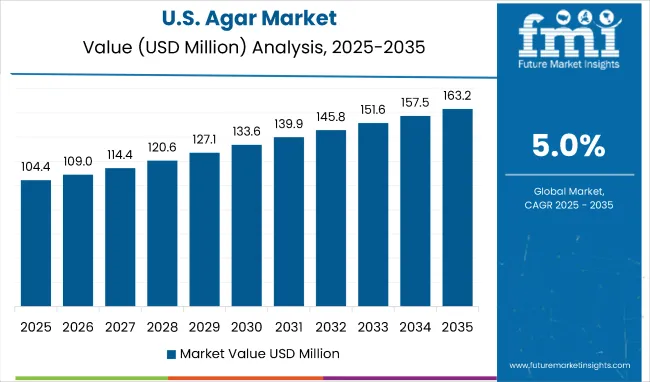
FMI’s report includes a comprehensive assessment of the Asia Pacific market. Beyond China and India, the report highlights Indonesia and the Philippines as critical upstream hubs where modernization of farming techniques is improving yield quality. South Korea is identified as a key processing technology provider, with its agar-agar exports valued at approximately USD 3 million annually, influencing regional quality standards. [5] Buyers in these markets should watch for policy shifts that incentivize domestic value addition over raw biomass exports.
Europe Agar Market Analysis
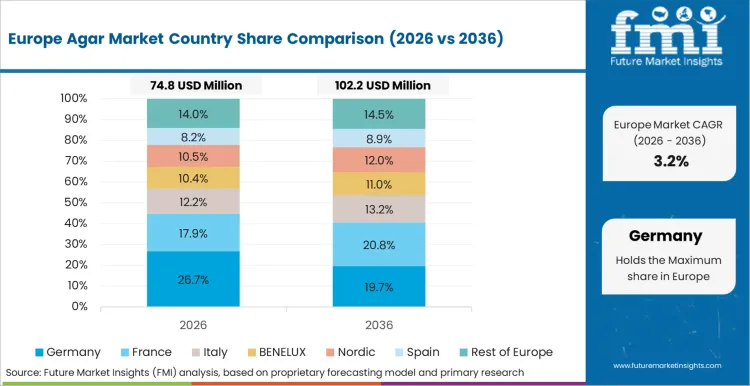
Europe represents the innovation hub for high-value agar applications, particularly in sustainable packaging and biotechnology. The region's stringent environmental regulations are catalyzing a shift toward marine-based polymers as alternatives to petrochemical plastics. Furthermore, the strong pharmaceutical manufacturing base in countries like Spain and Germany ensures steady demand for agarose resins. Companies here are leading the charge in certifying "clean label" ingredients to meet consumer demands for transparency and sustainability.
- United Kingdom: Growth tracks a CAGR of 5.2% as the country becomes a test-bed for sustainable packaging solutions, driven by partnerships like Notpla's deployment of 75 million seaweed-based items across sporting venues. This demand shift is reflected in Notpla securing £20 million in funding to scale production, signaling strong investor confidence in agar-derived material science. [7]
- Germany: At 4.6% CAGR, the country outlook is shaped by a robust pharmaceutical and food processing sector that demands high-purity, certified agar grades. Expansion is underpinned by the region's stringent quality audits, forcing suppliers to upgrade facilities, much like peers in Spain where ABT was awarded the "Innovative SME" label for its R&D excellence. [6]
FMI’s report includes a detailed growth analysis for the European region. Beyond the UK and Germany, Spain is highlighted as a critical production node for pharmaceutical-grade agarose, hosting major capacity expansions to serve the global biotech market. The report also notes growing demand in France and Italy, where culinary traditions are integrating premium gelling agent solutions into gastronomy and dessert manufacturing. [6]
North America Agar Market Analysis
North America remains a premium market focused on algae-based ingredients for health, wellness, and life sciences. The USA plant-based meat and seafood category alone was valued at USD 1.2 billion in 2024, driving specialized demand for agar to replicate seafood textures. [11] Additionally, the region's dominance in biopharmaceutical research supports high-value procurement of agarose for diagnostics and therapeutics. Suppliers are increasingly partnering with distributors to ensure deep market penetration across these varied verticals.
- United States: Demand for agar in the US is set to grow at 4.8% CAGR through 2036, supported by the booming biopharma sector's need for purification resins before new therapies enter commercial production. This trajectory is supported by Cytiva's launch of new agarose-based resins in 2025, which cater to the specific purification needs of modern biologic drug manufacturing. [12]
FMI’s report includes a detailed growth analysis for the North American region. Beyond the US, Canada is emerging as a significant market for agricultural biostimulants derived from seaweed. The expanded partnership between Acadian Plant Health and Koppert in 2025 to scale biostimulant reach demonstrates the region's broadening application scope beyond food. [13] Buyers should monitor Department of Energy funding, such as the USD 20.2 million allocated to algae projects, which could accelerate industrial-grade innovations. [14]
Latin America Agar Market Analysis
Latin America serves as both a key extraction hub and a growing consumption market for processed foods. Brazil's expanding food industry drives demand for cost-effective texturizers to support its large domestic population. The region faces currency volatility which impacts the import of high-grade agar, fostering a reliance on regional production and blended hydrocolloid systems.
- Brazil: A CAGR of 5.0% reflects the country's growing food processing capacity, where agar is increasingly used in dairy and confectionery to replace gelatin. This volume expansion is tied to the broader aquaculture growth in the Global South, where countries leverage coastal resources to integrate into the global hydrocolloid supply chain. [4]
FMI’s report includes a comprehensive assessment of the Latin American market. In addition to Brazil, Chile is recognized as a global powerhouse in seaweed harvesting, providing a substantial portion of the raw material for global agar production. The region's strategic importance is underscored by FAO reports highlighting the critical role of South American aquaculture in meeting global demand. [4]
Competitive Aligners for Market Players
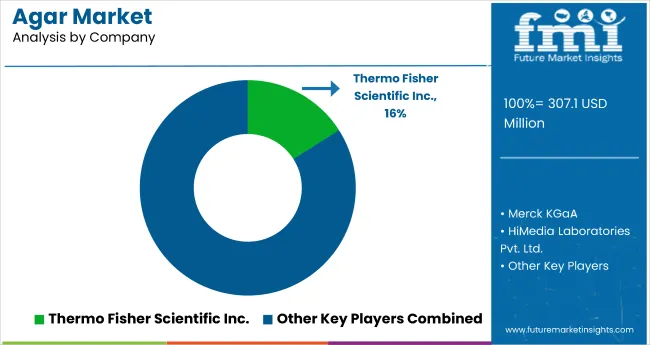
Consolidation is reshaping the competitive landscape as major ingredient players seek to own the entire texture stack. The completion of Tate & Lyle's combination with CP Kelco in November 2024 exemplifies this trend, creating a comprehensive platform for specialty food solutions. [1] For mid-sized agar producers, this signals a need to defend niches in technical or bacteriological grades, as broad-spectrum food contracts increasingly go to integrated giants offering "one-stop-shop" hydrocolloid portfolios.
Capacity expansion and quality certification are becoming non-negotiable for serving high-value sectors. Agarose Bead Technologies' expansion of its facility in Spain to 100,000 liters/year demonstrates the capital intensity required to meet pharmaceutical quality standards. [6] Suppliers failing to invest in GMP-compliant refining infrastructure risk being relegated to the commoditized food-grade market, where margins are thinner and competition from generic Asian producers is fiercer.
Strategic partnerships are unlocking new verticals beyond traditional food applications. Collaborations like the one between HPCL and Sea6 Energy to convert seaweed to biofuel introduce a new demand dynamic that could tighten raw material availability for food users. [8] Similarly, Notpla's alliance with Levy UK & Ireland validates the scalability of seaweed packaging, encouraging competitors to explore material science applications to diversify revenue streams. [7]
Recent Developments
The report includes full coverage of key trends from competitive benchmarking. Some of the recent developments covered in the reports:
- In November 2024, Tate & Lyle completed the acquisition of CP Kelco to create a leading global speciality food and beverage solutions business. [1]
- In September 2024, Notpla announced it secured £20 million in Series A+ funding to expand and scale seaweed-based packaging. [7]
Key Players in Agar Market
- Tate & Lyle
- Agarose Bead Technologies (ABT)
- Cytiva
- Marine Hydrocolloids
- Meron Group
- Hispanagar
- Setexam
- ROKO
- Sobigel
- Java Biocolloid
Scope of the Report
| Metric | Value |
|---|---|
| Quantitative Units | USD 322.5 million (2026) to USD 525.5 million (2036), at a CAGR of 5.0% |
| Market Definition | Agar is a hydrophilic colloid extracted from marine red algae used as a gelling agent, stabilizer, and thickener in food, pharma, and technical applications. |
| Form Segmentation | Powders, Strips, Squares |
| Application Segmentation | Food & Beverages, Pharmaceuticals, Bacteriology, Technical |
| Application Coverage | Bakery, Confectionery, Dairy, Microbiology Culture Media, Electrophoresis, Tissue Culture |
| Regions Covered | North America, Latin America, Europe, East Asia, South Asia, Oceania, Middle East and Africa |
| Countries Covered | United States, United Kingdom, China, India, Germany, Brazil and 40 plus countries |
| Key Companies Profiled | Tate & Lyle, Agarose Bead Technologies (ABT), Cytiva, Marine Hydrocolloids, Meron Group, Hispanagar, Setexam, ROKO, Sobigel, Java Biocolloid |
| Forecast Period | 2026 to 2036 |
| Approach | Hybrid top down and bottom up market modeling validated through primary interviews with resin producers and panel manufacturers, supported by trade data benchmarking and plant level capacity verification |
Agar Market Analysis by Segments
Form:
- Powders
- Strips
- Squares
Application:
- Food & Beverages
- Pharmaceuticals
- Bacteriology
- Technical
Region:
- Asia Pacific
- India
- China
- Japan
- South Korea
- Indonesia
- Australia & New Zealand
- ASEAN
- Rest of Asia Pacific
- Europe
- Germany
- Italy
- France
- United Kingdom
- Spain
- Benelux
- Nordics
- Central & Eastern Europe
- Rest of Europe
- North America
- United States
- Canada
- Mexico
- Latin America
- Brazil
- Argentina
- Chile
- Rest of Latin America
- Middle East & Africa
- Kingdom of Saudi Arabia
- United Arab Emirates
- South Africa
- Turkey
- Rest of Middle East & Africa
Bibliography
- [1] Tate & Lyle. (2024). Completion of combination with CP Kelco. Tate & Lyle News.
- [2] GFI. (2025). 2024 State of the Industry Report: Plant-based meat, seafood, eggs, and dairy. The Good Food Institute.
- [3] APEC. (2026). Seaweed Aquaculture Production and Value. APEC Publication.
- [4] FAO. (2024). The State of World Fisheries and Aquaculture 2024. FAO SOFIA.
- [5] NITI Aayog. (2024). Strategy for the Development of Seaweed Value Chain. Government of India.
- [6] ABT. (2024). Facility Expansion and Innovative SME Label. Agarose Bead Technologies News.
- [7] Earthshot Prize. (2024). Notpla and Levy UK & Ireland Partnership. The Earthshot Prize.
- [8] BioEnergy Times. (2024). HPCL Partners with Sea6 Energy. BioEnergy Times.
- [9] UNCTAD. (2024). Global Seaweed Market Report. UN Trade and Development.
- [10] PIB. (2026). Seaweed Production Targets and Initiatives. Press Information Bureau, Government of India.
- [11] GFI. (2024). Analyzing Plant-Based Meat and Seafood Sales. The Good Food Institute.
- [12] Cytiva. (2025). Launch of New Agarose-Based Resins. Cytiva Newsroom.
- [13] Koppert. (2025). Acadian Plant Health and Koppert Partnership Expansion. Koppert News.
- [14] DOE. (2024). Funding for Mixed Algae Conversion Research. USA Department of Energy.
This bibliography is provided for reader reference and is not exhaustive. The full report contains the complete reference list and detailed citations.
This Report Addresses
- Market intelligence to enable structured strategic decision making across mature and emerging hydrocolloid economies
- Market size estimation and 10 year revenue forecasts from 2026 to 2036, supported by validated seaweed processing capacity, seasonal harvest cycles, and export trade benchmarks across key producing and importing corridors
- Growth opportunity mapping across powder, strip, and bar forms with emphasis on food grade versus bacteriological grade transitions and higher gel strength, higher clarity premium specifications
- Segment and regional revenue forecasts covering food and beverages, microbiological culture media, pharmaceuticals, cosmetics and personal care, and technical applications where agar is used for gelling and stabilization
- Competition strategy assessment including vertical integration models from seaweed sourcing to refining, cost survivability positioning under raw material and energy volatility, and quality consistency benchmarking (gel strength, ash, moisture, clarity)
- Product reformulation and performance tracking including replacement and blending strategies versus gelatin, pectin, carrageenan, and starch systems, plus process tolerance across pH and thermal conditions in end products
- Regulatory impact analysis covering food additive specifications, microbiology grade quality and sterility expectations, contaminant thresholds (heavy metals), traceability requirements, and export driven specification upgrades for high compliance markets
- Market report delivery in PDF, Excel, PPT, and interactive dashboard formats for executive, commercial, procurement, QA/QC, and operations use
Frequently Asked Questions
How large is the demand for Agar in the global market in 2026?
Demand for Agar in the global market is estimated to be valued at USD 322.5 million in 2026.
What will be the market size of Agar in the global market by 2036?
Market size for Agar is projected to reach USD 525.5 million by 2036.
What is the expected demand growth for Agar in the global market between 2026 and 2036?
Demand for Agar in the global market is expected to grow at a CAGR of 5.0% between 2026 and 2036.
Which Form is poised to lead global sales by 2026?
Powders are expected to be the dominant form, capturing approximately 56% of global market share in 2026 due to processing efficiency.
How significant is the role of Food & Beverages Application in driving Agar adoption in 2026?
Food & Beverages represents a critical segment, projected to hold a substantial 35% share of the total market in 2026 as plant-based trends accelerate.
What is driving demand in India?
Demand is driven by government initiatives to scale domestic seaweed cultivation and establish a formalized processing value chain.
What compliance standards or regulations are referenced for India?
The NITI Aayog strategy and government production targets for 2030 are referenced as key policy benchmarks.
What is the India growth outlook in this report?
India is projected to grow at a CAGR of 5.5% during 2026 to 2036.
Why is Europe described as a priority region in this report?
Europe is prioritized due to its leadership in sustainable packaging innovation and demand for high-purity pharmaceutical grades.
What type of demand dominates in Europe?
Demand for certified, high-quality agar for biotech and eco-friendly packaging dominates regional consumption.
What is the United Kingdom growth outlook in this report?
The United Kingdom is projected to expand at a CAGR of 5.2% during 2026 to 2036.
Does the report cover China in its regional analysis?
Yes, China is included within East Asia under the regional scope of analysis.
What are the sources referred to for analyzing China?
Market analysis for China references global aquaculture statistics and trade data regarding seaweed production scale.
What is the main demand theme linked to China in its region coverage?
China demand is associated with massive scale in processing infrastructure and cost-competitive production.
Does the report cover Brazil in its regional analysis?
Yes, Brazil is included within Latin America under the regional coverage framework.
What is the main Brazil related demand theme in its region coverage?
The theme emphasizes Brazil's growing food processing sector and its integration into the global aquaculture supply chain.
Which product formats or configurations are strategically important for North America supply chains?
High-purity agarose resins and specialized food-grade powders are strategically important for the region's biotech and health sectors.
What is Agar and What is It Mainly Used For?
Agar is a red seaweed-derived hydrocolloid used primarily as a gelling agent in food, microbiology, and pharmaceutical applications.
What does Agar Market Mean in this Report?
Agar market refers to the global trade and industrial consumption of processed agar grades, excluding raw biomass.
What is Included in the Scope of this Agar Market Report?
Scope covers food, bacteriological, and technical grade agar in forms such as powders, strips, and squares.
What is Excluded from the Scope of this Report?
Raw seaweed biomass and non-red seaweed hydrocolloids like alginates are excluded unless part of a blend.
What does Market Forecast Mean on this Page?
Market forecast represents a model based projection built on defined assumptions for strategic planning purposes.
How does FMI Build and Validate the Agar Market Forecast?
Forecast is developed using hybrid top down and bottom up modeling validated through trade data, capacity checks, and industry review.
What does Zero Reliance on Speculative Third Party Market Research Mean Here?
Primary interviews and verifiable public datasets are used instead of unverified syndicated market estimates.
Preview the report firsthand - request a free sample
Get SampleGet the brochure for pricing and purchase details.
Get PDFTable of Content
- Executive Summary
- Global Market Outlook
- Demand-side Trends
- Supply-side Trends
- Technology Roadmap Analysis
- Analysis and Recommendations
- Market Overview
- Market Coverage / Taxonomy
- Market Definition / Scope / Limitations
- Research Methodology
- Chapter Orientation
- Analytical Lens and Working Hypotheses
- Market Structure, Signals, and Trend Drivers
- Benchmarking and Cross-market Comparability
- Market Sizing, Forecasting, and Opportunity Mapping
- Research Design and Evidence Framework
- Desk Research Programme (Secondary Evidence)
- Company Annual and Sustainability Reports
- Peer-reviewed Journals and Academic Literature
- Corporate Websites, Product Literature, and Technical Notes
- Earnings Decks and Investor Briefings
- Statutory Filings and Regulatory Disclosures
- Technical White Papers and Standards Notes
- Trade Journals, Industry Magazines, and Analyst Briefs
- Conference Proceedings, Webinars, and Seminar Materials
- Government Statistics Portals and Public Data Releases
- Press Releases and Reputable Media Coverage
- Specialist Newsletters and Curated Briefings
- Sector Databases and Reference Repositories
- FMI Internal Proprietary Databases and Historical Market Datasets
- Subscription Datasets and Paid Sources
- Social Channels, Communities, and Digital Listening Inputs
- Additional Desk Sources
- Expert Input and Fieldwork (Primary Evidence)
- Primary Modes
- Qualitative Interviews and Expert Elicitation
- Quantitative Surveys and Structured Data Capture
- Blended Approach
- Why Primary Evidence is Used
- Field Techniques
- Interviews
- Surveys
- Focus Groups
- Observational and In-context Research
- Social and Community Interactions
- Stakeholder Universe Engaged
- C-suite Leaders
- Board Members
- Presidents and Vice Presidents
- R&D and Innovation Heads
- Technical Specialists
- Domain Subject-matter Experts
- Scientists
- Physicians and Other Healthcare Professionals
- Governance, Ethics, and Data Stewardship
- Research Ethics
- Data Integrity and Handling
- Primary Modes
- Tooling, Models, and Reference Databases
- Desk Research Programme (Secondary Evidence)
- Data Engineering and Model Build
- Data Acquisition and Ingestion
- Cleaning, Normalisation, and Verification
- Synthesis, Triangulation, and Analysis
- Quality Assurance and Audit Trail
- Market Background
- Market Dynamics
- Drivers
- Restraints
- Opportunity
- Trends
- Scenario Forecast
- Demand in Optimistic Scenario
- Demand in Likely Scenario
- Demand in Conservative Scenario
- Opportunity Map Analysis
- Product Life Cycle Analysis
- Supply Chain Analysis
- Investment Feasibility Matrix
- Value Chain Analysis
- PESTLE and Porter’s Analysis
- Regulatory Landscape
- Regional Parent Market Outlook
- Production and Consumption Statistics
- Import and Export Statistics
- Market Dynamics
- Global Market Analysis 2021 to 2025 and Forecast, 2026 to 2036
- Historical Market Size Value (USD Million) Analysis, 2021 to 2025
- Current and Future Market Size Value (USD Million) Projections, 2026 to 2036
- Y-o-Y Growth Trend Analysis
- Absolute $ Opportunity Analysis
- Global Market Pricing Analysis 2021 to 2025 and Forecast 2026 to 2036
- Global Market Analysis 2021 to 2025 and Forecast 2026 to 2036, By Form
- Introduction / Key Findings
- Historical Market Size Value (USD Million) Analysis By Form , 2021 to 2025
- Current and Future Market Size Value (USD Million) Analysis and Forecast By Form , 2026 to 2036
- Powders
- Strips
- Squares
- Powders
- Y-o-Y Growth Trend Analysis By Form , 2021 to 2025
- Absolute $ Opportunity Analysis By Form , 2026 to 2036
- Global Market Analysis 2021 to 2025 and Forecast 2026 to 2036, By Application
- Introduction / Key Findings
- Historical Market Size Value (USD Million) Analysis By Application, 2021 to 2025
- Current and Future Market Size Value (USD Million) Analysis and Forecast By Application, 2026 to 2036
- Food & Beverages
- Pharmaceuticals
- Bacteriology
- Technical
- Food & Beverages
- Y-o-Y Growth Trend Analysis By Application, 2021 to 2025
- Absolute $ Opportunity Analysis By Application, 2026 to 2036
- Global Market Analysis 2021 to 2025 and Forecast 2026 to 2036, By Region
- Introduction
- Historical Market Size Value (USD Million) Analysis By Region, 2021 to 2025
- Current Market Size Value (USD Million) Analysis and Forecast By Region, 2026 to 2036
- North America
- Latin America
- Western Europe
- Eastern Europe
- East Asia
- South Asia and Pacific
- Middle East & Africa
- Market Attractiveness Analysis By Region
- North America Market Analysis 2021 to 2025 and Forecast 2026 to 2036, By Country
- Historical Market Size Value (USD Million) Trend Analysis By Market Taxonomy, 2021 to 2025
- Market Size Value (USD Million) Forecast By Market Taxonomy, 2026 to 2036
- By Country
- USA
- Canada
- Mexico
- By Form
- By Application
- By Country
- Market Attractiveness Analysis
- By Country
- By Form
- By Application
- Key Takeaways
- Latin America Market Analysis 2021 to 2025 and Forecast 2026 to 2036, By Country
- Historical Market Size Value (USD Million) Trend Analysis By Market Taxonomy, 2021 to 2025
- Market Size Value (USD Million) Forecast By Market Taxonomy, 2026 to 2036
- By Country
- Brazil
- Chile
- Rest of Latin America
- By Form
- By Application
- By Country
- Market Attractiveness Analysis
- By Country
- By Form
- By Application
- Key Takeaways
- Western Europe Market Analysis 2021 to 2025 and Forecast 2026 to 2036, By Country
- Historical Market Size Value (USD Million) Trend Analysis By Market Taxonomy, 2021 to 2025
- Market Size Value (USD Million) Forecast By Market Taxonomy, 2026 to 2036
- By Country
- Germany
- UK
- Italy
- Spain
- France
- Nordic
- BENELUX
- Rest of Western Europe
- By Form
- By Application
- By Country
- Market Attractiveness Analysis
- By Country
- By Form
- By Application
- Key Takeaways
- Eastern Europe Market Analysis 2021 to 2025 and Forecast 2026 to 2036, By Country
- Historical Market Size Value (USD Million) Trend Analysis By Market Taxonomy, 2021 to 2025
- Market Size Value (USD Million) Forecast By Market Taxonomy, 2026 to 2036
- By Country
- Russia
- Poland
- Hungary
- Balkan & Baltic
- Rest of Eastern Europe
- By Form
- By Application
- By Country
- Market Attractiveness Analysis
- By Country
- By Form
- By Application
- Key Takeaways
- East Asia Market Analysis 2021 to 2025 and Forecast 2026 to 2036, By Country
- Historical Market Size Value (USD Million) Trend Analysis By Market Taxonomy, 2021 to 2025
- Market Size Value (USD Million) Forecast By Market Taxonomy, 2026 to 2036
- By Country
- China
- Japan
- South Korea
- By Form
- By Application
- By Country
- Market Attractiveness Analysis
- By Country
- By Form
- By Application
- Key Takeaways
- South Asia and Pacific Market Analysis 2021 to 2025 and Forecast 2026 to 2036, By Country
- Historical Market Size Value (USD Million) Trend Analysis By Market Taxonomy, 2021 to 2025
- Market Size Value (USD Million) Forecast By Market Taxonomy, 2026 to 2036
- By Country
- India
- ASEAN
- Australia & New Zealand
- Rest of South Asia and Pacific
- By Form
- By Application
- By Country
- Market Attractiveness Analysis
- By Country
- By Form
- By Application
- Key Takeaways
- Middle East & Africa Market Analysis 2021 to 2025 and Forecast 2026 to 2036, By Country
- Historical Market Size Value (USD Million) Trend Analysis By Market Taxonomy, 2021 to 2025
- Market Size Value (USD Million) Forecast By Market Taxonomy, 2026 to 2036
- By Country
- Kingdom of Saudi Arabia
- Other GCC Countries
- Turkiye
- South Africa
- Other African Union
- Rest of Middle East & Africa
- By Form
- By Application
- By Country
- Market Attractiveness Analysis
- By Country
- By Form
- By Application
- Key Takeaways
- Key Countries Market Analysis
- USA
- Pricing Analysis
- Market Share Analysis, 2025
- By Form
- By Application
- Canada
- Pricing Analysis
- Market Share Analysis, 2025
- By Form
- By Application
- Mexico
- Pricing Analysis
- Market Share Analysis, 2025
- By Form
- By Application
- Brazil
- Pricing Analysis
- Market Share Analysis, 2025
- By Form
- By Application
- Chile
- Pricing Analysis
- Market Share Analysis, 2025
- By Form
- By Application
- Germany
- Pricing Analysis
- Market Share Analysis, 2025
- By Form
- By Application
- UK
- Pricing Analysis
- Market Share Analysis, 2025
- By Form
- By Application
- Italy
- Pricing Analysis
- Market Share Analysis, 2025
- By Form
- By Application
- Spain
- Pricing Analysis
- Market Share Analysis, 2025
- By Form
- By Application
- France
- Pricing Analysis
- Market Share Analysis, 2025
- By Form
- By Application
- India
- Pricing Analysis
- Market Share Analysis, 2025
- By Form
- By Application
- ASEAN
- Pricing Analysis
- Market Share Analysis, 2025
- By Form
- By Application
- Australia & New Zealand
- Pricing Analysis
- Market Share Analysis, 2025
- By Form
- By Application
- China
- Pricing Analysis
- Market Share Analysis, 2025
- By Form
- By Application
- Japan
- Pricing Analysis
- Market Share Analysis, 2025
- By Form
- By Application
- South Korea
- Pricing Analysis
- Market Share Analysis, 2025
- By Form
- By Application
- Russia
- Pricing Analysis
- Market Share Analysis, 2025
- By Form
- By Application
- Poland
- Pricing Analysis
- Market Share Analysis, 2025
- By Form
- By Application
- Hungary
- Pricing Analysis
- Market Share Analysis, 2025
- By Form
- By Application
- Kingdom of Saudi Arabia
- Pricing Analysis
- Market Share Analysis, 2025
- By Form
- By Application
- Turkiye
- Pricing Analysis
- Market Share Analysis, 2025
- By Form
- By Application
- South Africa
- Pricing Analysis
- Market Share Analysis, 2025
- By Form
- By Application
- USA
- Market Structure Analysis
- Competition Dashboard
- Competition Benchmarking
- Market Share Analysis of Top Players
- By Regional
- By Form
- By Application
- Competition Analysis
- Competition Deep Dive
- Tate & Lyle
- Overview
- Product Portfolio
- Profitability by Market Segments (Product/Age /Sales Channel/Region)
- Sales Footprint
- Strategy Overview
- Marketing Strategy
- Product Strategy
- Channel Strategy
- Agarose Bead Technologies (ABT)
- Cytiva
- Marine Hydrocolloids
- Meron Group
- Hispanagar
- Tate & Lyle
- Competition Deep Dive
- Assumptions & Acronyms Used


