

- Market Size (2026)
- USD 11.1 Bn
- Forecast (2036)
- USD 17.8 Bn
- CAGR (2026 to 2036)
- 4.8%
Automotive Fuel Delivery System Market Size, Market Forecast and Outlook By FMI
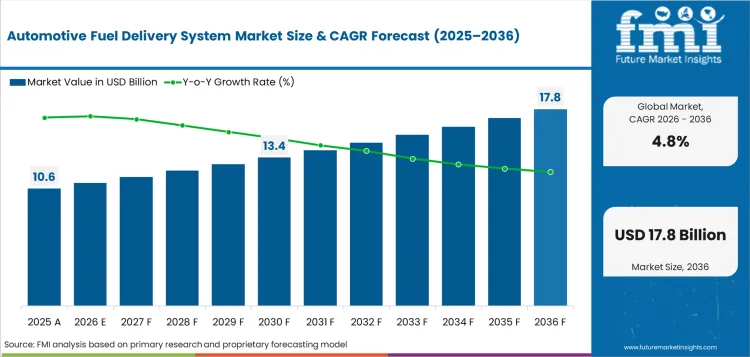
The automotive fuel delivery system market was valued at USD 10.6 billion in 2025. The market is set to reach USD 11.1 billion by 2026-end and grow at a CAGR of 4.8% between 2026-2036 to reach USD 17.8 billion by 2036. Gasoline will dominate with a 53.0% share, while Passenger Cars will lead with a 61.0% share.
Summary of the Automotive Fuel Delivery System Market
- Demand and Growth Drivers
- Regulatory pressure on vehicle safety and emission compliance is shaping demand for advanced fuel type configurations across passenger and commercial vehicle categories.
- Electrification of vehicle platforms is creating parallel demand for both conventional and next-generation components, supporting sustained procurement volumes.
- Aftermarket replacement cycles in mature economies continue to underpin demand, with aging vehicle fleets generating recurring procurement requirements.
- Product and Segment View
- Gasoline is expected to remain a major type of fuel, accounting for 53% of demand from primary end-use applications.
- Passenger Cars is the most lucrative vehicle type segment, accounting for 61% of demand, driven by volume-driven sourcing from core application segments.
- We expect existing players to maintain margin stability underpinned by product differentiation across technology tiers and application segments.
- Geography and Competitive Outlook
- South Korea is anticipated to remain an important market due to its technology-intensive manufacturing base, export-oriented production and government investment programs.
- Strong institutional procurement, regulatory compliance cycles and aftermarket demand in USA are likely to sustain demand.
- Companies that can combine fuel type capabilities and access to large scale producers are likely to gain traction in the forecast period.
- Analyst Opinion
- Nandini Roy Choudhury, Principal Consultant at FMI says, 'Companies that can improve cost competitiveness while delivering consistent performance in gasoline and passenger cars applications are likely to strengthen their position over the forecast period.'
- The automotive fuel delivery system market is evolving from a volume-driven category into a more defined market where product performance and compliance determine competitive positioning.
- Adoption is being shaped by structural shifts in end-use procurement rather than cyclical recovery, indicating sustained demand expansion.
- The market is also benefiting from regulatory-driven upgrade cycles that create replacement demand beyond organic growth.
- Demand is further supported by the need for solutions that balance performance, compliance, and long-term cost efficiency.
Key Takeaways, Market Size, and Forecast
- The automotive fuel delivery system market was valued at USD 10.60 billion in 2025.
- By 2036, the Automotive Fuel Delivery System Market is expected to be worth USD 17.75 billion.
- From 2026 to 2036, the market is projected to expand at a CAGR of 4.8%.
- The market is projected to create an incremental opportunity of USD 6.64 billion between 2026 and 2036.
- In 2026, Gasoline is expected to account for 53% of the Fuel Type, driven by sustained OEM procurement cycles and aftermarket replacement demand.
- South Korea (5.1%) and USA (5%) are two of the fastest growing markets in the world.
Automotive Fuel Delivery System Market Definition
The automotive fuel delivery system market includes all the products and services that are available commercially under this category. The market is segmented by fuel type, vehicle type, sales channel and technology. The market spans industrial, commercial and institutional applications, with both mature product configurations and emerging technology variants.
Automotive Fuel Delivery System Market Inclusions
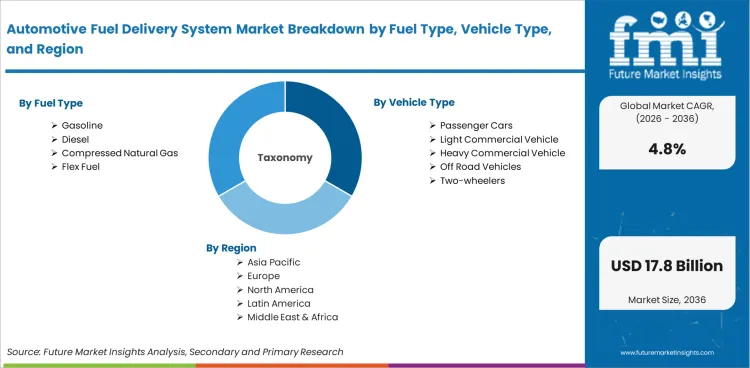
Market scope: All commercially available products, segmented by Fuel Type (Gasoline, Diesel, Compressed Natural Gas, Flex Fuel), Vehicle Type (Passenger Cars, Light Commercial Vehicle, Heavy Commercial Vehicle, Off Road Vehicles, Two-wheelers), Sales Channel (First-fit, Aftermarket), Technology (Port Fuel Injection, Gasoline Direct Injection, Common Rail Direct Injection). Revenue size range 2026 to 2036.
Automotive Fuel Delivery System Market Exclusions
Raw or unprocessed materials not classified as commercial products under the defined product taxonomy; Components marketed as part of unrelated systems where the functionality of the automotive fuel delivery system is incidental; and Products manufactured solely for internal consumption without commercial distribution.
Automotive Fuel Delivery System Market Research Methodology
Primary Research:
FMI analysts interviewed manufacturers, distributors, procurement managers, and technical specialists in key markets to gather primary demand intelligence and validate market dynamics.
Desk Research:
Collected data from trade publications, corporate annual reports, regulatory filings and industry associations to develop robust market intelligence.
Market sizing and forecast:
Bottom-up from segment-level transaction data by product categories, applications and regions. Validated against top-down industry benchmarks.
Data Validation:
Quarterly cross-validation with global production statistics, trade data and manufacturer disclosures to ensure forecast accuracy.
Why is the Automotive Fuel Delivery System Market Growing?
- The structural demand expansion across primary end-use segments is supporting a 4.8% CAGR through the forecast period, with growth concentrated in fuel type applications.
- South Korea led country-level growth at 5.1%, with technology-intensive manufacturing and export-oriented production supporting growth.
- Regulatory compliance requirements and performance standardization are creating upgrade cycles that will drive replacement demand above and beyond organic market growth.
The automotive fuel delivery system market is expected to grow at a CAGR of 4.8% from 2026 to 2036, driven by structural shifts in end-use procurement, regulatory compliance cycles, and technology-driven performance demands. Gasoline accounts for the largest demand share, with purchases concentrated in the main end uses where specifications drive purchases based on performance and reliability requirements.
Advanced safety requirements and the electrification of vehicles are affecting the demand for components in the OEM and aftermarket segments. Manufacturers who can support legacy internal combustion engine platforms and new generation electric and hybrid architectures are well positioned to retain procurement relationships as the vehicle parc evolves. Aftermarket replacements in North America and Europe provide a structural support for established product categories, while OEM expansion in East Asia drives volume growth.
Cost pressure is mounting across the automotive supply chain and the competition for margins among component suppliers is heating up. Tier-1 and Tier-2 manufacturers face challenges on multiple fronts for lower unit costs, higher performance specifications and adherence to multiple jurisdictions. Companies with vertically integrated manufacturing and multi-regional manufacturing footprints are better able to absorb cost volatility and ensure delivery reliability.
Market Segmentation Analysis
- Gasoline holds 53% of the fuel type segment, with fuel type used across multiple end-use categories.
- Passenger Cars accounts for the largest share of demand at 61%, with procurement concentrated in high-volume application categories.
- Robert Bosch GmbH leads distribution, reflecting established procurement relationships and contract manufacturing strength.
The automotive fuel delivery system market is divided into groups based on fuel type, vehicle type, sales channel, technology. By fuel type: Gasoline, Diesel, Compressed Natural Gas, Flex Fuel. By vehicle type: Passenger Cars, Light Commercial Vehicle, Heavy Commercial Vehicle, Off Road Vehicles. By sales channel: First-fit, Aftermarket. By technology: Port Fuel Injection, Gasoline Direct Injection, Common Rail Direct Injection.
Insights into the Gasoline Fuel Type Segment
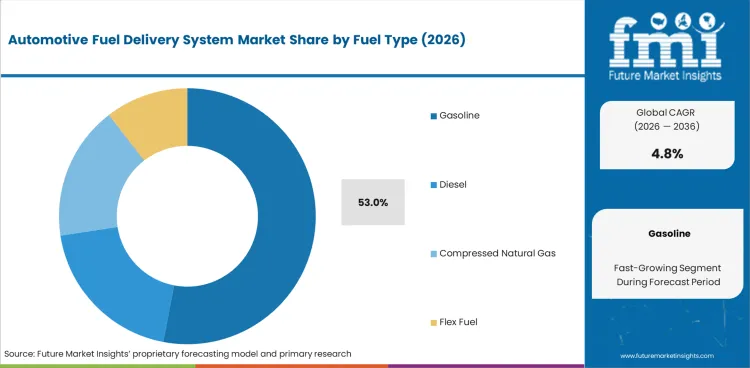
In 2026, Gasoline is expected to make up 53% of the market. Demand is concentrated in applications where fuel type performance directly affects operational outcomes and compliance positioning. Procurement decisions in this segment are shaped by specification requirements, cost-performance ratios, and supplier reliability across multi-year contracting cycles.
Insights into the Passenger Cars Vehicle Type Segment
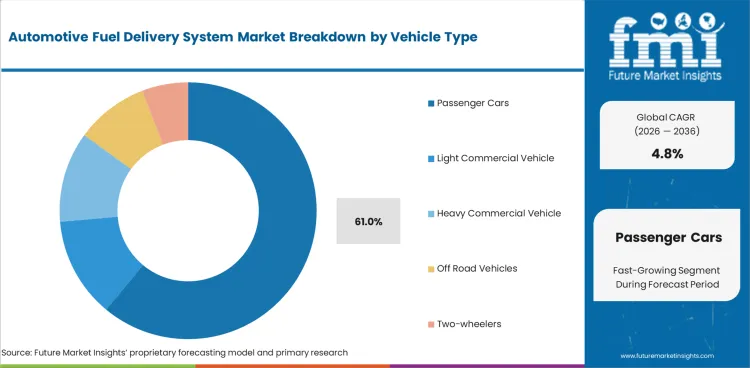
Passenger Cars accounts for 61% of the vehicle type segment. Growth in this category reflects expanding application scope and procurement volume increases from institutional and industrial buyers. Product differentiation is shaped by performance certification, regulatory compliance, and cost competitiveness across geographic markets.
Automotive Fuel Delivery System Market Drivers, Restraints, and Opportunities
- Regulatory compliance requirements and certification mandates are creating structured demand for automotive fuel delivery system products across primary end-use segments.
- Higher cost of advanced configurations compared to conventional alternatives limits adoption in price-sensitive segments, concentrating growth in premium and certified categories.
- Technology advancement and expanding application scope are creating incremental demand from previously underserved end-use categories.
The automotive fuel delivery system market keeps growing because of regulatory compliance requirements, technology advancement, and expanding application scope. Even though there are challenges like cost premiums and scaling constraints, opportunities exist in compliance-driven procurement, performance upgrading, and geographic expansion into high-growth markets.
Regulatory and Compliance Driven Demand
Demand is shaped by regulatory mandates that require standardized product specifications and performance certifications. Compliance requirements across North America, Europe, and East Asia are creating structured procurement cycles, with institutional buyers aligning purchasing decisions with regulatory timelines and certification renewal schedules.
Cost Premium and Scalability Constraints
Cost-performance trade-offs limit penetration in price-sensitive segments and hamper adoption. Higher margins in premium product categories where performance specifications justify procurement premiums. Margin compression in commodity-grade applications due to competitive intensity and input cost volatility.
Technology Driven Application Expansion
The growth is the result of technology evolution that widens the addressable application space. Increases in core product category performance are driving application adoption for which alternative solutions were previously used, creating incremental demand outside of traditional end-use segments.
Supply Chain and Sourcing Dynamics
Procurement considerations include supply chain concentration risks and sourcing reliability. Buyers with multi-year procurement needs are expanding supplier bases and turning to manufacturers with proven production capacity, quality consistency and delivery reliability in geographic markets.
Analysis of Automotive Fuel Delivery System Market By Key Countries
.webp "Top Country Growth Comparison Automotive Fuel Delivery System Market Cagr (2026 2036)")
| Country | CAGR |
|---|---|
| South Korea | 5.1% |
| USA | 5% |
| European Union | 4.8% |
| UK | 4.6% |
| Japan | 4.3% |
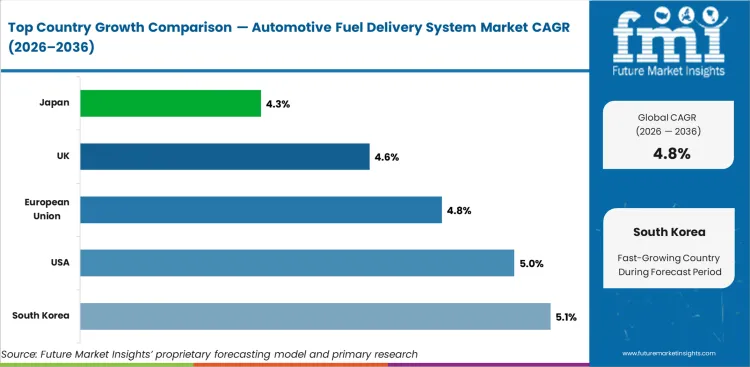
- South Korea at 5.1% reflects technology-intensive manufacturing and export-oriented production supporting growth.
- USA at 5% reflects institutional and aftermarket demand with regulatory compliance driving upgrade cycles.
- European Union at 4.8% reflects regulatory compliance mandates and sustainability requirements accelerating procurement.
- UK at 4.6% reflects compliance-driven procurement and institutional demand maintaining market momentum.
The global automotive fuel delivery system market is expected to grow at a rate of 4.8% per year from 2026 to 2036. The study covers more than 30 countries, and the main markets are listed below.
Demand Outlook for Automotive Fuel Delivery System Market in South Korea
South Korea is expected to grow at 5.1% through 2036. Technology-intensive manufacturing capacity and export-oriented production are supporting market growth. Government investment programs and domestic industrial modernization are generating sustained procurement volumes.
- Technology-intensive manufacturing drives export-oriented production demand.
- Government investment programs support domestic market modernization.
- Industrial procurement reflects quality and performance standardization.
Future Outlook for Automotive Fuel Delivery System Market in USA
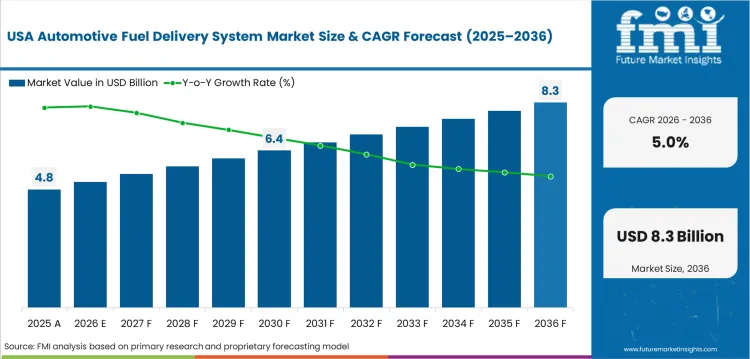
USA is expected to grow at 5% through 2036. Demand is supported by regulatory compliance cycles, aftermarket replacement volumes, and institutional procurement from large-scale end-users. Robert Bosch GmbH maintains established distribution channels and procurement relationships across the USA market.
- Regulatory compliance requirements sustain upgrade and replacement cycles.
- Aftermarket procurement from aging installed base generates recurring demand.
- Institutional buyers prioritize performance certification and supply reliability.
Opportunity Analysis of Automotive Fuel Delivery System Market in Europe
Europe is expected to grow at 4.8% through 2036. Regulatory compliance mandates, sustainability requirements, and advanced manufacturing infrastructure are shaping demand patterns. The European market emphasizes product certification, environmental compliance, and performance standardization across procurement processes.
- Sustainability mandates accelerate procurement of compliant products.
- Advanced manufacturing infrastructure supports premium product demand.
- Regulatory standardization creates compliance-driven upgrade cycles.
In-depth Analysis of Automotive Fuel Delivery System Market in UK
UK is expected to grow at 4.6% through 2036. Compliance-driven procurement, institutional demand, and post-regulatory transition requirements are maintaining market momentum. Quality standardization and performance certification requirements shape procurement decisions across end-use segments.
- Compliance-driven procurement maintains upgrade cycle demand.
- Institutional end-users prioritize certified product specifications.
- Post-regulatory transition creates incremental procurement requirements.
Sales Analysis of Automotive Fuel Delivery System Market in Japan
Japan is expected to grow at 4.3% through 2036. Advanced manufacturing capabilities and quality-driven procurement standards sustain technology leadership. Demand reflects institutional procurement patterns that prioritize product reliability, performance consistency, and long-term supplier relationships.
- Quality-driven procurement standards sustain premium product demand.
- Advanced manufacturing supports technology leadership and export competitiveness.
- Institutional procurement patterns prioritize long-term supplier relationships.
Competitive Landscape and Strategic Positioning
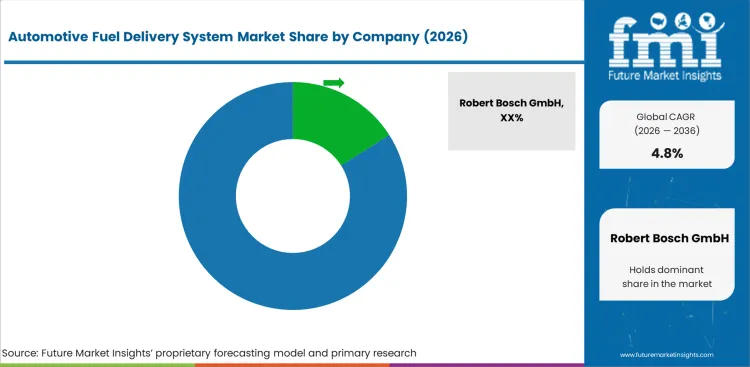
- Robert Bosch GmbH has a market share of about 16 % and is a leader based on its integrated production capabilities and proven procurement relationships across the main end-use segments.
- Continental AG, Denso Corporation and Delphi Technologies (BorgWarner Inc.) have complementary product portfolios in the value chain.
- New players are targeting niche applications and technology differentiation to gain competitive positions in high growth segments.
Robert Bosch GmbH has a leading position due to its wide coverage of the product portfolio, multi-regional manufacturing capabilities and well-established procurement relationships with institutional buyers. Continental AG’s competitive advantages are complementary product portfolio and regional distribution strength.
Established manufacturers such as Denso Corporation maintain market positions through technology specialization, access to regional markets and application-specific product development.
Barriers include price sensitivity across the value chain, regulatory approvals for new product entries, scaling up production challenges and current supply chain relationships. Strategic priorities include reducing costs, geographic expansion, and partnerships for compliance-driven procurement programs.
Key Companies in the Automotive Fuel Delivery System Market
Key global companies leading the automotive fuel delivery system market include:
- Robert Bosch GmbH, Continental AG, Denso Corporation, Delphi Technologies (BorgWarner Inc.), Magneti Marelli S.p.A., Hitachi Astemo Ltd., Keihin Corporation (Honda Group) maintain established market positions through broad product portfolios, multi-regional manufacturing capabilities, and institutional procurement relationships.
- TI Fluid Systems, US Engine Production Inc., Mikuni Corporation have become leaders in their regions by focusing on specialized product development and application-specific technical capabilities.
- Hyundai KEFICO Corporation, Stanadyne LLC, Walbro LLC are among the startups and small and medium-sized businesses building positions through technology differentiation and niche market focus.
Competitive Benchmarking: Automotive Fuel Delivery System Market
| Company | Product Breadth | Technology Capability | Distribution Reach | Geographic Footprint |
|---|---|---|---|---|
| Robert Bosch GmbH | High | High | Strong | Global |
| Continental AG | High | High | Strong | Global |
| Denso Corporation | High | Medium | Strong | Global |
| Delphi Technologies (BorgWarner Inc.) | Medium | Medium | Moderate | Multi-regional |
| Magneti Marelli S.p.A. | Medium | Medium | Moderate | Multi-regional |
| Hitachi Astemo Ltd. | Medium | Medium | Moderate | Multi-regional |
| Keihin Corporation (Honda Group) | Low | Medium | Low | Regional |
| TI Fluid Systems | Low | Medium | Low | Regional |
| US Engine Production Inc. | Low | Medium | Low | Regional |
| Mikuni Corporation | Low | Medium | Low | Regional |
Source: Future Market Insights competitive analysis, 2026.
Key Developments in Automotive Fuel Delivery System Market
- In 2025, Robert Bosch GmbH expanded its automotive fuel delivery system portfolio with advanced fuel injection and delivery technologies targeting high-growth vehicle segments across North America and Europe.
- In 2025, Continental AG announced expansion of its automotive component manufacturing capabilities to strengthen supply chain resilience and support growing demand from automotive manufacturers in East Asia.
Key Players in the Automotive Fuel Delivery System Market
Major Global Players
- Robert Bosch GmbH
- Continental AG
- Denso Corporation
- Delphi Technologies (BorgWarner Inc.)
- Magneti Marelli S.p.A.
- Hitachi Astemo Ltd.
- Keihin Corporation (Honda Group)
Emerging Players/Startups
- TI Fluid Systems
- US Engine Production Inc.
- Mikuni Corporation
- Hyundai KEFICO Corporation
- Stanadyne LLC
- Walbro LLC
- Pierburg GmbH (Rheinmetall Automotive)
- Carter Fuel Systems LLC
Report Scope and Coverage
| Parameter | Details |
|---|---|
| Quantitative Units | USD 11.11 billion to USD 17.75 billion, at a CAGR of 4.8% |
| Market Definition | The automotive fuel delivery system market encompasses fuel type, vehicle type, sales channel, technology segmentation across commercial and institutional applications. |
| Regions Covered | North America, Latin America, Europe, East Asia, South Asia and Pacific, Middle East and Africa |
| Countries Covered | South Korea, USA, European Union, UK, Japan, 30 plus countries |
| Key Companies Profiled | Robert Bosch GmbH, Continental AG, Denso Corporation, Delphi Technologies (BorgWarner Inc.), Magneti Marelli S.p.A., Hitachi Astemo Ltd., Keihin Corporation (Honda Group), TI Fluid Systems, US Engine Production Inc., Mikuni Corporation, Hyundai KEFICO Corporation, Stanadyne LLC |
| Forecast Period | 2026 to 2036 |
| Approach | Hybrid bottom-up and top-down methodology starting with verified transaction data, projecting adoption velocity across segments and regions. |
Market Segmentation Analysis
Automotive Fuel Delivery System Market Segmented by Fuel Type:
- Gasoline
- Diesel
- Compressed Natural Gas
- Flex Fuel
Automotive Fuel Delivery System Market Segmented by Vehicle Type:
- Passenger Cars
- Light Commercial Vehicle
- Heavy Commercial Vehicle
- Off Road Vehicles
- Two-wheelers
Automotive Fuel Delivery System Market Segmented by Sales Channel:
- First-fit
- Aftermarket
Automotive Fuel Delivery System Market Segmented by Technology:
- Port Fuel Injection
- Gasoline Direct Injection
- Common Rail Direct Injection
Automotive Fuel Delivery System Market by Region:
- North America
- USA
- Canada
- Mexico
- Latin America
- Brazil
- Chile
- Rest of Latin America
- Western Europe
- Germany
- UK
- Italy
- Spain
- France
- Nordic
- BENELUX
- Rest of Western Europe
- Eastern Europe
- Russia
- Poland
- Hungary
- Balkan & Baltic
- Rest of Eastern Europe
- East Asia
- China
- Japan
- South Korea
- South Asia and Pacific
- India
- ASEAN
- Australia & New Zealand
- Rest of South Asia and Pacific
- Middle East & Africa
- Kingdom of Saudi Arabia
- Other GCC Countries
- Turkiye
- South Africa
- Other African Union
- Rest of Middle East & Africa
Research Sources and Bibliography
- 1. International Organization of Motor Vehicle Manufacturers. (2025). OICA World Motor Vehicle Production Statistics. OICA.
- 2. United Nations Economic Commission for Europe. (2024). UNECE Vehicle Regulations and Standards. UNECE.
- 3. National Highway Traffic Safety Administration. (2025). NHTSA Motor Vehicle Safety Standards Database. NHTSA.
- 4. European Automobile Manufacturers Association. (2025). ACEA Automobile Industry Pocket Guide. ACEA.
- 5. World Bank. (2025). Transport Sector Overview and Statistics. World Bank.
This bibliography is provided for reader reference.
This Report Answers
- Estimating the size of the market and revenue projections from 2026 to 2036.
- Segmentation by fuel type, vehicle type, sales channel, technology.
- Insights about more than 30 markets in the region.
- Analysis of technology that includes core product categories and emerging configurations.
- Assessment of the competitive landscape.
- Finding investment opportunities in high-growth segments and regions.
- Keeping track of the supply chain.
- Delivery of data in PDF and Excel formats.
Frequently Asked Questions
What is the global market demand for Automotive Fuel Delivery System Market in 2026?
In 2026, the global automotive fuel delivery system market is expected to be worth USD 11.11 billion.
How big will the market for Automotive Fuel Delivery System Market be in 2036?
By 2036, the market for automotive fuel delivery system market is expected to be worth USD 17.75 billion.
How much do you think demand for Automotive Fuel Delivery System Market will grow between 2026 and 2036?
Between 2026 and 2036, the demand for automotive fuel delivery system market is expected to grow at a CAGR of 4.8%.
Which Fuel Type is likely to be the best seller in the Automotive Fuel Delivery System Market by 2026?
Gasoline will make up 53% of the market in 2026. This shows that gasoline is the primary demand category due to sustained OEM procurement cycles and aftermarket replacement demand.
What is causing demand to rise in South Korea in the Automotive Fuel Delivery System Market?
South Korea is expected to grow at a rate of 5.1% per year through 2036, thanks to technology-intensive manufacturing and export-oriented production supporting growth.
What is causing demand to rise in USA in the Automotive Fuel Delivery System Market?
USA is expected to grow at a rate of 5% per year through 2036, thanks to institutional and aftermarket demand with regulatory compliance driving upgrade cycles.
What does this report mean by 'Automotive Fuel Delivery System Market definition'?
The automotive fuel delivery system market includes products and services classified by fuel type, vehicle type, sales channel, technology, spanning the 2026 to 2036 forecast period.
How does FMI make the Automotive Fuel Delivery System Market forecast and check it?
Forecasting models use a hybrid bottom-up and top-down approach, starting with verified transaction data and checking it against global production statistics and manufacturer disclosures.
Preview the report firsthand - request a free sample
Get SampleGet the brochure for pricing and purchase details.
Get PDFTable of Content
- Executive Summary
- Global Market Outlook
- Demand-side Trends
- Supply-side Trends
- Technology Roadmap Analysis
- Analysis and Recommendations
- Market Overview
- Market Coverage / Taxonomy
- Market Definition / Scope / Limitations
- Research Methodology
- Chapter Orientation
- Analytical Lens and Working Hypotheses
- Market Structure, Signals, and Trend Drivers
- Benchmarking and Cross-market Comparability
- Market Sizing, Forecasting, and Opportunity Mapping
- Research Design and Evidence Framework
- Desk Research Programme (Secondary Evidence)
- Company Annual and Sustainability Reports
- Peer-reviewed Journals and Academic Literature
- Corporate Websites, Product Literature, and Technical Notes
- Earnings Decks and Investor Briefings
- Statutory Filings and Regulatory Disclosures
- Technical White Papers and Standards Notes
- Trade Journals, Industry Magazines, and Analyst Briefs
- Conference Proceedings, Webinars, and Seminar Materials
- Government Statistics Portals and Public Data Releases
- Press Releases and Reputable Media Coverage
- Specialist Newsletters and Curated Briefings
- Sector Databases and Reference Repositories
- FMI Internal Proprietary Databases and Historical Market Datasets
- Subscription Datasets and Paid Sources
- Social Channels, Communities, and Digital Listening Inputs
- Additional Desk Sources
- Expert Input and Fieldwork (Primary Evidence)
- Primary Modes
- Qualitative Interviews and Expert Elicitation
- Quantitative Surveys and Structured Data Capture
- Blended Approach
- Why Primary Evidence is Used
- Field Techniques
- Interviews
- Surveys
- Focus Groups
- Observational and In-context Research
- Social and Community Interactions
- Stakeholder Universe Engaged
- C-suite Leaders
- Board Members
- Presidents and Vice Presidents
- R&D and Innovation Heads
- Technical Specialists
- Domain Subject-matter Experts
- Scientists
- Physicians and Other Healthcare Professionals
- Governance, Ethics, and Data Stewardship
- Research Ethics
- Data Integrity and Handling
- Primary Modes
- Tooling, Models, and Reference Databases
- Desk Research Programme (Secondary Evidence)
- Data Engineering and Model Build
- Data Acquisition and Ingestion
- Cleaning, Normalisation, and Verification
- Synthesis, Triangulation, and Analysis
- Quality Assurance and Audit Trail
- Market Background
- Market Dynamics
- Drivers
- Restraints
- Opportunity
- Trends
- Scenario Forecast
- Demand in Optimistic Scenario
- Demand in Likely Scenario
- Demand in Conservative Scenario
- Opportunity Map Analysis
- Product Life Cycle Analysis
- Supply Chain Analysis
- Investment Feasibility Matrix
- Value Chain Analysis
- PESTLE and Porter’s Analysis
- Regulatory Landscape
- Regional Parent Market Outlook
- Production and Consumption Statistics
- Import and Export Statistics
- Market Dynamics
- Global Market Analysis 2021 to 2025 and Forecast, 2026 to 2036
- Historical Market Size Value (USD Million) Analysis, 2021 to 2025
- Current and Future Market Size Value (USD Million) Projections, 2026 to 2036
- Y-o-Y Growth Trend Analysis
- Absolute $ Opportunity Analysis
- Global Market Pricing Analysis 2021 to 2025 and Forecast 2026 to 2036
- Global Market Analysis 2021 to 2025 and Forecast 2026 to 2036, By Fuel Type
- Introduction / Key Findings
- Historical Market Size Value (USD Million) Analysis By Fuel Type , 2021 to 2025
- Current and Future Market Size Value (USD Million) Analysis and Forecast By Fuel Type , 2026 to 2036
- Gasoline
- Diesel
- Compressed Natural Gas
- Flex Fuel
- Gasoline
- Y-o-Y Growth Trend Analysis By Fuel Type , 2021 to 2025
- Absolute $ Opportunity Analysis By Fuel Type , 2026 to 2036
- Global Market Analysis 2021 to 2025 and Forecast 2026 to 2036, By Vehicle Type
- Introduction / Key Findings
- Historical Market Size Value (USD Million) Analysis By Vehicle Type, 2021 to 2025
- Current and Future Market Size Value (USD Million) Analysis and Forecast By Vehicle Type, 2026 to 2036
- Passenger Cars
- Light Commercial Vehicle
- Heavy Commercial Vehicle
- Off Road Vehicles
- Two-wheelers
- Passenger Cars
- Y-o-Y Growth Trend Analysis By Vehicle Type, 2021 to 2025
- Absolute $ Opportunity Analysis By Vehicle Type, 2026 to 2036
- Global Market Analysis 2021 to 2025 and Forecast 2026 to 2036, By Sales Channel
- Introduction / Key Findings
- Historical Market Size Value (USD Million) Analysis By Sales Channel, 2021 to 2025
- Current and Future Market Size Value (USD Million) Analysis and Forecast By Sales Channel, 2026 to 2036
- First-fit
- Aftermarket
- First-fit
- Y-o-Y Growth Trend Analysis By Sales Channel, 2021 to 2025
- Absolute $ Opportunity Analysis By Sales Channel, 2026 to 2036
- Global Market Analysis 2021 to 2025 and Forecast 2026 to 2036, By Technology
- Introduction / Key Findings
- Historical Market Size Value (USD Million) Analysis By Technology, 2021 to 2025
- Current and Future Market Size Value (USD Million) Analysis and Forecast By Technology, 2026 to 2036
- Port Fuel Injection
- Gasoline Direct Injection
- Common Rail Direct Injection
- Port Fuel Injection
- Y-o-Y Growth Trend Analysis By Technology, 2021 to 2025
- Absolute $ Opportunity Analysis By Technology, 2026 to 2036
- Global Market Analysis 2021 to 2025 and Forecast 2026 to 2036, By Region
- Introduction
- Historical Market Size Value (USD Million) Analysis By Region, 2021 to 2025
- Current Market Size Value (USD Million) Analysis and Forecast By Region, 2026 to 2036
- North America
- Latin America
- Western Europe
- Eastern Europe
- East Asia
- South Asia and Pacific
- Middle East & Africa
- Market Attractiveness Analysis By Region
- North America Market Analysis 2021 to 2025 and Forecast 2026 to 2036, By Country
- Historical Market Size Value (USD Million) Trend Analysis By Market Taxonomy, 2021 to 2025
- Market Size Value (USD Million) Forecast By Market Taxonomy, 2026 to 2036
- By Country
- USA
- Canada
- Mexico
- By Fuel Type
- By Vehicle Type
- By Sales Channel
- By Technology
- By Country
- Market Attractiveness Analysis
- By Country
- By Fuel Type
- By Vehicle Type
- By Sales Channel
- By Technology
- Key Takeaways
- Latin America Market Analysis 2021 to 2025 and Forecast 2026 to 2036, By Country
- Historical Market Size Value (USD Million) Trend Analysis By Market Taxonomy, 2021 to 2025
- Market Size Value (USD Million) Forecast By Market Taxonomy, 2026 to 2036
- By Country
- Brazil
- Chile
- Rest of Latin America
- By Fuel Type
- By Vehicle Type
- By Sales Channel
- By Technology
- By Country
- Market Attractiveness Analysis
- By Country
- By Fuel Type
- By Vehicle Type
- By Sales Channel
- By Technology
- Key Takeaways
- Western Europe Market Analysis 2021 to 2025 and Forecast 2026 to 2036, By Country
- Historical Market Size Value (USD Million) Trend Analysis By Market Taxonomy, 2021 to 2025
- Market Size Value (USD Million) Forecast By Market Taxonomy, 2026 to 2036
- By Country
- Germany
- UK
- Italy
- Spain
- France
- Nordic
- BENELUX
- Rest of Western Europe
- By Fuel Type
- By Vehicle Type
- By Sales Channel
- By Technology
- By Country
- Market Attractiveness Analysis
- By Country
- By Fuel Type
- By Vehicle Type
- By Sales Channel
- By Technology
- Key Takeaways
- Eastern Europe Market Analysis 2021 to 2025 and Forecast 2026 to 2036, By Country
- Historical Market Size Value (USD Million) Trend Analysis By Market Taxonomy, 2021 to 2025
- Market Size Value (USD Million) Forecast By Market Taxonomy, 2026 to 2036
- By Country
- Russia
- Poland
- Hungary
- Balkan & Baltic
- Rest of Eastern Europe
- By Fuel Type
- By Vehicle Type
- By Sales Channel
- By Technology
- By Country
- Market Attractiveness Analysis
- By Country
- By Fuel Type
- By Vehicle Type
- By Sales Channel
- By Technology
- Key Takeaways
- East Asia Market Analysis 2021 to 2025 and Forecast 2026 to 2036, By Country
- Historical Market Size Value (USD Million) Trend Analysis By Market Taxonomy, 2021 to 2025
- Market Size Value (USD Million) Forecast By Market Taxonomy, 2026 to 2036
- By Country
- China
- Japan
- South Korea
- By Fuel Type
- By Vehicle Type
- By Sales Channel
- By Technology
- By Country
- Market Attractiveness Analysis
- By Country
- By Fuel Type
- By Vehicle Type
- By Sales Channel
- By Technology
- Key Takeaways
- South Asia and Pacific Market Analysis 2021 to 2025 and Forecast 2026 to 2036, By Country
- Historical Market Size Value (USD Million) Trend Analysis By Market Taxonomy, 2021 to 2025
- Market Size Value (USD Million) Forecast By Market Taxonomy, 2026 to 2036
- By Country
- India
- ASEAN
- Australia & New Zealand
- Rest of South Asia and Pacific
- By Fuel Type
- By Vehicle Type
- By Sales Channel
- By Technology
- By Country
- Market Attractiveness Analysis
- By Country
- By Fuel Type
- By Vehicle Type
- By Sales Channel
- By Technology
- Key Takeaways
- Middle East & Africa Market Analysis 2021 to 2025 and Forecast 2026 to 2036, By Country
- Historical Market Size Value (USD Million) Trend Analysis By Market Taxonomy, 2021 to 2025
- Market Size Value (USD Million) Forecast By Market Taxonomy, 2026 to 2036
- By Country
- Kingdom of Saudi Arabia
- Other GCC Countries
- Turkiye
- South Africa
- Other African Union
- Rest of Middle East & Africa
- By Fuel Type
- By Vehicle Type
- By Sales Channel
- By Technology
- By Country
- Market Attractiveness Analysis
- By Country
- By Fuel Type
- By Vehicle Type
- By Sales Channel
- By Technology
- Key Takeaways
- Key Countries Market Analysis
- USA
- Pricing Analysis
- Market Share Analysis, 2025
- By Fuel Type
- By Vehicle Type
- By Sales Channel
- By Technology
- Canada
- Pricing Analysis
- Market Share Analysis, 2025
- By Fuel Type
- By Vehicle Type
- By Sales Channel
- By Technology
- Mexico
- Pricing Analysis
- Market Share Analysis, 2025
- By Fuel Type
- By Vehicle Type
- By Sales Channel
- By Technology
- Brazil
- Pricing Analysis
- Market Share Analysis, 2025
- By Fuel Type
- By Vehicle Type
- By Sales Channel
- By Technology
- Chile
- Pricing Analysis
- Market Share Analysis, 2025
- By Fuel Type
- By Vehicle Type
- By Sales Channel
- By Technology
- Germany
- Pricing Analysis
- Market Share Analysis, 2025
- By Fuel Type
- By Vehicle Type
- By Sales Channel
- By Technology
- UK
- Pricing Analysis
- Market Share Analysis, 2025
- By Fuel Type
- By Vehicle Type
- By Sales Channel
- By Technology
- Italy
- Pricing Analysis
- Market Share Analysis, 2025
- By Fuel Type
- By Vehicle Type
- By Sales Channel
- By Technology
- Spain
- Pricing Analysis
- Market Share Analysis, 2025
- By Fuel Type
- By Vehicle Type
- By Sales Channel
- By Technology
- France
- Pricing Analysis
- Market Share Analysis, 2025
- By Fuel Type
- By Vehicle Type
- By Sales Channel
- By Technology
- India
- Pricing Analysis
- Market Share Analysis, 2025
- By Fuel Type
- By Vehicle Type
- By Sales Channel
- By Technology
- ASEAN
- Pricing Analysis
- Market Share Analysis, 2025
- By Fuel Type
- By Vehicle Type
- By Sales Channel
- By Technology
- Australia & New Zealand
- Pricing Analysis
- Market Share Analysis, 2025
- By Fuel Type
- By Vehicle Type
- By Sales Channel
- By Technology
- China
- Pricing Analysis
- Market Share Analysis, 2025
- By Fuel Type
- By Vehicle Type
- By Sales Channel
- By Technology
- Japan
- Pricing Analysis
- Market Share Analysis, 2025
- By Fuel Type
- By Vehicle Type
- By Sales Channel
- By Technology
- South Korea
- Pricing Analysis
- Market Share Analysis, 2025
- By Fuel Type
- By Vehicle Type
- By Sales Channel
- By Technology
- Russia
- Pricing Analysis
- Market Share Analysis, 2025
- By Fuel Type
- By Vehicle Type
- By Sales Channel
- By Technology
- Poland
- Pricing Analysis
- Market Share Analysis, 2025
- By Fuel Type
- By Vehicle Type
- By Sales Channel
- By Technology
- Hungary
- Pricing Analysis
- Market Share Analysis, 2025
- By Fuel Type
- By Vehicle Type
- By Sales Channel
- By Technology
- Kingdom of Saudi Arabia
- Pricing Analysis
- Market Share Analysis, 2025
- By Fuel Type
- By Vehicle Type
- By Sales Channel
- By Technology
- Turkiye
- Pricing Analysis
- Market Share Analysis, 2025
- By Fuel Type
- By Vehicle Type
- By Sales Channel
- By Technology
- South Africa
- Pricing Analysis
- Market Share Analysis, 2025
- By Fuel Type
- By Vehicle Type
- By Sales Channel
- By Technology
- USA
- Market Structure Analysis
- Competition Dashboard
- Competition Benchmarking
- Market Share Analysis of Top Players
- By Regional
- By Fuel Type
- By Vehicle Type
- By Sales Channel
- By Technology
- Competition Analysis
- Competition Deep Dive
- Robert Bosch GmbH
- Overview
- Product Portfolio
- Profitability by Market Segments (Product/Age /Sales Channel/Region)
- Sales Footprint
- Strategy Overview
- Marketing Strategy
- Product Strategy
- Channel Strategy
- Continental AG
- Denso Corporation
- Delphi Technologies (BorgWarner Inc.)
- Magneti Marelli S.p.A.
- Hitachi Astemo Ltd.
- Keihin Corporation (Honda Group)
- TI Fluid Systems
- US Engine Production Inc.
- Mikuni Corporation
- Hyundai KEFICO Corporation
- Stanadyne LLC
- Walbro LLC
- Pierburg GmbH (Rheinmetall Automotive)
- Carter Fuel Systems LLC
- Robert Bosch GmbH
- Competition Deep Dive
- Assumptions & Acronyms Used


