

- Market Size (2026)
- USD 4.5 Bn
- Forecast (2036)
- USD 10.1 Bn
- CAGR (2026 to 2036)
- 8.3%
How big is Conductive Plastics Market in 2026?
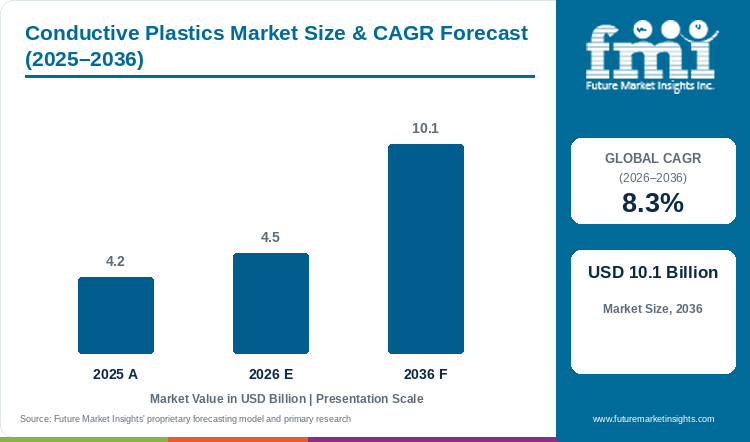
The conductive plastics market is estimated at USD 4.2 billion in 2025 and is expected to reach USD 4.5 billion in 2026. The market is forecast to grow at an 8.3% CAGR and reach USD 10.1 billion by 2036.
Sales of conductive plastics will expand at an 8.3% CAGR through the forecast decade on FMI's forecast. Sales are likely to rise from an estimated USD 4.2 billion in 2025 to USD 4.5 billion in 2026, then to USD 10.1 billion by 2036. Chip plants and electronics assemblers are tightening static control as output rises, since every wafer, die and finished board travels in dissipative trays, tapes and totes. The Semiconductor Industry Association reported global semiconductor sales of USD 146.8 billion for July 2026, 6.4% above June and 135.1% above July 2025.[1] Higher chip volumes feed straight into orders for antistatic packaging, the likely application leader in 2026 at 22%.
Across buyers, demand intensity peaks in electric vehicle battery and connector housings. In 2026, batteries are put at about 14.8% (estimated) of application sales and carmakers at about 24.8% of end-user purchases, and each pack carries cell holders, busbar covers and sensor housings molded from conductive or dissipative grades. Electric cars are expected to reach close to 30% of new car sales in 2026, pv magazine reported from IEA data in May 2026.[2] A carmaker moving a platform to battery power raises conductive plastic content per vehicle, so compounders with automotive approvals will sign multi-year supply contracts tied to vehicle programmes.
Key Market Trends & Insights
- Polyphenylene sulfide (PPS) compounds will hold a narrow 20% lead in 2026 product type sales, with polyamide near 18.4% (estimated).
- Antistatic packaging and coating is likely to account for 22% of 2026 application sales. Chip exports from South Korea were USD 60.3 billion in September 2026, 263% higher.[3]
- Electrical and electronics makers will buy an estimated 34.5% of 2026 end use sales, with automotive projected near 24.8%. Germany registered 58.1% more BEVs between January and September 2026 than a year earlier.[4]
Regional Highlights
- China grows at the quickest pace in the country table, a 9.2% CAGR in FMI's country forecast.
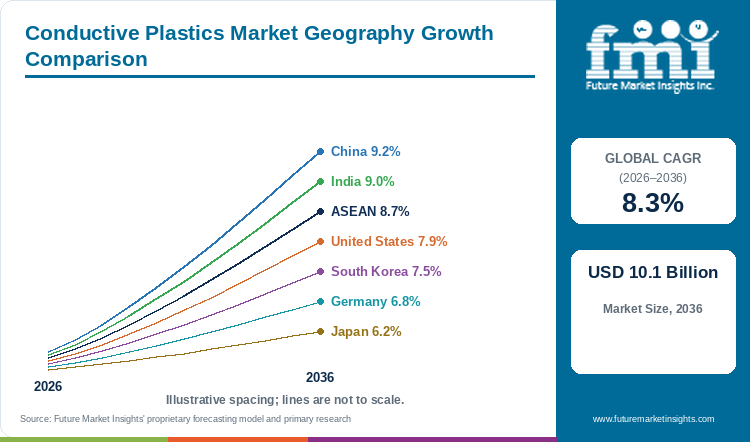
- India (9%) and ASEAN (8.7%) follow, both ahead of the 8.3% market figure, with the United States close behind at 7.9%. Large installed bases hold South Korea, Germany and Japan between 6.2% and 7.5%.
- Japan's IPA provided a further JPY 150 billion to Rapidus in June 2026, taking total funding to JPY 424.95 billion.[5]
Market Size & Forecast
Table 1: Market Size and Forecast for the Conductive Plastics Market (USD billion and percentage), 2025 to 2036
| Metric | Value |
|---|---|
| 2025 Market Size | USD 4.2 billion |
| Estimated Market Size in 2026 | USD 4.5 billion |
| Projected Market Size by 2036 | USD 10.1 billion |
| CAGR, 2026 to 2036 | 8.3% |
| Added Revenue, 2026 to 2036 | USD 5.6 billion |
| Market Expansion Multiple | 2.2x |
Compound orders follow chip and vehicle build schedules, so order volumes move with fab ramps and model launches. Engineered Materials at Celanese delivered USD 1.45 billion of net sales in April to June 2026, with pricing up 6% and volume up 3%.[6] Carbon black and nanotube additives set the conductivity, and a projected 9.1% CAGR for the carbon nanotubes market will widen the supply of low-loading conductive fillers. FMI's forecast puts the gain over the decade at USD 5.6 billion, so the 2036 market is likely to be 2.2 times as large as in 2026. The IEA reported an 8% fall in global electric car sales in Q1 2026 after policy changes, so a slowdown in battery electric launches in the United States stays the main risk.[2]
Chip Packaging, Vehicle Electrification and AI Servers
Static-safe packaging is growing with chip output. South Korea exported USD 60.3 billion of semiconductors in September 2026, the first month above USD 60 billion.[3] The Semiconductor Industry Association put July 2026 chip sales 135.1% above July 2025.[1] Each extra chip shipped needs carrier tape, reels and trays with controlled surface resistivity, and growth of the electrostatic discharge (ESD) packaging market will follow the same fabs.
Servers and electric cars are adding molded conductive parts. Celanese said AI servers need specialized materials for signal protection, thermal management and wire and cable, with a content opportunity about three times that of traditional servers.[6] Germany registered 604,144 BEVs from January to September 2026, equal to 27.2% of new cars.[4] Connector housings, sensor covers and battery parts will need EMI shielding grades as these volumes rise.
Table 2: Chip, Vehicle and Server Indicators for the Conductive Plastics Market (values, shares and growth), 2025 to 2026
| Indicator | Data Point | Relevance | Source |
|---|---|---|---|
| Global chip sales, July 2026 | USD 146.8 billion; up 135.1% | Static-safe trays and tapes. | [1] |
| South Korea chip exports, September 2026 | USD 60.3 billion; up 263% | Asian packaging volume. | [3] |
| Germany BEV registrations, January to September 2026 | 604,144; 27.2% share | Battery and connector parts. | [4] |
| Celanese Engineered Materials, Q2 2026 | USD 1.45 billion; price up 6% | Compound pricing. | [6] |
| Avient Specialty Engineered Materials, Q2 2026 | USD 343.9 million | Specialty compound sales. | [7] |
| Rapidus funding, June 2026 | JPY 424.95 billion in total | Japanese chip capacity. | [5] |
Analyst Perspective
“I expect battery housings and AI server connectors to bring the next large contracts for conductive compounders. Packaging grades will keep the volume, but approval on a vehicle platform locks in a supplier for six or seven years, so I would put development money into platform approvals now.”
- Nikhil Kaitwade, Principal Consultant, Future Market Insights.
How is the conductive plastics market segmented?
The market is segmented into product type, application, end use industry, and region. Polyphenylene sulfide is expected to lead product type with 20% share in 2026, antistatic packaging and coating is likely to lead application with 22%, and electrical and electronics is projected to lead end use at an estimated 34.5%.
By product type: polyphenylene sulfide, polyamide, polycarbonate, polypropylene, polyethylene, PBT, and others.
By application: antistatic packaging and coating, PCBs, batteries, capacitors, actuators and sensors, solar cells, electroluminescence, and others.
By end use industry: electrical and electronics, automotive, industrial, aerospace and defense, healthcare, telecommunications, and others.
By region: East Asia and South Asia and Pacific, North America and Latin America, Western Europe and Eastern Europe, and Middle East and Africa.
Why does polyphenylene sulfide lead conductive plastics sales by product type?
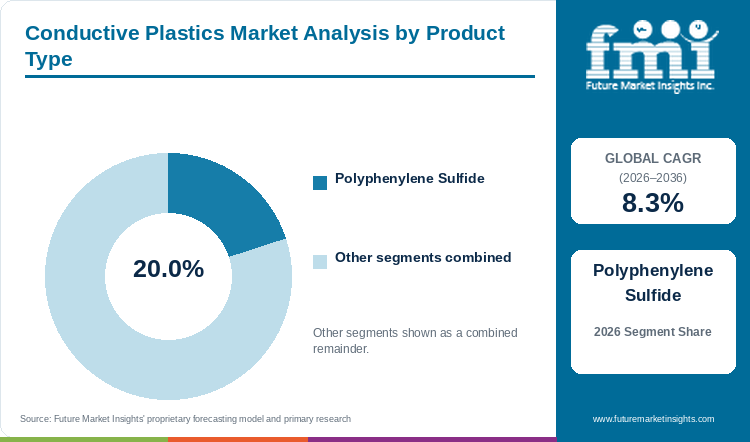
Polyphenylene sulfide is expected to lead product type sales with 20% share in 2026, ahead of polyamide at an estimated 18.4% and polycarbonate at about 16.2%.
Table 3: Product Type Share for the Conductive Plastics Market (percentage share), 2026
| Product Type | Estimated Share (2026) |
|---|---|
| Polyphenylene Sulfide | 20% |
| Polyamide | 18.4% |
| Polycarbonate | 16.2% |
| Polypropylene | 14.1% |
| Polyethylene | 12.3% |
| PBT | 9.6% |
| Others | 9.4% |
| Total | 100.0% |
Table 4: Product Type Leadership and Market Growth for the Conductive Plastics Market (segment and CAGR percentage), 2026 to 2036
| Metric | Value |
|---|---|
| Global CAGR (2026 to 2036) | 8.3% |
| Leading Segment | Polyphenylene Sulfide |
Polyphenylene sulfide is expected to lead with 20% share in 2026, because the resin keeps shape at high temperatures and resists coolant, which suits battery and engine-bay parts. Polyamide, an estimated 18.4%, is cheaper and easier to mold but absorbs moisture, so conductivity drifts in humid service. Polycarbonate, near 16.2%, is chosen for transparent or colored housings, and ATEX-grade polycarbonate enclosures sell at lower volume. Polypropylene, about 14.1%, and polyethylene, about 12.3%, lead by tonnage in trays and films but carry lower prices per kilogram, so value share stays below PPS. PBT, near 9.6%, serves connectors with modest heat loads and tight cost targets. Others, roughly 9.4%, include PEEK and blends. Battery and e-motor programmes also draw unfilled grades, and growth of the polyphenylene sulfide market will give compounders more base resin to fill. Engineers pick PPS when a part is mounted near a hot battery or motor, and polyamide when the budget is tight.
- Carbon fiber and carbon black filled PPS compounds go into battery modules, sensor housings and fuel system parts.
- In August 2026, Celanese reported 6% higher pricing in Engineered Materials for the second quarter.[6]
What gives antistatic packaging and coating the largest application share?
Antistatic packaging and coating is likely to lead application sales with 22% share in 2026, with PCBs at an estimated 16.5% and batteries at about 14.8%.
Table 5: Application Share for the Conductive Plastics Market (percentage share), 2026
| Application | Estimated Share (2026) |
|---|---|
| Antistatic Packaging and Coating | 22% |
| PCBs | 16.5% |
| Batteries | 14.8% |
| Capacitors | 12.1% |
| Actuators and Sensors | 11.6% |
| Solar Cells | 8.3% |
| Electroluminescence | 5.2% |
| Others | 9.5% |
| Total | 100.0% |
Packaging and coating for antistatic use is projected to lead with 22% share in 2026, since chips and boards are packed and repacked many times between fab, assembler and end user. PCBs, an estimated 16.5%, use conductive films and coatings on a smaller area per board, and growth of the conductive polymers market will widen coating choices for board makers. Batteries, about 14.8%, grow fastest with each new electric platform but start from a smaller base. Capacitors, near 12.1%, and actuators and sensors, near 11.6%, buy small precision parts. Solar cells, about 8.3%, and electroluminescence, near 5.2%, remain niche. Others hold roughly 9.5%. A chip packager reorders trays and tapes every month, which keeps packaging in front of one-time component designs.
- Carrier tapes, trays, tote boxes, bags and floor coatings form the antistatic group.
- In October 2026, South Korea reported that chip exports passed USD 60 billion in a single month for the first time.[3]
Which end use industry leads demand for conductive plastics?
Electrical and electronics is projected at an estimated 34.5% of end use sales in 2026, ahead of automotive at about 24.8%.
Table 6: End Use Industry Share for the Conductive Plastics Market (percentage share), 2026
| End Use Industry | Estimated Share (2026) |
|---|---|
| Electrical and Electronics | 34.5% |
| Automotive | 24.8% |
| Industrial | 12.6% |
| Aerospace and Defense | 8.4% |
| Healthcare | 7.9% |
| Telecommunications | 6.7% |
| Others | 5.1% |
| Total | 100.0% |
Makers of electrical and electronic goods will lead end use demand on an estimated 34.5% share in 2026, as chip, board and device makers buy packaging, housings and coatings at every stage of assembly. Automotive, about 24.8%, gains content per car as battery electric share rises. Industrial users, near 12.6%, buy ATEX-rated housings for explosive atmospheres. Aerospace and defense, an estimated 8.4%, needs EMI shielding, and Aerospace Systems at Parker Hannifin grew 13.4% organically in fiscal 2026.[8] Healthcare, near 7.9%, uses static-safe device housings, telecommunications holds about 6.7% and others about 5.1%. An electronics plant buys conductive plastics in every shift, so the segment keeps the largest share.
- Buyers include chip packagers, contract electronics assemblers, board makers and device brands.
- Specialty Engineered Materials sales at Avient were USD 343.9 million in the June quarter, the company reported in August 2026.[7]
What are the drivers, restraints, and opportunities in the conductive plastics market?
Rising chip and battery output increases the number of static-sensitive parts that need protection. Higher compound prices and long approval cycles hold back substitution of metal, and EMI-shielding grades for servers and vehicles open new contracts.
- Driver: Every rise in chip and board output adds trays, tapes and coatings, because static damage scraps finished parts.
- Restraint: Conductive compounds cost more than standard resins, and automotive approval cycles delay the switch from metal or coated parts.
- Opportunity: Shielding grades for AI servers and electric vehicles let compounders sell higher-value parts in place of metal housings.
Chip Output Raises Demand for Static-Safe Packaging
Static control budgets follow chip volume closely. July 2026 chip sales reached USD 146.8 billion, with the Americas 171.3% higher and Japan 50.8% higher than a year before, the Semiconductor Industry Association reported.[1] Japan is adding capacity through Rapidus, which targets full-scale 2nm manufacturing by 2027.[5] Packaging suppliers near new fabs will gain repeat tray and tape orders.
Price Increases and Approval Cycles Slow Substitution
Compound prices are rising faster than volume, as FMI's tracking of compounder results shows. Celanese raised Engineered Materials pricing by 6% in Q2 2026, against 3% volume growth.[6] Avient raised 2026 earnings guidance on 4.3% organic growth.[7] Carmakers test a new grade over one or more model cycles, so higher prices and long validation keep metal parts in place on older platforms.
Shielding Grades for Servers and Electric Vehicles Open New Contracts
AI servers and electric cars need parts that block interference without adding metal weight. Celanese described a content opportunity in AI servers about three times larger than in traditional servers.[6] German BEV registrations for the nine months to September 2026 were 58.1% higher.[4] Color and additive concentrates carry the conductive filler into many of these parts, and with the masterbatch market expected to expand at a 6.3% CAGR, conductive masterbatch will reach more molders.
Which country CAGRs are profiled in the conductive plastics market?
Table 7: Country CAGR Comparison for the Conductive Plastics Market (CAGR percentage), 2026 to 2036
| Country | CAGR (2026 to 2036) |
|---|---|
| China | 9.2% |
| India | 9% |
| ASEAN | 8.7% |
| United States | 7.9% |
| South Korea | 7.5% |
| Germany | 6.8% |
| Japan | 6.2% |
How do country-level CAGRs compare in the conductive plastics market?
Chinese plants made nearly three-quarters of the almost 22 million electric vehicles produced in 2025, the IEA reported.[2] Battery and electronics output carries China to 9.2% in FMI's country view, about 0.9 points over the market rate of 8.3%. India and ASEAN follow near 9% and 8.7% as new assembly lines open, and AI server builds keep the United States near 7.9%. South Korea, Germany and Japan grow from a larger installed base of electronics and auto plants, at 7.5%, 6.8% and 6.2%, led by chip exports, electric cars and fab subsidies.
- China builds most of the electric vehicles and batteries that use conductive housings.
- New phone and electronics assembly lines in India buy static-safe packaging.
- ASEAN electronics plants add tray and tape demand as production moves from China.
- AI server builds in the United States need EMI-shielding parts.
- Record chip exports keep Korean packaging lines busy.
- Electric cars made up 27.2% of new German car registrations in January to September 2026.
- Rapidus funding supports new chip capacity in Japan.
Full report country CAGRs cover: Electronics assembly hubs China, India and ASEAN are the three above the 8.3% global rate. Below that rate the United States comes first and South Korea next, Germany and Japan are slowest, and regional tables are reserved for Latin America, Eastern Europe, and Middle East and Africa.
Country-wise Analysis
China Conductive Plastics Market Outlook (2026 to 2036)
Battery and EV output give China the top rate in the set, and on FMI's forecast the country will grow at a 9.2% CAGR over 2026 to 2036. Chinese plants made nearly three-quarters of global electric vehicle output in 2025 and over 80% of battery cells.[2] Battery pack and connector suppliers there will buy the largest volumes of PPS and polyamide conductive grades.
Key takeaway: Battery and EV output keep China at the head of the table.
India Conductive Plastics Market Outlook (2026 to 2036)
Phone and electronics assembly lines opened by global brands in India need static-safe trays, bags and work surfaces from day one. MeitY approved 31 more proposals under the Electronics Components Manufacturing Scheme in August 2026, taking the total to 106, with enclosures, connectors and metal shielding covers among the target products.[9] A 9% CAGR is projected for India, second in the set. Two-wheeler and car makers adding battery models will buy conductive housings next.
Key takeaway: New electronics assembly gives India the second-highest profiled rate.
ASEAN Conductive Plastics Market Outlook (2026 to 2036)
Electronics plants across Vietnam, Malaysia and Thailand are buying carrier tapes and trays as production moves out of China. The IEA expects Southeast Asian electric car share to reach 60% by 2035, from close to 20% in 2025.[2] Growth across ASEAN is likely near 8.7%, 0.4 points over the market rate of 8.3%.
Key takeaway: Electronics relocation and fast EV growth keep ASEAN ahead of the market.
United States Conductive Plastics Market Outlook (2026 to 2036)
AI server builds support an expected 7.9% CAGR for conductive plastics in the United States, FMI's country estimate shows. Chip sales in the Americas for July 2026 were 171.3% above the prior July.[1] Celanese sees AI servers needing about three times the specialized material content of traditional servers.[6] Data center builders and server assemblers will buy EMI-shielding housings and cable parts.
Key takeaway: Chip demand and AI server builds keep the United States close to the market rate.
South Korea Conductive Plastics Market Outlook (2026 to 2036)
The ministry reported USD 60.3 billion of chip exports for September 2026, 263% higher.[3] Memory makers ship each chip in static-safe packaging, and Korean battery makers buy conductive cell holders. South Korea is forecast to grow at 7.5%, 0.8 points under the market, because the packaging base is already large.
Key takeaway: Record chip exports support Korean orders, though a large base limits growth to 7.5%.
Germany Conductive Plastics Market Outlook (2026 to 2036)
Germany added 604,144 BEV registrations between January and September 2026, 58.1% more than a year earlier.[4] German suppliers will mold more connector, sensor and battery parts from conductive PPS and polyamide. A 6.8% CAGR is projected for Germany.
Key takeaway: Electric car growth supports German demand from a mature auto parts base.
Japan Conductive Plastics Market Outlook (2026 to 2036)
Rapidus raised a further JPY 150 billion through the IPA in June 2026 to move toward full-scale 2nm production by 2027.[5] Japanese chip sales for July 2026 came in 50.8% above July 2025.[1] FMI has Japan at a 6.2% CAGR, the lowest in the table, as existing electronics plants already use conductive packaging.
Key takeaway: New fab capacity adds orders, but a mature base gives Japan the lowest profiled CAGR.
Who are the notable companies in the conductive plastics market?
Celanese, SABIC, Avient, RTP Company, Covestro, Premix Group, Parker Hannifin, Bekaert, Flamingo Additives & Colourants, Sinho Electronic and Kenner Material & System are the profiled companies.
Celanese, SABIC and Avient hold the most documented positions in engineered conductive compounds. For the June quarter of 2026, Celanese reported USD 1.45 billion of Engineered Materials net sales.[6] Avient reported USD 917.0 million of total sales in the same quarter, with 4.3% organic growth.[7] Parker Hannifin reported record fiscal 2026 sales of USD 21.5 billion, including the Aerospace Systems business that buys shielding materials.[8]
- Engineering compounders: Celanese, SABIC, Avient, RTP Company and Covestro.
- Specialty conductive suppliers: Premix Group, Parker Hannifin and Bekaert.
- Packaging and masterbatch makers: Flamingo Additives & Colourants, Sinho Electronic and Kenner Material & System.
Competitive Benchmarking: Conductive Plastics Market
Table 8: Competitive Benchmarking for the Conductive Plastics Market (qualitative documentation ratings), 2026
| Company | Compound Range | Automotive Approvals | Electronics Focus | Recency |
|---|---|---|---|---|
| Celanese | High | High | Medium | High |
| SABIC | High | Medium | Medium | Low |
| Avient | High | Medium | Medium | High |
| RTP Company | Medium | Medium | High | Low |
| Parker Hannifin | Medium | Low | Medium | High |
Higher grades mean more dated, public detail released on conductive grades and results, not a higher sales rank.
Key Developments in the Conductive Plastics Market
- On 16 October 2026, KBA data showed 604,144 BEV registrations in Germany for January to September.[4]
- On 1 October 2026, South Korea reported record September exports with chips at USD 60.3 billion.[3]
- On 4 September 2026, the Semiconductor Industry Association reported July chip sales of USD 146.8 billion.[1]
- On 10 August 2026, PlasticsToday reported Celanese second-quarter Engineered Materials sales of USD 1.45 billion.[6]
- On 6 August 2026, Avient raised full-year guidance after second-quarter sales of USD 917.0 million.[7]
- Parker Hannifin reported record fiscal 2026 sales of USD 21.5 billion on 6 August 2026.[8]
- In June 2026, Rapidus completed a JPY 150 billion funding round from the IPA.[5]
- In May 2026, the IEA projected close to 30% of new cars sold in 2026 to be electric.[2]
Key Players in the Conductive Plastics Market
Engineering Compounders
- Celanese
- SABIC
- Avient
- RTP Company
- Covestro
Specialty Conductive Suppliers
- Premix Group
- Parker Hannifin
- Bekaert
Packaging and Masterbatch Makers
- Flamingo Additives & Colourants
- Sinho Electronic
- Kenner Material & System
Conductive Plastics Market - Report Scope
Table 9: Report Scope for the Conductive Plastics Market (coverage fields and definitions), 2026 to 2036
| Coverage field | Report scope |
|---|---|
| Market breakdown | Product type; application; end use industry; region |
| Quantitative units | USD billion |
| Market definition | Thermoplastic compounds and coatings made electrically conductive or static dissipative with carbon, metal or polymer additives. |
| Regions covered | North America; Latin America; Western Europe; Eastern Europe; East Asia; South Asia and Pacific; Middle East and Africa |
| Countries covered | United States; Canada; Brazil; Mexico; Argentina; Chile; Germany; France; United Kingdom; Italy; Spain; Benelux; Nordics; Poland; Czech Republic; Romania; Hungary; China; Japan; South Korea; India; ASEAN; Australia and New Zealand; GCC Countries; South Africa; Türkiye; Israel |
| Key companies profiled | Celanese, SABIC, Avient, RTP Company, Covestro, Premix Group, Parker Hannifin, Bekaert, Flamingo Additives & Colourants, Sinho Electronic, Kenner Material & System |
| Forecast period | 2026 to 2036 |
Conductive Plastics Market - Research Methodology
Table 10: Research Methodology for the Conductive Plastics Market (research methods and approach), 2026 edition
| Method | Approach |
|---|---|
| Data Sources | Compounder results, chip and trade statistics releases, vehicle registration data and plastics trade press from May 2025 onward. |
| Desk Research | Desk research covers chip output, electric vehicle sales, compound pricing and fab funding. |
| Market Sizing and Forecasting | Sizing starts from the 2026 base of USD 4.5 billion and the 8.3% CAGR from 2026 to 2036. |
| Data Validation | Sales, export and registration figures were matched to the company or authority that published them. |
Conductive Plastics Market by Segments
Conductive Plastics Market segmented by Product Type:
- Polyphenylene Sulfide
- Polyamide
- Polycarbonate
- Polypropylene
- Polyethylene
- PBT
- Others
Conductive Plastics Market segmented by Application:
- Antistatic Packaging and Coating
- PCBs
- Batteries
- Capacitors
- Actuators and Sensors
- Solar Cells
- Electroluminescence
- Others
Conductive Plastics Market segmented by End Use Industry:
- Electrical and Electronics
- Automotive
- Industrial
- Aerospace and Defense
- Healthcare
- Telecommunications
- Others
Conductive Plastics Market by Region
- North America
- United States
- Canada
- Latin America
- Brazil
- Mexico
- Argentina
- Chile
- Western Europe
- Germany
- France
- United Kingdom
- Italy
- Spain
- Benelux
- Nordics
- Eastern Europe
- Poland
- Czech Republic
- Romania
- Hungary
- East Asia
- China
- Japan
- South Korea
- South Asia and Pacific
- India
- ASEAN
- Australia and New Zealand
- Middle East and Africa
- GCC Countries
- South Africa
- Türkiye
- Israel
Research Sources and Bibliography
- [1] Semiconductor Industry Association. (2026, September 4). Global Semiconductor Sales Increase 6.4% Month-to-Month in July. https://www.semiconductors.org/?p=31529
- [2] pv magazine Australia. (2026, May 26). Nearly 30% of cars sold in 2026 to be electric. https://www.pv-magazine-australia.com/?p=16016
- [3] The Korea Times. (2026, October 1). Korea's Sept. exports hit record $120.9 bil. on robust chip sales. https://www.koreatimes.co.kr/economy/20261001/koreas-sept-exports-hit-record-1209-bil-on-robust-chip-sales
- [4] ecomento. (2026, October 16). Pkw-Neuzulassungen in den ersten 9 Monaten 2026 nach Marken und alternativen Antrieben. https://ecomento.de/2026/10/16/pkw-neuzulassungen-in-den-ersten-9-monaten-2026-nach-marken-und-alternativen-antrieben/
- [5] Design & Reuse. (2026, June 8). Rapidus Completes 150 Billion Yen Funding Round from Japan Government. https://www.design-reuse.com/news/202530620-rapidus-completes-150-billion-yen-funding-round-from-japan-government/
- [6] PlasticsToday. (2026, August 10). Celanese Reports Strong Q2 Growth, Eyes AI Opportunities. https://www.plasticstoday.com/materials/celanese-reports-strong-q2-growth-eyes-ai-opportunities
- [7] Avient Corporation. (2026, August 6). Avient Announces Second Quarter 2026 Results; Increases Full-Year Guidance. https://www.sec.gov/Archives/edgar/data/0001122976/000112297626000123/avnt-20260630xnewsrelease.htm
- [8] Parker Hannifin. (2026, August 6). Parker Reports Record Fiscal 2026 Fourth Quarter and Full Year Results. https://www.sec.gov/Archives/edgar/data/0000076334/000007633426000082/exhibit991q4fy26.htm
- [9] Indian Infrastructure. (2026, August 18). Government approved 31 proposals under Electronics Components Manufacturing Scheme. https://indianinfrastructure.com/2026/08/18/government-approved-31-proposals-under-electronics-components-manufacturing-scheme/
This bibliography is provided for reader reference. The full report contains the complete reference list and detailed citations.
This Report Answers
- How big is the conductive plastics market during 2026?
- What market size is projected by 2036?
- Which product type holds notable share?
- Which application holds notable share?
- Which countries have notable growth?
- Which companies are notable in the market?
Frequently Asked Questions
How large is the conductive plastics market expected in 2026?
Around USD 4.5 billion is expected for 2026, from USD 4.2 billion in 2025. FMI projects USD 10.1 billion by 2036.
What CAGR is projected for the conductive plastics market through 2036?
Sales growth of the market is forecast at an 8.3% CAGR for the 2026 to 2036 period. Chip packaging, battery parts and AI server shielding supply most of that growth.
Which product type holds a notable market share in 2026?
Polyphenylene sulfide grades are expected to lead with 20% share in 2026. Polyamide follows at an estimated 18.4%.
Which application holds a notable market share in 2026?
Antistatic packaging is likely to lead application sales with 22% share in 2026. PCBs follow at an estimated 16.5%.
Which country has a notable expansion outlook through 2036?
The fastest country in the FMI set is China, on a 9.2% CAGR from 2026 to 2036. Japan is the slowest at 6.2%.
Who are the key companies in the conductive plastics market?
Engineering compounders Celanese, SABIC, Avient, RTP Company and Covestro are key suppliers. Premix Group, Parker Hannifin, Bekaert, Flamingo Additives & Colourants, Sinho Electronic and Kenner Material & System complete the group.
Preview the report firsthand - request a free sample
Get SampleGet the brochure for pricing and purchase details.
Get PDFTable of Content
- Key Takeaways
- Market Size and CAGR
- Top Growth Driver
- Fastest Growing Segment
- Leading Region
- Key Companies
- Emerging Opportunities
- Executive Summary
- Global Market Outlook
- Demand-side Trends
- Supply-side Trends
- Technology Roadmap Analysis
- Analysis and Recommendations
- Analyst Perspective (What is happening? Why now? What should investors know?)
- Key Questions Answered
- How large is the market?
- What is the CAGR?
- What are key trends?
- Which region dominates?
- Who are the leaders?
- Market Overview
- Market Coverage / Taxonomy
- Market Definition / Scope / Limitations
- Research Methodology
- Chapter Orientation
- Analytical Lens and Working Hypotheses
- Market Structure, Signals, and Trend Drivers
- Benchmarking and Cross-market Comparability
- Market Sizing, Forecasting, and Opportunity Mapping
- Research Design and Evidence Framework
- Desk Research Programme (Secondary Evidence)
- Expert Input and Fieldwork (Primary Evidence)
- Tooling, Models, and Reference Databases
- Data Engineering and Model Build
- Quality Assurance and Audit Trail
- Market Background
- Market Dynamics (Drivers, Restraints, Opportunity, Trends)
- Scenario Forecast (Optimistic, Likely, Conservative)
- Impact Analysis
- AI Impact
- Sustainability Impact
- Regulatory Impact
- Technology Impact
- Consumer / Buyer Analysis
- Purchase Drivers
- Adoption Barriers
- Buyer Journey
- Opportunity Map Analysis
- Product Life Cycle Analysis
- Supply Chain Analysis
- Investment Feasibility Matrix
- Value Chain Analysis
- PESTLE and Porter's Analysis
- Regulatory Landscape
- Regional Parent Market Outlook
- Production and Consumption Statistics
- Import and Export Statistics
- Global Market Analysis and Forecast, 2021 to 2036
- Historical Market Size Value (USD Billion) Analysis, 2021 to 2025
- Current and Future Market Size Value (USD Billion) Projections, 2026 to 2036
- Y-o-Y Growth Trend Analysis
- Absolute $ Opportunity Analysis
- Global Market Pricing Analysis, 2021 to 2036
- Global Market Analysis and Forecast, By Product Type, 2021 to 2036
- Introduction / Key Findings
- Historical Market Size Value (USD Billion) Analysis By Product Type, 2021 to 2025
- Current and Future Market Size Value (USD Billion) Analysis and Forecast By Product Type, 2026 to 2036
- Polyphenylene Sulfide
- Polyamide
- Polycarbonate
- Polypropylene
- Polyethylene
- PBT
- Others
- Y-o-Y Growth Trend Analysis By Product Type, 2021 to 2025
- Absolute $ Opportunity Analysis By Product Type, 2026 to 2036
- Global Market Analysis and Forecast, By Application, 2021 to 2036
- Introduction / Key Findings
- Historical Market Size Value (USD Billion) Analysis By Application, 2021 to 2025
- Current and Future Market Size Value (USD Billion) Analysis and Forecast By Application, 2026 to 2036
- Antistatic Packaging and Coating
- PCBs
- Batteries
- Capacitors
- Actuators and Sensors
- Solar Cells
- Electroluminescence
- Others
- Y-o-Y Growth Trend Analysis By Application, 2021 to 2025
- Absolute $ Opportunity Analysis By Application, 2026 to 2036
- Global Market Analysis and Forecast, By End Use Industry, 2021 to 2036
- Introduction / Key Findings
- Historical Market Size Value (USD Billion) Analysis By End Use Industry, 2021 to 2025
- Current and Future Market Size Value (USD Billion) Analysis and Forecast By End Use Industry, 2026 to 2036
- Electrical and Electronics
- Automotive
- Industrial
- Aerospace and Defense
- Healthcare
- Telecommunications
- Others
- Y-o-Y Growth Trend Analysis By End Use Industry, 2021 to 2025
- Absolute $ Opportunity Analysis By End Use Industry, 2026 to 2036
- Global Market Analysis and Forecast, By Region, 2021 to 2036
- Introduction
- Historical Market Size Value (USD Billion) Analysis By Region, 2021 to 2025
- Current Market Size Value (USD Billion) Analysis and Forecast By Region, 2026 to 2036
- North America
- Latin America
- Western Europe
- Eastern Europe
- East Asia
- South Asia and Pacific
- Middle East and Africa
- Market Attractiveness Analysis By Region
- North America Market Analysis and Forecast, By Country, 2021 to 2036
- Historical Market Size Value (USD Billion) Trend Analysis By Market Taxonomy, 2021 to 2025
- Market Size Value (USD Billion) Forecast By Market Taxonomy, 2026 to 2036
- By Country
- United States
- Canada
- By Product Type
- By Application
- By End Use Industry
- By Country
- Market Attractiveness Analysis
- By Country
- By Product Type
- By Application
- By End Use Industry
- Key Takeaways
- Latin America Market Analysis and Forecast, By Country
- Historical Market Size Value (USD Billion) Trend Analysis By Market Taxonomy, 2021 to 2025
- Market Size Value (USD Billion) Forecast By Market Taxonomy, 2026 to 2036
- By Country
- Brazil
- Mexico
- Argentina
- Chile
- By Product Type
- By Application
- By End Use Industry
- By Country
- Market Attractiveness Analysis
- By Country
- By Product Type
- By Application
- By End Use Industry
- Key Takeaways
- Western Europe Market Analysis and Forecast, By Country
- Historical Market Size Value (USD Billion) Trend Analysis By Market Taxonomy, 2021 to 2025
- Market Size Value (USD Billion) Forecast By Market Taxonomy, 2026 to 2036
- By Country
- Germany
- France
- United Kingdom
- Italy
- Spain
- Benelux
- Nordics
- By Product Type
- By Application
- By End Use Industry
- By Country
- Market Attractiveness Analysis
- By Country
- By Product Type
- By Application
- By End Use Industry
- Key Takeaways
- Eastern Europe Market Analysis and Forecast, By Country
- Historical Market Size Value (USD Billion) Trend Analysis By Market Taxonomy, 2021 to 2025
- Market Size Value (USD Billion) Forecast By Market Taxonomy, 2026 to 2036
- By Country
- Poland
- Czech Republic
- Romania
- Hungary
- By Product Type
- By Application
- By End Use Industry
- By Country
- Market Attractiveness Analysis
- By Country
- By Product Type
- By Application
- By End Use Industry
- Key Takeaways
- East Asia Market Analysis and Forecast, By Country
- Historical Market Size Value (USD Billion) Trend Analysis By Market Taxonomy, 2021 to 2025
- Market Size Value (USD Billion) Forecast By Market Taxonomy, 2026 to 2036
- By Country
- China
- Japan
- South Korea
- By Product Type
- By Application
- By End Use Industry
- By Country
- Market Attractiveness Analysis
- By Country
- By Product Type
- By Application
- By End Use Industry
- Key Takeaways
- South Asia and Pacific Market Analysis and Forecast, By Country
- Historical Market Size Value (USD Billion) Trend Analysis By Market Taxonomy, 2021 to 2025
- Market Size Value (USD Billion) Forecast By Market Taxonomy, 2026 to 2036
- By Country
- India
- ASEAN
- Australia and New Zealand
- By Product Type
- By Application
- By End Use Industry
- By Country
- Market Attractiveness Analysis
- By Country
- By Product Type
- By Application
- By End Use Industry
- Key Takeaways
- Middle East and Africa Market Analysis and Forecast, By Country
- Historical Market Size Value (USD Billion) Trend Analysis By Market Taxonomy, 2021 to 2025
- Market Size Value (USD Billion) Forecast By Market Taxonomy, 2026 to 2036
- By Country
- GCC Countries
- South Africa
- Türkiye
- Israel
- By Product Type
- By Application
- By End Use Industry
- By Country
- Market Attractiveness Analysis
- By Country
- By Product Type
- By Application
- By End Use Industry
- Key Takeaways
- Key Countries Market Analysis
- United States
- Pricing Analysis
- Market Share Analysis, 2025
- By Product Type
- By Application
- By End Use Industry
- Canada
- Pricing Analysis
- Market Share Analysis, 2025
- By Product Type
- By Application
- By End Use Industry
- Mexico
- Pricing Analysis
- Market Share Analysis, 2025
- By Product Type
- By Application
- By End Use Industry
- Brazil
- Pricing Analysis
- Market Share Analysis, 2025
- By Product Type
- By Application
- By End Use Industry
- Chile
- Pricing Analysis
- Market Share Analysis, 2025
- By Product Type
- By Application
- By End Use Industry
- Germany
- Pricing Analysis
- Market Share Analysis, 2025
- By Product Type
- By Application
- By End Use Industry
- United Kingdom
- Pricing Analysis
- Market Share Analysis, 2025
- By Product Type
- By Application
- By End Use Industry
- Italy
- Pricing Analysis
- Market Share Analysis, 2025
- By Product Type
- By Application
- By End Use Industry
- Spain
- Pricing Analysis
- Market Share Analysis, 2025
- By Product Type
- By Application
- By End Use Industry
- France
- Pricing Analysis
- Market Share Analysis, 2025
- By Product Type
- By Application
- By End Use Industry
- India
- Pricing Analysis
- Market Share Analysis, 2025
- By Product Type
- By Application
- By End Use Industry
- ASEAN
- Pricing Analysis
- Market Share Analysis, 2025
- By Product Type
- By Application
- By End Use Industry
- Australia and New Zealand
- Pricing Analysis
- Market Share Analysis, 2025
- By Product Type
- By Application
- By End Use Industry
- China
- Pricing Analysis
- Market Share Analysis, 2025
- By Product Type
- By Application
- By End Use Industry
- Japan
- Pricing Analysis
- Market Share Analysis, 2025
- By Product Type
- By Application
- By End Use Industry
- South Korea
- Pricing Analysis
- Market Share Analysis, 2025
- By Product Type
- By Application
- By End Use Industry
- Poland
- Pricing Analysis
- Market Share Analysis, 2025
- By Product Type
- By Application
- By End Use Industry
- Hungary
- Pricing Analysis
- Market Share Analysis, 2025
- By Product Type
- By Application
- By End Use Industry
- Türkiye
- Pricing Analysis
- Market Share Analysis, 2025
- By Product Type
- By Application
- By End Use Industry
- South Africa
- Pricing Analysis
- Market Share Analysis, 2025
- By Product Type
- By Application
- By End Use Industry
- United States
- Market Structure Analysis
- Competition Dashboard
- Competition Benchmarking
- Market Share Analysis of Top Players
- By Regional
- By Product Type
- By Application
- By End Use Industry
- Emerging Startups
- Innovation Benchmarking
- Competition Analysis
- Competition Deep Dive
- Celanese
- Overview
- Product Portfolio
- Profitability by Market Segments
- Sales Footprint
- Strategy Overview
- Marketing Strategy
- Product Strategy
- Channel Strategy
- SABIC
- Avient
- RTP Company
- Parker Hannifin
- Covestro
- Premix Group
- Bekaert
- Flamingo Additives & Colourants
- Sinho Electronic
- Kenner Material & System
- Celanese
- Case Studies
- Success Stories
- Recent Developments
- Competition Deep Dive
- Assumptions & Acronyms Used


