

- Market Size (2026)
- USD 1840.6 Mn
- Forecast (2036)
- USD 4950.5 Mn
- CAGR (2026 to 2036)
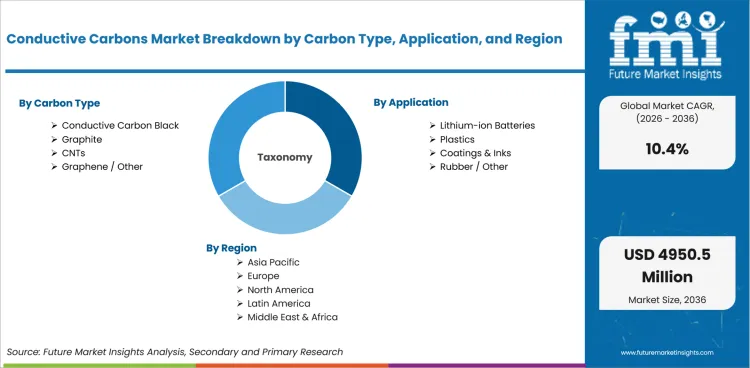
- 10.4%
How big is the conductive carbons market in 2026?
USD 1,840.6 million in 2026 and USD 4,950.5 million by 2036 at a 10.4% CAGR.
The conductive carbons industry value is forecast to grow from USD 1,667.2 million in 2025 to USD 4,950.5 million by 2036 at 10.4% CAGR as battery, polymer, coating, and cable buyers move toward specification-led carbon material selection. Direct sales are expected to represent 68.0% share in 2026 because battery and electronics customers require supplier engineers, grade approvals, and batch traceability. Powder is projected to account for 63.0% share in 2026, led by flexible slurry dosing, polymer compounding control, and broader plant handling familiarity.
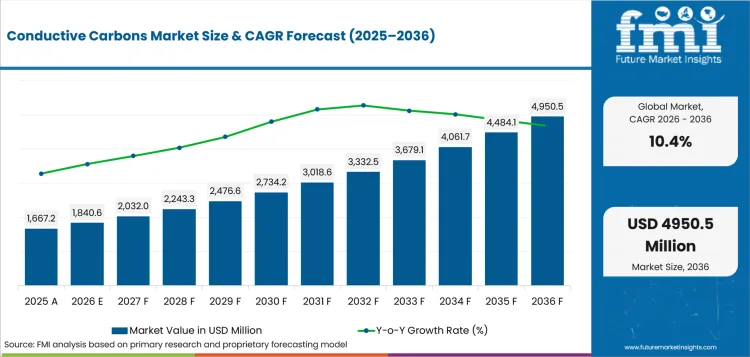
Conductive Carbons Market Overview: Size and Forecast
- 2026 Market Size: USD 1,840.6 million
- 2036 Market Size: USD 4,950.5 million
- Forecast CAGR: 10.4% from 2026 to 2036
- Leading Sales Channel: Direct
- Direct Share in 2026: 68.0%
- Leading Form: Powder
- Powder Share in 2026: 63.0%
- Fastest-growing Country: China
- China CAGR: 12.2% by 2036
Summary of the Conductive Carbons Market
- Demand and Growth Drivers
- Battery electrode makers are shifting toward conductive additives that maintain electron flow at lower inactive loading.
- Polymer compounders are using conductive carbons to control electrostatic discharge in packaging, trays, and molded parts.
- Cable, coating, and ink formulators are increasing grade validation because repeatable resistance is becoming a customer approval requirement.
- Supplier qualification is becoming more technical as buyers compare purity, morphology, dispersion behavior, and change-control support.
- Product and Segment View
- Direct is projected to account for 68.0% share in 2026, supported by buyer need for qualification support and batch documentation.
- Powder is forecast to hold 63.0% share in 2026, influenced by flexible dosing control in electrode slurry and polymer compounding systems.
- Lithium-ion Batteries are expected to represent 54.0% share in 2026, supported by the need for stable conductive networks in electrodes.
- Geography and Competitive Outlook
- China is projected to record 12.2% CAGR by 2036, backed by cell manufacturing scale and local carbon additive qualification.
- South Korea is expected to expand at 11.4% CAGR by 2036 as battery producers require high-purity conductive systems across global plants.
- Cabot Corporation and Orion Engineered Carbons compete through conductive carbon black portfolios and battery-grade technical support.
- Denka, Mitsubishi Chemical, Birla Carbon, Imerys Graphite & Carbon, and Nanocyl broaden competition across acetylene black, graphite, and CNT systems.
- Analyst Opinion
- Nikhil Kaitwade, Associate Vice President at FMI, observes, “Conductive carbons are moving from a formulation cost item into a performance-control material for battery and electronics buyers. Suppliers with proof on morphology, impurity control, and dispersion support will gain stronger approval positions. Battery customers will favor partners that can support both powder handling and application testing across long qualification cycles.”
Battery and electrification demand is the main value signal for conductive carbons as cell makers compare surface area, impurity control, and dispersion behavior before price. The International Energy Agency stated in June 2026 that EV battery deployment reached around 1.2 TWh in 2025 and is expected to rise to almost 3 TWh by 2030. The U.S. Geological Survey reported in January 2026 that U.S. companies consumed an estimated 71,000 tons of natural graphite in 2025, which gives conductive graphite and carbon black suppliers a stronger industrial sourcing signal. Cabot stated in its November 2025 annual report that its battery materials product line increased total contribution margin by 20% during fiscal 2025 after launching LITX 95F conductive carbon for lithium-ion energy storage systems.
Which factors support expansion in the conductive carbons market?
Battery-grade conductivity, polymer static control, and direct supplier qualification support market value across high-specification material channels.
- Market value is supported by battery electrode demand before plastics, coatings, and rubber compounds add recurring industrial sales.
- Supplier pricing reflects purity, particle structure, and dispersion support before broader carbon grade availability affects order timing.
- Revenue improves as battery plants qualify conductive carbons for electrode density, cycle-life stability, and slurry processability.
- Buyer confidence rises when suppliers document impurity levels, batch change controls, and application test evidence across approved grades.
Why is the conductive carbons market growing?
Lithium-ion electrodes need conductive networks that maintain electron flow without excessive inactive material loading.
Conductive carbon demand is growing as battery, static-control, and electronics applications require materials that perform beyond basic filler use. The International Energy Agency reported in May 2026 that global electric car sales grew by 20% in 2025 to exceed 20 million units and represented a quarter of all new cars sold worldwide. This scale makes conductive additive performance more important because small losses in conductivity can affect electrode output, charge acceptance, and cycle life. Buyers are therefore comparing carbon black, graphite, CNT, and graphene grades by impurity profile, dispersion stability, and test support. The same specification shift supports demand for carbon black market applications in antistatic plastics and conductive coating systems.
How is the conductive carbons market segmented?
The conductive carbons industry is segmented by carbon type, application, end use, form, and sales channel.
- Conductive Carbon Black is projected to secure 48.0% share in 2026, led by low loading, broad availability, and cost-efficient conductivity across electrodes and polymers.
- Lithium-ion Batteries are expected to represent 54.0% share in 2026, supported by electrode makers needing stable carbon pathways between active particles and current collectors.
- Automotive is anticipated to account for 41.0% share in 2026, reflected by electric vehicles, battery packs, sensors, cables, and static-control parts requiring qualified materials.
- Powder is forecast to hold 63.0% share in 2026, guided by slurry dosing flexibility, compounding familiarity, and easier formulation adjustment during customer trials.
- Direct is projected to account for 68.0% share in 2026, shaped by battery customer approvals, technical documentation, and supplier engineer involvement during scale-up.
Why does conductive carbon black dominate the conductive carbons market?
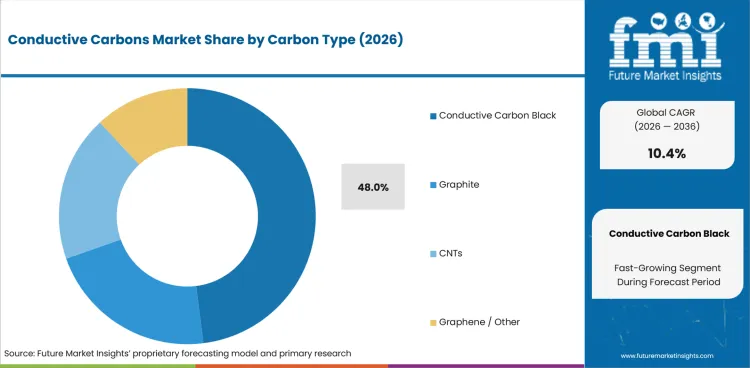
- Conductive Carbon Black is projected to account for 48.0% share in 2026, influenced by strong conductivity at lower loading and compatibility with battery and polymer processing.
- Graphite gains use in applications requiring thermal balance and plate-like structure, although buyers often need extra purity screening for high-specification battery formulations.
Which application leads the conductive carbons market?
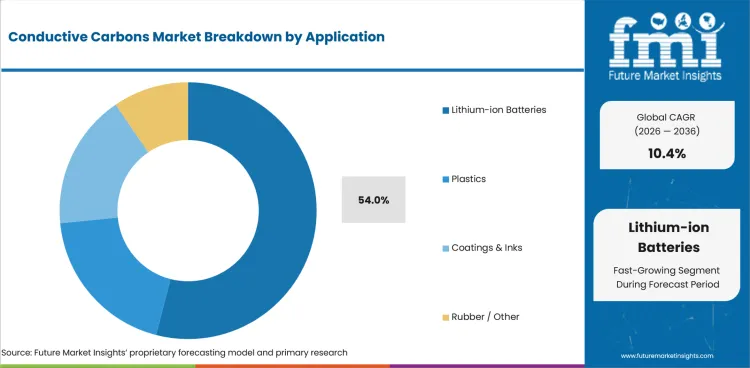
- Lithium-ion Batteries are expected to represent 54.0% share in 2026 through electrode qualification requirements and rising demand for low-resistance conductive pathways.
- Plastics remain important as processors require repeatable electrostatic discharge control in electronics packaging, safety parts, and industrial molded components.
Which end use leads the conductive carbons market?
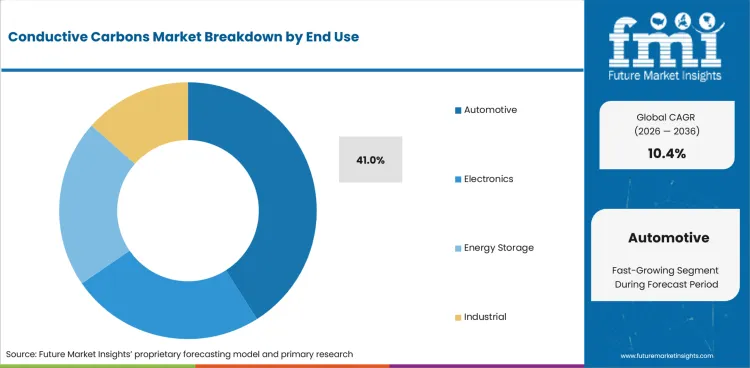
- Automotive is anticipated to hold 41.0% share in 2026, reflected by battery packs, power cables, sensors, tires, and static-control components using conductive carbon systems.
- Electronics demand gains value as trays, films, housings, and device packaging require stable surface resistance during production and component handling.
Which form leads the conductive carbons market?
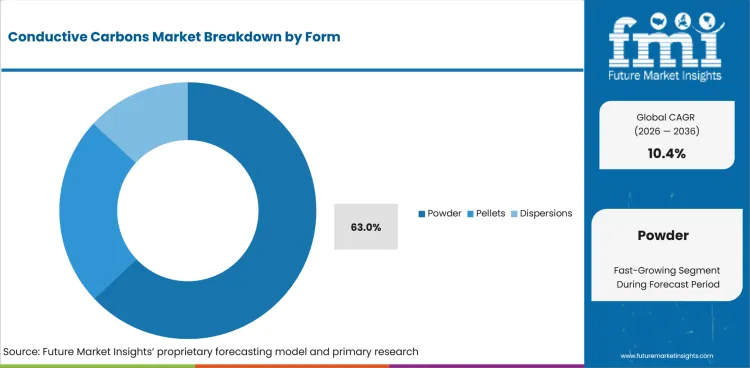
- Powder is forecast to secure 63.0% share in 2026, supported by flexible dosing during slurry preparation and polymer compounding operations.
- Dispersions gain attention when customers need safer handling, reduced dust exposure, and better mixing control for CNT or high-structure carbon systems.
Which sales channel leads the conductive carbons market?
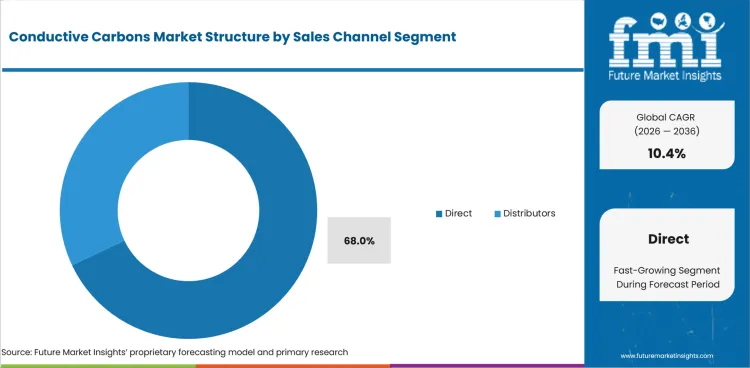
- Direct is projected to account for 68.0% share in 2026, shaped by battery qualification needs and customer requests for batch-level technical documentation.
- Distributors retain relevance for plastics, coatings, and smaller formulators that need local inventory access and application guidance.
What are the driver, restraints, and opportunities in the conductive carbons market?
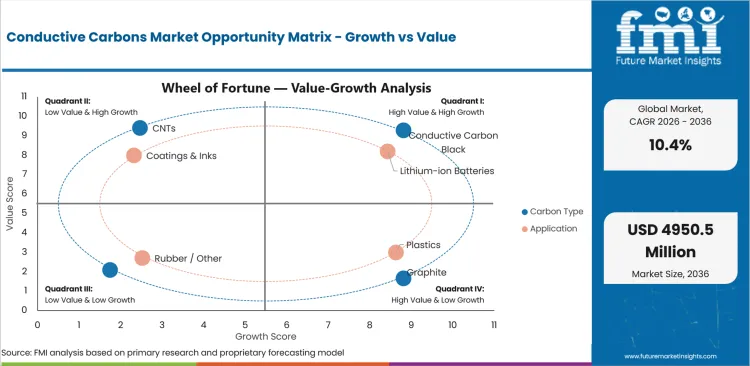
Electrode density and static-control demand support expansion while graphite exposure and dispersion failure can slow wider adoption.
- Driver: Battery producers are increasing additive qualification as electrode designs require reliable conductivity at lower inactive material loading.
- Restraint: Graphite and high-purity carbon sourcing can expose buyers to supply risk, qualification delays, and cost pressure.
- Opportunity: Supplier-backed dispersions and low-carbon carbon grades can improve formulation reliability when performance evidence is verified.
Electrode Conductivity Density
Battery producers are pushing conductive carbons toward higher technical standards because every inactive additive can reduce energy density. The International Energy Agency stated in June 2026 that EV battery deployment could reach around 4 TWh in the current policies scenario and almost 5 TWh in the stated policies scenario by 2035. This makes additive failure more costly because conductivity loss can affect cell output or cycle life. Suppliers supporting electrode testing and carbon nanotubes market outlook needs can gain stronger access during design approval.
Graphite Supply Security
Graphite exposure makes conductive carbon sourcing a supply-chain issue as much as a formulation issue. The U.S. Geological Survey reported in January 2026 that the United States imported an estimated 79,000 tons of natural graphite in 2025 while reporting no domestic mine production. This creates a clear restraint for battery and industrial buyers using graphite-based grades. Multi-grade suppliers can support backup qualification across graphite, carbon black, CNT, and graphene systems.
Dispersion and Lower-carbon Grade Opportunity
Dispersion is a practical opportunity because conductive performance depends on how evenly carbon spreads through slurry, polymer, ink, or rubber systems. The International Energy Agency stated in June 2026 that global battery storage capacity additions reached 108 GW in 2025, up around 40% from 2024. This shows why buyers ask for application data rather than only surface-area data when energy storage systems scale. Suppliers with dispersion support and verified lower-carbon carbon grades can strengthen battery materials market analysis decisions.
Which countries are growing fastest in the conductive carbons market?
China 12.2% CAGR, South Korea 11.4% CAGR, India 11.1% CAGR, United States 10.6% CAGR, Germany 10.2% CAGR, France 9.8% CAGR, United Kingdom 8.7% CAGR, and Japan 8.4% CAGR through 2036.
.webp "Top Country Growth Comparison Conductive Carbons Market Cagr (2026 2036)")
| Country | CAGR |
|---|---|
| United States | 10.6% |
| United Kingdom | 8.7% |
| Germany | 10.2% |
| France | 9.8% |
| Japan | 8.4% |
| China | 12.2% |
| South Korea | 11.4% |
| India | 11.1% |
Source: Future Market Insights, 2026.
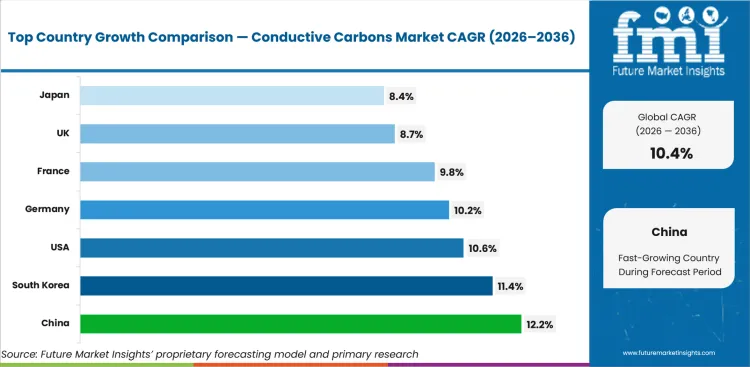
How do country-level CAGRs compare in the conductive carbons market?
China leads country expansion while Japan records the most cautious outlook among profiled markets due to slower domestic electric-vehicle volume pull.
- United States is expected to expand at 10.6% CAGR from 2026 to 2036 due to battery localization and graphite supply scrutiny.
- United Kingdom is projected to grow at 8.7% CAGR through 2036 as electric mobility policy supports specification-led carbon purchases.
- Germany is forecast to record 10.2% CAGR by 2036 as automotive electrification supports battery and cable material qualification.
- France is estimated to rise at 9.8% CAGR by 2036 with battery, coating, and polymer applications supporting technical grade demand.
- Japan is expected to advance at 8.4% CAGR over the forecast period as high-purity supplier capability offsets slower local EV uptake.
- China is projected to post 12.2% CAGR by 2036 as cell manufacturing scale and local energy storage demand support high-volume additive sourcing.
- South Korea is expected to increase at 11.4% CAGR through 2036 as battery exporters qualify conductive materials across global plants.
- India is forecast to grow at 11.1% CAGR by 2036 as electric two-wheelers, three-wheelers, cables, and plastics widen local use.
What is the conductive carbons market outlook in the United States?
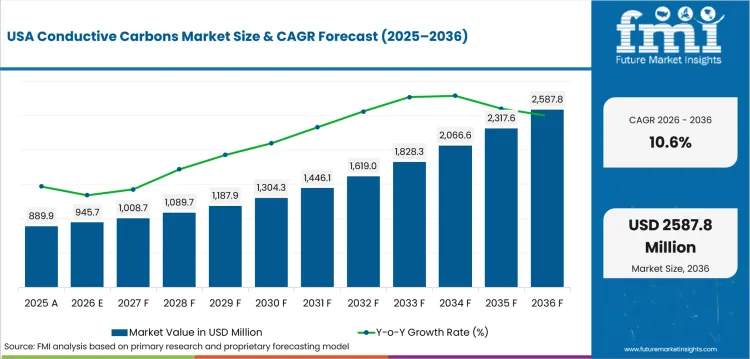
A 10.6% CAGR through 2036 reflects battery qualification, graphite sourcing scrutiny, and local technical support needs.
Country Market Snapshot Table
| Parameter | Value |
|---|---|
| Market Size in 2025 (Value) | USD 235.1 million |
| Market Size in 2026 (Value) | USD 260.0 million |
| Market Forecast in 2036 (Value) | USD 712.1 million |
| CAGR (2026 to 2036) | 10.6% |
| Years Considered | 2021 to 2036 |
| Base Year | 2025 |
| Forecast Period | 2026 to 2036 |
| Units Considered | Value (USD million) |
| Leading Sub-Region | South and Midwest battery manufacturing corridors |
United States Conductive Carbons Market Outlook
United States conductive carbons demand is shaped by battery qualification, polymer processing needs, and application-specific conductivity requirements. Buyers evaluate carbon grades by electrical performance, impurity control, dispersion behavior, and supplier support before approval.
Suppliers are expected to gain better traction when they provide technical documentation and practical handling guidance for powders or dispersions. Demand will develop through battery, electronics, cable, coating, and industrial compounding channels without relying only on broad carbon material availability.
Key Growth Drivers
- Domestic battery localization increases demand for approved conductive additives with traceable supply and local technical support. Argonne National Laboratory reported approximately 1.5 million U.S. plug-in electric vehicles sold in 2025.
- Polymer processors need conductive carbon for antistatic packaging and electronics protection across molded and extruded formats. The U.S. Department of Energy counted more than 210,000 public EV chargers at over 76,000 stations in February 2025, supporting wider electrification infrastructure.
- Graphite sourcing reviews are pushing battery buyers to qualify more than one carbon route before final platform approval.
- Local technical laboratories help suppliers shorten formulation trials when cell and polymer customers need resistance testing.
Key Restraints
- Graphite import exposure limits confidence for some graphite-based conductive grades. The U.S. Geological Survey estimated 79,000 tons of natural graphite imports in 2025 with no domestic mine production.
- Battery qualification cycles can delay new supplier entry because cell makers need long repeatability and impurity checks.
- Premium CNT and graphene grades face cost resistance when conductive carbon black already meets standard resistance targets.
What makes United States unique
The United States is unique because battery localization and raw material security pressure combine with large technical qualification needs.
Key Companies
- Cabot Corporation
- Orion Engineered Carbons
- Birla Carbon
- Imerys Graphite & Carbon
- Tokai Carbon
- Oxbow Carbon LLC
- Nanocyl SA
Sales & Marketing Channels
- Direct battery material contracts
- Polymer compounder technical sales
- Automotive OEM qualification routes
- Specialty chemical distributors
- Battery plant supplier approval systems
- Cable compound supplier channels
Country Segment Breakdown Table
| Segment | Sub-Segments |
|---|---|
| By Carbon Type | Conductive Carbon Black · Graphite · CNTs · Graphene / Other |
| By Application | Lithium-ion Batteries · Plastics · Coatings & Inks · Rubber / Other |
| By End Use | Automotive · Electronics · Energy Storage · Industrial |
| By Form | Powder · Pellets · Dispersions |
| By Sales Channel | Direct · Distributors |
| Key Sub-Regions Covered, Battery and Industrial Material Corridors | Texas · Michigan · Ohio · Georgia · Tennessee · California |
Frequently Asked Questions
How fast is United States conductive carbons market growing?
Sales in United States are ready to scale at 10.6% CAGR from 2026 to 2036, guided by battery and industrial material qualification.
Who leads United States conductive carbons market?
Cabot Corporation, Orion Engineered Carbons, and Birla Carbon compete through technical support, channel access, and material portfolio depth.
What is driving adoption in United States conductive carbons market?
Battery electrodes, conductive plastics, cable compounds, and electronics packaging are moving buyers toward qualified conductive carbon grades.
How is the conductive carbons market performing in the United Kingdom?
An 8.7% CAGR through 2036 is supported by electric mobility rules and specialty distributor-led material selection.
Country Market Snapshot Table
| Parameter | Value |
|---|---|
| Market Size in 2025 (Value) | USD 87.4 million |
| Market Size in 2026 (Value) | USD 95.0 million |
| Market Forecast in 2036 (Value) | USD 218.8 million |
| CAGR (2026 to 2036) | 8.7% |
| Years Considered | 2021 to 2036 |
| Base Year | 2025 |
| Forecast Period | 2026 to 2036 |
| Units Considered | Value (USD million) |
| Leading Sub-Region | Midlands and national formulation corridors |
United Kingdom Conductive Carbons Market Outlook
United Kingdom conductive carbons demand is shaped by battery qualification, polymer processing needs, and application-specific conductivity requirements. Buyers evaluate carbon grades by electrical performance, impurity control, dispersion behavior, and supplier support before approval.
Suppliers are expected to gain better traction when they provide technical documentation and practical handling guidance for powders or dispersions. Demand will develop through battery, electronics, cable, coating, and industrial compounding channels without relying only on broad carbon material availability.
Key Growth Drivers
- Battery-electric vehicle sales support material qualification across UK-linked automotive supply chains. The Department for Transport reported nearly 382,000 first-time BEV car registrations in 2024, over 21% above 2023.
- The electric car market gives suppliers a stronger downstream signal for battery and conductive plastics. The International Energy Agency stated that nearly half a million BEV sales in the United Kingdom represented 23% of all new cars sold in 2025.
- Electronics packaging buyers use conductive plastics to protect components during storage, shipping, and assembly handling.
- Specialist coatings formulators need stable carbon dispersions for low-resistance coating and printed electronics applications.
Key Restraints
- Zero-emission targets may pressure smaller automotive suppliers when demand falls short of mandate levels. The UK subsidy advice report stated that the 2025 ZEV mandate target was 28% while the market recorded 23.43% ZEV share.
- Limited domestic battery material production reduces direct conductive additive consumption compared with larger cell manufacturing markets.
- Import dependence exposes smaller buyers to lead-time risk when specialty carbon grades are allocated to larger customers first.
What makes United Kingdom unique
The United Kingdom is unique because distributors and formulation houses influence conductive carbon selection more than domestic cell output alone.
Key Companies
- Cabot Carbon Ltd.
- Imerys Minerals Ltd.
- Mitsubishi Chemical UK Ltd.
- Orion Engineered Carbons distribution partners
- Birla Carbon Europe distribution partners
- Nanocyl distribution partners
- Specialty chemical distributors
Sales & Marketing Channels
- Specialty chemical distributors
- Automotive Tier 1 qualification routes
- Coatings formulation houses
- Electronics packaging suppliers
- Battery research partnerships
- Cable compounder supply routes
Country Segment Breakdown Table
| Segment | Sub-Segments |
|---|---|
| By Carbon Type | Conductive Carbon Black · Graphite · CNTs · Graphene / Other |
| By Application | Lithium-ion Batteries · Plastics · Coatings & Inks · Rubber / Other |
| By End Use | Automotive · Electronics · Energy Storage · Industrial |
| By Form | Powder · Pellets · Dispersions |
| By Sales Channel | Direct · Distributors |
| Key Sub-Regions Covered, Battery and Industrial Material Corridors | Midlands · North East · London · Manchester · Wales · Scotland |
Frequently Asked Questions
How fast is United Kingdom conductive carbons market growing?
Sales in United Kingdom are ready to scale at 8.7% CAGR from 2026 to 2036, guided by battery and industrial material qualification.
Who leads United Kingdom conductive carbons market?
Cabot Carbon Ltd., Imerys Minerals Ltd., and Mitsubishi Chemical UK Ltd. compete through technical support, channel access, and material portfolio depth.
What is driving adoption in United Kingdom conductive carbons market?
Battery electrodes, conductive plastics, cable compounds, and electronics packaging are moving buyers toward qualified conductive carbon grades.
What is driving conductive carbons demand in Germany?
A 10.2% CAGR through 2036 is linked to automotive electrification, industrial compounding, and strict supplier documentation.
Country Market Snapshot Table
| Parameter | Value |
|---|---|
| Market Size in 2025 (Value) | USD 145.2 million |
| Market Size in 2026 (Value) | USD 160.0 million |
| Market Forecast in 2036 (Value) | USD 422.6 million |
| CAGR (2026 to 2036) | 10.2% |
| Years Considered | 2021 to 2036 |
| Base Year | 2025 |
| Forecast Period | 2026 to 2036 |
| Units Considered | Value (USD million) |
| Leading Sub-Region | Bavaria, Baden-Württemberg, and Rhine-Ruhr industrial clusters |
Germany Conductive Carbons Market Outlook
Germany conductive carbons demand is shaped by battery qualification, polymer processing needs, and application-specific conductivity requirements. Buyers evaluate carbon grades by electrical performance, impurity control, dispersion behavior, and supplier support before approval.
Suppliers are expected to gain better traction when they provide technical documentation and practical handling guidance for powders or dispersions. Demand will develop through battery, electronics, cable, coating, and industrial compounding channels without relying only on broad carbon material availability.
Key Growth Drivers
- Automotive electrification increases need for conductive additives in batteries, power cables, and static-control components. ACEA reported Germany battery-electric registrations grew 23.8% in January 2026.
- Industrial material users are tightening documentation requirements as suppliers prove conductivity and mechanical retention. The European Alternative Fuels Observatory recorded Germany as one of Europe’s largest EV markets in 2025, supporting technical grade screening across automotive programs.
- German material approval standards favor suppliers with strong technical data, resistance testing, and batch stability evidence.
- Cable and polymer compounders use conductive carbon grades when electro-dissipative parts need dependable processing under automotive quality systems.
Key Restraints
- Long validation cycles slow the entry of new carbon grades into automotive platforms. ACEA reported EU car registrations fell 3.9% in January 2026, keeping supplier cost controls tight.
- Cost-sensitive compounders can avoid CNT grades when conductive carbon black performs adequately for standard resistance needs.
- Energy-intensive carbon production can pressure local margins when customers request lower footprint data and stable pricing at the same time.
What makes Germany unique
Germany is unique because qualification discipline makes technical evidence more important than broad sales coverage.
Key Companies
- Orion Engineered Carbons GmbH
- Cabot distribution partners
- Imerys Graphite & Carbon
- Mitsubishi Chemical Europe
- Birla Carbon Europe
- Nanocyl distributors
- Denka Europe technical partners
Sales & Marketing Channels
- Automotive Tier supplier approvals
- Polymer compounder sales
- Specialty chemical distribution
- Battery system supplier qualification
- Industrial coating formulators
- Cable compounder channels
Country Segment Breakdown Table
| Segment | Sub-Segments |
|---|---|
| By Carbon Type | Conductive Carbon Black · Graphite · CNTs · Graphene / Other |
| By Application | Lithium-ion Batteries · Plastics · Coatings & Inks · Rubber / Other |
| By End Use | Automotive · Electronics · Energy Storage · Industrial |
| By Form | Powder · Pellets · Dispersions |
| By Sales Channel | Direct · Distributors |
| Key Sub-Regions Covered, Battery and Industrial Material Corridors | Bavaria · Baden-Württemberg · North Rhine-Westphalia · Lower Saxony · Saxony · Hesse |
Frequently Asked Questions
How fast is Germany conductive carbons market growing?
Sales in Germany are ready to scale at 10.2% CAGR from 2026 to 2036, guided by battery and industrial material qualification.
Who leads Germany conductive carbons market?
Orion Engineered Carbons GmbH, Cabot distribution partners, and Imerys Graphite & Carbon compete through technical support, channel access, and material portfolio depth.
What is driving adoption in Germany conductive carbons market?
Battery electrodes, conductive plastics, cable compounds, and electronics packaging are moving buyers toward qualified conductive carbon grades.
How is the conductive carbons market performing in France?
A 9.8% CAGR through 2036 reflects electric mobility, sustainability screening, and selective industrial material qualification.
Country Market Snapshot Table
| Parameter | Value |
|---|---|
| Market Size in 2025 (Value) | USD 123.0 million |
| Market Size in 2026 (Value) | USD 135.0 million |
| Market Forecast in 2036 (Value) | USD 343.8 million |
| CAGR (2026 to 2036) | 9.8% |
| Years Considered | 2021 to 2036 |
| Base Year | 2025 |
| Forecast Period | 2026 to 2036 |
| Units Considered | Value (USD million) |
| Leading Sub-Region | Île-de-France, Auvergne-Rhône-Alpes, and northern battery corridors |
France Conductive Carbons Market Outlook
France conductive carbons demand is shaped by battery qualification, polymer processing needs, and application-specific conductivity requirements. Buyers evaluate carbon grades by electrical performance, impurity control, dispersion behavior, and supplier support before approval.
Suppliers are expected to gain better traction when they provide technical documentation and practical handling guidance for powders or dispersions. Demand will develop through battery, electronics, cable, coating, and industrial compounding channels without relying only on broad carbon material availability.
Key Growth Drivers
- Electric mobility supports battery material qualification in France-linked automotive programs. The European Alternative Fuels Observatory reported 363,130 BEVs registered in France in 2025, up 10.5% from 2023.
- Electrified vehicle volume supports conductive plastics and cable materials. The same official European source reported 476,341 BEV and PHEV registrations in France in 2025.
- Sustainability screening encourages buyers to assess lower-carbon carbon grades alongside conductivity and dispersion performance.
- Coatings and plastics users need stable conductivity in specialist industrial applications, especially where resistance control affects quality acceptance.
Key Restraints
- Plug-in hybrid contraction can narrow some battery-adjacent demand signals. The European Alternative Fuels Observatory reported 113,221 PHEV registrations in France in 2025, down 30.7% compared with 2023.
- Limited domestic additive production makes buyers rely on imported specialty carbon grades for several high-specification applications.
- European cost pressure can delay premium CNT and graphene adoption when conductive carbon black is technically sufficient.
What makes France unique
France is unique because sustainability claims must be screened against technical performance before conductive carbon suppliers gain traction.
Key Companies
- Imerys Graphite & Carbon
- Arkema material networks
- Cabot Europe partners
- Orion Engineered Carbons distribution partners
- Mitsubishi Chemical Europe
- Birla Carbon Europe
- Nanocyl distribution partners
Sales & Marketing Channels
- Specialty distributor networks
- Automotive supplier qualification
- Battery alliance procurement routes
- Industrial coating formulators
- Polymer compounding channels
- Electronics packaging suppliers
Country Segment Breakdown Table
| Segment | Sub-Segments |
|---|---|
| By Carbon Type | Conductive Carbon Black · Graphite · CNTs · Graphene / Other |
| By Application | Lithium-ion Batteries · Plastics · Coatings & Inks · Rubber / Other |
| By End Use | Automotive · Electronics · Energy Storage · Industrial |
| By Form | Powder · Pellets · Dispersions |
| By Sales Channel | Direct · Distributors |
| Key Sub-Regions Covered, Battery and Industrial Material Corridors | Île-de-France · Hauts-de-France · Auvergne-Rhône-Alpes · Grand Est · Normandy · Occitanie |
Frequently Asked Questions
How fast is France conductive carbons market growing?
Sales in France are ready to scale at 9.8% CAGR from 2026 to 2036, guided by battery and industrial material qualification.
Who leads France conductive carbons market?
Imerys Graphite & Carbon, Arkema material networks, and Cabot Europe partners compete through technical support, channel access, and material portfolio depth.
What is driving adoption in France conductive carbons market?
Battery electrodes, conductive plastics, cable compounds, and electronics packaging are moving buyers toward qualified conductive carbon grades.
What is the conductive carbons market forecast for Japan?
An 8.4% CAGR through 2036 reflects high-purity supplier capability and electronics-led conductive material demand.
Country Market Snapshot Table
| Parameter | Value |
|---|---|
| Market Size in 2025 (Value) | USD 133.8 million |
| Market Size in 2026 (Value) | USD 145.0 million |
| Market Forecast in 2036 (Value) | USD 324.8 million |
| CAGR (2026 to 2036) | 8.4% |
| Years Considered | 2021 to 2036 |
| Base Year | 2025 |
| Forecast Period | 2026 to 2036 |
| Units Considered | Value (USD million) |
| Leading Sub-Region | Kanto, Chubu, and Kansai specialty material clusters |
Japan Conductive Carbons Market Outlook
Japan conductive carbons demand is shaped by battery qualification, polymer processing needs, and application-specific conductivity requirements. Buyers evaluate carbon grades by electrical performance, impurity control, dispersion behavior, and supplier support before approval.
Suppliers are expected to gain better traction when they provide technical documentation and practical handling guidance for powders or dispersions. Demand will develop through battery, electronics, cable, coating, and industrial compounding channels without relying only on broad carbon material availability.
Key Growth Drivers
- Automotive production supports conductive carbon use in sensors, power cables, rubber, and static-control parts. JAMA reported Japan motor vehicle production totaled 8.23 million units in 2024.
- Electronics applications support conductive carbon use in films, IC trays, heating sheets, and conductive rubber. JEITA projected global production by Japanese electronics and IT companies at ¥42,861.3 billion in 2025.
- Japanese suppliers use long technical know-how in carbon particle control and impurity management.
- Industrial buyers value supplier testing support before switching grades in electronics and specialty rubber applications.
Key Restraints
- Local EV volume is smaller than China or Europe. The International Energy Agency reported Japan electric car sales were just above 100,000 in 2025 and represented less than 3% of car sales.
- High quality expectations increase qualification time for overseas suppliers entering electronics and battery accounts.
- Premium CNT and graphene systems can face limited uptake when customers prioritize proven carbon black and graphite formats.
What makes Japan unique
Japan is unique because purity, particle control, and customer testing decide supplier value more than volume scale alone.
Key Companies
- Denka Company Limited
- Mitsubishi Chemical Group
- Tokai Carbon Co. Ltd.
- Cabot Japan K.K.
- Imerys Graphite & Carbon Japan
- Birla Carbon Japan partners
- Nanocyl distribution partners
Sales & Marketing Channels
- Direct technical sales to electronics firms
- Battery material qualification routes
- Industrial distributor networks
- Cable compound supplier channels
- Specialty rubber compounders
- Electronics packaging channels
Country Segment Breakdown Table
| Segment | Sub-Segments |
|---|---|
| By Carbon Type | Conductive Carbon Black · Graphite · CNTs · Graphene / Other |
| By Application | Lithium-ion Batteries · Plastics · Coatings & Inks · Rubber / Other |
| By End Use | Automotive · Electronics · Energy Storage · Industrial |
| By Form | Powder · Pellets · Dispersions |
| By Sales Channel | Direct · Distributors |
| Key Sub-Regions Covered, Battery and Industrial Material Corridors | Kanto · Chubu · Kansai · Kyushu · Tohoku · Chugoku |
Frequently Asked Questions
How fast is Japan conductive carbons market growing?
Sales in Japan are ready to scale at 8.4% CAGR from 2026 to 2036, guided by battery and industrial material qualification.
Who leads Japan conductive carbons market?
Denka Company Limited, Mitsubishi Chemical Group, and Tokai Carbon Co. Ltd. compete through technical support, channel access, and material portfolio depth.
What is driving adoption in Japan conductive carbons market?
Battery electrodes, conductive plastics, cable compounds, and electronics packaging are moving buyers toward qualified conductive carbon grades.
How fast is the conductive carbons market growing in China?
A 12.2% CAGR through 2036 reflects battery cell scale, energy storage output, and cost-disciplined additive sourcing.
Country Market Snapshot Table
| Parameter | Value |
|---|---|
| Market Size in 2025 (Value) | USD 445.6 million |
| Market Size in 2026 (Value) | USD 500.0 million |
| Market Forecast in 2036 (Value) | USD 1,580.9 million |
| CAGR (2026 to 2036) | 12.2% |
| Years Considered | 2021 to 2036 |
| Base Year | 2025 |
| Forecast Period | 2026 to 2036 |
| Units Considered | Value (USD million) |
| Leading Sub-Region | Yangtze River Delta and Pearl River Delta battery corridors |
China Conductive Carbons Market Outlook
China conductive carbons demand is shaped by battery qualification, polymer processing needs, and application-specific conductivity requirements. Buyers evaluate carbon grades by electrical performance, impurity control, dispersion behavior, and supplier support before approval.
Suppliers are expected to gain better traction when they provide technical documentation and practical handling guidance for powders or dispersions. Demand will develop through battery, electronics, cable, coating, and industrial compounding channels without relying only on broad carbon material availability.
Key Growth Drivers
- Large lithium-ion cell output supports scale demand for conductive carbon black and CNT systems. The International Energy Agency reported China accounted for over 80% of battery cell production in 2025.
- New energy vehicle scale keeps electrode additive demand high. China government statistics stated NEV sales reached nearly 11.23 million units in the first nine months of 2025, accounting for 46.1% of total vehicle sales.
- Energy storage systems increase additive demand beyond passenger electric vehicles as grid and industrial battery installations widen.
- Local polymer and electronics manufacturing supports conductive plastics and packaging materials at high production volume.
Key Restraints
- Domestic price pressure can compress margins for standard conductive carbon black grades. The International Energy Agency stated Chinese automakers supplied 60% of electric cars sold worldwide in 2025, intensifying cost competition through the supply chain.
- Qualification risk increases when cell makers rapidly change chemistry, electrode density, or additive packages.
- Export-oriented customers can request tighter documentation, which adds approval work for smaller local suppliers.
What makes China unique
China is unique because it sets the price-performance benchmark by combining battery scale with strong supplier competition.
Key Companies
- Cabot China Ltd.
- Orion Engineered Carbons China
- Shanxi Sunlight Coking Group materials suppliers
- Shanshan Technology
- CNGR Advanced Material networks
- Mitsubishi Chemical China
- Birla Carbon China partners
Sales & Marketing Channels
- Direct cell maker qualification
- Battery material distributors
- Polymer compounder sales
- Energy storage system supplier routes
- Cable and electronics component channels
- OEM procurement platforms
Country Segment Breakdown Table
| Segment | Sub-Segments |
|---|---|
| By Carbon Type | Conductive Carbon Black · Graphite · CNTs · Graphene / Other |
| By Application | Lithium-ion Batteries · Plastics · Coatings & Inks · Rubber / Other |
| By End Use | Automotive · Electronics · Energy Storage · Industrial |
| By Form | Powder · Pellets · Dispersions |
| By Sales Channel | Direct · Distributors |
| Key Sub-Regions Covered, Battery and Industrial Material Corridors | Shanghai · Jiangsu · Zhejiang · Guangdong · Fujian · Sichuan |
Frequently Asked Questions
How fast is China conductive carbons market growing?
Sales in China are ready to scale at 12.2% CAGR from 2026 to 2036, guided by battery and industrial material qualification.
Who leads China conductive carbons market?
Cabot China Ltd., Orion Engineered Carbons China, and Shanxi Sunlight Coking Group materials suppliers compete through technical support, channel access, and material portfolio depth.
What is driving adoption in China conductive carbons market?
Battery electrodes, conductive plastics, cable compounds, and electronics packaging are moving buyers toward qualified conductive carbon grades.
What is the conductive carbons market outlook in South Korea?
An 11.4% CAGR through 2036 is supported by battery exporter qualification and electronics-linked conductive material demand.
Country Market Snapshot Table
| Parameter | Value |
|---|---|
| Market Size in 2025 (Value) | USD 170.6 million |
| Market Size in 2026 (Value) | USD 190.0 million |
| Market Forecast in 2036 (Value) | USD 559.2 million |
| CAGR (2026 to 2036) | 11.4% |
| Years Considered | 2021 to 2036 |
| Base Year | 2025 |
| Forecast Period | 2026 to 2036 |
| Units Considered | Value (USD million) |
| Leading Sub-Region | Gyeonggi, Chungcheong, and Ulsan battery corridors |
South Korea Conductive Carbons Market Outlook
South Korea conductive carbons demand is shaped by battery qualification, polymer processing needs, and application-specific conductivity requirements. Buyers evaluate carbon grades by electrical performance, impurity control, dispersion behavior, and supplier support before approval.
Suppliers are expected to gain better traction when they provide technical documentation and practical handling guidance for powders or dispersions. Demand will develop through battery, electronics, cable, coating, and industrial compounding channels without relying only on broad carbon material availability.
Key Growth Drivers
- Korean battery makers need conductive additives qualified across overseas cell plants. The International Energy Agency stated Korean companies led overseas battery manufacturing capacity with nearly 400 GWh in 2025.
- Domestic EV adoption supports local testing and supplier engagement. The International Trade Administration stated South Korea produced 407,009 EVs in 2025, accounting for 11% of total automobile production.
- Electronics and battery exports support demand for high-purity carbon materials used in conductive films, trays, cells, and polymer parts.
- Supplier audits remain central because battery customers require impurity control, dispersion evidence, and lot traceability across regions.
Key Restraints
- Chemical export softness can pressure carbon material margins in supplier negotiations. MOTIR reported petrochemical exports declined 14.1% to USD 3.1 billion in November 2025 amid continued downward price pressure from global oversupply.
- High customer standards make supplier entry difficult for smaller carbon producers lacking application laboratories.
- Export-linked sourcing exposes suppliers to customer platform delays when overseas EV demand changes quickly.
What makes South Korea unique
South Korea is unique because domestic technical approval connects directly with overseas battery production support.
Key Companies
- LG Energy Solution supplier networks
- Samsung SDI supplier networks
- SK On supplier networks
- Denka Korea partners
- Mitsubishi Chemical Korea
- Cabot Korea partners
- Nanocyl distribution partners
Sales & Marketing Channels
- Direct battery maker qualification
- Battery material supplier audits
- Electronics component channels
- Specialty chemical distributors
- Overseas plant sourcing programs
- Cable compounder channels
Country Segment Breakdown Table
| Segment | Sub-Segments |
|---|---|
| By Carbon Type | Conductive Carbon Black · Graphite · CNTs · Graphene / Other |
| By Application | Lithium-ion Batteries · Plastics · Coatings & Inks · Rubber / Other |
| By End Use | Automotive · Electronics · Energy Storage · Industrial |
| By Form | Powder · Pellets · Dispersions |
| By Sales Channel | Direct · Distributors |
| Key Sub-Regions Covered, Battery and Industrial Material Corridors | Gyeonggi · Chungcheong · Ulsan · Pohang · Busan · Daegu |
Frequently Asked Questions
How fast is South Korea conductive carbons market growing?
Sales in South Korea are ready to scale at 11.4% CAGR from 2026 to 2036, guided by battery and industrial material qualification.
Who leads South Korea conductive carbons market?
LG Energy Solution supplier networks, Samsung SDI supplier networks, and SK On supplier networks compete through technical support, channel access, and material portfolio depth.
What is driving adoption in South Korea conductive carbons market?
Battery electrodes, conductive plastics, cable compounds, and electronics packaging are moving buyers toward qualified conductive carbon grades.
What is driving conductive carbons growth in India?
An 11.1% CAGR through 2036 is supported by electric two-wheelers, three-wheelers, cables, and cost-sensitive compounding demand.
Country Market Snapshot Table
| Parameter | Value |
|---|---|
| Market Size in 2025 (Value) | USD 135.0 million |
| Market Size in 2026 (Value) | USD 150.0 million |
| Market Forecast in 2036 (Value) | USD 429.8 million |
| CAGR (2026 to 2036) | 11.1% |
| Years Considered | 2021 to 2036 |
| Base Year | 2025 |
| Forecast Period | 2026 to 2036 |
| Units Considered | Value (USD million) |
| Leading Sub-Region | Western and southern industrial battery corridors |
India Conductive Carbons Market Outlook
India conductive carbons demand is shaped by battery qualification, polymer processing needs, and application-specific conductivity requirements. Buyers evaluate carbon grades by electrical performance, impurity control, dispersion behavior, and supplier support before approval.
Suppliers are expected to gain better traction when they provide technical documentation and practical handling guidance for powders or dispersions. Demand will develop through battery, electronics, cable, coating, and industrial compounding channels without relying only on broad carbon material availability.
Key Growth Drivers
- EV sales expansion supports battery additive consumption across two-wheeler and three-wheeler formats. NITI Aayog and the Press Information Bureau reported India EV sales increased from 50,000 in 2016 to 2.08 million in 2024.
- Public transport electrification supports battery and cable material demand. The Ministry of Heavy Industries stated PM E-DRIVE allocated Rs.4,391 crore for 14,028 electric buses and Rs.2,000 crore for EV public charging stations.
- Cable and industrial plastics buyers need conductive carbons for static control, safety, and resistance stability.
- Domestic carbon black supplier presence improves access for compounders and formulators seeking cost-effective conductive grades.
Key Restraints
- High-specification CNT and graphene grades face price barriers in mass-market applications. The Ministry of Heavy Industries reported the PM E-DRIVE scheme supports more than 28 lakh EVs, reinforcing cost-sensitive public incentive exposure.
- Imported battery additives can face lead-time and currency risk for smaller buyers qualifying high-purity grades.
- Supplier trials may be slower in smaller battery accounts because buyers need proof of cycle-life benefit before paying premium prices.
What makes India unique
India is unique because fast electrification combines with strong price discipline across two-wheelers, three-wheelers, cables, and plastics.
Key Companies
- Birla Carbon
- Cabot India Ltd.
- Orion distribution partners
- Himadri Speciality Chemical
- Epsilon Advanced Materials
- Imerys India partners
- Nanocyl distribution partners
Sales & Marketing Channels
- Direct sales to battery makers
- Distributor-led polymer sales
- Cable compounder supply routes
- Automotive Tier supplier channels
- Industrial coating formulators
- Electronics packaging suppliers
Country Segment Breakdown Table
| Segment | Sub-Segments |
|---|---|
| By Carbon Type | Conductive Carbon Black · Graphite · CNTs · Graphene / Other |
| By Application | Lithium-ion Batteries · Plastics · Coatings & Inks · Rubber / Other |
| By End Use | Automotive · Electronics · Energy Storage · Industrial |
| By Form | Powder · Pellets · Dispersions |
| By Sales Channel | Direct · Distributors |
| Key Sub-Regions Covered, Battery and Industrial Material Corridors | Maharashtra · Gujarat · Tamil Nadu · Karnataka · Telangana · Delhi NCR |
Frequently Asked Questions
How fast is India conductive carbons market growing?
Sales in India are ready to scale at 11.1% CAGR from 2026 to 2036, guided by battery and industrial material qualification.
Who leads India conductive carbons market?
Birla Carbon, Cabot India Ltd., and Orion distribution partners compete through technical support, channel access, and material portfolio depth.
What is driving adoption in India conductive carbons market?
Battery electrodes, conductive plastics, cable compounds, and electronics packaging are moving buyers toward qualified conductive carbon grades.
Who are the leading companies in the conductive carbons market?
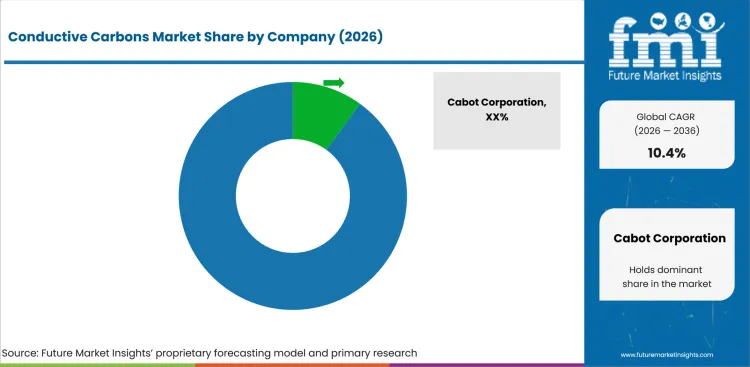
Cabot Corporation, Orion Engineered Carbons, Denka, Mitsubishi Chemical Group, and Imerys Graphite & Carbon are prominent suppliers across conductive carbon black, acetylene black, graphite, and specialty conductive additives.
- Established carbon black suppliers hold an advantage through battery-grade process control and customer qualification support.
- Graphite and acetylene black specialists gain value when buyers need impurity control and thermal-performance balance.
- CNT and dispersion specialists gain selective opportunities in high-energy batteries and advanced conductive coatings.
- Regional suppliers compete by offering local inventory, technical documentation, and shorter formulation support cycles.
Conductive carbon suppliers compete by combining material consistency with application support. Cabot and Orion hold strong positions because battery and polymer customers need conductive carbon black grades with proven conductivity, impurity control, and batch reliability. Denka and Mitsubishi Chemical gain relevance where acetylene black and high-purity specialty carbons support lithium-ion battery, cable, and electronics formulations. Imerys and Birla Carbon broaden competition across graphite and carbon black channels.
Qualification depth has become a competitive separator as battery and electronics buyers move beyond bulk carbon purchasing. Suppliers with technical laboratories can support viscosity testing, resistance measurement, cycle-life evaluation, and dispersion troubleshooting before large contracts are awarded. The specialty carbon black market outlook also shows how carbon black grades are being separated by function, purity, and processing behavior rather than treated as broad commodity materials.
Smaller and specialist players can win in narrower uses where CNT dispersions, recovered carbon, or graphene-based systems deliver performance that standard carbon black cannot provide. Buyers favor suppliers that document carbon black content tester market analysis needs, resistance stability, and dispersion guidance during scale-up. Companies best positioned to win will combine test evidence, regional supply options, and practical support for battery, cable, polymer, and coating customers.
How do top conductive carbons companies compare?
Cabot and Orion score strongest on conductive carbon black depth while Denka leads high-purity acetylene black relevance.
| Company | Relevance to Market Title | Battery-grade Portfolio | Dispersion and Morphology Control | Channel Reach | Geographic Footprint |
|---|---|---|---|---|---|
| Cabot Corporation | Very High | Very Strong | Very Strong | Very Strong | Global |
| Orion Engineered Carbons | Very High | Very Strong | Strong | Very Strong | Global |
| Denka | High | Very Strong | Strong | Strong | Japan and Asia |
| Mitsubishi Chemical Group | High | Strong | Strong | Strong | Asia and global sales |
| Imerys Graphite & Carbon | High | Strong | Moderate | Strong | Global |
| Birla Carbon | High | Moderate | Moderate | Strong | Global |
| Nanocyl | High | Moderate | Very Strong | Moderate | Europe and global distributors |
| Tokai Carbon | Moderate to High | Moderate | Moderate | Moderate | Asia and global sales |
Source: Future Market Insights competitive analysis, 2026.
Who are the key players in the conductive carbons market?
Cabot Corporation, Orion Engineered Carbons, Denka, Mitsubishi Chemical Group, and Imerys Graphite & Carbon are listed with Birla Carbon, Tokai Carbon, Nanocyl, and other suppliers.
Key global companies leading the conductive carbons market include:
- Cabot Corporation
- Orion Engineered Carbons
- Denka
- Mitsubishi Chemical Group
- Imerys Graphite & Carbon
- Birla Carbon
- Tokai Carbon
- Oxbow Carbon LLC
- Nanocyl
- Black Bear Carbon
Key Developments in Conductive Carbons Market
- In November 2025, Cabot reported that fiscal 2025 included the launch of LITX 95F conductive carbon for lithium-ion batteries used in energy storage systems.
- In November 2025, Orion stated that its conductive additives had gained commercial traction in high-voltage cable compounds and battery energy storage systems.
- In September 2025, Birla Carbon highlighted Nanocyl carbon nanotube products that improve lithium-ion battery conductivity, energy density, and fast-charging performance.
Key Players in the Conductive Carbons Market
Conductive Carbon Black and Acetylene Black Suppliers
- Cabot Corporation
- Orion Engineered Carbons
- Denka
- Mitsubishi Chemical Group
Graphite and Broader Carbon Material Suppliers
- Imerys Graphite & Carbon
- Tokai Carbon
- Birla Carbon
- Oxbow Carbon LLC
CNT and Circular Carbon Specialists
- Nanocyl
- Black Bear Carbon
- Specialty conductive dispersion suppliers
Conductive Carbons Market - Report Scope
| Parameter | Details |
|---|---|
| Forecast period | 2026 to 2036 |
| Historical period | 2021 to 2025 |
| Quantitative unit | Revenue in USD million |
| By carbon type | Conductive carbon black, graphite, CNTs, graphene / other |
| By application | Lithium-ion batteries, plastics, coatings & inks, rubber / other |
| By end use | Automotive, electronics, energy storage, industrial |
| By form | Powder, pellets, dispersions |
| By sales channel | Direct, distributors |
| Regions covered | North America, Latin America, Europe, East Asia, South Asia and Pacific, Middle East and Africa |
| Countries covered | United States, United Kingdom, Germany, France, Japan, China, South Korea, India |
| Key companies profiled | Cabot Corporation, Orion Engineered Carbons, Birla Carbon, Tokai Carbon, Imerys Graphite & Carbon, Denka, Oxbow, Mitsubishi Chemical, Black Bear Carbon, Nanocyl |
| Approach | Hybrid bottom-up and top-down approach using additive loading, end-use demand, average selling price, form mix, channel mix, and country-level adoption |
Source: Future Market Insights, 2026.
Conductive Carbons Market Breakdown by Carbon Type, Application, End Use, Form, Sales Channel, and Region
Conductive Carbons Market Segmented by Carbon Type:
- Conductive Carbon Black
- Graphite
- CNTs
- Graphene / Other
Conductive Carbons Market Segmented by Application:
- Lithium-ion Batteries
- Plastics
- Coatings & Inks
- Rubber / Other
Conductive Carbons Market Segmented by End Use:
- Automotive
- Electronics
- Energy Storage
- Industrial
Conductive Carbons Market Segmented by Form:
- Powder
- Pellets
- Dispersions
Conductive Carbons Market Segmented by Sales Channel:
- Direct
- Distributors
Conductive Carbons Market by Region:
- North America
- United States
- Canada
- Mexico
- Latin America
- Brazil
- Chile
- Rest of Latin America
- Western Europe
- Germany
- UK
- Italy
- Spain
- France
- Nordic
- BENELUX
- Rest of Western Europe
- Eastern Europe
- Russia
- Poland
- Hungary
- Balkan & Baltic
- Rest of Eastern Europe
- East Asia
- China
- Japan
- South Korea
- South Asia and Pacific
- India
- ASEAN
- Australia & New Zealand
- Rest of South Asia and Pacific
- Middle East & Africa
- Kingdom of Saudi Arabia
- Other GCC Countries
- Turkiye
- South Africa
- Other African Union
- Rest of Middle East & Africa
Research Sources and Bibliography
- USA Geological Survey. (2026, January). Graphite natural mineral commodity summary 2026. U.S. Geological Survey.
- International Energy Agency. (2026, June). Electric vehicle batteries: Global EV Outlook 2026. International Energy Agency.
- International Energy Agency. (2026, June). Trends in electric cars: Global EV Outlook 2026. International Energy Agency.
- International Energy Agency. (2026, June). Executive summary: Global EV Outlook 2026. International Energy Agency.
- International Energy Agency. (2026, June). Outlook for electric mobility: Global EV Outlook 2026. International Energy Agency.
- International Energy Agency. (2026, June). Battery storage is scaling up and taking on a larger system role. International Energy Agency.
- Argonne National Laboratory. (2026, March). Light duty electric drive vehicles monthly sales updates. Argonne National Laboratory.
- USA Department of Energy. (2025, February). Facts about electric vehicles: Charging availability. Argonne National Laboratory.
- Department for Transport. (2026, January). Department for Transport annual report and accounts 2024 to 2025. Government of the United Kingdom.
- Department for Business and Trade. (2026, March). Subsidy Advice Unit report on the Electric Car Grant Scheme. Government of the United Kingdom.
- Department for Transport. (2025, October). Updates to the Vehicle Emissions Trading Schemes Order 2023. Government of the United Kingdom.
- European Alternative Fuels Observatory. (2026, January). France’s EV market in 2025: Renewed momentum and growing fleet. European Commission.
- European Automobile Manufacturers’ Association. (2026, February). New car registrations: Battery-electric market share in January 2026. ACEA.
- National Bureau of Statistics of China. (2025, February). Statistical communique of the People’s Republic of China on the 2024 national economic and social development. Government of China.
- The State Council of the People’s Republic of China. (2025, October). China’s NEV output, sales surge in first nine months of 2025. Government of China.
- Press Information Bureau. (2025, August). NITI Aayog launches the report on Unlocking a $200 billion opportunity: Electric vehicles in India. Government of India.
- Press Information Bureau. (2026, February). PM E-DRIVE scheme. Government of India.
- Press Information Bureau. (2026, March). FAME-II and PM E-DRIVE schemes. Government of India.
- Cabot Corporation. (2025, November). Annual report 2025. Cabot Corporation.
- Orion S.A. (2025, November). Orion S.A. gains commercial traction with conductive additives vital for grid modernization. Orion S.A.
- Orion S.A. (2025, June). Orion S.A.’s sustainability report highlights contribution to electrification. Orion S.A.
- Birla Carbon. (2025, September). Birla Carbon sustainability report 2025. Birla Carbon.
- Denka Company Limited. (2025, November). Denka report 2025: New business development. Denka Company Limited.
- Mitsubishi Chemical Group. (2024, October). KAITEKI report 2024. Mitsubishi Chemical Group.
- Japan Automobile Manufacturers Association. (2025, September). The motor industry of Japan 2025. Japan Automobile Manufacturers Association.
- Japan Electronics and Information Technology Industries Association. (2024, December). Production forecasts for the global electronics and information technology industries. JEITA.
- International Trade Administration. (2025, July). South Korea electric vehicles EV market. U.S. Department of Commerce.
- Ministry of Trade, Industry and Resources. (2025, December). Korea’s exports hit record high in November. Government of the Republic of Korea.
- This bibliography is provided for reader reference and is not exhaustive. The full report contains the complete reference list and detailed citations.
Conductive Carbons Market - Scope & Definition
| Attribute | Detail |
|---|---|
| Market Definition | Engineered carbon materials used to provide electrical conductivity in batteries, plastics, coatings, inks, rubber, and industrial compounds. |
| Functions Covered | Electrical conductivity, electrostatic discharge control, electrode conductivity, thermal support, slurry conductivity, and resistance control. |
| Applications Covered | Lithium-ion batteries, conductive plastics, coatings, inks, rubber, cable compounds, electronics packaging, and industrial materials. |
| Grades Covered | Conductive carbon black, graphite, CNTs, graphene-based conductive grades, powders, pellets, and dispersions. |
| Inclusions | All commercially relevant conductive carbon materials sold for conductivity in battery, polymer, coating, rubber, cable, and electronics applications. |
| Exclusions | Pigment-only carbon black, metallurgical coke, activated carbon, finished battery cells, finished conductive films, carbon fiber composites, and non-conductive filler grades. |
Conductive Carbons Market - Research Methodology
| Method | Description |
|---|---|
| Primary Research | FMI analyst interviews with battery material buyers, polymer compounders, conductive coating formulators, carbon producers, distributors, and technical sales teams across key markets. |
| Desk Research | Review of government mineral data, EV outlooks, battery reports, company annual reports, product pages, technical disclosures, and official association statistics. |
| Market Sizing & Forecasting | Hybrid bottom-up and top-down modeling using additive loading, average selling price, end-use mix, form mix, country adoption, and battery-grade premium assessment. |
| Data Validation | Cross-verification using graphite consumption, EV battery deployment, conductive additive supplier activity, announced investments, country demand signals, and company portfolio checks. |
This Report Answers
- What is the expected size of the Conductive Carbons Market in 2026 and by 2036?
- What CAGR is forecast for the Conductive Carbons Market during the 2026 to 2036 period?
- Which carbon type is projected to account for the largest share of conductive carbon demand?
- Which application is expected to represent the largest share of conductive carbon consumption in 2026?
- How do lithium-ion batteries, conductive plastics, and coatings change supplier qualification needs?
- Which countries are forecast to grow fastest in the Conductive Carbons Market during the assessment period?
- How do graphite supply risk and battery localization affect conductive carbon sourcing decisions?
- Which companies compete across conductive carbon black, graphite, CNTs, and circular carbon materials?
- What product types and adjacent categories are included or excluded from the market definition?
- How does FMI size and forecast demand across carbon type, application, form, and channel?
Frequently Asked Questions
What is the growth prospect for conductive carbons?
Demand for conductive carbons is expected to rise at a considerable pace as battery, polymer, electronics, and cable buyers seek repeatable conductivity.
Which companies are expected to shape the conductive carbons market?
Cabot, Orion, Denka, Mitsubishi Chemical, Imerys, Birla Carbon, Tokai Carbon, Nanocyl, and Black Bear Carbon are expected to shape supplier competition.
Why are leading carbon companies investing in conductive carbons?
Leading companies are investing in conductive carbons because battery and electronics customers need higher purity, better dispersion, and stronger technical support.
Why are direct sales important in the conductive carbons market?
Direct sales support customer qualification because approved battery and polymer grades require technical documentation, testing support, and change-control discipline.
Which product formats are gaining attention in conductive carbons?
Powders remain widely used, while dispersions are gaining attention when customers need safer handling and improved mixing control.
How do battery rules influence conductive carbon sourcing?
Battery rules influence sourcing by increasing traceability, impurity control, and regional supply checks across electrode material purchases.
Why is dispersion important for conductive carbon performance?
Dispersion is important because agglomerated carbon can weaken conductivity, reduce process stability, and create inconsistent surface resistance.
What role do CNTs play in conductive carbon adoption?
CNTs support high-energy battery designs that need conductivity at very low loading, although cost limits wider use in basic compounds.
How do distributors support conductive carbons in some countries?
Distributors support conductive carbons by serving smaller plastics, coating, and rubber customers that need local inventory and formulation advice.
What is the difference between conductive carbon black and graphite?
Conductive carbon black builds networks at low loading, while graphite adds conductivity and thermal support with a plate-like particle structure.
How do conductive carbons work in plastics?
Conductive carbons create electrical pathways through plastic compounds, lowering surface resistance and helping protect parts from static discharge.
What are the main disadvantages of conductive carbons?
The main limits are dust handling, dispersion difficulty, impurity control, qualification time, and higher cost for CNT or graphene-based grades.
Preview the report firsthand - request a free sample
Get SampleGet the brochure for pricing and purchase details.
Get PDFTable of Content
- Key Takeaways
- Market Size and CAGR
- Top Growth Driver
- Fastest Growing Segment
- Leading Region
- Key Companies
- Emerging Opportunities
- Executive Summary
- Global Market Outlook
- Demand-side Trends
- Supply-side Trends
- Technology Roadmap Analysis
- Analysis and Recommendations
- Analyst Perspective (What is happening? Why now? What should investors know?)
- Key Questions Answered
- How large is the market?
- What is the CAGR?
- What are key trends?
- Which region dominates?
- Who are the leaders?
- Market Overview
- Market Coverage / Taxonomy
- Market Definition / Scope / Limitations
- Research Methodology
- Chapter Orientation
- Analytical Lens and Working Hypotheses
- Market Structure, Signals, and Trend Drivers
- Benchmarking and Cross-market Comparability
- Market Sizing, Forecasting, and Opportunity Mapping
- Research Design and Evidence Framework
- Desk Research Programme (Secondary Evidence)
- Expert Input and Fieldwork (Primary Evidence)
- Tooling, Models, and Reference Databases
- Data Engineering and Model Build
- Quality Assurance and Audit Trail
- Market Background
- Market Dynamics (Drivers, Restraints, Opportunity, Trends)
- Scenario Forecast (Optimistic, Likely, Conservative)
- Impact Analysis
- AI Impact
- Sustainability Impact
- Regulatory Impact
- Technology Impact
- Consumer / Buyer Analysis
- Purchase Drivers
- Adoption Barriers
- Buyer Journey
- Opportunity Map Analysis
- Product Life Cycle Analysis
- Supply Chain Analysis
- Investment Feasibility Matrix
- Value Chain Analysis
- PESTLE and Porter's Analysis
- Regulatory Landscape
- Regional Parent Market Outlook
- Production and Consumption Statistics
- Import and Export Statistics
- Global Market Analysis and Forecast, 2021 to 2036
- Historical Market Size Value (USD Million) Analysis, 2021 to 2025
- Current and Future Market Size Value (USD Million) Projections, 2026 to 2036
- Y-o-Y Growth Trend Analysis
- Absolute $ Opportunity Analysis
- Global Market Pricing Analysis, 2021 to 2036
- Global Market Analysis and Forecast, By Carbon Type, 2021 to 2036
- Introduction / Key Findings
- Historical Market Size Value (USD Million) Analysis By Carbon Type, 2021 to 2025
- Current and Future Market Size Value (USD Million) Analysis and Forecast By Carbon Type, 2026 to 2036
- Conductive Carbon Black
- Graphite
- CNTs
- Graphene / Other
- Conductive Carbon Black
- Y-o-Y Growth Trend Analysis By Carbon Type, 2021 to 2025
- Absolute $ Opportunity Analysis By Carbon Type, 2026 to 2036
- Global Market Analysis and Forecast, By Application, 2021 to 2036
- Introduction / Key Findings
- Historical Market Size Value (USD Million) Analysis By Application, 2021 to 2025
- Current and Future Market Size Value (USD Million) Analysis and Forecast By Application, 2026 to 2036
- Lithium-ion Batteries
- Plastics
- Coatings & Inks
- Rubber / Other
- Lithium-ion Batteries
- Y-o-Y Growth Trend Analysis By Application, 2021 to 2025
- Absolute $ Opportunity Analysis By Application, 2026 to 2036
- Global Market Analysis and Forecast, By End Use, 2021 to 2036
- Introduction / Key Findings
- Historical Market Size Value (USD Million) Analysis By End Use, 2021 to 2025
- Current and Future Market Size Value (USD Million) Analysis and Forecast By End Use, 2026 to 2036
- Automotive
- Electronics
- Energy Storage
- Industrial
- Automotive
- Y-o-Y Growth Trend Analysis By End Use, 2021 to 2025
- Absolute $ Opportunity Analysis By End Use, 2026 to 2036
- Global Market Analysis and Forecast, By Form, 2021 to 2036
- Introduction / Key Findings
- Historical Market Size Value (USD Million) Analysis By Form, 2021 to 2025
- Current and Future Market Size Value (USD Million) Analysis and Forecast By Form, 2026 to 2036
- Powder
- Pellets
- Dispersions
- Powder
- Y-o-Y Growth Trend Analysis By Form, 2021 to 2025
- Absolute $ Opportunity Analysis By Form, 2026 to 2036
- Global Market Analysis and Forecast, By Sales Channel, 2021 to 2036
- Introduction / Key Findings
- Historical Market Size Value (USD Million) Analysis By Sales Channel, 2021 to 2025
- Current and Future Market Size Value (USD Million) Analysis and Forecast By Sales Channel, 2026 to 2036
- Direct
- Distributors
- Direct
- Y-o-Y Growth Trend Analysis By Sales Channel, 2021 to 2025
- Absolute $ Opportunity Analysis By Sales Channel, 2026 to 2036
- Global Market Analysis and Forecast, By Region, 2021 to 2036
- Introduction
- Historical Market Size Value (USD Million) Analysis By Region, 2021 to 2025
- Current Market Size Value (USD Million) Analysis and Forecast By Region, 2026 to 2036
- North America
- Latin America
- Western Europe
- Eastern Europe
- East Asia
- South Asia and Pacific
- Middle East & Africa
- Market Attractiveness Analysis By Region
- North America Market Analysis and Forecast, By Country, 2021 to 2036
- Historical Market Size Value (USD Million) Trend Analysis By Market Taxonomy, 2021 to 2025
- Market Size Value (USD Million) Forecast By Market Taxonomy, 2026 to 2036
- By Country
- USA
- Canada
- Mexico
- By Carbon Type
- By Application
- By End Use
- By Form
- By Sales Channel
- By Country
- Market Attractiveness Analysis
- By Country
- By Carbon Type
- By Application
- By End Use
- By Form
- By Sales Channel
- Key Takeaways
- Latin America Market Analysis and Forecast, By Country
- Historical Market Size Value (USD Million) Trend Analysis By Market Taxonomy, 2021 to 2025
- Market Size Value (USD Million) Forecast By Market Taxonomy, 2026 to 2036
- By Country
- Brazil
- Chile
- Rest of Latin America
- By Carbon Type
- By Application
- By End Use
- By Form
- By Sales Channel
- By Country
- Market Attractiveness Analysis
- By Country
- By Carbon Type
- By Application
- By End Use
- By Form
- By Sales Channel
- Key Takeaways
- Western Europe Market Analysis and Forecast, By Country
- Historical Market Size Value (USD Million) Trend Analysis By Market Taxonomy, 2021 to 2025
- Market Size Value (USD Million) Forecast By Market Taxonomy, 2026 to 2036
- By Country
- Germany
- UK
- Italy
- Spain
- France
- Nordic
- BENELUX
- Rest of Western Europe
- By Carbon Type
- By Application
- By End Use
- By Form
- By Sales Channel
- By Country
- Market Attractiveness Analysis
- By Country
- By Carbon Type
- By Application
- By End Use
- By Form
- By Sales Channel
- Key Takeaways
- Eastern Europe Market Analysis and Forecast, By Country
- Historical Market Size Value (USD Million) Trend Analysis By Market Taxonomy, 2021 to 2025
- Market Size Value (USD Million) Forecast By Market Taxonomy, 2026 to 2036
- By Country
- Russia
- Poland
- Hungary
- Balkan & Baltic
- Rest of Eastern Europe
- By Carbon Type
- By Application
- By End Use
- By Form
- By Sales Channel
- By Country
- Market Attractiveness Analysis
- By Country
- By Carbon Type
- By Application
- By End Use
- By Form
- By Sales Channel
- Key Takeaways
- East Asia Market Analysis and Forecast, By Country
- Historical Market Size Value (USD Million) Trend Analysis By Market Taxonomy, 2021 to 2025
- Market Size Value (USD Million) Forecast By Market Taxonomy, 2026 to 2036
- By Country
- China
- Japan
- South Korea
- By Carbon Type
- By Application
- By End Use
- By Form
- By Sales Channel
- By Country
- Market Attractiveness Analysis
- By Country
- By Carbon Type
- By Application
- By End Use
- By Form
- By Sales Channel
- Key Takeaways
- South Asia and Pacific Market Analysis and Forecast, By Country
- Historical Market Size Value (USD Million) Trend Analysis By Market Taxonomy, 2021 to 2025
- Market Size Value (USD Million) Forecast By Market Taxonomy, 2026 to 2036
- By Country
- India
- ASEAN
- Australia & New Zealand
- Rest of South Asia and Pacific
- By Carbon Type
- By Application
- By End Use
- By Form
- By Sales Channel
- By Country
- Market Attractiveness Analysis
- By Country
- By Carbon Type
- By Application
- By End Use
- By Form
- By Sales Channel
- Key Takeaways
- Middle East & Africa Market Analysis and Forecast, By Country
- Historical Market Size Value (USD Million) Trend Analysis By Market Taxonomy, 2021 to 2025
- Market Size Value (USD Million) Forecast By Market Taxonomy, 2026 to 2036
- By Country
- Kingdom of Saudi Arabia
- Other GCC Countries
- Türkiye
- South Africa
- Other African Union
- Rest of Middle East & Africa
- By Carbon Type
- By Application
- By End Use
- By Form
- By Sales Channel
- By Country
- Market Attractiveness Analysis
- By Country
- By Carbon Type
- By Application
- By End Use
- By Form
- By Sales Channel
- Key Takeaways
- Key Countries Market Analysis
- USA
- Pricing Analysis
- Market Share Analysis, 2025
- By Carbon Type
- By Application
- By End Use
- By Form
- By Sales Channel
- Canada
- Pricing Analysis
- Market Share Analysis, 2025
- By Carbon Type
- By Application
- By End Use
- By Form
- By Sales Channel
- Mexico
- Pricing Analysis
- Market Share Analysis, 2025
- By Carbon Type
- By Application
- By End Use
- By Form
- By Sales Channel
- Brazil
- Pricing Analysis
- Market Share Analysis, 2025
- By Carbon Type
- By Application
- By End Use
- By Form
- By Sales Channel
- Chile
- Pricing Analysis
- Market Share Analysis, 2025
- By Carbon Type
- By Application
- By End Use
- By Form
- By Sales Channel
- Germany
- Pricing Analysis
- Market Share Analysis, 2025
- By Carbon Type
- By Application
- By End Use
- By Form
- By Sales Channel
- UK
- Pricing Analysis
- Market Share Analysis, 2025
- By Carbon Type
- By Application
- By End Use
- By Form
- By Sales Channel
- Italy
- Pricing Analysis
- Market Share Analysis, 2025
- By Carbon Type
- By Application
- By End Use
- By Form
- By Sales Channel
- Spain
- Pricing Analysis
- Market Share Analysis, 2025
- By Carbon Type
- By Application
- By End Use
- By Form
- By Sales Channel
- France
- Pricing Analysis
- Market Share Analysis, 2025
- By Carbon Type
- By Application
- By End Use
- By Form
- By Sales Channel
- India
- Pricing Analysis
- Market Share Analysis, 2025
- By Carbon Type
- By Application
- By End Use
- By Form
- By Sales Channel
- ASEAN
- Pricing Analysis
- Market Share Analysis, 2025
- By Carbon Type
- By Application
- By End Use
- By Form
- By Sales Channel
- Australia & New Zealand
- Pricing Analysis
- Market Share Analysis, 2025
- By Carbon Type
- By Application
- By End Use
- By Form
- By Sales Channel
- China
- Pricing Analysis
- Market Share Analysis, 2025
- By Carbon Type
- By Application
- By End Use
- By Form
- By Sales Channel
- Japan
- Pricing Analysis
- Market Share Analysis, 2025
- By Carbon Type
- By Application
- By End Use
- By Form
- By Sales Channel
- South Korea
- Pricing Analysis
- Market Share Analysis, 2025
- By Carbon Type
- By Application
- By End Use
- By Form
- By Sales Channel
- Russia
- Pricing Analysis
- Market Share Analysis, 2025
- By Carbon Type
- By Application
- By End Use
- By Form
- By Sales Channel
- Poland
- Pricing Analysis
- Market Share Analysis, 2025
- By Carbon Type
- By Application
- By End Use
- By Form
- By Sales Channel
- Hungary
- Pricing Analysis
- Market Share Analysis, 2025
- By Carbon Type
- By Application
- By End Use
- By Form
- By Sales Channel
- Kingdom of Saudi Arabia
- Pricing Analysis
- Market Share Analysis, 2025
- By Carbon Type
- By Application
- By End Use
- By Form
- By Sales Channel
- Türkiye
- Pricing Analysis
- Market Share Analysis, 2025
- By Carbon Type
- By Application
- By End Use
- By Form
- By Sales Channel
- South Africa
- Pricing Analysis
- Market Share Analysis, 2025
- By Carbon Type
- By Application
- By End Use
- By Form
- By Sales Channel
- USA
- Market Structure Analysis
- Competition Dashboard
- Competition Benchmarking
- Market Share Analysis of Top Players
- By Regional
- By Carbon Type
- By Application
- By End Use
- By Form
- By Sales Channel
- Emerging Startups
- Innovation Benchmarking
- Competition Analysis
- Competition Deep Dive
- Cabot Corporation
- Overview
- Product Portfolio
- Profitability by Market Segments (Product/Region/Sales Channel)
- Sales Footprint
- Strategy Overview
- Marketing Strategy
- Product Strategy
- Channel Strategy
- Orion Engineered Carbons
- Denka
- Mitsubishi Chemical Group
- Imerys Graphite & Carbon
- Birla Carbon
- Nanocyl
- Tokai Carbon
- Cabot Corporation
- Case Studies
- Success Stories
- Recent Developments
- Competition Deep Dive
- Assumptions & Acronyms Used


