

- Industry Size (2026)
- USD 0.88 Bn
- Forecast (2036)
- USD 1.58 Bn
- CAGR (2026 to 2036)
- 6%
Abaca Fiber Market Size, Market Forecast and Outlook By FMI
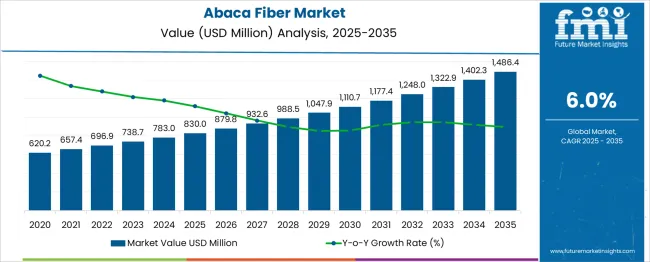
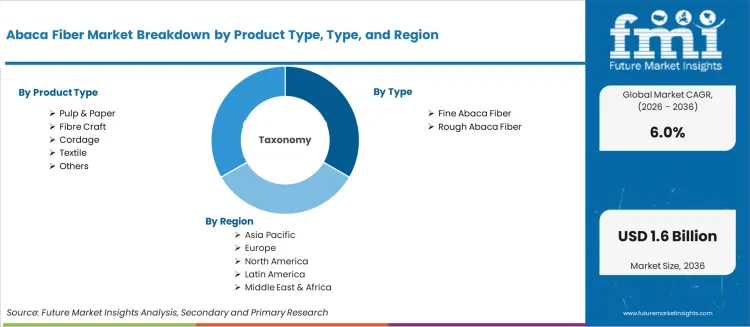
The Abaca Fiber market was valued at USD 0.83 billion in 2025, projected to reach USD 0.88 billion in 2026, and is forecast to expand to USD 1.58 billion by 2036 at a 6% CAGR. As per FMI, the absolute dollar opportunity across the forecast period amounts to USD 0.70 billion, reflecting steady conversion of latent demand into measurable procurement activity across end-use buyer segments.
FMI analysts observe that the specialty paper industry's demand for abaca pulp is the dominant consumption channel, with banknote, tea bag, filter, and specialty packaging paper manufacturers specifying Philippine-origin abaca fiber for its superior tensile strength and porosity characteristics. As per FMI, the fibre craft and cordage sectors maintain secondary demand channels where abaca's natural durability and saltwater resistance serve marine rope, agricultural twine, and handicraft export production. Fine abaca fiber grades commanding premium pricing are increasingly allocated to high-security banknote substrate production, where central bank specifications create multi-year procurement contracts with Philippine and Ecuadorian fiber processors. Textile-grade abaca is gaining traction in sustainable fashion supply chains as brands seek natural fiber alternatives to synthetic materials.
Summary of Abaca Fiber Market
- Market Snapshot
- The market is valued at USD 0.83 billion in 2025 and is projected to reach USD 1.58 billion by 2036.
- The industry is expected to grow at a 6% CAGR from 2026 to 2036, creating an incremental opportunity of USD 0.70 billion.
- The market remains a specification-driven category where product performance, regulatory compliance, and supply chain reliability define competitive positioning.
- Demand and Growth Drivers
- Demand is rising as end-use sectors face tightening performance specifications and compliance requirements that favour qualified product sources.
- Technology upgrade cycles and capacity expansion programmes across primary verticals are accelerating procurement schedules.
- Growth is further supported by expanding capacity in Asia Pacific and policy incentive frameworks in North America and Europe.
- Among key countries, China at 8.1%, India at 7.5%, Germany at 6.9%, France at 6.3%, UK at 5.7%, USA at 5.1%, Brazil at 4.5%.
- Product and Segment View
- The market includes abaca fiber is a natural cellulosic fiber extracted from the leaf sheaths of the musa textilis plant, prized for its tensile strength, flexibility, and resistance to saltwater degradation.
- Pulp and Paper leads by Product Type with 84.2% share in 2026.
- Fine Abaca Fiber leads by Type with 62.3% share in 2026.
- Scope includes market scope includes global and regional revenue sizing for abaca fiber segmented by product type and fiber grade.
- Geography and Competitive Outlook
- China and India are the fastest-growing markets, while mature economies sustain high-value demand through established procurement channels.
- Competition is shaped by product specification compliance, distribution network breadth, and supplier qualification track records.
- Key players include Ching Bee Trading Corporation, Yzen Handicraft Export Trading, Italfil Expo Bags Co., Ltd., Selinrail International Trading, MAP Enterprises, Fiber World, Tag Fibers, Inc..
- Analyst Opinion at FMI
- Nikhil Kaitwade, Principal Consultant at Future Market Insights, opines: 'In my analysis, I have observed that the Abaca Fiber market is transitioning from commodity procurement to specification-driven sourcing structures. Buyers delaying alignment with updated qualification frameworks risk supply disruptions as certified suppliers prioritize long-term contract holders. Capital allocation toward qualified capacity and regional distribution infrastructure will define competitive positioning through the forecast period.'
- Strategic Implications / Executive Takeaways
- Suppliers must secure product qualification certifications ahead of procurement cycle deadlines to qualify for multi-year contract awards.
- Capital project directors should prioritize capacity expansion in high-growth geographies where demand density and incentive frameworks reduce payback periods.
- Product development teams must invest in next-generation specification compliance capabilities to maintain competitiveness.
Abaca Fiber Market Key Takeaways
| Metric | Details |
|---|---|
| Industry Size (2026) | USD 0.88 billion |
| Industry Value (2036) | USD 1.58 billion |
| CAGR (2026-2036) | 6% |
Source: Future Market Insights, 2026
All tracked country markets reflect differentiated growth trajectories. China leads at 8.1% CAGR, propelled by specialty paper manufacturing capacity expansion and growing demand for natural fiber reinforcement in composite materials. India leads at 7.5% CAGR, supported by jute and natural fiber industry diversification programmes and growing handicraft export manufacturing. Germany leads at 6.9% CAGR, driven by specialty paper mill procurement for high-security banknote substrate and sustainable packaging applications.
France leads at 6.3% CAGR, backed by luxury brand sustainable packaging sourcing mandates and natural fiber textile research programmes. UK leads at 5.7% CAGR, sustained by Bank of England banknote substrate procurement cycles and sustainable fashion supply chain fibre sourcing. USA leads at 5.1% CAGR, anchored by Federal Reserve banknote paper procurement and specialty filtration paper manufacturing demand. Brazil registers a 4.5% pace, supported by growing domestic abaca cultivation pilots and natural fiber cordage manufacturing for marine applications.
Abaca Fiber Market Definition
Abaca fiber is a natural cellulosic fiber extracted from the leaf sheaths of the Musa textilis plant, prized for its tensile strength, flexibility, and resistance to saltwater degradation. The market covers pulp and paper grade, fibre craft, cordage, and textile applications across fine and rough fiber classifications. Primary consumption channels include specialty paper manufacturing for banknotes, tea bags, and filter media, as well as marine cordage, handicraft production, and sustainable textile supply chains.
Abaca Fiber Market Inclusions
Market scope includes global and regional revenue sizing for abaca fiber segmented by product type and fiber grade. Coverage spans pulp and paper, fibre craft, cordage, and textile applications across fine and rough fiber classifications with a 2026 to 2036 forecast period and country-level analysis.
Abaca Fiber Market Exclusions
The scope excludes jute, sisal, hemp, and other natural bast fibers. Finished paper products, woven textiles, and fabricated rope assemblies are excluded. Synthetic fiber substitutes and non-Musa textilis banana plant fibers fall outside the valuation boundary.
Abaca Fiber Market Research Methodology
- Primary Research: Analysts engaged with procurement leads, product specification engineers, and supply chain managers to map purchase decision triggers and qualification requirements.
- Desk Research: Data collection phases aggregated regulatory standards documentation, industry association publications, and company disclosure filings.
- Market-Sizing and Forecasting: Baseline values derive from a bottom-up aggregation of product shipments and contract values, applying region-specific adoption curves to project demand velocity.
- Data Validation and Update Cycle: Projections are tested against publicly reported revenue guidance from leading suppliers and cross-referenced with trade association data.
Why is the Abaca Fiber Market Growing?
The abaca fiber market is gaining traction due to its biodegradability, high tensile strength, and increased global focus on sustainable material alternatives. Industries are turning to abaca fiber as a viable replacement for synthetic fibers in various applications, particularly in sectors sensitive to environmental regulations.
Its use in paper production, especially in specialty and security paper, has expanded steadily as demand for eco-friendly and high-strength materials has intensified. Additionally, technological advancements in fiber extraction and processing have enhanced consistency in fiber grades, further supporting its industrial adaptability.
As regulatory bodies and manufacturers place greater emphasis on plastic substitutes, abaca is anticipated to play a critical role in the bio-based economy across both developed and emerging markets.
Segmental Analysis
The abaca fiber market is segmented by product type (fiber grade) and geographic regions. By product type, the abaca fiber market is divided into Pulp & Paper, Fibre Craft, Cordage, Textile, and others. The abaca fiber market is classified by type (fiber grade) into Fine Abaca Fiber and Rough Abaca Fiber. Regionally, the abaca fiber industry is classified into North America, Latin America, Western Europe, Eastern Europe, Balkan & Baltic Countries, Russia & Belarus, Central Asia, East Asia, South Asia & Pacific, and the Middle East & Africa.
Insights into the Pulp & Paper Product Type Segment
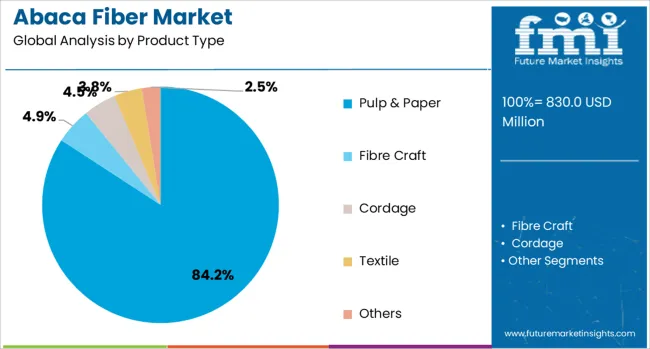
The pulp & paper segment is projected to contribute 84.2% of the total revenue in the abaca fiber market by 2026, making it the dominant product type. The growth of this segment has been driven by abaca's superior strength, long fiber length, and resistance to saltwater damage, making it especially suited for high-grade paper production.
Its wide adoption in manufacturing currency paper, filter paper, and other specialty paper products is reflective of increased demand from government and commercial institutions seeking sustainable alternatives. Rising awareness regarding non-wood fibers and the resurgence of traditional paper applications have reinforced this segment's market position.
Furthermore, abaca’s ability to blend with other cellulose-based fibers adds to its functional value in paper manufacturing.
Insights into the Fine Abaca Fiber Type Segment
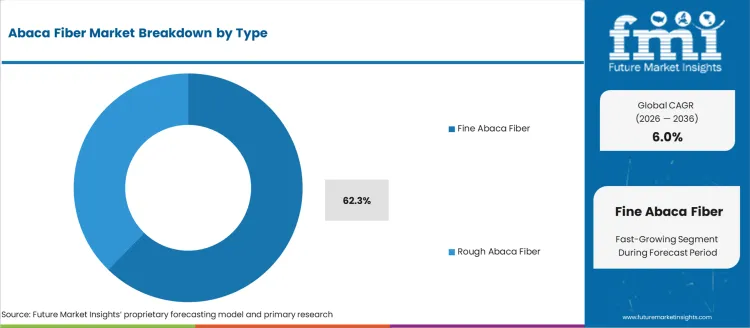
Fine abaca fiber is expected to account for 62.3% of the overall market share in 2026, establishing it as the leading fiber grade. This dominance stems from its high tensile strength, smooth texture, and superior fineness, which make it especially desirable in premium-grade applications such as security papers and specialty textiles.
The segment’s expansion has also been encouraged by innovations in fiber sorting and refinement technologies, which have allowed for more consistent fiber quality and reduced processing time. Increasing use of fine abaca in biodegradable composites and green packaging solutions has further added to demand.
With manufacturers prioritizing fibers that offer both performance and environmental compatibility, fine abaca is expected to remain the preferred grade in the years ahead.
What are the Drivers, Restraints, and Key Trends of the Abaca Fiber Market?
The abaca fiber market is expanding across specialty paper, marine cordage, automotive composites, and luxury goods. Its durability, tensile strength, and versatility are ensuring consistent growth in both industrial and high-value consumer applications worldwide.
Rising Demand in Specialty Paper and Pulp Applications
The abaca fiber market is experiencing strong demand in specialty paper and pulp industries, particularly for products such as tea bags, filter papers, and currency notes. Its exceptional tensile strength, long fiber length, and resistance to tearing make it a preferred choice where synthetic alternatives cannot deliver comparable performance. Expansion in banknote production, coupled with the need for high-grade filter materials in industrial and consumer applications, is fueling market growth. Increasing use in premium stationery and archival-quality documents adds to its appeal. Manufacturers are focusing on refining fiber processing techniques to improve uniformity and quality, which in turn strengthens supply chain reliability for paper and pulp producers.
Expanding Role in Marine and Cordage Industries
Marine and cordage applications continue to drive abaca fiber consumption due to its natural resistance to saltwater and decay. This makes it highly suitable for manufacturing ropes, hawsers, and nets used in shipping, fishing, and offshore construction sectors. The fiber’s ability to maintain structural integrity under prolonged exposure to moisture offers significant advantages over synthetic alternatives in specific marine conditions. Growth in global shipping activities and fishing exports in Southeast Asia is expanding demand. Manufacturers are also diversifying cordage products for both heavy-duty industrial applications and decorative uses in architectural projects, reinforcing abaca’s versatility across functional and aesthetic purposes.
Increasing Penetration in Automotive and Composite Materials
Abaca fiber is gaining traction in the automotive and composite manufacturing sectors, driven by its lightweight structure and high tensile strength. It is increasingly incorporated into car interior panels, seat structures, and reinforcement components, enhancing strength-to-weight ratios. The fiber’s compatibility with polymer matrices allows manufacturers to create durable composite materials suitable for various engineering applications. Rising production of electric and hybrid vehicles is creating additional demand for lightweight components, where abaca-based composites offer performance and environmental benefits. Collaborative research between automakers and fiber processors is accelerating the development of standardized abaca-reinforced parts for commercial-scale production.
Growing Opportunities in Fashion and Home Décor Segments
The fashion and home décor industries are increasingly adopting abaca fiber for luxury handbags, footwear, rugs, and furniture elements. Its unique texture and natural sheen provide a distinctive aesthetic that appeals to premium consumers. Designers are leveraging its durability for products that combine style with long-term usability. Expansion in artisanal crafts and the revival of traditional weaving techniques are adding cultural value to abaca-based goods. Export-oriented manufacturers are tapping into niche markets in Europe and North America, where natural fiber-based luxury items are in high demand. Collaborations between local artisans and international fashion houses support this segment’s growth.
Analysis of Abaca Fiber Market By Key Countries
.webp "Top Country Growth Comparison Abaca Fiber Market Cagr (2026 2036)")
| Country | CAGR |
|---|---|
| China | 8.1% |
| India | 7.5% |
| Germany | 6.9% |
| France | 6.3% |
| UK | 5.7% |
| USA | 5.1% |
| Brazil | 4.5% |
Source: FMI analysis based on primary research and proprietary forecasting model
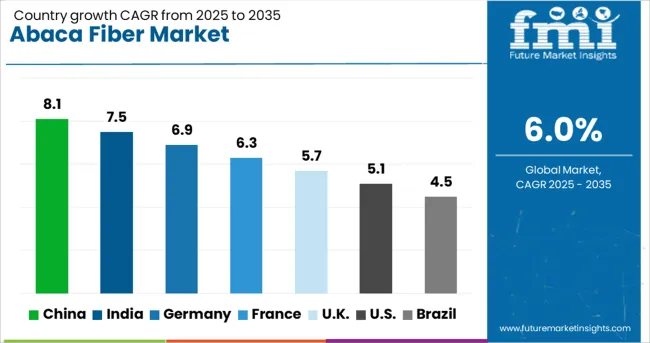
The abaca fiber market is projected to grow globally at a CAGR of 6.0% between 2026 and 2036, supported by rising demand in specialty paper, marine cordage, automotive composites, and premium home décor products. China leads with a CAGR of 8.1%, driven by expansion in specialty paper production, government-backed industrial projects, and increasing exports of abaca-based marine ropes. India follows at 7.5%, fueled by growing applications in industrial textiles, artisanal crafts, and the automotive sector. Germany posts 6.9%, benefiting from its advanced automotive manufacturing base and growing demand for high-strength natural fiber composites. The United Kingdom records 5.7%, with rising adoption in home décor, artisanal weaving, and industrial cordage. The United States stands at 5.1%, influenced by demand from specialty paper mills, eco-friendly product manufacturers, and composite material producers. The analysis covers more than 40 countries, with these five serving as key benchmarks for product innovation, export strategies, and market expansion opportunities shaping the future of the abaca fiber industry globally.
Expanding Utilization of Abaca Fiber in China
China is expected to post a CAGR of 8.1% for 2026-2036, rising from about 7.0% during 2020-2024, which is higher than the global average of 6.0%. The improvement in growth rate is linked to the scaling of specialty paper production, expanded export contracts for marine cordage, and increased investments in eco-friendly fiber applications. In the earlier phase, demand was mainly supported by traditional rope and textile manufacturing. Post-2024, the shift toward high-strength automotive composites, premium home décor, and industrial filtration materials is driving market acceleration. Supportive trade policies and targeted R&D in fiber processing continue to enhance China’s competitive standing.
- Specialty paper manufacturing expansion strengthens export potential.
- Growing applications in automotive and industrial composites.
- Government-backed fiber innovation centers boost quality standards.
Rising Industrial Adoption of Abaca Fiber in India
India is projected to register a CAGR of 7.5% for 2026-2036, increasing from nearly 6.6% in 2020-2024, showing steady upward momentum. The growth shift is driven by expanding use of abaca in industrial textiles, packaging materials, and artisanal craft exports. Earlier, the market was largely dependent on small-scale rope and mat production. Post-2024, rising automotive sector demand for natural fiber composites, coupled with export-oriented policies, is amplifying opportunities. Collaboration between local producers and international buyers is fostering quality improvements, while state-level initiatives are encouraging diversified fiber applications in home décor and eco-friendly industrial goods.
- Automotive sector adoption strengthens long-term demand outlook.
- Export-oriented policies support competitive pricing in global markets.
- Increased investment in fiber processing enhances scalability.
Growing Market Presence of Abaca Fiber in Germany
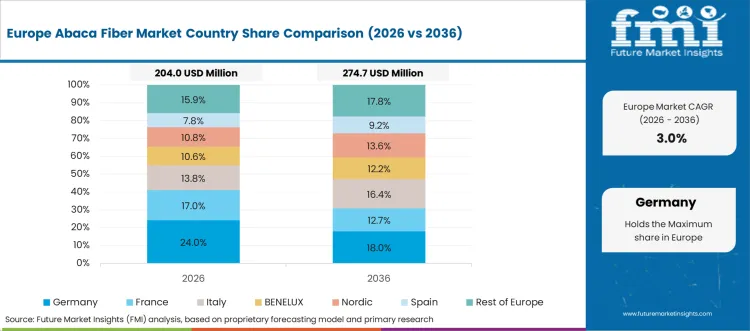
Germany is anticipated to grow at a CAGR of 6.9% for 2026-2036, up from roughly 5.8% during 2020-2024, reflecting the country’s shift toward advanced manufacturing applications. The earlier period’s growth came mainly from niche uses in packaging and specialty paper. Post-2024, higher demand from the automotive and renewable energy sectors for durable natural composites is driving expansion. German manufacturers are investing in precision processing methods to enhance fiber quality for industrial-grade applications. Increased collaborations with Southeast Asian suppliers are ensuring stable raw material flows, supporting both domestic production and re-export opportunities.
- Adoption in renewable energy sector components strengthens demand.
- Advanced fiber processing boosts competitiveness in composites market.
- Stable raw material supply via long-term import contracts.
Shifting Trends in Abaca Fiber Demand in the United Kingdom
The United Kingdom is expected to post a CAGR of 5.7% for 2026-2036, compared to about 4.8% in 2020-2024, marking a measured but steady rise. The earlier period’s growth was driven by artisanal crafts, small-scale packaging, and marine rope applications. After 2024, demand has expanded into premium furniture, eco-conscious packaging, and niche home décor segments. Import partnerships with Southeast Asian producers have strengthened market resilience against raw material shortages. Efforts by local manufacturers to blend abaca with other natural fibers are also creating innovative product lines for both domestic and export markets.
- Premium furniture applications generate higher-margin opportunities.
- Eco-conscious packaging adoption boosts retail sector demand.
- Product innovation through fiber blends enhances versatility.
Increasing Demand for Abaca Fiber in the United States
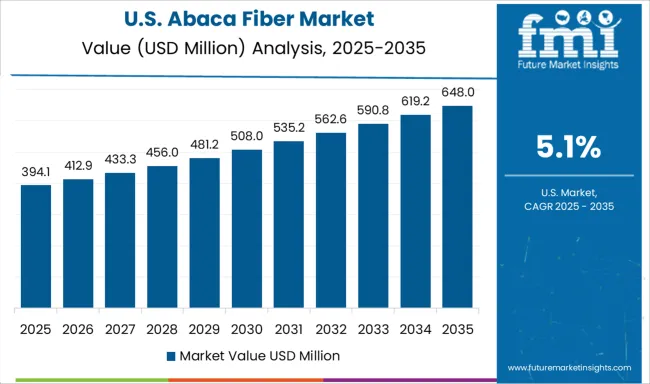
The United States is forecast to grow at a CAGR of 5.1% during 2026-2036, rising from approximately 4.4% in 2020-2024, signaling steady improvement. Earlier growth was centered on specialty paper mills and marine industries. Post-2024, market expansion is supported by the use of abaca in automotive interiors, biodegradable packaging, and industrial filtration. Strengthening supply chains from the Philippines and Ecuador has helped maintain consistent fiber availability. Large-scale retailers are increasingly sourcing abaca-based home décor and utility products, while R&D in composite manufacturing is opening new industrial applications.
- Biodegradable packaging adoption strengthens presence in retail supply chains.
- Automotive interior applications expand manufacturing partnerships.
- Stable imports from major producing nations ensure supply security.
Competitive Landscape of Abaca Fiber Market
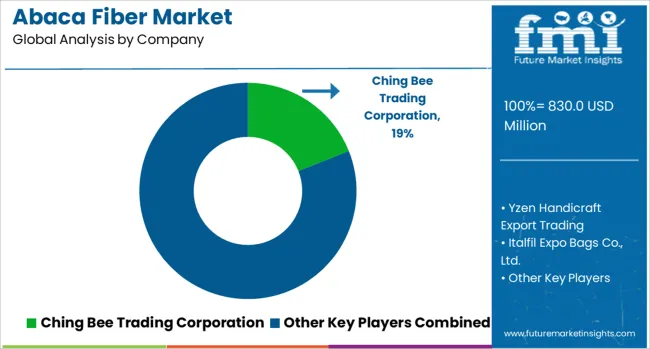
The abaca fiber market is led by established producers and exporters such as Ching Bee Trading Corporation, Yzen Handicraft Export Trading, Italfil Expo Bags Co., Ltd., Selinrail International Trading, MAP Enterprises, Fiber World, and Tag Fibers, Inc., each competing on fiber quality, processing capabilities, and export reliability. Ching Bee Trading Corporation maintains a strong foothold in premium-grade fiber supply, catering to specialty paper and marine cordage manufacturers worldwide. Yzen Handicraft Export Trading focuses on artisan-grade fiber for handicrafts, décor, and bespoke rope applications, targeting niche retail and boutique markets. Italfil Expo Bags Co., Ltd. specializes in eco-friendly abaca-based bag production, serving both fashion and packaging sectors with customizable, export-ready designs.
Selinrail International Trading operates as a diversified exporter, balancing bulk industrial fiber shipments with finished goods production for the global market. MAP Enterprises has built a reputation for consistent supply to industrial composite and specialty textile manufacturers. Fiber World focuses on value-added processing, producing fiber with uniform length and strength specifications for demanding industrial clients. Tag Fibers, Inc. emphasizes supply chain reliability, ensuring timely delivery to North America, Europe, and East Asia through long-term supplier agreements. The competitive environment is shaped by increasing demand from specialty paper mills, automotive composite manufacturers, and eco-conscious packaging companies. Strategies among these players include vertical integration of farming and processing, investment in fiber treatment technology for higher durability, and expansion into blended fiber applications. Partnerships with downstream manufacturers, diversification into higher-margin finished goods, and adherence to strict international quality standards are also central to maintaining competitiveness. Future positioning will depend on the ability to meet growing global demand while ensuring scalability, consistency, and compliance with export market regulations.
Scope of the Report
| Metric | Value |
|---|---|
| Quantitative Units | USD 0.88 billion to USD 1.58 billion, at a CAGR of 6% |
| Market Definition | Abaca fiber is a natural cellulosic fiber extracted from the leaf sheaths of the Musa textilis plant, prized for its tensile strength, flexibility, and resistance to saltwater degradation. The market covers pulp and paper grade, fibre craft, cordage, and textile applications across fine and rough fiber classifications. |
| Segmentation | Product Type: Pulp and Paper, Fibre Craft, Cordage, Textile, Others; Type: Fine Abaca Fiber, Rough Abaca Fiber |
| Regions Covered | North America, Latin America, Europe, East Asia, South Asia, Oceania, Middle East & Africa |
| Countries Covered | China, India, Germany, France, UK, USA, Brazil, and 40 plus countries |
| Key Companies Profiled | Ching Bee Trading Corporation, Yzen Handicraft Export Trading, Italfil Expo Bags Co., Ltd., Selinrail International Trading, MAP Enterprises, Fiber World, Tag Fibers, Inc. |
| Forecast Period | 2026 to 2036 |
| Approach | Forecasting models apply a bottom-up methodology starting with global installed base and consumption metrics, projecting conversion rates to advanced specifications. |
Abaca Fiber Market by Segments
Product Type:
- Pulp & Paper
- Fibre Craft
- Cordage
- Textile
- Others
Type (Fiber Grade):
- Fine Abaca Fiber
- Rough Abaca Fiber
Region:
- North America
- USA
- Canada
- Mexico
- Latin America
- Brazil
- Chile
- Rest of Latin America
- Western Europe
- Germany
- UK
- Italy
- Spain
- France
- Nordic
- BENELUX
- Rest of Western Europe
- Eastern Europe
- Russia
- Poland
- Hungary
- Balkan & Baltic
- Rest of Eastern Europe
- East Asia
- China
- Japan
- South Korea
- South Asia and Pacific
- India
- ASEAN
- Australia & New Zealand
- Rest of South Asia and Pacific
- Middle East & Africa
- Kingdom of Saudi Arabia
- Other GCC Countries
- Turkiye
- South Africa
- Other African Union
- Rest of Middle East & Africa
Bibliography
- 1. Philippine Fiber Industry Development Authority. (2024). Abaca production statistics and export performance report. PhilFIDA.
- 2. Food and Agriculture Organization of the United Nations. (2024). World fibre production and trade statistics: Hard fiber commodities. FAO.
- 3. European Central Bank. (2024). Banknote production framework: Substrate material specifications and procurement. ECB.
- 4. International Jute Study Group. (2024). Natural fiber market intelligence: Abaca, jute, and sisal trade flows. IJSG.
- 5. Bureau of Plant Industry, Philippines. (2024). Abaca variety development and quality grading standards. BPI.
This bibliography is provided for reader reference. The full Future Market Insights report contains the complete reference list with primary research documentation.
Frequently Asked Questions
How large is the demand for Abaca Fiber in the global market in 2026?
Demand for Abaca Fiber in the global market is estimated to be valued at USD 0.88 billion in 2026.
What will be the market size of Abaca Fiber in the global market by 2036?
Market size for Abaca Fiber is projected to reach USD 1.58 billion by 2036.
What is the expected demand growth for Abaca Fiber between 2026 and 2036?
Demand for Abaca Fiber is expected to grow at a CAGR of 6% between 2026 and 2036.
Which Product Type is poised to lead global sales by 2026?
Pulp and Paper accounts for 84.2% in 2026 based on established procurement patterns across primary end-use sectors.
What is driving demand in China?
China leads with a 8.1% CAGR through 2036, driven by expanding capacity, policy support, and growing end-user adoption.
What is the India growth outlook in this report?
India is projected to grow at a CAGR of 7.5% during 2026 to 2036.
What is Abaca Fiber and what is it mainly used for?
Abaca fiber is a natural cellulosic fiber extracted from the leaf sheaths of the Musa textilis plant, prized for its tensile strength, flexibility, and resistance to saltwater degradation. The market covers pulp and paper grade, fibre craft, cordage, and textile applications across fine and rough fiber classifications.
How does FMI build and validate the Abaca Fiber forecast?
Forecasting models apply a bottom-up methodology starting with global installed base metrics and cross-validate projections against quarterly industry revenue volumes and primary research inputs.
Preview the report firsthand - request a free sample
Get SampleGet the brochure for pricing and purchase details.
Get PDFTable of Content
- Executive Summary
- Global Market Outlook
- Demand-side Trends
- Supply-side Trends
- Technology Roadmap Analysis
- Analysis and Recommendations
- Market Overview
- Market Coverage / Taxonomy
- Market Definition / Scope / Limitations
- Research Methodology
- Chapter Orientation
- Analytical Lens and Working Hypotheses
- Market Structure, Signals, and Trend Drivers
- Benchmarking and Cross-market Comparability
- Market Sizing, Forecasting, and Opportunity Mapping
- Research Design and Evidence Framework
- Desk Research Programme (Secondary Evidence)
- Company Annual and Sustainability Reports
- Peer-reviewed Journals and Academic Literature
- Corporate Websites, Product Literature, and Technical Notes
- Earnings Decks and Investor Briefings
- Statutory Filings and Regulatory Disclosures
- Technical White Papers and Standards Notes
- Trade Journals, Industry Magazines, and Analyst Briefs
- Conference Proceedings, Webinars, and Seminar Materials
- Government Statistics Portals and Public Data Releases
- Press Releases and Reputable Media Coverage
- Specialist Newsletters and Curated Briefings
- Sector Databases and Reference Repositories
- FMI Internal Proprietary Databases and Historical Market Datasets
- Subscription Datasets and Paid Sources
- Social Channels, Communities, and Digital Listening Inputs
- Additional Desk Sources
- Expert Input and Fieldwork (Primary Evidence)
- Primary Modes
- Qualitative Interviews and Expert Elicitation
- Quantitative Surveys and Structured Data Capture
- Blended Approach
- Why Primary Evidence is Used
- Field Techniques
- Interviews
- Surveys
- Focus Groups
- Observational and In-context Research
- Social and Community Interactions
- Stakeholder Universe Engaged
- C-suite Leaders
- Board Members
- Presidents and Vice Presidents
- R&D and Innovation Heads
- Technical Specialists
- Domain Subject-matter Experts
- Scientists
- Physicians and Other Healthcare Professionals
- Governance, Ethics, and Data Stewardship
- Research Ethics
- Data Integrity and Handling
- Primary Modes
- Tooling, Models, and Reference Databases
- Desk Research Programme (Secondary Evidence)
- Data Engineering and Model Build
- Data Acquisition and Ingestion
- Cleaning, Normalisation, and Verification
- Synthesis, Triangulation, and Analysis
- Quality Assurance and Audit Trail
- Market Background
- Market Dynamics
- Drivers
- Restraints
- Opportunity
- Trends
- Scenario Forecast
- Demand in Optimistic Scenario
- Demand in Likely Scenario
- Demand in Conservative Scenario
- Opportunity Map Analysis
- Product Life Cycle Analysis
- Supply Chain Analysis
- Investment Feasibility Matrix
- Value Chain Analysis
- PESTLE and Porter’s Analysis
- Regulatory Landscape
- Regional Parent Market Outlook
- Production and Consumption Statistics
- Import and Export Statistics
- Market Dynamics
- Global Market Analysis 2021 to 2025 and Forecast, 2026 to 2036
- Historical Market Size Value (USD Million) Analysis, 2021 to 2025
- Current and Future Market Size Value (USD Million) Projections, 2026 to 2036
- Y-o-Y Growth Trend Analysis
- Absolute $ Opportunity Analysis
- Global Market Pricing Analysis 2021 to 2025 and Forecast 2026 to 2036
- Global Market Analysis 2021 to 2025 and Forecast 2026 to 2036, By Product Type
- Introduction / Key Findings
- Historical Market Size Value (USD Million) Analysis By Product Type , 2021 to 2025
- Current and Future Market Size Value (USD Million) Analysis and Forecast By Product Type , 2026 to 2036
- Pulp & Paper
- Fibre Craft
- Cordage
- Textile
- Others
- Pulp & Paper
- Y-o-Y Growth Trend Analysis By Product Type , 2021 to 2025
- Absolute $ Opportunity Analysis By Product Type , 2026 to 2036
- Global Market Analysis 2021 to 2025 and Forecast 2026 to 2036, By Type
- Introduction / Key Findings
- Historical Market Size Value (USD Million) Analysis By Type, 2021 to 2025
- Current and Future Market Size Value (USD Million) Analysis and Forecast By Type, 2026 to 2036
- Fine Abaca Fiber
- Rough Abaca Fiber
- Fine Abaca Fiber
- Y-o-Y Growth Trend Analysis By Type, 2021 to 2025
- Absolute $ Opportunity Analysis By Type, 2026 to 2036
- Global Market Analysis 2021 to 2025 and Forecast 2026 to 2036, By Region
- Introduction
- Historical Market Size Value (USD Million) Analysis By Region, 2021 to 2025
- Current Market Size Value (USD Million) Analysis and Forecast By Region, 2026 to 2036
- North America
- Latin America
- Western Europe
- Eastern Europe
- East Asia
- South Asia and Pacific
- Middle East & Africa
- Market Attractiveness Analysis By Region
- North America Market Analysis 2021 to 2025 and Forecast 2026 to 2036, By Country
- Historical Market Size Value (USD Million) Trend Analysis By Market Taxonomy, 2021 to 2025
- Market Size Value (USD Million) Forecast By Market Taxonomy, 2026 to 2036
- By Country
- USA
- Canada
- Mexico
- By Product Type
- By Type
- By Country
- Market Attractiveness Analysis
- By Country
- By Product Type
- By Type
- Key Takeaways
- Latin America Market Analysis 2021 to 2025 and Forecast 2026 to 2036, By Country
- Historical Market Size Value (USD Million) Trend Analysis By Market Taxonomy, 2021 to 2025
- Market Size Value (USD Million) Forecast By Market Taxonomy, 2026 to 2036
- By Country
- Brazil
- Chile
- Rest of Latin America
- By Product Type
- By Type
- By Country
- Market Attractiveness Analysis
- By Country
- By Product Type
- By Type
- Key Takeaways
- Western Europe Market Analysis 2021 to 2025 and Forecast 2026 to 2036, By Country
- Historical Market Size Value (USD Million) Trend Analysis By Market Taxonomy, 2021 to 2025
- Market Size Value (USD Million) Forecast By Market Taxonomy, 2026 to 2036
- By Country
- Germany
- UK
- Italy
- Spain
- France
- Nordic
- BENELUX
- Rest of Western Europe
- By Product Type
- By Type
- By Country
- Market Attractiveness Analysis
- By Country
- By Product Type
- By Type
- Key Takeaways
- Eastern Europe Market Analysis 2021 to 2025 and Forecast 2026 to 2036, By Country
- Historical Market Size Value (USD Million) Trend Analysis By Market Taxonomy, 2021 to 2025
- Market Size Value (USD Million) Forecast By Market Taxonomy, 2026 to 2036
- By Country
- Russia
- Poland
- Hungary
- Balkan & Baltic
- Rest of Eastern Europe
- By Product Type
- By Type
- By Country
- Market Attractiveness Analysis
- By Country
- By Product Type
- By Type
- Key Takeaways
- East Asia Market Analysis 2021 to 2025 and Forecast 2026 to 2036, By Country
- Historical Market Size Value (USD Million) Trend Analysis By Market Taxonomy, 2021 to 2025
- Market Size Value (USD Million) Forecast By Market Taxonomy, 2026 to 2036
- By Country
- China
- Japan
- South Korea
- By Product Type
- By Type
- By Country
- Market Attractiveness Analysis
- By Country
- By Product Type
- By Type
- Key Takeaways
- South Asia and Pacific Market Analysis 2021 to 2025 and Forecast 2026 to 2036, By Country
- Historical Market Size Value (USD Million) Trend Analysis By Market Taxonomy, 2021 to 2025
- Market Size Value (USD Million) Forecast By Market Taxonomy, 2026 to 2036
- By Country
- India
- ASEAN
- Australia & New Zealand
- Rest of South Asia and Pacific
- By Product Type
- By Type
- By Country
- Market Attractiveness Analysis
- By Country
- By Product Type
- By Type
- Key Takeaways
- Middle East & Africa Market Analysis 2021 to 2025 and Forecast 2026 to 2036, By Country
- Historical Market Size Value (USD Million) Trend Analysis By Market Taxonomy, 2021 to 2025
- Market Size Value (USD Million) Forecast By Market Taxonomy, 2026 to 2036
- By Country
- Kingdom of Saudi Arabia
- Other GCC Countries
- Turkiye
- South Africa
- Other African Union
- Rest of Middle East & Africa
- By Product Type
- By Type
- By Country
- Market Attractiveness Analysis
- By Country
- By Product Type
- By Type
- Key Takeaways
- Key Countries Market Analysis
- USA
- Pricing Analysis
- Market Share Analysis, 2025
- By Product Type
- By Type
- Canada
- Pricing Analysis
- Market Share Analysis, 2025
- By Product Type
- By Type
- Mexico
- Pricing Analysis
- Market Share Analysis, 2025
- By Product Type
- By Type
- Brazil
- Pricing Analysis
- Market Share Analysis, 2025
- By Product Type
- By Type
- Chile
- Pricing Analysis
- Market Share Analysis, 2025
- By Product Type
- By Type
- Germany
- Pricing Analysis
- Market Share Analysis, 2025
- By Product Type
- By Type
- UK
- Pricing Analysis
- Market Share Analysis, 2025
- By Product Type
- By Type
- Italy
- Pricing Analysis
- Market Share Analysis, 2025
- By Product Type
- By Type
- Spain
- Pricing Analysis
- Market Share Analysis, 2025
- By Product Type
- By Type
- France
- Pricing Analysis
- Market Share Analysis, 2025
- By Product Type
- By Type
- India
- Pricing Analysis
- Market Share Analysis, 2025
- By Product Type
- By Type
- ASEAN
- Pricing Analysis
- Market Share Analysis, 2025
- By Product Type
- By Type
- Australia & New Zealand
- Pricing Analysis
- Market Share Analysis, 2025
- By Product Type
- By Type
- China
- Pricing Analysis
- Market Share Analysis, 2025
- By Product Type
- By Type
- Japan
- Pricing Analysis
- Market Share Analysis, 2025
- By Product Type
- By Type
- South Korea
- Pricing Analysis
- Market Share Analysis, 2025
- By Product Type
- By Type
- Russia
- Pricing Analysis
- Market Share Analysis, 2025
- By Product Type
- By Type
- Poland
- Pricing Analysis
- Market Share Analysis, 2025
- By Product Type
- By Type
- Hungary
- Pricing Analysis
- Market Share Analysis, 2025
- By Product Type
- By Type
- Kingdom of Saudi Arabia
- Pricing Analysis
- Market Share Analysis, 2025
- By Product Type
- By Type
- Turkiye
- Pricing Analysis
- Market Share Analysis, 2025
- By Product Type
- By Type
- South Africa
- Pricing Analysis
- Market Share Analysis, 2025
- By Product Type
- By Type
- USA
- Market Structure Analysis
- Competition Dashboard
- Competition Benchmarking
- Market Share Analysis of Top Players
- By Regional
- By Product Type
- By Type
- Competition Analysis
- Competition Deep Dive
- Ching Bee Trading Corporation
- Overview
- Product Portfolio
- Profitability by Market Segments (Product/Age /Sales Channel/Region)
- Sales Footprint
- Strategy Overview
- Marketing Strategy
- Product Strategy
- Channel Strategy
- Yzen Handicraft Export Trading
- Italfil Expo Bags Co., Ltd.
- Selinrail International Trading
- MAP Enterprises
- Fiber World
- Tag Fibers, Inc.
- Ching Bee Trading Corporation
- Competition Deep Dive
- Assumptions & Acronyms Used


