

- Market Size (2026)
- USD 83.7 Bn
- Forecast (2036)
- USD 246.2 Bn
- CAGR (2026 to 2036)
- 11.4%
How big is the earphone and headphone market in 2026?
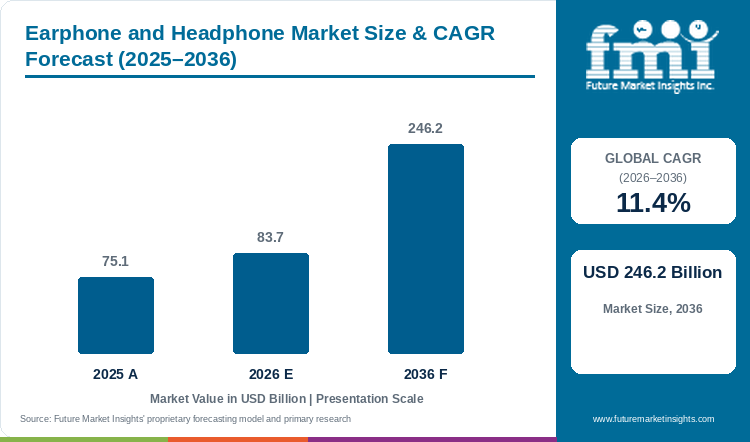
The Earphone and Headphone Market is projected to expand at a CAGR of 11.4% between 2026 and 2036. Market value rises from USD 75.1 billion in 2025 to USD 83.7 billion in 2026 and USD 246.2 billion by 2036. [1]
The earphone and headphone market was valued at USD 75.1 billion in 2025. It is estimated at USD 83.7 billion in 2026 and forecast at USD 246.2 billion by 2036, with an 11.4% CAGR over the forecast period. Demand covers personal and professional listening products across wired and wireless connections. Product choice depends on fit, the source device, listening conditions and the controls needed during everyday use. Earphones and headphones occupy several purchasing settings within consumer electronics. A commuter may want isolation and convenient calls, a musician may need a repeatable monitoring arrangement, and a gamer may prioritize the microphone and connection. The same customer can own more than one format because the requirements change between activities. Manufacturers compete through the listening experience and the practical work of pairing, charging, adjusting and maintaining the product. [1] Recent launches show suppliers refining those different requirements. Apple introduced AirPods Pro 3 in September 2025 with changes to fit and workout features. Sony introduced its WH-1000XM6 over-ear model in May 2025, while Bose announced a second generation of QuietComfort Ultra Headphones in September. Samsung’s February 2026 Galaxy Buds4 announcement provides a more recent example of earbud development. These offers bring software, acoustic design and connection choices into the purchase alongside the physical format. [2, 3, 4, 10]
Key Market Trends & Insights
- Wireless products held 58.4% of connectivity-type demand in 2025. [1]
- Online channels accounted for 61.7% of distribution-channel revenue in 2025. [1]
- Medium-range products represented 42.6% of price-range demand in 2025. [1]
- Product launches combine acoustic design, fit and device-supported listening functions. [2, 3, 10]
Regional Highlights
- The United States and United Kingdom profiles cover everyday listening, professional audio and retail routes. [2, 3, 4, 8]
- Japan’s supplier portfolio spans wireless earbuds, wired formats and monitor headphones. [8, 11, 12]
- South Korea’s profile includes Samsung’s February 2026 Galaxy Buds4 introduction and its broader consumer audio setting. [10, 13]
Market Size & Forecast
Table 1: Market Size and Forecast for the Earphone and Headphone Market (USD billion and percentage), 2025 to 2036
| Metric | Value |
|---|---|
| 2025 Market Size | USD 75.1 billion |
| Estimated Market Size in 2026 | USD 83.7 billion |
| Projected Market Size by 2036 | USD 246.2 billion |
| CAGR, 2026 to 2036 | 11.4% |
| Added Revenue, 2026 to 2036 | USD 162.5 billion |
| Market Expansion Multiple | 2.9x |
The market is forecast to expand at 11.4% CAGR over 2026 to 2036. [1]
Earphone and Headphone Market Industry and Operating Indicators
Published product, supplier and service developments describe the operating choices within this market.
Table 2: Industry Indicators for the Earphone and Headphone Market, 2025 to 2026
| Indicator | Data Point | Why It Matters | Source |
|---|---|---|---|
| Over-ear product generation | Sony announced WH-1000XM6 on May 15, 2025, adding a new generation to its over-ear noise-cancelling series. | Updates a documented noise-cancelling headphone range. | [3] |
| Earbud fit and workout functions | Apple announced AirPods Pro 3 on September 9, 2025, with availability beginning September 19. The offer included revised fit and heart-rate sensing during workouts. | Adds revised fit and workout heart-rate sensing to the product comparison. | [2] |
| Adaptive earbud audio | Samsung’s February 26, 2026 announcement introduced Galaxy Buds4 and Buds4 Pro with adaptive audio and fit updates. | Provides a current earbud launch combining audio adaptation and fit development. | [10] |
Analyst Perspective
The purchase extends beyond the first listening session. A product must remain comfortable, connect with the devices the customer uses and provide controls that suit the setting. Suppliers can make the offer easier to assess through clear compatibility information, service support and a precise description of the listening functions. Those details matter when buyers compare several similar-looking products.
- Sudip Saha, Principal Consultant, Future Market Insights.
How is the earphone and headphone market segmented?
The market is segmented by Connectivity Type, Distribution Channel, Price Range, Application and Product Type. [1]
By Connectivity Type: Wired, Wireless.
By Distribution Channel: Online, Offline.
By Price Range: Low-Range Price, Medium-Range Price, High-Range Price.
By Application: Personal, Professional.
By Product Type: In-Ear / Earbuds, Over-Ear and On-Ear.
By Region: North America, Latin America, Western Europe, Eastern Europe, East Asia, South Asia and Pacific, Middle East and Africa.
Connectivity distinguishes wired and wireless products; distribution separates online and offline channels. Price ranges cover low, medium and high categories. Applications distinguish personal and professional use. Product types cover in-ear and earbud designs as well as over-ear and on-ear formats. A wireless headphone can also provide a wired input, so the advertised connection should be considered with the intended use and supported source. The categories describe the offer without making every product within one group interchangeable. [1, 4, 12]
Why do wireless products lead connectivity?
Wireless products held 58.4% of connectivity-type demand in 2025. Pairing, charging and source-device compatibility remain part of the listening offer. [1, 5]
Table 3: Connectivity Type Share for the Earphone and Headphone Market (percentage share), 2025
| Connectivity Type | Share (2025) |
|---|---|
| Wireless | 58.4% |
| Other Segments Combined | 41.6% |
| Total | 100.0% |
Table 4: Connectivity Type Focus and Market Growth for the Earphone and Headphone Market, 2026 to 2036
| Metric | Value |
|---|---|
| Global CAGR (2026 to 2036) | 11.4% |
| Leading Segment | Wireless |
Wireless products held 58.4% of connectivity-type demand in 2025. Their appeal includes movement without a cable and a compact arrangement for daily listening. Wireless audio products also depend on pairing, charging and the supported audio connection. Bluetooth SIG documents LE Audio, the LC3 codec and Auracast broadcast audio, expanding the connection options available to developers. A customer needs compatibility at both ends of the connection to use a particular function. Brands can distinguish their offer through a clear setup process and reliable access to the features advertised. [1, 5]
- Wireless products held 58.4% of the connectivity segment in 2025. [1]
- LE Audio and Auracast provide additional audio-delivery options. [5]
What keeps wired products commercially relevant?
Wired products support defined listening and production arrangements. Connector, cable and source-output requirements help buyers assess the signal path and equipment fit. [8, 12] [1]
A wired connection can suit a fixed listening or production arrangement. Audio-Technica’s ATH-M50x is a professional monitor-headphone example, while JVC lists wired earbud and headband products alongside wireless models. Customers selecting such products need to check the connector, cable arrangement and source output. The value can lie in a simple, defined signal path and the fit required for the session. A professional buyer may also need several users to work with the same equipment arrangement, making the product’s physical connections part of the specification. [8, 12]
- Wired remains a distinct connectivity category. [1]
- JVC’s portfolio includes USB-C wired earbuds and wired headband formats. [12]
How do online and offline channels affect the purchase?
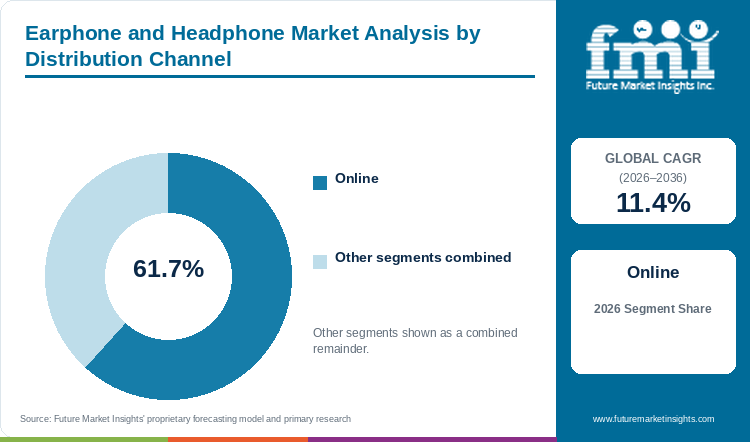
Online channels accounted for 61.7% of distribution-channel revenue in 2025. Digital retail gives customers access to specifications, compatibility information and several models within a brand’s range. Mobile phone accessories often reach the buyer through the same shopping session, which makes the distinction between a general accessory and a chosen listening device commercially useful. Offline stores can add a way to assess physical size and fit where demonstration is available. Across both routes, the offer needs clear information on the product supplied, the support arrangements and any device requirements. [1, 12, 14]
- Online channels held 61.7% of distribution-channel revenue in 2025. [1]
- Offline distribution remains part of the channel taxonomy. [1]
What supports medium-range products?
Medium-range products represented 42.6% of price-range demand in 2025. This category provides a comparison point between basic listening products and more specialized offers. Price labels alone do not establish an identical feature set across manufacturers. Buyers can compare the connection, fit, controls and support supplied at the price offered. Skullcandy and JVC document ranges covering several listening formats and feature combinations. For a supplier, a clear progression between models helps the customer decide which additional functions are useful for the intended setting. [1, 12, 14]
- Medium-range products represented 42.6% of price-range demand in 2025. [1]
- Low-, medium- and high-range prices complete the taxonomy. [1]
How do personal and professional applications differ?
Personal use can involve music, video, calls and exercise across several locations. Professional use can involve monitoring, production or a defined communication task. Alclair’s custom and universal in-ear monitors illustrate a specialist offer, while Audio-Technica supplies monitoring headphones. The buyer needs to establish the work the product must support and the equipment used with it. Comfort, replaceable accessories and consistent setup can affect practical value when the same person uses a device regularly. A headphone’s appearance or price does not by itself determine whether it suits that work. [8, 15]
- Personal and professional applications form separate categories. [1]
- Custom in-ear monitors provide a specialist product route. [15]
How does product format influence demand?
In-ear products place the listening components at the ear and can use a small charging case. Over-ear and on-ear products use a headband and ear-cup arrangement. The physical format affects storage, wearing comfort and how the user adjusts the device. Apple’s current earbuds, Sony’s over-ear series and Grado’s headphone portfolio illustrate different designs. Buyers should assess the fit for their own routine, including the duration of a session and whether they need to carry the product between locations. The range provides several solutions to a listening requirement rather than one universal format. [2, 3, 16]
- In-ear and earbuds, over-ear and on-ear formats are covered. [1]
- Physical fit and portability remain important across connection types.
What drives and constrains earphone and headphone demand?
Daily listening and product upgrades support demand; compatibility, fit and listening exposure constrain use; clearer connectivity and differentiated formats create opportunities.
- Driver: Listening, calls and interactive entertainment create several everyday audio requirements.
- Restraint: The advertised features must work with the customer’s devices and listening routine.
- Opportunity: Suppliers can connect useful audio functions with practical setup, support and delivery.
Driver. Products increasingly combine listening with other daily activities. Apple’s 2025 introduction includes heart-rate sensing during workouts, while Logitech G’s PRO X 2 includes a microphone and several connection routes for gaming. These examples address different jobs for the user. A supplier can develop a product around the activity, with controls, fit and connection choices suited to it. The commercial question is which functions the buyer can use regularly and how well the product fits the devices already owned. [2, 9]
Restraint. Listening exposure is a material product-use consideration. WHO guidance links the risk of hearing damage to sound level and duration, and recommends safe-listening features such as exposure monitoring and volume limiting. Noise cancellation can reduce the need to raise playback volume in a noisy setting, but users still need an appropriate level and listening routine. Manufacturers and retailers can explain those functions clearly alongside fit and device compatibility. The operating instructions are part of the usable product offer. [6]
Opportunity. Additional connection options can broaden where a product is useful. Bluetooth SIG describes Auracast, using Bluetooth Low Energy, as broadcast audio allowing a source to serve multiple receiving devices. Bose’s second-generation over-ear offer includes USB-C digital audio as well as wireless connectivity. These developments make the connection arrangement a point of product choice. A buyer needs to know which sources are supported and what equipment is needed to access the function. Clear information can help a customer choose a suitable product and reduce avoidable setup problems. [4, 5]
How do country opportunities compare?
The geographic comparison examines current product offers, distribution and implementation requirements relevant to the 2026 to 2036 outlook.
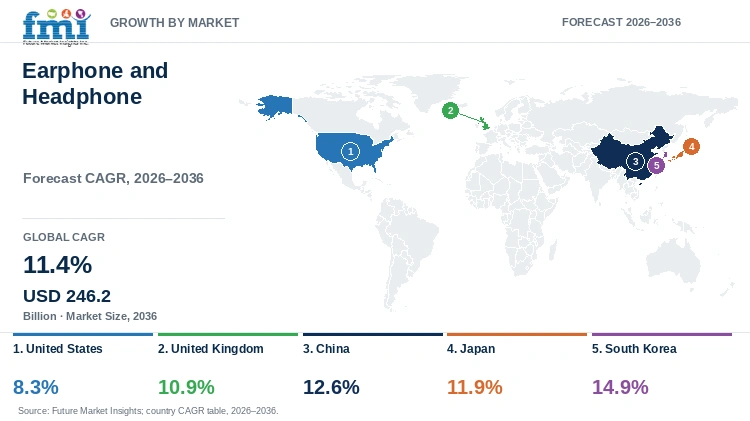
| Country | CAGR |
|---|---|
| USA | 8.3% |
| UK | 10.9% |
| China | 12.6% |
| Japan | 11.9% |
| South Korea | 14.9% |
What shapes geographic demand?
A global audio platform still needs a local commercial offer. Customers need the model sold in their market, supported device information and a route for service. Regional manufacturer pages illustrate how the product reaches different audiences, while European charging requirements affect covered devices sold in that market. Country analysis therefore considers the available offer and the implementation conditions around it. The same broad listening activity can be served by different product ranges, retail channels and support arrangements. [2, 7, 10, 11, 12, 17]
In the United States, personal audio brands and gaming suppliers provide several purchasing settings. In the United Kingdom, local product ranges connect global brands with regional retail and support. In China, local-language product information supports the device and audio purchase. In Japan, domestic brands supply wireless and specialist listening products. In South Korea, earbud development connects with smartphone-platform functions. In the European Union, charging requirements affect covered products and sales information.
Country-wise Analysis
United States
The U.S. profile includes personal listening, gaming and specialist audio offers. Sony’s U.S. announcement and Bose’s product launch document over-ear development, while Logitech G provides a gaming-headset example. Manufacturers can serve these settings through different microphones, controls and connection arrangements. Retail positioning needs to make the intended use clear so the customer can compare relevant alternatives. A product offered for travel may have different practical priorities from a desk-based gaming setup. Service access and precise compatibility information remain part of the purchase when the buyer already uses several devices. [3, 4, 9]
United Kingdom
The U.K. profile includes regional availability of global audio ranges. Skullcandy identifies a U.K. retail destination within its distribution information, while JVC provides a broad portfolio spanning wired and wireless formats. Suppliers need to connect the selected range with local pricing, delivery and support. A buyer comparing alternatives needs the exact model and connection information, especially where a product name is used across several versions. The commercial opportunity concerns a clearly described listening product backed by a usable local service arrangement, with online and offline channels serving different parts of the selection process. [12, 14]
China
China’s profile is illustrated by Apple’s local AirPods Pro 3 introduction, which describes the product and its supported listening and workout functions for that audience. Local information helps buyers assess the offer against the phone and software they use. Companies distributing an audio range need to communicate those requirements alongside fit, controls and support. A feature listed on a global product page may require particular software or regional availability. Retailers can improve the purchasing experience by identifying the functions available with the customer’s actual device arrangement and the version supplied. [17]
Japan
Japan’s profile combines domestic audio manufacturers with several listening formats. Panasonic’s January 2025 announcement introduced Technics EAH-AZ100 earbuds in Japan, while JVC’s portfolio and Audio-Technica’s monitor headphones illustrate other product routes. Buyers can choose between portable wireless listening and a more fixed monitoring arrangement. Suppliers need to explain the use supported by each model and the physical accessories supplied. That portfolio breadth gives retailers several customer groups to serve, with the listening activity and equipment already owned providing a useful basis for matching a product to the buyer. [8, 11, 12]
South Korea
South Korea’s profile includes Samsung’s Galaxy Buds4 series, introduced in February 2026. Its announcement describes adaptive audio functions and fit development within an earbud offer. This provides a current example of product development connected with a smartphone platform. HARMAN is also a wholly owned Samsung subsidiary, with consumer audio activity within its broader business. Companies serving this setting need to distinguish the particular headphone or earbud offer and its supported functions. Customers can compare the practical listening experience, device requirements and support available through the relevant brand and distribution channel. [10, 13]
European Union
The European Union provides an important distribution and product-design setting. Common-charger requirements applying from December 28, 2024 cover categories including headphones, headsets and earbuds. The rules concern covered devices supporting wired charging, with a common USB-C arrangement and information requirements. Manufacturers and distributors need to address these requirements when placing the applicable products on the market. For the buyer, charging compatibility is one part of using a device with the equipment already owned. Audio connectivity and the feature set still need a separate assessment because the charging connector does not establish every listening capability. [7]
Who participates in earphones and headphones?
Participants include Sony, JVC/JVCKENWOOD, HARMAN, Bose, Audio-Technica, Skullcandy, Alclair Audio, Apple, Grado Labs, Logitech and Panasonic.
The supplier base covers mass-market personal audio, smartphone-associated earbuds, gaming and specialist listening equipment. Sony, Bose and Apple illustrate connected personal-audio offers. Audio-Technica, Alclair and Grado provide different specialist formats, while Logitech addresses gaming. JVC, Skullcandy and Panasonic document additional product ranges. HARMAN operates within Samsung ownership. Competitive comparison needs to follow the product supplied and the customer’s intended use, with device integration, physical fit and support considered alongside the acoustic offer. [2, 3, 4, 8, 9, 10, 11, 12, 13, 14, 15, 16]
- Connected personal audio: Sony, Bose, Apple and Panasonic.
- Broad listening portfolios: JVC/JVCKENWOOD, HARMAN and Skullcandy.
- Specialist and interactive listening: Audio-Technica, Alclair Audio, Grado Labs and Logitech.
Competitive Benchmarking: Earphone and Headphone Market
| Participant | Market Role | Offer | Connection or Format | Buyer Relevance |
|---|---|---|---|---|
| Sony | Personal audio manufacturer | WH-1000XM6 | Wireless over-ear | Travel and daily listening |
| Bose | Personal audio manufacturer | QuietComfort Ultra, second generation | Wireless and USB-C audio | Connection choice and noise control |
| Apple | Device and audio supplier | AirPods Pro 3 | Wireless in-ear | Supported Apple-device functions |
| JVC / JVCKENWOOD | Audio brand | Earbuds and headband ranges | Wired and wireless | Format and price choice |
| Audio-Technica | Audio manufacturer | ATH-M50x | Monitor headphones | Defined monitoring arrangement |
| Logitech G | Gaming supplier | PRO X 2 | Wireless, Bluetooth and wired | Gaming audio and microphone |
| Alclair Audio | Specialist audio supplier | In-ear monitors | Custom and universal fit | Monitoring and fit |
| Panasonic / Technics | Audio manufacturer | EAH-AZ100 | Wireless earbuds | Portable listening offer |
Key Developments in Earphones and Headphones
- Sony announced WH-1000XM6 on May 15, 2025, adding a new generation to its over-ear noise-cancelling series. [3]
- Apple announced AirPods Pro 3 on September 9, 2025, with availability beginning September 19. The offer included revised fit and heart-rate sensing during workouts. [2]
- Samsung’s February 26, 2026 announcement introduced Galaxy Buds4 and Buds4 Pro with adaptive audio and fit updates. [10]
Key Players in Earphones and Headphones
- Sony Corporation
- JVC brand / JVCKENWOOD
- HARMAN International, a Samsung subsidiary
- Bose Corporation
- Audio-Technica Corporation
- Skullcandy
- Alclair Audio
- Apple
- Grado Labs
- Logitech International
- Panasonic / Technics
Earphone and Headphone Market - Report Scope
| Coverage Field | Report Scope |
|---|---|
| Market Breakdown | Connectivity Type; Distribution Channel; Price Range; Application; Product Type |
| Quantitative Units | Revenue in USD billion |
| Market Definition | Personal and professional earphones and headphones, including in-ear/earbud, over-ear and on-ear formats with wired or wireless connections. |
| Exclusions | Standalone speakers, audio content subscriptions, separate microphones, unrelated accessories and medical hearing aids; duplicate counting of bundled components. |
| Regions Covered | North America; Latin America; Western Europe; Eastern Europe; East Asia; South Asia and Pacific; Middle East and Africa |
| Geographic Profiles | United States; United Kingdom; China; Japan; South Korea; European Union |
| Competitive Coverage | Personal audio, gaming and specialist listening products |
| 2025 Market Value | USD 75.1 billion |
| 2026 Market Value | Estimated at USD 83.7 billion |
| 2036 Forecast Value | USD 246.2 billion |
| CAGR | 11.4% |
| Forecast Period | 2026 to 2036 |
| Historical Segment Shares (2025) | Wireless 58.4%; Online 61.7%; Medium-range price 42.6% |
Earphone and Headphone Market - Research Framework
| Research Area | Coverage |
|---|---|
| Market Coverage | Earphone and headphone products across five market axes |
| Industry Evidence | Manufacturer portfolios, dated launches and connection documentation |
| Geographic Analysis | Regional product offers, distribution and charging requirements |
| Competitive Analysis | Format, compatibility, controls, fit and support |
Earphone and Headphone Market by Segments
Earphone and Headphone Market segmented by Connectivity Type:
- Wired
- Wireless
Earphone and Headphone Market segmented by Distribution Channel:
- Online
- Offline
Earphone and Headphone Market segmented by Price Range:
- Low-Range Price
- Medium-Range Price
- High-Range Price
Earphone and Headphone Market segmented by Application:
- Personal
- Professional
Earphone and Headphone Market segmented by Product Type:
- In-Ear / Earbuds
- Over-Ear and On-Ear
- Over-Ear
- On-Ear
- Over-Ear and On-Ear
Earphone and Headphone Market by Region
- North America
- United States
- Canada
- Mexico
- Latin America
- Brazil
- Chile
- Rest of Latin America
- Western Europe
- Germany
- United Kingdom
- Italy
- Spain
- France
- Nordics
- Benelux
- Rest of Western Europe
- Eastern Europe
- Russia
- Poland
- Hungary
- Balkan and Baltic Countries
- Rest of Eastern Europe
- East Asia
- China
- Japan
- South Korea
- South Asia and Pacific
- India
- Bangladesh
- ASEAN
- Australia
- New Zealand
- Rest of South Asia and Pacific
- Middle East and Africa
- GCC Countries
- South Africa
- Israel
- Other African Union Countries
- Rest of Middle East and Africa
Research Sources and Bibliography
- [1] Future Market Insights. Earphone and Headphone Market.
- [2] Apple (2025, September 9). AirPods Pro 3 Introduction.
- [3] Sony (2025, May 15). WH-1000XM6 Introduction.
- Bose (2025, September 10). QuietComfort Ultra Headphones, Second Generation.
- [5] Bluetooth SIG. LE Audio and Auracast.
- [6] World Health Organization. Safe Listening.
- [7] European Commission (2024, December 28). Common Charger Rules.
- [8] Audio-Technica. ATH-M50x Professional Monitor Headphones.
- Logitech G. PRO X 2 Wireless Gaming Headset.
- [10] Samsung (2026, February 26). Galaxy Buds4 Series.
- Panasonic (2025, January 8). Technics EAH-AZ100 Japan Introduction.
- [12] JVC. Headphones and Earbuds.
- HARMAN. Company and Samsung Ownership.
- Skullcandy. Wireless and Wired Headphones.
- [15] Alclair Audio. Custom and Universal In-ear Monitors.
- Grado Labs. Headphone Portfolio.
- [17] Apple China (2025, September). AirPods Pro 3 Local Offer.
This Report Answers
- What was the earphone and headphone market value in 2025?
- How large is the estimated market in 2026 and what is forecast for 2036?
- Which connectivity, channel and price categories led in 2025?
- How do wired and wireless offers differ?
- What shapes personal and professional purchasing requirements?
- Which current regional product and distribution conditions are profiled?
- Which suppliers provide connected and specialist listening products?
- How do compatibility, fit and safe listening affect use?
Frequently Asked Questions
How big is the earphone and headphone market in 2026?
The market is estimated at USD 83.7 billion in 2026, following USD 75.1 billion in 2025. [1]
What is forecast for 2036?
The market is forecast at USD 246.2 billion by 2036 at 11.4% CAGR over 2026 to 2036. [1]
Which connectivity type led in 2025?
Wireless products held 58.4% of connectivity-type demand in 2025. [1]
Which distribution channel led in 2025?
Online channels accounted for 61.7% of distribution-channel revenue in 2025. [1]
Which price range led in 2025?
Medium-range products represented 42.6% of price-range demand in 2025. [1]
Which applications and formats are covered?
Personal and professional applications, with in-ear/earbud, over-ear and on-ear products. [1]
Preview the report firsthand - request a free sample
Get SampleGet the brochure for pricing and purchase details.
Get PDFTable of Content
- Key Takeaways
- Market Size and CAGR
- Top Growth Driver
- Fastest Growing Segment
- Leading Region
- Key Companies
- Emerging Opportunities
- Executive Summary
- Global Market Outlook
- Demand-side Trends
- Supply-side Trends
- Technology Roadmap Analysis
- Analysis and Recommendations
- Analyst Perspective (What is happening? Why now? What should investors know?)
- Key Questions Answered
- How large is the market?
- What is the CAGR?
- What are key trends?
- Which region dominates?
- Who are the leaders?
- Market Overview
- Market Coverage / Taxonomy
- Market Definition / Scope / Limitations
- Research Methodology
- Chapter Orientation
- Analytical Lens and Working Hypotheses
- Market Structure, Signals, and Trend Drivers
- Benchmarking and Cross-market Comparability
- Market Sizing, Forecasting, and Opportunity Mapping
- Research Design and Evidence Framework
- Desk Research Programme (Secondary Evidence)
- Expert Input and Fieldwork (Primary Evidence)
- Tooling, Models, and Reference Databases
- Data Engineering and Model Build
- Quality Assurance and Audit Trail
- Market Background
- Market Dynamics (Drivers, Restraints, Opportunity, Trends)
- Scenario Forecast (Optimistic, Likely, Conservative)
- Impact Analysis
- AI Impact
- Sustainability Impact
- Regulatory Impact
- Technology Impact
- Consumer / Buyer Analysis
- Purchase Drivers
- Adoption Barriers
- Buyer Journey
- Opportunity Map Analysis
- Product Life Cycle Analysis
- Supply Chain Analysis
- Investment Feasibility Matrix
- Value Chain Analysis
- PESTLE and Porter's Analysis
- Regulatory Landscape
- Regional Parent Market Outlook
- Production and Consumption Statistics
- Import and Export Statistics
- Global Market Analysis and Forecast, 2021 to 2036
- Historical Market Size Value (USD Billion) Analysis, 2021 to 2025
- Current and Future Market Size Value (USD Billion) Projections, 2026 to 2036
- Y-o-Y Growth Trend Analysis
- Absolute $ Opportunity Analysis
- Global Market Pricing Analysis, 2021 to 2036
- Global Market Analysis and Forecast, By Connectivity Type, 2021 to 2036
- Introduction / Key Findings
- Historical Market Size Value (USD Billion) Analysis By Connectivity Type, 2021 to 2025
- Current and Future Market Size Value (USD Billion) Analysis and Forecast By Connectivity Type, 2026 to 2036
- Wired
- Wireless
- Y-o-Y Growth Trend Analysis By Connectivity Type, 2021 to 2025
- Absolute $ Opportunity Analysis By Connectivity Type, 2026 to 2036
- Global Market Analysis and Forecast, By Distribution Channel, 2021 to 2036
- Introduction / Key Findings
- Historical Market Size Value (USD Billion) Analysis By Distribution Channel, 2021 to 2025
- Current and Future Market Size Value (USD Billion) Analysis and Forecast By Distribution Channel, 2026 to 2036
- Online
- Offline
- Y-o-Y Growth Trend Analysis By Distribution Channel, 2021 to 2025
- Absolute $ Opportunity Analysis By Distribution Channel, 2026 to 2036
- Global Market Analysis and Forecast, By Price Range, 2021 to 2036
- Introduction / Key Findings
- Historical Market Size Value (USD Billion) Analysis By Price Range, 2021 to 2025
- Current and Future Market Size Value (USD Billion) Analysis and Forecast By Price Range, 2026 to 2036
- Low-Range Price
- Medium-Range Price
- High-Range Price
- Y-o-Y Growth Trend Analysis By Price Range, 2021 to 2025
- Absolute $ Opportunity Analysis By Price Range, 2026 to 2036
- Global Market Analysis and Forecast, By Application, 2021 to 2036
- Introduction / Key Findings
- Historical Market Size Value (USD Billion) Analysis By Application, 2021 to 2025
- Current and Future Market Size Value (USD Billion) Analysis and Forecast By Application, 2026 to 2036
- Personal
- Professional
- Y-o-Y Growth Trend Analysis By Application, 2021 to 2025
- Absolute $ Opportunity Analysis By Application, 2026 to 2036
- Global Market Analysis and Forecast, By Product Type, 2021 to 2036
- Introduction / Key Findings
- Historical Market Size Value (USD Billion) Analysis By Product Type, 2021 to 2025
- Current and Future Market Size Value (USD Billion) Analysis and Forecast By Product Type, 2026 to 2036
- In-Ear / Earbuds
- Over-Ear and On-Ear
- Over-Ear
- On-Ear
- Y-o-Y Growth Trend Analysis By Product Type, 2021 to 2025
- Absolute $ Opportunity Analysis By Product Type, 2026 to 2036
- Global Market Analysis and Forecast, By Region, 2021 to 2036
- Introduction
- Historical Market Size Value (USD Billion) Analysis By Region, 2021 to 2025
- Current Market Size Value (USD Billion) Analysis and Forecast By Region, 2026 to 2036
- North America
- Latin America
- Western Europe
- Eastern Europe
- East Asia
- South Asia and Pacific
- Middle East and Africa
- Market Attractiveness Analysis By Region
- North America Market Analysis and Forecast, By Country, 2021 to 2036
- Historical Market Size Value (USD Billion) Trend Analysis By Market Taxonomy, 2021 to 2025
- Market Size Value (USD Billion) Forecast By Market Taxonomy, 2026 to 2036
- By Country
- United States
- Canada
- Mexico
- By Connectivity Type
- By Distribution Channel
- By Price Range
- By Application
- By Product Type
- By Country
- Market Attractiveness Analysis
- By Country
- By Connectivity Type
- By Distribution Channel
- By Price Range
- By Application
- By Product Type
- Key Takeaways
- Latin America Market Analysis and Forecast, By Country
- Historical Market Size Value (USD Billion) Trend Analysis By Market Taxonomy, 2021 to 2025
- Market Size Value (USD Billion) Forecast By Market Taxonomy, 2026 to 2036
- By Country
- Brazil
- Chile
- Rest of Latin America
- By Connectivity Type
- By Distribution Channel
- By Price Range
- By Application
- By Product Type
- By Country
- Market Attractiveness Analysis
- By Country
- By Connectivity Type
- By Distribution Channel
- By Price Range
- By Application
- By Product Type
- Key Takeaways
- Western Europe Market Analysis and Forecast, By Country
- Historical Market Size Value (USD Billion) Trend Analysis By Market Taxonomy, 2021 to 2025
- Market Size Value (USD Billion) Forecast By Market Taxonomy, 2026 to 2036
- By Country
- Germany
- United Kingdom
- Italy
- Spain
- France
- Nordics
- Benelux
- Rest of Western Europe
- By Connectivity Type
- By Distribution Channel
- By Price Range
- By Application
- By Product Type
- By Country
- Market Attractiveness Analysis
- By Country
- By Connectivity Type
- By Distribution Channel
- By Price Range
- By Application
- By Product Type
- Key Takeaways
- Eastern Europe Market Analysis and Forecast, By Country
- Historical Market Size Value (USD Billion) Trend Analysis By Market Taxonomy, 2021 to 2025
- Market Size Value (USD Billion) Forecast By Market Taxonomy, 2026 to 2036
- By Country
- Russia
- Poland
- Hungary
- Balkan and Baltic Countries
- Rest of Eastern Europe
- By Connectivity Type
- By Distribution Channel
- By Price Range
- By Application
- By Product Type
- By Country
- Market Attractiveness Analysis
- By Country
- By Connectivity Type
- By Distribution Channel
- By Price Range
- By Application
- By Product Type
- Key Takeaways
- East Asia Market Analysis and Forecast, By Country
- Historical Market Size Value (USD Billion) Trend Analysis By Market Taxonomy, 2021 to 2025
- Market Size Value (USD Billion) Forecast By Market Taxonomy, 2026 to 2036
- By Country
- China
- Japan
- South Korea
- By Connectivity Type
- By Distribution Channel
- By Price Range
- By Application
- By Product Type
- By Country
- Market Attractiveness Analysis
- By Country
- By Connectivity Type
- By Distribution Channel
- By Price Range
- By Application
- By Product Type
- Key Takeaways
- South Asia and Pacific Market Analysis and Forecast, By Country
- Historical Market Size Value (USD Billion) Trend Analysis By Market Taxonomy, 2021 to 2025
- Market Size Value (USD Billion) Forecast By Market Taxonomy, 2026 to 2036
- By Country
- India
- Bangladesh
- ASEAN
- Australia
- New Zealand
- Rest of South Asia and Pacific
- By Connectivity Type
- By Distribution Channel
- By Price Range
- By Application
- By Product Type
- By Country
- Market Attractiveness Analysis
- By Country
- By Connectivity Type
- By Distribution Channel
- By Price Range
- By Application
- By Product Type
- Key Takeaways
- Middle East and Africa Market Analysis and Forecast, By Country
- Historical Market Size Value (USD Billion) Trend Analysis By Market Taxonomy, 2021 to 2025
- Market Size Value (USD Billion) Forecast By Market Taxonomy, 2026 to 2036
- By Country
- GCC Countries
- South Africa
- Israel
- Other African Union Countries
- Rest of Middle East and Africa
- By Connectivity Type
- By Distribution Channel
- By Price Range
- By Application
- By Product Type
- By Country
- Market Attractiveness Analysis
- By Country
- By Connectivity Type
- By Distribution Channel
- By Price Range
- By Application
- By Product Type
- Key Takeaways
- Key Countries Market Analysis
- United States
- Pricing Analysis
- Market Share Analysis, 2025
- By Connectivity Type
- By Distribution Channel
- By Price Range
- By Application
- By Product Type
- Canada
- Pricing Analysis
- Market Share Analysis, 2025
- By Connectivity Type
- By Distribution Channel
- By Price Range
- By Application
- By Product Type
- Mexico
- Pricing Analysis
- Market Share Analysis, 2025
- By Connectivity Type
- By Distribution Channel
- By Price Range
- By Application
- By Product Type
- Brazil
- Pricing Analysis
- Market Share Analysis, 2025
- By Connectivity Type
- By Distribution Channel
- By Price Range
- By Application
- By Product Type
- Chile
- Pricing Analysis
- Market Share Analysis, 2025
- By Connectivity Type
- By Distribution Channel
- By Price Range
- By Application
- By Product Type
- Germany
- Pricing Analysis
- Market Share Analysis, 2025
- By Connectivity Type
- By Distribution Channel
- By Price Range
- By Application
- By Product Type
- United Kingdom
- Pricing Analysis
- Market Share Analysis, 2025
- By Connectivity Type
- By Distribution Channel
- By Price Range
- By Application
- By Product Type
- Italy
- Pricing Analysis
- Market Share Analysis, 2025
- By Connectivity Type
- By Distribution Channel
- By Price Range
- By Application
- By Product Type
- Spain
- Pricing Analysis
- Market Share Analysis, 2025
- By Connectivity Type
- By Distribution Channel
- By Price Range
- By Application
- By Product Type
- France
- Pricing Analysis
- Market Share Analysis, 2025
- By Connectivity Type
- By Distribution Channel
- By Price Range
- By Application
- By Product Type
- India
- Pricing Analysis
- Market Share Analysis, 2025
- By Connectivity Type
- By Distribution Channel
- By Price Range
- By Application
- By Product Type
- ASEAN
- Pricing Analysis
- Market Share Analysis, 2025
- By Connectivity Type
- By Distribution Channel
- By Price Range
- By Application
- By Product Type
- China
- Pricing Analysis
- Market Share Analysis, 2025
- By Connectivity Type
- By Distribution Channel
- By Price Range
- By Application
- By Product Type
- Japan
- Pricing Analysis
- Market Share Analysis, 2025
- By Connectivity Type
- By Distribution Channel
- By Price Range
- By Application
- By Product Type
- South Korea
- Pricing Analysis
- Market Share Analysis, 2025
- By Connectivity Type
- By Distribution Channel
- By Price Range
- By Application
- By Product Type
- Russia
- Pricing Analysis
- Market Share Analysis, 2025
- By Connectivity Type
- By Distribution Channel
- By Price Range
- By Application
- By Product Type
- Poland
- Pricing Analysis
- Market Share Analysis, 2025
- By Connectivity Type
- By Distribution Channel
- By Price Range
- By Application
- By Product Type
- Hungary
- Pricing Analysis
- Market Share Analysis, 2025
- By Connectivity Type
- By Distribution Channel
- By Price Range
- By Application
- By Product Type
- South Africa
- Pricing Analysis
- Market Share Analysis, 2025
- By Connectivity Type
- By Distribution Channel
- By Price Range
- By Application
- By Product Type
- United States
- Market Structure Analysis
- Competition Dashboard
- Competition Benchmarking
- Market Share Analysis of Top Players
- By Regional
- By Connectivity Type
- By Distribution Channel
- By Price Range
- By Application
- By Product Type
- Emerging Startups
- Innovation Benchmarking
- Competition Analysis
- Competition Deep Dive
- Sony
- Overview
- Product Portfolio
- Profitability by Market Segments
- Sales Footprint
- Strategy Overview
- Marketing Strategy
- Product Strategy
- Channel Strategy
- Bose
- Apple
- JVC / JVCKENWOOD
- Audio-Technica
- Logitech G
- Alclair Audio
- Panasonic / Technics
- Sony Corporation
- JVC brand / JVCKENWOOD
- HARMAN International, a Samsung subsidiary
- Bose Corporation
- Audio-Technica Corporation
- Skullcandy
- Grado Labs
- Logitech International
- Sony
- Case Studies
- Success Stories
- Recent Developments
- Competition Deep Dive
- Assumptions & Acronyms Used


