

- Market Size (2026)
- USD 2.1 Bn
- Forecast (2036)
- USD 3.4 Bn
- CAGR (2026 to 2036)
- 4.6%
How Big is the Fruit Concentrate Puree Market in 2026?
The fruit concentrate puree market is valued at USD 2.1 billion in 2026 and is projected to reach USD 3.4 billion by 2036, growing at a 4.6% CAGR.
The sales of fruit concentrate puree will record 4.6% CAGR during the forecast period.
Analyst at FMI opines high demand for concentrated fruit will come from food makers seeking flavor, color, and body with less water to ship and store. Adoption of concentrated formats will rise as removing water from single-strength puree intensifies taste and color.
Sales of fruit concentrate purees will increase from beverage, dairy, bakery, and snack brands during the forecast period. Demand for fruit and vegetable ingredients in product formulation will increase. Investments in no added sugar marketing claims and actual implementation will open up developed markets for food producers given the sugar-reduction rules in several countries during the forecast period.
Labeling policies and food processing structures will govern GTM strategies across key countries. Among others, fruit concentrate purees market in Japan will witness a slower yet measured demand. Beverage and specifically soft drinks segments in the UK will see an intense labelling policies, which food producers will need to stay abreast with. Partnerships with South Korean processors will create better sales opportunities as the regional market heavily depends on imported intermediate ingredients. New federal dietary guidance in the USA pushes food makers to cut added sugars. Adherence to specifications for end uses will hold the key to unlock retainer trade prospects for suppliers during the forecast period.
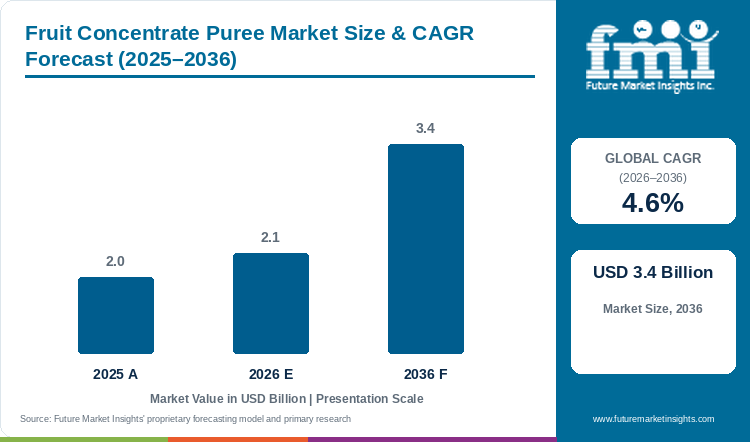
Key Takeaways of Fruit Concentrate Puree Market
- Exotic fruit will hold 28.5% of the fruit family category in 2026. Most sales will come from mango puree, passion fruit, and pineapple profiles.
- Döhler Group, AGRANA Beteiligungs-AG, Tree Top, Kanegrade Limited, Symrise AG, iTi Tropicals, and Andros Group, including many more players are studied for competitive benchmarking in the full report of FMI.
- No added sugar concentrates will account for 65.3% of type revenue in 2026.
- The USA (5.8%) and South Korea (5.2%) will post the fastest CAGRs among profiled countries till 2036, while Japan grows slowest at 3.5%.
- Weather shocks across European fruit origins will keep multi-origin sourcing and firm Brix targets central to supplier selection.
Analyst Perspective
“In my opinion, suppliers with several sourcing regions and application teams close to the customer will secure the next round of reformulation projects.”
- Nandini Roy Choudhury, Principal Consultant, Future Market Insights
How is the Fruit Concentrate Puree Market Segmented?
The fruit concentrate puree market is segmented by Fruit Family, Type, and Region.
The fruit concentrate puree market uses two segment axes with region as the geographic split.
Fruit family covers exotic fruit, tomato, citrus fruit, orange, orchard fruit, berry fruit, apricot, and others.
Type covers no added sugar and with sugar.
Why Does Exotic Fruit Lead the Fruit Family Category?
As per FMI’s analysis, sales of exotic fruit concentrates will lead the fruit family through 2036. Demand for exotic fruits such as mango, passion fruit, pineapple, and guava puree concentrates will stay strong across beverage, dairy, and snack formats. Value sales will overpower volume sales given that concentrates are used in small doses, reflecting the high intensity of flavor and color per unit weight. Buyers will prefer suppliers with direct access to tropical origins.
- Exotic fruit will take 28.5% of fruit family market share in 2026.
- In January 2026, Kanegrade named warm orange and yellow hues among the company’s food and beverage trends for 2026.
Why Does No Added Sugar Lead the Type Category?
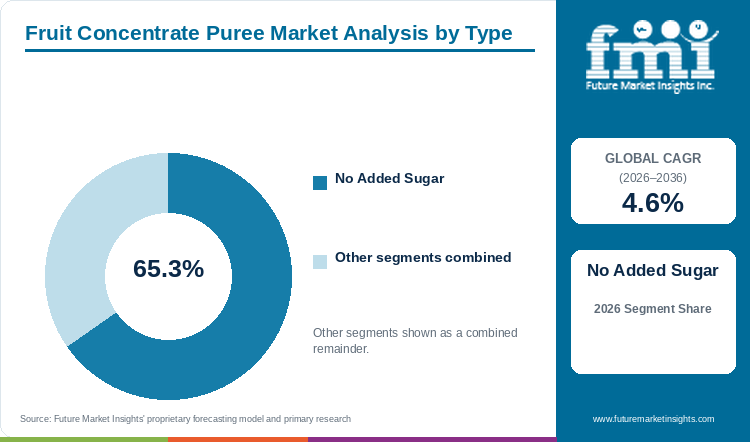
Adoption of no added sugar concentrates will rise among food makers under pressure to cut sugar. As product formulators must justify product labels and demand full control over sugar quantity, demand for no added sugar concentrates will remain high over other types. Such control matters when a yogurt, a snack, or one of many fruit beverages needs to balance fruit solids with other carbohydrates.
- Sales of no added sugar grades will hold 65.3% of type revenue in 2026.
- In July 2026, HM Revenue & Customs published draft legislation proposing a reduction in the Soft Drinks Industry Levy sugar threshold from 5g to 4.5g per 100ml, effective 1 January 2028, subject to parliamentary approval.
What are the Drivers, Restraints, and Opportunities in the Fruit Concentrate Puree Market?
Consumers are increasingly seeking clean-label, nutrient-rich, and natural food and beverage products. Fruit purees offer vitamins, fiber, antioxidants, and natural flavors, aligning with these health-conscious trends.
Expansion in beverages (juices, smoothies, functional drinks), bakery, dairy products, and nutritional supplements is propelling demand for concentrated fruit purees to enhance taste, color, and nutritional value.
- Driver: Emerging markets in Asia-Pacific, Latin America, and parts of the Middle East offer opportunities due to rising disposable incomes, urbanization, and growth in the processed food and beverage sectors.
- Restraint: Sudden fluctuations in fruit prices can affect the cost of production for purees, limiting profitability and potentially restraining market expansion.
- Opportunity: New flavor profiles, functional beverages, and baby food formats are expanding the application base for fruit purees, with organic and exotic varieties supporting premium positioning in developed retail channels.
The fruit concentrate puree market is positioned for growth with strong drivers in health trends, convenience, and industrial adoption. While challenges such as seasonal dependency, price volatility, and regulatory compliance persist, technological adoption, specialty product development, and emerging market expansion present significant opportunities for market players to increase revenue, diversify product offerings, and strengthen global footprint.
Key growth areas include beverages, bakery, dairy, infant nutrition, functional foods, and organic or exotic puree product lines, particularly in high-growth regions such as Asia-Pacific and North America. Concentrate puree will keep more fruit body and texture than clear juice concentrate.
Which Country CAGRs are Profiled in the Fruit Concentrate Puree Market?
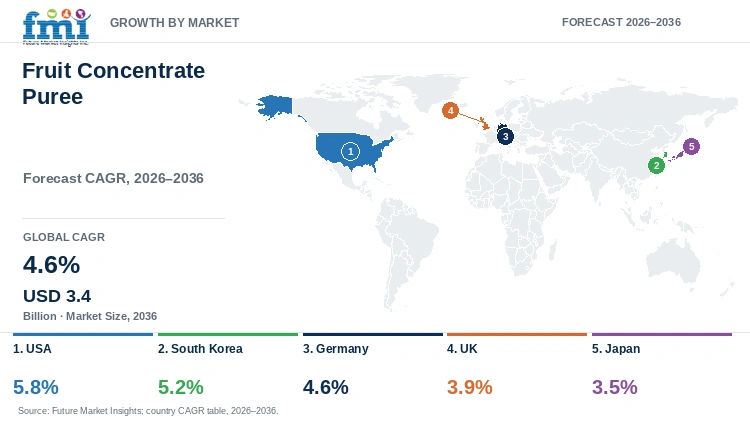
| Country | CAGR, 2026 to 2036 |
|---|---|
| USA | 5.8% |
| South Korea | 5.2% |
| Germany | 4.6% |
| UK | 3.9% |
| Japan | 3.5% |
How Do Country-Level CAGRs Compare?
Country CAGRs for fruit concentrate puree span 2.3 percentage points till 2036, as per FMI. The USA sets the upper end at 5.8%, and Japan sets the lower end at 3.5%. South Korea follows close behind the USA at 5.2%. Germany matches market pace at 4.6%, and the UK stands at 3.9%. Analysts suggest that rates measure growth pace, not market size.
- The USA's 0.6-point edge over South Korea is due to a broad formulation base already in place, and new federal guidance pushing added-sugar cuts.
- Imported processing ingredients dominate South Korea's supply chain.
- Germany's pace tracks the global rate almost exactly owing to its processed-food industry and rising appetite for healthier convenience foods.
- Sugar-discipline incentives from levy changes should be pushing the UK ahead. However, mature buying systems that resist fast supplier switches hold it 0.7 points below Germany instead.
- The market in Japan is estimated at 3.5% CAGR during the forecast period.
Regional CAGR coverage in the full report includes North America, Latin America, Western Europe, Eastern Europe, East Asia, South Asia and Pacific, and the Middle East and Africa, with over 30 countries falling within the report scope.
Country Outlook
- Demand for fruit concentrate puree in the USA will grow at a 5.8% CAGR from 2026 to 2036, the fastest pace among profiled countries. USDA and HHS released the 2025–2030 Dietary Guidelines for Americans in January 2026, recommending no more than 10 grams of added sugar per meal, prompting food manufacturers to review product formulations in response to shifting consumer expectations and retail pressure.
- Growth in South Korea will hold at a 5.2% CAGR till 2036, mainly because the country depends on imports. USDA FAS reported in May 2025 that Korean processors imported USD 16.9 billion worth of basic and intermediate products the year before, with fruit and vegetable juice imports up 25% and concentrates named a top growth area.
- Sales of fruit concentrate puree in Germany will grow at a 4.6% CAGR through 2036, matching the overall market pace. USDA FAS valued Germany's processed food and beverage sector at USD 270.1 billion in March 2026, spread across nearly 5,991 companies, with growing demand for healthy, convenient, and sustainable snacks.
- Demand for fruit concentrate puree in the UK will grow at a 3.9% CAGR over the forecast period, driven mostly by soft drinks policy. HM Revenue & Customs is lowering the sugar levy threshold to 4.5 grams per 100 millilitres starting January 2028, and milk-based drinks will lose their exemption at the same time.
- Sales of fruit concentrate puree in Japan will grow at a steady 3.5% CAGR till 2036, the slowest among profiled countries. USDA FAS valued Japan's food-processing sector at USD 174 billion in 2025, a 3% drop from the year before, even as soft drinks, juices, health foods, and frozen foods all grew, and yogurt kept replacing rice at breakfast.
Who are the Notable Companies in the Fruit Concentrate Puree Market?
Key companies operating in the fruit concentrate puree market include Döhler Group, AGRANA Beteiligungs-AG, Tree Top, Kanegrade Limited, Symrise AG, iTi Tropicals, and Andros Group. Many more players appear in the full FMI report.
Fruit concentrate puree suppliers compete on fruit access, Brix control, and application support, as per FMI. SVZ operates as Döhler Group’s industrial fruit and vegetable ingredients business and is not profiled separately. Several suppliers sell fruit powders, juices, and flavors alongside concentrate purees.
- Integrated Fruit Processing Platforms: Döhler Group, AGRANA Beteiligungs-AG, and Tree Top control fruit sourcing and industrial processing.
- Natural Ingredient and Formulation Specialists: Kanegrade Limited and Symrise AG compete on formulation know-how. Kanegrade supplies purées, concentrates, powders, and pieces.
- Tropical and Foodservice Fruit Specialists: iTi Tropicals and Andros Group serve niche fruit needs.
Competitive Benchmarking
| Company | Concentrate-Puree Portfolio | Fruit Sourcing and Processing Integration | Formulation and Application Support | Geographic Reach |
|---|---|---|---|---|
| Döhler Group | High | High | High | Global, with SVZ processing in Europe and a new plant in Mexico |
| AGRANA Beteiligungs-AG | Medium | High | High | Europe, the Americas and Asia, with AUSTRIA JUICE sites in seven countries |
| Tree Top | High | High | Medium | USA, with plants in Washington, Oregon and California |
| Kanegrade Limited | High | Medium | High | UK base with worldwide ingredient sourcing and supply |
| Symrise AG | Low | High | High | Global natural-ingredient network with tropical dry ingredient processing in Ecuador, producing banana flakes and powders; concentrate-puree sourcing relies on broader supplier network |
| iTi Tropicals | High | Medium | Medium | North America, sourcing from Latin America and Asia |
| Andros Group | Low | Medium | High | France-based group with US foodservice manufacturing |
Scoring basis: Concentrate-Puree Portfolio covers the breadth of documented puree or concentrate-puree offerings for industrial use. Fruit Sourcing and Processing Integration covers documented raw-material sourcing, processing plants, and supply-chain control. Formulation and Application Support covers documented technical help in adapting fruit ingredients to food or beverage recipes. High marks broad, clearly documented capability. Medium marks credible but narrower documented capability. Low marks limited public documentation for that criterion. Geographic Reach reflects evidenced sales, sourcing, or facility activity. FMI set these scores after a September 2026 review of public company documentation.
Key Developments
- In June 2025, Symrise AG completed major upgrades at the company’s Pasaje, Ecuador site.
- In September 2025, SVZ announced the full integration of tropical fruit specialist Netra Agro into the core SVZ portfolio, bringing mango, banana, and pineapple ingredients under a single sourcing and distribution platform, with the process expected to conclude in early 2026.
- In October 2025, AGRANA Beteiligungs-AG completed the purchase of RWA’s 49.99% stake in AUSTRIA JUICE.
Key Players
Integrated Fruit Processing Platforms
- Döhler Group
- AGRANA Beteiligungs-AG
- Tree Top
Natural Ingredient and Formulation Specialists
- Kanegrade Limited
- Symrise AG
Tropical and Foodservice Fruit Specialists
- iTi Tropicals
- Andros Group
Report Scope and Methodology
| Coverage field | Report scope |
|---|---|
| Market breakdown | Fruit Family (Exotic Fruit, Tomato, Citrus Fruit excluding Orange, Orange, Orchard Fruit, Berry Fruit, Apricot, Others). Note: Orange is segmented separately from the broader Citrus Fruit category to reflect distinct demand and sourcing profiles. Type (No Added Sugar, With Sugar), and Region, across 3 categories |
| Quantitative units | USD Billion |
| Market definition | Revenue from industrial fruit concentrate puree sold within the defined Fruit Family and Type categories. Concentrate puree is fruit or vegetable puree with part of the water removed. The scope excludes finished-product revenue, single-strength puree, fruit juice concentrate, NFC juice, fruit powders, frozen whole or cut fruit, and other adjacent substitutes. |
| Regions covered | North America, Latin America, Western Europe, Eastern Europe, East Asia, South Asia and Pacific, Middle East and Africa |
| Countries covered | 30+ countries, including the USA, South Korea, Germany, the UK, and Japan |
| Key companies profiled | Döhler Group, AGRANA Beteiligungs-AG, Tree Top, Kanegrade Limited, Symrise AG, iTi Tropicals, and Andros Group, a few of the notable companies out of many players covered by FMI |
| Forecast period | 2026 to 2036 |
| Approach | FMI applies a hybrid bottom-up and top-down sizing framework that reconciles supplier revenue, fruit-processing volumes and pricing with demand-side food and beverage production indicators. |
Research Methodology
| Method | Approach |
|---|---|
| Primary research | FMI’s primary-research framework engages fruit processors, ingredient distributors, food and beverage formulators, procurement teams and quality specialists to test specification needs, qualification steps, pricing behavior and supply continuity. |
| Desk research | The analysis reviews government statistics, tax and labeling publications, trade reports, company filings, product documentation and dated corporate announcements. FMI retains sources that define demand mechanisms, supplier roles, country conditions or material developments inside the market boundary. |
| Market sizing and forecasting | The sizing framework combines the baseline value with segment structure, pricing and volume indicators, crop conditions, supplier participation and country-level demand. Forecasts consider reformulation activity, sugar policy, processing capacity and purchasing cycles. |
| Data validation | Supplier evidence is triangulated with demand-side indicators, and segment logic is checked against the revenue boundary. Single-strength puree, juice concentrate, powders, finished-product revenue and duplicate channel counting are excluded before final reconciliation. |
Fruit Concentrate Puree Market by Segments
Fruit Concentrate Puree Market Segmented by Fruit Family
- Exotic Fruit
- Tomato
- Others
- Citrus Fruit
- Orange
- Orchard Fruit
- Berry Fruit
- Apricot
Fruit Concentrate Puree Market Segmented by Type
- No Added Sugar
- With Sugar
Fruit Concentrate Puree Market Segmented by Region
- North America
- Latin America
- Western Europe
- Eastern Europe
- East Asia
- South Asia and Pacific
- Middle East and Africa
Research Sources and Bibliography
- SVZ (2025, May 8). Concentrated vs single-strength purees: When, why and how to use both to perfect your products.
- SVZ (2025, July 30). Summer 2025 brings weather challenges, high demand and reasons to hope.
- SVZ (2025, September 24). SVZ expands premium fruit and vegetable ingredient portfolio with integration of tropical fruit specialists Netra Agro.
- SVZ (2026, September 22). Harvest update: Poland’s fruit crops feel the heat this summer.
- Symrise AG (2025, June 19). Symrise strengthens tropical ingredients production with major upgrades to its Ecuadorian facility.
- AGRANA Beteiligungs-AG (2025, May 30). AGRANA resolves to acquire Raiffeisen Ware Austria (RWA) shares in AUSTRIA JUICE GmbH [ad-hoc announcement, EQS]; acquisition of 49.99% stake completed mid-October 2025.
- AGRANA Beteiligungs-AG (2026, May). At a glance & Highlights of 2025|26.
- Kanegrade Limited (2026, January 23). Kanegrade’s Food and Beverage Product Trends for 2026.
- Döhler Group (2026, July 27). Döhler Inaugurates New Plant in Mexico, Strengthening its Growth Strategy in Latin America.
- HM Revenue & Customs (2026, July 13). Changes to the Soft Drinks Industry Levy.
- USDA Foreign Agricultural Service (2025, May 5). South Korea: Food Processing Ingredients Annual.
- USDA Foreign Agricultural Service (2026, March 30). Germany: Food Processing Ingredients Annual.
- USDA Foreign Agricultural Service (2026, April 1). Japan: Food Processing Ingredients Annual.
- Harvard T.H. Chan School of Public Health, The Nutrition Source (2026, January 9). Dietary Guidelines for Americans 2025-2030: Progress on added sugar, protein hype, saturated fat contradictions.
This bibliography is provided for reader reference and is not exhaustive. The full FMI report contains the complete reference list and detailed citations.
This Report Answers
- How big is the Fruit Concentrate Puree Market size in 2026?
- How will sugar-reduction pressures continue to support demand for fruit concentrate puree?
- Why is Exotic Fruit expected to lead within the Fruit Family category in 2026?
- Why are No Added Sugar concentrates capturing significant share within the Type category?
- How do CAGRs differ across the USA, South Korea, Germany, the UK, and Japan till 2036?
- How should buyers assess roles and capabilities of profiled companies?
- How does crop variability across fruit origins limit supplier switching?
- What should food and beverage procurement and product development teams evaluate before selecting a fruit concentrate puree supplier?
Frequently Asked Questions
How Big is the Fruit Concentrate Puree Market Expected to be in 2026?
Fruit concentrate puree market size is estimated at USD 2.1 Billion in 2026 by FMI. Sales reach USD 3.4 Billion by 2036.
What is the CAGR of the Fruit Concentrate Puree Market from 2026 to 2036?
Growth of the fruit concentrate puree market will hold a 4.6% CAGR from 2026 to 2036.
Which Fruit Family Holds the Largest Share of the Fruit Concentrate Puree Market?
Exotic fruit leads with 28.5% of fruit family revenue in 2026. Mango, passion fruit, and pineapple concentrates deliver strong aroma and color at low use levels.
Which Type Leads the Fruit Concentrate Puree Market?
No added sugar concentrates are projected to hold 65.3% of type revenue in 2026. Adoption is higher among food makers facing sugar-reduction pressure.
Which Country is Expected to Grow Fastest in the Fruit Concentrate Puree Market?
Demand in the USA grows at a 5.8% CAGR till 2036, the fastest among profiled countries. South Korea ranks second at 5.2%.
What is the Key Restraint in the Fruit Concentrate Puree Market?
Crop variability forms the main restraint. Weather, harvest timing, and source region shift Brix, color, and taste from one season to the next.
Which are the Key Companies in the Fruit Concentrate Puree Market?
Key companies operating in the fruit concentrate puree market include Döhler Group, AGRANA Beteiligungs-AG, Tree Top, Kanegrade Limited, Symrise AG, iTi Tropicals, and Andros Group.
Preview the report firsthand - request a free sample
Get SampleGet the brochure for pricing and purchase details.
Get PDFTable of Content
- Key Takeaways
- Market Size and CAGR
- Top Growth Driver
- Fastest Growing Segment
- Leading Region
- Key Companies
- Emerging Opportunities
- Executive Summary
- Global Market Outlook
- Demand-side Trends
- Supply-side Trends
- Technology Roadmap Analysis
- Analysis and Recommendations
- Analyst Perspective (What is happening? Why now? What should investors know?)
- Key Questions Answered
- How large is the market?
- What is the CAGR?
- What are key trends?
- Which region dominates?
- Who are the leaders?
- Market Overview
- Market Coverage / Taxonomy
- Market Definition / Scope / Limitations
- Research Methodology
- Chapter Orientation
- Analytical Lens and Working Hypotheses
- Market Structure, Signals, and Trend Drivers
- Benchmarking and Cross-market Comparability
- Market Sizing, Forecasting, and Opportunity Mapping
- Research Design and Evidence Framework
- Desk Research Programme (Secondary Evidence)
- Expert Input and Fieldwork (Primary Evidence)
- Tooling, Models, and Reference Databases
- Data Engineering and Model Build
- Quality Assurance and Audit Trail
- Market Background
- Market Dynamics (Drivers, Restraints, Opportunity, Trends)
- Scenario Forecast (Optimistic, Likely, Conservative)
- Impact Analysis
- AI Impact
- Sustainability Impact
- Regulatory Impact
- Technology Impact
- Consumer / Buyer Analysis
- Purchase Drivers
- Adoption Barriers
- Buyer Journey
- Opportunity Map Analysis
- Product Life Cycle Analysis
- Supply Chain Analysis
- Investment Feasibility Matrix
- Value Chain Analysis
- PESTLE and Porter's Analysis
- Regulatory Landscape
- Regional Parent Market Outlook
- Production and Consumption Statistics
- Import and Export Statistics
- Global Market Analysis and Forecast, 2021 to 2036
- Historical Market Size Value (USD Billion) Analysis, 2021 to 2025
- Current and Future Market Size Value (USD Billion) Projections, 2026 to 2036
- Y-o-Y Growth Trend Analysis
- Absolute $ Opportunity Analysis
- Global Market Pricing Analysis, 2021 to 2036
- Global Market Analysis and Forecast, By Fruit Family, 2021 to 2036
- Introduction / Key Findings
- Historical Market Size Value (USD Billion) Analysis By Fruit Family, 2021 to 2025
- Current and Future Market Size Value (USD Billion) Analysis and Forecast By Fruit Family, 2026 to 2036
- Exotic Fruit
- Tomato
- Others
- Citrus Fruit
- Orange
- Orchard Fruit
- Berry Fruit
- Apricot
- Y-o-Y Growth Trend Analysis By Fruit Family, 2021 to 2025
- Absolute $ Opportunity Analysis By Fruit Family, 2026 to 2036
- Global Market Analysis and Forecast, By Type, 2021 to 2036
- Introduction / Key Findings
- Historical Market Size Value (USD Billion) Analysis By Type, 2021 to 2025
- Current and Future Market Size Value (USD Billion) Analysis and Forecast By Type, 2026 to 2036
- No Added Sugar
- With Sugar
- Y-o-Y Growth Trend Analysis By Type, 2021 to 2025
- Absolute $ Opportunity Analysis By Type, 2026 to 2036
- Global Market Analysis and Forecast, By Region, 2021 to 2036
- Introduction
- Historical Market Size Value (USD Billion) Analysis By Region, 2021 to 2025
- Current Market Size Value (USD Billion) Analysis and Forecast By Region, 2026 to 2036
- North America
- Latin America
- Western Europe
- Eastern Europe
- East Asia
- South Asia and Pacific
- Middle East and Africa
- Market Attractiveness Analysis By Region
- North America Market Analysis and Forecast, By Country, 2021 to 2036
- Historical Market Size Value (USD Billion) Trend Analysis By Market Taxonomy, 2021 to 2025
- Market Size Value (USD Billion) Forecast By Market Taxonomy, 2026 to 2036
- By Country
- By Fruit Family
- By Type
- Market Attractiveness Analysis
- By Country
- By Fruit Family
- By Type
- Key Takeaways
- Latin America Market Analysis and Forecast, By Country
- Historical Market Size Value (USD Billion) Trend Analysis By Market Taxonomy, 2021 to 2025
- Market Size Value (USD Billion) Forecast By Market Taxonomy, 2026 to 2036
- By Country
- By Fruit Family
- By Type
- Market Attractiveness Analysis
- By Country
- By Fruit Family
- By Type
- Key Takeaways
- Western Europe Market Analysis and Forecast, By Country
- Historical Market Size Value (USD Billion) Trend Analysis By Market Taxonomy, 2021 to 2025
- Market Size Value (USD Billion) Forecast By Market Taxonomy, 2026 to 2036
- By Country
- By Fruit Family
- By Type
- Market Attractiveness Analysis
- By Country
- By Fruit Family
- By Type
- Key Takeaways
- Eastern Europe Market Analysis and Forecast, By Country
- Historical Market Size Value (USD Billion) Trend Analysis By Market Taxonomy, 2021 to 2025
- Market Size Value (USD Billion) Forecast By Market Taxonomy, 2026 to 2036
- By Country
- By Fruit Family
- By Type
- Market Attractiveness Analysis
- By Country
- By Fruit Family
- By Type
- Key Takeaways
- East Asia Market Analysis and Forecast, By Country
- Historical Market Size Value (USD Billion) Trend Analysis By Market Taxonomy, 2021 to 2025
- Market Size Value (USD Billion) Forecast By Market Taxonomy, 2026 to 2036
- By Country
- By Fruit Family
- By Type
- Market Attractiveness Analysis
- By Country
- By Fruit Family
- By Type
- Key Takeaways
- South Asia and Pacific Market Analysis and Forecast, By Country
- Historical Market Size Value (USD Billion) Trend Analysis By Market Taxonomy, 2021 to 2025
- Market Size Value (USD Billion) Forecast By Market Taxonomy, 2026 to 2036
- By Country
- By Fruit Family
- By Type
- Market Attractiveness Analysis
- By Country
- By Fruit Family
- By Type
- Key Takeaways
- Middle East and Africa Market Analysis and Forecast, By Country
- Historical Market Size Value (USD Billion) Trend Analysis By Market Taxonomy, 2021 to 2025
- Market Size Value (USD Billion) Forecast By Market Taxonomy, 2026 to 2036
- By Country
- By Fruit Family
- By Type
- Market Attractiveness Analysis
- By Country
- By Fruit Family
- By Type
- Key Takeaways
- Key Countries Market Analysis
- USA
- Pricing Analysis
- Market Share Analysis, 2025
- By Fruit Family
- By Type
- South Korea
- Pricing Analysis
- Market Share Analysis, 2025
- By Fruit Family
- By Type
- Germany
- Pricing Analysis
- Market Share Analysis, 2025
- By Fruit Family
- By Type
- UK
- Pricing Analysis
- Market Share Analysis, 2025
- By Fruit Family
- By Type
- Japan
- Pricing Analysis
- Market Share Analysis, 2025
- By Fruit Family
- By Type
- USA
- Market Structure Analysis
- Competition Dashboard
- Competition Benchmarking
- Market Share Analysis of Top Players
- By Regional
- By Fruit Family
- By Type
- Emerging Startups
- Innovation Benchmarking
- Competition Analysis
- Competition Deep Dive
- Döhler Group
- Overview
- Product Portfolio
- Profitability by Market Segments
- Sales Footprint
- Strategy Overview
- Marketing Strategy
- Product Strategy
- Channel Strategy
- AGRANA Beteiligungs-AG
- Tree Top
- Kanegrade Limited
- Symrise AG
- iTi Tropicals
- Andros Group
- Döhler Group
- Case Studies
- Success Stories
- Recent Developments
- Competition Deep Dive
- Assumptions & Acronyms Used


