

- Market Size (2026)
- USD 7.1 Bn
- Forecast (2036)
- USD 18.2 Bn
- CAGR (2026 to 2036)
- 9.8%
How big is the fuel cell market in 2026?
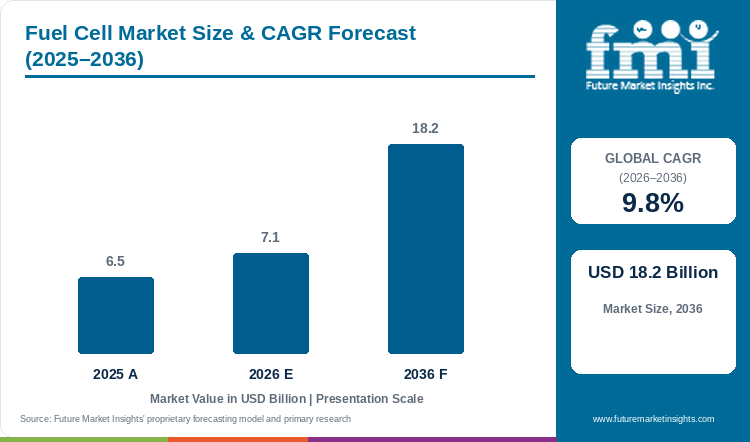
Demand is projected to expand at 9.8% CAGR from 2026 to 2036. Market value rises from USD 6.47 billion in 2025 to USD 7.1 billion in 2026 and USD 18.2 billion by 2036. [1]
FMI values the fuel cell market at USD 7.1 billion in 2026, compared with USD 6.47 billion in 2025, and projects USD 18.2 billion by 2036 at a 9.8% CAGR. [1] Proton exchange membrane fuel cells account for 52.0% by product type and transportation represents 43.0% by application in 2026, leading their respective equipment classifications. [1] Buyers select systems for a defined duty cycle, fuel supply and installation arrangement, with supporting equipment and service completing the operating requirements of the stack or integrated system. IEA's Global Hydrogen Review 2025 reports that low-emissions hydrogen represented less than 1% of global production in 2024, making the production pathway relevant to the emissions profile of hydrogen use. [2] Available fuel also influences installation planning, while announced hydrogen supply capacity and commissioned capacity represent different project stages that need to remain distinct when assessing an equipment purchase. [2] DOE guidance describes PEM systems as operating at relatively low temperatures with comparatively quick start-up, characteristics relevant to assessments involving changing vehicle loads and the intended operating schedule. [3] Transportation installations connect the fuel-cell equipment with a vehicle's utilization, refuelling and maintenance arrangements, whereas stationary and portable systems serve different load and site requirements. China has the fastest profiled growth rate at 12.4% CAGR from 2026 to 2036, within an outlook covering transportation, stationary power and portable power uses. [1] Suppliers can make system selection clearer by defining the stack, supporting equipment and operating tasks together, helping a buyer connect commissioning and ongoing service with the actual installation planned for the duty cycle.
Key Market Trends and Insights
- PEMFC carries 52.0% of the forecast product mix. [1]
- Transportation accounts for 43.0% of application revenue. [1]
- Low-emissions hydrogen remained below 1% of global production in 2024. [2]
Regional Highlights
- Fastest-growing profiled market: China at 12.4% CAGR from 2026 to 2036. [1]
- Hydrogen serves industrial applications as well as fuel cells, and the supply pathway, delivery arrangements and operating load shape the role of fuel-cell equipment in each installation. [2]
Market Size and Forecast
Table 1: Market size and forecast for the fuel cell market in USD billion and percentage
| Metric | Value |
|---|---|
| 2025 market size | USD 6.47 billion |
| Estimated market size in 2026 | USD 7.1 billion |
| Projected market size by 2036 | USD 18.2 billion |
| CAGR 2026 to 2036 | 9.8% |
| Added revenue 2026 to 2036 | USD 11.1 billion |
| Market expansion multiple | 2.6x |
Growth requires delivered systems, suitable fuel and maintenance support. Gas generator sets offer another route to on-site power, while floating power plants serve installations with different location and infrastructure requirements.
Fuel Supply and Chemistry Indicators
The IEA review describes hydrogen production and emissions pathways. DOE guidance explains fuel-cell chemistries and operating characteristics, connecting fuel supply with equipment selection. [2][3]
Table 2: Evidence and adoption indicators for the fuel cell market
| Indicator | Data point or finding | Commercial relevance | Source |
|---|---|---|---|
| Low-emissions hydrogen | Less than 1% of global production in 2024 | Fuel pathway is separate from equipment orders | [2] |
| PEM operating characteristic | Relatively low temperature and quick start-up | Relevant to changing duty cycles | [3] |
| Technology comparison | Chemistries have distinct advantages and challenges | Application-specific selection is necessary | [4] |
Analyst Perspective
"A fuel-cell order follows a workable operating plan for the equipment, the available fuel and the service needed to keep the installation running. Stack performance is one part of that plan, with the balance of the system depending on the load and site. Advanced biofuels provide another energy pathway with its own production and supply conditions. Buyers can assess fuel-cell suitability more clearly when the proposed equipment boundary, commissioning tasks and continuing fuel arrangement are stated together for the intended use."
- Nikhil Kaitwade, Principal Consultant, FMI
How is the fuel cell market segmented?
The market covers 2 commercial axes and region: product type; application.
By product type: Proton exchange membrane fuel cells; Solid oxide fuel cells; Molten carbonate fuel cells; Phosphoric acid fuel cells; Direct methanol fuel cells. By application: Transportation; Stationary power; Portable power.
Why does PEMFC lead demand within the product type category?
The PEMFC segment accounts for 52.0% of product type demand in 2026. [1]
Proton exchange membrane fuel cells operate at relatively low temperatures and offer comparatively quick start-up according to DOE guidance, making those characteristics relevant when a system must respond to changing vehicle loads. [3] A buyer still needs to assess the stack within the complete installation, including supporting equipment, fuel availability and service tasks. CNG tanks and cylinders address a different vehicle fuel-storage option with their own equipment purpose. PEMFC's leading position therefore sits within a system-selection process that connects chemistry and operating characteristics with the intended duty cycle.
- PEMFC systems account for 52.0% of product-type demand in 2026, leading the chemistry mix that also covers solid oxide, molten carbonate, phosphoric acid and direct methanol fuel-cell technologies. [1]
- Low operating temperature and comparatively quick start-up inform PEM system assessment, while supporting equipment, fuel supply and service arrangements determine how the complete installation fits the intended vehicle load and operating schedule. [3]
Table 3: Leading product type share for the fuel cell market
| Product type | Share in 2026 |
|---|---|
| PEMFC | 52.0% |
| Other segments combined | 48.0% |
| Total | 100.0% |
Table 4: Segment leadership and market growth for the fuel cell market
| Metric | Value |
|---|---|
| Global CAGR 2026 to 2036 | 9.8% |
| Leading segment | PEMFC |
Why does transportation lead demand within the application category?
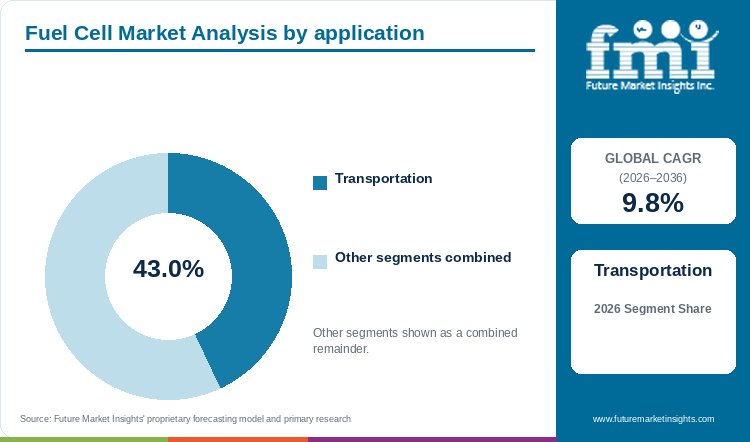
The transportation segment accounts for 43.0% of application demand in 2026. [1]
Transportation applications place a fuel-cell system within a vehicle operating under a defined load and utilization pattern, creating equipment requirements tied to the actual duty cycle. Refuelling access and maintenance arrangements influence whether the system can meet that schedule, while supporting components form part of the complete vehicle installation. Fleet buyers consequently need to assess fuel supply and service together with the equipment being offered. These connected operating needs support transportation's leading share within the application classification, with stationary and portable power representing different uses for fuel-cell technology.
- Transportation accounts for 43.0% of application demand in 2026, holding the leading position within the application classification that also includes stationary power and portable power uses for fuel-cell equipment. [1]
- Fleet utilization, refuelling access and maintenance need to fit the proposed vehicle duty cycle, with the fuel-cell system assessed as one component of an installation that also requires supporting equipment and dependable fuel supply.
What are the drivers restraints and opportunities in the fuel cell market?
- Driver: Vehicle and stationary buyers procure fuel-cell equipment for defined loads and operating schedules, supporting orders when the proposed system, available fuel and service arrangements can work together within a practical installation and commissioning plan for the intended use.
- Restraint: Hydrogen-project barriers and delays can limit the supply arrangements available to a planned installation, while announced capacity remains a different project stage from operating capacity and cannot by itself establish the fuel available for commissioning equipment. [2]
- Opportunity: Suppliers can describe the stack, supporting equipment and operating tasks within one installation plan, giving buyers a clearer basis for commissioning and ongoing service while connecting the equipment boundary with its fuel arrangement and intended duty cycle.
Specific duty cycles create equipment demand
Vehicle and stationary users purchase equipment for defined loads and operating schedules, with system selection bringing those requirements together with the fuel and service arrangements needed to turn a planned installation into a workable equipment order.
Fuel supply and project execution can delay orders
IEA's review identifies barriers and delays across hydrogen projects, keeping announced supply capacity distinct from operating capacity while commissioned fuel-cell installations follow the planning, procurement and execution needed to bring equipment into practical use. [2]
System integration and service can improve project conversion
Documenting the stack, supporting equipment and operating tasks within one installation plan gives suppliers a way to explain commissioning and ongoing service, connecting the stack's technical role with the complete system that the buyer intends to operate.
Which country CAGRs are profiled in the fuel cell market?
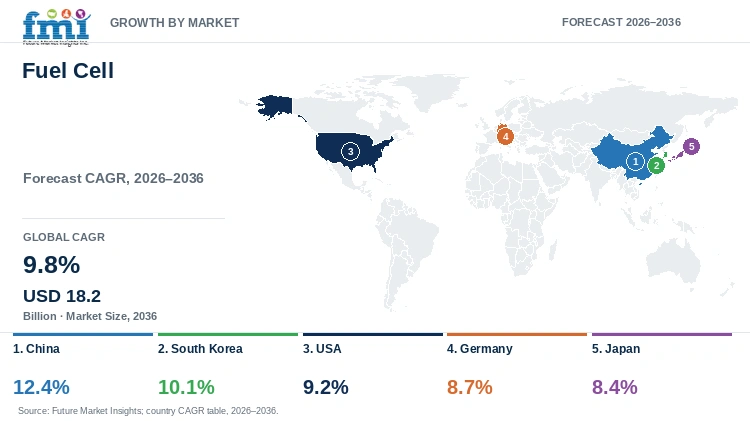
Table 5: Country CAGR comparison for the fuel cell market
| Country | CAGR 2026 to 2036 |
|---|---|
| China | 12.4% |
| South Korea | 10.1% |
| USA | 9.2% |
| Germany | 8.7% |
| Japan | 8.4% |
Country-wise Analysis
China
Commercial-vehicle programmes and the development of refuelling corridors connect China's fuel-cell demand with the practical operation of buses, trucks and other fleet vehicles. [1] A vehicle purchase needs to be matched with available fuel, the route served and the workshop capacity supporting the fleet, because a stack's rated performance alone does not establish usable daily capacity. DOE's description of PEM technology explains the relatively quick start-up and lower operating temperatures relevant to changing transport loads. [3] China records the highest profiled growth rate at 12.4% CAGR from 2026 to 2036 as commercial-vehicle demand connects equipment orders with usable hydrogen infrastructure. [1] Suppliers support fleet selection by defining the stack, controls and supporting equipment within the delivered system, while service and refuelling arrangements help customers assess whether a planned deployment can move beyond a limited demonstration.
South Korea
Power-generation and mobility demand give South Korean fuel-cell suppliers two operating settings, with each requiring a different equipment and maintenance arrangement. [1] A stationary installation is assessed around the electrical load, available fuel and servicing schedule, while a vehicle system also has to fit packaging constraints and repeated changes in demand. The South Korea forecast projects 10.1% CAGR from 2026 to 2036 across these different operating duties. [1] DOE's technology comparison identifies differences in operating temperature, fuel requirements and typical applications, providing a technical basis for comparing the chemistry offered for those duties. [4] Buyers need a defined boundary between the stack and the complete supplied system, including controls and supporting components, so that installation work, operating responsibilities and future maintenance can be assessed against the equipment actually being purchased.
USA
A US buyer comparing transport equipment with a stationary fuel-cell installation faces different requirements for fuel delivery, operating hours and integration with the surrounding system. DOE's comparison of fuel-cell technologies helps relate chemistry and operating characteristics to the intended application, while its PEM guidance explains features relevant to relatively quick start-up. [3][4] These distinctions matter when a fleet operator compares vehicle availability with refuelling capacity or a facility assesses power equipment against a continuing electrical load. The USA outlook records 9.2% CAGR from 2026 to 2036, with procurement involving commissioning and service access as well as the equipment specification. [1] Those arrangements matter because the stack must function with its supporting equipment after installation. Clear system specifications allow buyers to discuss maintenance and fuel requirements with the supplier before committing to the proposed operating schedule.
Germany
German industrial customers assessing hydrogen use need to connect the fuel-cell installation with the energy and operating requirements of the process it will serve. [1] The hydrogen supplied also affects the emissions description: IEA's production review distinguishes production pathways and shows why available hydrogen cannot be treated as having a uniform emissions profile. [2] Germany's outlook projects 8.7% CAGR from 2026 to 2036 within this industrial operating context. [1] For a stationary buyer, the equipment comparison includes load, fuel quality, integration and access for maintenance, while transport users assess the same system alongside vehicle duty and refuelling availability. A planned production project and a commissioned source of fuel provide different levels of operating certainty, making actual supply arrangements relevant to the timing of equipment orders and the responsibilities agreed during commissioning.
Japan
Residential fuel-cell programmes give Japan an installed-system context that differs from markets focused mainly on commercial-vehicle deployment, while mobility applications create another route for equipment demand. [1] A household installation and a vehicle platform have different load patterns, space constraints and service requirements, so their system specifications need to remain tied to the intended use. DOE's technology descriptions provide a basis for comparing those operating characteristics without treating every fuel-cell chemistry as interchangeable. [3] Suppliers also need to define the supporting components and maintenance available after commissioning, especially when an installation is intended for repeated daily operation. Japan's forecast records 8.4% CAGR from 2026 to 2036 as continued demand involves the operating and service needs of existing installations alongside the fuel arrangements supporting additional systems. [1]
Who are the notable companies in the fuel cell market?
Ballard; Bloom Energy; Doosan Fuel Cell; Plug Power; PowerCell Sweden
Competitive Benchmarking
Table 6: Competitive positioning for the fuel cell market
| Company or institution | Positioning | Evidence or purchasing distinction |
|---|---|---|
| Ballard | Fuel-cell stacks and systems | Identify stack versus integrated-system scope [1] |
| Bloom Energy | Stationary fuel-cell systems | Load and fuel arrangement differ from vehicle uses [1] |
| Doosan Fuel Cell | Stationary fuel-cell equipment | Commissioning and service responsibilities [1] |
| Plug Power | Material-handling fuel-cell power | GenDrive provides hydrogen fuel-cell power for material-handling equipment. [5] |
| PowerCell Sweden | Integrated fuel-cell systems | PowerCell Group documents marine fuel-cell system offerings. [6] |
Key Developments in the Fuel Cell Market
- IEA's Global Hydrogen Review 2025 reported that low-emissions hydrogen accounted for less than 1% of global production in 2024, providing supply-pathway context relevant to installation planning and the emissions profile of hydrogen used in fuel cells. [2]
- DOE guidance distinguishes fuel-cell chemistries and their operating characteristics, including the relatively low temperature and comparatively quick start-up of PEM systems, giving equipment buyers a technical basis for assessing a chemistry against the intended application and load. [3]
Key Players in the Fuel Cell Market
Toyota; Hyundai; Ballard; Plug Power; Bloom Energy; FuelCell Energy; PowerCell Sweden; Doosan Fuel Cell; Intelligent Energy; Cummins.
Fuel Cell Market Report Scope
Coverage includes proton exchange membrane, solid oxide, molten carbonate, phosphoric acid and direct methanol systems for transportation, stationary and portable power. Stacks and complete systems have different equipment boundaries; hydrogen supply is an input to the installation.
Table 7: Report coverage for the fuel cell market
| Coverage field | Report scope |
|---|---|
| Market breakdown | Product type; Application; region |
| Quantitative units | USD billion |
| Market definition | Fuel-cell equipment and systems by chemistry and application within the reported scope. General hydrogen production, electrolyzers and all vehicle sales are excluded from the equipment total. |
| Regions covered | North America; Latin America; Western Europe; Eastern Europe; East Asia; South Asia and Pacific; Middle East and Africa |
| Countries profiled | China; South Korea; USA; Germany; Japan |
| Key companies profiled | Toyota; Hyundai; Ballard; Plug Power; Bloom Energy; FuelCell Energy; PowerCell Sweden; Doosan Fuel Cell; Intelligent Energy; Cummins |
| Forecast period | 2026 to 2036 |
Fuel Cell Market Research Methodology
Table 8: Research methods for the fuel cell market
| Method | Approach |
|---|---|
| Market definition | The study examines the fuel cell market through product type and application, identifying the products or services and purchasing transactions covered. |
| Public documentary research | FMI market research, IEA hydrogen-supply analysis, DOE technology guidance and official equipment descriptions inform the analysis of product characteristics, operating conditions and market context. |
| Company portfolio research | Official product pages and company disclosures describe relevant offerings, intended customers and participation within wider business portfolios. |
| Segment assessment | The product type and application categories are examined through product or service characteristics, practical use and purchase conditions. |
| Country research | Local distribution, purchasing arrangements and applicable public requirements inform country analysis alongside the reported market outlook. |
| Regulatory and technical assessment | Fuel-cell chemistry, duty cycle and fuel supply inform equipment assessment, with stack boundaries, supporting components and commissioning considered together in the proposed installation. |
| Forecast coverage | The forecast considers the demand drivers, purchasing constraints and supplier opportunities affecting the market across the study period. |
Fuel Cell Market by Segments
By product type
- Proton exchange membrane fuel cells
- Solid oxide fuel cells
- Molten carbonate fuel cells
- Phosphoric acid fuel cells
- Direct methanol fuel cells
By application
- Transportation
- Stationary power
- Portable power
Fuel Cell Market by Region
- North America
- USA
- Canada
- Latin America
- Brazil
- Mexico
- Argentina
- Chile
- Western Europe
- Germany
- France
- UK
- Italy
- Spain
- Benelux
- Nordics
- Eastern Europe
- Poland
- Czech Republic
- Romania
- Hungary
- East Asia
- China
- Japan
- South Korea
- South Asia and Pacific
- India
- ASEAN
- Australia and New Zealand
- Middle East and Africa
- GCC countries
- South Africa
- Türkiye
- Israel
Research Sources and Bibliography
- [1] Future Market Insights. Published outlook accessed 12 October 2026. Fuel Cell Market.
- [2] International Energy Agency. 2025. Global Hydrogen Review 2025: Production highlights.
- [3] US Department of Energy. Accessed October 2026. Types of Fuel Cells.
- [4] US Department of Energy. Accessed October 2026. Comparison of Fuel Cell Technologies.
- [5] Plug Power. Accessed October 2026. GenDrive Fuel Cell Power.
- [6] PowerCell Group. Accessed October 2026. Hydrogen Fuel Cells.
This Report Answers
- How big is the fuel cell market in 2026?
- What market value is projected by 2036?
- Which product type segment leads demand?
- Which other commercial categories shape the market?
- Which countries have the fastest profiled growth?
- Which companies and institutions participate in the market?
Frequently Asked Questions
How large is the fuel cell market in 2026?
FMI estimates market value at USD 7.1 billion in 2026. The estimated 2025 value is USD 6.47 billion. [1]
What value and CAGR are projected through 2036?
Market value is projected to reach USD 18.2 billion by 2036 at a 9.8% CAGR from 2026 to 2036. [1]
Which product type segment leads in 2026?
PEMFC accounts for 52.0% of this category. [1]
What is the report segmentation?
Product type; Application, and region.
Which profiled market records the highest CAGR?
China has the highest profiled rate at 12.4% from 2026 to 2036. [1]
Who are the key participants?
Toyota; Hyundai; Ballard; Plug Power; Bloom Energy; FuelCell Energy; PowerCell Sweden; Doosan Fuel Cell; Intelligent Energy; Cummins.
Preview the report firsthand - request a free sample
Get SampleGet the brochure for pricing and purchase details.
Get PDFTable of Content
- Key Takeaways
- Market Size and CAGR
- Top Growth Driver
- Fastest Growing Segment
- Leading Region
- Key Companies
- Emerging Opportunities
- Executive Summary
- Global Market Outlook
- Demand-side Trends
- Supply-side Trends
- Technology Roadmap Analysis
- Analysis and Recommendations
- Analyst Perspective (What is happening? Why now? What should investors know?)
- Key Questions Answered
- How large is the market?
- What is the CAGR?
- What are key trends?
- Which region dominates?
- Who are the leaders?
- Market Overview
- Market Coverage / Taxonomy
- Market Definition / Scope / Limitations
- Research Methodology
- Chapter Orientation
- Analytical Lens and Working Hypotheses
- Market Structure, Signals, and Trend Drivers
- Benchmarking and Cross-market Comparability
- Market Sizing, Forecasting, and Opportunity Mapping
- Research Design and Evidence Framework
- Desk Research Programme (Secondary Evidence)
- Expert Input and Fieldwork (Primary Evidence)
- Tooling, Models, and Reference Databases
- Data Engineering and Model Build
- Quality Assurance and Audit Trail
- Market Background
- Market Dynamics (Drivers, Restraints, Opportunity, Trends)
- Scenario Forecast (Optimistic, Likely, Conservative)
- Impact Analysis
- AI Impact
- Sustainability Impact
- Regulatory Impact
- Technology Impact
- Consumer / Buyer Analysis
- Purchase Drivers
- Adoption Barriers
- Buyer Journey
- Opportunity Map Analysis
- Product Life Cycle Analysis
- Supply Chain Analysis
- Investment Feasibility Matrix
- Value Chain Analysis
- PESTLE and Porter's Analysis
- Regulatory Landscape
- Regional Parent Market Outlook
- Production and Consumption Statistics
- Import and Export Statistics
- Global Market Analysis and Forecast, 2021 to 2036
- Historical Market Size Value (USD Billion) Analysis, 2021 to 2025
- Current and Future Market Size Value (USD Billion) Projections, 2026 to 2036
- Y-o-Y Growth Trend Analysis
- Absolute $ Opportunity Analysis
- Global Market Pricing Analysis, 2021 to 2036
- Global Market Analysis and Forecast, By product type, 2021 to 2036
- Introduction / Key Findings
- Historical Market Size Value (USD Billion) Analysis By product type, 2021 to 2025
- Current and Future Market Size Value (USD Billion) Analysis and Forecast By product type, 2026 to 2036
- Proton exchange membrane fuel cells
- Solid oxide fuel cells
- Molten carbonate fuel cells
- Phosphoric acid fuel cells
- Direct methanol fuel cells
- Y-o-Y Growth Trend Analysis By product type, 2021 to 2025
- Absolute $ Opportunity Analysis By product type, 2026 to 2036
- Global Market Analysis and Forecast, By application, 2021 to 2036
- Introduction / Key Findings
- Historical Market Size Value (USD Billion) Analysis By application, 2021 to 2025
- Current and Future Market Size Value (USD Billion) Analysis and Forecast By application, 2026 to 2036
- Transportation
- Stationary power
- Portable power
- Y-o-Y Growth Trend Analysis By application, 2021 to 2025
- Absolute $ Opportunity Analysis By application, 2026 to 2036
- Global Market Analysis and Forecast, By Region, 2021 to 2036
- Introduction
- Historical Market Size Value (USD Billion) Analysis By Region, 2021 to 2025
- Current Market Size Value (USD Billion) Analysis and Forecast By Region, 2026 to 2036
- North America
- Latin America
- Western Europe
- Eastern Europe
- East Asia
- South Asia and Pacific
- Middle East and Africa
- Market Attractiveness Analysis By Region
- North America Market Analysis and Forecast, By Country, 2021 to 2036
- Historical Market Size Value (USD Billion) Trend Analysis By Market Taxonomy, 2021 to 2025
- Market Size Value (USD Billion) Forecast By Market Taxonomy, 2026 to 2036
- By Country
- USA
- Canada
- By product type
- By application
- By Country
- Market Attractiveness Analysis
- By Country
- By product type
- By application
- Key Takeaways
- Latin America Market Analysis and Forecast, By Country
- Historical Market Size Value (USD Billion) Trend Analysis By Market Taxonomy, 2021 to 2025
- Market Size Value (USD Billion) Forecast By Market Taxonomy, 2026 to 2036
- By Country
- Brazil
- Mexico
- Argentina
- Chile
- By product type
- By application
- By Country
- Market Attractiveness Analysis
- By Country
- By product type
- By application
- Key Takeaways
- Western Europe Market Analysis and Forecast, By Country
- Historical Market Size Value (USD Billion) Trend Analysis By Market Taxonomy, 2021 to 2025
- Market Size Value (USD Billion) Forecast By Market Taxonomy, 2026 to 2036
- By Country
- Germany
- France
- UK
- Italy
- Spain
- Benelux
- Nordics
- By product type
- By application
- By Country
- Market Attractiveness Analysis
- By Country
- By product type
- By application
- Key Takeaways
- Eastern Europe Market Analysis and Forecast, By Country
- Historical Market Size Value (USD Billion) Trend Analysis By Market Taxonomy, 2021 to 2025
- Market Size Value (USD Billion) Forecast By Market Taxonomy, 2026 to 2036
- By Country
- Poland
- Czech Republic
- Romania
- Hungary
- By product type
- By application
- By Country
- Market Attractiveness Analysis
- By Country
- By product type
- By application
- Key Takeaways
- East Asia Market Analysis and Forecast, By Country
- Historical Market Size Value (USD Billion) Trend Analysis By Market Taxonomy, 2021 to 2025
- Market Size Value (USD Billion) Forecast By Market Taxonomy, 2026 to 2036
- By Country
- China
- Japan
- South Korea
- By product type
- By application
- By Country
- Market Attractiveness Analysis
- By Country
- By product type
- By application
- Key Takeaways
- South Asia and Pacific Market Analysis and Forecast, By Country
- Historical Market Size Value (USD Billion) Trend Analysis By Market Taxonomy, 2021 to 2025
- Market Size Value (USD Billion) Forecast By Market Taxonomy, 2026 to 2036
- By Country
- India
- ASEAN
- Australia and New Zealand
- By product type
- By application
- By Country
- Market Attractiveness Analysis
- By Country
- By product type
- By application
- Key Takeaways
- Middle East and Africa Market Analysis and Forecast, By Country
- Historical Market Size Value (USD Billion) Trend Analysis By Market Taxonomy, 2021 to 2025
- Market Size Value (USD Billion) Forecast By Market Taxonomy, 2026 to 2036
- By Country
- GCC countries
- South Africa
- Türkiye
- Israel
- By product type
- By application
- By Country
- Market Attractiveness Analysis
- By Country
- By product type
- By application
- Key Takeaways
- Key Countries Market Analysis
- USA
- Pricing Analysis
- Market Share Analysis, 2025
- By product type
- By application
- Canada
- Pricing Analysis
- Market Share Analysis, 2025
- By product type
- By application
- Mexico
- Pricing Analysis
- Market Share Analysis, 2025
- By product type
- By application
- Brazil
- Pricing Analysis
- Market Share Analysis, 2025
- By product type
- By application
- Chile
- Pricing Analysis
- Market Share Analysis, 2025
- By product type
- By application
- Germany
- Pricing Analysis
- Market Share Analysis, 2025
- By product type
- By application
- UK
- Pricing Analysis
- Market Share Analysis, 2025
- By product type
- By application
- Italy
- Pricing Analysis
- Market Share Analysis, 2025
- By product type
- By application
- Spain
- Pricing Analysis
- Market Share Analysis, 2025
- By product type
- By application
- France
- Pricing Analysis
- Market Share Analysis, 2025
- By product type
- By application
- India
- Pricing Analysis
- Market Share Analysis, 2025
- By product type
- By application
- ASEAN
- Pricing Analysis
- Market Share Analysis, 2025
- By product type
- By application
- Australia and New Zealand
- Pricing Analysis
- Market Share Analysis, 2025
- By product type
- By application
- China
- Pricing Analysis
- Market Share Analysis, 2025
- By product type
- By application
- Japan
- Pricing Analysis
- Market Share Analysis, 2025
- By product type
- By application
- South Korea
- Pricing Analysis
- Market Share Analysis, 2025
- By product type
- By application
- Poland
- Pricing Analysis
- Market Share Analysis, 2025
- By product type
- By application
- Hungary
- Pricing Analysis
- Market Share Analysis, 2025
- By product type
- By application
- Türkiye
- Pricing Analysis
- Market Share Analysis, 2025
- By product type
- By application
- South Africa
- Pricing Analysis
- Market Share Analysis, 2025
- By product type
- By application
- USA
- Market Structure Analysis
- Competition Dashboard
- Competition Benchmarking
- Market Share Analysis of Top Players
- By Regional
- By product type
- By application
- Emerging Startups
- Innovation Benchmarking
- Competition Analysis
- Competition Deep Dive
- Ballard
- Overview
- Product Portfolio
- Profitability by Market Segments
- Sales Footprint
- Strategy Overview
- Marketing Strategy
- Product Strategy
- Channel Strategy
- Bloom Energy
- Doosan Fuel Cell
- Plug Power
- PowerCell Sweden
- Ballard
- Case Studies
- Success Stories
- Recent Developments
- Competition Deep Dive
- Assumptions & Acronyms Used


