

- Market Size (2026)
- USD 971.2 Mn
- Forecast (2036)
- USD 1772.4 Mn
- CAGR (2026 to 2036)
- 6.2%
How big is Fuel Cell Gasket Materials Market in 2026?
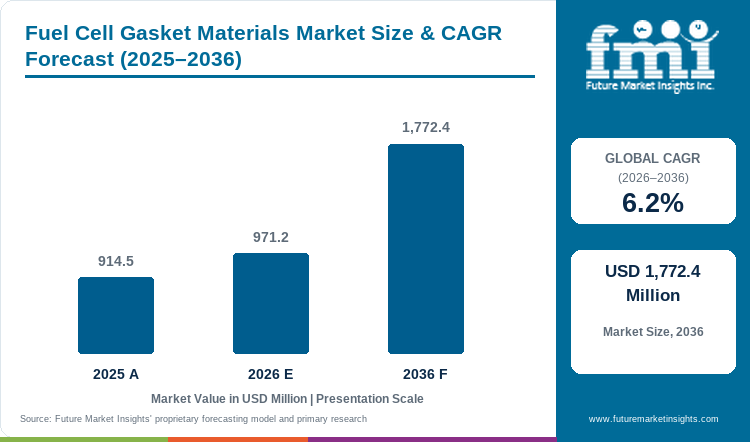
USD 971.2 million in 2026 and USD 1,772.4 million by 2036, expanding at 6.2% CAGR.
Demand for fuel cell gasket materials is projected to expand at 6.2% CAGR from 2026 to 2036. Valuation grows from USD 914.5 million in 2025 to USD 971.2 million in 2026 and reaches USD 1,772.4 million by 2036. Stack teams buy hydrogen sealants for approved seal shapes and compounds. In May 2026, the U.S. Department of Energy modeled 20,000 fuel-cell stacks per year. Series output uses approved seals across many stack builds. Makers keep seal size and material quality stable.
South Korea is projected to grow at 7.2% CAGR through 2036 compared with 5.9% for the USA. Korean bus aid sets national rules for fuel cell electric vehicles. In January 2025, the Ministry of Environment backed 2,000 hydrogen buses and replacement costs for 118 old stacks. US programs cover heavy-duty transport and local power across several stack designs. These programs widen the range of seal tests used for approval. Local support teams keep approved seal processes stable.
Key Takeaways
- Stack scale-up raises demand because approved designs use gas and coolant seals.
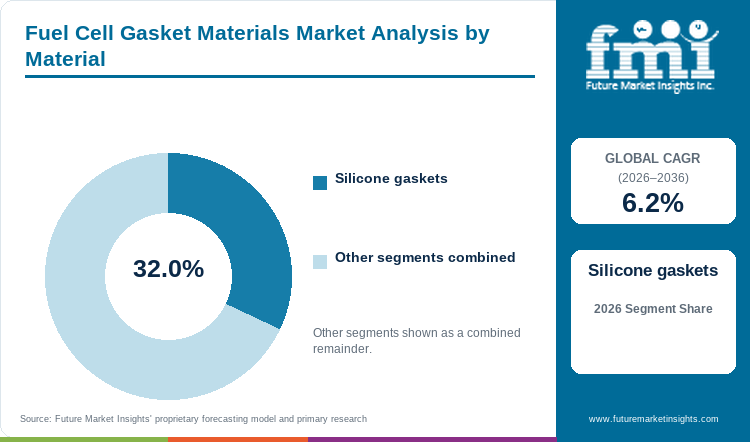
- By material, silicone gaskets are estimated to hold 32.0% in 2026, supported by flexible molding for complex seal shapes.
- In 2026, PEM fuel cells are expected to lead fuel-cell type at 49.0% share, driven by dense gas and coolant sealing.
- By application, stack sealing is forecast to represent 34.0% in 2026, attributable to repeated gas and coolant boundaries.
- Long approval tests constrain material changes because new compounds alter gas loss and pressure.
- Some of the key players in this market include Freudenberg Sealing Technologies, Trelleborg Sealing Solutions, Parker Hannifin, Greene Tweed, DuPont, Saint-Gobain, ElringKlinger, Garlock, Dana Incorporated, and NOK Corporation.
Analyst Perspective
"Seal makers gain recurring orders as stack teams confirm seal life and stable output. Built-in seals cut assembly work, but material changes require the same leak and life tests."
- Nikhil Kaitwade, Principal Consultant, Future Market Insights
How is the fuel cell gasket materials market segmented?
Fuel Cell Gasket Materials Market is segmented by Material, Fuel Cell Type, Application, End Use, Sales Channel, and Region. Forecast period from 2026 to 2036.
The fuel cell gasket materials market is segmented six ways: by Material, Fuel Cell Type, Application, End Use, Sales Channel, and Region. Silicone gaskets lead Material with 32.0% of 2026 revenue, PEM fuel cells lead Fuel Cell Type with 49.0%, and stack sealing leads Application with 34.0%.
Why do silicone gaskets lead material use?
Silicone works in thin seals that need spring-back and simple molding. Teams are molding or dispensing silicone gasket sealants on shaped stack parts. In December 2025, ENGEL showed liquid-silicone overmolding on fuel-cell gas diffusion layers for high-output production.
- By material, silicone gaskets are estimated to hold 32.0% in 2026, enabled by flexible processing for complex seal shapes.
- In December 2025, ENGEL showed liquid silicone molding on fuel-cell layers in a factory process.
Why do PEM fuel cells need many seals?
PEM stacks contain many gas and coolant paths. The seals hold position and keep compounds clean during operation. In May 2026, the U.S. Department of Energy reviewed a 275-kW net heavy-duty system based on PEM fuel cells. The review linked stack design choices with the overall part cost.
- In 2026, PEM fuel cells are expected to lead fuel-cell type with 49.0% share, reinforced by their many precision seals.
- The May 2026 DOE review used a 275-kW net PEM system as its heavy-duty cost case.
Why does stack sealing lead application use?
Stack sealing covers edge and port seals inside each stack. These seals keep fluids and gases within key stack boundaries. In November 2025, Saint-Gobain described frame gaskets for fuel cells and electrolyzers. Its bipolar plate components link low gas loss with stable seal pressure.
- By application, stack sealing is forecast to represent 34.0% in 2026, owing to repeated gas and coolant boundaries.
- Saint-Gobain said in November 2025 that hydrogen frame gaskets need tight size control and stable pressure during cycling.
Why do fuel cell vehicles lead end use?
Vehicle stacks face vibration and changing loads in tight spaces. Cold starts place extra stress on seal materials. In May 2025, Japan chose five priority regions for fuel-cell commercial vehicles. Series builds turn those programs into orders for automotive seals and gaskets.
- Based on end use, fuel cell vehicles are projected to account for 34.0% in 2026, influenced by approved platforms with many seals.
- Japan chose five fuel-cell commercial-vehicle priority regions in May 2025 to build early truck and bus demand.
Why do stack OEMs lead direct sales?
Stack OEMs control seal drawings and approval plans. They choose whether seals stay separate or are molded onto plates. In March 2026, Dana introduced a metallic bipolar plate with a molded elastomer seal. The launch ties gaskets and seals to high-volume series plate production.
- Stack OEMs are set to lead sales channel with 38.0% share in 2026, tied to seal approval and series release.
- Dana introduced a bipolar plate with a molded elastomer seal in March 2026 for high-volume part production.
What are the drivers, restraints and opportunities in the Fuel Cell Gasket Materials Market?
Higher stack output raises qualified seal demand, long validation slows material switching, and integrated sealing can reduce assembly work.
- In the Fuel Cell Gasket Materials Market, the key driver is higher stack output that increases demand for approved gas and coolant seals, the key restraint is stack-specific life and gas-loss testing that limits material changes, and the key opportunity is wider hydrogen adoption across transport and power applications.
- Restraint: Stack-specific life and gas-loss tests constrain material changes because approved seals require renewed qualification.
- Opportunity: Built-in molding removes a placement step and improves seal position across multi-cell stacks.
Stack output converts approved designs into repeated seal orders
Fuel-cell stack output is raising gasket demand as approved designs enter production. Each stack uses approved gas and coolant seals across many cells. In May 2026, the U.S. Department of Energy modeled 20,000 stacks per year. That output requires stable seal size and material quality across long runs. Fuel cell systems rely on the same leak control during service. Seal makers are carrying approved settings from trials into series output. Plant scale converts approved seal content into recurring gasket orders. Stable tooling also limits variation during long runs. Stack makers gain a stable source for service parts and design updates.
Qualification work slows substitution after the stack design is frozen
Fuel-cell gaskets control leaks and stack pressure across approved designs. Late material changes require new tests for gas loss and spring-back. New compounds can change residue levels and assembly force. The H2Coat project began in July 2025 to reduce hydrogen loss with dispensed silicone seals on bipolar plates. The project partners planned performance tests under real fuel-cell operating conditions. Stack teams compare each result with the approved seal before release. Extra qualification keeps proven compounds in use across longer production periods. Tool freeze makes late material changes harder during active series production. The full test program protects field reliability across the stack life.
Integrated sealing can remove handling steps from stack assembly
Built-in sealing moves gasket placement into plate or substrate production. The process removes one handling step and limits seal movement during assembly. In June 2026, Freudenberg described direct overmolding and other hydrogen seal production methods. The same route supports electrolyzer sealants and fuel-cell stacks with many cells. Makers are controlling tools because one defect can affect many parts. Firms managing compound and tool setup can shorten assembly work. They maintain approved leak and life results as production volume grows. Integrated molding reduces manual seal placement across high-output fuel-cell production lines. Stable tooling protects stack yield across long and steady production runs.
Which country CAGRs are profiled in the Fuel Cell Gasket Materials Market?
| Country | CAGR |
|---|---|
| South Korea | 7.2% |
| Mexico | 6.9% |
| Japan | 6.6% |
| Canada | 6.2% |
| USA | 5.9% |
| Germany | 5.5% |
| France | 5.2% |
How do country-level CAGRs compare in the Fuel Cell Gasket Materials Market?
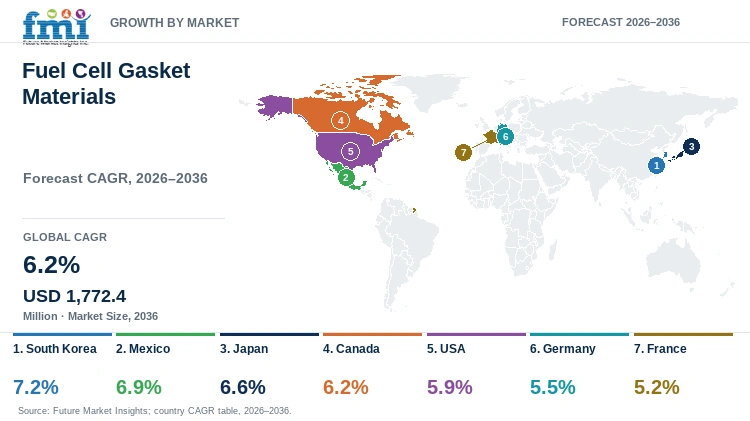
Within the Fuel Cell Gasket Materials Market, South Korea is projected to grow at 7.2% CAGR through 2036, followed by Mexico at 6.9%, Japan at 6.6%, Canada at 6.2%, the USA at 5.9%, Germany at 5.5%, and France at 5.2%.
- South Korea is projected at 7.2% CAGR, driven by bus funding tied to stack performance and service.
- Mexico is forecast at 6.9% CAGR, enabled by local conversion support for imported stack designs.
- Japan is projected at 6.6% CAGR, shaped by priority regions that group truck and bus demand.
- Canada is estimated at 6.2% CAGR, supported by hydrogen hubs linking fuel-cell firms with fleets and plants.
- The USA is forecast at 5.9% CAGR, influenced by truck and power programs with several seal approval routes.
- Germany is projected at 5.5% CAGR, reinforced by an automotive parts base that supports long stack tests.
- France is expected at 5.2% CAGR, tied to public support for selected fuel-cell production projects.
Similar CAGRs can produce different entry terms because approval routes and stack programs vary.
The full report provides country-level CAGR analysis across North America, Latin America, Western Europe, Eastern Europe, East Asia, South Asia and Pacific, and the Middle East and Africa.
Country-wise Analysis
- Fuel cell gasket demand in the USA is predicted to advance at 5.9% CAGR through 2036, influenced by stack output. Heavy-duty transport and local power programs create several seal approval routes. In May 2026, the U.S. Department of Energy put capacity below 2,000 stacks per year. Its case reached 20,000 stacks per year for near-term production. Seal makers build tools and quality checks across trial and series production. Program dates can delay production volume despite completed seal approval work. Local design support keeps approved seal processes stable across stack programs. Local stock reduces delays across scheduled production and service work.
- Fuel cell gasket material sales in Germany are forecast to expand at 5.5% CAGR by 2036, supported by bus programs. German stack programs use a mature auto parts base and strict quality checks. In May 2026, the federal transport ministry opened support for at least 1,500 zero-emission buses. Fuel-cell buses qualify for national support under that program. Seal makers meet traceability rules and change controls before series tooling starts. Project cost can delay volume despite completed technical approval. Local design teams reduce rework as stack makers change seal rules. Local stock protects bus build schedules across production and service runs.
- Japan is estimated to post 6.6% CAGR over the forecast period, shaped by truck and bus projects. Japanese stack teams focus on seal size and local support during qualification. In May 2025, METI chose five priority regions and six core local governments for fuel-cell commercial vehicles. The plan gives parts firms clearer local routes for testing and service. Large orders can take longer beyond local trials. Seal makers use clean compounds and tight molding control for domestic OEM rules. Local engineers resolve tool issues before full vehicle production begins. Their support shortens the move from trial parts to series production.
- Adoption of fuel cell gasket materials in South Korea is estimated to expand at 7.2% CAGR through 2036, driven by bus demand. National bus programs link vehicle aid with field results and stack service. In January 2025, the Ministry of Environment covered replacement costs for 118 out-of-warranty fuel-cell stacks. The rule extends seal demand beyond each vehicle's first sale. Seal makers prove long service life and respond to field faults. Local OEM and converter support improves repair access and later program participation. Service records help teams compare seal performance across fleets. Local service protects bus uptime and later fleet orders.
- Canada is estimated to post 6.2% CAGR over the forecast period, supported by hubs linking firms with fleets and plants. Canadian demand clusters near regional hydrogen firms instead of one national vehicle platform. In June 2025, PacifiCan said British Columbia held over half of Canada's hydrogen firms and counted 1,350 full-time workers. Hydrogen storage tanks and stack parts share test and service skills. Long travel distances can slow design support outside the main hubs. Seal makers use small trial runs until larger projects justify dedicated tooling. Local stock reduces delays as projects move into regular use. Regional support helps smaller production runs reach steady commercial output.
- France is projected to grow at 5.2% CAGR by 2036, reinforced by programs for stack and parts output. French hydrogen policy backs selected equipment projects and ties support to plant goals. In April 2025, the government said it supported more than 150 hydrogen projects and about 20 key equipment projects. Fuel-cell production formed part of that national plan. Project cost can delay investments despite public support. Seal makers align account plans with approved projects before new tool commitments. Close work with stack firms limits tooling spend on projects lacking series demand. Focused account plans protect capacity for projects with firmer production schedules.
- Fuel cell gasket material demand in Mexico is forecast to rise at 6.9% CAGR, enabled by local clean-energy rules. Mexican demand is beginning with imported stack designs and local assembly. In August 2025, the National Energy Commission said fuel-cell power can count as clean energy under set rules. Hydrogen supply and local standards vary across regions. Seal makers are pairing proven compounds with local cutting or molding to reduce risk. Local conversion limits tooling spend until demand reaches steady production volume. Local service helps imported designs move from trials into regular plant orders. That support also helps teams manage design changes during assembly.
Who are the notable companies in the Fuel Cell Gasket Materials Market?
Freudenberg Sealing Technologies, Trelleborg Sealing Solutions, Parker Hannifin, Greene Tweed, DuPont, Saint-Gobain, ElringKlinger, Garlock, Dana Incorporated, and NOK Corporation
Competition includes stack-part firms, seal specialists, and material makers. Stack-part firms combine gasket design with plate work. Seal specialists provide several compound choices and technical hydrogen test support. Material makers supply PTFE, graphite, and elastomer routes for stack needs. Entry requires proof for the exact stack duty and service conditions.
- Freudenberg Sealing Technologies, ElringKlinger, Dana Incorporated, and NOK Corporation make seals part of stack or plate work.
- Trelleborg Sealing Solutions, Parker Hannifin, and Greene Tweed focus on seal materials and use tests.
- DuPont, Saint-Gobain, and Garlock supply high-performance gasket materials for hydrogen use.
Competitive Benchmarking: Fuel Cell Gasket Materials Market
| Company | Fuel-Cell Seal Integration | Hydrogen-Compatible Material Breadth | OEM Co-Engineering and Scale-Up | Geographic Reach |
|---|---|---|---|---|
| Freudenberg Sealing Technologies | High | High | High | Global |
| Trelleborg Sealing Solutions | Medium | High | High | Global |
| Parker Hannifin | Medium | High | High | Global |
| Greene Tweed | Medium | High | Medium | North America, Europe, Asia |
| DuPont | Low | High | Medium | Global |
| Saint-Gobain | Low | High | Medium | Global |
| ElringKlinger | High | Medium | High | Europe, Asia, North America |
| Garlock | Low | High | Medium | Americas, Europe, Asia |
| Dana Incorporated | High | Medium | High | Global |
| NOK Corporation | High | High | High | Asia with global support |
Scoring basis: High requires proof of built-in seals or several approved material routes. Medium covers fewer proven routes, while Low marks firms with narrow exact-market proof. Geographic reach lists the regions each company serves.
Key Developments in the Fuel Cell Gasket Materials Market
- In October 2025, Freudenberg Sealing Technologies expanded hydrogen-seal output at its Manchester site in New Hampshire.
- In January 2025, Trelleborg Sealing Solutions debuted FlexiBond for electrolyzers and fuel cells.
- In January 2025, Greene Tweed launched Arlon 3160XT for fuel-cell and electrolyzer parts.
Key Players in the Fuel Cell Gasket Materials Market
Integrated stack-sealing and plate engineering
- Freudenberg Sealing Technologies
- ElringKlinger
- Dana Incorporated
- NOK Corporation
Engineered hydrogen sealing
- Trelleborg Sealing Solutions
- Parker Hannifin
- Greene Tweed
High-performance material platforms
- DuPont
- Saint-Gobain
- Garlock
Fuel Cell Gasket Materials Market - Report Scope
| Coverage field | Report scope |
|---|---|
| Market breakdown | By material, fuel cell type, application, end use, sales channel, and region. |
| Quantitative Units | USD million. |
| Market Definition | Materials and converted gasket systems used to seal gas, coolant, and compression interfaces in fuel-cell stacks and related assemblies. |
| Regions Covered | North America, Latin America, Western Europe, Eastern Europe, East Asia, South Asia and Pacific, and Middle East and Africa. |
| Countries Covered | South Korea, Mexico, Japan, Canada, USA, Germany, France, and 20+ countries included in the full report. |
| Key Companies Profiled | Freudenberg Sealing Technologies, Trelleborg Sealing Solutions, Parker Hannifin, Greene Tweed, DuPont, Saint-Gobain, ElringKlinger, Garlock, Dana Incorporated, and NOK Corporation. |
| Forecast Period | 2026 to 2036. |
| Approach | Primary and secondary research with market triangulation. |
Fuel Cell Gasket Materials Market - Research Methodology
| Method | Approach |
|---|---|
| Primary Research | FMI analysts gathered input from manufacturers, service providers, technology developers, distributors, end users, procurement teams, and subject-matter experts. Interviews examined purchasing decisions, product or service evaluation, adoption barriers, approval requirements, pricing considerations, and expectations for technical or commercial support. Respondents were also asked what evidence is required before a trial, pilot, or initial order develops into regular purchasing. |
| Desk Research | Desk research covered government statistics, regulatory publications, trade data, industry associations, technical literature, standards, company filings, product information, and official corporate announcements. Sources were reviewed for relevance, publication date, geographic coverage, and consistency with the defined market scope. Claims relating to performance, applications, approvals, capacity, investment, and commercial activity were retained only when supported by credible public evidence. |
| Market Sizing and Forecasting | The market model combined the baseline value with historical performance, segment structure, pricing and volume indicators, adoption levels, company participation, and country-level demand conditions. Forecast assumptions considered economic activity, investment trends, regulatory developments, technology adoption, purchasing cycles, supply availability, and barriers to wider market use. Segment and regional estimates were reconciled before the final market total was calculated. |
| Data Validation | Estimates were checked against multiple independent indicators, including public data, company activity, trade patterns, industry developments, and findings from primary interviews. Validation also tested whether products, services, applications, and company revenues fell within the defined market boundaries. Adjacent categories, unsupported claims, overlapping revenues, and activities without direct market relevance were excluded to reduce double counting and maintain consistency across segments and countries. |
Fuel Cell Gasket Materials Market by Segments
Fuel Cell Gasket Materials Market segmented by Material:
- Silicone gaskets
- EPDM gaskets
- Fluoroelastomer gaskets
- PTFE gaskets
- Graphite composite gaskets
Fuel Cell Gasket Materials Market segmented by Fuel Cell Type:
- PEM fuel cells
- SOFC systems
- DMFC systems
- AFC - AEM systems
- Stationary stacks
Fuel Cell Gasket Materials Market segmented by Application:
- Stack sealing
- Bipolar plate sealing
- Manifold sealing
- Cooling loop sealing
- Hydrogen sealing
Fuel Cell Gasket Materials Market segmented by End Use:
- Fuel cell vehicles
- Stationary power
- Material handling
- Backup power
- Marine - rail pilots
Fuel Cell Gasket Materials Market segmented by Sales Channel:
- Stack OEMs
- Gasket converters
- Material distributors
- Custom molders
Fuel Cell Gasket Materials Market by Region:
- North America
- United States
- Canada
- Latin America
- Brazil
- Mexico
- Chile
- Rest of Latin America
- Western Europe
- Germany
- United Kingdom
- Italy
- Spain
- France
- Nordics
- Benelux
- Rest of Western Europe
- Eastern Europe
- Russia
- Poland
- Hungary
- Balkan and Baltic States
- Rest of Eastern Europe
- East Asia
- China
- Japan
- South Korea
- South Asia and Pacific
- India
- ASEAN
- Australia and New Zealand
- Rest of South Asia and Pacific
- Middle East and Africa
- Kingdom of Saudi Arabia
- Other GCC Countries
- Türkiye
- South Africa
- Other African Union Countries
- Rest of Middle East and Africa
Research Sources and Bibliography
- U.S. Department of Energy. (2026, May 14). 2030 fuel cell stack manufacturing capacities.U.S. Department of Energy
- Ministry of Environment, Republic of Korea. (2025, January 1). Early finalization of the 2025 hydrogen vehicle subsidy guidelines.Ministry of Environment, Republic of Korea
- ENGEL. (2025, December 31). Vertical efficiency for LSR processes: How the ENGEL insert halves cycle times and maximizes quality.
- U.S. Department of Energy. (2026, May 14). Heavy-duty fuel cell system cost - 2024.U.S. Department of Energy
- Saint-Gobain Tape Solutions. (2025, November 26). Why skived films outperform in hydrogen gasketing.
- Ministry of Economy, Trade and Industry, Japan. (2025, May 19). First selection of priority regions for promoting the deployment of fuel-cell commercial vehicles.Ministry of Economy, Trade and Industry, Japan
- Reinz-Dichtungs-GmbH / Dana Incorporated. (2026, March 5). Dana metallic bipolar plate accelerates cost-efficient green hydrogen.
- Zentrum für BrennstoffzellenTechnik GmbH. (2025, July). H2Coat - Special coating for silicone seals in fuel cells to reduce permeation.
- Freudenberg Sealing Technologies. (2026, June 30). New production methods for seals in the hydrogen and electrolyzers sector.
- Federal Ministry of Transport, Germany. (2026, May 21). Federal support for zero-emission buses.
- Pacific Economic Development Canada. (2025, June 5). Government of Canada invests in British Columbia’s hydrogen and fuel cell sector.
- Government of France. (2025, April 16). National hydrogen strategy update.
- National Energy Commission, Mexico. (2025, August 22). Clean energy certificates: Frequently asked questions.
- Freudenberg Sealing Technologies. (2025, October 31). Hydrogen as a key technology.
- Trelleborg Sealing Solutions. (2025, January 21). Trelleborg showcases proven hydrogen solutions at Hyvolution 2025.
- Greene Tweed. (2025, January 16). Greene Tweed unveils Arlon 3160XT for hydrogen applications.
- NOK Corporation. (2026, June 30). Next-gen seal technology for a hydrogen society presented at international symposium.
- Parker Hannifin. (2025, October). Your one-stop-shop for hydrogen solutions at Hydrogen Technology Expo 2025.
- Garlock Europe. (2025, August). Hydrogen Technology Expo Europe 2025 announcement.
- Freudenberg Sealing Technologies. (2025, July 25). The transformation continues - Moving from combustion engines to innovative e-mobility solutions.
- Trelleborg Sealing Solutions. (2025, May 13). Trelleborg showcases proven hydrogen solutions at Hydrogen Expo 2025.
- Parker Hannifin. (2025, June). Hydrogen Technology Expo North America 2025.
- Greene Tweed. (2026, September 3). Greene Tweed adds cryogenic leak and supercritical CO2 capabilities to testing portfolio.
- DuPont. (2026, June). New research for evaluating lubricants in fuel cell electric vehicles featured in the Hydrogen journal.
- Saint-Gobain Tape Solutions. (2026, January). Hyvolution Paris 2026.
- ElringKlinger. (2025, September 8). The heart of hydrogen mobility: EKPO showcases its high-performance NM12-single stack for automotive applications at IAA Mobility.
- Garlock Europe. (2025, May). Hydrogen Expo 2025 participation in Piacenza.
- NOK Corporation. (2026, March 10). NOK to exhibit at BATTERY JAPAN.
- ElringKlinger. (2026, September 14). A new milestone for heavy-duty transportation: EKPO unveils its next-generation NM20 stack at IAA Transportation 2026.
This bibliography is provided for reader reference and is not exhaustive. The full report contains the complete reference list and detailed citations.
This Report Answers
- What are the 2026 and 2036 values?
- What turns stack output into gasket orders?
- Why do silicone gaskets hold 32.0%?
- How do PEM fuel cells affect seals?
- Why does stack sealing hold 34.0%?
- How do country CAGRs compare?
- What slows seal changes after approval?
- Which companies serve key roles?
Frequently Asked Questions
How big is the fuel cell gasket materials market in 2026?
The fuel cell gasket materials market is valued at USD 971.2 million in 2026. It is projected to reach USD 1,772.4 million by 2036 as approved stack output grows.
What CAGR is projected for the fuel cell gasket materials market from 2026 to 2036?
The fuel cell gasket materials market is projected to grow at 6.2% CAGR from 2026 to 2036. Series output turns approved seal designs and tools into regular orders for stack makers.
Which material holds the reported 32.0% share in 2026?
Silicone gaskets are expected to hold 32.0% of material revenue in 2026. Their molding range supports thin seals and complex stack shapes during series output.
Which fuel cell type holds the reported 49.0% share in 2026?
PEM fuel cells are projected to account for 49.0% of fuel-cell-type revenue in 2026. Their many gas and coolant paths require precise seal placement and clean compounds.
Which companies are active in the fuel cell gasket materials market?
Notable companies in the Fuel Cell Gasket Materials Market include Freudenberg Sealing Technologies, Trelleborg Sealing Solutions, Parker Hannifin, Greene Tweed, DuPont, Saint-Gobain, ElringKlinger, Garlock, Dana Incorporated, and NOK Corporation.
Preview the report firsthand - request a free sample
Get SampleGet the brochure for pricing and purchase details.
Get PDFTable of Content
- Key Takeaways
- Market Size and CAGR
- Top Growth Driver
- Fastest Growing Segment
- Leading Region
- Key Companies
- Emerging Opportunities
- Executive Summary
- Global Market Outlook
- Demand-side Trends
- Supply-side Trends
- Technology Roadmap Analysis
- Analysis and Recommendations
- Analyst Perspective (What is happening? Why now? What should investors know?)
- Key Questions Answered
- How large is the market?
- What is the CAGR?
- What are key trends?
- Which region dominates?
- Who are the leaders?
- Market Overview
- Market Coverage / Taxonomy
- Market Definition / Scope / Limitations
- Research Methodology
- Chapter Orientation
- Analytical Lens and Working Hypotheses
- Market Structure, Signals, and Trend Drivers
- Benchmarking and Cross-market Comparability
- Market Sizing, Forecasting, and Opportunity Mapping
- Research Design and Evidence Framework
- Desk Research Programme (Secondary Evidence)
- Expert Input and Fieldwork (Primary Evidence)
- Tooling, Models, and Reference Databases
- Data Engineering and Model Build
- Quality Assurance and Audit Trail
- Market Background
- Market Dynamics (Drivers, Restraints, Opportunity, Trends)
- Scenario Forecast (Optimistic, Likely, Conservative)
- Impact Analysis
- AI Impact
- Sustainability Impact
- Regulatory Impact
- Technology Impact
- Consumer / Buyer Analysis
- Purchase Drivers
- Adoption Barriers
- Buyer Journey
- Opportunity Map Analysis
- Product Life Cycle Analysis
- Supply Chain Analysis
- Investment Feasibility Matrix
- Value Chain Analysis
- PESTLE and Porter's Analysis
- Regulatory Landscape
- Regional Parent Market Outlook
- Production and Consumption Statistics
- Import and Export Statistics
- Global Market Analysis and Forecast, 2021 to 2036
- Historical Market Size Value (USD Million) Analysis, 2021 to 2025
- Current and Future Market Size Value (USD Million) Projections, 2026 to 2036
- Y-o-Y Growth Trend Analysis
- Absolute $ Opportunity Analysis
- Global Market Pricing Analysis, 2021 to 2036
- Global Market Analysis and Forecast, By Material, 2021 to 2036
- Introduction / Key Findings
- Historical Market Size Value (USD Million) Analysis By Material, 2021 to 2025
- Current and Future Market Size Value (USD Million) Analysis and Forecast By Material, 2026 to 2036
- Silicone gaskets
- EPDM gaskets
- Fluoroelastomer gaskets
- PTFE gaskets
- Graphite composite gaskets
- Y-o-Y Growth Trend Analysis By Material, 2021 to 2025
- Absolute $ Opportunity Analysis By Material, 2026 to 2036
- Global Market Analysis and Forecast, By Fuel Cell Type, 2021 to 2036
- Introduction / Key Findings
- Historical Market Size Value (USD Million) Analysis By Fuel Cell Type, 2021 to 2025
- Current and Future Market Size Value (USD Million) Analysis and Forecast By Fuel Cell Type, 2026 to 2036
- PEM fuel cells
- SOFC systems
- DMFC systems
- AFC - AEM systems
- Stationary stacks
- Y-o-Y Growth Trend Analysis By Fuel Cell Type, 2021 to 2025
- Absolute $ Opportunity Analysis By Fuel Cell Type, 2026 to 2036
- Global Market Analysis and Forecast, By Application, 2021 to 2036
- Introduction / Key Findings
- Historical Market Size Value (USD Million) Analysis By Application, 2021 to 2025
- Current and Future Market Size Value (USD Million) Analysis and Forecast By Application, 2026 to 2036
- Stack sealing
- Bipolar plate sealing
- Manifold sealing
- Cooling loop sealing
- Hydrogen sealing
- Y-o-Y Growth Trend Analysis By Application, 2021 to 2025
- Absolute $ Opportunity Analysis By Application, 2026 to 2036
- Global Market Analysis and Forecast, By End Use, 2021 to 2036
- Introduction / Key Findings
- Historical Market Size Value (USD Million) Analysis By End Use, 2021 to 2025
- Current and Future Market Size Value (USD Million) Analysis and Forecast By End Use, 2026 to 2036
- Fuel cell vehicles
- Stationary power
- Material handling
- Backup power
- Marine - rail pilots
- Y-o-Y Growth Trend Analysis By End Use, 2021 to 2025
- Absolute $ Opportunity Analysis By End Use, 2026 to 2036
- Global Market Analysis and Forecast, By Sales Channel, 2021 to 2036
- Introduction / Key Findings
- Historical Market Size Value (USD Million) Analysis By Sales Channel, 2021 to 2025
- Current and Future Market Size Value (USD Million) Analysis and Forecast By Sales Channel, 2026 to 2036
- Stack OEMs
- Gasket converters
- Material distributors
- Custom molders
- Y-o-Y Growth Trend Analysis By Sales Channel, 2021 to 2025
- Absolute $ Opportunity Analysis By Sales Channel, 2026 to 2036
- Global Market Analysis and Forecast, By Region, 2021 to 2036
- Introduction
- Historical Market Size Value (USD Million) Analysis By Region, 2021 to 2025
- Current Market Size Value (USD Million) Analysis and Forecast By Region, 2026 to 2036
- North America
- Latin America
- Western Europe
- Eastern Europe
- East Asia
- South Asia and Pacific
- Middle East and Africa
- Market Attractiveness Analysis By Region
- North America Market Analysis and Forecast, By Country, 2021 to 2036
- Historical Market Size Value (USD Million) Trend Analysis By Market Taxonomy, 2021 to 2025
- Market Size Value (USD Million) Forecast By Market Taxonomy, 2026 to 2036
- By Country
- United States
- Canada
- By Material
- By Fuel Cell Type
- By Application
- By End Use
- By Sales Channel
- By Country
- Market Attractiveness Analysis
- By Country
- By Material
- By Fuel Cell Type
- By Application
- By End Use
- By Sales Channel
- Key Takeaways
- Latin America Market Analysis and Forecast, By Country
- Historical Market Size Value (USD Million) Trend Analysis By Market Taxonomy, 2021 to 2025
- Market Size Value (USD Million) Forecast By Market Taxonomy, 2026 to 2036
- By Country
- Brazil
- Mexico
- Chile
- Rest of Latin America
- By Material
- By Fuel Cell Type
- By Application
- By End Use
- By Sales Channel
- By Country
- Market Attractiveness Analysis
- By Country
- By Material
- By Fuel Cell Type
- By Application
- By End Use
- By Sales Channel
- Key Takeaways
- Western Europe Market Analysis and Forecast, By Country
- Historical Market Size Value (USD Million) Trend Analysis By Market Taxonomy, 2021 to 2025
- Market Size Value (USD Million) Forecast By Market Taxonomy, 2026 to 2036
- By Country
- Germany
- United Kingdom
- Italy
- Spain
- France
- Nordics
- Benelux
- Rest of Western Europe
- By Material
- By Fuel Cell Type
- By Application
- By End Use
- By Sales Channel
- By Country
- Market Attractiveness Analysis
- By Country
- By Material
- By Fuel Cell Type
- By Application
- By End Use
- By Sales Channel
- Key Takeaways
- Eastern Europe Market Analysis and Forecast, By Country
- Historical Market Size Value (USD Million) Trend Analysis By Market Taxonomy, 2021 to 2025
- Market Size Value (USD Million) Forecast By Market Taxonomy, 2026 to 2036
- By Country
- Russia
- Poland
- Hungary
- Balkan and Baltic States
- Rest of Eastern Europe
- By Material
- By Fuel Cell Type
- By Application
- By End Use
- By Sales Channel
- By Country
- Market Attractiveness Analysis
- By Country
- By Material
- By Fuel Cell Type
- By Application
- By End Use
- By Sales Channel
- Key Takeaways
- East Asia Market Analysis and Forecast, By Country
- Historical Market Size Value (USD Million) Trend Analysis By Market Taxonomy, 2021 to 2025
- Market Size Value (USD Million) Forecast By Market Taxonomy, 2026 to 2036
- By Country
- China
- Japan
- South Korea
- By Material
- By Fuel Cell Type
- By Application
- By End Use
- By Sales Channel
- By Country
- Market Attractiveness Analysis
- By Country
- By Material
- By Fuel Cell Type
- By Application
- By End Use
- By Sales Channel
- Key Takeaways
- South Asia and Pacific Market Analysis and Forecast, By Country
- Historical Market Size Value (USD Million) Trend Analysis By Market Taxonomy, 2021 to 2025
- Market Size Value (USD Million) Forecast By Market Taxonomy, 2026 to 2036
- By Country
- India
- ASEAN
- Australia and New Zealand
- Rest of South Asia and Pacific
- By Material
- By Fuel Cell Type
- By Application
- By End Use
- By Sales Channel
- By Country
- Market Attractiveness Analysis
- By Country
- By Material
- By Fuel Cell Type
- By Application
- By End Use
- By Sales Channel
- Key Takeaways
- Middle East and Africa Market Analysis and Forecast, By Country
- Historical Market Size Value (USD Million) Trend Analysis By Market Taxonomy, 2021 to 2025
- Market Size Value (USD Million) Forecast By Market Taxonomy, 2026 to 2036
- By Country
- Kingdom of Saudi Arabia
- Other GCC Countries
- Türkiye
- South Africa
- Other African Union Countries
- Rest of Middle East and Africa
- By Material
- By Fuel Cell Type
- By Application
- By End Use
- By Sales Channel
- By Country
- Market Attractiveness Analysis
- By Country
- By Material
- By Fuel Cell Type
- By Application
- By End Use
- By Sales Channel
- Key Takeaways
- Key Countries Market Analysis
- United States
- Pricing Analysis
- Market Share Analysis, 2025
- By Material
- By Fuel Cell Type
- By Application
- By End Use
- By Sales Channel
- Canada
- Pricing Analysis
- Market Share Analysis, 2025
- By Material
- By Fuel Cell Type
- By Application
- By End Use
- By Sales Channel
- Mexico
- Pricing Analysis
- Market Share Analysis, 2025
- By Material
- By Fuel Cell Type
- By Application
- By End Use
- By Sales Channel
- Brazil
- Pricing Analysis
- Market Share Analysis, 2025
- By Material
- By Fuel Cell Type
- By Application
- By End Use
- By Sales Channel
- Chile
- Pricing Analysis
- Market Share Analysis, 2025
- By Material
- By Fuel Cell Type
- By Application
- By End Use
- By Sales Channel
- Germany
- Pricing Analysis
- Market Share Analysis, 2025
- By Material
- By Fuel Cell Type
- By Application
- By End Use
- By Sales Channel
- United Kingdom
- Pricing Analysis
- Market Share Analysis, 2025
- By Material
- By Fuel Cell Type
- By Application
- By End Use
- By Sales Channel
- Italy
- Pricing Analysis
- Market Share Analysis, 2025
- By Material
- By Fuel Cell Type
- By Application
- By End Use
- By Sales Channel
- Spain
- Pricing Analysis
- Market Share Analysis, 2025
- By Material
- By Fuel Cell Type
- By Application
- By End Use
- By Sales Channel
- France
- Pricing Analysis
- Market Share Analysis, 2025
- By Material
- By Fuel Cell Type
- By Application
- By End Use
- By Sales Channel
- India
- Pricing Analysis
- Market Share Analysis, 2025
- By Material
- By Fuel Cell Type
- By Application
- By End Use
- By Sales Channel
- ASEAN
- Pricing Analysis
- Market Share Analysis, 2025
- By Material
- By Fuel Cell Type
- By Application
- By End Use
- By Sales Channel
- Australia and New Zealand
- Pricing Analysis
- Market Share Analysis, 2025
- By Material
- By Fuel Cell Type
- By Application
- By End Use
- By Sales Channel
- China
- Pricing Analysis
- Market Share Analysis, 2025
- By Material
- By Fuel Cell Type
- By Application
- By End Use
- By Sales Channel
- Japan
- Pricing Analysis
- Market Share Analysis, 2025
- By Material
- By Fuel Cell Type
- By Application
- By End Use
- By Sales Channel
- South Korea
- Pricing Analysis
- Market Share Analysis, 2025
- By Material
- By Fuel Cell Type
- By Application
- By End Use
- By Sales Channel
- Russia
- Pricing Analysis
- Market Share Analysis, 2025
- By Material
- By Fuel Cell Type
- By Application
- By End Use
- By Sales Channel
- Poland
- Pricing Analysis
- Market Share Analysis, 2025
- By Material
- By Fuel Cell Type
- By Application
- By End Use
- By Sales Channel
- Hungary
- Pricing Analysis
- Market Share Analysis, 2025
- By Material
- By Fuel Cell Type
- By Application
- By End Use
- By Sales Channel
- Kingdom of Saudi Arabia
- Pricing Analysis
- Market Share Analysis, 2025
- By Material
- By Fuel Cell Type
- By Application
- By End Use
- By Sales Channel
- Türkiye
- Pricing Analysis
- Market Share Analysis, 2025
- By Material
- By Fuel Cell Type
- By Application
- By End Use
- By Sales Channel
- South Africa
- Pricing Analysis
- Market Share Analysis, 2025
- By Material
- By Fuel Cell Type
- By Application
- By End Use
- By Sales Channel
- United States
- Market Structure Analysis
- Competition Dashboard
- Competition Benchmarking
- Market Share Analysis of Top Players
- By Regional
- By Material
- By Fuel Cell Type
- By Application
- By End Use
- By Sales Channel
- Emerging Startups
- Innovation Benchmarking
- Competition Analysis
- Competition Deep Dive
- Freudenberg Sealing Technologies
- Overview
- Product Portfolio
- Profitability by Market Segments
- Sales Footprint
- Strategy Overview
- Marketing Strategy
- Product Strategy
- Channel Strategy
- Trelleborg Sealing Solutions
- Parker Hannifin
- Greene Tweed
- DuPont
- Saint-Gobain
- ElringKlinger
- Garlock
- Dana Incorporated
- NOK Corporation
- Freudenberg Sealing Technologies
- Case Studies
- Success Stories
- Recent Developments
- Competition Deep Dive
- Assumptions & Acronyms Used


