

- Market Size (2026)
- USD 4.3 Bn
- Forecast (2036)
- USD 12.4 Bn
- CAGR (2026 to 2036)
- 11.2%
How big is Cellular Starting Materials Market in 2026?
USD 4.3 billion in 2026 and USD 12.4 billion by 2036 at an 11.2% CAGR.
Demand for cellular starting materials is projected to expand at 11.2% CAGR between 2026 and 2036, increasing valuation from USD 4.3 billion in 2026 to USD 12.4 billion. Early source selection determines whether donor rights and cell characteristics remain acceptable during clinical scale-up and commercial transfer. United States therapy programs place donor screening and communicable-disease testing inside the starting-material control strategy for regulated manufacturing. In January 2025 the USA Food and Drug Administration issued draft donor-eligibility guidance for human cells and tissues. The framework strengthens documented sourcing within cell line development workflows because qualified banks reduce later comparability work and release uncertainty. Cell-material companies gain repeat revenue through reserved donors and traceable change records across regulated development stages.
Canada offers a shorter route between specialist cell-culture production and domestic therapy developers building programs. German therapy programs face deeper comparability review during material changes and regulated manufacturing transfer between development sites. Canadian capacity expansion can reduce import dependence for research inputs that later support regulated cell programs. In March 2025, STEMCELL Technologies announced two Canadian facilities for critical inputs used in vaccines and therapies. The project strengthens domestic access for iPSC production workflows that require consistent culture materials and technical support. Germany provides dense biopharmaceutical infrastructure and cross-border logistics for qualified banks serving advanced-therapy programs across Europe. Material substitutions require quality records that explain source history and expected effects on manufacturing performance. Cell-material companies need local documentation support instead of relying on faster shipping as their main commercial advantage.
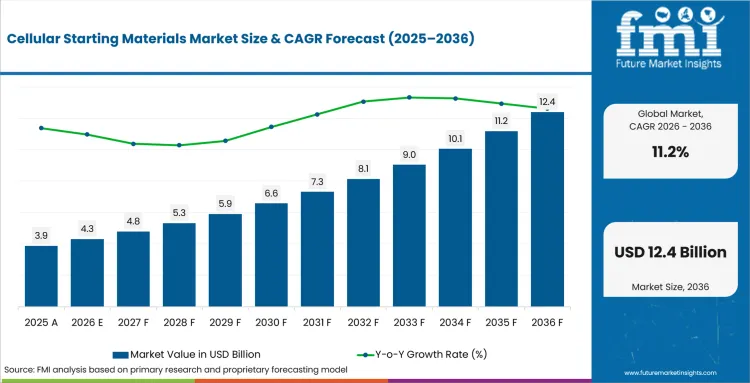
Key Takeaways of Cellular Starting Materials Market
- Demand rises through therapy programs that require traceable starting material with stable identity and functional performance across regulated manufacturing stages.
- Primary cells are expected to lead product type with 34.0% share in 2026 driven by direct biological relevance across translational and therapy workflows.
- Cell and gene therapy manufacturing is projected to capture 38.0% share in 2026 due to early source commitment across regulated process development programs.
- Biopharmaceutical companies are estimated to represent 41.0% share in 2026 owing to repeated qualification work across clinical and commercial development portfolios.
- Donor variability and restricted consent create material barriers through later source changes that require comparability studies and renewed regulatory documentation.
- Competition includes Lonza Group, STEMCELL Technologies, FUJIFILM Cellular Dynamics, Rose BioSolutions, PromoCell GmbH, REPROCELL Inc., ATCC, and Pluristyx across sourcing and banking capabilities.
Analyst Perspective
"Cellular starting materials determine whether a therapy can preserve the same biological foundation from early research through commercial manufacturing. Development teams should secure donor rights and source continuity before process parameters become difficult to change. Companies that connect reserved donor access with matched research and GMP banks can reduce rederivation work. Their commercial advantage comes from protecting potency and comparability across each regulated transfer between development and manufacturing sites."
- Anurag Sharma, Principal Analyst, Future Market Insights
How is the Cellular Starting Materials Market segmented?
The cellular starting materials industry is segmented by product type, application, end user, distribution channel, source, and region.
The segmentation separates the physical cell source from its application and the commercial route used for purchasing. Product type covers primary cells, stem cells, established cell lines, and defined banks used in research or clinical programs. Application distinguishes cell and gene therapy manufacturing, biopharmaceutical production, and research workflows with separate material requirements. End user identifies the organization responsible for source qualification across development and regulated manufacturing stages. Distribution channel separates direct technical agreements, distributor networks, online routes, and institutional laboratory purchasing platforms. Source records donor or tissue origin, which determines consent rights, testing duties, and later commercial-use limits. Regional analysis captures licensing, logistics, and service conditions that shape company entry and customer qualification across regulated programs.
How do primary cells shape demand within the product type category?
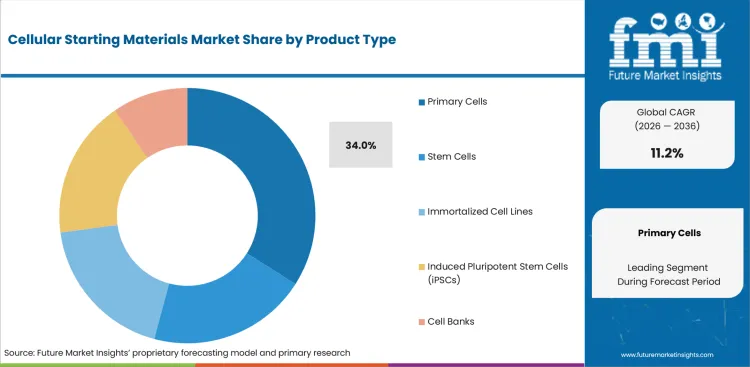
Primary cells preserve donor biology that established lines cannot reproduce across many immune and regenerative workflows. Research laboratories need compatible media and documented donor attributes to control assay variability across repeated studies. In November 2025 PromoCell GmbH introduced Cell KITs that pair primary human cells with optimized ready-to-use growth media. The launch reduces setup variation across research applications that depend on repeatable primary-cell expansion and consistent culture conditions. Related stem cell therapies programs also require early control of viability and phenotype through regulated development.
- Based on product type, primary cells are projected to account for 34.0% in 2026 due to their direct biological relevance in translational research. Donor-specific phenotypes help development teams model disease responses without adapting immortalized lines that weaken biological relevance. The position remains sensitive to collection capacity and access to repeat donors across long development programs.
- Biopharmaceutical laboratories are drawing demand for primary cells through assays that must reflect the intended patient population. Purchase approval depends on viable cell count and infectious-disease testing alongside donor records that permit the intended use. Repeat orders improve through reserved donor access and reproducible collection methods that support several development stages without replacing the biological model.
What keeps cell and gene therapy manufacturing ahead within application?
Cell and gene therapy manufacturing places starting material inside the final product control strategy from the first process-development study. Manufacturing teams evaluate source quality alongside expansion behavior and handling controls across clinical transfer and later production stages. The cell therapy manufacturing shows why selected cells must remain traceable between development and production sites. Commercial risk rises through donor shortages or weak source records that alter yield and potency during regulated manufacturing.
- By application, cell and gene therapy manufacturing is forecast to represent 38.0% in 2026 driven by early source commitment across regulated programs. A selected cell source influences expansion yield and final potency throughout development and manufacturing transfer. Manufacturers prioritize documented origin and stable specifications during process engineering and later clinical production across regulated sites.
- Therapy developers are expected to favor qualified cells and controlled expansion workflows across clinical and commercial stages. A dedicated manufacturing route becomes necessary as a source bank enters regulated process validation and repeated production campaigns. In April 2026, REPROCELL USA opened a GMP-compliant facility for clinical iPSCs and master cell banks. The facility preserves starting-cell history and bank documentation across regulated scale-up programs serving clinical development and commercial transfer.
Which buying mechanism supports biopharmaceutical companies within end user?
Biopharmaceutical companies carry regulatory responsibility for material changes that affect final product comparability across clinical development. Stable production cells can reduce process variation across vector manufacturing and later scale-up across clinical and commercial production stages. In May 2026, Lonza launched its Xcite AAV stable producer cell-line platform for scalable viral vector manufacturing. The platform shows how a controlled cell line becomes part of product strategy instead of routine laboratory supply. Similar therapy manufacturing decisions favor companies that combine technical transfer support with controlled cell platforms and documented change management.
- The end user category is forecast to be led by biopharmaceutical companies at 41.0% share in 2026, owing to repeated qualification work across therapy pipelines. Large sponsors purchase research and regulated material grades across several manufacturing stages within broad advanced-therapy development portfolios. Their scale sustains custom donor criteria and reserved banking capacity that smaller laboratories rarely secure through individual orders.
- Biopharmaceutical developers are increasingly purchasing multi-year material agreements because each contract defines ownership of donor records and change notifications. The agreements reduce uncertainty during process validation and preserve technical continuity between separate development and manufacturing sites. Portfolio demand becomes recurring revenue as one qualified bank supports several candidates without weakening traceability or consent coverage.
What supports the position of direct sales within distribution channel?
Cellular starting materials often require specifications that standard catalog ordering cannot capture for regulated development. Direct agreements align quality documentation and controlled shipping requirements with program workflows across several sites. The biopharmaceutical contract manufacturing market offers a useful comparison for long-term quality responsibility under regulated supply agreements. Technical account teams also coordinate donor forecasts and material-change communication throughout one therapy program across several regulated sites.
- In 2026, direct sales are expected to lead distribution channel with 46.0% share attributable to custom quality requirements across regulated programs. Dedicated agreements reserve scarce donor profiles and define release specifications for repeated collections and scheduled production campaigns. The route also establishes notification duties during material changes and shipment deviations across recurring regulated supply agreements.
- Therapy developers are drawing attention to direct channels through technical support and testing access for clinical-grade cell materials. Regional service coverage becomes valuable for living materials that have narrow shipping windows and defined testing requirements. In July 2026, REPROCELL Inc. partnered with WEIPU Biotechnology to provide clinical iPSC materials and characterization services in China. The arrangement connects commercial access with regional biosafety testing and cell-bank characterization for therapy programs operating in China.
Why do human-derived materials lead within the source category?
Human-derived materials provide disease-relevant biology and donor diversity that engineered substitutes cannot reproduce across every research workflow. Their commercial value depends on lawful consent and access to cohorts with defined clinical characteristics. In August 2025, REPROCELL Inc. launched ReproRegistry to connect volunteers with human skin research and condition-specific clinical studies across the United Kingdom. The registry expands access to condition-specific tissue samples that strengthen translational testing and preserve relevant donor context. Related regenerative medicine programs also require traceable human material that preserves donor context across development.
- Human-derived materials are likely to capture 44.0% share in 2026, supported by direct clinical relevance across therapy development. The category provides human phenotypes and disease-state access that animal or engineered substitutes cannot reproduce fully. Commercial strength depends on lawful consent and repeat access to suitable donor groups across long research and therapy programs.
- Manufacturers are expected to favor human-derived materials for disease models and living therapies that require human biological responses. Recallable donors and standardized screening improve replenishment planning across long development programs that require comparable material over time. Complete chain-of-custody records also protect material continuity through site transfers and changing production volumes across regulated manufacturing programs.
What are the drivers, restraints, and opportunities in the Cellular Starting Materials Market?
Regulated therapy pipelines create recurring demand for traceable cellular starting materials that remain usable across clinical and commercial manufacturing stages. Donor variability and restricted consent delay source qualification through uncertain replenishment rights and changing biological performance across collections. Matched research and GMP banks provide a commercial route that preserves comparability across regulated development and manufacturing transfer stages.
- Driver: Regulated therapy pipelines create recurring demand for qualified cells and documented source histories across clinical development programs.
- Restraint: Donor variability and restricted consent often force source changes that require comparability work during advanced clinical development.
- Opportunity: Matched research and GMP banks reduce rederivation risk across the complete cell-therapy development lifecycle.
Approved living therapies create a direct need for qualified cells and defensible source histories across repeated manufacturing campaigns. Autologous programs also depend on collection controls that protect patient material throughout transport and processing. In December 2025, the USA Food and Drug Administration approved Waskyra as the first cell-based gene therapy for Wiskott-Aldrich syndrome. The approval confirms that cell collection and manufacturing controls can carry commercial value throughout an authorized treatment pathway. Related therapy clinical trials create recurring work for qualified cell banks and source documentation across regulated development programs.
Donor variability limits adoption because separate collections can change viable cell count and functional phenotype across manufacturing campaigns. Clinical teams must explain those differences through material controls that remain defensible during regulatory review. In February 2025, the European Medicines Agency published revised quality requirements for investigational advanced therapy medicinal products. The guideline requires structured information on starting materials and manufacturing controls across clinical trials for investigational advanced therapies. Programs with weak donor continuity face extra comparability work and delayed transfer into larger production campaigns.
Matched material systems offer a practical route from research evaluation into regulated manufacturing without replacing the donor origin. Therapy developers can compare candidate lines early and reserve the selected clone for later banking. Commercial capture depends on connected documentation and reserved material across each regulated therapy development stage. In March 2026, REPROCELL Inc. launched GMP master cell bank manufacturing for clinical iPSCs through an integrated workflow covering seed production and gene editing. The service reduces rederivation work and gives one company responsibility for seed production and regulated banking.
Which country CAGRs are profiled in the Cellular Starting Materials Market?
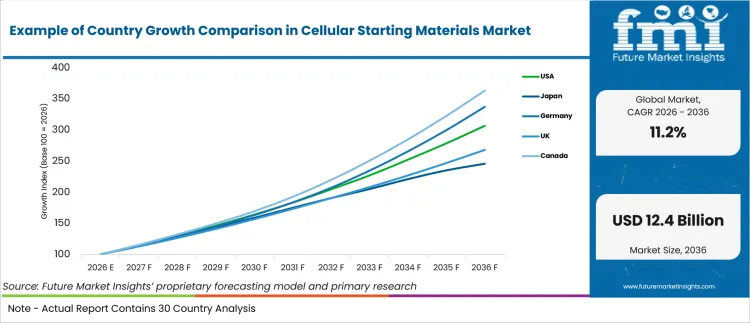
| Country | CAGR |
|---|---|
| Canada | 13.8% |
| Australia | 13.3% |
| Germany | 12.9% |
| USA | 11.9% |
| UK | 10.4% |
| Japan | 9.4% |
| South Korea | 8.6% |
How do country-level CAGRs compare in the Cellular Starting Materials Market?
The country forecasts show a relatively concentrated growth pattern across the cellular starting materials market, with the first four countries remaining within a two-percentage-point band. Canada, Australia and Germany form a closely aligned upper group, reflecting strong activity in cell therapy development, bioprocessing research and advanced biologics manufacturing. The USA follows within the same broader range, indicating sustained demand for high-quality cellular inputs despite a more mature commercialization environment. A more visible gap appears between the USA and the UK, after which Japan and South Korea continue the progression at a measured pace. This distribution reflects differences in cell and gene therapy pipelines, biomanufacturing investments and the availability of specialized research infrastructure. Markets with expanding regenerative medicine ecosystems generally demonstrate stronger demand for donor-derived cells, cell banks and other critical starting materials used throughout the development process.
- Canada benefits from increasing investments in regenerative medicine research and expanding capabilities in cell therapy development, creating demand for high-quality and traceable cellular starting materials.
- Australia's outlook is supported by a growing clinical research ecosystem and continued focus on advanced therapies, where reliable cellular inputs are essential for process consistency and regulatory compliance.
- Germany reflects strong momentum through established biopharmaceutical manufacturing expertise and ongoing development of cell and gene therapy programs across research and commercial settings.
- The USA continues to generate substantial demand through its broad base of biotechnology companies, contract manufacturers and developers advancing next-generation therapeutic platforms.
- The UK supports market expansion through active participation in regenerative medicine research and increasing efforts to strengthen domestic advanced therapy manufacturing capacity.
- Japan maintains steady growth as healthcare innovators and biotechnology organizations continue to invest in cell-based therapeutic approaches and translational research programs.
- South Korea's position is influenced by expanding biopharmaceutical capabilities and growing interest in advanced therapy development, although commercialization activity remains more concentrated than in several larger markets.
Similar CAGRs do not necessarily create identical opportunities for suppliers of cellular starting materials. Differences in clinical development activity, regulatory requirements, manufacturing capacity and sourcing standards can significantly influence purchasing patterns and qualification processes. As a result, companies may encounter distinct commercialization pathways even where growth rates appear broadly comparable. The full report provides country-level CAGR analysis across North America, Latin America, Europe, East Asia, South Asia, Oceania and the Middle East and Africa.
Country-wise Analysis
- Canada regulates biological starting materials through lifecycle requirements that cover fabrication and distribution of biologic drugs. Canada’s cellular starting materials outlook is anticipated to advance at 13.8% CAGR over the assessment period, supported by domestic biomanufacturing and modernized biologics rules. In June 2025, Health Canada published guidance for the new Division 4 requirements covering biological source and starting materials. The guidance gives therapy developers a defined route for documenting cell substrates across the product lifecycle. Research hubs in British Columbia and Ontario offer technical collaboration and specialized laboratory capacity for domestic therapy programs. Long transport distances and provincial purchasing differences raise delivery risk for fresh collections with narrow handling windows.
- Australian manufacturers of human-cell biologicals must follow national GMP requirements for advanced therapies and biological materials. In May 2025, the Therapeutic Goods Administration confirmed licensing expectations for biologicals and cellular therapy manufacturing. Cellular starting materials demand in Australia is forecast to rise at 13.3% CAGR over the forecast period, linked to regulated manufacturing and concentrated translational hubs. Clear licensing gives imported cell banks a defined qualification route across major development sites and specialist manufacturing programs. Specialist research capacity in Sydney and Melbourne offers a focused entry path for technical service teams. Geographic distance and smaller donor pools increase freight exposure and replenishment costs across remote customer locations.
- Germany requires approval documentation that covers collection procedures and donor testing for regulated stem-cell preparations. By 2036, Germany is projected to grow at 12.9% CAGR owing to mature advanced-therapy infrastructure and structured donor review. Dense logistics across German life-science clusters provide an enabler for bank transfer and technical support between development sites. In January 2026, the Paul-Ehrlich-Institut updated its application section for stem-cell preparations and allogeneic donor information. The current materials give cell-material companies a clearer route for documenting collection procedures and donor-testing changes within approval submissions. Detailed review and European traceability duties extend qualification for a new donor source during regulated production changes.
- United States developers operate under FDA donor-eligibility and biologics requirements across clinical and commercial programs. Large therapy pipelines create demand for custom donor programs and reserved collection capacity across several manufacturing networks. In May 2026, the FDA issued guidance describing CMC flexibilities for human cellular and gene therapy products. In the USA, cellular starting materials demand is predicted to advance at 11.9% CAGR through 2036 reinforced by contract manufacturing capacity and large therapy pipelines. Early agency engagement clarifies material-control plans during development and reduces avoidable questions during later biologics license preparation. High qualification costs and nationwide logistics restrict smaller companies without validated shipping systems or regulatory support.
- United Kingdom manufacturing sites require suitable authorization for cell therapies and biologically active starting materials. In January 2026 the Medicines and Healthcare products Regulatory Agency authorized NHS Blood and Transplant for advanced-therapy products and biological starting materials. The UK cellular starting materials sector is projected to record 10.4% CAGR during the assessment period, shaped by licensed hospital infrastructure and centralized quality review. Concentrated clinical networks can combine technical support with shared documentation across related programs and regulated hospital manufacturing sites. Limited manufacturing slots and import paperwork extend onboarding for overseas companies without established local quality routes and import experience.
- Japan applies dedicated regenerative-product rules and biological raw-material standards to human-cell manufacturing programs throughout regulated clinical development. Local technical partners help overseas companies prepare Japanese-language material records and consultation packages for regulator meetings and submissions. In March 2026, the Ministry of Health, Labour and Welfare amended operating guidance for biological raw-material standards covering human cells and tissue-derived products. Japan is estimated to post 9.4% CAGR over the forecast period, due to established cell science and demanding material standards. The revised framework gives therapy developers a current basis for source qualification and biological raw-material documentation across clinical programs. Conservative change management restricts rapid switching between donor sources or bank providers during regulated development.
- South Korea licenses human-cell management businesses and cell-processing facilities under its advanced regenerative framework for regulated material supply. Dense metropolitan logistics shorten service routes for fresh collections across major hospitals and research centers. Adoption of cellular starting materials in South Korea is estimated to expand at 8.6% CAGR through 2036, aided by licensed processing infrastructure and dense delivery routes. In January 2026, the Ministry of Food and Drug Safety issued guidance covering human-cell management businesses and cell-processing facilities. Local partnerships provide practical support for licensing and Korean-language operating records across regulated collection and processing activities. Renewal requirements and Korean-language documentation remain material frictions for overseas companies without experienced local quality personnel.
Who are the notable companies in the Cellular Starting Materials Market?
Lonza Group, STEMCELL Technologies, FUJIFILM Cellular Dynamics, Rose BioSolutions, PromoCell GmbH, REPROCELL Inc., ATCC, and Pluristyx are the notable companies shaping this market.
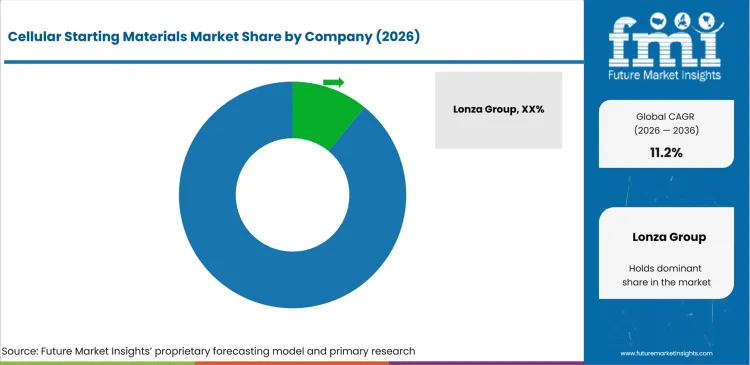
Competition remains moderately concentrated in regulated clinical-grade supply and more fragmented in research-grade cell access. Integrated platforms control entry points because donor rights and GMP banking must remain connected through one quality system. Specialist laboratories can enter through rare donor profiles or defined iPSC lines without building a complete manufacturing network. Their growth depends on documentation that transfers directly into a therapy developer’s regulated process without renewed source qualification. Cross-border programs favor companies with local quality support and validated shipment routes across major development regions. Smaller companies remain viable through short service distances and reliable access to specific tissue cohorts that larger catalogs cannot guarantee. Market position reflects control over usable biological material and change management more than catalog breadth.
- Lonza Group and Rose BioSolutions focus on integrated programs connecting regulated cell banks with manufacturing support. REPROCELL Inc. adds clinical iPSC banks and gene-editing services across several regulatory regions and regulated development stages. These platforms target sponsors seeking one accountable route from initial source qualification through advanced therapy products manufacturing transfer.
- STEMCELL Technologies and PromoCell GmbH compete through broad human-cell access and direct scientific support for complex research workflows. Pluristyx concentrates on GMP-compliant iPSC banks and regulatory documentation that supports clinical transfer across advanced-therapy manufacturing programs. Their entry strength depends on source controls that remain usable across research and regulated manufacturing.
- FUJIFILM Cellular Dynamics and ATCC concentrate on defined cell lines and reproducible model systems for translational research. Their positions strengthen through bank quality and characterization depth across programs requiring controlled biological models. Selection differs between clinical manufacturing transfer and CMO and CDMO services that use authenticated research references.
Competitive Benchmarking: Cellular Starting Materials Market
| Company | Donor and Cell Access | GMP Banking Readiness | Characterization Support | Geographic Reach |
|---|---|---|---|---|
| Lonza Group | Medium | High | High | Global |
| STEMCELL Technologies | High | Medium | High | Global |
| FUJIFILM Cellular Dynamics | Medium | High | High | Global |
| Rose BioSolutions | High | High | High | North America and Europe |
| PromoCell GmbH | High | Medium | Medium | Europe and North America |
| REPROCELL Inc. | High | High | High | North America, Europe and Asia |
| ATCC | Medium | High | High | Global |
| Pluristyx | Medium | High | High | North America |
Key Developments in the Cellular Starting Materials Market
- In July 2026, STEMCELL Technologies and CCRM partnered to provide matched GMP and research-use iPSC lines from one donor origin. The matched lines include genomic characterization and a connected route into regulated banking for cell-therapy development. Development teams can begin research with the matched line and preserve source continuity through clinical translation. The arrangement reduces rederivation risk for programs that would otherwise replace an early research line during process transfer.
- In May 2026, FUJIFILM Cellular Dynamics opened a new iPSC manufacturing facility in Madison to expand development and production capacity. The site adds dedicated space for research and clinical-grade cell lines across regenerative medicine programs. Therapy developers gain a broader route to bank defined iPSC material under controlled processes across research and regulated development stages. The expansion increases commercial availability for programs that need consistent starting cells across discovery and regulated manufacturing.
- In April 2026, ATCC and the Broad Institute announced engineered cancer models designed to study resistance to targeted therapies. The collaboration adds characterized cell lines with defined genetic changes across translational research workflows and targeted-therapy assay development. Drug developers gain reproducible material for comparing resistance mechanisms and validating assays across controlled programs. The project expands ATCC’s model portfolio without presenting these research lines as clinical manufacturing banks for regulated therapy production.
- In June 2026, Charles River Laboratories reported that GI Partners had acquired its CDMO and Cell Solutions businesses and formed Rose BioSolutions. The completed transaction transferred cellular starting materials and therapy manufacturing services into a new operating company. Existing customers need updated quality agreements and legal-party records for continuing programs across the transferred manufacturing and cell-sourcing businesses. The ownership change places related cell-source and manufacturing capabilities within one independent platform serving advanced-therapy developers.
Cellular Starting Materials Market - Report Scope
| Coverage field | Report scope |
|---|---|
| Market breakdown | Product type, application, end user, distribution channel, source, and region. |
| Quantitative Units | Revenue in USD Billion and CAGR in %. |
| Market Definition | Primary cells, stem cells, cell lines, cell banks, tissues, and qualified biological starting materials used in cell and gene therapy, research, and biomanufacturing. |
| Regions Covered | North America, Latin America, Europe, East Asia, South Asia, Oceania, and Middle East and Africa. |
| Countries Covered | Canada, Australia, Germany, USA, UK, Japan, and South Korea. |
| Key Companies Profiled | Lonza Group, STEMCELL Technologies, FUJIFILM Cellular Dynamics, Rose BioSolutions, PromoCell GmbH, REPROCELL Inc., ATCC, Pluristyx |
| Forecast Period | 2026 to 2036. |
| Approach | Hybrid bottom-up and top-down market sizing supported by primary interviews and official desk research. |
Cellular Starting Materials Market - Research Methodology
| Method | Approach |
|---|---|
| Primary Research | FMI analysts gathered input from manufacturers, service providers, technology developers, distributors, end users, procurement teams, and subject-matter experts. Interviews examined purchasing decisions, product or service evaluation, adoption barriers, approval requirements, pricing considerations, and expectations for technical or commercial support. Respondents were also asked what evidence is required before a trial, pilot, or initial order develops into regular purchasing. |
| Desk Research | Desk research covered government statistics, regulatory publications, trade data, industry associations, technical literature, standards, company filings, product information, and official corporate announcements. Sources were reviewed for relevance, publication date, geographic coverage, and consistency with the defined market scope. Claims relating to performance, applications, approvals, capacity, investment, and commercial activity were retained only when supported by credible public evidence. |
| Market Sizing and Forecasting | The market model combined the baseline value with historical performance, segment structure, pricing and volume indicators, adoption levels, company participation, and country-level demand conditions. Forecast assumptions considered economic activity, investment trends, regulatory developments, technology adoption, purchasing cycles, supply availability, and barriers to wider market use. Segment and regional estimates were reconciled before the final market total was calculated. |
| Data Validation | Estimates were checked against multiple independent indicators, including public data, company activity, trade patterns, industry developments, and findings from primary interviews. Validation also tested whether products, services, applications, and company revenues fell within the defined market boundaries. Adjacent categories, unsupported claims, overlapping revenues, and activities without direct market relevance were excluded to reduce double counting and maintain consistency across segments and countries. |
Cellular Starting Materials Market by Segments
Cellular Starting Materials Market segmented by Product Type:
- Primary Cells
- Human Primary Cells
- Animal Primary Cells
- Stem Cells
- Hematopoietic Stem Cells
- Mesenchymal Stem Cells
- Immortalized Cell Lines
- Human Cell Lines
- Animal Cell Lines
- Induced Pluripotent Stem Cells (iPSCs)
- Research Grade iPSCs
- Clinical Grade iPSCs
- Cell Banks
- Master Cell Banks
- Working Cell Banks
Cellular Starting Materials Market segmented by Application:
- Cell & Gene Therapy Manufacturing
- CAR-T Cell Therapy
- Gene-Modified Cell Therapy
- Biopharmaceutical Production
- Monoclonal Antibody Production
- Recombinant Protein Production
- Drug Discovery & Development
- High Throughput Screening
- Toxicology Studies
- Regenerative Medicine
- Tissue Engineering
- Stem Cell Therapy
- Academic & Clinical Research
- Basic Research
- Translational Research
Cellular Starting Materials Market segmented by End User:
- Biopharmaceutical Companies
- Large Biopharma Companies
- Emerging Biotech Companies
- Cell Therapy Manufacturers
- Commercial Manufacturers
- Contract Manufacturers
- Research Institutes
- Academic Institutes
- Government Research Centers
- Contract Development & Manufacturing Organizations
- Cell Therapy CDMOs
- Biologics CDMOs
- Hospitals & Clinical Centers
- University Hospitals
- Specialty Treatment Centers
Cellular Starting Materials Market segmented by Distribution Channel:
- Direct Sales
- Key Account Sales
- Enterprise Contracts
- Specialized Life Science Distributors
- Global Distributors
- Regional Distributors
- Online Sales
- Manufacturer Websites
- E-Commerce Platforms
- Laboratory Supply Dealers
- Authorized Dealers
- Local Suppliers
- Research Procurement Platforms
- Digital Procurement Portals
- Institutional Purchasing Networks
Cellular Starting Materials Market segmented by Source:
- Human-Derived Materials
- Peripheral Blood
- Bone Marrow
- Umbilical Cord & Placental Sources
- Cord Blood
- Wharton’s Jelly
- Bone Marrow Sources
- Bone Marrow Aspirates
- Bone Marrow Stem Cells
- Adipose Tissue Sources
- Adipose-Derived Stem Cells
- Lipoaspirate Tissue
- Other Tissue Sources
- Skin Tissue
- Dental Pulp Tissue
Cellular Starting Materials Market by Region:
- North America
- United States
- Canada
- Latin America
- Brazil
- Mexico
- Argentina
- Chile
- Western Europe
- Germany
- France
- United Kingdom
- Italy
- Spain
- Benelux
- Nordics
- Eastern Europe
- Poland
- Czech Republic
- Romania
- Hungary
- East Asia
- China
- Japan
- South Korea
- South Asia and Pacific
- India
- ASEAN
- Australia and New Zealand
- Middle East and Africa
- GCC Countries
- South Africa
- Türkiye
- Israel
Research Sources and Bibliography
- USA Food and Drug Administration. (2025, January 6). Recommendations for Determining Eligibility of Donors of Human Cells, Tissues, and Cellular and Tissue-Based Products (HCT/Ps).
- STEMCELL Technologies. (2025, March 19). Federal government invests $49.9 million in STEMCELL Technologies Canada Inc.
- PromoCell GmbH. (2025, November 6). Introducing our Cell KITs: Ready-to-use solutions for primary cell culture.
- REPROCELL Inc. (2026, April 9). REPROCELL USA Inaugurates GMP-Compliant Cell Culture Facility.
- Lonza. (2026, May 12). Lonza Expands AAV Offering with Xcite® AAV Stable Producer Cell Line Platform to Industrialize Viral Vector Manufacturing.
- REPROCELL Inc. (2026, July 27). REPROCELL Expands Clinical iPSC and Stem Cell Solutions in China Through Strategic Collaboration with WEIPU Biotechnology.
- REPROCELL Inc. (2025, August 21). REPROCELL Launches ReproRegistry to Strengthen Access to Human Skin Samples for Research.
- USA Food and Drug Administration. (2025, December 9). FDA Approves First Gene Therapy Treatment for Wiskott-Aldrich Syndrome.
- European Medicines Agency. (2025, February 6). Guideline on quality, non-clinical and clinical requirements for investigational advanced therapy medicinal products in clinical trials.
- REPROCELL Inc. (2026, March 3). REPROCELL Launches GMP Master Cell Bank Manufacturing for Clinical iPSCs.
- Health Canada. (2025, June 23). Guidance document on submission information for biologic drugs (Division 4, Schedule D): Overview.
- Therapeutic Goods Administration. (2025, May 9). Manufacturing biologicals, blood and tissues and advanced therapies.
- Paul-Ehrlich-Institut. (2026, January 19). Stem Cell Preparations.
- USA Food and Drug Administration. (2026, May). Chemistry, Manufacturing, and Controls Flexibilities for Developing Human Cellular and Gene Therapy Products for a Biologics License Application.
- Medicines and Healthcare products Regulatory Agency. (2026, January 8). UK MIA(IMP) 25224.
- Ministry of Health, Labour and Welfare. (2026, March 31).
- Ministry of Food and Drug Safety. (2026, January 21).
- STEMCELL Technologies. (2026, July 8). STEMCELL Technologies and CCRM Partner to Expand Access to Matched GMP and RUO iPSC Lines for Cell Therapy Development.
- FUJIFILM Corporation. (2026, May 19). FUJIFILM Cellular Dynamics Launches New iPSC Manufacturing Facility in Madison.
- ATCC. (2026, April 20). ATCC and Broad Institute Engineer New Cancer Models to Decode Resistance to Targeted Therapy.
- Charles River Laboratories. (2026, June 15). GI Partners Acquires CDMO and Cell Solutions.
- PromoCell GmbH. (2025, September 30). Press release - PromoCell enters the GMP field with custom cell culture media services for cell-based therapy and regenerative medicine.
- Pluristyx. (2025, January 7). Pluristyx Announces Immediate Availability of GMP-Compliant PSXi013 iPSC Line for Advanced Therapy Development.
This bibliography is provided for reader reference and is not exhaustive. The full report contains the complete reference list and detailed citations
This Report Answers
- How large is the cellular starting materials market in 2026 and 2036?
- Which regulatory controls shape donor and tissue qualification across major countries?
- Why do primary cells account for the largest product type share in 2026?
- How does cell and gene therapy manufacturing influence source qualification decisions?
- Why do biopharmaceutical companies represent the largest end user share in 2026?
- How do direct sales agreements support custom donor and quality requirements?
- How do country growth rates differ across Canada, Australia, Germany, USA, UK, Japan, and South Korea?
- Which companies provide donor material, cell banks, processing support, or characterization services?
- What limits continuity between research material and regulated clinical manufacturing?
Frequently Asked Questions
How big is the Cellular Starting Materials Market in 2026?
The cellular starting materials market is valued at USD 4.3 billion in 2026 and is forecast to reach USD 12.4 billion by 2036. Growth is supported by regulated therapy programs requiring traceable donor sourcing and communicable-disease testing within the starting-material control strategy across clinical development and commercial manufacturing stages worldwide.
What is the CAGR of the Cellular Starting Materials Market from 2026 to 2036?
The cellular starting materials market grows at a CAGR of 11.2% between 2026 and 2036, supported by therapy developers adopting qualified cell banks once those programs demonstrate stable donor identity, documented source histories, and preserved comparability across regulated clinical and commercial manufacturing transfer stages.
Which product type leads the Cellular Starting Materials Market?
Primary cells account for 34.0% of the cellular starting materials market by product type in 2026, driven by direct biological relevance across translational research where donor-specific phenotypes help development teams model disease responses without adapting immortalized lines that weaken biological relevance.
How much will the Cellular Starting Materials Market add between 2026 and 2036?
The cellular starting materials market is set to add USD 8.1 billion between 2026 and 2036, growing from USD 4.3 billion to USD 12.4 billion as primary cells, stem cell banks, and GMP-compliant iPSC manufacturing platforms enter funded regulated pathways across a widening base of cell and gene therapy development programs worldwide.
Who are the leading companies in the Cellular Starting Materials Market?
Five companies lead the cellular starting materials market, including Lonza Group, STEMCELL Technologies, FUJIFILM Cellular Dynamics, Rose BioSolutions, and PromoCell GmbH, competing through integrated donor and GMP banking programs, broad human-cell access, stable producer cell-line platforms, and reproducible characterization support across regulated cell and gene therapy development programs worldwide.
Preview the report firsthand - request a free sample
Get SampleGet the brochure for pricing and purchase details.
Get PDFTable of Content
- Key Takeaways
- Market Size and CAGR
- Top Growth Driver
- Fastest Growing Segment
- Leading Region
- Key Companies
- Emerging Opportunities
- Executive Summary
- Global Market Outlook
- Demand-side Trends
- Supply-side Trends
- Technology Roadmap Analysis
- Analysis and Recommendations
- Analyst Perspective (What is happening? Why now? What should investors know?)
- Key Questions Answered
- How large is the market?
- What is the CAGR?
- What are key trends?
- Which region dominates?
- Who are the leaders?
- Market Overview
- Market Coverage / Taxonomy
- Market Definition / Scope / Limitations
- Research Methodology
- Chapter Orientation
- Analytical Lens and Working Hypotheses
- Market Structure, Signals, and Trend Drivers
- Benchmarking and Cross-market Comparability
- Market Sizing, Forecasting, and Opportunity Mapping
- Research Design and Evidence Framework
- Desk Research Programme (Secondary Evidence)
- Expert Input and Fieldwork (Primary Evidence)
- Tooling, Models, and Reference Databases
- Data Engineering and Model Build
- Quality Assurance and Audit Trail
- Market Background
- Market Dynamics (Drivers, Restraints, Opportunity, Trends)
- Scenario Forecast (Optimistic, Likely, Conservative)
- Impact Analysis
- AI Impact
- Sustainability Impact
- Regulatory Impact
- Technology Impact
- Consumer / Buyer Analysis
- Purchase Drivers
- Adoption Barriers
- Buyer Journey
- Opportunity Map Analysis
- Product Life Cycle Analysis
- Supply Chain Analysis
- Investment Feasibility Matrix
- Value Chain Analysis
- PESTLE and Porter's Analysis
- Regulatory Landscape
- Regional Parent Market Outlook
- Production and Consumption Statistics
- Import and Export Statistics
- Global Market Analysis and Forecast, 2021 to 2036
- Historical Market Size Value (USD Billion) Analysis, 2021 to 2025
- Current and Future Market Size Value (USD Billion) Projections, 2026 to 2036
- Y-o-Y Growth Trend Analysis
- Absolute $ Opportunity Analysis
- Global Market Pricing Analysis, 2021 to 2036
- Global Market Analysis and Forecast, By Product Type, 2021 to 2036
- Introduction / Key Findings
- Historical Market Size Value (USD Billion) Analysis By Product Type, 2021 to 2025
- Current and Future Market Size Value (USD Billion) Analysis and Forecast By Product Type, 2026 to 2036
- Primary Cells
- Human Primary Cells
- Animal Primary Cells
- Stem Cells
- Hematopoietic Stem Cells
- Mesenchymal Stem Cells
- Immortalized Cell Lines
- Human Cell Lines
- Animal Cell Lines
- Induced Pluripotent Stem Cells (iPSCs)
- Research Grade iPSCs
- Clinical Grade iPSCs
- Cell Banks
- Master Cell Banks
- Working Cell Banks
- Primary Cells
- Y-o-Y Growth Trend Analysis By Product Type, 2021 to 2025
- Absolute $ Opportunity Analysis By Product Type, 2026 to 2036
- Global Market Analysis and Forecast, By Application, 2021 to 2036
- Introduction / Key Findings
- Historical Market Size Value (USD Billion) Analysis By Application, 2021 to 2025
- Current and Future Market Size Value (USD Billion) Analysis and Forecast By Application, 2026 to 2036
- Cell & Gene Therapy Manufacturing
- CAR-T Cell Therapy
- Gene-Modified Cell Therapy
- Biopharmaceutical Production
- Monoclonal Antibody Production
- Recombinant Protein Production
- Drug Discovery & Development
- High Throughput Screening
- Toxicology Studies
- Regenerative Medicine
- Tissue Engineering
- Stem Cell Therapy
- Academic & Clinical Research
- Basic Research
- Translational Research
- Cell & Gene Therapy Manufacturing
- Y-o-Y Growth Trend Analysis By Application, 2021 to 2025
- Absolute $ Opportunity Analysis By Application, 2026 to 2036
- Global Market Analysis and Forecast, By End User, 2021 to 2036
- Introduction / Key Findings
- Historical Market Size Value (USD Billion) Analysis By End User, 2021 to 2025
- Current and Future Market Size Value (USD Billion) Analysis and Forecast By End User, 2026 to 2036
- Biopharmaceutical Companies
- Large Biopharma Companies
- Emerging Biotech Companies
- Cell Therapy Manufacturers
- Commercial Manufacturers
- Contract Manufacturers
- Research Institutes
- Academic Institutes
- Government Research Centers
- Contract Development & Manufacturing Organizations
- Cell Therapy CDMOs
- Biologics CDMOs
- Hospitals & Clinical Centers
- University Hospitals
- Specialty Treatment Centers
- Biopharmaceutical Companies
- Y-o-Y Growth Trend Analysis By End User, 2021 to 2025
- Absolute $ Opportunity Analysis By End User, 2026 to 2036
- Global Market Analysis and Forecast, By Distribution Channel, 2021 to 2036
- Introduction / Key Findings
- Historical Market Size Value (USD Billion) Analysis By Distribution Channel, 2021 to 2025
- Current and Future Market Size Value (USD Billion) Analysis and Forecast By Distribution Channel, 2026 to 2036
- Direct Sales
- Key Account Sales
- Enterprise Contracts
- Specialized Life Science Distributors
- Global Distributors
- Regional Distributors
- Online Sales
- Manufacturer Websites
- E-Commerce Platforms
- Laboratory Supply Dealers
- Authorized Dealers
- Local Suppliers
- Research Procurement Platforms
- Digital Procurement Portals
- Institutional Purchasing Networks
- Direct Sales
- Y-o-Y Growth Trend Analysis By Distribution Channel, 2021 to 2025
- Absolute $ Opportunity Analysis By Distribution Channel, 2026 to 2036
- Global Market Analysis and Forecast, By Source, 2021 to 2036
- Introduction / Key Findings
- Historical Market Size Value (USD Billion) Analysis By Source, 2021 to 2025
- Current and Future Market Size Value (USD Billion) Analysis and Forecast By Source, 2026 to 2036
- Human-Derived Materials
- Peripheral Blood
- Bone Marrow
- Umbilical Cord & Placental Sources
- Cord Blood
- Wharton's Jelly
- Bone Marrow Sources
- Bone Marrow Aspirates
- Bone Marrow Stem Cells
- Adipose Tissue Sources
- Adipose-Derived Stem Cells
- Lipoaspirate Tissue
- Other Tissue Sources
- Skin Tissue
- Dental Pulp Tissue
- Human-Derived Materials
- Y-o-Y Growth Trend Analysis By Source, 2021 to 2025
- Absolute $ Opportunity Analysis By Source, 2026 to 2036
- Global Market Analysis and Forecast, By Region, 2021 to 2036
- Introduction
- Historical Market Size Value (USD Billion) Analysis By Region, 2021 to 2025
- Current Market Size Value (USD Billion) Analysis and Forecast By Region, 2026 to 2036
- North America
- Latin America
- Western Europe
- Eastern Europe
- East Asia
- South Asia and Pacific
- Middle East & Africa
- Market Attractiveness Analysis By Region
- North America Market Analysis and Forecast, By Country, 2021 to 2036
- Historical Market Size Value (USD Billion) Trend Analysis By Market Taxonomy, 2021 to 2025
- Market Size Value (USD Billion) Forecast By Market Taxonomy, 2026 to 2036
- By Country
- USA
- Canada
- By Product Type
- By Application
- By End User
- By Distribution Channel
- By Source
- By Country
- Market Attractiveness Analysis
- By Country
- By Product Type
- By Application
- By End User
- By Distribution Channel
- By Source
- Key Takeaways
- Latin America Market Analysis and Forecast, By Country
- Historical Market Size Value (USD Billion) Trend Analysis By Market Taxonomy, 2021 to 2025
- Market Size Value (USD Billion) Forecast By Market Taxonomy, 2026 to 2036
- By Country
- Brazil
- Mexico
- Chile
- Rest of Latin America
- By Product Type
- By Application
- By End User
- By Distribution Channel
- By Source
- By Country
- Market Attractiveness Analysis
- By Country
- By Product Type
- By Application
- By End User
- By Distribution Channel
- By Source
- Key Takeaways
- Western Europe Market Analysis and Forecast, By Country
- Historical Market Size Value (USD Billion) Trend Analysis By Market Taxonomy, 2021 to 2025
- Market Size Value (USD Billion) Forecast By Market Taxonomy, 2026 to 2036
- By Country
- Germany
- UK
- Italy
- Spain
- France
- Nordic
- BENELUX
- Rest of Western Europe
- By Product Type
- By Application
- By End User
- By Distribution Channel
- By Source
- By Country
- Market Attractiveness Analysis
- By Country
- By Product Type
- By Application
- By End User
- By Distribution Channel
- By Source
- Key Takeaways
- Eastern Europe Market Analysis and Forecast, By Country
- Historical Market Size Value (USD Billion) Trend Analysis By Market Taxonomy, 2021 to 2025
- Market Size Value (USD Billion) Forecast By Market Taxonomy, 2026 to 2036
- By Country
- Russia
- Poland
- Hungary
- Balkan & Baltic
- Rest of Eastern Europe
- By Product Type
- By Application
- By End User
- By Distribution Channel
- By Source
- By Country
- Market Attractiveness Analysis
- By Country
- By Product Type
- By Application
- By End User
- By Distribution Channel
- By Source
- Key Takeaways
- East Asia Market Analysis and Forecast, By Country
- Historical Market Size Value (USD Billion) Trend Analysis By Market Taxonomy, 2021 to 2025
- Market Size Value (USD Billion) Forecast By Market Taxonomy, 2026 to 2036
- By Country
- China
- Japan
- South Korea
- By Product Type
- By Application
- By End User
- By Distribution Channel
- By Source
- By Country
- Market Attractiveness Analysis
- By Country
- By Product Type
- By Application
- By End User
- By Distribution Channel
- By Source
- Key Takeaways
- South Asia and Pacific Market Analysis and Forecast, By Country
- Historical Market Size Value (USD Billion) Trend Analysis By Market Taxonomy, 2021 to 2025
- Market Size Value (USD Billion) Forecast By Market Taxonomy, 2026 to 2036
- By Country
- India
- ASEAN
- Australia & New Zealand
- Rest of South Asia and Pacific
- By Product Type
- By Application
- By End User
- By Distribution Channel
- By Source
- By Country
- Market Attractiveness Analysis
- By Country
- By Product Type
- By Application
- By End User
- By Distribution Channel
- By Source
- Key Takeaways
- Middle East & Africa Market Analysis and Forecast, By Country
- Historical Market Size Value (USD Billion) Trend Analysis By Market Taxonomy, 2021 to 2025
- Market Size Value (USD Billion) Forecast By Market Taxonomy, 2026 to 2036
- By Country
- Kingdom of Saudi Arabia
- Other GCC Countries
- Türkiye
- South Africa
- Other African Union
- Rest of Middle East & Africa
- By Product Type
- By Application
- By End User
- By Distribution Channel
- By Source
- By Country
- Market Attractiveness Analysis
- By Country
- By Product Type
- By Application
- By End User
- By Distribution Channel
- By Source
- Key Takeaways
- Key Countries Market Analysis
- USA
- Pricing Analysis
- Market Share Analysis, 2025
- By Product Type
- By Application
- By End User
- By Distribution Channel
- By Source
- Canada
- Pricing Analysis
- Market Share Analysis, 2025
- By Product Type
- By Application
- By End User
- By Distribution Channel
- By Source
- Mexico
- Pricing Analysis
- Market Share Analysis, 2025
- By Product Type
- By Application
- By End User
- By Distribution Channel
- By Source
- Brazil
- Pricing Analysis
- Market Share Analysis, 2025
- By Product Type
- By Application
- By End User
- By Distribution Channel
- By Source
- Chile
- Pricing Analysis
- Market Share Analysis, 2025
- By Product Type
- By Application
- By End User
- By Distribution Channel
- By Source
- Germany
- Pricing Analysis
- Market Share Analysis, 2025
- By Product Type
- By Application
- By End User
- By Distribution Channel
- By Source
- UK
- Pricing Analysis
- Market Share Analysis, 2025
- By Product Type
- By Application
- By End User
- By Distribution Channel
- By Source
- Italy
- Pricing Analysis
- Market Share Analysis, 2025
- By Product Type
- By Application
- By End User
- By Distribution Channel
- By Source
- Spain
- Pricing Analysis
- Market Share Analysis, 2025
- By Product Type
- By Application
- By End User
- By Distribution Channel
- By Source
- France
- Pricing Analysis
- Market Share Analysis, 2025
- By Product Type
- By Application
- By End User
- By Distribution Channel
- By Source
- India
- Pricing Analysis
- Market Share Analysis, 2025
- By Product Type
- By Application
- By End User
- By Distribution Channel
- By Source
- ASEAN
- Pricing Analysis
- Market Share Analysis, 2025
- By Product Type
- By Application
- By End User
- By Distribution Channel
- By Source
- Australia & New Zealand
- Pricing Analysis
- Market Share Analysis, 2025
- By Product Type
- By Application
- By End User
- By Distribution Channel
- By Source
- China
- Pricing Analysis
- Market Share Analysis, 2025
- By Product Type
- By Application
- By End User
- By Distribution Channel
- By Source
- Japan
- Pricing Analysis
- Market Share Analysis, 2025
- By Product Type
- By Application
- By End User
- By Distribution Channel
- By Source
- South Korea
- Pricing Analysis
- Market Share Analysis, 2025
- By Product Type
- By Application
- By End User
- By Distribution Channel
- By Source
- Russia
- Pricing Analysis
- Market Share Analysis, 2025
- By Product Type
- By Application
- By End User
- By Distribution Channel
- By Source
- Poland
- Pricing Analysis
- Market Share Analysis, 2025
- By Product Type
- By Application
- By End User
- By Distribution Channel
- By Source
- Hungary
- Pricing Analysis
- Market Share Analysis, 2025
- By Product Type
- By Application
- By End User
- By Distribution Channel
- By Source
- Kingdom of Saudi Arabia
- Pricing Analysis
- Market Share Analysis, 2025
- By Product Type
- By Application
- By End User
- By Distribution Channel
- By Source
- Türkiye
- Pricing Analysis
- Market Share Analysis, 2025
- By Product Type
- By Application
- By End User
- By Distribution Channel
- By Source
- South Africa
- Pricing Analysis
- Market Share Analysis, 2025
- By Product Type
- By Application
- By End User
- By Distribution Channel
- By Source
- USA
- Market Structure Analysis
- Competition Dashboard
- Competition Benchmarking
- Market Share Analysis of Top Players
- By Regional
- By Product Type
- By Application
- By End User
- By Distribution Channel
- By Source
- Emerging Startups
- Innovation Benchmarking
- Competition Analysis
- Competition Deep Dive
- Lonza Group
- Overview
- Product Portfolio
- Profitability by Market Segments
- Sales Footprint
- Strategy Overview
- Marketing Strategy
- Product Strategy
- Channel Strategy
- STEMCELL Technologies
- Miltenyi Biotec
- FUJIFILM Cellular Dynamics
- Thermo Fisher Scientific
- Charles River Laboratories
- PromoCell GmbH
- CellGenix GmbH
- Takara Bio Inc.
- Bio-Techne Corporation
- Lonza Group
- Case Studies
- Success Stories
- Recent Developments
- Competition Deep Dive
- Assumptions & Acronyms Used


