

- Market Size (2026)
- USD 2.7 Bn
- Forecast (2036)
- USD 4.9 Bn
- CAGR (2026 to 2036)
- 6.0%
How big is Insoluble Dietary Fiber Market in 2026?
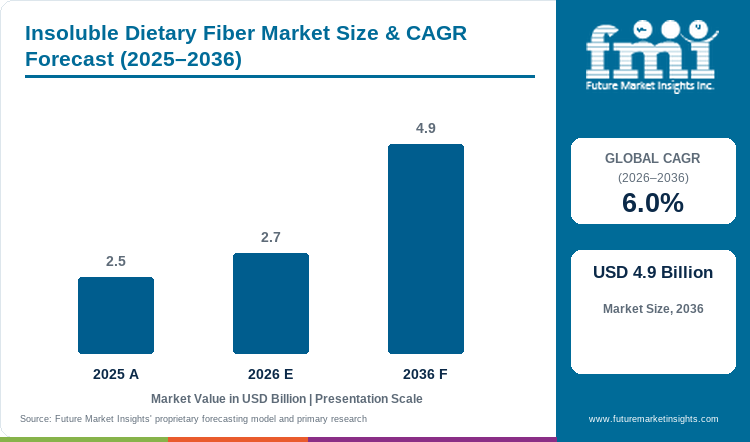
The insoluble dietary fiber market is valued at USD 2.7 billion in 2026 and is projected to reach USD 4.9 billion by 2036, growing at a 6.0% CAGR.
Sales of insoluble dietary fiber are estimated to rise at a 6.0% CAGR through 2036, from USD 2.5 Billion in 2025 to USD 2.7 Billion in 2026 and USD 4.9 Billion by 2036. A 2026 Foods review described microwave-assisted enzymatic treatment of pearl millet bran. In the reported test, in vitro fermentability rose from 36% to 59% and butyrate production doubled. The result suggests that processing can change the fermentation behavior of an insoluble-rich ingredient while retaining its structural role in food.
Processing can also change how food manufacturers use plant side streams. A 2025 potato dietary fiber study found that high hydrostatic pressure combined with cellulase increased the soluble fraction by 63.37% and raised water retention 1.56 times. Such treatment could make residues more useful as functional food ingredients in bakery and other texture-sensitive recipes. Buyers still need repeatable hydration, mouthfeel and performance at the intended dose.
Key Takeaways of Insoluble Dietary Fiber Market
- Demand is increasingly tied to reformulation in which insoluble fiber must support nutrition without creating an abrasive or dry eating experience.
- Based on Product Type, Cellulose is projected to lead revenue in 2026, supported by standardized grades and controllable particle behavior.
- By Source, Cereals & Grains are estimated to lead in 2026 as bran, wheat-associated streams and other cereal residues move into food-ingredient use.
- Feedstock variability remains a restraint because treatment response, water binding, and sensory behavior can shift between botanical sources.
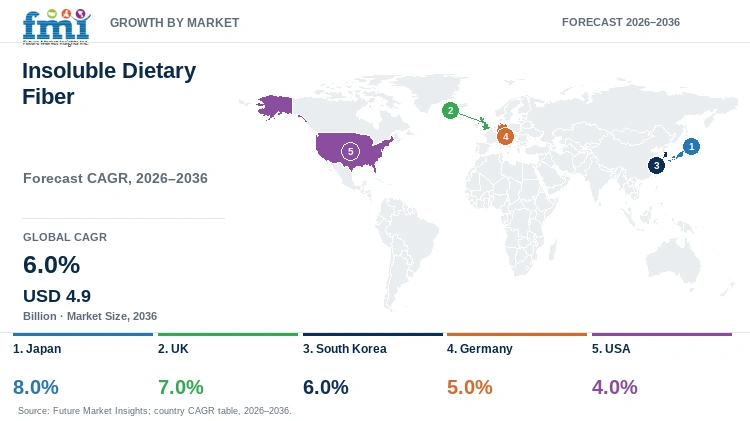
- Japan carries the highest profiled country CAGR at 8.0% from 2026 to 2036, followed by the UK at 7.0%.
- Notable companies include Tate & Lyle PLC, J. Rettenmaier & Sohne GmbH (JRS), Roquette Freres; ADM and Ingredion Incorporated.
Analyst Perspective
“Food manufacturers buy insoluble fiber for more than its fiber content. They test how a grade absorbs water, handles in production and feels in the finished product. Processors that control those properties across batches can make better use of bran and other plant side streams.”
- Nandini Roy Choudhury, Principal Consultant, Future Market Insights
How is the Insoluble Dietary Fiber Market segmented?
The insoluble dietary fiber market is segmented by Product Type, Source, and Region.
The insoluble dietary fiber market uses two segment axes with region as the geographic split.
Product type covers cellulose, bran, lignin, hemicellulose, resistant starch, chitin & chitosan, and others.
Source covers cereals & grains, fruits, citrus fruits, vegetables, legumes, exotic fruits, and other sources.
Why does Cellulose lead demand within the Product Type category?
Cellulose gives formulators a highly controlled way to add insoluble fiber without introducing the broader flavor, color or compositional variation of a minimally refined plant material. Current JRS VITACEL L/LC specifications place dietary fiber above 95% and offer multiple particle-size grades for moisture control, texturizing; anti-caking and sensory-neutral applications. That degree of grade control is valuable in bakery, dry mixes, meat alternatives and other recipes where a small change in water demand can alter processing or bite.
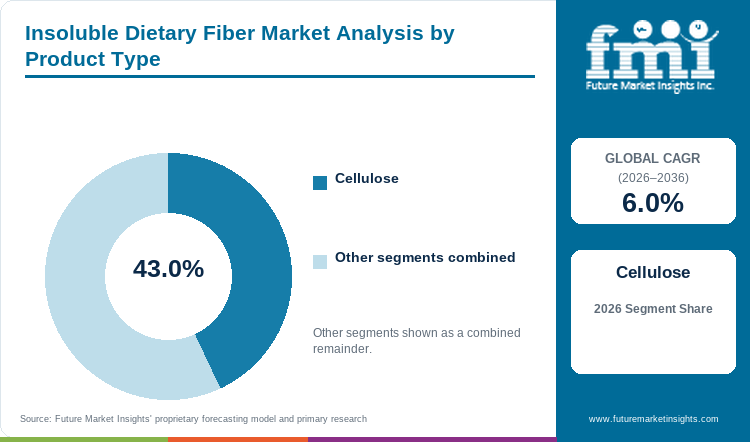
- Cellulose is projected to hold 43.0% of Product Type revenue in 2026, making it the leading chemistry within the Product Type category.
- The commercial advantage is grade precision: particle structure can be selected around water management and texture instead of changing the entire botanical composition of a recipe.
Why do Cereals & Grains lead demand within the Source category?
Cereal processing creates large, concentrated side streams that can be standardized into food-grade dietary fibers. JRS describes its wheat fiber as a standardized ingredient containing about 97% cellulose and hemicellulose, while current research on bran processing shows how physical and enzymatic treatment can reduce the sensory penalty associated with coarse insoluble material. This combination of feedstock availability and established food use keeps cereal-derived fibers relevant even as fruit; vegetable and legume sources expand.
- Cereals & Grains are estimated to account for 31.0% of Source revenue in 2026, the highest share among the listed feedstock groups.
- Cereal residues can enter bakery and grain-based foods with familiar sourcing routes, while modification technologies improve hydration and fermentation behavior when native bran is too rigid.
What are the drivers, restraints and opportunities in the Insoluble Dietary Fiber Market?
Nutrition-led reformulation is increasing ingredient trials, feedstock variability limits standardization, and structural modification is opening higher-value uses for by-product-derived fiber.
- Driver: Fiber enrichment is becoming a formulation decision as food producers try to raise fiber content while protecting texture and repeat-use acceptance.
- Restraint: Botanical variability and aggressive processing can change hydration, particle structure, color and sensory behavior; increasing reformulation work.
- Opportunity: Enzymatic, pressure, microwave and combined treatments can convert underused pomace; bran; okara and potato residues into ingredients with stronger functional value.
Why is fiber enrichment becoming a formulation decision rather than only a nutrition claim?
Public-health data keeps fiber intake on the product-development agenda, but the purchasing trigger occurs inside the recipe. The UK National Diet and Nutrition Survey published in June 2025 found that only 4% of adults met the recommended fiber intake. Manufacturers can respond through familiar foods, yet a higher-fiber label has limited value if the product becomes dry; gritty or difficult to process. Insoluble grades that contribute bulk while remaining neutral in taste and color can therefore win recurring use in bakery; cereals; snacks and nutrition products.
Why does feedstock variability remain a restraint for engineered IDF?
Modification does not create the same result across every plant matrix. Cellulose crystallinity, lignin content, particle size and residual protein or starch affect how a fiber responds to milling; enzymes; pressure or thermal treatment. The 2025 potato-fiber study shows large functional gains under a specific pressure and cellulase route but a formulator still has to match the treated ingredient with the target product. This raises development time when suppliers cannot hold water binding and sensory behavior within a narrow specification from lot to lot.
Where can processing create the strongest commercial opportunity?
The strongest opportunity is to sell functionality with fiber rather than fiber alone. Upcycled citrus fiber can contribute water binding and emulsion stability, while modified cereal or vegetable IDF can support bulk and texture. Reviews published in 2025 and 2026 also describe structurally modified IDF as a low-calorie fat replacer and as a texture-building component in plant-based meat. This widens the addressable use case from fortification to recipe architecture, where value can be measured through yield; mouthfeel; fat reduction or simplified ingredient systems.
Which country CAGRs are profiled in the Insoluble Dietary Fiber Market?
| Country | CAGR |
|---|---|
| Japan | 8.0% |
| UK | 7.0% |
| South Korea | 6.0% |
| Germany | 5.0% |
| USA | 4.0% |
How do country-level CAGRs compare in the Insoluble Dietary Fiber Market?
Japan and the UK sit above the global 6.0% CAGR among the profiled countries, South Korea matches the global rate and Germany and the USA expand more slowly. The rate spread reflects different adoption conditions, from analytical-method changes in Japan to fortification economics in the UK and ingredient-positioning choices in the USA.
- Japan: The 8.0% CAGR coincides with a 2026 Ministry of Health, Labour and Welfare update that reported 18.1 grams of average adult dietary-fiber intake per day in the 2024 survey and discussed newer analytical methods that capture resistant starch and related fractions.
- UK: The 7.0% CAGR is supported by a large intake gap and by 2025 survey evidence showing fiber intake differs by income, which favors affordable reformulation of everyday foods rather than premium positioning alone.
- South Korea: The 6.0% CAGR operates within a market where 2026 import guidance distinguishes ordinary foods from health functional foods, making intended product category important for documentation and channel access.
- Germany: The 5.0% CAGR develops alongside 2025 German-speaking reference values that continue to place fiber-rich foods, including whole grains and bran, at the center of dietary guidance.
- USA: The 4.0% CAGR reflects a mature ingredient market where the 2025-2030 Dietary Guidelines, released in 2026, emphasize nutrient-dense whole foods and whole grains while manufacturers continue to reformulate packaged foods around nutrition and texture goals.
Country-wise Analysis
- Japan: Japan is forecast to expand at 8.0% CAGR from 2026 to 2036. The February 2026 MHLW update highlights both low average fiber intake and a measurement transition that captures more resistant starch and related fractions. Ingredient suppliers that provide method-consistent specifications can reduce confusion when a customer compares old and new fiber values during reformulation.
- UK: The UK market is forecast at 7.0% CAGR through 2036. The June 2025 National Diet and Nutrition Survey found that only a small share of adults met the recommended intake and that intake generally rose with income. This creates room for fiber enrichment in mainstream breads, cereals, and snacks where the finished price and eating quality remain acceptable.
- South Korea: South Korea is projected to grow at 6.0% CAGR. The 2026 USDA FAS country report separates ordinary foods from health functional foods and outlines traceability obligations for the latter. Suppliers therefore benefit when the fiber grade, end-product category, and importer documentation are aligned before commercial scale-up.
- Germany: Germany is projected at 5.0% CAGR from 2026 to 2036. Updated 2025 reference values keep whole grains and bran visible within fiber guidance, so isolated ingredients compete with a strong whole-food route. Grades that improve water management or texture have a clearer commercial role when they solve a formulation problem that whole-grain substitution alone cannot solve.
- USA: The USA carries a 4.0% CAGR through 2036. The 2025-2030 Dietary Guidelines were issued in January 2026 with a strong emphasis on whole, nutrient-dense foods, including whole grains. For ingredient suppliers; the growth route is therefore practical reformulation: achieving a desired fiber level while maintaining the sensory and processing performance consumers already expect.
Who are the notable companies in the Insoluble Dietary Fiber Market?
Tate & Lyle PLC, J. Rettenmaier & Sohne GmbH (JRS), Roquette Freres; ADM and Ingredion Incorporated are notable companies serving this market.
Competition is shaped by what each supplier can do inside a formulation. JRS emphasizes cellulose, wheat, citrus and potato fiber grades with different physical behavior. Tate & Lyle and Ingredion are active in citrus-derived texturizing systems while ADM brings resistant starch options that can add fiber with relatively low water demand. Roquette supplies pea-derived fiber for nutrition and texture applications. The practical comparison is the dose; hydration demand; sensory effect and processing tolerance of the selected grade not the breadth of the parent company alone.
- Cellulose and cereal-fiber specialization: J. Rettenmaier & Sohne GmbH (JRS), with multiple particle-size and botanical grades for food processing.
- Crop-derived cell-wall texturization: Tate & Lyle PLC, Roquette Freres and Ingredion Incorporated, with citrus or pea fiber positioned around water management and texture.
- Resistant-starch and broader fortification systems: ADM and Ingredion Incorporated, which complement insoluble cell-wall fibers with high-fiber starch-based options.
Competitive Benchmarking: Insoluble Dietary Fiber Market
| Company | Cell-wall fiber range | Resistant-starch range | Food-application breadth | Geographic Reach |
|---|---|---|---|---|
| Tate & Lyle PLC | Medium | Low | High | Global specialty food and beverage network |
| J. Rettenmaier & Sohne GmbH (JRS) | High | Low | High | Europe, USA, and international ingredient markets |
| Roquette Freres | Medium | Low | High | Europe, North America, and Asia ingredient markets |
| ADM | Low | Medium | Medium | North America and global ingredient channels |
| Ingredion Incorporated | Medium | Medium | High | Global food and beverage ingredient network |
Key Developments in the Insoluble Dietary Fiber Market
- In July 2026, Tate & Lyle PLC announced shareholder approval of the proposed cash acquisition by Ingredion Incorporated. The transaction remained subject to additional conditions, with effectiveness expected in the second half of 2027. The proposed combination would bring major texturizing and fiber activities into a broader specialty-ingredients portfolio.
- In October 2025, JRS highlighted VITACEL fiber applications in cookies, wafers and fillings; including roles in dough stability; crunch and oil control. The development illustrates a shift from selling fiber only as nutrition toward using physical functionality to support bakery performance.
- In July 2025, Tate & Lyle showcased its expanded portfolio at IFT FIRST 2025 in Chicago, featuring NUTRAVA Citrus Fiber applications and unveiling a new Mouthfeel Lab. The showcase highlighted mouthfeel, sugar reduction and fiber fortification prototypes at its first IFT event following its combination with CP Kelco.
Key Players in the Insoluble Dietary Fiber Market
Cellulose and cereal-fiber specialists
- J. Rettenmaier & Sohne GmbH (JRS)
Crop-derived cell-wall and texturizing fiber suppliers
- Tate & Lyle PLC
- Roquette Freres
- Ingredion Incorporated
Resistant-starch and broader fortification suppliers
- ADM
- Ingredion Incorporated
Insoluble Dietary Fiber Market - Report Scope
| Coverage field | Report scope |
|---|---|
| Market breakdown | By Product Type, Source, and Region. |
| Quantitative Units | USD Billion |
| Market Definition | Revenue from human food- and nutrition-grade insoluble dietary fiber sold within the listed Product Type, Source, and Region categories, including the attributable insoluble component of mixed-fiber ingredients. Finished-product revenue, soluble-only ingredients, and non-food uses are excluded. |
| Regions Covered | North America; Latin America; Western Europe; Eastern Europe; East Asia; South Asia and Pacific; Middle East and Africa |
| Countries Covered | USA; UK; Germany; Japan; South Korea |
| Key Companies Profiled | Tate & Lyle PLC; J. Rettenmaier & Sohne GmbH (JRS); Roquette Freres; ADM; Ingredion Incorporated |
| Forecast Period | 2026 to 2036 |
| Approach | Primary and secondary research with market triangulation. |
Insoluble Dietary Fiber Market - Research Methodology
| Method | Approach |
|---|---|
| Primary Research | FMI analysts gathered input from manufacturers, ingredient suppliers, distributors; food formulators; procurement teams and subject-matter experts. Interviews examined purchasing decisions; formulation requirements; adoption barriers; pricing considerations and expectations for technical support. |
| Desk Research | Desk research covered government nutrition data, regulatory publications, technical literature; peer-reviewed research; company product information and official corporate announcements. Sources were reviewed for relevance; date; geographic coverage and consistency with the defined market scope. |
| Market Sizing and Forecasting | The market model combined the baseline value with segment structure, pricing and volume indicators, adoption levels; company participation and country demand conditions. Forecast assumptions considered reformulation activity; food-industry use; technology adoption; supply availability and barriers to wider use. |
| Data Validation | Estimates were checked against multiple independent indicators, including public data, company activity; industry developments and findings from primary interviews. Validation also tested whether product activity and revenues fell within the defined market boundaries. |
Insoluble Dietary Fiber Market by Segments
Insoluble Dietary Fiber Market segmented by Product Type
- Cellulose
- Bran
- Lignin
- Hemicellulose
- Resistant Starch
- Chitin & Chitosan
- Others
Insoluble Dietary Fiber Market segmented by Source
- Cereals & Grains
- Fruits
- Citrus Fruits
- Vegetables
- Legumes
- Others
- Exotic Fruits
Insoluble Dietary Fiber Market by Region
- North America
- United States
- Canada
- Latin America
- Brazil
- Mexico
- Argentina
- Chile
- Western Europe
- Germany
- France
- United Kingdom
- Italy
- Spain
- Benelux
- Nordics
- Eastern Europe
- Poland
- Czech Republic
- Romania
- Hungary
- East Asia
- China
- Japan
- South Korea
- South Asia and Pacific
- India
- ASEAN
- Australia and New Zealand
- Middle East and Africa
- GCC Countries
- South Africa
- Türkiye
- Israel
Research Sources and Bibliography
- Office for Health Improvement and Disparities (2025, June 11). National Diet and Nutrition Survey 2019 to 2023: report.
- Ministry of Health, Labour and Welfare, Japan (2026; February 16). The need for dietary fiber and health.
- USDA Foreign Agricultural Service (2026, May 7). FAIRS Country Report Annual: Korea - Republic of (KS2026-0007).
- German Nutrition Society and Austrian Nutrition Society (2025). Reference values for nutrient intake, 3rd edition, dietary fiber guidance.
- U.S. Department of Health and Human Services and U.S. Department of Agriculture (2026, January). Dietary Guidelines for Americans, 2025-2030.
- Foods (2026). Insights into the Mechanisms and Functional Effects of Insoluble Dietary Fiber Modification: A Review. 15(1), 38.
- Ma, M. et al. (2025). High hydrostatic pressure-assisted cellulase modification of potato dietary fiber. International Journal of Biological Macromolecules.
- Spiess, R., Jeske; S.; Arcari; M. and Denkel; C. (2025). From insoluble to soluble: An overview of processing methods for dietary fibers in okara. Trends in Food Science & Technology; 156; 104861.
- Cheng, Z. et al. (2025). Structural Modification Strategies to Enhance the Water-Holding Capacity of Insoluble Dietary Fiber in Soybean Residue: Mechanisms and Applications. Food Frontiers.
- J. Rettenmaier & Sohne GmbH (JRS) (current product documentation). VITACEL L/LC Powdered Cellulose; VITACEL WF Wheat Fiber; VITACEL CF Citrus Fiber; VITACEL Potato Fiber.
- J. Rettenmaier & Sohne GmbH (JRS) (2025, October 17). Smarter Cookies Start with Fiber.
- Tate & Lyle PLC (2025, July 7). IFT FIRST 2025 portfolio and NUTRAVA citrus fiber application showcase.
- Ingredion Incorporated (2025, October 24). Citrus fiber gains ground across bakery, beverage; plant-based and savory applications.
- ADM (current product documentation). Resistant tapioca starch for high-fiber food applications.
- Roquette Freres (current product documentation). PEA FIBER I 50M.
- Tate & Lyle PLC (2026, July 28). Recommended cash acquisition of Tate & Lyle PLC by Ingredion Incorporated: Results of Shareholder Meetings.
This bibliography is provided for reader reference and is not exhaustive. The full report contains the complete reference list and detailed citations.
This Report Answers
- How large is the insoluble dietary fiber market in 2026 and what is forecast for 2036?
- How are processing technologies changing the functionality of insoluble dietary fiber?
- Why does Cellulose lead the Product Type category?
- What supports Cereals & Grains in the Source category?
- How are food-processing side streams being converted into higher-value fiber ingredients?
- How do growth rates and adoption conditions differ across the profiled countries?
- Which companies supply cellulose, crop-derived cell-wall fiber, and resistant-starch systems?
- What formulation risks can delay switching or scale-up for a new insoluble fiber grade?
Frequently Asked Questions
How big is the Insoluble Dietary Fiber Market in 2026, and what is forecast for 2036?
The market is valued at USD 2.7 Billion in 2026 and is forecast to reach USD 4.9 Billion by 2036.
What is the CAGR of the Insoluble Dietary Fiber Market from 2026 to 2036?
The forecast CAGR is 6.0% from 2026 to 2036.
Which Product Type segment leads the Insoluble Dietary Fiber Market?
Cellulose leads Product Type revenue in 2026.
Which Source segment leads the Insoluble Dietary Fiber Market?
Cereals & Grains lead Source revenue in 2026.
Which profiled countries have the highest growth rates?
Japan at 8.0% and the UK at 7.0% carry the highest profiled CAGRs from 2026 to 2036.
Which companies are active in the Insoluble Dietary Fiber Market?
The profiled companies are Tate & Lyle PLC, J. Rettenmaier & Sohne GmbH (JRS), Roquette Freres; ADM and Ingredion Incorporated.
Preview the report firsthand - request a free sample
Get SampleGet the brochure for pricing and purchase details.
Get PDFTable of Content
- Key Takeaways
- Market Size and CAGR
- Top Growth Driver
- Fastest Growing Segment
- Leading Region
- Key Companies
- Emerging Opportunities
- Executive Summary
- Global Market Outlook
- Demand-side Trends
- Supply-side Trends
- Technology Roadmap Analysis
- Analysis and Recommendations
- Analyst Perspective (What is happening? Why now? What should investors know?)
- Key Questions Answered
- How large is the market?
- What is the CAGR?
- What are key trends?
- Which region dominates?
- Who are the leaders?
- Market Overview
- Market Coverage / Taxonomy
- Market Definition / Scope / Limitations
- Research Methodology
- Chapter Orientation
- Analytical Lens and Working Hypotheses
- Market Structure, Signals, and Trend Drivers
- Benchmarking and Cross-market Comparability
- Market Sizing, Forecasting, and Opportunity Mapping
- Research Design and Evidence Framework
- Desk Research Programme (Secondary Evidence)
- Expert Input and Fieldwork (Primary Evidence)
- Tooling, Models, and Reference Databases
- Data Engineering and Model Build
- Quality Assurance and Audit Trail
- Market Background
- Market Dynamics (Drivers, Restraints, Opportunity, Trends)
- Scenario Forecast (Optimistic, Likely, Conservative)
- Impact Analysis
- AI Impact
- Sustainability Impact
- Regulatory Impact
- Technology Impact
- Consumer / Buyer Analysis
- Purchase Drivers
- Adoption Barriers
- Buyer Journey
- Opportunity Map Analysis
- Product Life Cycle Analysis
- Supply Chain Analysis
- Investment Feasibility Matrix
- Value Chain Analysis
- PESTLE and Porter's Analysis
- Regulatory Landscape
- Regional Parent Market Outlook
- Production and Consumption Statistics
- Import and Export Statistics
- Global Market Analysis and Forecast, 2021 to 2036
- Historical Market Size Value (USD Billion) Analysis, 2021 to 2025
- Current and Future Market Size Value (USD Billion) Projections, 2026 to 2036
- Y-o-Y Growth Trend Analysis
- Absolute $ Opportunity Analysis
- Global Market Pricing Analysis, 2021 to 2036
- Global Market Analysis and Forecast, By Product Type, 2021 to 2036
- Introduction / Key Findings
- Historical Market Size Value (USD Billion) Analysis By Product Type, 2021 to 2025
- Current and Future Market Size Value (USD Billion) Analysis and Forecast By Product Type, 2026 to 2036
- Cellulose
- Bran
- Lignin
- Hemicellulose
- Resistant Starch
- Chitin & Chitosan
- Others
- Y-o-Y Growth Trend Analysis By Product Type, 2021 to 2025
- Absolute $ Opportunity Analysis By Product Type, 2026 to 2036
- Global Market Analysis and Forecast, By Source, 2021 to 2036
- Introduction / Key Findings
- Historical Market Size Value (USD Billion) Analysis By Source, 2021 to 2025
- Current and Future Market Size Value (USD Billion) Analysis and Forecast By Source, 2026 to 2036
- Cereals & Grains
- Fruits
- Citrus Fruits
- Vegetables
- Legumes
- Others
- Exotic Fruits
- Y-o-Y Growth Trend Analysis By Source, 2021 to 2025
- Absolute $ Opportunity Analysis By Source, 2026 to 2036
- Global Market Analysis and Forecast, By Region, 2021 to 2036
- Introduction
- Historical Market Size Value (USD Billion) Analysis By Region, 2021 to 2025
- Current Market Size Value (USD Billion) Analysis and Forecast By Region, 2026 to 2036
- North America
- Latin America
- Western Europe
- Eastern Europe
- East Asia
- South Asia and Pacific
- Middle East and Africa
- Market Attractiveness Analysis By Region
- North America Market Analysis and Forecast, By Country, 2021 to 2036
- Historical Market Size Value (USD Billion) Trend Analysis By Market Taxonomy, 2021 to 2025
- Market Size Value (USD Billion) Forecast By Market Taxonomy, 2026 to 2036
- By Country
- United States
- Canada
- By Product Type
- By Source
- By Country
- Market Attractiveness Analysis
- By Country
- By Product Type
- By Source
- Key Takeaways
- Latin America Market Analysis and Forecast, By Country
- Historical Market Size Value (USD Billion) Trend Analysis By Market Taxonomy, 2021 to 2025
- Market Size Value (USD Billion) Forecast By Market Taxonomy, 2026 to 2036
- By Country
- Brazil
- Mexico
- Argentina
- Chile
- By Product Type
- By Source
- By Country
- Market Attractiveness Analysis
- By Country
- By Product Type
- By Source
- Key Takeaways
- Western Europe Market Analysis and Forecast, By Country
- Historical Market Size Value (USD Billion) Trend Analysis By Market Taxonomy, 2021 to 2025
- Market Size Value (USD Billion) Forecast By Market Taxonomy, 2026 to 2036
- By Country
- Germany
- France
- United Kingdom
- Italy
- Spain
- Benelux
- Nordics
- By Product Type
- By Source
- By Country
- Market Attractiveness Analysis
- By Country
- By Product Type
- By Source
- Key Takeaways
- Eastern Europe Market Analysis and Forecast, By Country
- Historical Market Size Value (USD Billion) Trend Analysis By Market Taxonomy, 2021 to 2025
- Market Size Value (USD Billion) Forecast By Market Taxonomy, 2026 to 2036
- By Country
- Poland
- Czech Republic
- Romania
- Hungary
- By Product Type
- By Source
- By Country
- Market Attractiveness Analysis
- By Country
- By Product Type
- By Source
- Key Takeaways
- East Asia Market Analysis and Forecast, By Country
- Historical Market Size Value (USD Billion) Trend Analysis By Market Taxonomy, 2021 to 2025
- Market Size Value (USD Billion) Forecast By Market Taxonomy, 2026 to 2036
- By Country
- China
- Japan
- South Korea
- By Product Type
- By Source
- By Country
- Market Attractiveness Analysis
- By Country
- By Product Type
- By Source
- Key Takeaways
- South Asia and Pacific Market Analysis and Forecast, By Country
- Historical Market Size Value (USD Billion) Trend Analysis By Market Taxonomy, 2021 to 2025
- Market Size Value (USD Billion) Forecast By Market Taxonomy, 2026 to 2036
- By Country
- India
- ASEAN
- Australia and New Zealand
- By Product Type
- By Source
- By Country
- Market Attractiveness Analysis
- By Country
- By Product Type
- By Source
- Key Takeaways
- Middle East and Africa Market Analysis and Forecast, By Country
- Historical Market Size Value (USD Billion) Trend Analysis By Market Taxonomy, 2021 to 2025
- Market Size Value (USD Billion) Forecast By Market Taxonomy, 2026 to 2036
- By Country
- GCC Countries
- South Africa
- Türkiye
- Israel
- By Product Type
- By Source
- By Country
- Market Attractiveness Analysis
- By Country
- By Product Type
- By Source
- Key Takeaways
- Key Countries Market Analysis
- United States
- Pricing Analysis
- Market Share Analysis, 2025
- By Product Type
- By Source
- Canada
- Pricing Analysis
- Market Share Analysis, 2025
- By Product Type
- By Source
- Mexico
- Pricing Analysis
- Market Share Analysis, 2025
- By Product Type
- By Source
- Brazil
- Pricing Analysis
- Market Share Analysis, 2025
- By Product Type
- By Source
- Chile
- Pricing Analysis
- Market Share Analysis, 2025
- By Product Type
- By Source
- Germany
- Pricing Analysis
- Market Share Analysis, 2025
- By Product Type
- By Source
- United Kingdom
- Pricing Analysis
- Market Share Analysis, 2025
- By Product Type
- By Source
- Italy
- Pricing Analysis
- Market Share Analysis, 2025
- By Product Type
- By Source
- Spain
- Pricing Analysis
- Market Share Analysis, 2025
- By Product Type
- By Source
- France
- Pricing Analysis
- Market Share Analysis, 2025
- By Product Type
- By Source
- India
- Pricing Analysis
- Market Share Analysis, 2025
- By Product Type
- By Source
- ASEAN
- Pricing Analysis
- Market Share Analysis, 2025
- By Product Type
- By Source
- Australia and New Zealand
- Pricing Analysis
- Market Share Analysis, 2025
- By Product Type
- By Source
- China
- Pricing Analysis
- Market Share Analysis, 2025
- By Product Type
- By Source
- Japan
- Pricing Analysis
- Market Share Analysis, 2025
- By Product Type
- By Source
- South Korea
- Pricing Analysis
- Market Share Analysis, 2025
- By Product Type
- By Source
- Poland
- Pricing Analysis
- Market Share Analysis, 2025
- By Product Type
- By Source
- Hungary
- Pricing Analysis
- Market Share Analysis, 2025
- By Product Type
- By Source
- Türkiye
- Pricing Analysis
- Market Share Analysis, 2025
- By Product Type
- By Source
- South Africa
- Pricing Analysis
- Market Share Analysis, 2025
- By Product Type
- By Source
- United States
- Market Structure Analysis
- Competition Dashboard
- Competition Benchmarking
- Market Share Analysis of Top Players
- By Regional
- By Product Type
- By Source
- Emerging Startups
- Innovation Benchmarking
- Competition Analysis
- Competition Deep Dive
- Tate & Lyle PLC
- Overview
- Product Portfolio
- Profitability by Market Segments
- Sales Footprint
- Strategy Overview
- Marketing Strategy
- Product Strategy
- Channel Strategy
- J. Rettenmaier & Sohne GmbH (JRS)
- Roquette Freres
- ADM
- Ingredion Incorporated
- Tate & Lyle PLC
- Case Studies
- Success Stories
- Recent Developments
- Competition Deep Dive
- Assumptions & Acronyms Used


