

- Market Size (2026)
- USD 8.9 Bn
- Forecast (2036)
- USD 19.6 Bn
- CAGR (2026 to 2036)
- 8.2%
How big is Dietary Fibers & Prebiotic Fiber Market in 2026?
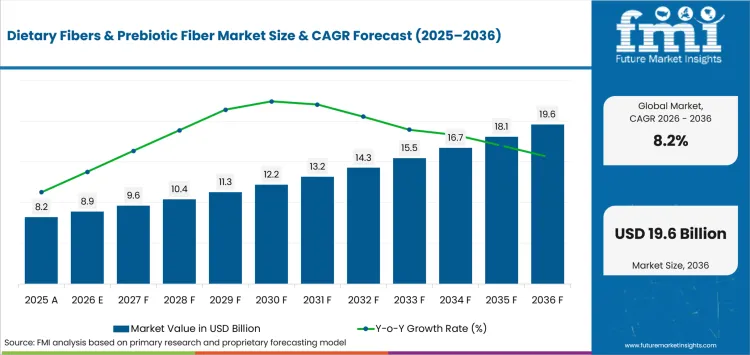
USD 8.9 billion in 2026 and USD 19.6 billion by 2036 at an 8.2% CAGR.
Demand for dietary fibers and prebiotic fiber is projected to expand at 8.2% CAGR between 2026 and 2036, increasing valuation from USD 8.9 billion in 2026 to USD 19.6 billion by 2036. Food manufacturers convert nutrition targets into orders once the ingredient performs inside the finished recipe at the intended commercial dose. Tate & Lyle reported in May 2025 that new-product revenue increased 9% amid strong fibre demand within its food and beverage business. Commercial orders favor dietary fiber ingredients that preserve texture and taste at the intended inclusion level.
National nutrition policy changes country conversion rates by giving food manufacturers different local enrichment benchmarks and labeling conditions. China’s Ministry of Agriculture and Rural Affairs reported in March 2025 that the national food guideline targets daily fiber intake of 25 to 30 grams by 2030, giving domestic teams a quantified recipe benchmark. USA and European manufacturers face separate label and claim rules, so prebiotic fiber ingredients require different proof packages for commercial positioning.
Key Takeaways of Dietary Fibers & Prebiotic Fiber Market
- Food manufacturers increase fiber use once declaration rules and formulation testing support a credible nutrition claim without disrupting finished-product performance.
- Based on type, inulin is projected to account for 39.0% in 2026 due to its established prebiotic role across food formulations.
- By source, plant-based fiber is estimated to hold 50.4% in 2026 owing to broad botanical feedstocks and familiar ingredient positioning.
- In 2026, bakery is expected to lead application with 37.9% share because industrial dough systems accept controlled fiber dosing at scale.
- Digestive tolerance and sensory change can cap inclusion levels despite a finished product meeting its intended fiber claim.
- BENEO and Roquette join Ingredion and Tate & Lyle among the eight profiled companies serving food formulations. ADM and IFF join Cosun Ingredients and Nexira across documented fiber chemistries and formulation routes.
Analyst Perspective
"For prebiotic fibers a claim-ready dossier has little value if the required dose changes taste or causes avoidable tolerance complaints. Dietary-fiber companies earn repeat business by matching claim evidence with recipe performance at a dose consumers can consistently tolerate."
- Nandini Roy Choudhury, Principal Consultant, Future Market Insights
How is the Dietary Fibers & Prebiotic Fiber Market segmented?
The dietary fibers & prebiotic fiber market covers type and source plus application and region.
The dietary fibers & prebiotic fiber market uses four dimensions to separate ingredient chemistry from commercial use and geography. Type includes inulin and resistant starch alongside soluble or insoluble fiber, beta-glucan and polydextrose ingredients. Source distinguishes plant-based and animal-based inputs from microbial and synthetic routes used in commercial ingredient production. Application covers bakery and beverages alongside dairy and supplements, while region follows the standard FMI geographic taxonomy.
Why does bakery lead the application category?
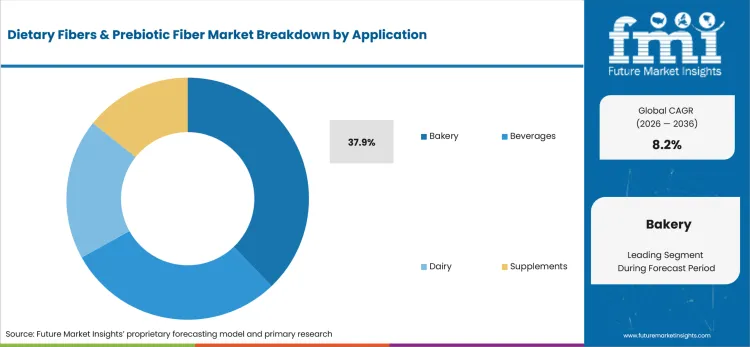
Bakery gives fiber ingredients a high-volume route because dry powders can enter doughs and batters during routine mixing. RIVM reported in June 2026 that Dutch supermarket brown bread contained 0.3 grams more fiber per 100 grams than 2020 products, documenting recipe change in a monitored bakery category.
- Bakery is set to lead the application category with 37.9% share in 2026 due to routine dry-ingredient dosing across high-throughput production.
- Industrial bakers compare water binding and machinability against crumb texture as resistant starch or other fibers advance toward repeat production during commercial qualification at scale.
What makes inulin central to the type category?
Inulin ingredients give food formulators soluble fiber enrichment plus prebiotic positioning within one ingredient. Selected reduced-sugar and reduced-fat recipes also use inulin for solids and body as nutrition targets change across categories.
- By type, inulin is forecast to represent 39.0% in 2026 driven by soluble fiber enrichment with texture support. SAMR published an English version of China’s inulin quality requirement in September 2025, giving domestic and imported ingredients one common quality reference.
- Food formulators select inulin where solubility and sweetness replacement reduce recipe changes, but dose tolerance and claim wording still require product-specific qualification.
Why do plant-based sources lead the source category?
Plant-based fiber lets manufacturers match solubility and texture against the cost limits of each finished product. Chicory and cereal inputs cover familiar fortification routes, while acacia and citrus give formulators different sensory profiles and sourcing options across food formats.
- The plant-based segment is likely to capture 50.4% share in 2026 attributable to broad feedstock choice across multiple fiber chemistries.
- Traceable sourcing matters for plant-based fiber users that need documented collection and processing records during ingredient qualification. Nexira announced in November 2025 that four acacia-gum references received Fair For Life certification from collection to processing.
What are the drivers, restraints and opportunities in the Dietary Fibers & Prebiotic Fiber Market?
Nutrition guidance and label rules turn fiber targets into formulation work, although tolerance limits adoption and multifunctional fibers widen reformulation budgets.
- Driver: Formal nutrition guidance gives manufacturers measurable reasons to raise fiber content across frequently consumed food formats.
- Restraint: Claim substantiation and dose tolerance increase the evidence and testing burden during scale-up of higher fiber levels.
- Opportunity: Multifunctional fibers can win reformulation budgets if nutrition improvement also preserves texture or replaces cost-sensitive ingredients.
National Nutrition Guidance Converts Into Formulation Briefs
USDA and HHS released the 2025-2030 Dietary Guidelines in January 2026, giving USA food manufacturers a current federal nutrition reference. The guidance prioritizes whole grains and nutrient-dense foods, placing fiber enrichment inside routine reformulation briefs for frequently consumed products. Commercial conversion depends on food dietary fibers meeting texture and use-level targets to turn a nutrition brief into recurring ingredient demand.
Claim Standards Raise the Cost of Prebiotic Positioning
European prebiotic positioning requires scientific substantiation beyond a basic fiber declaration during claim development for commercial use. EFSA’s health-claims page reviewed in April 2025 records more than 2,300 applications evaluated under the European system and makes product-specific evidence a routine qualification cost. Fiber manufacturers therefore spend additional time on dossiers for beta-glucan fibers or other candidates that rely on prebiotic or digestive claims.
Multifunctional Ingredients Broaden Reformulation Budgets
Food manufacturers can justify a higher fiber ingredient cost if the same reformulation also protects texture in the finished product. Application teams therefore compare nutrition gains with process stability during the same development cycle for bars, beverages and other reformulated foods. Tate & Lyle began operating with CP Kelco as one combined business in April 2025, placing fiber fortification beside a broader texture portfolio for citrus fiber and related reformulation work.
Which country CAGRs are profiled in the Dietary Fibers & Prebiotic Fiber Market?
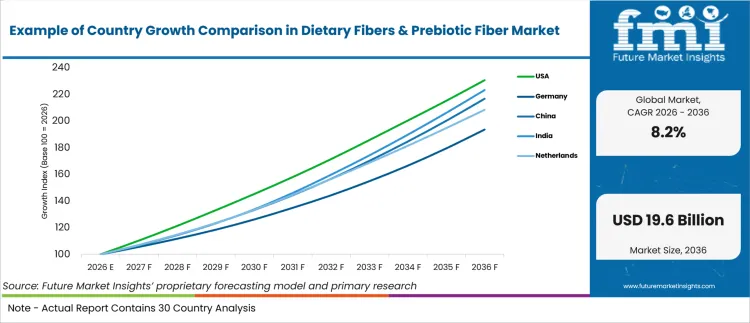
| Country | CAGR |
|---|---|
| USA | 8.7% |
| India | 8.4% |
| China | 8.0% |
| Netherlands | 7.6% |
| Germany | 6.8% |
How do country-level CAGRs compare in the Dietary Fibers & Prebiotic Fiber Market?
The 1.9-point spread forms an upper USA-India pair, a China-Netherlands middle band and a separate German rate. The spacing is narrow enough that qualification economics matter more than small forecast gaps. Label rules and test methods therefore determine whether similar growth rates convert into comparable account opportunities for dietary fiber ingredient companies.
- USA label rules make claim eligibility a gate for repeat retail orders.
- Indian mass-market recipes impose tighter cost ceilings on added-fiber dosage.
- China’s revised test method raises the value of locally reproducible fiber results.
- Dutch supermarket reformulation rewards fibers that preserve established bread texture.
- German cereal and bakery accounts require claim evidence beside sensory stability.
Similar CAGRs can therefore produce different qualification costs and entry timing.
The full report provides country-level CAGR analysis across North America, Latin America, Europe, East Asia, South Asia, Oceania and the Middle East and Africa.
Country-wise Analysis
- USA packaged-food manufacturers assess fiber against label eligibility and recipe performance across cereals and snack bars sold through national retail channels with strict specifications and frequent reformulation cycles across multiple branded product lines. FDA stated in March 2025 that the updated “healthy” claim requires qualifying food-group amounts plus nutrient limits, so added fiber alone cannot secure that voluntary label position during finished-product review at launch. Dietary fibers and prebiotic fiber demand in the USA is forecast to rise at 8.7% CAGR over the forecast period, supported by broad reformulation activity despite claim-record and sensory-testing costs for repeat national accounts.
- Indian food manufacturers test fiber enrichment against tight price ceilings in staple foods and mass-market packaged products, since small recipe cost increases can block adoption outside premium supplements or specialized nutrition channels. The Indian dietary fibers and prebiotic fiber sector is projected to record 8.4% CAGR during the assessment period, aided by broad retail reach and familiar cereal or dairy formats that can carry added fiber. FSSAI places foods containing prebiotics within a defined functional-food category under its 2016 framework, giving companies a national approval route that still requires licensing evidence plus competitive cost-in-use and familiar taste at scale.
- Chinese food manufacturers need dietary-fiber results that domestic laboratories can reproduce as imported ingredients enter large retail programs with separate commercial quality-review schedules and claim records. China’s dietary fibers and prebiotic fiber outlook is anticipated to advance at 8.0% CAGR over the assessment period, and SAMR’s July 2025 revision project gives laboratories sixteen months to update the national dietary-fiber test method. The changing test route rewards ingredient companies with local laboratory support and method-ready documentation, but imported fibers face added validation work whenever existing certificates do not align with domestic testing results across commercial product files for national retail accounts.
- Dutch food manufacturers work inside a national product-improvement program, and the Health Council’s July 2026 revision of dietary reference values gives nutrition teams an updated benchmark for everyday food reformulation decisions. Concentrated supermarket channels make recipe changes visible across bread categories, so ingredient companies can reach large volumes quickly if a fiber preserves established dough handling and familiar consumer texture during national rollouts. By 2036 the Netherlands is projected to grow at 7.6% CAGR supported by active reformulation, but commercial conversion remains sensitive to crumb structure and flavor as established bakery brands reject fibers that change core eating quality.
- German bakery and cereal manufacturers work in a mature nutrition market where DGE reaffirmed an adult fiber reference of at least 30 grams per day in May 2026, keeping a familiar nutrition benchmark inside national formulation briefs. Adoption of dietary fibers and prebiotic fiber in Germany is estimated to expand at 6.8% CAGR through 2036, supported by familiar high-fiber positioning across breads and cereals sold through national retail channels. Established awareness lowers the education burden for ingredient companies, but commercial wins still depend on processing stability and claim evidence that preserves familiar taste across repeat bakery and cereal production.
Who are the notable companies in the Dietary Fibers & Prebiotic Fiber Market?
BENEO, Roquette, Ingredion, Tate & Lyle, ADM, IFF, Cosun Ingredients and Nexira are the eight companies profiled in this market.
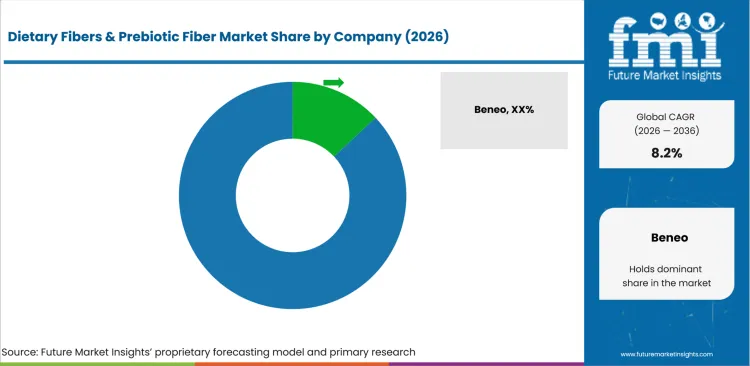
The competitive field is fragmented across chicory-root specialists, starch-derived fiber producers and diversified food-ingredient groups. Companies with focused soluble fiber formats compete on evidence depth while diversified groups combine polydextrose systems with texture tools and application laboratories. Entry barriers center on stable finished-product performance plus regional supply that can reproduce the same specification after qualification.
- BENEO and Cosun Ingredients concentrate on chicory-root inulin and fructan fibers with documented prebiotic positioning across food applications.
- Roquette and ADM join Tate & Lyle across soluble starch or dextrin fibers with broad application coverage.
- Ingredion and Nexira cover citrus and acacia fiber routes, while IFF adds polydextrose-based prebiotic fiber for bakery formulation.
Competitive Benchmarking: Dietary Fibers & Prebiotic Fiber Market
| Company | Fiber Chemistry Breadth | Application Coverage | Evidence & Claim Support | Geographic Reach |
|---|---|---|---|---|
| BENEO | Medium | High | High | Europe, North America, Asia-Pacific |
| Roquette | Medium | High | High | Europe, North America, Asia-Pacific |
| Ingredion | High | High | Medium | North America, Latin America, Europe, Asia-Pacific |
| Tate & Lyle | High | High | High | North America, Europe, Asia-Pacific |
| ADM | Medium | High | High | North America, Europe, Asia-Pacific |
| IFF | Low | Low | Medium | North America |
| Cosun Ingredients | Low | High | Medium | Europe, North America, Asia-Pacific |
| Nexira | Low | High | High | Europe, North America, Asia-Pacific |
Key Developments in the Dietary Fibers & Prebiotic Fiber Market
- In February 2026, Roquette announced that NUTRIOSE soluble fibers gained NutraStrong Prebiotic Verified certification from SGS Nutrasource for three specified fiber references.
- In September 2025, ADM announced that Fibersol soluble prebiotic fiber received Australian TGA approval for use as an active ingredient in regulated health products.
- In September 2025, BENEO announced Thai FDA approval for an exclusive prebiotic claim covering Orafti Inulin after scientific evaluation by Thailand’s CNACT.
Key Players in the Dietary Fibers & Prebiotic Fiber Market
Chicory and Fructan Fiber Platforms
- BENEO
- Cosun Ingredients
Starch and Dextrin Fiber Platforms
- Roquette
- ADM
- Tate & Lyle
Specialty Citrus, Acacia and Polydextrose Platforms
- Ingredion
- Nexira
- IFF
Dietary Fibers & Prebiotic Fiber Market - Report Scope
| Coverage field | Report scope |
|---|---|
| Market breakdown | By type, source, application and region. |
| Quantitative Units | Revenue in USD billion and CAGR in %. |
| Market Definition | Revenue covers dietary fiber and prebiotic fiber ingredient sales across the defined type, source and application categories while excluding downstream finished-product revenue. |
| Regions Covered | North America, Latin America, Europe, East Asia, South Asia and Pacific, and Middle East and Africa. |
| Countries Covered | USA, India, China, Netherlands, Germany, and 20+ countries included in the full report. |
| Key Companies Profiled | BENEO, Roquette, Ingredion, Tate & Lyle, ADM, IFF, Cosun Ingredients, Nexira. |
| Forecast Period | 2026 to 2036. |
| Approach | Primary and secondary research with market triangulation. |
Dietary Fibers & Prebiotic Fiber Market - Research Methodology
| Method | Approach |
|---|---|
| Primary Research | FMI analysts gathered input from manufacturers, service providers, technology developers, distributors, end users, procurement teams, and subject-matter experts. Interviews examined purchasing decisions, product or service evaluation, adoption barriers, approval requirements, pricing considerations, and expectations for technical or commercial support. Respondents were also asked what evidence is required before a trial, pilot, or initial order develops into regular purchasing. |
| Desk Research | Desk research covered government statistics, regulatory publications, trade data, industry associations, technical literature, standards, company filings, product information, and official corporate announcements. Sources were reviewed for relevance, publication date, geographic coverage, and consistency with the defined market scope. Claims relating to performance, applications, approvals, capacity, investment, and commercial activity were retained only when supported by credible public evidence. |
| Market Sizing and Forecasting | The market model combined the baseline value with historical performance, segment structure, pricing and volume indicators, adoption levels, company participation, and country-level demand conditions. Forecast assumptions considered economic activity, investment trends, regulatory developments, technology adoption, purchasing cycles, supply availability, and barriers to wider market use. Segment and regional estimates were reconciled before the final market total was calculated. |
| Data Validation | Estimates were checked against multiple independent indicators, including public data, company activity, trade patterns, industry developments, and findings from primary interviews. Validation also tested whether products, services, applications, and company revenues fell within the defined market boundaries. Adjacent categories, unsupported claims, overlapping revenues, and activities without direct market relevance were excluded to reduce double counting and maintain consistency across segments and countries. |
Dietary Fibers & Prebiotic Fiber Market by Segments
Dietary Fibers & Prebiotic Fiber Market segmented by Type:
- Inulin
- Resistant Starch
- Soluble/Insoluble
- Beta-glucan
- Polydextrose
Dietary Fibers & Prebiotic Fiber Market segmented by Source:
- Plant-Based
- Animal-Based
- Microbial
- Synthetic
Dietary Fibers & Prebiotic Fiber Market segmented by Application:
- Bakery
- Beverages
- Dairy
- Supplements
Dietary Fibers & Prebiotic Fiber Market by Region:
- North America
- United States
- Canada
- Latin America
- Brazil
- Mexico
- Chile
- Rest of Latin America
- Western Europe
- Germany
- United Kingdom
- Italy
- Spain
- France
- Nordics
- Benelux
- Rest of Western Europe
- Eastern Europe
- Russia
- Poland
- Hungary
- Balkan and Baltic States
- Rest of Eastern Europe
- East Asia
- China
- Japan
- South Korea
- South Asia and Pacific
- India
- ASEAN
- Australia and New Zealand
- Rest of South Asia and Pacific
- Middle East and Africa
- Kingdom of Saudi Arabia
- Other GCC Countries
- Türkiye
- South Africa
- Other African Union Countries
- Rest of Middle East and Africa
Research Sources and Bibliography
- Tate & Lyle PLC. (2025, May 22). Tate & Lyle PLC 2025 Full Year Results Statement.
- Ministry of Agriculture and Rural Affairs of the People’s Republic of China. (2025, March 19). Guideline aims to promote balanced nutrition, healthier lifestyles.
- State Administration for Market Regulation. (2025, September 23). Quality requirements for inulin.
- Nexira. (2025, November 27). Nexira launches a Fair For Life certified acacia gum range.
- National Institute for Public Health and the Environment. (2026, June 26). Monitor van de Nationale Aanpak Productverbetering 2025.
- USA Department of Health and Human Services & USA Department of Agriculture. (2026, January). Dietary Guidelines for Americans, 2025-2030.
- European Food Safety Authority. (2025, April 3). Health claims.
- Tate & Lyle PLC. (2025, April 15). Integration update and Pre-close statement.
- USA Food and Drug Administration. (2025, March 27). FDA Reschedules Webinar on the Updated “Healthy” Claim.
- Food Safety and Standards Authority of India. (2017, January 6). Gazette Notification of Food Safety and Standards (Food or Health Supplements, Nutraceuticals, Foods for Special Dietary Uses, Foods for Special Medical Purpose, Functional Foods and Novel Food) Regulations, 2016.
- State Administration for Market Regulation. (2025, July 1). Determination of dietary fiber in foods-Enzymatic gravimetric method-liquid chromatography.
- Health Council of the Netherlands. (2026, July 7). Revised dietary reference values for fatty acids, fats, carbohydrates and dietary fibre.
- Deutsche Gesellschaft für Ernährung. (2026, May 7). Ausgewählte Fragen und Antworten zu Ballaststoffen.
- Ingredion. (2025, October 24). Citrus fiber gains ground as clean label solution to complex challenges.
- International Flavors & Fragrances Inc. (2025, September 2). IFF tackles top challenges in baking at IBIE 2025.
- Royal Cosun. (2026, February 13). Strong headwinds impact results in dynamic 2025.
- BENEO. (2025, September 18). BENEO secures first-ever Thai FDA approval for exclusive prebiotic claim.
- Roquette. (2026, February 3). NUTRIOSE Soluble Fibers: NutraStrong Prebiotic Verified.
- ADM. (2025, September 29). ADM’s Fibersol Approved by Therapeutic Goods Administration as an Active Ingredient for Health Products in Australia.
This bibliography is provided for reader reference and is not exhaustive. The full report contains the complete reference list and detailed citations
This Report Answers
- How large is the dietary fibers & prebiotic fiber market in 2026 and 2036?
- Which formulation and nutrition conditions support recurring demand for dietary fiber ingredients?
- Why does inulin account for 39.0% of type demand in 2026?
- How do plant-based sources change feedstock choice and qualification requirements?
- Why does bakery represent 37.9% of application demand in 2026?
- How do country growth conditions differ across the USA, India, China, the Netherlands and Germany?
- Which companies compete across chicory, starch-derived, citrus, acacia and polydextrose fiber routes?
- What limits wider use across claim substantiation, sensory performance and digestive tolerance?
Frequently Asked Questions
How big is the Dietary Fibers & Prebiotic Fiber Market in 2026?
The dietary fibers & prebiotic fiber market is expected to be valued at USD 8.9 billion in 2026. It is projected to reach USD 19.6 billion by 2036 as manufacturers add documented fiber without sacrificing finished-product performance.
What is the CAGR of the Dietary Fibers & Prebiotic Fiber Market from 2026 to 2036?
The dietary fibers & prebiotic fiber market is projected to grow at 8.2% CAGR from 2026 to 2036. Nutrition guidance sustains the forecast, although claim substantiation and digestive tolerance influence commercial conversion.
Which type segment is projected to account for 39.0% of the Dietary Fibers & Prebiotic Fiber Market?
The dietary fibers & prebiotic fiber market is expected to record a 39.0% type share for inulin in 2026. Its position reflects soluble-fiber enrichment plus prebiotic use in selected reduced-sugar and reduced-fat formulations.
How much will the Dietary Fibers & Prebiotic Fiber Market add between 2026 and 2036?
The dietary fibers & prebiotic fiber market is expected to add USD 10.7 billion between 2026 and 2036. The incremental value reflects ingredient use across foods and supplements with documented fiber status and stable taste or processing performance.
Which companies are active in the Dietary Fibers & Prebiotic Fiber Market?
The dietary fibers & prebiotic fiber market includes BENEO and Roquette alongside Ingredion and Tate & Lyle among active companies. ADM and IFF join Cosun Ingredients and Nexira across chicory, starch-derived, citrus, acacia and polydextrose fiber routes.
Preview the report firsthand - request a free sample
Get SampleGet the brochure for pricing and purchase details.
Get PDFTable of Content
- Key Takeaways
- Market Size and CAGR
- Top Growth Driver
- Fastest Growing Segment
- Leading Region
- Key Companies
- Emerging Opportunities
- Executive Summary
- Global Market Outlook
- Demand-side Trends
- Supply-side Trends
- Technology Roadmap Analysis
- Analysis and Recommendations
- Analyst Perspective (What is happening? Why now? What should investors know?)
- Key Questions Answered
- How large is the market?
- What is the CAGR?
- What are key trends?
- Which region dominates?
- Who are the leaders?
- Market Overview
- Market Coverage / Taxonomy
- Market Definition / Scope / Limitations
- Research Methodology
- Chapter Orientation
- Analytical Lens and Working Hypotheses
- Market Structure, Signals, and Trend Drivers
- Benchmarking and Cross-market Comparability
- Market Sizing, Forecasting, and Opportunity Mapping
- Research Design and Evidence Framework
- Desk Research Programme (Secondary Evidence)
- Expert Input and Fieldwork (Primary Evidence)
- Tooling, Models, and Reference Databases
- Data Engineering and Model Build
- Quality Assurance and Audit Trail
- Market Background
- Market Dynamics (Drivers, Restraints, Opportunity, Trends)
- Scenario Forecast (Optimistic, Likely, Conservative)
- Impact Analysis
- AI Impact
- Sustainability Impact
- Regulatory Impact
- Technology Impact
- Consumer / Buyer Analysis
- Purchase Drivers
- Adoption Barriers
- Buyer Journey
- Opportunity Map Analysis
- Product Life Cycle Analysis
- Supply Chain Analysis
- Investment Feasibility Matrix
- Value Chain Analysis
- PESTLE and Porter's Analysis
- Regulatory Landscape
- Regional Parent Market Outlook
- Production and Consumption Statistics
- Import and Export Statistics
- Global Market Analysis and Forecast, 2021 to 2036
- Historical Market Size Value (USD Billion) Analysis, 2021 to 2025
- Current and Future Market Size Value (USD Billion) Projections, 2026 to 2036
- Y-o-Y Growth Trend Analysis
- Absolute $ Opportunity Analysis
- Global Market Pricing Analysis, 2021 to 2036
- Global Market Analysis and Forecast, By Type, 2021 to 2036
- Introduction / Key Findings
- Historical Market Size Value (USD Billion) Analysis By Type, 2021 to 2025
- Current and Future Market Size Value (USD Billion) Analysis and Forecast By Type, 2026 to 2036
- Inulin
- Resistant Starch
- Soluble/Insoluble
- Beta-glucan
- Polydextrose
- Inulin
- Y-o-Y Growth Trend Analysis By Type, 2021 to 2025
- Absolute $ Opportunity Analysis By Type, 2026 to 2036
- Global Market Analysis and Forecast, By Source, 2021 to 2036
- Introduction / Key Findings
- Historical Market Size Value (USD Billion) Analysis By Source, 2021 to 2025
- Current and Future Market Size Value (USD Billion) Analysis and Forecast By Source, 2026 to 2036
- Plant-Based
- Animal-Based
- Microbial
- Synthetic
- Plant-Based
- Y-o-Y Growth Trend Analysis By Source, 2021 to 2025
- Absolute $ Opportunity Analysis By Source, 2026 to 2036
- Global Market Analysis and Forecast, By Application, 2021 to 2036
- Introduction / Key Findings
- Historical Market Size Value (USD Billion) Analysis By Application, 2021 to 2025
- Current and Future Market Size Value (USD Billion) Analysis and Forecast By Application, 2026 to 2036
- Bakery
- Beverages
- Dairy
- Supplements
- Bakery
- Y-o-Y Growth Trend Analysis By Application, 2021 to 2025
- Absolute $ Opportunity Analysis By Application, 2026 to 2036
- Global Market Analysis and Forecast, By Region, 2021 to 2036
- Introduction
- Historical Market Size Value (USD Billion) Analysis By Region, 2021 to 2025
- Current Market Size Value (USD Billion) Analysis and Forecast By Region, 2026 to 2036
- North America
- Latin America
- Western Europe
- Eastern Europe
- East Asia
- South Asia and Pacific
- Middle East & Africa
- Market Attractiveness Analysis By Region
- North America Market Analysis and Forecast, By Country, 2021 to 2036
- Historical Market Size Value (USD Billion) Trend Analysis By Market Taxonomy, 2021 to 2025
- Market Size Value (USD Billion) Forecast By Market Taxonomy, 2026 to 2036
- By Country
- USA
- Canada
- By Type
- By Source
- By Application
- By Country
- Market Attractiveness Analysis
- By Country
- By Type
- By Source
- By Application
- Key Takeaways
- Latin America Market Analysis and Forecast, By Country
- Historical Market Size Value (USD Billion) Trend Analysis By Market Taxonomy, 2021 to 2025
- Market Size Value (USD Billion) Forecast By Market Taxonomy, 2026 to 2036
- By Country
- Brazil
- Mexico
- Chile
- Rest of Latin America
- By Type
- By Source
- By Application
- By Country
- Market Attractiveness Analysis
- By Country
- By Type
- By Source
- By Application
- Key Takeaways
- Western Europe Market Analysis and Forecast, By Country
- Historical Market Size Value (USD Billion) Trend Analysis By Market Taxonomy, 2021 to 2025
- Market Size Value (USD Billion) Forecast By Market Taxonomy, 2026 to 2036
- By Country
- Germany
- UK
- Italy
- Spain
- France
- Nordic
- BENELUX
- Rest of Western Europe
- By Type
- By Source
- By Application
- By Country
- Market Attractiveness Analysis
- By Country
- By Type
- By Source
- By Application
- Key Takeaways
- Eastern Europe Market Analysis and Forecast, By Country
- Historical Market Size Value (USD Billion) Trend Analysis By Market Taxonomy, 2021 to 2025
- Market Size Value (USD Billion) Forecast By Market Taxonomy, 2026 to 2036
- By Country
- Russia
- Poland
- Hungary
- Balkan & Baltic
- Rest of Eastern Europe
- By Type
- By Source
- By Application
- By Country
- Market Attractiveness Analysis
- By Country
- By Type
- By Source
- By Application
- Key Takeaways
- East Asia Market Analysis and Forecast, By Country
- Historical Market Size Value (USD Billion) Trend Analysis By Market Taxonomy, 2021 to 2025
- Market Size Value (USD Billion) Forecast By Market Taxonomy, 2026 to 2036
- By Country
- China
- Japan
- South Korea
- By Type
- By Source
- By Application
- By Country
- Market Attractiveness Analysis
- By Country
- By Type
- By Source
- By Application
- Key Takeaways
- South Asia and Pacific Market Analysis and Forecast, By Country
- Historical Market Size Value (USD Billion) Trend Analysis By Market Taxonomy, 2021 to 2025
- Market Size Value (USD Billion) Forecast By Market Taxonomy, 2026 to 2036
- By Country
- India
- ASEAN
- Australia & New Zealand
- Rest of South Asia and Pacific
- By Type
- By Source
- By Application
- By Country
- Market Attractiveness Analysis
- By Country
- By Type
- By Source
- By Application
- Key Takeaways
- Middle East & Africa Market Analysis and Forecast, By Country
- Historical Market Size Value (USD Billion) Trend Analysis By Market Taxonomy, 2021 to 2025
- Market Size Value (USD Billion) Forecast By Market Taxonomy, 2026 to 2036
- By Country
- Kingdom of Saudi Arabia
- Other GCC Countries
- Türkiye
- South Africa
- Other African Union
- Rest of Middle East & Africa
- By Type
- By Source
- By Application
- By Country
- Market Attractiveness Analysis
- By Country
- By Type
- By Source
- By Application
- Key Takeaways
- Key Countries Market Analysis
- USA
- Pricing Analysis
- Market Share Analysis, 2025
- By Type
- By Source
- By Application
- Canada
- Pricing Analysis
- Market Share Analysis, 2025
- By Type
- By Source
- By Application
- Mexico
- Pricing Analysis
- Market Share Analysis, 2025
- By Type
- By Source
- By Application
- Brazil
- Pricing Analysis
- Market Share Analysis, 2025
- By Type
- By Source
- By Application
- Chile
- Pricing Analysis
- Market Share Analysis, 2025
- By Type
- By Source
- By Application
- Germany
- Pricing Analysis
- Market Share Analysis, 2025
- By Type
- By Source
- By Application
- UK
- Pricing Analysis
- Market Share Analysis, 2025
- By Type
- By Source
- By Application
- Italy
- Pricing Analysis
- Market Share Analysis, 2025
- By Type
- By Source
- By Application
- Spain
- Pricing Analysis
- Market Share Analysis, 2025
- By Type
- By Source
- By Application
- France
- Pricing Analysis
- Market Share Analysis, 2025
- By Type
- By Source
- By Application
- India
- Pricing Analysis
- Market Share Analysis, 2025
- By Type
- By Source
- By Application
- ASEAN
- Pricing Analysis
- Market Share Analysis, 2025
- By Type
- By Source
- By Application
- Australia & New Zealand
- Pricing Analysis
- Market Share Analysis, 2025
- By Type
- By Source
- By Application
- China
- Pricing Analysis
- Market Share Analysis, 2025
- By Type
- By Source
- By Application
- Japan
- Pricing Analysis
- Market Share Analysis, 2025
- By Type
- By Source
- By Application
- South Korea
- Pricing Analysis
- Market Share Analysis, 2025
- By Type
- By Source
- By Application
- Russia
- Pricing Analysis
- Market Share Analysis, 2025
- By Type
- By Source
- By Application
- Poland
- Pricing Analysis
- Market Share Analysis, 2025
- By Type
- By Source
- By Application
- Hungary
- Pricing Analysis
- Market Share Analysis, 2025
- By Type
- By Source
- By Application
- Kingdom of Saudi Arabia
- Pricing Analysis
- Market Share Analysis, 2025
- By Type
- By Source
- By Application
- Türkiye
- Pricing Analysis
- Market Share Analysis, 2025
- By Type
- By Source
- By Application
- South Africa
- Pricing Analysis
- Market Share Analysis, 2025
- By Type
- By Source
- By Application
- USA
- Market Structure Analysis
- Competition Dashboard
- Competition Benchmarking
- Market Share Analysis of Top Players
- By Regional
- By Type
- By Source
- By Application
- Emerging Startups
- Innovation Benchmarking
- Competition Analysis
- Competition Deep Dive
- Beneo
- Overview
- Product Portfolio
- Profitability by Market Segments
- Sales Footprint
- Strategy Overview
- Marketing Strategy
- Product Strategy
- Channel Strategy
- Roquette
- Ingredion
- Tate & Lyle
- ADM
- Cargill
- Cosun (Sensus)
- Nexira
- Kerry
- Beneo
- Case Studies
- Success Stories
- Recent Developments
- Competition Deep Dive
- Assumptions & Acronyms Used


