

- Market Size (2026)
- USD 14.6 Bn
- Forecast (2036)
- USD 36.8 Bn
- CAGR (2026 to 2036)
- 9.7%
How big is Probiotic Supplements Market in 2026?
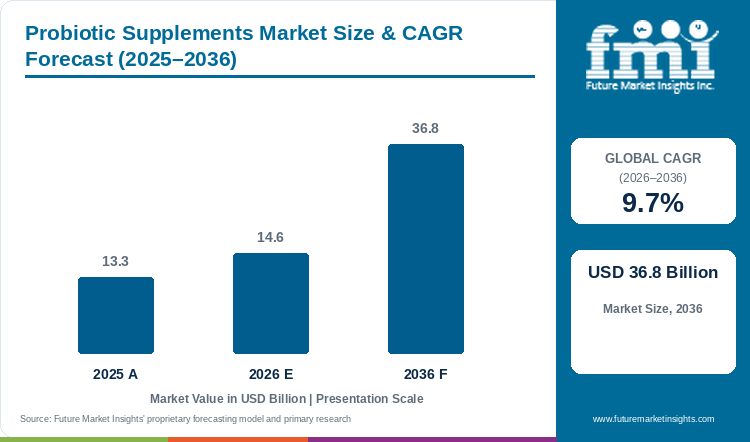
Demand for probiotic supplements is projected to expand at 9.7% CAGR between 2026 and 2036. Industry value grows from USD 13.30 billion in 2025 to USD 14.59 billion in 2026 and is projected to reach USD 36.82 billion by 2036.
In latest analysis by FMI, it has been observed that probiotic supplements have gained significant traction in recent years owing to increasing focus on digestive health, daily wellness and life-stage nutrition. The market is valued at USD 13.30 billion in 2025 and is expected to reach USD 14.59 billion in 2026. Probiotic supplements market is further projected to reach USD 36.82 billion by 2036, witnessing 9.7% CAGR during the forecast period. Probiotic products generally carry genus, species, strain and viable count on the label. In 2025, the NIH continued to identify these as important product information and also stated that higher CFU number does not always mean a greater benefit[1]. Due to this, consumers are increasingly checking named strain and the use for which the supplement is offered. Availability of digestive health supplements in capsules, powders, gummies, baby drops and other convenient formats is expected to support the market growth.
Adoption trajectories diverge across key markets, depending on supplement use and health functional food rules. South Korea is projected to grow at 11.4% CAGR through 2036, followed by Japan at 10.9% CAGR. In April 2026, the USDA reported that South Korea health functional food industry reached USD 3.7 billion in 2024, while imported products held 28.4% share and probiotics accounted for 15.9% of the sales[2]. Japan also has a mature functional food industry and large older population. However, Foods with Function Claims requires product evidence and manufacturing records, whereas South Korea provides a defined ingredient-recognition route.
Key Takeaways of Probiotic Supplements Market
- Demand is supported by repeat digestive-health use when the strain, dose, and purpose are clear.
- Based on functionality, digestive health support is projected to account for 38.0% in 2026, supported by recognizable daily-use needs.
- By customer orientation, baby products are estimated to hold 28.0% in 2026 owing to life-stage-specific formats and purchase routines.
- In 2026, capsules are expected to lead form demand with 36.0% share, helped by measured dosing and portability.
- South Korea is projected at 11.4% CAGR, whereas Japan is forecast at 10.9% because their filing and quality routes differ.
- Notable companies in the probiotic supplements market include BioGaia, Culturelle, Nestlé Health Science, Danone, Kerry Group, Lallemand, Probi, and NOW Foods.
Analyst Perspective
“In my experience, strain-defined products will receive wider preference as consumers compare purpose and viable count. Products maintaining viability through expiry will create stronger repeat demand.”
- Nandini Roy Choudhury, Principal Consultant, Future Market Insights.
How is the Probiotic Supplements Market segmented?
Probiotic supplements market is segmented by five primary axes: functionality, customer orientation, form, distribution channel, and region. Digestive health support is projected at 38.0%, baby products at 28.0%, and capsules at 36.0% in 2026.
- By functionality: digestive health support, immune support, women’s health, metabolic support, and general wellness.
- By customer orientation: baby, children, adults, women, men, and unisex.
- By form: capsules, tablets, powders and sachets, gummies, liquids and drops, and chewables.
- By distribution channel: pharmacies and drugstores, supermarkets and hypermarkets, specialty health stores, direct sales, and online retail.
- By region: North America, Latin America, Western Europe, Eastern Europe, East Asia, South Asia and Pacific, and Middle East and Africa.
Why does digestive health support hold notable functionality demand?
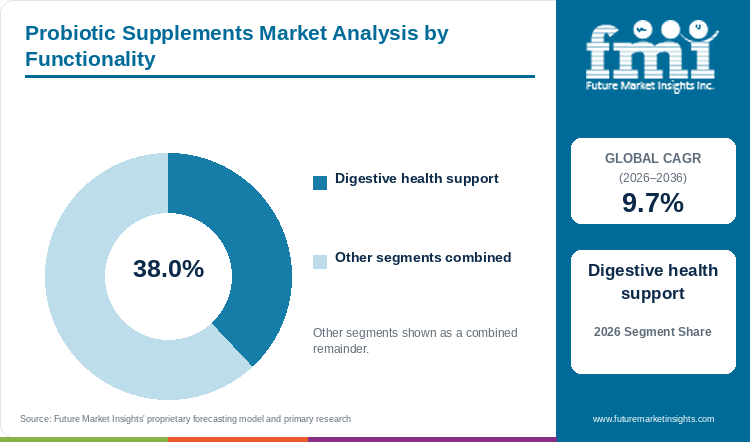
Based on functionality, digestive health support is projected to account for 38.0% in 2026, driven by recognizable daily gut-health needs.
Digestive health is one of the primary applications of probiotic supplements. Consumers are increasingly selecting products which mention the strain and digestive use for which it is developed. In September 2026, BioGaia announced Colus with L. reuteri BG-R59 and delayed-release technology developed for the lower gastrointestinal tract[3]. This connects named probiotic strains with a defined digestive use and makes the product purpose easier to understand. Increasing introduction of such targeted digestive products is expected to drive digestive health support demand.
- Digestive health support is projected at 38.0% in 2026 because the use case is familiar and repeatable.
- Named-strain positioning helps retailers compare the product purpose without relying on a larger CFU number.
What supports baby products as a preferred customer orientation?
By customer orientation, baby products are estimated to hold 28.0% in 2026, supported by measured drops and caregiver-led routines.
Baby probiotic supplements are generally offered in liquid drops as this format allows measured use by caregivers. In May 2026, BioGaia launched Protectis Plus with two L. reuteri strains in baby-drop form and introduced the product first in the UK for babies with colic and fussy tummies[4]. Age-specific product development and easy measured administration across specialized infant nutrition formulations is increasing the preference for baby probiotic supplements. However, evidence developed for infants cannot be applied directly to adult products or every other baby formulation.
- Baby products are estimated at 28.0% in 2026 because measured formats fit regular caregiver use.
- Age-specific formats require evidence and instructions that match the intended infant population.
How do capsules meet changing supplement form requirements?
In 2026, capsules are expected to lead form demand with 36.0% share, owing to measured dosing and portable storage.
Capsules are widely used for probiotic supplements as they provide measured serving and protect the culture from unpleasant taste. They are also easy to store and carry for daily consumption. A 2025 review indexed by the National Library of Medicine stated that probiotic encapsulation protects the cells during production, storage and gastrointestinal transit and can also support controlled release at the intended site[5]. Increasing requirement for stable viable count and protected delivery of active probiotic ingredients is expected to upkeep the demand for probiotic capsules.
- Capsules are expected at 36.0% in 2026 because each serving is measured and easy to carry.
- Capsule performance still depends on formulation controls that preserve viable organisms through the stated shelf life.
Why are online channels gaining use in supplement distribution?
By distribution channel, online retail is forecast to represent 31.0% in 2026, enabled by product comparison and recurring orders.
Online retail is gaining adoption as consumers can compare probiotic strain, form, price and product reviews on one platform. Subscription options are also supporting repeat purchase of daily gut health supplements. In October 2025, LifeVantage completed acquisition of LoveBiome operating assets connected with microbiome health products and added these products to its direct-sales network[6]. Expansion of online and direct-selling platforms is anticipated to increase probiotic supplement sales beyond pharmacy and mass retail channels.
- Online retail is projected at 31.0% in 2026 as comparison tools support recurring purchase.
- Online comparison raises the cost of unclear strain names, unsupported claims, and incomplete product information.
What are the drivers, restraints, and opportunities in the Probiotic Supplements Market?
In the probiotic supplements market, the key driver is defined digestive use, the key restraint is uneven evidence, and the key opportunity is expiry-stable formulation.
- Driver: Strain-defined products make digestive-health use easier for consumers and retail buyers to assess.
- Restraint: Evidence cannot be transferred freely between strains, doses, age groups, or country claim systems.
- Opportunity: Expiry-stable formulations and advanced delivery technologies create new product positioning through 2036.
Clear Use Supports Repeat Purchase
Clear and understandable product use is one of the major factors driving probiotic supplements market. In 2025, the NIH consumer fact sheet continued to mention genus, species and strain as central label information for probiotic products. Consumers can understand a product better when strain, dose and intended function is written together. This also helps the retailers in comparing digestive, women, baby and general wellness products. Increasing availability of strain-defined supplements is expected to drive repeat purchase during the forecast period.
Uneven Evidence Limits Claim Transfer
Uneven evidence is a major factor restraining the growth of probiotic supplements market. A 2025 randomized trial evaluating women’s health supplements involving 72 postmenopausal women reported no difference in measured bone outcomes between probiotic and placebo groups[7]. This result does not apply to every probiotic use, but it shows that result from one strain and population cannot be used for another strain or user group. High product variation and limited transfer of evidence may restrict the claims used by manufacturers of single-strain formulas and multi-ingredient synbiotic products.
Delivery Technology Opens New Positions
Delivery technology is creating new product opportunities in probiotic supplements market. In July 2026, Probi reported more than 300 publications for LP299V and more than 450 publications across its strains[8]. Documented strains can be combined with capsules, sachets and other protected formats for maintaining viability during storage. Apart from that, delayed release can place the culture nearer to the intended digestive site, expanding commercial avenues alongside emerging postbiotic supplements.
Which country CAGRs are profiled in the Probiotic Supplements Market?
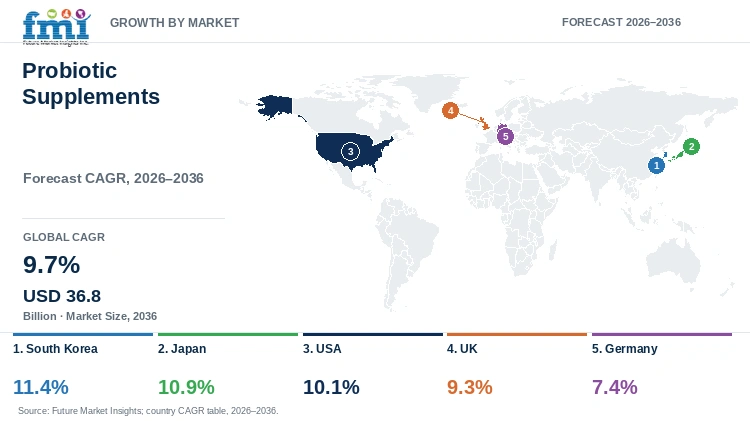
| Country | CAGR, 2026 to 2036 |
|---|---|
| South Korea | 11.4% |
| Japan | 10.9% |
| USA | 10.1% |
| UK | 9.3% |
| Germany | 7.4% |
How do country-level CAGRs compare in the probiotic supplements market?
The country outlook separates markets with active functional-food filing routes from mature supplement channels where claim review carries more weight. South Korea and Japan show an expansion outlook shaped by formal product records, while the USA, UK, and Germany rely more heavily on compliant labels and established retail access.
- South Korea uses a defined health functional food system that keeps recognized ingredients and product records visible to buyers.
- Japan links Foods with Function Claims to premarket filing and company responsibility for the supporting evidence.
- The USA gives manufacturers responsibility for safety and labeling before dietary supplements reach the market.
- The UK allows only authorized claims in the Great Britain nutrition and health claims register.
- Germany requires supplement notification, while product marketability remains the business operator’s responsibility.
Full report country CAGRs cover: North America; Latin America; Western Europe; Eastern Europe; East Asia; South Asia and Pacific; Middle East and Africa.
Country-wise Analysis
- South Korea probiotic supplements market is projected to grow at 11.4% CAGR through 2036, owing to established demand for health functional foods. In August 2026, the Ministry of Food and Drug Safety published Regulation No. 2026-33 for recognition of functional ingredients and standards[9]. The Korean route requires approved function, recognized ingredient and product label to remain connected. Probiotic suppliers also require viable-count control and Korean-language evidence before wider distribution. Availability of recognized ingredients is expected to provide documented probiotic products a clearer market route in South Korea.
- Japan probiotic supplements market is anticipated to expand at 10.9% CAGR during the forecast period, supported by daily health-product use among older consumers. Japan Statistics Bureau reported in September 2025 that 36.19 million people were aged 65 years or above, accounting for 29.4% of total population[10]. This large consumer group supports demand for convenient capsules, powders and other daily formats. However, Foods with Function Claims requires consistency between notified ingredient, displayed function and manufacturing record. Products with readable dosage information and maintained quality through expiry are expected to witness better adoption in Japan.
- The USA probiotic supplements market is forecast to rise at 10.1% CAGR over the forecast period, owing to established use of dietary supplements. In May 2026, the CDC reported that 60.2% of adults had used a dietary supplement during the previous 30 days, while 38.7% used two or more supplements[11]. These figures cover all dietary supplements, but shows that daily supplementation is familiar among a large consumer base. Wide availability through pharmacies, supermarkets and online channels along with clear strain information is expected to drive probiotic supplement sales in the USA.
- Demand for probiotic supplements in the UK is estimated to grow at 9.3% CAGR through 2036. Government guidance published in June 2026 lists tablets, capsules, gummies, powders and liquids as common food supplement forms and also states that supplements cannot claim to prevent, treat or cure a medical condition[12]. Companies can offer products in several formats, but the wording must remain within food supplement rules. Capsules and powders are used for adult routines, whereas drops support measured baby use. Availability of these formats is expected to support the UK probiotic supplements market.
- Germany probiotic supplements market is projected to register 7.4% CAGR during the assessment period, supported by pharmacy and online supplement channels. In January 2026, the Federal Office of Consumer Protection and Food Safety modernized the notification process for food supplements[13]. From July 2026, companies are required to use the federal portal online form before placing a supplement in the market. However, this filing does not confirm compliance with food law. Thus, suppliers requires German label and strain documents, while responsibility of product remains with the business operator.
Who are the notable companies in the Probiotic Supplements Market?
BioGaia, Culturelle, Nestlé Health Science, Danone, Kerry Group, Lallemand, Probi (part of Symrise Group), and NOW Foods are notable companies in the probiotic supplements market.
Probiotic supplements market is moderately fragmented with the presence of consumer brands, strain developers, nutrition companies and culture suppliers. BioGaia and Probi are focusing on named strains and targeted probiotic products. Kerry Group and Lallemand supplies cultures and formulation support to finished-product manufacturers. Culturelle, Nestlé Health Science, Danone and NOW Foods are offering capsules, powders and other consumer formats through retail and online channels. Companies are increasingly introducing products for digestive health, baby use, women's health, men's health, and general wellness. Expansion of strain portfolio and regional distribution is expected to increase competition in probiotic supplements market.
- Consumer supplement brands: Culturelle, Nestlé Health Science, Danone, and NOW Foods compete through retail recognition and broad format coverage.
- Strain-led specialists: BioGaia and Probi compete through named microorganisms, documented applications, and targeted finished products.
- Ingredient and formulation suppliers: Kerry Group and Lallemand support supplement makers with cultures, formulation knowledge, and technical service.
Competitive Benchmarking: Probiotic Supplements Market
| Company | Strain evidence | Shelf-life control | Consumer portfolio | Reach |
|---|---|---|---|---|
| BioGaia | High | High | High | High |
| Culturelle | High | High | High | High |
| Nestlé Health Science | High | High | High | High |
| Danone | High | Medium | High | High |
| Kerry Group | High | High | Medium | High |
| Lallemand | High | High | Medium | High |
| Probi | High | High | Medium | High |
| NOW Foods | Medium | Medium | High | High |
Scoring basis: High represents broad current public evidence in the stated area, Medium represents narrower documented activity and Low represents limited documented breadth. These ratings describe evidence coverage and not product quality, company rank or revenue share.
Key Developments in the Probiotic Supplements Market
- In September 2026, BioGaia announced BioGaia Colus with L. reuteri BG-R59 and delayed-release delivery for adult colon health.
- In August 2026, BioGaia and Recordati signed a long-term exclusive distribution agreement covering Spain and Portugal.
- In May 2026, BioGaia launched Protectis Plus as dual-strain baby drops with the UK as the first market.
- In October 2025, LifeVantage completed the acquisition of LoveBiome operating assets for its microbiome health business.
Key Players in the Probiotic Supplements Market
Consumer Supplement Brands
- Culturelle
- Nestlé Health Science
- Danone
- NOW Foods
Strain and Science-led Specialists
- BioGaia
- Probi
Ingredient and Formulation Suppliers
- Kerry Group
- Lallemand
Probiotic Supplements Market - Report Scope
| Coverage field | Report scope |
|---|---|
| Market breakdown | Functionality; customer orientation; form; distribution channel; region. |
| Quantitative units | USD billion. |
| Market definition | Revenue from probiotic dietary supplements sold as capsules, tablets, powders, sachets, gummies, liquids, drops, and chewables. Probiotic foods, infant formula, pharmaceuticals, animal products, and standalone bulk ingredients are excluded. |
| Regions covered | North America; Latin America; Western Europe; Eastern Europe; East Asia; South Asia and Pacific; Middle East and Africa. |
| Countries covered | South Korea, Japan, USA, UK, Germany, and additional countries in the full report. |
| Key companies profiled | BioGaia; Culturelle; Nestlé Health Science; Danone; Kerry Group; Lallemand; Probi; NOW Foods. |
| Forecast period | 2026 to 2036. |
| Approach | The Future Market Insights report covers product-level revenue, segment structure, channel conditions, and country adoption routes. |
Probiotic Supplements Market - Research Methodology
| Method | Approach |
|---|---|
| Primary Research | The research study includes primary interviews with manufacturers, distributors, retailers, procurement teams, end users and industry experts. Interviews covers purchasing decision, product evaluation, price, adoption barriers and approval requirement. |
| Desk Research | Desk research includes government publications, regulatory material, technical literature, company filings, product information and official company announcements. Sources were checked according to date, geography and relevance to probiotic supplements market. |
| Market Sizing and Forecasting | Market sizing combines the base market value with historical growth, segment share, pricing, product use, company participation and country demand. Forecast considers supplement adoption, evidence requirement, distribution and product availability. |
| Data Validation | Market estimates were checked against public data, company developments, supplement use and primary interviews. Adjacent foods, pharmaceuticals, animal probiotics and unsupported claims were excluded from probiotic supplements market. |
Probiotic Supplements Market by Segments
Probiotic Supplements Market segmented by Functionality:
- Digestive health support
- Immune support
- Women’s health
- Metabolic support
- General wellness
Probiotic Supplements Market segmented by Customer Orientation:
- Baby
- Children
- Adults
- Women
- Men
- Unisex
Probiotic Supplements Market segmented by Form:
- Capsules
- Tablets
- Powders and sachets
- Gummies
- Liquids and drops
- Chewables
Probiotic Supplements Market segmented by Distribution Channel:
- Pharmacies and drugstores
- Supermarkets and hypermarkets
- Specialty health stores
- Direct sales
- Online retail
Probiotic Supplements Market by Region
- North America
- United States
- Canada
- Latin America
- Brazil
- Mexico
- Argentina
- Chile
- Western Europe
- Germany
- France
- United Kingdom
- Italy
- Spain
- Benelux
- Nordics
- Eastern Europe
- Poland
- Czech Republic
- Romania
- Hungary
- East Asia
- Japan
- South Korea
- South Asia and Pacific
- ASEAN
- Australia and New Zealand
- Middle East and Africa
- GCC Countries
- South Africa
- Türkiye
- Israel
Research Sources and Bibliography
- [1] National Institutes of Health, Office of Dietary Supplements. (2025, March 25). Probiotics: Health professional fact sheet.
- [2] U.S. Department of Agriculture, Foreign Agricultural Service. (2026, April 6). Health functional food and supplements: Market brief for the Republic of Korea.
- [3] BioGaia AB. (2026, September 9). BioGaia AB will launch a new clinically proven probiotic to support colon health.
- [4] BioGaia AB. (2026, May 7). BioGaia launches Protectis Plus next-generation patented probiotic drops.
- [5] Bhutada, S., Dahikar, S., Hassan, M. Z., & Kovaleva, E. G. (2025). A comprehensive review of probiotics and human health: Current prospective and applications. Frontiers in Microbiology, 15, 1487641.
- [6] LifeVantage Corporation. (2025, October 2). LifeVantage announces closing of LoveBiome acquisition.
- [7] Yumol, J. L., Binda, S., Nagulesapillai, V., Bhardwaj, R., & Ward, W. E. (2025). Using probiotic supplementation to support bone health in postmenopausal women. Archives of Osteoporosis, 20, 103.
- [8] Probi. (2026, July 1). Probi celebrates 35 years of science and a new chapter with Symrise.
- [9] Ministry of Food and Drug Safety, Republic of Korea. (2026, August 13). Regulation on recognition of functional ingredient and standard/specification for health functional foods, No. 2026-33.
- [10] Statistics Bureau of Japan. (2025, September 14). Statistical topics No. 146: Elderly persons in Japan.
- [11] Centers for Disease Control and Prevention, National Center for Health Statistics. (2026, May). Dietary supplement use: United States, August 2021-August 2023.
- [12] Department of Health and Social Care. (2026, June 25). Food supplements guidance.
- [13] Federal Office of Consumer Protection and Food Safety (BVL). (2026, January 8). Modernisation of notification procedures for food supplements.
This bibliography is provided for reader reference. The full report contains the complete reference list and detailed citations.
This Report Answers
- What is Probiotic Supplements Market worth during 2026?
- What value is Probiotic Supplements Market projected by 2036?
- Which functionality has notable Probiotic Supplements Market share?
- Which customer group has notable Probiotic Supplements Market share?
- Which country has notable Probiotic Supplements Market growth?
- Which companies are notable in Probiotic Supplements Market today?
Frequently Asked Questions
How large is the Probiotic Supplements Market expected to be in 2026?
Future Market Insights estimates that the probiotic supplements market will reach USD 14.59 billion in 2026. The market is projected to expand further and reach USD 36.82 billion by 2036.
What CAGR is forecast for the Probiotic Supplements Market through 2036?
As per FMI, the probiotic supplements market is projected to grow at a 9.7% CAGR from 2026 to 2036. Growth is supported by increasing adoption of strain-defined digestive products and repeat supplement routines.
Which functionality holds a notable probiotic supplements demand share in 2026?
Future Market Insights projects digestive health support to hold 38.0% of functionality demand in 2026. The segment benefits from familiar daily use and clear digestive positioning.
Which customer orientation holds a notable probiotic supplements share in 2026?
FMI finds that baby products will hold 28.0% of customer-orientation demand in 2026. Demand is supported by measured drops and caregiver-led routines.
Which country has a notable probiotic supplements expansion outlook during the forecast period?
Future Market Insights predicts South Korea to expand at an 11.4% CAGR during the 2026 to 2036 assessment period. Growth is supported by the country's established health functional food route and current ingredient-recognition records.
Which companies are active in the Probiotic Supplements Market during 2026?
As per FMI analysis, notable companies include BioGaia, Culturelle, Nestlé Health Science, Danone, Kerry Group, Lallemand, Probi, and NOW Foods. These companies are focusing on strain portfolio expansion, wider delivery formats, and regional distribution capabilities.
Preview the report firsthand - request a free sample
Get SampleGet the brochure for pricing and purchase details.
Get PDFTable of Content
- Key Takeaways
- Market Size and CAGR
- Top Growth Driver
- Fastest Growing Segment
- Leading Region
- Key Companies
- Emerging Opportunities
- Executive Summary
- Global Market Outlook
- Demand-side Trends
- Supply-side Trends
- Technology Roadmap Analysis
- Analysis and Recommendations
- Analyst Perspective (What is happening? Why now? What should investors know?)
- Key Questions Answered
- How large is the market?
- What is the CAGR?
- What are key trends?
- Which region dominates?
- Who are the leaders?
- Market Overview
- Market Coverage / Taxonomy
- Market Definition / Scope / Limitations
- Research Methodology
- Chapter Orientation
- Analytical Lens and Working Hypotheses
- Market Structure, Signals, and Trend Drivers
- Benchmarking and Cross-market Comparability
- Market Sizing, Forecasting, and Opportunity Mapping
- Research Design and Evidence Framework
- Desk Research Programme (Secondary Evidence)
- Expert Input and Fieldwork (Primary Evidence)
- Tooling, Models, and Reference Databases
- Data Engineering and Model Build
- Quality Assurance and Audit Trail
- Market Background
- Market Dynamics (Drivers, Restraints, Opportunity, Trends)
- Scenario Forecast (Optimistic, Likely, Conservative)
- Impact Analysis
- AI Impact
- Sustainability Impact
- Regulatory Impact
- Technology Impact
- Consumer / Buyer Analysis
- Purchase Drivers
- Adoption Barriers
- Buyer Journey
- Opportunity Map Analysis
- Product Life Cycle Analysis
- Supply Chain Analysis
- Investment Feasibility Matrix
- Value Chain Analysis
- PESTLE and Porter's Analysis
- Regulatory Landscape
- Regional Parent Market Outlook
- Production and Consumption Statistics
- Import and Export Statistics
- Global Market Analysis and Forecast, 2021 to 2036
- Historical Market Size Value (USD Billion) Analysis, 2021 to 2025
- Current and Future Market Size Value (USD Billion) Projections, 2026 to 2036
- Y-o-Y Growth Trend Analysis
- Absolute $ Opportunity Analysis
- Global Market Pricing Analysis, 2021 to 2036
- Global Market Analysis and Forecast, By Functionality, 2021 to 2036
- Introduction / Key Findings
- Historical Market Size Value (USD Billion) Analysis By Functionality, 2021 to 2025
- Current and Future Market Size Value (USD Billion) Analysis and Forecast By Functionality, 2026 to 2036
- Digestive health support
- Immune support
- Women’s health
- Metabolic support
- General wellness
- Y-o-Y Growth Trend Analysis By Functionality, 2021 to 2025
- Absolute $ Opportunity Analysis By Functionality, 2026 to 2036
- Global Market Analysis and Forecast, By Customer Orientation, 2021 to 2036
- Introduction / Key Findings
- Historical Market Size Value (USD Billion) Analysis By Customer Orientation, 2021 to 2025
- Current and Future Market Size Value (USD Billion) Analysis and Forecast By Customer Orientation, 2026 to 2036
- Baby
- Children
- Adults
- Women
- Men
- Unisex
- Y-o-Y Growth Trend Analysis By Customer Orientation, 2021 to 2025
- Absolute $ Opportunity Analysis By Customer Orientation, 2026 to 2036
- Global Market Analysis and Forecast, By Form, 2021 to 2036
- Introduction / Key Findings
- Historical Market Size Value (USD Billion) Analysis By Form, 2021 to 2025
- Current and Future Market Size Value (USD Billion) Analysis and Forecast By Form, 2026 to 2036
- Capsules
- Tablets
- Powders and sachets
- Gummies
- Liquids and drops
- Chewables
- Y-o-Y Growth Trend Analysis By Form, 2021 to 2025
- Absolute $ Opportunity Analysis By Form, 2026 to 2036
- Global Market Analysis and Forecast, By Distribution Channel, 2021 to 2036
- Introduction / Key Findings
- Historical Market Size Value (USD Billion) Analysis By Distribution Channel, 2021 to 2025
- Current and Future Market Size Value (USD Billion) Analysis and Forecast By Distribution Channel, 2026 to 2036
- Pharmacies and drugstores
- Supermarkets and hypermarkets
- Specialty health stores
- Direct sales
- Online retail
- Y-o-Y Growth Trend Analysis By Distribution Channel, 2021 to 2025
- Absolute $ Opportunity Analysis By Distribution Channel, 2026 to 2036
- Global Market Analysis and Forecast, By Region, 2021 to 2036
- Introduction
- Historical Market Size Value (USD Billion) Analysis By Region, 2021 to 2025
- Current Market Size Value (USD Billion) Analysis and Forecast By Region, 2026 to 2036
- North America
- Latin America
- Western Europe
- Eastern Europe
- East Asia
- South Asia and Pacific
- Middle East and Africa
- Market Attractiveness Analysis By Region
- North America Market Analysis and Forecast, By Country, 2021 to 2036
- Historical Market Size Value (USD Billion) Trend Analysis By Market Taxonomy, 2021 to 2025
- Market Size Value (USD Billion) Forecast By Market Taxonomy, 2026 to 2036
- By Country
- United States
- Canada
- By Functionality
- By Customer Orientation
- By Form
- By Distribution Channel
- By Country
- Market Attractiveness Analysis
- By Country
- By Functionality
- By Customer Orientation
- By Form
- By Distribution Channel
- Key Takeaways
- Latin America Market Analysis and Forecast, By Country
- Historical Market Size Value (USD Billion) Trend Analysis By Market Taxonomy, 2021 to 2025
- Market Size Value (USD Billion) Forecast By Market Taxonomy, 2026 to 2036
- By Country
- Brazil
- Mexico
- Argentina
- Chile
- By Functionality
- By Customer Orientation
- By Form
- By Distribution Channel
- By Country
- Market Attractiveness Analysis
- By Country
- By Functionality
- By Customer Orientation
- By Form
- By Distribution Channel
- Key Takeaways
- Western Europe Market Analysis and Forecast, By Country
- Historical Market Size Value (USD Billion) Trend Analysis By Market Taxonomy, 2021 to 2025
- Market Size Value (USD Billion) Forecast By Market Taxonomy, 2026 to 2036
- By Country
- Germany
- France
- United Kingdom
- Italy
- Spain
- Benelux
- Nordics
- By Functionality
- By Customer Orientation
- By Form
- By Distribution Channel
- By Country
- Market Attractiveness Analysis
- By Country
- By Functionality
- By Customer Orientation
- By Form
- By Distribution Channel
- Key Takeaways
- Eastern Europe Market Analysis and Forecast, By Country
- Historical Market Size Value (USD Billion) Trend Analysis By Market Taxonomy, 2021 to 2025
- Market Size Value (USD Billion) Forecast By Market Taxonomy, 2026 to 2036
- By Country
- Poland
- Czech Republic
- Romania
- Hungary
- By Functionality
- By Customer Orientation
- By Form
- By Distribution Channel
- By Country
- Market Attractiveness Analysis
- By Country
- By Functionality
- By Customer Orientation
- By Form
- By Distribution Channel
- Key Takeaways
- East Asia Market Analysis and Forecast, By Country
- Historical Market Size Value (USD Billion) Trend Analysis By Market Taxonomy, 2021 to 2025
- Market Size Value (USD Billion) Forecast By Market Taxonomy, 2026 to 2036
- By Country
- Japan
- South Korea
- By Functionality
- By Customer Orientation
- By Form
- By Distribution Channel
- By Country
- Market Attractiveness Analysis
- By Country
- By Functionality
- By Customer Orientation
- By Form
- By Distribution Channel
- Key Takeaways
- South Asia and Pacific Market Analysis and Forecast, By Country
- Historical Market Size Value (USD Billion) Trend Analysis By Market Taxonomy, 2021 to 2025
- Market Size Value (USD Billion) Forecast By Market Taxonomy, 2026 to 2036
- By Country
- ASEAN
- Australia and New Zealand
- By Functionality
- By Customer Orientation
- By Form
- By Distribution Channel
- By Country
- Market Attractiveness Analysis
- By Country
- By Functionality
- By Customer Orientation
- By Form
- By Distribution Channel
- Key Takeaways
- Middle East and Africa Market Analysis and Forecast, By Country
- Historical Market Size Value (USD Billion) Trend Analysis By Market Taxonomy, 2021 to 2025
- Market Size Value (USD Billion) Forecast By Market Taxonomy, 2026 to 2036
- By Country
- GCC Countries
- South Africa
- Türkiye
- Israel
- By Functionality
- By Customer Orientation
- By Form
- By Distribution Channel
- By Country
- Market Attractiveness Analysis
- By Country
- By Functionality
- By Customer Orientation
- By Form
- By Distribution Channel
- Key Takeaways
- Key Countries Market Analysis
- United States
- Pricing Analysis
- Market Share Analysis, 2025
- By Functionality
- By Customer Orientation
- By Form
- By Distribution Channel
- Canada
- Pricing Analysis
- Market Share Analysis, 2025
- By Functionality
- By Customer Orientation
- By Form
- By Distribution Channel
- Mexico
- Pricing Analysis
- Market Share Analysis, 2025
- By Functionality
- By Customer Orientation
- By Form
- By Distribution Channel
- Brazil
- Pricing Analysis
- Market Share Analysis, 2025
- By Functionality
- By Customer Orientation
- By Form
- By Distribution Channel
- Chile
- Pricing Analysis
- Market Share Analysis, 2025
- By Functionality
- By Customer Orientation
- By Form
- By Distribution Channel
- Germany
- Pricing Analysis
- Market Share Analysis, 2025
- By Functionality
- By Customer Orientation
- By Form
- By Distribution Channel
- United Kingdom
- Pricing Analysis
- Market Share Analysis, 2025
- By Functionality
- By Customer Orientation
- By Form
- By Distribution Channel
- Italy
- Pricing Analysis
- Market Share Analysis, 2025
- By Functionality
- By Customer Orientation
- By Form
- By Distribution Channel
- Spain
- Pricing Analysis
- Market Share Analysis, 2025
- By Functionality
- By Customer Orientation
- By Form
- By Distribution Channel
- France
- Pricing Analysis
- Market Share Analysis, 2025
- By Functionality
- By Customer Orientation
- By Form
- By Distribution Channel
- ASEAN
- Pricing Analysis
- Market Share Analysis, 2025
- By Functionality
- By Customer Orientation
- By Form
- By Distribution Channel
- Australia and New Zealand
- Pricing Analysis
- Market Share Analysis, 2025
- By Functionality
- By Customer Orientation
- By Form
- By Distribution Channel
- Japan
- Pricing Analysis
- Market Share Analysis, 2025
- By Functionality
- By Customer Orientation
- By Form
- By Distribution Channel
- South Korea
- Pricing Analysis
- Market Share Analysis, 2025
- By Functionality
- By Customer Orientation
- By Form
- By Distribution Channel
- Poland
- Pricing Analysis
- Market Share Analysis, 2025
- By Functionality
- By Customer Orientation
- By Form
- By Distribution Channel
- Hungary
- Pricing Analysis
- Market Share Analysis, 2025
- By Functionality
- By Customer Orientation
- By Form
- By Distribution Channel
- Türkiye
- Pricing Analysis
- Market Share Analysis, 2025
- By Functionality
- By Customer Orientation
- By Form
- By Distribution Channel
- South Africa
- Pricing Analysis
- Market Share Analysis, 2025
- By Functionality
- By Customer Orientation
- By Form
- By Distribution Channel
- United States
- Market Structure Analysis
- Competition Dashboard
- Competition Benchmarking
- Market Share Analysis of Top Players
- By Regional
- By Functionality
- By Customer Orientation
- By Form
- By Distribution Channel
- Emerging Startups
- Innovation Benchmarking
- Competition Analysis
- Competition Deep Dive
- BioGaia
- Overview
- Product Portfolio
- Profitability by Market Segments
- Sales Footprint
- Strategy Overview
- Marketing Strategy
- Product Strategy
- Channel Strategy
- Culturelle
- Nestlé Health Science
- Danone
- Kerry Group
- Lallemand
- Probi
- NOW Foods
- BioGaia
- Case Studies
- Success Stories
- Recent Developments
- Competition Deep Dive
- Assumptions & Acronyms Used


