


By Nikhil Kaitwade
Spending on safe access at height is tightening with new rules and softer construction cycles. Buyers face changing standards, cleaner engines, and rental fleets shifting strategy. Fatal falls remain the top cause of US construction deaths, which keeps demand focused on engineered access over ad-hoc solutions.
- OSHA cites 421 fatal falls to a lower level in 2023 and continues high-priority enforcement in 2024-2026.
- Regulation is also driving up emissions limits where AWP fleets operate.
- Greater London's Non-Road Mobile Machinery rules require Stage IV engines citywide from January 1, 2025, with Stage V required by 2030 and a zero-emission expectation by 2040.
- Contractors working in London now check diesel machines and specify electric scissor lifts for indoor sites to meet compliance.
- These timelines are likely to effect OEM product roadmaps and rental purchasing in 2025-2030.
What is driving demand in the Aerial Work Platforms Market
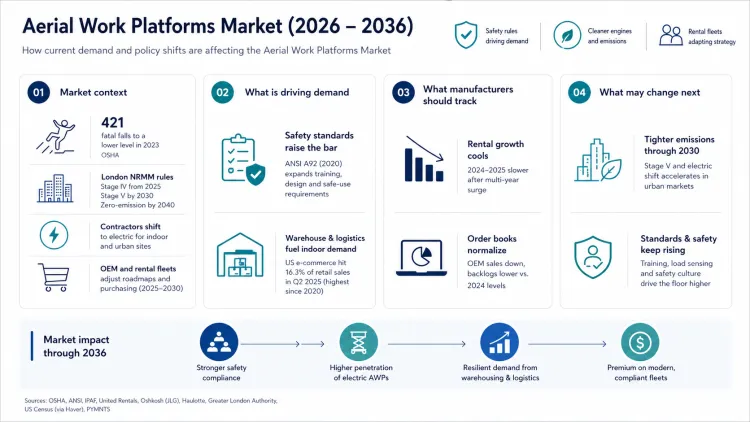
- Formal safety standards have expanded training and design obligations since the ANSI A92 suite took effect in 2020.
- Warehouse expansion and logistics activity are sustaining demand for indoor aerial work platforms.
Formal safety standards have expanded training and design obligations since the ANSI A92 suite took effect in 2020. Design and safe-use rules added requirements for load sensing, gated entrances, and documented risk assessments, which push end users toward newer compliant machines.
Warehouse expansion and logistics activity are sustaining demand for indoor aerial work platforms. US e-commerce reached a 16.3% retail share in Q2 2025, the highest since 2020. Electric scissor lifts and vertical mast lifts are well suited to indoor sites where emissions and ventilation constraints matter most. These use cases hold up even when broader construction weakens. (US Census via Haver Analytics, Q2 2025; PYMNTS citing Census, 2025.)
What should manufacturers track in the Aerial Work Platforms Market
- Rental market momentum cooled in 2024-2025 from prior highs, and fleet managers tempered capex.
- OEM order books confirm the transition.
Rental market momentum cooled in 2024-2025 from prior highs, and fleet managers tempered capex. IPAF's 2025 rental reports flag slower growth in North America after a multi-year surge, while US Market leaders such as United Rentals reported record revenue but thinner margins and tighter used equipment spreads in early 2025.
OEM order books confirm the transition. Oshkosh's Access segment, which includes JLG, showed year-over-year sales declines in 2025 and a sharp backlog reduction from 2024 levels, reflecting normalized lead times and channel adjustment. Haulotte reported 2024 sales down 17% year over year, citing a cooler demand context, even as services grew. Buyers get shorter waits for common lifts. Premium electrified models can remain tight depending on region.
What may change next in the Aerial Work Platforms Market
- Urban emissions policies will stiffen through 2030, pressing fleets toward Stage V and electric.
- Standards and safety culture will keep raising the floor.
Urban emissions policies will stiffen through 2030, pressing fleets toward Stage V and electric. London's calendar is explicit, and similar clean-air rules influence procurement in other European cities. Expect higher resale risk for older diesel scissors in low-emission zones and a valuation premium for lithium and hybrid booms used on urban projects.
Standards and safety culture will keep raising the floor. A92 training and device features like load sensing are now baseline, and OSHA's enforcement data show why employers keep investing. IPAF's rental studies also point to a maturing market where utilization, fleet size, drives returns. Over 2026-2030, competitive advantage shifts to rental fleets with strong electric availability, faster parts support, and proof of safety training at handover. FMI's outlook, which projects a 5.7% CAGR to 2036 and highlights stronger growth in India and China, aligns with these operational realities but assumes disciplined capital cycles and.
Bibliography
- https://www.osha.gov/stop-falls/
- https://www.osha.gov/fall-protection/construction
- https://www.enr.com/articles/48411-effective-date-nears-for-new-mobile-elevating-work-platform-safety-standards
- https://www.jlg.com/en/press-releases/new-jlg-whitepaper-marks-5th-anniversary-of-ansi-a92-standards-update
- https://www.niftylift.com/usa/about-us/blog/articles/ansi-a92-and-csa-b354-standards
- https://investors.unitedrentals.com/press-releases/press-releases-details/2025/United-Rentals-Announces-First-Quarter-2025-Results-Reaffirms-Full-Year-Guidance-and-Introduces-New-1-5-Billion-Share-Repurchase-Program/
- https://www.businesswire.com/news/home/20250429470989/en/Oshkosh-Corporation-Reports-2025-First-Quarter-Results
- https://www.accessbriefing.com/news/softening-demand-slows-q4-growth-for-jlg/8050739.article
- https://www.haulotte.com/en/2024-annual-sales
- https://www.ipaf.org/en/news/ipaf-publishes-2025-rental-market-reports-revealing-slower-growth-amid-economic-uncertainty
- https://www.london.gov.uk/sites/default/files/2024-03/nrmm_lez_exemption_and_retrofit_policy_update_2024.pdf
- https://www.cwplant.co.uk/2025/02/03/emissions-legislation-changes-in-greater-london-what-you-need-to-know/
- https://www.haver.com/articles/u-s-retail-e-commerce-sales-rise-in-q2-25
- https://www.pymnts.com/news/ecommerce/2025/ecommerce-now-drives-16-3-of-retail-sales/

