

- Market Size (2026)
- USD 447.8 Mn
- Forecast (2036)
- USD 897.5 Mn
- CAGR (2026 to 2036)
- 7.2%
Bio-Based Polymer Insulation Cable Systems Market Size, Market Forecast and Outlook By FMI
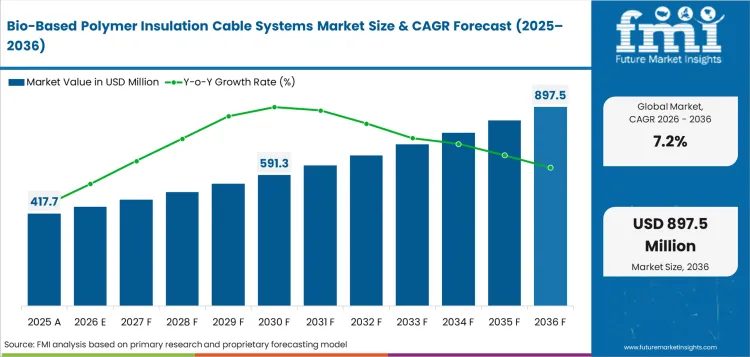
The bio-based polymer insulation cable systems market size stood at USD 417.7 million in 2025. Industry revenue is anticipated to scale to USD 447.8 million in 2026 and increase to USD 897.5 million by 2036 at 7.2% CAGR. ISCC Plus certified systems are expected to represent 46.2% share of certification type in 2026. Low voltage systems are projected to garner 44.7% share of voltage class in 2026.
Summary of Bio-Based Polymer Insulation Cable Systems Market
- Demand and Growth Drivers
- Grid renewal keeps insulation material choices under review as cable volumes rise in power distribution projects.
- Building wiring demand favors low voltage insulation with fire safety and traceable material content.
- Electric vehicle charging cables need flexible jackets meeting abrasion and flame requirements.
- Product and Segment View
- ISCC Plus certified systems are projected to account for 46.2% share in 2026 since cable buyers need chain-of-custody proof.
- Low voltage systems are expected to capture 44.7% share in 2026 as building and distribution cables create broad volume.
- Bio-PE is forecast to represent 38.4% share in 2026 due to known extrusion behavior in cable insulation lines.
- Geography and Competitive Outlook
- China demand is projected to record 8.2% CAGR by 2036 through grid spending and renewable project connections.
- United States demand is expected to expand at 7.8% CAGR by 2036, led by transmission planning and grid funding.
- Borouge International and Covestro anchor supply based on cable-grade polymer depth and material traceability.
- Analyst Opinion
- Nikhil Kaitwade, Principal Consultant for Industrial Automation at FMI, observes, “Bio-based polymer insulation cable systems will grow in projects proving electrical safety and verified material origin together. Cable buyers will not accept a green claim if flame behavior or aging data is weak. Suppliers joining polymer traceability with cable performance evidence will be better placed in approval-led buying.”
- Bio-Based Polymer Insulation Cable Systems Market Value Analysis
- Market value depends on cable projects in which insulation materials must meet safety rules and carbon disclosure requests.
- Supplier pricing reflects polymer qualification cost and chain-of-custody work. Cable producers compare insulation options during fire and thermal approval planning.
- Replacement value stays selective as cable buyers avoid untested insulation in safety-critical installations.
- Utilities and building cable makers support premium demand for plastic grades with known extrusion and aging behavior.
Key Takeaways, Market Size, and Forecast
- The bio-based polymer insulation cable systems market was valued at USD 417.7 million in 2025.
- Industry value is expected to reach USD 897.5 million by 2036 as grid renewal and cable carbon accounting raise material scrutiny.
- From 2026 to 2036, the sector is projected to expand at 7.2% CAGR.
- Industry revenue is forecast to create incremental opportunity of USD 449.7 million from 2026 to 2036.
- ISCC Plus certified systems are expected to account for 46.2% share of certification type in 2026.
- Low voltage systems are poised to garner 44.7% share of voltage class in 2026.
- China leads the country outlook by an anticipated 8.2% CAGR, followed by the United States at 7.8% CAGR by 2036.
Supplier checks are shifting toward proven polymer sources and verified carbon data at the cable level. In April 2024, Borealis introduced Borcycle ME7153SY for low and medium voltage cable jackets with 50.0% post-consumer recyclate and a 13.0% lower production carbon footprint than the virgin equivalent. Cable makers now need material evidence able to stand with flame and aging tests. Project teams will favor suppliers documenting polymer origin before cable approval work begins.
Fire safety and flexibility keep bio-based cable materials from becoming a simple polymer swap. Covestro launched Desmopan FR thermoplastic polyurethane grades for cable jackets in June 2024 with halogen-free and low-smoke properties. Partial bio-based grades give charging and electronics cables a route to lower fossil content. Cable brands will need verified safety behavior before they shift from conventional insulation systems.
Bio-Based Polymer Insulation Cable Systems Market Definition
Bio-based polymer insulation cable systems are insulated wire and cable products using polymers made partly or fully from renewable feedstocks. Scope covers insulation and jacket systems made with bio-PE, bio-PA and bio-TPU. Revenue includes cable-grade materials and finished cable systems supplied for building, grid and transport applications. Conventional fossil-only insulation is excluded unless it forms a hybrid cable system with verified renewable content.
Bio-Based Polymer Insulation Cable Systems Market Inclusions
Scope includes low voltage and medium voltage cable systems using renewable or mass-balanced polymer content. Grid cables, charging cables and data cables are included when insulation or jacketing contains verified bio-based polymer input. ISCC Plus certified systems and environmental product declaration backed systems are counted. Halogen-free systems are included when bio-based polymer chemistry supports safety approval. Building electrical systems are included when cable insulation forms part of the specified material change.
Bio-Based Polymer Insulation Cable Systems Market Exclusions
Scope excludes standard copper and aluminum conductor value when insulation material is not part of the commercial claim. Fossil-only polyethylene and polyvinyl chloride cables are excluded. Loose bio-based resin sold for non-cable uses is excluded. Fiber optic cable hardware is excluded unless polymer insulation content is sold as part of a qualified cable system. Recycling services are counted only when bundled with cable material or finished cable supply.
Bio-Based Polymer Insulation Cable Systems Market Research Methodology
- Primary Research: FMI analysts reviewed cable buyer needs across utilities, building wire producers and polymer compounders.
- Desk Research: Public energy data and official company releases supported market checks. Regulator filings supported project timing review.
- Market Sizing and Forecasting: Forecast values used cable project signals and cable-grade polymer price checks. Segment shares reflected approval burden and material readiness.
- Data Validation: Checks compared 2026 value with 2036 value and tested CAGR consistency. Country rates were reviewed against grid and renewable power signals.
Why is the Bio-Based Polymer Insulation Cable Systems Market Growing?
- Grid expansion supports market growth as utilities review insulation materials more closely during network upgrades.
- Fire-safe flexible jackets support adoption as cable makers reduce fossil polymer use in power and electronics lines.
- Traceable polymer origin supports cable demand as circular product rules increase documentation needs across European supply chains.
Electricity system expansion gives cable insulation a clearer role in project material reviews as power networks and renewable sites add connection points. International Energy Agency reported in 2025, global electricity consumption rose by 4.3% in 2024. International Renewable Energy Agency reported in March 2025, renewable capacity additions reached 585.0 GW in 2024. Renewable projects use cable systems across generation and grid connection work. Bio-based polymer insulation gains a stronger outlook when developers assess material footprints along with fire safety and long-term aging performance. Wider use will depend on cable makers proving flame resistance, process stability and traceable polymer origin before adoption moves into critical grid lines.
Market Segmentation Analysis
- Bio-PE is forecast to capture 38.4% share in 2026 due to familiar polyethylene processing across cable extrusion lines.
- Low voltage systems are projected to account for 44.7% share in 2026 through building wiring and distribution cable demand.
- Building wiring is expected to represent 32.6% share in 2026 as construction codes require safe cable insulation.
- Utilities are anticipated to account for 34.3% share in 2026 since grid expansion increases cable approval work.
- ISCC Plus certified systems are forecast to hold 46.2% share in 2026, led by chain-of-custody proof guiding material claims.
Segmentation is divided into five parent groups based on how cable buyers specify material and approval needs. Material type separates bio-PE from higher-performance bio-PA and bio-TPU systems. Voltage class shows how insulation risk rises from building wiring to grid cables. Application shows whether cable systems serve buildings or offshore projects. End use sector separates construction and transport demand. Certification type shows how buyers verify polymer origin before commercial approval.
Insights into Bio-Based Polymer Insulation Cable Systems Market by Material Type
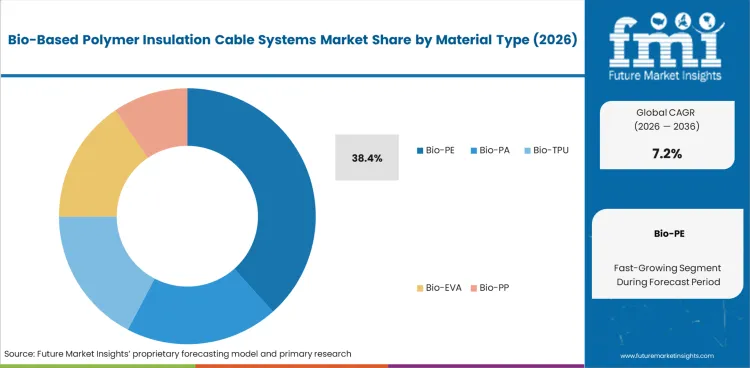
- Bio-PE is projected to account for 38.4% share in 2026 as cable makers can adapt known polyethylene extrusion methods with limited process change.
- Bio-PA and bio-TPU gain value in flexible cables since abrasion resistance and bend life are important for charging cable use.
Insights into Bio-Based Polymer Insulation Cable Systems Market by Voltage Class
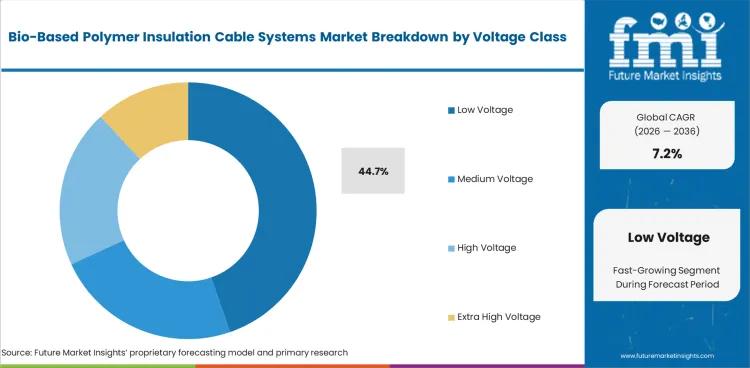
- Low voltage systems are expected to represent 44.7% share in 2026, driven by buildings and distribution networks creating broad cable volume.
- Medium voltage systems will gain selective acceptance once cable makers validate aging and water-tree resistance under utility standards.
Insights into Bio-Based Polymer Insulation Cable Systems Market by Application
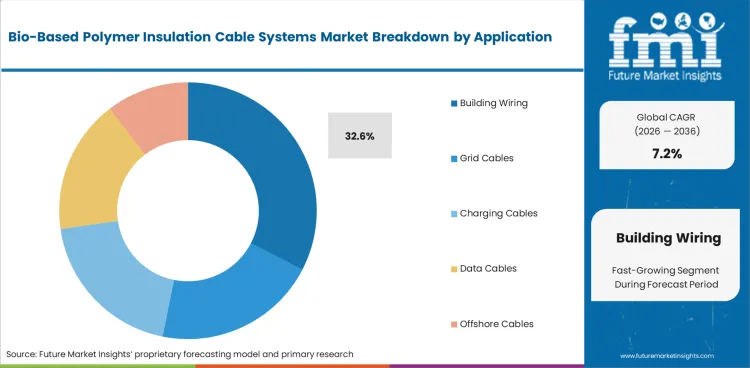
- Building wiring is projected to capture 32.6% share in 2026 due to low voltage systems requiring safer and traceable polymer insulation.
- Charging cables gain share led by flexible jackets needing abrasion resistance and flame safety for repeated handling.
Insights into Bio-Based Polymer Insulation Cable Systems Market by End Use Sector
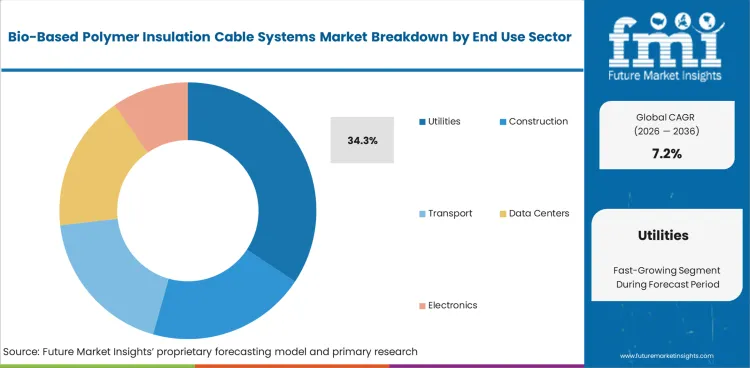
- Utilities are anticipated to account for 34.3% share in 2026 with grid renewal making cable material approval a strategic purchasing point.
- Construction keeps a visible route as building owners compare cable fire safety with embodied carbon documents.
Insights into Bio-Based Polymer Insulation Cable Systems Market by Certification Type
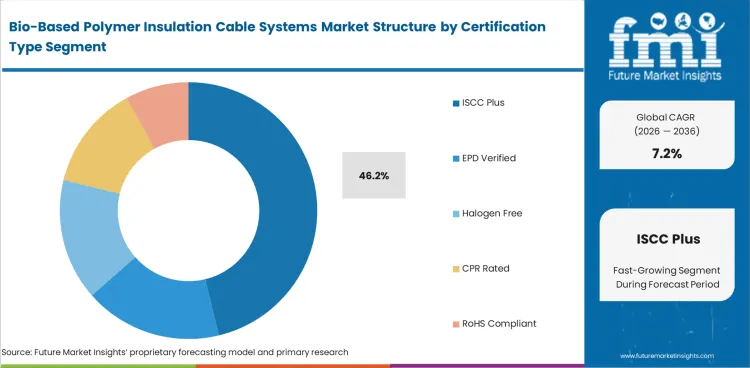
- ISCC Plus certified systems are expected to represent 46.2% share in 2026 since buyers need verified mass-balance or renewable content records.
- Environmental product declaration verified systems strengthen tender scoring when cable suppliers must compare lifecycle data.
Bio-Based Polymer Insulation Cable Systems Market Drivers, Restraints and Opportunities
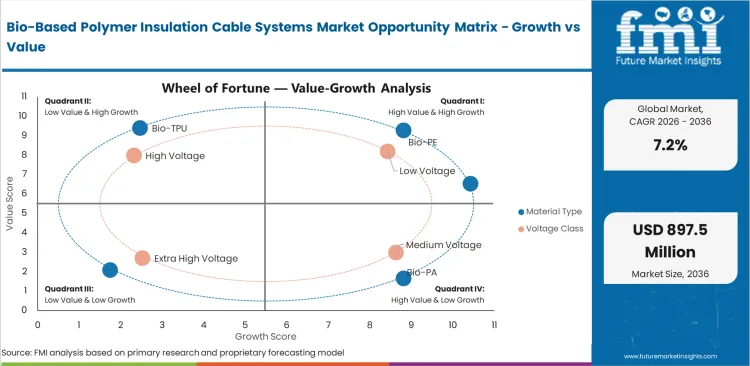
- Grid reinforcement supports market growth as cable material reviews become part of power network rebuild plans.
- Long qualification cycles restrain substitution as medium voltage systems need proof on insulation safety and water resistance.
- Charging cable expansion creates opportunity for flexible bio-based jackets with stronger flame and abrasion performance.
Grid reinforcement will keep cable insulation under closer review as utilities rebuild power networks for higher load. United States Department of Energy reported in January 2025, American Electric Power will reconductor or rebuild almost 5,000 miles of transmission lines across five states. Medium voltage adoption will move more carefully since International Electrotechnical Commission IEC 60502-2:2014+AMD1:2024 specifies construction and test requirements for extruded insulation cables from 6 kV to 30 kV. Charging cable demand gives suppliers a clearer opportunity since International Energy Agency reported, over 1.3 million public charging points were added globally in 2024. Bio-based polymer suppliers can gain if they prove flame safety and stable processing before cable makers shift from conventional insulation.
Installed Base and Replacement Cycle Analysis
Aging grid assets will keep replacement cycles active for bio-based polymer insulation cable systems during the forecast period. American Society of Civil Engineers stated in July 2025, many United States bulk transmission components were built in the 1950s and 1960s with a 50-year life expectancy. Same source noted, over 640,000 miles of high-voltage transmission lines in the lower 48 states operate at full capacity. Cable suppliers will see stronger review of insulation and jacket materials as utilities replace older lines and rebuild capacity. Bio-based systems can enter replacement planning only when they meet long-life performance needs and do not raise failure risk.
Regulatory Compliance and Operating Standards Analysis
Compliance needs will make documentation a stronger filter for bio-based polymer insulation cable systems used in building and infrastructure projects. Cable makers supplying construction and building wiring channels will need clearer proof of safety behavior and lifecycle data. Suppliers handling cable test records with product-level documentation will have a better route into regulated projects.
Analysis of Bio-Based Polymer Insulation Cable Systems Market by Key Countries
.webp "Top Country Growth Comparison Bio Based Polymer Insulation Cable Systems Market Cagr (2026 2036)")
| Country | CAGR |
|---|---|
| China | 8.2% |
| United States | 7.8% |
| India | 7.5% |
| Germany | 7.3% |
| United Kingdom | 7.0% |
| Japan | 6.8% |
| South Korea | 6.6% |
Source: Future Market Insights, 2026.
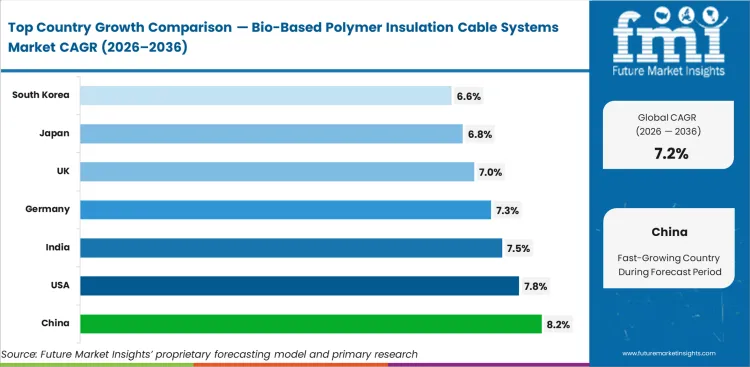
Bio-Based Polymer Insulation Cable Systems Market CAGR Analysis by Country
- China is projected to record 8.2% CAGR by 2036, driven by grid investment and renewable projects raising cable needs.
- United States is expected to expand at 7.8% CAGR by 2036, influenced by transmission planning increasing qualified cable supply needs.
- India is forecast to grow at 7.5% CAGR by 2036 due to renewable additions creating demand for distribution cables.
- Germany is expected to advance at 7.3% CAGR by 2036 as renewable generation and EU product rules support verified cables.
- United Kingdom is projected to rise at 7.0% CAGR by 2036 through connection queues creating pressure on grid cable planning.
- Japan is forecast at 6.8% CAGR by 2036 since energy policy supports cleaner grid and industrial electrification.
- South Korea is expected to post 6.6% CAGR by 2036 reflecting power planning increasing future cable system requirements.
Country performance is led by grid size and renewable project flow. China and the United States track above the global pace due to larger transmission activity. India and Germany stay close to the global rate as renewable connection needs remain visible. Japan and South Korea grow at measured rates as cable qualification remains conservative in utility channels.
Demand Outlook for Bio-Based Polymer Insulation Cable Systems in China
Industry in China is projected to record 8.2% CAGR by 2036, led by grid spending and renewable additions increasing cable system needs. China State Council statistics published in January 2025 said grid project investment reached 608.3 billion yuan in 2024. Such spending lifts demand for distribution and connection cables. Suppliers will need local qualification support before bio-based insulation can move into regulated projects.
- Grid investment gives cable suppliers a broad project route across distribution and connection work.
- Renewable energy construction increases the need for cable jackets with long outdoor service life.
- Local qualification favors suppliers with polymer processing support and Chinese compliance files.
Demand Analysis of Bio-Based Polymer Insulation Cable Systems in the United States
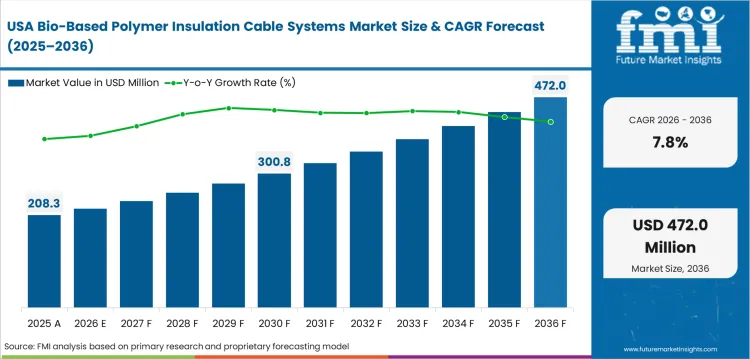
Demand in the United States is expected to expand at 7.8% CAGR by 2036, driven by federal grid planning raising cable qualification visibility. United States Department of Energy selections in October 2024 backed four transmission projects with USD 1.5 billion. Long-distance transmission work increases the need for qualified insulation and jacket materials. Bio-based options will need safety records before utility approval becomes practical.
- Transmission funding gives cable makers a clearer schedule for material and capacity planning.
- Utility approvals keep high voltage insulation changes slower than building wire upgrades.
- Environmental product documents can improve tender responses once safety proof is already accepted.
Sales Outlook for Bio-Based Polymer Insulation Cable Systems in India
Sales in India are forecast to grow at 7.5% CAGR by 2036 due to renewable capacity additions increasing cable needs in generation and distribution. India’s Ministry of New and Renewable Energy recorded 258.0 GW total renewable energy capacity as of December 2025. Cable systems must support new connections and distribution upgrades. Cost control will shape how quickly bio-based insulation moves into mainstream cable programs.
- Renewable installations create a steady route for distribution and project cable demand.
- Cost sensitivity keeps bio-based insulation focused on approved and price-competitive formulations.
- Local cable makers need supplier support on extrusion stability and flame tests.
Growth Outlook for Bio-Based Polymer Insulation Cable Systems in Germany
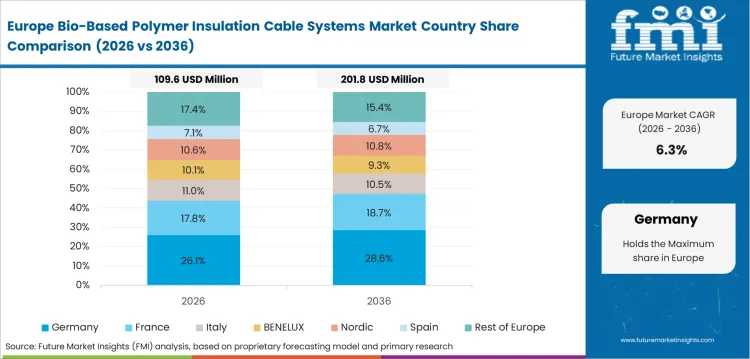
Bio-based polymer insulation cable systems in Germany are expected to advance at 7.3% CAGR by 2036, influenced by renewable generation increasing cable replacement and connection work. Fraunhofer Institute for Solar Energy Systems reported in January 2025, renewables reached 62.7% of net public electricity generation in 2024. Grid connection work will keep cable demand visible. Buyers will require evidence lowering carbon insulation does not weaken fire or aging performance.
- Renewable electricity growth makes grid connection cables a steady demand channel.
- EU sustainable product rules encourage environmental product documents for cable systems.
- German buyers will screen insulation materials for safety documents before accepting carbon claims.
Industry Outlook for Bio-Based Polymer Insulation Cable Systems in the United Kingdom
Sector in the United Kingdom is projected to rise at 7.0% CAGR by 2036, through clean power planning creating pressure on grid connection capacity. Clean Power 2030 Action Plan data published in December 2024 showed a connection queue of 739.0 GW at the end of October 2024. Such backlog points to cable planning needs across grid projects. Suppliers with proven low voltage and medium voltage materials can benefit as project reviews move forward.
- Connection queues reflects grid cable demand being tied to project clearance and network timing.
- Offshore wind and solar connections need durable jackets with traceable material records.
- Cable suppliers can improve project bids with carbon data and established safety approval.
Demand Outlook for Bio-Based Polymer Insulation Cable Systems in Japan
Demand in Japan is forecast at 6.8% CAGR by 2036 since policy supports cleaner power and industrial electrification. Ministry of Economy, Trade and Industry said in February 2025, Japan adopted a 73.0% greenhouse gas reduction target for fiscal 2040 from fiscal 2013. Cable producers will see more interest in lower carbon material routes. Performance proof will decide whether bio-based insulation enters critical industrial systems.
- Energy policy gives cable makers a reason to review lower carbon insulation routes.
- Industrial and electronics users value stable cable performance before switching materials.
- Utility channels will require long aging records before accepting bio-based insulation in critical lines.
Sales Analysis of Bio-Based Polymer Insulation Cable Systems in South Korea
Sales in South Korea are forecast at 6.6% CAGR by 2036 as power planning supports clean energy and grid reinforcement. International Energy Agency policy data updated in March 2026 said Korea’s 2038 plan foresees 704.5 TWh total power generation. Higher future power generation raises the need for reliable cable systems. Bio-based insulation gains where cable makers can prove flame safety and production consistency.
- Power planning supports longer cable demand visibility for domestic and export suppliers.
- Electronics and transport applications favor flexible cable jackets with flame and abrasion proof.
- Grid applications will need conservative qualification before new polymer insulation gains wider use.
Competitive Landscape and Strategic Positioning
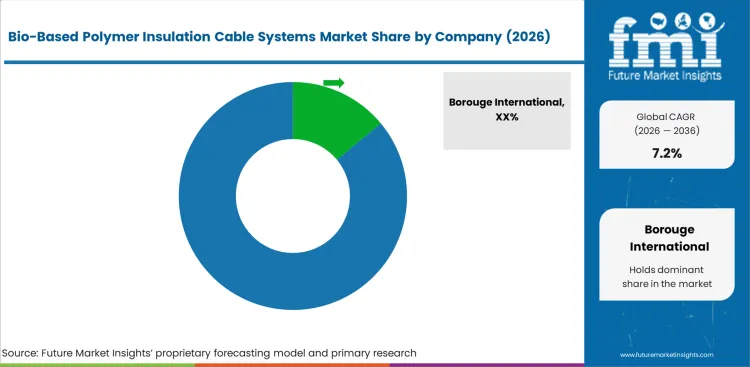
- Polymer suppliers hold an advantage when bio-based feedstock access is backed by cable-grade processing support.
- Cable manufacturers gain value when material claims are converted into verified product labels and environmental documents.
- Recycling partnerships improve competitiveness as project owners ask for clearer circular material evidence.
The competition outlook is defined by two groups, one includes polymer suppliers who focus on renewable feedstock access and cable-grade processing support. Cable manufacturers compete by turning material claims into approved cable products and customer-ready documents. Borouge International through Borealis brings cable-grade polyolefin depth and circular jacketing evidence. Covestro adds thermoplastic polyurethane jacket capability, and Arkema supports higher-performance bio-polyamide choices. Prysmian and Nexans link material work with finished cable products and customer documentation.
Supplier selection will depend on evidence that bio-based or recycled content does not weaken cable safety. Smaller compounders can serve local projects but may face limits in utility contracts requiring aging data and global certification. Project owners will favor suppliers explaining chain-of-custody records and cable test behavior before sale. Companies with cable-grade polymer access and strong traceability support are best positioned to win repeat orders.
Key Companies in the Bio-Based Polymer Insulation Cable Systems Market
Competitive structure is grouped by polymer suppliers, cable manufacturers and compound specialists.
- Polymer Suppliers: Borouge International, Covestro AG and Arkema S.A. supply bio-based or circular polymer materials relevant to cable insulation systems.
- Cable Manufacturers: Prysmian S.p.A. and Nexans S.A. convert lower carbon material work into cable products and customer documents.
- Compounders and Additive Specialists: Sumitomo Electric Industries Ltd. and Avient Corporation support polymer modification for flame and processing needs.
Competitive Benchmarking: Bio-Based Polymer Insulation Cable Systems Market
| Company | Bio-Polymer Access | Cable Qualification Depth | Carbon Proof Strength | Geographic Footprint |
|---|---|---|---|---|
| Borouge International | High | Strong | Strong | Europe, Middle East and global |
| Covestro AG | High | Strong | Medium | Europe and Asia Pacific |
| Arkema S.A. | High | Medium | Strong | Europe, North America and Asia |
| Prysmian S.p.A. | Medium | Strong | Strong | Global |
| Nexans S.A. | Medium | Strong | Strong | Europe and global |
| Sumitomo Electric Industries Ltd. | Medium | Strong | Medium | Japan and global |
| Avient Corporation | Medium | Medium | Medium | North America and global |
Source: Future Market Insights competitive analysis 2026. Ratings reflect relative positioning based on cable-grade polymer access and product documentation depth.
Key Developments in Bio-Based Polymer Insulation Cable Systems Market
- In December 2025, Prysmian and Versalis signed a partnership to chemically recycle plastic cable scrap into new polymers for high-performance cable production.
- In March 2026, Sumitomo Electric developed IRRAX™BM, a biomass electrical wire using raw materials derived from discarded scallop shells.
- In March 2026, Prysmian created a negative-carbon-footprint cable using bio-polymers, low-carbon materials and recycled materials for power grid applications.
Key Players in the Bio-Based Polymer Insulation Cable Systems Market
Major Global Players:
- Borouge International
- Covestro AG
- Arkema S.A.
- Prysmian S.p.A.
- Nexans S.A.
Specialist and Regional Players:
- Sumitomo Electric Industries Ltd.
- Avient Corporation
Market Report Scope
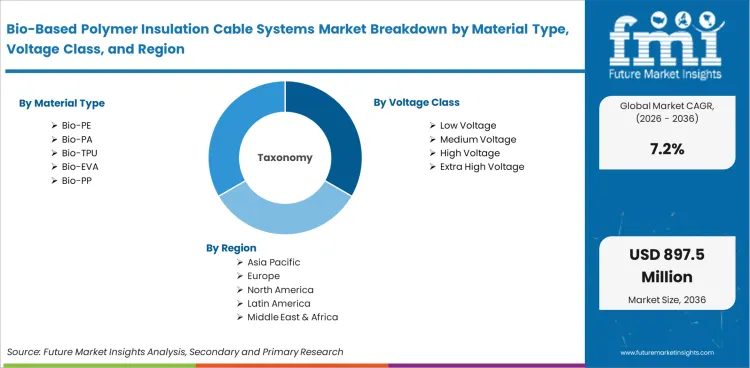
| Parameter | Details |
|---|---|
| Quantitative units | USD 447.8 million to USD 897.5 million, at 7.2% CAGR |
| Market definition | Cable insulation and jacket systems using verified bio-based polymer content |
| Material type | Bio-PE, Bio-PA, Bio-TPU, Bio-EVA, Bio-PP |
| Voltage class | Low voltage, medium voltage, high voltage, extra high voltage |
| Application | Building wiring, grid cables, charging cables, data cables, offshore cables |
| End use sector | Utilities, construction, transport, data centers, electronics |
| Certification type | ISCC Plus, EPD verified, halogen free, CPR rated, RoHS compliant |
| Regions covered | North America, Europe, East Asia, South Asia, Rest of World |
| Countries covered | China, United States, India, Germany, United Kingdom, Japan, South Korea |
| Key companies profiled | Borouge International, Covestro, Arkema, Prysmian, Nexans, Sumitomo Electric Industries Ltd., Avient |
| Forecast period | 2026 to 2036 |
| Approach | Hybrid top-down and bottom-up model with cable project checks and polymer price review |
Source: Future Market Insights, 2026.
Bio-Based Polymer Insulation Cable Systems Market Breakdown by Material Type, Voltage Class, Application, End Use Sector, Certification Type, and Region
By Material Type:
- Bio-PE
- Bio-PA
- Bio-TPU
- Bio-EVA
- Bio-PP
By Voltage Class:
- Low Voltage
- Medium Voltage
- High Voltage
- Extra High Voltage
By Application:
- Building Wiring
- Grid Cables
- Charging Cables
- Data Cables
- Offshore Cables
By End Use Sector:
- Utilities
- Construction
- Transport
- Data Centers
- Electronics
By Certification Type:
- ISCC Plus
- EPD Verified
- Halogen Free
- CPR Rated
- RoHS Compliant
By Region:
- North America
- United States
- Europe
- Germany
- United Kingdom
- East Asia
- China
- Japan
- South Korea
- South Asia
- India
- Rest of World
Research Sources and Bibliography
- Borealis. (2024, April 3). Borealis to unveil sustainable cable jacketing solution at wire Düsseldorf 2024.
- Covestro. (2024, June 6). Covestro launches Desmopan FR TPU series for cable jacket solutions.
- European Commission. (2024, July 18). Ecodesign for Sustainable Products Regulation.
- Federal Energy Regulatory Commission. (2024, May 13). Fact sheet: Building for the future through electric regional transmission planning and cost allocation.
- Fraunhofer Institute for Solar Energy Systems. (2025, January 7). German net power generation in 2024: Electricity mix cleaner than ever.
- Government of the United Kingdom. (2024, December 13). Clean Power 2030 Action Plan.
- International Electrotechnical Commission. (2024, May). IEC 60502-2:2014+AMD1:2024 CSV: Power cables with extruded insulation and their accessories for rated voltages from 1 kV up to 30 kV.
- International Energy Agency. (2025, March 24). Global Energy Review 2025.
- International Energy Agency. (2025, May). Global EV Outlook 2025: Electric vehicle charging.
- International Energy Agency. (2026, March 24). 11th Basic Electricity Supply and Demand Plan.
- International Renewable Energy Agency. (2025, March 26). Record-breaking annual growth in renewable power capacity.
- Ministry of New and Renewable Energy. (2025, December). Programme/scheme wise cumulative physical progress as on 31 December 2025.
- Ministry of Economy, Trade and Industry. (2025, February 18). Cabinet decision on the Seventh Strategic Energy Plan.
- Prysmian. (2025, December 22). Prysmian and Versalis partner to give new life to plastic cable scrap.
- Prysmian. (2026, March 24). Prysmian creates the world’s first negative-carbon-footprint cable.
- State Council of the People’s Republic of China. (2025, January 21). China’s installed power generation capacity up 14.6 percent in 2024.
- U.S. Department of Energy. (2024, October 3). Transmission Facilitation Program selections.
- U.S. Department of Energy. (2025, January 16). LPO announces conditional commitment to AEP to upgrade nearly 5,000 miles of transmission lines.
- American Society of Civil Engineers. (2025, July 10). Policy Statement 484: Electricity generation and transmission infrastructure.
- European Commission. (2025, January 7). New EU rules on the safety and sustainability of construction products mark a new step for the sector’s competitiveness.
- Sumitomo Electric Industries, Ltd. (2026, March 25). Sumitomo Electric successfully develops “IRRAX™BM,” UL Standard 125°C heat-resistant biomass electrical wire utilizing discarded scallop shells.
Bibliography uses primary government and official company sources.
This Report Answers
- What is the expected value of bio-based polymer insulation cable systems market by 2036?
- What CAGR is forecast for bio-based polymer insulation cable systems market from 2026 to 2036?
- Which material type is projected to account for a leading share in 2026?
- Which voltage class is expected to hold a strong share of bio-based polymer insulation cable systems demand?
- How do polymer traceability rules affect bio-based polymer insulation cable systems supplier selection?
- Which countries are forecast to record stronger growth by 2036?
- Which companies compete in bio-based polymer insulation cable systems market?
- How do grid and building wiring applications affect market value?
- What methodology supports the bio-based polymer insulation cable systems market forecast?
Frequently Asked Questions
What will be the bio-based polymer insulation cable systems market value in 2026?
The bio-based polymer insulation cable systems market size is anticipated to scale USD 447.8 million in 2026.
What is the expected value of bio-based polymer insulation cable systems market by 2036?
The bio-based polymer insulation cable systems industry revenue is forecast to reach USD 897.5 million by 2036 as grid and building cable needs continue.
What CAGR is expected for bio-based polymer insulation cable systems market?
The bio-based polymer insulation cable systems sector is anticipated to expand at 7.2% CAGR from 2026 to 2036 with cable qualification demand.
Which material segment holds a strong share in bio-based polymer insulation cable systems market?
Bio-PE is expected to account for 38.4% share in 2026 due to familiar extrusion behavior in cable insulation lines.
Which voltage class is prominent in bio-based polymer insulation cable systems market?
Low voltage systems are projected to account for 44.7% share in 2026 as building wiring and distribution cables need safer insulation.
Which country grows faster in bio-based polymer insulation cable systems market?
China is projected to record 8.2% CAGR by 2036 since grid investment and renewable power additions raise qualified cable demand.
What are bio-based polymer insulation cable systems?
Bio-based polymer insulation cable systems use renewable or mass-balanced polymer content in insulation and jackets for power or signal cables.
How is bio-based polymer insulation cable systems market forecast prepared?
Forecasting uses market values and segment shares. Country rates and application checks refine grid, building wiring and charging cable exposure.
Why do bio-based polymer insulation cable systems need certification?
Certification proves renewable content and product traceability. Cable buyers need this evidence before they accept material claims in regulated projects.
Do bio-based polymer insulation cable systems replace standard cables?
Bio-based polymer insulation cable systems replace standard insulation only after safety and aging performance checks meet cable approval needs.
Who uses bio-based polymer insulation cable systems?
Utilities and transport cable makers use these systems where lower carbon material claims can meet cable safety requirements.
Are bio-based polymer insulation cable systems better than conventional insulation?
Bio-based systems can reduce fossil polymer exposure. Conventional insulation remains preferred where long qualification records and lower prices dominate.
Preview the report firsthand - request a free sample
Get SampleGet the brochure for pricing and purchase details.
Get PDFTable of Content
- Key Takeaways
- Market Size and CAGR
- Top Growth Driver
- Fastest Growing Segment
- Leading Region
- Key Companies
- Emerging Opportunities
- Executive Summary
- Global Market Outlook
- Demand-side Trends
- Supply-side Trends
- Technology Roadmap Analysis
- Analysis and Recommendations
- Analyst Perspective (What is happening? Why now? What should investors know?)
- Key Questions Answered
- How large is the market?
- What is the CAGR?
- What are key trends?
- Which region dominates?
- Who are the leaders?
- Market Overview
- Market Coverage / Taxonomy
- Market Definition / Scope / Limitations
- Research Methodology
- Chapter Orientation
- Analytical Lens and Working Hypotheses
- Market Structure, Signals, and Trend Drivers
- Benchmarking and Cross-market Comparability
- Market Sizing, Forecasting, and Opportunity Mapping
- Research Design and Evidence Framework
- Desk Research Programme (Secondary Evidence)
- Expert Input and Fieldwork (Primary Evidence)
- Tooling, Models, and Reference Databases
- Data Engineering and Model Build
- Quality Assurance and Audit Trail
- Market Background
- Market Dynamics (Drivers, Restraints, Opportunity, Trends)
- Scenario Forecast (Optimistic, Likely, Conservative)
- Impact Analysis
- AI Impact
- Sustainability Impact
- Regulatory Impact
- Technology Impact
- Consumer / Buyer Analysis
- Purchase Drivers
- Adoption Barriers
- Buyer Journey
- Opportunity Map Analysis
- Product Life Cycle Analysis
- Supply Chain Analysis
- Investment Feasibility Matrix
- Value Chain Analysis
- PESTLE and Porter's Analysis
- Regulatory Landscape
- Regional Parent Market Outlook
- Production and Consumption Statistics
- Import and Export Statistics
- Global Market Analysis and Forecast, 2021 to 2036
- Historical Market Size Value (USD Million) Analysis, 2021 to 2025
- Current and Future Market Size Value (USD Million) Projections, 2026 to 2036
- Y-o-Y Growth Trend Analysis
- Absolute $ Opportunity Analysis
- Global Market Pricing Analysis, 2021 to 2036
- Global Market Analysis and Forecast, By Material Type, 2021 to 2036
- Introduction / Key Findings
- Historical Market Size Value (USD Million) Analysis By Material Type, 2021 to 2025
- Current and Future Market Size Value (USD Million) Analysis and Forecast By Material Type, 2026 to 2036
- Bio-PE
- Bio-PA
- Bio-TPU
- Bio-EVA
- Bio-PP
- Bio-PE
- Y-o-Y Growth Trend Analysis By Material Type, 2021 to 2025
- Absolute $ Opportunity Analysis By Material Type, 2026 to 2036
- Global Market Analysis and Forecast, By Voltage Class, 2021 to 2036
- Introduction / Key Findings
- Historical Market Size Value (USD Million) Analysis By Voltage Class, 2021 to 2025
- Current and Future Market Size Value (USD Million) Analysis and Forecast By Voltage Class, 2026 to 2036
- Low Voltage
- Medium Voltage
- High Voltage
- Extra High Voltage
- Low Voltage
- Y-o-Y Growth Trend Analysis By Voltage Class, 2021 to 2025
- Absolute $ Opportunity Analysis By Voltage Class, 2026 to 2036
- Global Market Analysis and Forecast, By Application, 2021 to 2036
- Introduction / Key Findings
- Historical Market Size Value (USD Million) Analysis By Application, 2021 to 2025
- Current and Future Market Size Value (USD Million) Analysis and Forecast By Application, 2026 to 2036
- Building Wiring
- Grid Cables
- Charging Cables
- Data Cables
- Offshore Cables
- Building Wiring
- Y-o-Y Growth Trend Analysis By Application, 2021 to 2025
- Absolute $ Opportunity Analysis By Application, 2026 to 2036
- Global Market Analysis and Forecast, By End Use Sector, 2021 to 2036
- Introduction / Key Findings
- Historical Market Size Value (USD Million) Analysis By End Use Sector, 2021 to 2025
- Current and Future Market Size Value (USD Million) Analysis and Forecast By End Use Sector, 2026 to 2036
- Utilities
- Construction
- Transport
- Data Centers
- Electronics
- Utilities
- Y-o-Y Growth Trend Analysis By End Use Sector, 2021 to 2025
- Absolute $ Opportunity Analysis By End Use Sector, 2026 to 2036
- Global Market Analysis and Forecast, By Certification Type, 2021 to 2036
- Introduction / Key Findings
- Historical Market Size Value (USD Million) Analysis By Certification Type, 2021 to 2025
- Current and Future Market Size Value (USD Million) Analysis and Forecast By Certification Type, 2026 to 2036
- ISCC Plus
- EPD Verified
- Halogen Free
- CPR Rated
- RoHS Compliant
- ISCC Plus
- Y-o-Y Growth Trend Analysis By Certification Type, 2021 to 2025
- Absolute $ Opportunity Analysis By Certification Type, 2026 to 2036
- Global Market Analysis and Forecast, By Region, 2021 to 2036
- Introduction
- Historical Market Size Value (USD Million) Analysis By Region, 2021 to 2025
- Current Market Size Value (USD Million) Analysis and Forecast By Region, 2026 to 2036
- North America
- Latin America
- Western Europe
- Eastern Europe
- East Asia
- South Asia and Pacific
- Middle East & Africa
- Market Attractiveness Analysis By Region
- North America Market Analysis and Forecast, By Country, 2021 to 2036
- Historical Market Size Value (USD Million) Trend Analysis By Market Taxonomy, 2021 to 2025
- Market Size Value (USD Million) Forecast By Market Taxonomy, 2026 to 2036
- By Country
- USA
- Canada
- By Material Type
- By Voltage Class
- By Application
- By End Use Sector
- By Certification Type
- By Country
- Market Attractiveness Analysis
- By Country
- By Material Type
- By Voltage Class
- By Application
- By End Use Sector
- By Certification Type
- Key Takeaways
- Latin America Market Analysis and Forecast, By Country
- Historical Market Size Value (USD Million) Trend Analysis By Market Taxonomy, 2021 to 2025
- Market Size Value (USD Million) Forecast By Market Taxonomy, 2026 to 2036
- By Country
- Brazil
- Mexico
- Chile
- Rest of Latin America
- By Material Type
- By Voltage Class
- By Application
- By End Use Sector
- By Certification Type
- By Country
- Market Attractiveness Analysis
- By Country
- By Material Type
- By Voltage Class
- By Application
- By End Use Sector
- By Certification Type
- Key Takeaways
- Western Europe Market Analysis and Forecast, By Country
- Historical Market Size Value (USD Million) Trend Analysis By Market Taxonomy, 2021 to 2025
- Market Size Value (USD Million) Forecast By Market Taxonomy, 2026 to 2036
- By Country
- Germany
- UK
- Italy
- Spain
- France
- Nordic
- BENELUX
- Rest of Western Europe
- By Material Type
- By Voltage Class
- By Application
- By End Use Sector
- By Certification Type
- By Country
- Market Attractiveness Analysis
- By Country
- By Material Type
- By Voltage Class
- By Application
- By End Use Sector
- By Certification Type
- Key Takeaways
- Eastern Europe Market Analysis and Forecast, By Country
- Historical Market Size Value (USD Million) Trend Analysis By Market Taxonomy, 2021 to 2025
- Market Size Value (USD Million) Forecast By Market Taxonomy, 2026 to 2036
- By Country
- Russia
- Poland
- Hungary
- Balkan & Baltic
- Rest of Eastern Europe
- By Material Type
- By Voltage Class
- By Application
- By End Use Sector
- By Certification Type
- By Country
- Market Attractiveness Analysis
- By Country
- By Material Type
- By Voltage Class
- By Application
- By End Use Sector
- By Certification Type
- Key Takeaways
- East Asia Market Analysis and Forecast, By Country
- Historical Market Size Value (USD Million) Trend Analysis By Market Taxonomy, 2021 to 2025
- Market Size Value (USD Million) Forecast By Market Taxonomy, 2026 to 2036
- By Country
- China
- Japan
- South Korea
- By Material Type
- By Voltage Class
- By Application
- By End Use Sector
- By Certification Type
- By Country
- Market Attractiveness Analysis
- By Country
- By Material Type
- By Voltage Class
- By Application
- By End Use Sector
- By Certification Type
- Key Takeaways
- South Asia and Pacific Market Analysis and Forecast, By Country
- Historical Market Size Value (USD Million) Trend Analysis By Market Taxonomy, 2021 to 2025
- Market Size Value (USD Million) Forecast By Market Taxonomy, 2026 to 2036
- By Country
- India
- ASEAN
- Australia & New Zealand
- Rest of South Asia and Pacific
- By Material Type
- By Voltage Class
- By Application
- By End Use Sector
- By Certification Type
- By Country
- Market Attractiveness Analysis
- By Country
- By Material Type
- By Voltage Class
- By Application
- By End Use Sector
- By Certification Type
- Key Takeaways
- Middle East & Africa Market Analysis and Forecast, By Country
- Historical Market Size Value (USD Million) Trend Analysis By Market Taxonomy, 2021 to 2025
- Market Size Value (USD Million) Forecast By Market Taxonomy, 2026 to 2036
- By Country
- Kingdom of Saudi Arabia
- Other GCC Countries
- Türkiye
- South Africa
- Other African Union
- Rest of Middle East & Africa
- By Material Type
- By Voltage Class
- By Application
- By End Use Sector
- By Certification Type
- By Country
- Market Attractiveness Analysis
- By Country
- By Material Type
- By Voltage Class
- By Application
- By End Use Sector
- By Certification Type
- Key Takeaways
- Key Countries Market Analysis
- USA
- Pricing Analysis
- Market Share Analysis, 2025
- By Material Type
- By Voltage Class
- By Application
- By End Use Sector
- By Certification Type
- Canada
- Pricing Analysis
- Market Share Analysis, 2025
- By Material Type
- By Voltage Class
- By Application
- By End Use Sector
- By Certification Type
- Mexico
- Pricing Analysis
- Market Share Analysis, 2025
- By Material Type
- By Voltage Class
- By Application
- By End Use Sector
- By Certification Type
- Brazil
- Pricing Analysis
- Market Share Analysis, 2025
- By Material Type
- By Voltage Class
- By Application
- By End Use Sector
- By Certification Type
- Chile
- Pricing Analysis
- Market Share Analysis, 2025
- By Material Type
- By Voltage Class
- By Application
- By End Use Sector
- By Certification Type
- Germany
- Pricing Analysis
- Market Share Analysis, 2025
- By Material Type
- By Voltage Class
- By Application
- By End Use Sector
- By Certification Type
- UK
- Pricing Analysis
- Market Share Analysis, 2025
- By Material Type
- By Voltage Class
- By Application
- By End Use Sector
- By Certification Type
- Italy
- Pricing Analysis
- Market Share Analysis, 2025
- By Material Type
- By Voltage Class
- By Application
- By End Use Sector
- By Certification Type
- Spain
- Pricing Analysis
- Market Share Analysis, 2025
- By Material Type
- By Voltage Class
- By Application
- By End Use Sector
- By Certification Type
- France
- Pricing Analysis
- Market Share Analysis, 2025
- By Material Type
- By Voltage Class
- By Application
- By End Use Sector
- By Certification Type
- India
- Pricing Analysis
- Market Share Analysis, 2025
- By Material Type
- By Voltage Class
- By Application
- By End Use Sector
- By Certification Type
- ASEAN
- Pricing Analysis
- Market Share Analysis, 2025
- By Material Type
- By Voltage Class
- By Application
- By End Use Sector
- By Certification Type
- Australia & New Zealand
- Pricing Analysis
- Market Share Analysis, 2025
- By Material Type
- By Voltage Class
- By Application
- By End Use Sector
- By Certification Type
- China
- Pricing Analysis
- Market Share Analysis, 2025
- By Material Type
- By Voltage Class
- By Application
- By End Use Sector
- By Certification Type
- Japan
- Pricing Analysis
- Market Share Analysis, 2025
- By Material Type
- By Voltage Class
- By Application
- By End Use Sector
- By Certification Type
- South Korea
- Pricing Analysis
- Market Share Analysis, 2025
- By Material Type
- By Voltage Class
- By Application
- By End Use Sector
- By Certification Type
- Russia
- Pricing Analysis
- Market Share Analysis, 2025
- By Material Type
- By Voltage Class
- By Application
- By End Use Sector
- By Certification Type
- Poland
- Pricing Analysis
- Market Share Analysis, 2025
- By Material Type
- By Voltage Class
- By Application
- By End Use Sector
- By Certification Type
- Hungary
- Pricing Analysis
- Market Share Analysis, 2025
- By Material Type
- By Voltage Class
- By Application
- By End Use Sector
- By Certification Type
- Kingdom of Saudi Arabia
- Pricing Analysis
- Market Share Analysis, 2025
- By Material Type
- By Voltage Class
- By Application
- By End Use Sector
- By Certification Type
- Türkiye
- Pricing Analysis
- Market Share Analysis, 2025
- By Material Type
- By Voltage Class
- By Application
- By End Use Sector
- By Certification Type
- South Africa
- Pricing Analysis
- Market Share Analysis, 2025
- By Material Type
- By Voltage Class
- By Application
- By End Use Sector
- By Certification Type
- USA
- Market Structure Analysis
- Competition Dashboard
- Competition Benchmarking
- Market Share Analysis of Top Players
- By Regional
- By Material Type
- By Voltage Class
- By Application
- By End Use Sector
- By Certification Type
- Emerging Startups
- Innovation Benchmarking
- Competition Analysis
- Competition Deep Dive
- Prysmian S.p.A.
- Overview
- Product Portfolio
- Profitability by Market Segments
- Sales Footprint
- Strategy Overview
- Marketing Strategy
- Product Strategy
- Channel Strategy
- Borouge International
- Covestro AG
- Arkema S.A.
- Nexans S.A.
- Sumitomo Electric Industries Ltd.
- Avient Corporation
- Prysmian S.p.A.
- Case Studies
- Success Stories
- Recent Developments
- Competition Deep Dive
- Assumptions & Acronyms Used


