

- Market Size (2026)
- USD 520.1 Mn
- Forecast (2036)
- USD 941.2 Mn
- CAGR (2026 to 2036)
- 6.1%
Aluminum Conductor Automotive Cable Systems Market Size, Market Forecast and Outlook By FMI
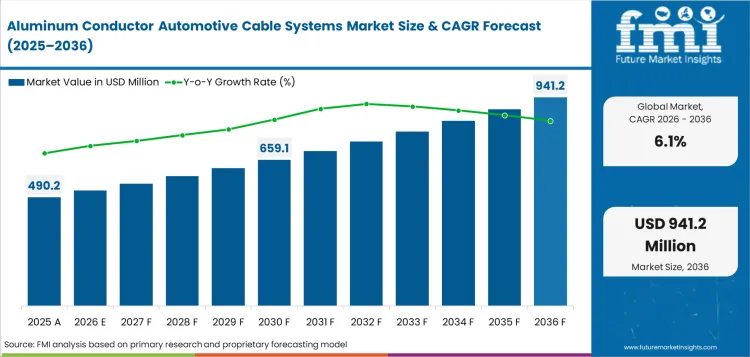
The aluminum conductor automotive cable systems market was valued at USD 490.2 million in 2025 and is projected to reach USD 520.1 million in 2026. Industry revenue is forecast to rise to USD 941.2 million by 2036 at 6.1% CAGR. By sales channel, OEM supply is anticipated to represent 84.2% share in 2026. By conductor format, stranded core is expected to represent 71.6% share in 2026.
Summary of Aluminum Conductor Automotive Cable Systems Market
- Demand and Growth Drivers
- Electric vehicle production increases the number of power and signal paths needing lower mass cable choices.
- Copper price exposure makes aluminum more attractive in circuits passing bend and corrosion validation.
- Automakers need validated terminals as aluminum conductors require tighter crimp control than copper cable systems.
- Product and Segment View
- OEM supply is projected to account for 84.2% share in 2026 led by cable systems entering vehicles through platform approval work.
- Stranded core is expected to capture 71.6% share in 2026 since vehicle routing needs flexible conductors across moving body sections.
- Low voltage cable is forecast to represent 58.4% share in 2026 due to body electronics and auxiliary systems covering several conductor runs.
- Geography and Competitive Outlook
- India is projected to record 8.1% CAGR by 2036 as domestic vehicle output and electric mobility content create cable localization needs.
- China is expected to expand at 7.8% CAGR by 2036 as new energy vehicle registrations support aluminum wire harness qualification.
- Aptiv and Yazaki define competition across aluminum automotive cable systems, with Sumitomo Electric and LEONI adding harness and conductor depth.
- Analyst Opinion
- Nikhil Kaitwade, Principal Consultant for Automotive at FMI, observes, "Aluminum conductor cables implementation in automotive wiring is a strategic and application-specific evolution. True adoption will depend on proven, scalable solutions for corrosion resistance and crimp reliability withstanding the rigors of high-volume production and real-world durability demands."
- Aluminum Conductor Automotive Cable Systems Market Value Analysis
- Cable value is shifting toward lighter conductor systems with documented terminal sealing and bend performance around aluminum input exposure.
- Manufacturer spending reflects vehicle weight control as electrified cars carry more wiring and lightweight automotive body panels influence design targets.
- Validation cost keeps aluminum use selective in safety-sensitive circuits and high-vibration areas.
- Demand is supported by automakers seeking lower mass solutions using lightweight polymers and conductor changes without altering reliability targets.
Key Takeaways, Market Size, and Forecast
- The aluminum conductor automotive cable systems market size stood at USD 490.2 million in 2025.
- Industry value is expected to cross USD 941.2 million by 2036 as electric platforms raise cable routing content.
- From 2026 to 2036, the sector is projected to expand at 6.1% CAGR.
- Industry revenue is forecast to create incremental opportunity of USD 421.1 million from 2026 to 2036.
- OEM supply is expected to account for 84.2% share of sales channel in 2026 led by automakers approving cable systems during platform sourcing.
- Stranded core is projected to account for 71.6% share of conductor format in 2026 due to routing bend needs and vibration exposure.
- India is anticipated to witness expansion at 8.1% CAGR, followed by China at 7.8% CAGR by 2036.
Vehicle cable selection is under pressure from weight targets and electrical safety review at the same time. OEM sourcing will favor suppliers tracking revised cable standards before platform release since wiring drawings must meet safety and routing requirements early. In February 2025, the USA Department of Transportation delayed FMVSS No. 305a’s effective date to March 20, 2025, for light and heavy vehicles.
The rule update shows how electric vehicle cable systems are entering formal safety documentation and post-crash electrical protection review. In July 2024, Yazaki’s U.S. Patent No. 12,037,514 described an anti-corrosive terminal material with viscosity of 18,900 mPa·s or less. The same patent cited elongation of 60% or greater after heating at 120 °C for 4,000 hours. This supports a stronger case for suppliers with sealed terminal designs and repeatable crimp control in aluminum conductor harness programs.
Aluminum Conductor Automotive Cable Systems Market Definition
Aluminum conductor automotive cable systems are vehicle wiring assemblies using aluminum conductors in place of copper for selected power and signal paths. Scope covers low voltage cable and high voltage cable for validated vehicle cable systems. Terminals and insulation are included when supplied inside the assembly. Revenue includes original equipment supply and service kit channels. Loose aluminum rod, building wire and non-automotive cable are excluded unless supplied as finished vehicle cable assemblies.
Aluminum Conductor Automotive Cable Systems Market Inclusions
Scope includes aluminum conductors used in passenger cars and commercial vehicles for power distribution, battery connection and charging link applications. Aluminum wire and stranded cable are included when supplied for vehicle wiring programs. Clad aluminum formats and selected automotive connectors are included under the same condition. Cable systems for battery electric, hybrid electric and conventional vehicle platforms are included. OEM supply and defined service kits are counted as revenue channels.
Aluminum Conductor Automotive Cable Systems Market Exclusions
Scope excludes copper-only automotive cable systems and general electrical cable sold outside vehicle applications. Bare aluminum rod, construction cable and utility conductor products are outside scope. Loose terminals sold without vehicle-specific cable assembly value are excluded. Charging station cables are excluded unless supplied as part of an on-vehicle charging link. Software and diagnostic services are outside revenue scope.
Aluminum Conductor Automotive Cable Systems Market Research Methodology
- Primary Research: FMI analysts reviewed sourcing needs across wiring harness suppliers and vehicle platform engineers. Distributor feedback was checked separately for service kit demand.
- Desk Research: Official vehicle output data and electric vehicle sales data supported demand checks. Company releases supported supplier mapping and development validation.
- Market Sizing and Forecasting: Forecast values used vehicle production exposure and estimated cable value per vehicle. Segment share checks reflected voltage class and channel approval routes.
- Data Validation: Checks compared 2026 value with 2036 value and tested CAGR consistency. Country growth was reviewed against vehicle output and electrification evidence.
Why is the Aluminum Conductor Automotive Cable Systems Market Growing?
- Electrified vehicle platforms are adding cable paths raising mass sensitivity across body and battery routing areas.
- Copper exposure is pushing automakers to qualify aluminum conductors in circuits with lower thermal stress and suitable bend limits.
- Terminal sealing and crimp control are lowering one barrier for aluminum wire use in vehicle harnesses.
Market growth is driven by vehicle electrification, which is changing wiring content per platform. International Energy Agency reported electric car sales reached 21.0 million units in 2025 and one in four cars sold was electric. Higher electrified content increases interest in wire harness designs reducing mass without raising warranty exposure. U.S. Geological Survey reported in February 2026, copper was added to the Final 2025 List of Critical Minerals. Copper supply scrutiny gives automakers another reason to review validated aluminum conductor systems in suitable vehicle circuits. Supplier gains will depend on sealed terminal proof and repeatable crimp process control.
Market Segmentation Analysis
- Low voltage cable is forecast to capture 58.4% share in 2026 due to body electronics and auxiliary circuits creating broad runs suited to aluminum qualification.
- Battery electric is projected to account for 47.9% share in 2026 since EV platforms create cable mass pressure around battery and power routing zones.
- Power distribution is expected to represent 44.6% share in 2026, led by main harness branches offering recurring opportunities for conductor substitution.
- Stranded core is projected to hold 71.6% share in 2026, influenced by flexible routing and vibration tolerance being central to vehicle cable acceptance.
- OEM supply is anticipated to account for 84.2% share in 2026 since cable systems need platform validation before vehicle production starts.
Market segmentation is divided into five parent groups based on how vehicle cable systems are specified and approved. Voltage separates low voltage, high voltage and signal runs. Vehicle type captures battery electric and hybrid demand linked to electric vehicle battery architectures. Cable function shows routing purpose across power and charging areas. Conductor format explains how flexibility and core design affect installation. Sales channel separates platform supply from service kit replacement.
Insights into Aluminum Conductor Automotive Cable Systems Market by Voltage
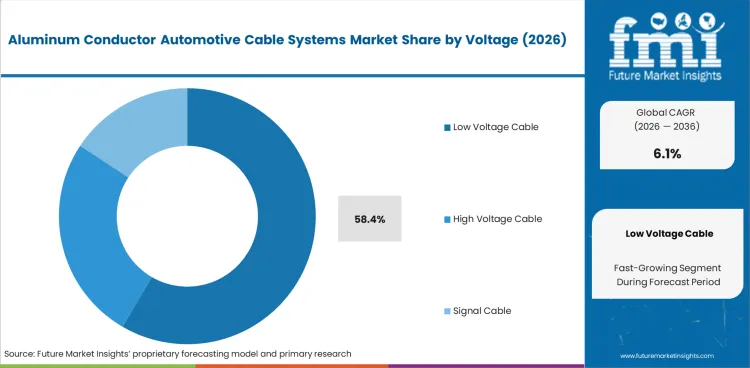
- Low voltage cable is projected to account for 58.4% share in 2026, driven by body electronics and auxiliary routes providing wider space for aluminum substitution after validation.
- High voltage cable is gaining relevance through battery and inverter paths requiring lower mass along with stricter insulation and terminal control.
Insights into Aluminum Conductor Automotive Cable Systems Market by Vehicle Type
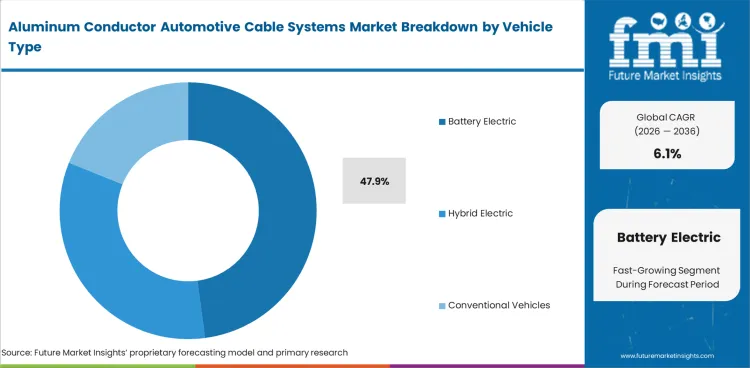
- Battery electric is expected to represent 47.9% share in 2026 as electric platforms carry extra cable content around battery packs and power electronics.
- Hybrid electric demand rises through mixed powertrains depending on battery links and conventional control wiring in the same vehicle.
Insights into Aluminum Conductor Automotive Cable Systems Market by Cable Function
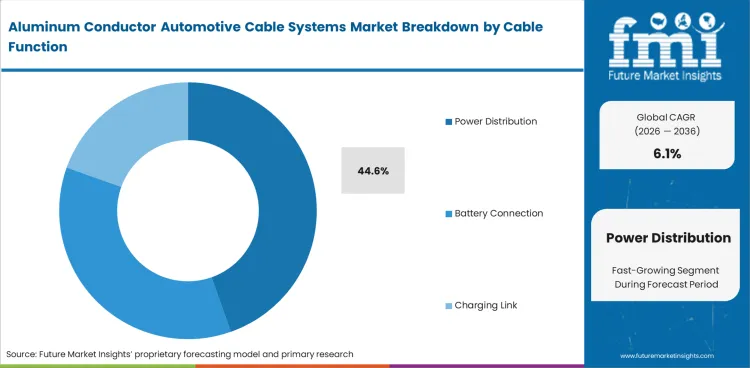
- Power distribution is forecast to account for 44.6% share in 2026 since vehicle power branches provide enough conductor length to justify aluminum qualification work.
- Battery connection gains attention in electrified platforms where mass savings near battery systems can support range and packaging targets.
Insights into Aluminum Conductor Automotive Cable Systems Market by Conductor Format
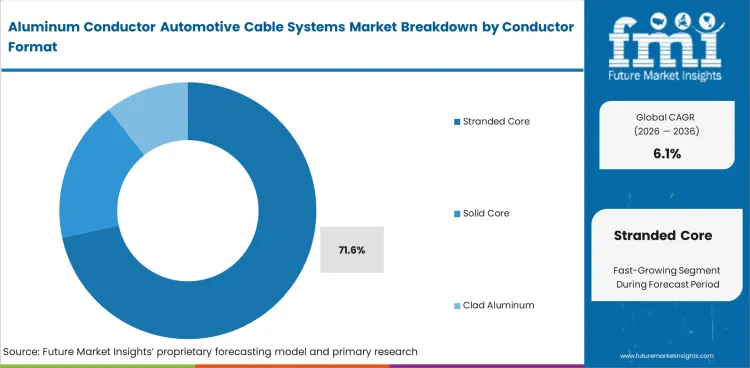
- Stranded core is projected to account for 71.6% share in 2026 as bend performance and vibration tolerance make it the practical format for vehicle routing.
- Solid core remains limited to protected runs as repeated flexing can raise breakage risk in moving vehicle sections.
Insights into Aluminum Conductor Automotive Cable Systems Market by Sales Channel
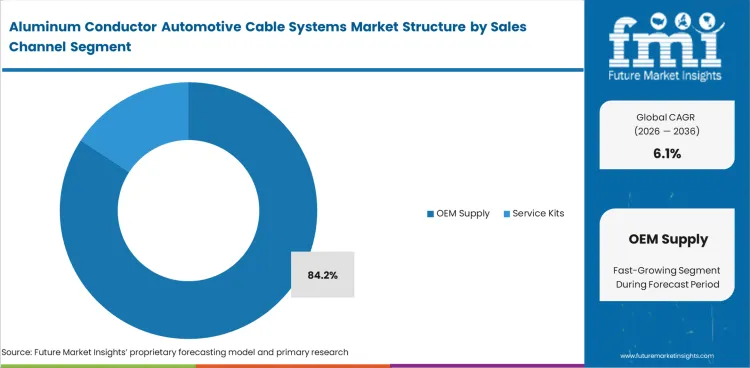
- OEM supply is anticipated to represent 84.2% share in 2026 with cable systems being approved during platform engineering and carry strict drawing controls.
- Service kits hold a smaller share as replacement demand is tied to defined assemblies and repair jobs instead of open aftermarket conversion.
Aluminum Conductor Automotive Cable Systems Market Drivers, Restraints and Opportunities
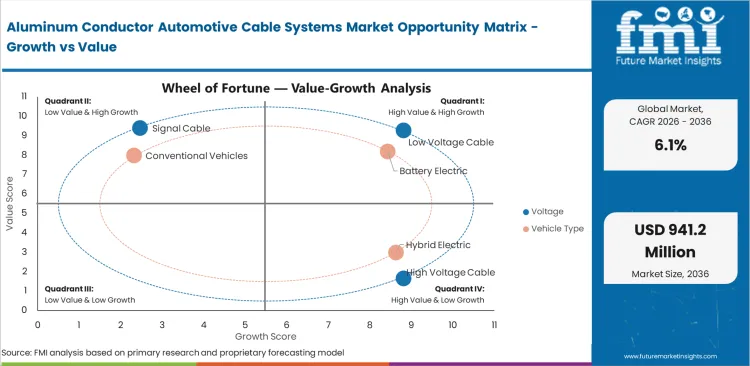
- Electrified platform wiring content is supporting aluminum conductor use in selected body and battery cable routes.
- Crimp reliability testing is expected to restrain suppliers with limited terminal sealing proof and weak process control.
- Copper price exposure creates opportunities for validated aluminum cable systems in cost-sensitive vehicle programs.
Aluminum conductor automotive cable system market growth is expected to depend on how quickly automakers balance weight reduction with long-term wiring reliability. Cost pressure gives aluminum a clearer opening in selected circuits as USGS reported COMEX high-grade copper averaged 480 cents per pound in 2025. Copper and copper alloy products had 18.0% exposure to transportation equipment in the same review. USGS reported transportation accounted for 36.0% of domestic aluminum consumption in 2025. Supplier gains are expected to come from sealed terminals, repeatable crimp measurement and validated cable assemblies reducing mass without increasing warranty risk.
Competitive Benchmarking and Technology Positioning Analysis
Competitive positioning in aluminum conductor automotive cable systems is expected to shift toward suppliers that combine conductor knowledge with automation-ready connector design. TE Connectivity reported in July 2025 that its Next2OEM work developed connector geometry for robotic gripper systems and automated harness production. Yazaki and Sumitomo Electric hold an advantage in vehicle harness integration. Furukawa Electric and Coficab carry stronger relevance in conductor and terminal know-how. Aptiv, Lear and Leoni remain important for electrical distribution architecture. Next phase of competition will favor suppliers connecting automotive wiring harness design with traceable connector assembly and stable process control.
Installed Base and Replacement Cycle Analysis
Installed base expansion is expected to support aluminum conductor cable systems through new platform builds before broad aftermarket replacement develops. IEA’s 2025 outlook states that EV stock across all modes except two-wheelers and three-wheelers reaches 250 million units by 2030 under stated policies, with more than 90.0% of fleet as expected to be electric cars. This creates a larger long-term service pool for validated cable assemblies and repair procedures. Replacement cycles will stay selective because aluminum conductors require approved terminals and trained repair handling. OEM supply will remain the main route as automotive wire and cable material choices shift toward lighter conductor systems across battery and body routing areas.
Analysis of Aluminum Conductor Automotive Cable Systems Market by Key Countries
.webp "Top Country Growth Comparison Aluminum Conductor Automotive Cable Systems Market Cagr (2026 2036)")
| Country | CAGR |
|---|---|
| India | 8.1% |
| China | 7.8% |
| United States | 6.6% |
| Mexico | 6.3% |
| Germany | 5.9% |
| South Korea | 5.4% |
| Japan | 4.7% |
Source: Future Market Insights, 2026.
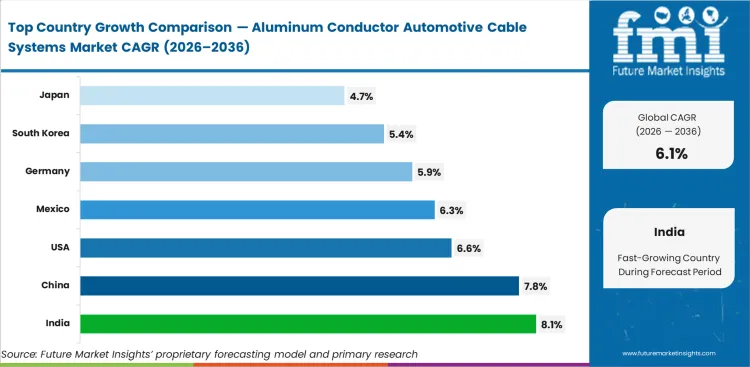
Aluminum Conductor Automotive Cable Systems Market CAGR Analysis by Country
- India is projected to record 8.1% CAGR by 2036 as vehicle output and wiring localization improve aluminum conductor qualification.
- China is expected to expand at 7.8% CAGR by 2036 through new energy vehicle scale and domestic harness engineering depth.
- United States is forecast to grow at 6.6% CAGR by 2036, led by electric pickup and SUV platforms maintaining cable mass pressure.
- Mexico is expected to advance at 6.3% CAGR by 2036 since export-focused assembly keeps wiring suppliers close to vehicle plants.
- Germany is projected to rise at 5.9% CAGR by 2036 due to electric car output and premium vehicle wiring complexity.
- South Korea is forecast at 5.4% CAGR by 2036, influenced by vehicle production and battery manufacturing links sustaining selective adoption.
- Japan is expected to post 4.7% CAGR by 2036 with quality-focused automakers introducing aluminum conductors in controlled circuits.
Country performance differs by electric vehicle output and local harness supplier depth. India and China track above global pace as platform growth leaves more room for cable material change. Mexico benefits from export assembly work tied to North American vehicle programs. Germany, South Korea and Japan grow at measured rates because qualification discipline limits fast material switching.
Demand Outlook for Aluminum Conductor Automotive Cable Systems in India
Demand in India is projected to record 8.1% CAGR by 2036, driven by domestic vehicle output supporting cable localization. Society of Indian Automobile Manufacturers placed total vehicle production at 34.7 million units in financial year 2025 to 2026. High assembly volume gives harness suppliers a larger path to qualify aluminum conductors in cost-sensitive models. Electric two-wheelers and passenger vehicles add further routing needs. Local suppliers can gain if terminal reliability is proven before platform launch.
- High vehicle output supports aluminum conductor trials in power distribution circuits and body harness areas.
- Cable localization reduces lead time for automakers seeking lighter harness systems across repeat production runs.
- EV growth improves the case for automotive wires used around battery and auxiliary systems.
Opportunity Analysis of Aluminum Conductor Automotive Cable Systems in China
Industry in China is expected to expand at 7.8% CAGR by 2036, influenced by new energy vehicle scale keeping cable mass reduction high on supplier agendas. Official Chinese statistics recorded 5.62 million new energy vehicle registrations in the first half of 2025. NEVs made up 44.97% of all new vehicle registrations in that period. Such scale supports repeated qualification of aluminum conductor harnesses across local platforms. Domestic suppliers can move faster because vehicle makers run shorter design cycles.
- New energy vehicle scale supports aluminum conductor use in battery and body wiring routes.
- Local connector depth improves fit with electric vehicle battery connector assemblies used in high-volume programs.
- Short design cycles encourage suppliers to prove corrosion-proof terminals early in vehicle development.
Demand Analysis of Aluminum Conductor Automotive Cable Systems in the United States
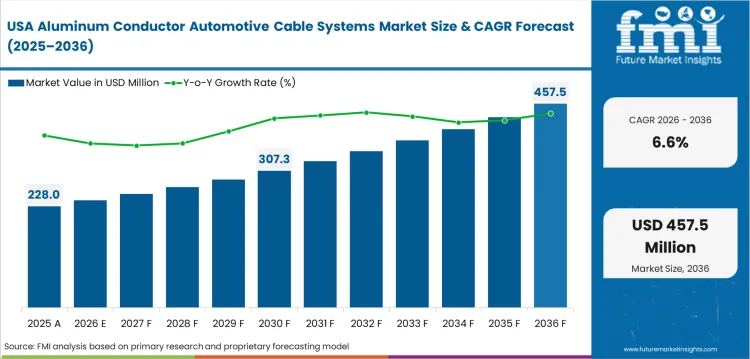
Demand in the United States is forecast to grow at 6.6% CAGR by 2036, led by electric pickup and SUV designs keeping wiring mass under review. International Energy Agency stated U.S. electric car sales declined 2.0% in 2025 after policy changes, although sales reached a quarterly record before tax credit removal. Supplier planning must therefore balance near-term policy noise with platform-level wiring content. Aluminum conductors remain relevant in circuits that pass durability and repair checks.
- Large vehicles create weight pressure that supports aluminum conductor review in long cable runs.
- Policy volatility keeps adoption selective as automakers avoid material shifts without clear platform payback.
- Driver assistance systems add routing needs for automotive radar sensors and related power lines.
Sales Outlook for Aluminum Conductor Automotive Cable Systems in Mexico
Sales in Mexico are expected to advance at 6.3% CAGR by 2036 since electrified vehicle demand adds wiring content to North American vehicle programs. IEA reported electric car sales in Mexico more than tripled in 2025. Faster EV uptake gives harness suppliers a clearer reason to qualify lighter conductor systems for local and export platforms. Supplier proximity remains important as cable systems require platform approval before production scale-up.
- Export assembly creates demand for consistent cable kits used across North American vehicle platforms.
- Supplier proximity reduces logistics risk for harness programs needing scheduled line-side delivery.
- Light truck output supports weight-saving cable designs in long body and chassis routes.
Growth Outlook for Aluminum Conductor Automotive Cable Systems in Germany
The market in Germany is projected to rise at 5.9% CAGR by 2036 due to electric car production and premium vehicle wiring complexity. German automotive association VDA reported 1.67 million electric passenger cars produced in 2025. Electric cars represented 40.0% of domestic passenger car production. Premium platforms demand careful validation before aluminum conductors replace copper in selected runs. Suppliers with proof in high voltage and body harness assemblies gain a clearer path.
- Premium vehicle programs need stable conductor performance across electronics-rich body architectures.
- Electric production supports cable mass reduction around battery systems and power electronics.
- Lightweight design work connects aluminum cable choices with automotive lightweight materials decisions.
Future Outlook for Aluminum Conductor Automotive Cable Systems in South Korea
Sector in South Korea is forecast at 5.4% CAGR by 2036, reflecting vehicle production and battery supply links supporting selective aluminum conductor use. South Korea’s Ministry of Trade, Industry and Resources reported domestic automobile production of 4.1 million units in 2025. Eco-friendly vehicle exports reached USD 25.8 billion in the same year. Battery-focused vehicle platforms give cable suppliers a route into power distribution and charging links. Adoption will stay measured as automakers require repeatable terminal sealing and vibration evidence before wider use.
- Vehicle production scale supports aluminum cable qualification across export-oriented vehicle programs.
- Battery manufacturing depth strengthens the case for local cable systems near electric platform engineering.
- Charging applications can support demand for ultra fast charging EV battery interface components over time.
Sales Analysis of Aluminum Conductor Automotive Cable Systems in Japan
Japan industry is expected to grow at 4.7% CAGR by 2036 through quality-focused automakers adding aluminum conductors in controlled applications. JAMA’s Motor Industry of Japan 2025 states Japan produced 8.23 million vehicles in 2024. Domestic production depth keeps cable qualification tied to defect control and long service life. Supplier gains will come from proven corrosion protection and stable assembly methods rather than broad material conversion.
- Quality discipline favors suppliers with long test records and low defect history across wire harness programs.
- Hybrid platform strength keeps aluminum conductor use selective across power distribution and body electronics.
- Vehicle electronics growth links cable systems with automotive sensors and data routing needs.
Competitive Landscape and Strategic Positioning
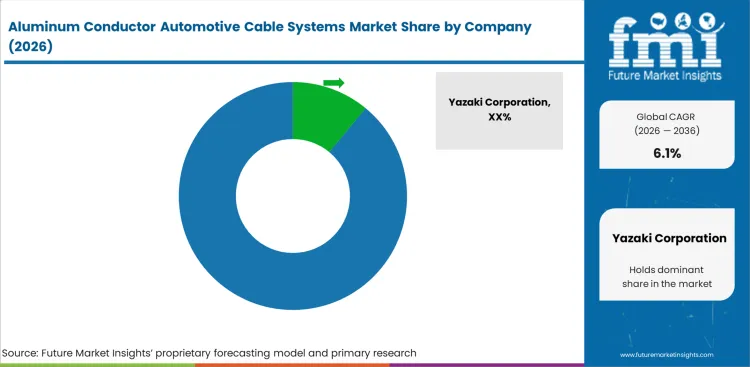
- Global harness suppliers hold an advantage through long vehicle program approval history and automated crimp checks.
- Regional players focus on cost efficient assembly and closeness to vehicle production clusters.
- Specialist cable firms focus on aluminum conductor evidence including terminal sealing and insulation proof.
Competition in aluminum conductor automotive cable systems market is centered on vehicle program access, proven production control and support for lighter wiring designs at scale. Yazaki Corporation and Sumitomo Electric Industries hold deep wiring harness relationships with global automakers. Furukawa Electric adds specific aluminum wire terminal evidence through its JSAE-recognized development. Aptiv is separating its electrical distribution systems business into Versigent to sharpen focus on low voltage and high voltage architectures. Automakers are expected to favor suppliers that can connect conductor systems with automotive data connectors and approved platform drawings.
Supplier strength is clearest in circuits where cable failure can raise warranty costs or stop vehicle assembly. Lear Corporation and Leoni bring electric distribution system depth across vehicle programs. Coficab adds conductor and cable manufacturing reach for OEM supply chains. Connector compatibility remains an important approval point because aluminum conductors need stable joints. Suppliers with material proof and plant-level process discipline are positioned to secure multi-country vehicle programs.
Key Companies in the Aluminum Conductor Automotive Cable Systems Market
Competitive structure is differentiated by wiring harness integrators, conductor specialists and electrical distribution system suppliers.
- Global Wiring Harness Leaders: Yazaki Corporation, Sumitomo Electric Industries and Lear Corporation supply large vehicle wiring programs with established OEM approval depth.
- Aluminum Wire and Terminal Specialists: Furukawa Electric and Coficab Group compete through conductor capability and cable process experience.
- Electrical Distribution System Suppliers: Aptiv and Leoni support vehicle platforms through low voltage and high voltage architecture knowledge.
Competitive Benchmarking: Aluminum Conductor Automotive Cable Systems Market
| Company | Aluminum Conductor Fit | Terminal Validation Depth | OEM Program Reach | Geographic Footprint |
|---|---|---|---|---|
| Yazaki Corporation | High | Strong | Strong | Global automotive wiring |
| Sumitomo Electric Industries | High | Strong | Strong | Global automotive wiring |
| Furukawa Electric | High | Strong | Medium | Japan and global programs |
| Aptiv | High | Medium | Strong | Global EDS programs |
| Lear Corporation | High | Medium | Strong | Global vehicle architectures |
| Leoni AG | Medium | Medium | Strong | Europe and global OEMs |
| Coficab Group | Medium | Strong | Medium | Global cable supply |
Source: Future Market Insights competitive analysis 2026. Ratings reflect relative positioning based on aluminum conductor fit and OEM program reach.
Key Developments in Aluminum Conductor Automotive Cable Systems Market
- In July 2025, TE Connectivity said its Next2OEM work contributed connector geometry designed for automated manufacturing with robotic gripper systems.
- In July 2025, Luxshare-ICT secured 50.1% ownership of LEONI AG with its Wiring Systems Division after regulatory approvals.
- In April 2025, Lear won a 2025 Automotive News PACE Award for its Zone Control Module.
Key Players in the Aluminum Conductor Automotive Cable Systems Market
Major Global Players:
- Yazaki Corporation
- Sumitomo Electric Industries Ltd.
- Furukawa Electric Co. Ltd.
- Versigent Limited
- Lear Corporation
Specialist and Regional Players:
- Luxshare-ICT / LEONI
- Coficab Group
Market Report Scope
| Parameter | Details |
|---|---|
| Quantitative Units | USD 520.1 million to USD 941.2 million, at 6.1% CAGR |
| Market Definition | Automotive cable systems using aluminum conductors in validated vehicle wiring assemblies |
| Voltage | Low voltage cable, high voltage cable, signal cable |
| Vehicle Type | Battery electric, hybrid electric, conventional vehicles |
| Cable Function | Power distribution, battery connection, charging link |
| Conductor Format | Stranded core, solid core, clad aluminum |
| Sales Channel | OEM supply, service kits |
| Regions Covered | North America, Latin America, Europe, East Asia, South Asia and Pacific |
| Countries Covered | India, China, United States, Mexico, Germany, South Korea, Japan |
| Key Companies Profiled | Yazaki Corporation, Sumitomo Electric Industries, Furukawa Electric, Aptiv, Lear, Leoni, Coficab |
| Forecast Period | 2026 to 2036 |
| Approach | Hybrid top-down and bottom-up model with vehicle output and cable value checks |
Source: Future Market Insights, 2026.
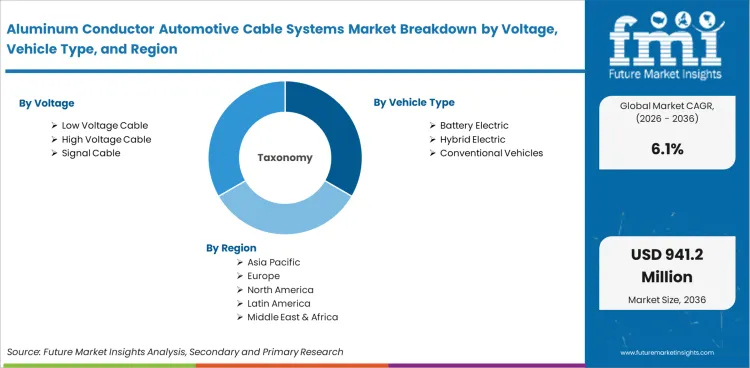
Aluminum Conductor Automotive Cable Systems Market Breakdown by Voltage, Vehicle Type, Cable Function, Conductor Format, Sales Channel and Region.
By Voltage:
- Low Voltage Cable
- High Voltage Cable
- Signal Cable
By Vehicle Type:
- Battery Electric
- Hybrid Electric
- Conventional Vehicles
By Cable Function:
- Power Distribution
- Battery Connection
- Charging Link
By Conductor Format:
- Stranded Core
- Solid Core
- Clad Aluminum
By Sales Channel:
- OEM Supply
- Service Kits
By Region:
- North America
- Latin America
- Europe
- East Asia
- South Asia and Pacific
Research Sources and Bibliography
- USA Department of Transportation. (2025, February 14). Federal Motor Vehicle Safety Standards; FMVSS No. 305a electric-powered vehicles: Electric powertrain integrity global technical regulation No. 20; incorporation by reference.
- Mano, K., & Osada, K. (2024, July 16). Anti-corrosive material, wire with terminal, and wire harness (USA Patent No. 12,037,514). USA Patent and Trademark Office.
- International Energy Agency. (2025). Global EV Outlook 2025: Outlook for electric mobility.
- International Energy Agency. (2026). Global Energy Review 2026: Technology: Electric vehicles.
- USA Geological Survey. (2026, February 6). Mineral commodity summaries 2026.
- USA Geological Survey. (2025, November 14). Interior Department releases final 2025 List of Critical Minerals.
- TE Connectivity. (2025, July 30). TE participates in Next2OEM research initiative to advance automotive automation technology.
- Society of Indian Automobile Manufacturers. (2026, April 14). Auto industry performance of Q4 (Jan-March 2026) & FY 2025-26.
- State Council of the People’s Republic of China. (2025, July 14). China’s new energy vehicle registrations hit record 5.62 mln in H1 2025.
- German Association of the Automotive Industry. (2026, February 3). Production and market in January 2026.
- Ministry of Trade, Industry and Resources. (2026, January 15). Automobile exports hit record high of USD 72 billion in 2025.
- Japan Automobile Manufacturers Association. (2025, September). The motor industry of Japan 2025.
- Furukawa Electric Co., Ltd. (2024, May 28). Awarded “The Technological Development Award” at the 74th JSAE Awards.
- Versigent Limited. (2026, April 1). Versigent launches as new publicly traded company.
- LEONI AG. (2025, July 10). Luxshare-ICT secures majority ownership of Leoni, after its successful turnaround.
- Lear Corporation. (2025, April 16). Lear wins 2025 Automotive News PACE Award for its innovative Zone Control Module.
Bibliography uses government sources, official company evidence and non-commercial trade data relevant to market demand signals.
This Report Answers
- What is the expected value of the aluminum conductor automotive cable systems market by 2036?
- Which conductor format is projected to account for a leading share in 2026?
- Which sales channel is expected to hold a strong share in 2026?
- Which countries are forecast to record stronger growth by 2036?
- Which companies compete in aluminum conductor automotive cable systems?
- How do electric vehicles affect cable system specification and supplier selection?
- What restraints affect aluminum conductor replacement of copper cable systems?
Frequently Asked Questions
What is the aluminum conductor automotive cable systems market value in 2026?
The aluminum conductor automotive cable systems market value is projected at USD 520.1 million in 2026 and is forecast to reach USD 941.2 million by 2036.
What CAGR is expected for aluminum conductor automotive cable systems market?
The aluminum conductor automotive cable systems market is anticipated to expand at 6.1% CAGR from 2026 to 2036 as electric platforms need more cable.
Which segment holds a strong share in aluminum conductor automotive cable systems market?
OEM supply is expected to account for 84.2% share in 2026 as cable systems need platform approval before vehicle production.
Which conductor format is prominent in aluminum conductor automotive cable systems market?
Stranded core is projected to hold 71.6% share in 2026 since vehicle routing needs flexible conductors with vibration tolerance.
Which country grows faster in aluminum conductor automotive cable systems market?
India is projected to record 8.1% CAGR by 2036 since vehicle output and electric wiring localization expand supplier opportunities.
Who are the key aluminum conductor automotive cable systems market participants?
Yazaki and Sumitomo Electric compete across harness systems. Furukawa Electric, Aptiv, Lear, Leoni and Coficab add conductor and electrical distribution systems depth.
Preview the report firsthand - request a free sample
Get SampleGet the brochure for pricing and purchase details.
Get PDFTable of Content
- Key Takeaways
- Market Size and CAGR
- Top Growth Driver
- Fastest Growing Segment
- Leading Region
- Key Companies
- Emerging Opportunities
- Executive Summary
- Global Market Outlook
- Demand-side Trends
- Supply-side Trends
- Technology Roadmap Analysis
- Analysis and Recommendations
- Analyst Perspective (What is happening? Why now? What should investors know?)
- Key Questions Answered
- How large is the market?
- What is the CAGR?
- What are key trends?
- Which region dominates?
- Who are the leaders?
- Market Overview
- Market Coverage / Taxonomy
- Market Definition / Scope / Limitations
- Research Methodology
- Chapter Orientation
- Analytical Lens and Working Hypotheses
- Market Structure, Signals, and Trend Drivers
- Benchmarking and Cross-market Comparability
- Market Sizing, Forecasting, and Opportunity Mapping
- Research Design and Evidence Framework
- Desk Research Programme (Secondary Evidence)
- Expert Input and Fieldwork (Primary Evidence)
- Tooling, Models, and Reference Databases
- Data Engineering and Model Build
- Quality Assurance and Audit Trail
- Market Background
- Market Dynamics (Drivers, Restraints, Opportunity, Trends)
- Scenario Forecast (Optimistic, Likely, Conservative)
- Impact Analysis
- AI Impact
- Sustainability Impact
- Regulatory Impact
- Technology Impact
- Consumer / Buyer Analysis
- Purchase Drivers
- Adoption Barriers
- Buyer Journey
- Opportunity Map Analysis
- Product Life Cycle Analysis
- Supply Chain Analysis
- Investment Feasibility Matrix
- Value Chain Analysis
- PESTLE and Porter's Analysis
- Regulatory Landscape
- Regional Parent Market Outlook
- Production and Consumption Statistics
- Import and Export Statistics
- Global Market Analysis and Forecast, 2021 to 2036
- Historical Market Size Value (USD Million) Analysis, 2021 to 2025
- Current and Future Market Size Value (USD Million) Projections, 2026 to 2036
- Y-o-Y Growth Trend Analysis
- Absolute $ Opportunity Analysis
- Global Market Pricing Analysis, 2021 to 2036
- Global Market Analysis and Forecast, By Voltage, 2021 to 2036
- Introduction / Key Findings
- Historical Market Size Value (USD Million) Analysis By Voltage, 2021 to 2025
- Current and Future Market Size Value (USD Million) Analysis and Forecast By Voltage, 2026 to 2036
- Low Voltage Cable
- High Voltage Cable
- Signal Cable
- Low Voltage Cable
- Y-o-Y Growth Trend Analysis By Voltage, 2021 to 2025
- Absolute $ Opportunity Analysis By Voltage, 2026 to 2036
- Global Market Analysis and Forecast, By Vehicle Type, 2021 to 2036
- Introduction / Key Findings
- Historical Market Size Value (USD Million) Analysis By Vehicle Type, 2021 to 2025
- Current and Future Market Size Value (USD Million) Analysis and Forecast By Vehicle Type, 2026 to 2036
- Battery Electric
- Hybrid Electric
- Conventional Vehicles
- Battery Electric
- Y-o-Y Growth Trend Analysis By Vehicle Type, 2021 to 2025
- Absolute $ Opportunity Analysis By Vehicle Type, 2026 to 2036
- Global Market Analysis and Forecast, By Cable Function, 2021 to 2036
- Introduction / Key Findings
- Historical Market Size Value (USD Million) Analysis By Cable Function, 2021 to 2025
- Current and Future Market Size Value (USD Million) Analysis and Forecast By Cable Function, 2026 to 2036
- Power Distribution
- Battery Connection
- Charging Link
- Power Distribution
- Y-o-Y Growth Trend Analysis By Cable Function, 2021 to 2025
- Absolute $ Opportunity Analysis By Cable Function, 2026 to 2036
- Global Market Analysis and Forecast, By Conductor Format, 2021 to 2036
- Introduction / Key Findings
- Historical Market Size Value (USD Million) Analysis By Conductor Format, 2021 to 2025
- Current and Future Market Size Value (USD Million) Analysis and Forecast By Conductor Format, 2026 to 2036
- Stranded Core
- Solid Core
- Clad Aluminum
- Stranded Core
- Y-o-Y Growth Trend Analysis By Conductor Format, 2021 to 2025
- Absolute $ Opportunity Analysis By Conductor Format, 2026 to 2036
- Global Market Analysis and Forecast, By Sales Channel, 2021 to 2036
- Introduction / Key Findings
- Historical Market Size Value (USD Million) Analysis By Sales Channel, 2021 to 2025
- Current and Future Market Size Value (USD Million) Analysis and Forecast By Sales Channel, 2026 to 2036
- OEM Supply
- Service Kits
- OEM Supply
- Y-o-Y Growth Trend Analysis By Sales Channel, 2021 to 2025
- Absolute $ Opportunity Analysis By Sales Channel, 2026 to 2036
- Global Market Analysis and Forecast, By Region, 2021 to 2036
- Introduction
- Historical Market Size Value (USD Million) Analysis By Region, 2021 to 2025
- Current Market Size Value (USD Million) Analysis and Forecast By Region, 2026 to 2036
- North America
- Latin America
- Western Europe
- Eastern Europe
- East Asia
- South Asia and Pacific
- Middle East & Africa
- Market Attractiveness Analysis By Region
- North America Market Analysis and Forecast, By Country, 2021 to 2036
- Historical Market Size Value (USD Million) Trend Analysis By Market Taxonomy, 2021 to 2025
- Market Size Value (USD Million) Forecast By Market Taxonomy, 2026 to 2036
- By Country
- USA
- Canada
- By Voltage
- By Vehicle Type
- By Cable Function
- By Conductor Format
- By Sales Channel
- By Country
- Market Attractiveness Analysis
- By Country
- By Voltage
- By Vehicle Type
- By Cable Function
- By Conductor Format
- By Sales Channel
- Key Takeaways
- Latin America Market Analysis and Forecast, By Country
- Historical Market Size Value (USD Million) Trend Analysis By Market Taxonomy, 2021 to 2025
- Market Size Value (USD Million) Forecast By Market Taxonomy, 2026 to 2036
- By Country
- Brazil
- Mexico
- Chile
- Rest of Latin America
- By Voltage
- By Vehicle Type
- By Cable Function
- By Conductor Format
- By Sales Channel
- By Country
- Market Attractiveness Analysis
- By Country
- By Voltage
- By Vehicle Type
- By Cable Function
- By Conductor Format
- By Sales Channel
- Key Takeaways
- Western Europe Market Analysis and Forecast, By Country
- Historical Market Size Value (USD Million) Trend Analysis By Market Taxonomy, 2021 to 2025
- Market Size Value (USD Million) Forecast By Market Taxonomy, 2026 to 2036
- By Country
- Germany
- UK
- Italy
- Spain
- France
- Nordic
- BENELUX
- Rest of Western Europe
- By Voltage
- By Vehicle Type
- By Cable Function
- By Conductor Format
- By Sales Channel
- By Country
- Market Attractiveness Analysis
- By Country
- By Voltage
- By Vehicle Type
- By Cable Function
- By Conductor Format
- By Sales Channel
- Key Takeaways
- Eastern Europe Market Analysis and Forecast, By Country
- Historical Market Size Value (USD Million) Trend Analysis By Market Taxonomy, 2021 to 2025
- Market Size Value (USD Million) Forecast By Market Taxonomy, 2026 to 2036
- By Country
- Russia
- Poland
- Hungary
- Balkan & Baltic
- Rest of Eastern Europe
- By Voltage
- By Vehicle Type
- By Cable Function
- By Conductor Format
- By Sales Channel
- By Country
- Market Attractiveness Analysis
- By Country
- By Voltage
- By Vehicle Type
- By Cable Function
- By Conductor Format
- By Sales Channel
- Key Takeaways
- East Asia Market Analysis and Forecast, By Country
- Historical Market Size Value (USD Million) Trend Analysis By Market Taxonomy, 2021 to 2025
- Market Size Value (USD Million) Forecast By Market Taxonomy, 2026 to 2036
- By Country
- China
- Japan
- South Korea
- By Voltage
- By Vehicle Type
- By Cable Function
- By Conductor Format
- By Sales Channel
- By Country
- Market Attractiveness Analysis
- By Country
- By Voltage
- By Vehicle Type
- By Cable Function
- By Conductor Format
- By Sales Channel
- Key Takeaways
- South Asia and Pacific Market Analysis and Forecast, By Country
- Historical Market Size Value (USD Million) Trend Analysis By Market Taxonomy, 2021 to 2025
- Market Size Value (USD Million) Forecast By Market Taxonomy, 2026 to 2036
- By Country
- India
- ASEAN
- Australia & New Zealand
- Rest of South Asia and Pacific
- By Voltage
- By Vehicle Type
- By Cable Function
- By Conductor Format
- By Sales Channel
- By Country
- Market Attractiveness Analysis
- By Country
- By Voltage
- By Vehicle Type
- By Cable Function
- By Conductor Format
- By Sales Channel
- Key Takeaways
- Middle East & Africa Market Analysis and Forecast, By Country
- Historical Market Size Value (USD Million) Trend Analysis By Market Taxonomy, 2021 to 2025
- Market Size Value (USD Million) Forecast By Market Taxonomy, 2026 to 2036
- By Country
- Kingdom of Saudi Arabia
- Other GCC Countries
- Türkiye
- South Africa
- Other African Union
- Rest of Middle East & Africa
- By Voltage
- By Vehicle Type
- By Cable Function
- By Conductor Format
- By Sales Channel
- By Country
- Market Attractiveness Analysis
- By Country
- By Voltage
- By Vehicle Type
- By Cable Function
- By Conductor Format
- By Sales Channel
- Key Takeaways
- Key Countries Market Analysis
- USA
- Pricing Analysis
- Market Share Analysis, 2025
- By Voltage
- By Vehicle Type
- By Cable Function
- By Conductor Format
- By Sales Channel
- Canada
- Pricing Analysis
- Market Share Analysis, 2025
- By Voltage
- By Vehicle Type
- By Cable Function
- By Conductor Format
- By Sales Channel
- Mexico
- Pricing Analysis
- Market Share Analysis, 2025
- By Voltage
- By Vehicle Type
- By Cable Function
- By Conductor Format
- By Sales Channel
- Brazil
- Pricing Analysis
- Market Share Analysis, 2025
- By Voltage
- By Vehicle Type
- By Cable Function
- By Conductor Format
- By Sales Channel
- Chile
- Pricing Analysis
- Market Share Analysis, 2025
- By Voltage
- By Vehicle Type
- By Cable Function
- By Conductor Format
- By Sales Channel
- Germany
- Pricing Analysis
- Market Share Analysis, 2025
- By Voltage
- By Vehicle Type
- By Cable Function
- By Conductor Format
- By Sales Channel
- UK
- Pricing Analysis
- Market Share Analysis, 2025
- By Voltage
- By Vehicle Type
- By Cable Function
- By Conductor Format
- By Sales Channel
- Italy
- Pricing Analysis
- Market Share Analysis, 2025
- By Voltage
- By Vehicle Type
- By Cable Function
- By Conductor Format
- By Sales Channel
- Spain
- Pricing Analysis
- Market Share Analysis, 2025
- By Voltage
- By Vehicle Type
- By Cable Function
- By Conductor Format
- By Sales Channel
- France
- Pricing Analysis
- Market Share Analysis, 2025
- By Voltage
- By Vehicle Type
- By Cable Function
- By Conductor Format
- By Sales Channel
- India
- Pricing Analysis
- Market Share Analysis, 2025
- By Voltage
- By Vehicle Type
- By Cable Function
- By Conductor Format
- By Sales Channel
- ASEAN
- Pricing Analysis
- Market Share Analysis, 2025
- By Voltage
- By Vehicle Type
- By Cable Function
- By Conductor Format
- By Sales Channel
- Australia & New Zealand
- Pricing Analysis
- Market Share Analysis, 2025
- By Voltage
- By Vehicle Type
- By Cable Function
- By Conductor Format
- By Sales Channel
- China
- Pricing Analysis
- Market Share Analysis, 2025
- By Voltage
- By Vehicle Type
- By Cable Function
- By Conductor Format
- By Sales Channel
- Japan
- Pricing Analysis
- Market Share Analysis, 2025
- By Voltage
- By Vehicle Type
- By Cable Function
- By Conductor Format
- By Sales Channel
- South Korea
- Pricing Analysis
- Market Share Analysis, 2025
- By Voltage
- By Vehicle Type
- By Cable Function
- By Conductor Format
- By Sales Channel
- Russia
- Pricing Analysis
- Market Share Analysis, 2025
- By Voltage
- By Vehicle Type
- By Cable Function
- By Conductor Format
- By Sales Channel
- Poland
- Pricing Analysis
- Market Share Analysis, 2025
- By Voltage
- By Vehicle Type
- By Cable Function
- By Conductor Format
- By Sales Channel
- Hungary
- Pricing Analysis
- Market Share Analysis, 2025
- By Voltage
- By Vehicle Type
- By Cable Function
- By Conductor Format
- By Sales Channel
- Kingdom of Saudi Arabia
- Pricing Analysis
- Market Share Analysis, 2025
- By Voltage
- By Vehicle Type
- By Cable Function
- By Conductor Format
- By Sales Channel
- Türkiye
- Pricing Analysis
- Market Share Analysis, 2025
- By Voltage
- By Vehicle Type
- By Cable Function
- By Conductor Format
- By Sales Channel
- South Africa
- Pricing Analysis
- Market Share Analysis, 2025
- By Voltage
- By Vehicle Type
- By Cable Function
- By Conductor Format
- By Sales Channel
- USA
- Market Structure Analysis
- Competition Dashboard
- Competition Benchmarking
- Market Share Analysis of Top Players
- By Regional
- By Voltage
- By Vehicle Type
- By Cable Function
- By Conductor Format
- By Sales Channel
- Emerging Startups
- Innovation Benchmarking
- Competition Analysis
- Competition Deep Dive
- Yazaki Corporation
- Overview
- Product Portfolio
- Profitability by Market Segments
- Sales Footprint
- Strategy Overview
- Marketing Strategy
- Product Strategy
- Channel Strategy
- Sumitomo Electric Industries Ltd.
- Furukawa Electric Co. Ltd.
- Versigent Limited
- Lear Corporation
- Yazaki Corporation
- Case Studies
- Success Stories
- Recent Developments
- Competition Deep Dive
- Assumptions & Acronyms Used


