


Executive Summary: From Equipment Sale to Installed-Base Revenue Control
Industrial equipment services are shifting from break-fix support to installed-base revenue control. OEMs and distributors are no longer looking only at new equipment sales. They are using service contracts, connected asset records and parts forecasting to protect revenue after installation.
The revenue problem is clear. A machine sold once can generate parts, labor and upgrade revenue for years. That value is often missed when sales teams do not know which assets are active, which contracts are expiring and which parts will be needed next.
This report examines the needs of Sales leaders, CEOs, CIOs and CTOs in industrial equipment services. It connects Future Market Insights market data with public evidence from the Federal Reserve, Eurostat and industrial providers. The SaaS opportunity is to turn installed-equipment records into a commercial system for contract renewal, parts planning and customer account growth.
The Federal Reserve reported in May 2026 that USA manufacturing capacity utilization reached 75.8% in April 2026. The rate was 2.4 percentage points below its long-run average. This context matters because service teams must protect equipment uptime even when factories run below full capacity. [5]
Market Overview: The Installed-Base Revenue Shift in Industrial Services
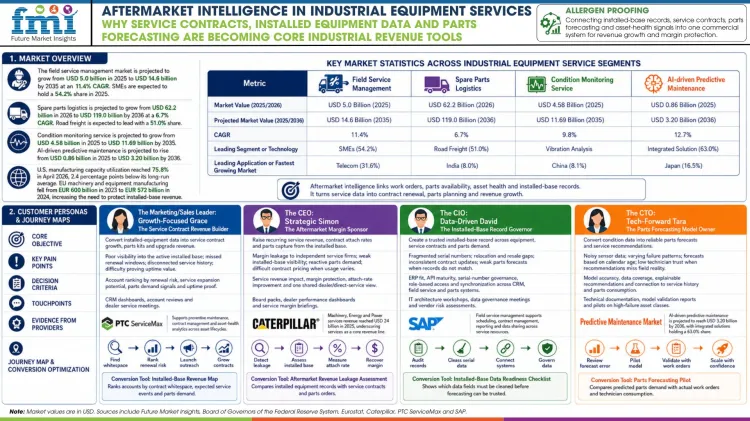
The field service management market is projected to grow from USD 5.0 billion in 2025 to USD 14.6 billion by 2035. Future Market Insights places the forecast CAGR at 11.4% over the period. SMEs are expected to hold a 54.2% share of organization size in 2025. [1]
Spare parts logistics is projected to grow from USD 62.2 billion in 2026 to USD 119.0 billion by 2036. The market is forecast to expand at a 6.7% CAGR. Road freight is expected to lead mode of transport with a 51.0% share. [2]
Condition monitoring service is projected to grow from USD 4.58 billion in 2025 to USD 11.69 billion by 2035. AI-driven predictive maintenance is expected to reach USD 3.20 billion by 2036 from USD 0.86 billion in 2025. These markets show why service revenue now depends on equipment data, technician workflows and parts availability. [3] [4]
Eurostat reported in July 2025 that EU machinery and equipment manufacturing fell from EUR 600 billion in 2023 to EUR 572 billion in 2024. This decline gives equipment providers a stronger reason to protect revenue from the active installed base. Aftermarket intelligence becomes useful when new equipment cycles soften and service revenue must carry more of the commercial load. [6]
Key Market Statistics Across Industrial Equipment Service Segments:
| Metric | Field Service Management | Spare Parts Logistics | Condition Monitoring Service | AI-driven Predictive Maintenance |
|---|---|---|---|---|
| Market Value (2025/2026) | USD 5.0 billion (2025) | USD 62.2 billion (2026) | USD 4.58 billion (2025) | USD 0.86 billion (2025) |
| Projected Market Value (2035/2036) | USD 14.6 billion (2035) | USD 119.0 billion (2036) | USD 11.69 billion (2035) | USD 3.20 billion (2036) |
| CAGR | 11.4% | 6.7% | 9.8% | 12.7% |
| Leading Segment or Technology | SMEs (54.2%) | Road Freight (51.0%) | Vibration Analysis | Integrated Solution (63.0%) |
| Leading Application or Fastest Growing Market | Telecom (31.6%) | India (8.0%) | China (8.1%) | Japan (16.5%) |
These figures show that aftermarket intelligence sits across four connected markets. Field service management controls work orders and contract execution. Spare parts logistics controls availability for urgent repairs. Condition monitoring service creates the asset-health signal. AI-driven predictive maintenance turns that signal into service timing. This makes aftermarket software useful for sales and CEO teams that want service revenue from equipment already in the field.
Customer Personas: Turning Installed Equipment into Service Revenue
Marketing & Sales: Growth-Focused Grace - The Service Contract Revenue Builder
Growth-Focused Grace leads sales for an industrial equipment OEM. Her team knows the customer bought equipment three years ago. The problem is that the service history, warranty status and parts use often sit in separate systems. Grace needs to know which accounts are ready for renewals and which machines are likely to need service soon.
- Core Objective: Grace must convert installed-equipment data into service contract growth. She needs account teams to sell renewals, parts kits and upgrades before customers move to third-party service providers.
- Pain Points: Sales teams often lack a clean view of the active installed base. Contract expiration dates may not connect to asset condition or parts history. Customers may treat service as a cost if the sales team cannot show uptime proof. Account teams may miss renewal windows when installed assets are not linked to CRM records.
- Decision Criteria: Grace needs dashboards that rank accounts by renewal risk and service expansion potential. She values parts demand signals that can support planned sales outreach. She also needs proof that service contracts reduce downtime and protect customer output.
- Touchpoints: Grace uses CRM dashboards, account reviews and dealer service meetings to find service revenue opportunities.
Evidence from Providers:
PTC states that ServiceMax supports service execution across asset lifecycles and includes preventive maintenance, contract management and analytics for asset health. This evidence fits Grace’s need for a platform that joins installed assets with service contract activity. [9]
Journey Map & Conversion Optimization:
Grace’s journey begins with a service revenue gap review. She asks which installed machines are not under contract and which customers buy parts only after failures occur. She then needs account-level signals that show renewal timing, asset age and parts use. A SaaS provider should offer an Installed-Base Revenue Map. The map should rank accounts by contract whitespace, expected service events and parts demand. Conversion improves when Grace sees a sales list that her team can use within the same quarter.
The CEO: Strategic Simon - The Aftermarket Margin Sponsor
Strategic Simon is the CEO of an industrial equipment company. He knows that new equipment orders can move with capital spending cycles. The service business should be steadier, but only if the company knows which assets are active and which customers need support. Simon’s concern is that aftermarket margin leaks to independent service firms when his company loses sight of the installed base.
- Core Objective: Simon must raise recurring service revenue from the installed base. He needs better contract attach rates, parts capture and customer retention after the equipment sale.
- Pain Points: New equipment cycles can weaken revenue visibility. Dealer records may not show every active machine in the field. Parts demand can become reactive when failure data is not connected to service planning. Contract pricing becomes harder when asset use varies by customer and application.
- Decision Criteria: Simon evaluates software by service revenue impact and margin protection. He reviews whether the platform improves contract attach rate and parts capture. He also checks whether dealer and direct service teams can work from the same installed-base record.
- Touchpoints: Simon reviews board packs, dealer performance dashboards and service margin briefings.
Evidence from Providers:
Caterpillar reported that Machinery, Energy and Power services revenue reached USD 24 billion in 2025. The company linked this result to efforts that simplify customer engagement and improve eCommerce access. This evidence shows why industrial OEMs treat services as a core revenue line and not only a support function. [8]
Journey Map & Conversion Optimization:
Simon’s journey starts with a service-margin review by product family and customer segment. He asks where the company loses parts sales and which assets have no active contract. A SaaS provider should offer an Aftermarket Revenue Leakage Assessment. The assessment should compare installed equipment records with service contracts and parts orders. Conversion improves when Simon can see the lost revenue pool by dealer, region and machine class.
The CIO: Data-Driven David - The Installed-Base Record Governor
Data-Driven David is the CIO. His problem is record quality. Equipment serial numbers may sit in warranty systems, dealer portals and ERP records. Service contracts may sit in CRM. Parts demand may sit in warehouse data. David must connect these records before the company can trust any aftermarket forecast.
- Core Objective: David must create a reliable installed-base record across equipment, service contracts and parts demand. He needs a data model that supports sales planning and service execution.
- Pain Points: Installed equipment records are often incomplete after resale or relocation. Dealer data may use different asset naming rules. Contract records may not update when equipment ownership changes. Parts forecasts become weak when service history is not tied to the correct serial number.
- Decision Criteria: David reviews ERP fit and API maturity. He needs serial-number governance and role-based access. He also needs clean synchronization between CRM, field service and parts systems.
- Touchpoints: David reviews IT architecture workshops, data governance meetings and vendor risk assessments.
Evidence from Providers:
SAP describes field service management as support for scheduling workers, managing contracts and reporting. SAP also notes that field service management supports data sharing across service resources. This supports David’s need for a connected service record instead of separate contract and work-order systems. [10]
Journey Map & Conversion Optimization:
David’s journey starts with an installed-base data audit. He checks which systems hold serial numbers, service contracts and parts consumption. He then measures how often records disagree by asset and customer. A SaaS provider should offer an Installed-Base Data Readiness Checklist. The checklist should show which fields must be cleaned before forecasting can be trusted. Conversion improves when David sees a working asset record that connects CRM, ERP and field service data.
The CTO: Tech-Forward Tara - The Parts Forecasting Model Owner
Tech-Forward Tara is the CTO. She owns the technical model behind parts forecasting and service timing. Her challenge is that equipment fails differently by duty cycle, site condition and maintenance history. She needs models that can turn asset signals into practical service plans.
- Core Objective: Tara must convert condition data into reliable parts forecasts and service recommendations. She needs models that reduce stockouts without creating excess inventory.
- Pain Points: Sensor data can be noisy when equipment operates in harsh conditions. Failure patterns may vary by customer application. Parts forecasts can be wrong when the model uses calendar age instead of actual use. Technicians lose trust when recommendations do not match field reality.
- Decision Criteria: Tara reviews model accuracy and data coverage. She tests whether the system can combine asset condition, service history and parts consumption. She also checks whether recommendations can be explained to service managers and technicians.
- Touchpoints: Tara reviews technical documentation, model validation reports and pilot results from high-failure asset classes.
Evidence from Providers:
The AI-driven predictive maintenance market is expected to reach USD 3.20 billion by 2036. FMI states that integrated solutions are expected to hold 63.0% of the solution segment in 2026. Manufacturing is expected to lead the industry segment with a 30.5% share. This supports Tara’s need for systems that connect sensor data, analytics and maintenance workflows. [4]
Journey Map & Conversion Optimization:
Tara’s journey begins with a parts forecast error review. She identifies which components cause emergency orders and which forecasts create excess stock. A SaaS provider should offer a Parts Forecasting Pilot. The pilot should compare predicted parts demand with actual work orders and technician consumption. Conversion improves when Tara can show lower stockout risk without increasing slow-moving inventory.
Key Market Research Pointers: Future Outlook for B2B SaaS in Industrial Equipment Services
To provide a specific perspective beyond standard syndicated research, consider these five evidence-based pointers for the future of the Industrial Equipment Services Market, specifically for B2B SaaS providers:
- Installed-Base Revenue Scoring for Sales Teams: Service sales will depend on knowing which assets are active and which customers lack contracts. SaaS platforms can score each account by asset age, service history and parts spend. Sales teams can use this score to prioritize renewal outreach. This turns installed equipment data into a revenue queue rather than a static asset list.
- Contract Attach-Rate Intelligence for CEOs: OEMs need a clearer view of how many installed assets are covered by service agreements. SaaS dashboards can show contract attach rate by product family, dealer and customer segment. CEOs can then see where margin is leaking to third-party repair. This makes service contract coverage a board-level metric.
- Parts Forecasting from Service Event Signals: Parts planning should not rely only on past order history. SaaS platforms can combine work orders, asset condition and duty-cycle data. This improves the timing of stocked parts and repair kits. The value comes from fewer emergency shipments and better first-time fix rates.
- Dealer and Direct-Service Data Reconciliation: Industrial service networks often split records across dealers and OEM service teams. SaaS tools can reconcile serial numbers, contract records and parts orders across channels. This gives sales leaders a cleaner view of the customer. It also gives CIOs a controlled data foundation for forecasting and account planning.
- Outcome-Based Service Packaging: Customers increasingly want service contracts tied to uptime or production continuity. SaaS platforms can connect asset performance, service history and parts availability to support these offers. Sales teams can use the data to price contract tiers. CEOs can use the same data to check whether outcome-based commitments protect margin.
Uniqueness Explanation: These pointers move beyond field technician scheduling and basic maintenance software. The article focuses on the commercial shift from equipment sale to aftermarket revenue control. The operating shift is from reactive service to installed-base planning. The technology shift is from isolated work orders to asset-level intelligence. The buyer shift is from service cost approval to revenue and margin management.
Conclusion: The Strategic Imperative of Aftermarket Intelligence
Aftermarket intelligence is becoming a core revenue system for industrial equipment providers. Service contracts, installed equipment data and parts forecasting now shape how OEMs protect margin after the initial sale. The strongest companies will not only respond to service calls. They will know which assets need coverage, which customers need outreach and which parts must be ready.
B2B SaaS providers must connect sales, service and parts planning into one aftermarket view. Sales teams need account-level contract signals. CEOs need revenue leakage visibility. CIOs need clean installed-base records. CTOs need forecasting models that field teams can trust. The practical opportunity is clear. Industrial service data must become a revenue planning system before the customer calls a competitor.
Ready to turn industrial equipment data into service revenue? Request a Demo of our Aftermarket Intelligence Platform to grow service contracts, forecast parts demand and protect installed-base margin.
References
- [1] Future Market Insights. "Field Service Management Market: Global Industry Analysis 2015 - 2024 and Opportunity Assessment 2025 - 2035."
- [2] Future Market Insights. "Spare Parts Logistics Market: Global Industry Analysis 2016 - 2025 and Opportunity Assessment 2026 - 2036."
- [3] Future Market Insights. "Condition Monitoring Service Market Size & Forecast 2025 to 2035."
- [4] Future Market Insights. "AI-driven Predictive Maintenance Market: Global Industry Analysis 2016 - 2025 and Opportunity Assessment 2026 - 2036."
- [5] Board of Governors of the Federal Reserve System. "Industrial Production and Capacity Utilization - G.17." May 15, 2026.
- [6] Eurostat. "Decrease in industrial production in 2024." July 24, 2025.
- [7] Caterpillar. "Caterpillar 2025 Annual Report." February 13, 2026.
- [8] Caterpillar. "2024 Annual Report - Segment Highlights."
- [9] PTC. "ServiceMax Core: Field Service Management."
- [10] SAP. "What is field service management?" January 26, 2026.

