

- Market Size (2026)
- USD 23.0 Bn
- Forecast (2036)
- USD 59.7 Bn
- CAGR (2026 to 2036)
- 10.0%
How big is the AI-enabled Industrial Robot Arms (Adaptive Assembly) Market in 2026?
USD 23.0 billion in 2026 and USD 59.7 billion by 2036 at a 10.0% CAGR.
Demand for AI-enabled industrial robot arms is projected to expand at 10.0% CAGR between 2026 and 2036, increasing valuation from USD 23.0 billion in 2026 to USD 59.7 billion by 2036. The International Federation of Robotics reported in September 2025 that factories installed 542,000 industrial robots during 2024. That installed base is expected to widen the addressable field for adaptive assembly cells that correct small position changes during fastening or insertion. The commercial gain is likely to come from fewer dedicated fixtures and shorter model changes rather than from robot speed alone.
China is expected to support faster pilot-to-scale cycles because its automotive and electronics plants can spread a proven cell design across large production networks. Japan is anticipated to place greater weight on repeatability records and local service depth before an adaptive routine is approved across established lines. The Japan Robot Association released its 2025 results in June 2026 and recorded 173,323 export shipments during 2025. Plant engineering teams are likely to compare camera coverage with force limits and recovery records during platform approval. Selection is forecast to favor systems that connect machine vision tools with stable cycle performance under the plant’s actual lighting and part conditions. These differences are expected to reward controlled flexibility without weaker output or service response over time.
-market-value-analysis.webp "Ai Enabled Industrial Robot Arms (adaptive Assembly) Market Value Analysis")
Key Takeaways of AI-enabled Industrial Robot Arms (Adaptive Assembly) Market
- Demand for AI-enabled industrial robot arms is driven by product variation across mixed-model production lines, with adaptive arms reducing fixture changes across related models while maintaining controlled process limits.
- By component, hardware remains the main cost block, as each cell still needs a robot platform and controller capable of holding production loads.
- Assembly applications are the dominant use case, benefiting first from measurable feedback on task success and final part seating during insertion and fastening.
- Compact payload classes are estimated to retain broad use in electronics and automotive subassemblies that use lighter tools and offer limited floor space.
- Vision and force sensing remain critical differentiators, widening the task range of one cell and reducing manual intervention during normal part variation.
- China, South Korea, the United States, Japan, and the European Union are expected to follow distinct adoption paths, with China and South Korea scaling through electronics/vehicle networks, the US through brownfield upgrades, and Japan/EU requiring stronger operating proof before line approval.
- Competition centers on global platform groups, vision software providers, and industrial customers weighing spare-parts access, with vendors differentiating through controller design, retraining speed for new parts, and safe recovery with clear version control after production starts.
Analyst Perspective
"The adaptive assembly systems market is gaining traction as manufacturers seek automation that can accommodate product variation without sacrificing throughput or quality. Real-world production performance depends on reliable vision guidance, stable process recovery, and smooth integration with existing assembly operations rather than laboratory demonstrations alone. Companies that help manufacturers modernize brownfield facilities with scalable deployment strategies and practical engineering support are expected to secure stronger long-term opportunities across high-mix production environments."
- Nikhil Kaitwade, Principal Analyst at Future Market Insights
How is the AI-enabled Industrial Robot Arms (Adaptive Assembly) Market segmented?
payload capacity, application, component, end-use industry, sales channel, and region
The market is segmented by payload capacity and application to show which arms fit each task and production layout. Component analysis separates hardware from software and services to show where cell spending is concentrated. End-use industry compares automotive and electronics with metals or consumer goods because cycle needs differ across each production setting. Sales channel shows whether plants buy directly from the robot company or use a system integrator for complete cell work. Assembly and disassembly is estimated to hold 26.0% of application revenue in 2026 because insertion and fastening provide measurable pass-or-fail signals. Hardware is projected to account for 62.0% of component revenue since the arm and controller remain the main physical cost. The regional assessment compares factory automation systems against local production density and service access.
Which application is expected to lead adaptive assembly demand?
-market-analysis-by-application.webp "Ai Enabled Industrial Robot Arms (adaptive Assembly) Market Analysis By Application")
A clear pass-or-fail signal is expected to make assembly a practical starting point for adaptive automation. ABB launched OmniCore EyeMotion in September 2025 and stated that commissioning time could fall by up to 90% versus custom vision systems. Faster camera setup is likely to improve model changes by providing reliable part location for fastening or pressing. The release indicates that simpler configuration can improve cell reuse without lowering the proof needed for production approval.
- With an estimated 26.0% of application revenue in 2026, assembly and disassembly is anticipated to lead through force feedback that confirms correct seating and permits the next production step under approved conditions.
- Assembly and disassembly adoption is projected to rise in automotive plants through repeatable insertion checks and controlled error recovery. Approved part variation is expected to trigger an automatic retry instead of a manual reset during routine production. Connections to industrial machine vision are anticipated to shorten part-location setup and support model changes without rebuilding every fixture.
Why is hardware expected to retain the primary component share?
-market-analysis-by-component.webp "Ai Enabled Industrial Robot Arms (adaptive Assembly) Market Analysis By Component")
Hardware is expected to retain its value because an adaptive cell still depends on a robot arm and controller that hold position under production loads. HD Hyundai Robotics launched the Hi7 controller in September 2025 with integrated safety functions and links for AI-based industrial applications. The announcement shows how controller capability is likely to raise hardware value even as software takes a larger role in task learning. Plant engineers still need the physical platform to execute each approved motion at the required speed and load.
- By component, hardware is expected to account for 62.0% in 2026 because the arm and controller carry the main physical cost ahead of sensing and onsite integration services during cell commissioning.
- Demand for hardware is expected to grow among cell integrators owing to controller upgrades and added sensing. Industrial robot controller platforms are likely to shape commissioning since motion limits and recovery steps must remain clear. Later program changes are anticipated to preserve those approved controls across each connected production cycle.
What supports demand for robot arms up to 16 kg?
-market-analysis-by-payload-capacity.webp "Ai Enabled Industrial Robot Arms (adaptive Assembly) Market Analysis By Payload Capacity")
Compact arms are expected to fit electronics and automotive subassembly stations because tools remain light and available floor space stays limited. FANUC presented the SR-12A/C in February 2025 with a 12 kg payload for food and cleanroom applications. The release shows how a compact platform can serve several sectors once the cell design is shaped by washdown needs and controlled handling. That range is expected to widen the addressable base without forcing plants to reserve space for a heavier arm.
- Compact station design is projected to push arms up to 16 kg to a 30.0% payload share in 2026 through broad use across light assembly and inspection tasks in space-constrained layouts.
- Electronics process engineers are expected to favor compact arms because shorter reaches and lighter tools reduce the space required around each station. The smaller footprint is likely to preserve access for later product or tool changes onsite. Comparisons with collaborative robot options are anticipated to shape placement decisions when the safety design permits closer work beside operators or existing equipment.
What are the drivers, restraints, and opportunities in the AI-enabled Industrial Robot Arms (Adaptive Assembly) Market?
Driver: mixed-model production is expected to raise demand for flexible robot cells across related product families. Restraint: integration work is anticipated to extend commissioning across complex vision and force-controlled assembly tasks. Opportunity: brownfield upgrades are projected to widen access without requiring complete line replacement or long production shutdowns.
- Driver: Mixed-model production is expected to favor cells that locate and align related parts without a dedicated fixture for every model.
- Restraint: Vision and force routines are anticipated to need representative testing before safe recovery can support production cycle times.
- Opportunity: Existing lines are projected to support phased retrofits when one repeated stop can justify a controlled first project.
Mixed-model production is expected to raise the value of cells that absorb planned variation across related products. The International Federation of Robotics reported in March 2026 that global industrial robot installations are forecast to exceed 700,000 units in 2028. That trajectory is likely to expand the installed base available for adaptive assembly upgrades across established factories. The commercial case is anticipated to depend on shorter changeovers and fewer line stops without weaker product quality.
Commissioning friction is expected to remain a real restraint because perception and motion must be tested together under plant conditions. The International Organization for Standardization published ISO 10218-2:2025 in February 2025 for industrial robot application and cell integration. The standard covers integration and commissioning together with operation and maintenance across the complete robot application. Its scope is likely to increase the proof needed before automatic recovery is accepted beside people or connected equipment.
Brownfield lines are projected to support near-term upgrades because installed conveyors and machines can often remain in service. ABB announced a LandingAI collaboration in September 2025 that could reduce vision AI training and rollout time by up to 80%. Faster setup is expected to improve the case for robotics retrofit services when a full line rebuild would interrupt production. Plant engineers are still likely to require local proof before expanding from one station to a wider program.
Which country CAGRs are profiled in the AI-enabled Industrial Robot Arms (Adaptive Assembly) Market?
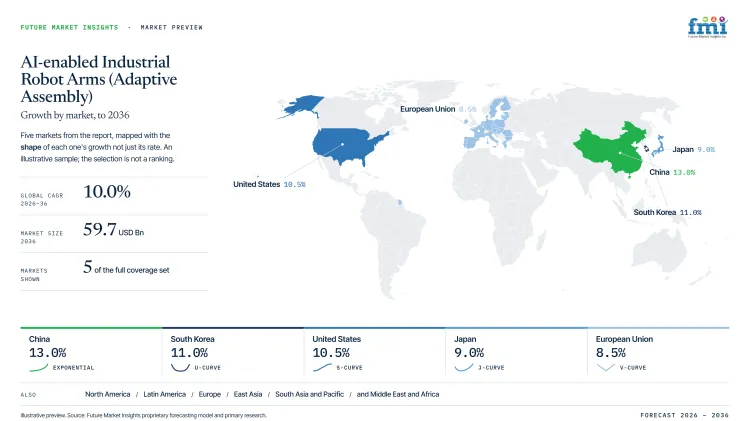
| Country or Market | Forecast CAGR, 2026 to 2036 |
|---|---|
| China | 13.0% |
| South Korea | 11.0% |
| United States | 10.5% |
| Japan | 9.0% |
| European Union | 8.5% |
Source: Future Market Insights country forecast model and primary research
How do country-level CAGRs compare in the AI-enabled Industrial Robot Arms (Adaptive Assembly) Market?
The country comparison spans 4.5 percentage points and reveals three distinct growth groups across the AI-enabled industrial robot arms (adaptive assembly) market. China and South Korea form the leading tier with a 2.0-point difference between them. The United States occupies the middle position, sitting just 0.5 percentage points below South Korea. Japan and the European Union complete the comparison within a narrow 0.5-point range. The variation reflects differences in advanced manufacturing investment, AI integration in production systems and the adoption of adaptive assembly technologies.
- China leads the comparison with a CAGR of 13.0%. Manufacturers are increasingly integrating AI-enabled robot arms into assembly operations where product variation, real-time process adjustments and consistent production quality require greater flexibility than conventional automation.
- South Korea follows at 11.0%, remaining 2.0 percentage points behind China. The country's highly automated electronics and automotive production base continues to create opportunities for adaptive robotic systems that optimize assembly accuracy while responding to changing production conditions.
- With a CAGR of 10.5%, the United States sits only 0.5 percentage points below South Korea. Interest is centered on AI-assisted robot arms that simplify mixed-model manufacturing, reduce manual intervention during assembly and improve productivity across high-value industrial operations.
- Japan records a CAGR of 9.0%, placing it 1.5 percentage points behind the United States. Established expertise in industrial robotics and precision manufacturing supports adoption of adaptive assembly platforms capable of adjusting to variable components and complex production workflows.
- The European Union reaches 8.5%, just 0.5 percentage points below Japan. Market activity is associated with continued factory digitalization and modernization of automated assembly lines, although implementation differs across member states because manufacturing sectors and automation priorities are not uniform.
Comparable CAGRs can still produce different market entry conditions. Differences in manufacturing complexity, AI software integration, production flexibility requirements and automation investment priorities influence deployment timelines and long-term commercial opportunities. The full report provides country-level CAGR analysis across North America, Latin America, Europe, East Asia, South Asia, Oceania and the Middle East and Africa.
Country-wise Analysis
Country growth is expected to reflect factory density and the pace of model change inside local production networks. China is projected to scale through large automotive and electronics programs that can reuse a proven cell across several lines. South Korea is anticipated to benefit from national investment in AI-based manufacturing and dense electronics production. The United States is forecast to create demand through brownfield upgrades and wider robot use beyond automotive plants. Japan is likely to favor measured adoption across a mature supplier base with established service routines. The European Union is expected to place greater weight on safety records and integration documentation.
- China is expected to hold the first position among industrial robot producers in East Asia through 2036. China is projected to grow at 13.0% CAGR by 2036 reflecting dense automotive and electronics production networks. The State Council Information Office reported in December 2025 that China produced 556,000 industrial robots during 2024. That production base is anticipated to support faster pilot-to-scale work through industrial automation controls that connect vision and motion across related lines. Local integrators are likely to gain when a new platform can reuse existing line signals and service routes. Commercial approval is expected to depend on stable cycle time across full production shifts rather than flexible motion in a laboratory.
- South Korea’s production mix is projected to shift toward AI-based electronics and battery assembly through 2036. The country’s outlook is anticipated to advance at 11.0% CAGR over the assessment period supported by national AI factory investment. South Korea’s Ministry of Trade reported in September 2025 that the government planned more than 500 autonomous AI factories by 2030 from 26 sites in 2024. Electronics process teams are likely to favor compact arms that handle small parts without adding a large safety footprint. Robot companies are projected to differ more through local service once hardware specifications converge across similar payload classes.
- Robot integrators in the United States are expected to benefit from brownfield upgrades as reshoring places more production inside existing plants. Demand is forecast to rise at 10.5% CAGR over the forecast period on the back of wider robot use beyond automotive assembly. The Association for Advancing Automation reported in February 2026 that North American companies ordered 36,766 robots during 2025. Existing factories are expected to favor retrofit support when conveyors and safety systems cannot be replaced without long shutdowns. Plant engineering teams are likely to require compatibility with installed controls and a clear spare-parts route. This structure is anticipated to reward integrators that prove value at one station before proposing a plant-wide program.
- Japan’s role as an export hub for industrial robots is expected to give local producers a broad customer base for testing adaptive assembly features. Adoption is estimated to expand at 9.0% CAGR through 2036 given the country’s mature automation base and deep engineering support. The Japan Robot Association released its yearly results in June 2026 and recorded 25,936 assembly robot shipments during 2025. That shipment base is expected to support upgrades for connector and battery tasks that need controlled variation. Quality engineers are likely to test lighting changes and force limits before permitting automatic retries. Local engineering depth and stable version control are anticipated to carry more weight than rapid experimentation.
- The EU Machinery Regulation is projected to reshape European Union sourcing from its application date on 20 January 2027. The sector is forecast to record 8.5% CAGR during the assessment period owing to upgrade demand across established vehicle and machinery plants. Eurostat reported in December 2025 that 20.0% of European Union enterprises used at least one AI technology during 2025. That adoption base is expected to support vision and decision tools inside robot cells as industrial sites modernize existing equipment. Integration teams are likely to compare machine safety systems with robot programming and recovery plans before final approval. Commercial progress is anticipated to remain measured because investment conditions differ across member states and industrial sectors.
Who are the notable companies in the AI-enabled Industrial Robot Arms (Adaptive Assembly) Market?
FANUC, Yaskawa Electric Corporation, KUKA, ABB, and HD Hyundai Robotics
-market-analysis-by-company.webp "Ai Enabled Industrial Robot Arms (adaptive Assembly) Market Analysis By Company")
Competition is expected to move beyond arm specifications toward complete cell performance and long-term support. Platform breadth is likely to simplify service planning inside plants that use several payload classes across related tasks. Controller access is anticipated to shape how quickly integrators can adjust vision and force routines. Local training and spare-parts coverage are projected to reduce operating risk after an adaptive cell enters production. The robot software environment is expected to become a clearer source of differentiation because version control and safe recovery must remain visible throughout the cell life.
- FANUC and ABB are expected to compete through broad robot ranges and controller tools that connect engineering work with production. FMI assigns FANUC an 11.0% company share in 2026 and supplies no share for the other named companies. FANUC’s May 2025 M-710D launch and ABB’s September 2025 RobotStudio assistant show different routes toward easier commissioning and cell reuse.
- KUKA and Yaskawa Electric Corporation are anticipated to emphasize connected engineering and adaptive programming across mixed-model production. KUKA partnered with Dassault Systèmes in February 2025 and Yaskawa presented MOTOMAN NEXT as an AI-ready platform in June 2025. These approaches are expected to reduce engineering work during repeated model changes without weakening control over approved robot actions.
- HD Hyundai Robotics is projected to focus on welding and heavy production settings that need larger tools or longer reach. The company secured an ArcLift GO order in May 2026 for three North American shipyards and one Brazilian site. That position is likely to support welding programs that need controlled motion across complex steel structures.
Competitive Benchmarking: AI-enabled Industrial Robot Arms (Adaptive Assembly) Market
| Company | Robot Portfolio | Adaptive and AI Capability | Production Settings | Support Model |
|---|---|---|---|---|
| FANUC | High | High | High | High |
| Yaskawa Electric Corporation | High | High | High | High |
| KUKA | High | High | High | High |
| ABB | High | High | High | High |
| HD Hyundai Robotics | Medium | Medium | High | Medium |
Scoring basis assigns High to broad official evidence across a dimension and Medium to credible capability with narrower product or geographic coverage.
Source: Official company newsrooms and corporate disclosures cited in the bibliography
Key Developments in the AI-enabled Industrial Robot Arms (Adaptive Assembly) Market
- In May 2026, FANUC strengthened its NVIDIA collaboration by integrating ROBOGUIDE with Isaac Sim and Jetson Thor. The Jetson T5000 module raised onboard AI compute by more than 7.5 times to accelerate real-time human-robot collision avoidance loops.
- In March 2026, KUKA unveiled KUKA AMP at NVIDIA GTC as a software bridge between AI agents and physical equipment. The platform aims to standardize actions and data across factories and warehouses so AI commands can produce repeatable machine behavior.
- In July 2026, Yaskawa Electric Corporation and SoftBank validated a Physical AI system that used MOTOMAN NEXT to handle deformable objects. The demonstration covered wire harnesses whose shape and position varied across cycles, showing how the system can extend assembly automation beyond rigid parts.
- In July 2026, HD Hyundai Robotics launched three HDC Series hybrid collaborative robots with payloads up to 50 kg. The range widens collaborative palletizing and machine tending where heavy loads previously required fenced industrial systems.
Key Players AI-enabled Industrial Robot Arms (Adaptive Assembly) Market
Broad Robot Platforms and Global Service
- FANUC
- ABB
Adaptive Software and Connected Engineering
- KUKA
- Yaskawa Electric Corporation
Heavy Manufacturing and Industrial Control
- HD Hyundai Robotics
AI-enabled Industrial Robot Arms (Adaptive Assembly) Market - Report Scope
-market-breakdown-by-payload-capacity,-application,-and-region.webp "Ai Enabled Industrial Robot Arms (adaptive Assembly) Market Breakdown By Payload Capacity, Application, And Region")
| Report Attribute | Coverage |
|---|---|
| Market Breakdown | Payload Capacity, Application, Component, End-use Industry, Sales Channel, and Region |
| Quantitative Units | USD billion |
| Market Definition | AI-enabled industrial robot arms for adaptive assembly combine robot platforms with vision and force sensing. Software and integration services help each cell handle controlled part variation across production tasks during normal operation. |
| Regions Covered | North America, Latin America, Europe, East Asia, South Asia and Pacific, and Middle East and Africa |
| Countries Covered | China, South Korea, United States, Japan, European Union, and other countries within the regional model |
| Key Companies Profiled | FANUC, Yaskawa Electric Corporation, KUKA, ABB, and HD Hyundai Robotics |
| Approach | Demand-side review of assembly tasks combined with robot platform evidence and country forecast reconciliation |
Source: Future Market Insights proprietary forecasting model and primary research
AI-enabled Industrial Robot Arms (Adaptive Assembly) Market - Research Methodology
| Method | Application |
|---|---|
| Primary Research | FMI analysts gathered input from manufacturers, service providers, technology developers, distributors, end users, procurement teams, and subject-matter experts. Interviews examined purchasing decisions, product or service evaluation, adoption barriers, approval requirements, pricing considerations, and expectations for technical or commercial support. Respondents were also asked what evidence is required before a trial, pilot, or initial order develops into regular purchasing. |
| Desk Research | Desk research covered government statistics, regulatory publications, trade data, industry associations, technical literature, standards, company filings, product information, and official corporate announcements. Sources were reviewed for relevance, publication date, geographic coverage, and consistency with the defined market scope. Claims relating to performance, applications, approvals, capacity, investment, and commercial activity were retained only when supported by credible public evidence. |
| Market Sizing and Forecasting | The market model combined the baseline value with historical performance, segment structure, pricing and volume indicators, adoption levels, company participation, and country-level demand conditions. Forecast assumptions considered economic activity, investment trends, regulatory developments, technology adoption, purchasing cycles, supply availability, and barriers to wider market use. Segment and regional estimates were reconciled before the final market total was calculated. |
| Data Validation | Estimates were checked against multiple independent indicators, including public data, company activity, trade patterns, industry developments, and findings from primary interviews. Validation also tested whether products, services, applications, and company revenues fell within the defined market boundaries. Adjacent categories, unsupported claims, overlapping revenues, and activities without direct market relevance were excluded to reduce double counting and maintain consistency across segments and countries. |
AI-enabled Industrial Robot Arms (Adaptive Assembly) Market by Segments
AI-enabled Industrial Robot Arms (Adaptive Assembly) Market segmented by Payload Capacity:
- Up to 16 kg
- 16 kg to 60 kg
- 60 kg to 225 kg
- Above 225 kg
- Dual-arm and specialty systems
AI-enabled Industrial Robot Arms (Adaptive Assembly) Market segmented by Application:
- Assembly and disassembly
- Material handling and machine loading
- Welding and soldering
- Dispensing and processing
- Inspection and testing
AI-enabled Industrial Robot Arms (Adaptive Assembly) Market segmented by Component:
- Hardware
- Software including AI and vision
- Services
AI-enabled Industrial Robot Arms (Adaptive Assembly) Market segmented by End-use Industry:
- Automotive
- Electronics and semiconductors
- Metals and machinery
- Food and consumer goods
- Pharmaceutical and other industries
AI-enabled Industrial Robot Arms (Adaptive Assembly) Market segmented by Sales Channel:
- Direct to OEM
- System integrators
- Distributors
- Online and aftermarket
AI-enabled Industrial Robot Arms (Adaptive Assembly) Market by Region:
- North America
- United States
- Canada
- Latin America
- Brazil
- Mexico
- Other Latin American Countries
- Europe
- European Union
- United Kingdom
- Other European Countries
- East Asia
- China
- Japan
- South Korea
- South Asia and Pacific
- India
- ASEAN Countries
- Other South Asian and Pacific Countries
- Middle East and Africa
- Gulf Cooperation Council Countries
- South Africa
- Other Middle Eastern and African Countries
Research Sources and Bibliography
- ABB. (2025, March 11). ABB expands robotic item-picking family with AI-powered functional modules.
- ABB. (2025, September 17). ABB and LandingAI unleash generative AI for robotic vision.
- ABB. (2025, September 23). ABB Robotics launches OmniCore EyeMotion.
- ABB. (2025, September 25). ABB Robotics adds a generative AI assistant to RobotStudio.
- FANUC Europe. (2025, February 12). Strong FANUC SCARA robot withstands cleaning procedures.
- FANUC Europe. (2025, March 11). FANUC unveils an explosion-proof collaborative paint robot.
- FANUC Europe. (2025, May 13). New M-710D series robots provide design and performance enhancements.
- FANUC Europe. (2026, May 22). FANUC strengthens collaboration with NVIDIA.
- HD Hyundai Robotics. (2025, September 30). HD Hyundai Robotics launches the Hi7 industrial AI robot controller.
- HD Hyundai Robotics. (2026, May 8). HD Hyundai Robotics secures a robotic welding solution order from Chouest Group.
- HD Hyundai Robotics. (2025, December 22). HD Hyundai Robotics partners with HD Hyundai Samho on smart shipyard automation.
- HD Hyundai Robotics. (2026, July 1). HD Hyundai Robotics launches three HDC Series high-payload hybrid collaborative robots.
- European Commission. (2023, June 14). Machinery Regulation (EU) 2023/1230.
- State Council Information Office of China. (2025, December 9). Chinese robotics expand global reach.
- Japan Robot Association. (2026, June). Yearly Results 2025.
- International Federation of Robotics. (2025, September 25). Global robot demand in factories doubles over ten years.
- International Federation of Robotics. (2026, March 5). Women in Robotics 2026 awarded by the International Federation of Robotics.
- Ministry of Trade Industry and Energy of South Korea. (2025, September 1). 2026 Ministry of Trade Industry and Energy budget proposal.
- Association for Advancing Automation. (2026, February 6). Robot Orders Grow 6.6% in 2025 as General Industries Drive Broader Automation Adoption.
- Eurostat. (2025, December 11). 20% of EU enterprises use AI technologies.
- International Organization for Standardization. (2025, February). ISO 10218-2:2025 Robotics - Safety requirements - Part 2.
- KUKA. (2025, February 25). Dassault Systèmes and KUKA partner to offer improved robotics and automation efficiency.
- KUKA. (2025, June 24). KUKA highlights at automatica 2025.
- KUKA. (2026, March 19). KUKA unveils KUKA AMP at NVIDIA GTC 2026.
- Yaskawa Electric Corporation. (2025, June 12). MOTOMAN NEXT - A new platform for intelligent adaptive robotic automation and AI.
- Yaskawa Electric Corporation. (2025, June 19). Yaskawa establishes a new campus in Franklin Wisconsin.
- Yaskawa Electric Corporation. (2026, July 13). Yaskawa Electric and SoftBank Corp. validate a Physical AI-based deformable object manipulation system.
- This bibliography gives readers direct access to primary standards bodies and official company sources together with related Future Market Insights topic pages.
This Report Answers
- How large is the ai-enabled industrial robot arms (adaptive assembly) market in 2026 and 2036?
- Which CAGR is projected for the ai-enabled industrial robot arms (adaptive assembly) market from 2026 to 2036?
- Which application and component categories hold the disclosed 2026 positions?
- Why are compact payload classes suited to adaptive assembly tasks?
- How do vision and force control change the value of mixed-model automation?
- Why do country growth rates differ across China and established automation markets?
- Which competitive dimensions separate robot platforms from software capability?
- How does Future Market Insights size and forecast the market?
- Which factors should plant teams review before approving adaptive assembly platform providers?
Frequently Asked Questions
What is driving growth in the AI-enabled Industrial Robot Arms (Adaptive Assembly) Market?
Mixed-model production is expected to raise demand for cells that handle controlled part variation without repeated fixture changes. Vision and force sensing are projected to widen the task range across related product families while keeping pass-or-fail checks visible.
Who are the key players in the AI-enabled Industrial Robot Arms (Adaptive Assembly) Market?
FANUC and Yaskawa Electric Corporation provide broad industrial robot platforms across major manufacturing regions. KUKA and ABB are expected to compete through connected engineering tools while HD Hyundai Robotics focuses on industrial control and heavy production.
What is a notable restraint in the AI-enabled Industrial Robot Arms (Adaptive Assembly) Market?
Commissioning is expected to remain difficult because vision and force routines need realistic lighting and representative parts. Safe recovery must be proven before automatic retries are accepted beside people or connected equipment.
Why should executives track the AI-enabled Industrial Robot Arms (Adaptive Assembly) Market?
Adaptive assembly is expected to change automation economics when one cell supports several product variants. Executives should compare lower fixture work and fewer stops against added sensing and integration costs.
What business problem does the AI-enabled Industrial Robot Arms (Adaptive Assembly) Market address?
These systems are expected to address production lines that stop after small changes in part position or surface finish. Adaptive perception is projected to respond inside tested limits instead of rejecting every normal variation.
What should procurement leaders evaluate before selecting suppliers?
Plant engineering leaders should compare controller access and camera coverage with force limits or local service depth. Representative cycle tests should confirm safe recovery and stable output before a platform is approved for wider use.
What limits return on investment for purchasers?
Return is expected to weaken when commissioning runs beyond plan or the cell misses cycle time under normal variation. Added sensing is projected to create value through measurable savings from fewer fixtures and stoppages during production.
How do suppliers build long-term account confidence?
Robot platform companies are expected to build confidence through clear program versions and reliable spare-parts support. They should document safe recovery and prove that later software changes do not weaken quality or cycle performance.
Preview the report firsthand - request a free sample
Get SampleGet the brochure for pricing and purchase details.
Get PDFTable of Content
- Key Takeaways
- Market Size and CAGR
- Top Growth Driver
- Fastest Growing Segment
- Leading Region
- Key Companies
- Emerging Opportunities
- Executive Summary
- Global Market Outlook
- Demand-side Trends
- Supply-side Trends
- Technology Roadmap Analysis
- Analysis and Recommendations
- Analyst Perspective (What is happening? Why now? What should investors know?)
- Key Questions Answered
- How large is the market?
- What is the CAGR?
- What are key trends?
- Which region dominates?
- Who are the leaders?
- Market Overview
- Market Coverage / Taxonomy
- Market Definition / Scope / Limitations
- Research Methodology
- Chapter Orientation
- Analytical Lens and Working Hypotheses
- Market Structure, Signals, and Trend Drivers
- Benchmarking and Cross-market Comparability
- Market Sizing, Forecasting, and Opportunity Mapping
- Research Design and Evidence Framework
- Desk Research Programme (Secondary Evidence)
- Expert Input and Fieldwork (Primary Evidence)
- Tooling, Models, and Reference Databases
- Data Engineering and Model Build
- Quality Assurance and Audit Trail
- Market Background
- Market Dynamics (Drivers, Restraints, Opportunity, Trends)
- Scenario Forecast (Optimistic, Likely, Conservative)
- Impact Analysis
- AI Impact
- Sustainability Impact
- Regulatory Impact
- Technology Impact
- Consumer / Buyer Analysis
- Purchase Drivers
- Adoption Barriers
- Buyer Journey
- Opportunity Map Analysis
- Product Life Cycle Analysis
- Supply Chain Analysis
- Investment Feasibility Matrix
- Value Chain Analysis
- PESTLE and Porter's Analysis
- Regulatory Landscape
- Regional Parent Market Outlook
- Production and Consumption Statistics
- Import and Export Statistics
- Global Market Analysis and Forecast, 2021 to 2036
- Historical Market Size Value (USD Bn) Analysis, 2021 to 2025
- Current and Future Market Size Value (USD Bn) Projections, 2026 to 2036
- Y-o-Y Growth Trend Analysis
- Absolute $ Opportunity Analysis
- Global Market Pricing Analysis, 2021 to 2036
- Global Market Analysis and Forecast, By Payload Capacity, 2021 to 2036
- Introduction / Key Findings
- Historical Market Size Value (USD Bn) Analysis By Payload Capacity, 2021 to 2025
- Current and Future Market Size Value (USD Bn) Analysis and Forecast By Payload Capacity, 2026 to 2036
- Up to 16 kg
- 16-60 kg
- 60-225 kg
- Above 225 kg
- Dual-arm - specialty
- Up to 16 kg
- Y-o-Y Growth Trend Analysis By Payload Capacity, 2021 to 2025
- Absolute $ Opportunity Analysis By Payload Capacity, 2026 to 2036
- Global Market Analysis and Forecast, By Application, 2021 to 2036
- Introduction / Key Findings
- Historical Market Size Value (USD Bn) Analysis By Application, 2021 to 2025
- Current and Future Market Size Value (USD Bn) Analysis and Forecast By Application, 2026 to 2036
- Assembly & disassembly
- Material handling & machine loading
- Welding & soldering
- Dispensing & processing
- Inspection & testing
- Assembly & disassembly
- Y-o-Y Growth Trend Analysis By Application, 2021 to 2025
- Absolute $ Opportunity Analysis By Application, 2026 to 2036
- Global Market Analysis and Forecast, By Component, 2021 to 2036
- Introduction / Key Findings
- Historical Market Size Value (USD Bn) Analysis By Component, 2021 to 2025
- Current and Future Market Size Value (USD Bn) Analysis and Forecast By Component, 2026 to 2036
- Hardware
- Software (AI - vision)
- Services
- Hardware
- Y-o-Y Growth Trend Analysis By Component, 2021 to 2025
- Absolute $ Opportunity Analysis By Component, 2026 to 2036
- Global Market Analysis and Forecast, By End-use Industry, 2021 to 2036
- Introduction / Key Findings
- Historical Market Size Value (USD Bn) Analysis By End-use Industry, 2021 to 2025
- Current and Future Market Size Value (USD Bn) Analysis and Forecast By End-use Industry, 2026 to 2036
- Automotive
- Electronics & semiconductors
- Metals & machinery
- Food & consumer goods
- Pharma & others
- Automotive
- Y-o-Y Growth Trend Analysis By End-use Industry, 2021 to 2025
- Absolute $ Opportunity Analysis By End-use Industry, 2026 to 2036
- Global Market Analysis and Forecast, By Sales Channel, 2021 to 2036
- Introduction / Key Findings
- Historical Market Size Value (USD Bn) Analysis By Sales Channel, 2021 to 2025
- Current and Future Market Size Value (USD Bn) Analysis and Forecast By Sales Channel, 2026 to 2036
- Direct - OEM
- System integrators
- Distributors
- Online - aftermarket
- Direct - OEM
- Y-o-Y Growth Trend Analysis By Sales Channel, 2021 to 2025
- Absolute $ Opportunity Analysis By Sales Channel, 2026 to 2036
- Global Market Analysis and Forecast, By Region, 2021 to 2036
- Introduction
- Historical Market Size Value (USD Bn) Analysis By Region, 2021 to 2025
- Current Market Size Value (USD Bn) Analysis and Forecast By Region, 2026 to 2036
- North America
- Latin America
- Western Europe
- Eastern Europe
- East Asia
- South Asia and Pacific
- Middle East & Africa
- Market Attractiveness Analysis By Region
- North America Market Analysis and Forecast, By Country, 2021 to 2036
- Historical Market Size Value (USD Bn) Trend Analysis By Market Taxonomy, 2021 to 2025
- Market Size Value (USD Bn) Forecast By Market Taxonomy, 2026 to 2036
- By Country
- USA
- Canada
- By Payload Capacity
- By Application
- By Component
- By End-use Industry
- By Sales Channel
- By Country
- Market Attractiveness Analysis
- By Country
- By Payload Capacity
- By Application
- By Component
- By End-use Industry
- By Sales Channel
- Key Takeaways
- Latin America Market Analysis and Forecast, By Country
- Historical Market Size Value (USD Bn) Trend Analysis By Market Taxonomy, 2021 to 2025
- Market Size Value (USD Bn) Forecast By Market Taxonomy, 2026 to 2036
- By Country
- Brazil
- Mexico
- Chile
- Rest of Latin America
- By Payload Capacity
- By Application
- By Component
- By End-use Industry
- By Sales Channel
- By Country
- Market Attractiveness Analysis
- By Country
- By Payload Capacity
- By Application
- By Component
- By End-use Industry
- By Sales Channel
- Key Takeaways
- Western Europe Market Analysis and Forecast, By Country
- Historical Market Size Value (USD Bn) Trend Analysis By Market Taxonomy, 2021 to 2025
- Market Size Value (USD Bn) Forecast By Market Taxonomy, 2026 to 2036
- By Country
- Germany
- UK
- Italy
- Spain
- France
- Nordic
- BENELUX
- Rest of Western Europe
- By Payload Capacity
- By Application
- By Component
- By End-use Industry
- By Sales Channel
- By Country
- Market Attractiveness Analysis
- By Country
- By Payload Capacity
- By Application
- By Component
- By End-use Industry
- By Sales Channel
- Key Takeaways
- Eastern Europe Market Analysis and Forecast, By Country
- Historical Market Size Value (USD Bn) Trend Analysis By Market Taxonomy, 2021 to 2025
- Market Size Value (USD Bn) Forecast By Market Taxonomy, 2026 to 2036
- By Country
- Russia
- Poland
- Hungary
- Balkan & Baltic
- Rest of Eastern Europe
- By Payload Capacity
- By Application
- By Component
- By End-use Industry
- By Sales Channel
- By Country
- Market Attractiveness Analysis
- By Country
- By Payload Capacity
- By Application
- By Component
- By End-use Industry
- By Sales Channel
- Key Takeaways
- East Asia Market Analysis and Forecast, By Country
- Historical Market Size Value (USD Bn) Trend Analysis By Market Taxonomy, 2021 to 2025
- Market Size Value (USD Bn) Forecast By Market Taxonomy, 2026 to 2036
- By Country
- China
- Japan
- South Korea
- By Payload Capacity
- By Application
- By Component
- By End-use Industry
- By Sales Channel
- By Country
- Market Attractiveness Analysis
- By Country
- By Payload Capacity
- By Application
- By Component
- By End-use Industry
- By Sales Channel
- Key Takeaways
- South Asia and Pacific Market Analysis and Forecast, By Country
- Historical Market Size Value (USD Bn) Trend Analysis By Market Taxonomy, 2021 to 2025
- Market Size Value (USD Bn) Forecast By Market Taxonomy, 2026 to 2036
- By Country
- India
- ASEAN
- Australia & New Zealand
- Rest of South Asia and Pacific
- By Payload Capacity
- By Application
- By Component
- By End-use Industry
- By Sales Channel
- By Country
- Market Attractiveness Analysis
- By Country
- By Payload Capacity
- By Application
- By Component
- By End-use Industry
- By Sales Channel
- Key Takeaways
- Middle East & Africa Market Analysis and Forecast, By Country
- Historical Market Size Value (USD Bn) Trend Analysis By Market Taxonomy, 2021 to 2025
- Market Size Value (USD Bn) Forecast By Market Taxonomy, 2026 to 2036
- By Country
- Kingdom of Saudi Arabia
- Other GCC Countries
- Türkiye
- South Africa
- Other African Union
- Rest of Middle East & Africa
- By Payload Capacity
- By Application
- By Component
- By End-use Industry
- By Sales Channel
- By Country
- Market Attractiveness Analysis
- By Country
- By Payload Capacity
- By Application
- By Component
- By End-use Industry
- By Sales Channel
- Key Takeaways
- Key Countries Market Analysis
- USA
- Pricing Analysis
- Market Share Analysis, 2025
- By Payload Capacity
- By Application
- By Component
- By End-use Industry
- By Sales Channel
- Canada
- Pricing Analysis
- Market Share Analysis, 2025
- By Payload Capacity
- By Application
- By Component
- By End-use Industry
- By Sales Channel
- Mexico
- Pricing Analysis
- Market Share Analysis, 2025
- By Payload Capacity
- By Application
- By Component
- By End-use Industry
- By Sales Channel
- Brazil
- Pricing Analysis
- Market Share Analysis, 2025
- By Payload Capacity
- By Application
- By Component
- By End-use Industry
- By Sales Channel
- Chile
- Pricing Analysis
- Market Share Analysis, 2025
- By Payload Capacity
- By Application
- By Component
- By End-use Industry
- By Sales Channel
- Germany
- Pricing Analysis
- Market Share Analysis, 2025
- By Payload Capacity
- By Application
- By Component
- By End-use Industry
- By Sales Channel
- UK
- Pricing Analysis
- Market Share Analysis, 2025
- By Payload Capacity
- By Application
- By Component
- By End-use Industry
- By Sales Channel
- Italy
- Pricing Analysis
- Market Share Analysis, 2025
- By Payload Capacity
- By Application
- By Component
- By End-use Industry
- By Sales Channel
- Spain
- Pricing Analysis
- Market Share Analysis, 2025
- By Payload Capacity
- By Application
- By Component
- By End-use Industry
- By Sales Channel
- France
- Pricing Analysis
- Market Share Analysis, 2025
- By Payload Capacity
- By Application
- By Component
- By End-use Industry
- By Sales Channel
- India
- Pricing Analysis
- Market Share Analysis, 2025
- By Payload Capacity
- By Application
- By Component
- By End-use Industry
- By Sales Channel
- ASEAN
- Pricing Analysis
- Market Share Analysis, 2025
- By Payload Capacity
- By Application
- By Component
- By End-use Industry
- By Sales Channel
- Australia & New Zealand
- Pricing Analysis
- Market Share Analysis, 2025
- By Payload Capacity
- By Application
- By Component
- By End-use Industry
- By Sales Channel
- China
- Pricing Analysis
- Market Share Analysis, 2025
- By Payload Capacity
- By Application
- By Component
- By End-use Industry
- By Sales Channel
- Japan
- Pricing Analysis
- Market Share Analysis, 2025
- By Payload Capacity
- By Application
- By Component
- By End-use Industry
- By Sales Channel
- South Korea
- Pricing Analysis
- Market Share Analysis, 2025
- By Payload Capacity
- By Application
- By Component
- By End-use Industry
- By Sales Channel
- Russia
- Pricing Analysis
- Market Share Analysis, 2025
- By Payload Capacity
- By Application
- By Component
- By End-use Industry
- By Sales Channel
- Poland
- Pricing Analysis
- Market Share Analysis, 2025
- By Payload Capacity
- By Application
- By Component
- By End-use Industry
- By Sales Channel
- Hungary
- Pricing Analysis
- Market Share Analysis, 2025
- By Payload Capacity
- By Application
- By Component
- By End-use Industry
- By Sales Channel
- Kingdom of Saudi Arabia
- Pricing Analysis
- Market Share Analysis, 2025
- By Payload Capacity
- By Application
- By Component
- By End-use Industry
- By Sales Channel
- Türkiye
- Pricing Analysis
- Market Share Analysis, 2025
- By Payload Capacity
- By Application
- By Component
- By End-use Industry
- By Sales Channel
- South Africa
- Pricing Analysis
- Market Share Analysis, 2025
- By Payload Capacity
- By Application
- By Component
- By End-use Industry
- By Sales Channel
- USA
- Market Structure Analysis
- Competition Dashboard
- Competition Benchmarking
- Market Share Analysis of Top Players
- By Regional
- By Payload Capacity
- By Application
- By Component
- By End-use Industry
- By Sales Channel
- Emerging Startups
- Innovation Benchmarking
- Competition Analysis
- Competition Deep Dive
- FANUC (JP)
- Overview
- Product Portfolio
- Profitability by Market Segments
- Sales Footprint
- Strategy Overview
- Marketing Strategy
- Product Strategy
- Channel Strategy
- Yaskawa (JP)
- KUKA (DE)
- ABB (CH)
- HD Hyundai Robotics (KR)
- FANUC (JP)
- Case Studies
- Success Stories
- Recent Developments
- Competition Deep Dive
- Assumptions & Acronyms Used


