

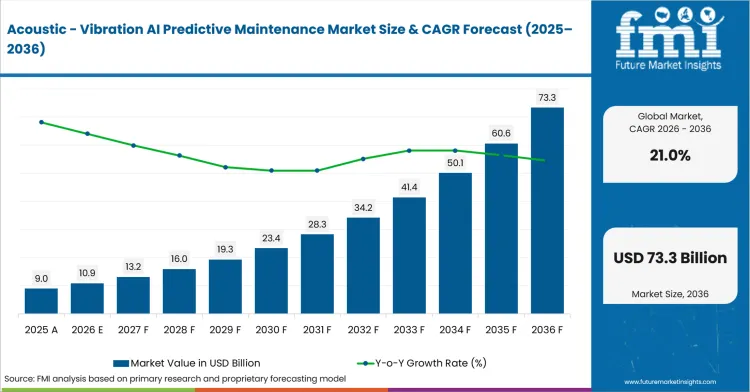
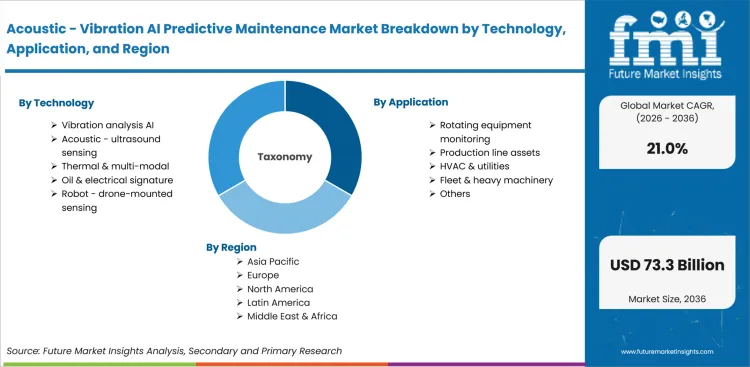
- Market Size (2026)
- USD 10.9 Bn
- Forecast (2036)
- USD 73.3 Bn
- CAGR (2026 to 2036)
- 21.0%
How big is the Acoustic and Vibration AI Predictive Maintenance Market in 2026?
USD 10.9 billion in 2026 and USD 73.3 billion by 2036 at a 21.0% CAGR.
Demand for acoustic and vibration AI predictive maintenance is projected to expand at a 21.0% CAGR between 2026 and 2036. Valuation is estimated to rise from USD 10.9 billion in 2026 to USD 73.3 billion by 2036. Wireless sensors are expected to extend continuous coverage through condition monitoring systems across machines that once received periodic checks. The International Federation of Robotics reported in September 2025 that factories installed 542,000 industrial robots during 2024. This equipment base is anticipated to increase the value of early fault screening that guides maintenance labor and spare-part decisions.
China and India are expected to support earlier sensor installation during new equipment commissioning projects. Japan and Germany are likely to place more weight on controlled retrofits across established plants. New plants are likely to establish clean machine baselines during commissioning and separate normal operating patterns from developing faults more easily. Older industrial sites are anticipated to demand more detailed mounting tests and tighter links with work-order systems. Destatis reported in January 2026 that German machinery and equipment investment declined 2.3% during 2025. This decline is likely to favor targeted monitoring retrofits over broad equipment replacement across older plants. Reliability engineers therefore compare signal stability and data access during approval of machine condition monitoring for wider use. A credible business case is expected to come from trusted diagnosis rather than more dashboard features.
Key Takeaways of Acoustic and Vibration AI Predictive Maintenance Market
- Demand for acoustic and vibration AI predictive maintenance is driven by downtime risk, with commercial value depending on early signals that lead to clear maintenance action before machine failure.
- By offering, AI software platforms are expected to lead with 38.0% share in 2026, turning sensor records into ranked maintenance actions.
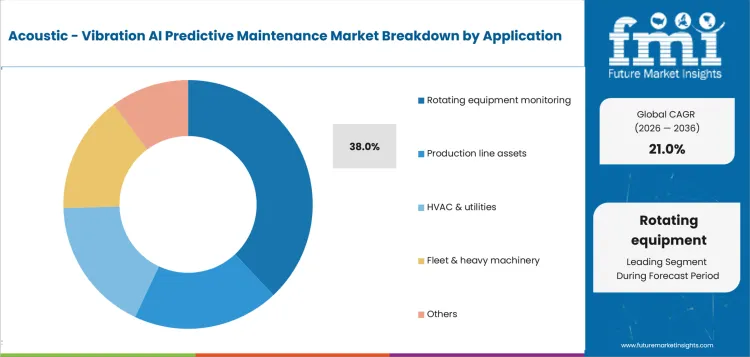
- Rotating equipment monitoring is the dominant application segment, projected to hold 38.0% share in 2026, as motors and pumps provide stable cycles for comparison.
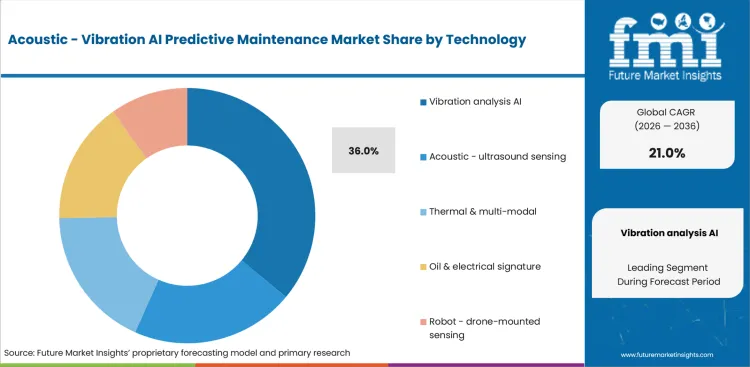
- Vibration analysis AI is estimated to lead the technology category with 36.0% share in 2026, driven by familiar fault signatures across rotating machines.
- Cloud deployment is anticipated to capture 48.0% share in 2026, supported by central model updates and shared specialist review across multiple sites.
- China, India, the United States, Japan, and the European Union are expected to follow distinct adoption paths, shaped by new-capacity sensor integration, remote asset monitoring, precision-equipment baselines, and retrofit-driven data access questions.
- Competition centers on rotating-equipment specialists, industrial machine-health AI providers, and enterprise software groups, with vendors differentiating through sensor quality and fault interpretation, ranked findings across multiple plants, and cloud-scale integration with maintenance planning systems.
Analyst Perspective
"Unplanned equipment failures remain one of the most expensive challenges in modern manufacturing, making early fault detection a business priority rather than a maintenance upgrade. The strongest AI predictive maintenance platforms are those that distinguish genuine machine deterioration from normal operating variation across changing loads and production cycles. Vendors that help maintenance teams diagnose problems faster, reduce false alarms, and integrate actionable insights into routine maintenance planning will earn lasting confidence across industrial operations."
-Nikhil Kaitwade Principal Analyst at Future Market Insights
How is the Acoustic and Vibration AI Predictive Maintenance Market segmented?
Technology, application, deployment, end-use industry, offering, and region
The market is segmented first by Technology and Application to show how physical signals reach maintenance decisions. Technology covers vibration analysis AI and acoustic sensing together with thermal or multi-signal methods used for early fault detection. Application compares rotating equipment with production lines and mobile assets across routine maintenance programs in industrial settings. Deployment separates cloud delivery from hybrid systems and analysis near the machine under different data constraints across sites. End-use Industry covers manufacturing and energy operations together with mining sites and commercial building systems. Offering distinguishes software platforms from sensors and managed monitoring that carry findings into daily maintenance work. Regional analysis shows how industrial capacity and service access shape rollout speed across AI-driven predictive maintenance programs.
Why does vibration analysis AI hold 36.0% of technology in 2026?
Vibration is expected to remain the main input because rotating faults alter movement around bearings and housings. Imbalance is projected to change vibration near running speed, and misalignment is likely to create patterns at multiples of shaft speed. Bearing damage is anticipated to create impact patterns linked to bearing shape and operating speed. Diagnostic models are expected to separate those patterns from normal load changes so a specialist reviews the clearest case. Segment value is projected to rest on reliable normal records and fault descriptions that guide the next inspection.
- With an estimated 36.0% of Technology revenue in 2026, vibration analysis AI is anticipated to hold the disclosed share because familiar fault signatures are available across motors and pumps.
- Reliability engineers are expected to favor vibration analysis over less direct methods due to established fault patterns across motors and pumps. Better vibration sensor selection is projected to improve signal quality as models compare speed and load against each machine's normal pattern. Commercial value is expected to improve through fewer false alerts instead of more raw measurements.
How is rotating equipment monitoring positioned within application?
Rotating equipment is projected to provide repeated operating cycles that make condition changes easier to compare over time. Motors and pumps are anticipated to show imbalance or bearing wear well ahead of a complete stop during production. Fans and compressors are likely to add a broad installed base with similar diagnostic needs across industrial sites. A warning on one drive is expected to protect connected stages that rely on the same machine. Linked production stages are expected to make continuous coverage more valuable than occasional manual rounds across each process.
- Repeated operating cycles are projected to push rotating equipment monitoring to 38.0% of Application volume in 2026. Stable comparison points across widely used motors and pumps are expected to support the disclosed share.
- Rotating equipment monitoring is expected to draw demand from plant reliability teams owing to its ability to protect connected production stages. Wider motor monitoring programs are projected to reveal condition changes beyond routine technician routes across large sites. Commercial return is anticipated to improve when clear alert urgency protects downstream output and product quality.
Why does cloud account for 48.0% of deployment in 2026?
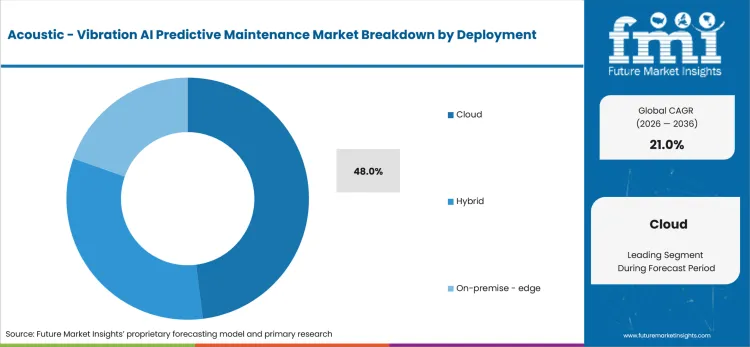
Cloud delivery is anticipated to give multi-site operators one view of machine health without an analytics system at every plant. Central model updates are projected to apply consistent diagnostic rules across similar assets at separate plants. Shared specialist review is likely to support sites with limited in-house vibration expertise during operations. Hybrid systems and analysis near the machine are forecast to remain necessary where bandwidth or data policy limits external transfer. The 48.0% share is estimated to reflect fleet-wide visibility rather than a universal fit for every plant.
- By Deployment, cloud is expected to lead with 48.0% share in 2026 due to multi-site visibility and central model control. Local data storage is projected to support service continuity across monitored sites during temporary network interruptions.
- Demand for cloud systems is expected to grow among corporate reliability teams due to shared model control across several sites. Outside specialist review is anticipated to provide expert input without a full internal vibration group at each plant. Wider use is forecast to require secure data transfer and dependable local data storage during network interruptions.
What supports manufacturing within the end-use Industry category?
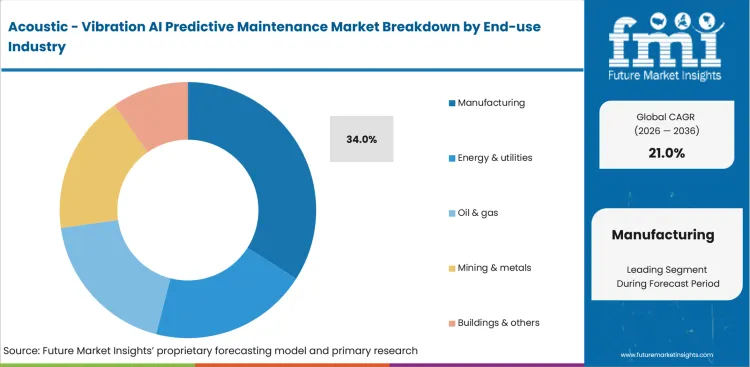
Manufacturing plants are expected to contain dense populations of motors and gearboxes across production lines and utility systems. This equipment density is projected to create repeatable installation patterns across comparable production assets and plant utilities. One failed drive is likely to stop healthy stations that depend on the same sequence. Similar machines are anticipated to support standard sensor placement across several connected production lines within one industrial site. Manufacturing share is estimated to reflect machine count and links between production stages rather than fault severity alone.
- A 34.0% share in End-use Industry is anticipated for manufacturing in 2026 due to dense machine populations. Repeatable installation patterns are projected to support wider monitoring programs across production lines and plant utilities.
- Purchase activity for plant monitoring systems is anticipated to rise during planned shutdowns due to dense machine populations. Ranked alerts are expected to help line maintenance technicians protect output and product quality across connected production stages. Commercial return is projected to reflect avoided production disruption rather than the number of sensors installed on each line.
How do AI software platforms create value within offering?
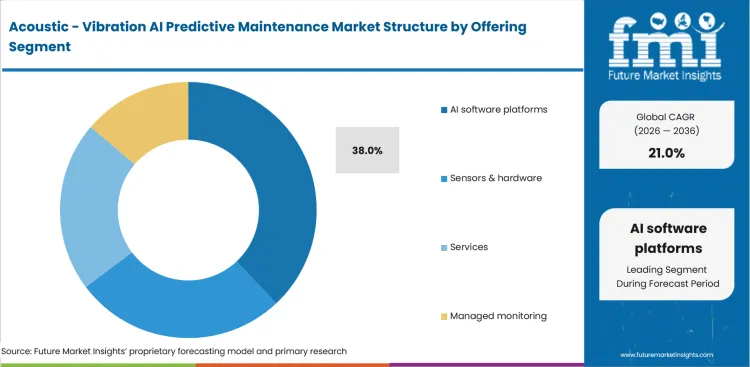
AI software platforms are anticipated to create value by deciding which machine change deserves immediate attention. Platform software is projected to compare each change with machine history and current operating state. Implementation services are expected to support sensor setup and difficult fault diagnosis during early rollout. Managed monitoring is anticipated to transfer daily signal review to outside vibration specialists across monitored industrial sites. Software share is likely to reflect its role in directing labor toward the clearest operational risk.
- Mixed asset fleets mean AI software platforms are forecast to hold 38.0% of Offering revenue in 2026. Ranked findings are expected to direct maintenance labor toward the clearest operational risk across monitored sites.
- AI software platforms are expected to draw attention from maintenance planners that need clear fault urgency across mixed asset groups. Practical vibration analyzer workflows are projected to connect detailed vibration patterns with plain maintenance guidance during specialist review. Long-term value is projected to rest on clear alert reasons and direct work-order routing across each monitored site.
What are the drivers, restraints, and opportunities in the Acoustic and Vibration AI Predictive Maintenance Market?
Early fault warnings are expected to move machine repairs into scheduled maintenance windows across industrial sites. Poor mounting and missing operating data are likely to restrain wider use through false alerts. Combined signal analysis and mobile inspection routes are projected to extend monitoring to slow or hard-to-reach assets.
- Driver: Continuous monitoring is expected to identify faults early enough for scheduled repairs that protect connected production from avoidable disruption.
- Restraint: Poor sensor placement is likely to create false alerts and reduce trust through added diagnostic work.
- Opportunity: Multi-signal and mobile sensing is projected to extend coverage across slow machines and hard-to-reach industrial assets.
Ranked alerts are expected to shift more repairs from reactive work into planned maintenance windows across industrial sites. Siemens reported in March 2025 that early Industrial Copilot pilots saved an average 25% of reactive maintenance time. This result is projected to strengthen the case for software that links diagnosis with daily maintenance work. Expansion is anticipated to require links with work-order systems that turn each finding into a timely inspection and protect production.
Sensor data is expected to move between industrial equipment and cloud services during routine condition reviews. This transfer is projected to raise questions about access rights and provider switching during formal approval. The European Commission reported in September 2025 that the EU Data Act had started to apply to connected devices and industrial machinery. The Commission stated that users could access generated data and switch between cloud providers under the rules. Platform selection is therefore likely to include data rights beside diagnostic accuracy and cybersecurity controls.
Coverage is projected to widen as fixed sensors guide mobile inspection teams toward assets that need a closer check. SKF reported in June 2025 that one online monitoring program covered nine mines and five plants across 11 production lines in Tunisia. This operating scale is expected to support remote review across similar assets and several industrial locations. Platforms that combine acoustic and vibration evidence with structural health monitoring are likely to give technicians a clearer target before they enter difficult locations.
Which country and regional CAGRs are profiled in the Acoustic and Vibration AI Predictive Maintenance Market?
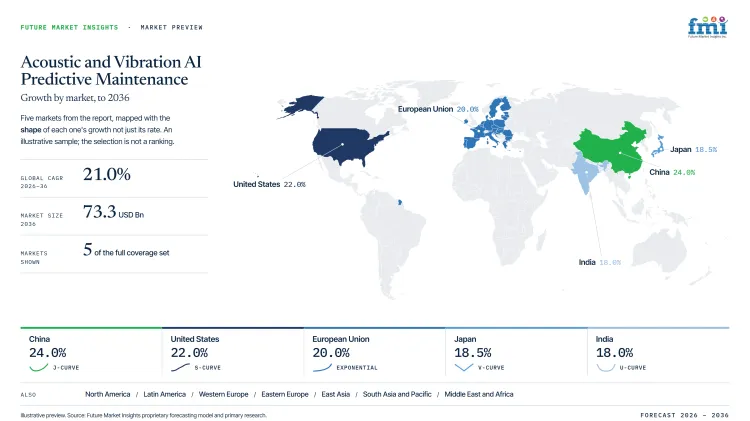
| Country or Market | CAGR |
|---|---|
| China | 24.0% |
| United States | 22.0% |
| European Union | 20.0% |
| Japan | 18.5% |
| India | 18.0% |
Source: FMI's proprietary forecasting model and primary research
How do country and regional CAGRs compare in the Acoustic and Vibration AI Predictive Maintenance Market?
The country comparison spans 6.0 percentage points and reveals three distinct growth groups across the acoustic and vibration AI predictive maintenance market. China and the United States form the leading tier with a 2.0-point difference between them. The European Union occupies the middle position, sitting 2.0 percentage points below the United States. Japan and India complete the comparison within a narrow 0.5-point range. The variation reflects differences in industrial digitalization, condition monitoring adoption and deployment of AI-enabled asset management systems.
- China leads the comparison with a CAGR of 24.0%. Industrial operators are increasingly incorporating acoustic and vibration analytics into predictive maintenance programs to detect equipment anomalies, reduce unplanned downtime and improve asset utilization across manufacturing facilities.
- The United States follows at 22.0%, remaining 2.0 percentage points below China. Market expansion reflects broader integration of AI with industrial sensors, allowing manufacturers and process industries to monitor rotating equipment, identify early signs of failure and optimize maintenance scheduling.
- At 20.0%, the European Union stands 2.0 percentage points behind the United States. Demand is associated with continued investment in smart factories and connected industrial assets, where AI-assisted condition monitoring helps improve equipment reliability and production efficiency. Adoption levels vary across member states because industrial sectors and digital transformation priorities differ.
- Japan records a CAGR of 18.5%, placing it 1.5 percentage points below the European Union. Established expertise in factory automation and precision manufacturing continues to encourage the use of acoustic and vibration monitoring systems that support predictive maintenance throughout production operations.
- India posts a CAGR of 18.0%, only 0.5 percentage points behind Japan. Growing implementation of industrial IoT platforms and increasing modernization of manufacturing facilities are creating opportunities for AI-based predictive maintenance solutions that improve equipment availability and reduce maintenance costs.
Comparable CAGRs can still produce different market entry conditions. Differences in industrial automation maturity, AI deployment, installed equipment base and maintenance strategies influence adoption timelines and long-term commercial opportunities. The full report provides country-level CAGR analysis across North America, Latin America, Europe, East Asia, South Asia, Oceania and the Middle East and Africa.
Country-wise Analysis
Growth across the five profiled geographies is anticipated to depend on machine age and the point of first sensor installation. New industrial capacity is projected to give China and India an earlier point for sensor installation. United States demand is expected to reflect remote energy assets and broad plant networks that cannot tolerate long inspection gaps. Japan is anticipated to emphasize stable baselines across precision equipment that remains in service for long periods. European Union requirements are likely to add industrial data access questions to retrofit decisions across older equipment fleets. These differences are expected to preserve a role for handheld vibration analyzers during targeted checks as continuous platforms expand.
- China's role as an industrial machinery production hub is expected to support sensor installation during equipment commissioning. By 2036, China is projected to record a 24.0% CAGR due to new plants that can include sensors in the initial equipment setup. The National Bureau of Statistics reported in January 2026 that general-purpose machinery value added grew 8.0% during 2025. Machinery output at that level is likely to support local records of normal motor and gearbox behavior during each plant rollout. Plant engineers are anticipated to favor platforms that compare similar machines and show how speed or load affects each alert. Local service is expected to matter because early setup must match each machine family and operating routine. Growth is projected to reward fast commissioning and trusted diagnosis rather than software breadth alone.
- Reliability leaders at USA energy and manufacturing sites are expected to evaluate cybersecurity and work-order links before approving continuous monitoring. United States demand is anticipated to advance at a 22.0% CAGR during the assessment period, driven by energy infrastructure and downtime exposure. In its February 2026 outlook, the USA Energy Information Administration projected average dry natural gas production of 110.0 Bcf per day for 2026. Production at that scale is likely to sustain monitoring demand across compressors and pumps where periodic specialist rounds leave long gaps between checks. Maintenance planners are expected to value local diagnosis and secure data handling during company-wide approval. Commercial return is anticipated to reflect fewer interruptions across dispersed assets rather than wider dashboard coverage.
- Industrial service networks in the European Union are expected to support monitoring retrofits across older equipment fleets in separate national markets. Monitoring demand in the European Union is forecast to record a 20.0% CAGR during the assessment period, supported by retrofit needs across older industrial equipment. Eurostat reported in March 2026 that EU industrial production rose 2.3% year over year during December 2025. December's recovery is expected to support targeted sensor spending across plants that need careful installation around established machinery. Data portability and connected equipment access are likely to carry more weight during cloud contract reviews. Adoption across the region is anticipated to combine reliable diagnosis with clear data rights across member states and service partners.
- Japan's maintenance technology mix is projected to shift toward automated diagnosis across long-life precision equipment. Acoustic and vibration monitoring demand in Japan is estimated to expand at an 18.5% CAGR through 2036, linked to long asset lives and controlled production routines. In April 2026, the Cabinet Office reported that private-sector machinery orders excluding ships and electric power companies rose 13.6% during February 2026. Higher machinery orders are expected to support careful expansion through controlled pilots across established production assets. Reliability engineers are likely to require repeatable mounting and analysis near the machine before approving automated alerts across precision plants. Long-term value is anticipated to favor systems that preserve measurement consistency across extended service periods.
- India's service base is anticipated to expand as factory programs add more monitored equipment across new industrial sites. India is estimated to post an 18.0% CAGR during the forecast period on the back of manufacturing expansion and wider access to wireless sensing. The Press Information Bureau reported in April 2026 that manufacturing output grew 4.3% year over year during March 2026. Manufacturing growth at that pace is projected to expand the installed machine base that needs routine condition checks across new industrial sites. Plant maintenance leads are likely to favor wireless devices and condition monitoring services where specialist coverage remains uneven. Adoption is expected to favor simple installation and clear fault guidance beyond a small set of critical assets.
Who are the notable companies in the Acoustic and Vibration AI Predictive Maintenance Market?
SKF, Augury, Siemens Senseye, and Nanoprecise are notable companies across sensing, industrial AI diagnosis, cloud workflows, and managed monitoring support.
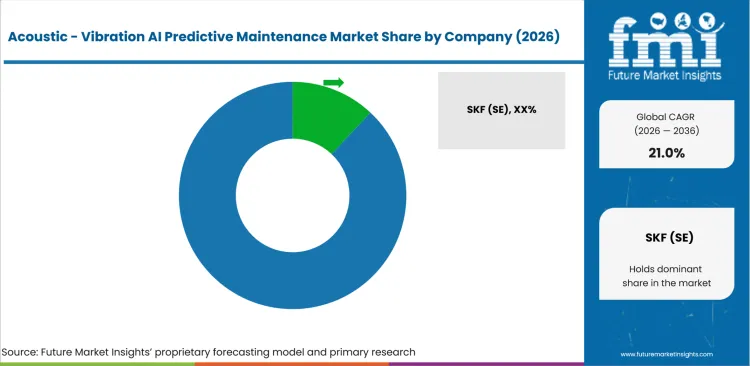
Competition is expected to combine rotating-machine knowledge with industrial AI software and outside specialist review across industrial operations. Measurement quality is projected to matter because every later diagnosis depends on mounting quality and signal stability. Software coverage is anticipated to matter across plants that need shared diagnostic rules and one maintenance workflow. Service reach is likely to decide whether plant reliability teams trust uncertain alerts during early use. Competitive separation is expected to depend on how well ranked alerts fit existing asset performance management systems and daily maintenance work. Final selection is anticipated to rest on diagnostic clarity and support for wider rollout across each plant network.
- Rotating-equipment specialist: SKF combines bearing knowledge with condition monitoring instruments and remote services for motors and gearboxes. The proprietary model assigns SKF the only disclosed company share at 12.0% for 2026 within the selected company set. SKF's position is expected to be valuable where diagnosis depends on machine behavior and field support.
- Industrial machine-health AI providers: Augury and Nanoprecise combine connected sensing with ranked alerts for industrial operations. Their advantage is projected to come from wireless coverage and guided diagnosis across machine groups that local reliability staff cannot review continuously during every shift.
- Enterprise predictive maintenance software: Siemens Senseye connects predictive findings with cloud scale and existing industrial software used for maintenance. This approach is anticipated to suit multi-site operators that need machine alerts to reach planners without creating a separate daily process for each site.
Competitive Benchmarking: Acoustic and Vibration AI Predictive Maintenance Market
| Company | Acoustic and Vibration Capability | AI Diagnosis | Multi-site Workflow | Geographic Footprint |
|---|---|---|---|---|
| SKF | High | Medium | Medium | Global |
| Augury | High | High | High | Global |
| Siemens Senseye | Medium | High | High | Global |
| Nanoprecise | High | High | Medium | North America, Europe and Asia |
Source: Future Market Insights competitive analysis for 2026 based on relative portfolio relevance and documented fit with maintenance workflows. Service capability and geographic reach were assessed separately so one rating did not determine another.
Key Developments in the Acoustic and Vibration AI Predictive Maintenance Market
- March 2026, SKF signed an agreement to acquire G-Tech Instruments and expand its condition monitoring instrument portfolio. This acquisition is expected to add specialist measurement capability and turn measured machine data into a clearer diagnosis.
- February 2025, Augury raised USD 75 million through a Series F round led by Lightrock. New funding is projected to support product expansion across machine reliability and process control without relying on a single machine class.
- June 2025, Siemens, disclosed a Senseye Predictive Maintenance pilot with Sachsenmilch that detected a pump nearing the end of service life. The project is expected to show how vibration data and maintenance records can guide maintenance action in food processing.
- April 2025, Nanoprecise announced the ReKurv.ai launch for maintenance professionals working across monitored industrial assets. ReKurv.ai uses machine history and site context to support troubleshooting through a mobile interface once an alert appears.
Key Players in the Acoustic and Vibration AI Predictive Maintenance Market
Rotating-equipment and condition monitoring specialist
- SKF
Industrial machine-health AI providers
- Augury
- Nanoprecise
Enterprise predictive maintenance software provider
- Siemens Senseye
Acoustic and Vibration AI Predictive Maintenance Market - Report Scope
| Report Attribute | Coverage |
|---|---|
| Market Breakdown | Technology, Application, Deployment, End-use Industry, Offering, and Region |
| Quantitative Units | USD billion |
| Market Definition | Hardware, software, and services that use acoustic or vibration signals as a central input for predictive maintenance decisions |
| Regions Covered | North America, Latin America, Western Europe, Eastern Europe, East Asia, South Asia and Pacific, Middle East and Africa |
| Countries Covered | United States, Canada, China, Japan, India, Germany, France, United Kingdom, and 30+ countries |
| Key Companies Profiled | SKF, Augury, Siemens Senseye, and Nanoprecise |
| Approach | The approach combined monitored asset counts and maintenance workflows with company portfolios and geographic forecasts |
Source: Future Market Insights - analysis driven by proprietary forecasting models and primary research
Acoustic and Vibration AI Predictive Maintenance Market - Research Methodology
| Method | Application |
|---|---|
| Primary Research | FMI analysts gathered input from manufacturers, service providers, technology developers, distributors, end users, sourcing teams, and subject-matter experts. Interviews examined purchasing decisions, product or service evaluation, adoption barriers, approval requirements, pricing considerations, and expectations for technical or commercial support. Respondents were also asked what evidence is required before a trial, pilot, or initial order develops into regular purchasing. |
| Desk Research | Desk research covered government statistics, regulatory publications, trade data, industry associations, technical literature, standards, company filings, product information, and official corporate announcements. Sources were reviewed for relevance, publication date, geographic coverage, and consistency with the defined market scope. Claims relating to performance, applications, approvals, capacity, investment, and commercial activity were retained only when supported by credible public evidence. |
| Market Sizing and Forecasting | The market model combined the baseline value with historical performance, segment structure, pricing and volume indicators, adoption levels, company participation, and country-level demand conditions. Forecast assumptions considered economic activity, investment trends, regulatory developments, technology adoption, purchasing cycles, supply availability, and barriers to wider market use. Segment and regional estimates were reconciled before the final market total was calculated. |
| Data Validation | Estimates were checked against multiple independent indicators, including public data, company activity, trade patterns, industry developments, and findings from primary interviews. Validation also tested whether products, services, applications, and company revenues fell within the defined market boundaries. Adjacent categories, unsupported claims, overlapping revenues, and activities without direct market relevance were excluded to reduce double counting and maintain consistency across segments and countries. |
Acoustic and Vibration AI Predictive Maintenance Market by Segments
Acoustic and Vibration AI Predictive Maintenance Market segmented by Technology:
- Vibration analysis AI
- Acoustic and ultrasound sensing
- Thermal and multi-modal
- Oil and electrical signature
- Robot-mounted and drone-mounted sensing
Acoustic and Vibration AI Predictive Maintenance Market segmented by Application:
- Rotating equipment monitoring
- Production line assets
- HVAC and utilities
- Fleet and heavy machinery
- Others
Acoustic and Vibration AI Predictive Maintenance Market segmented by Deployment:
- Cloud
- Hybrid
- On-premise and edge
Acoustic and Vibration AI Predictive Maintenance Market segmented by End-use Industry:
- Manufacturing
- Energy and utilities
- Oil and gas
- Mining and metals
- Buildings and others
Acoustic and Vibration AI Predictive Maintenance Market segmented by Offering:
- AI software platforms
- Sensors and hardware
- Services
- Managed monitoring
Acoustic and Vibration AI Predictive Maintenance Market by Region:
- North America
- United States
- Canada
- Latin America
- Brazil
- Mexico
- Rest of Latin America
- Western Europe
- Germany
- United Kingdom
- France
- Italy
- Spain
- Rest of Western Europe
- Eastern Europe
- Poland
- Romania
- Czech Republic
- Rest of Eastern Europe
- East Asia
- China
- Japan
- South Korea
- South Asia and Pacific
- India
- ASEAN
- Australia and New Zealand
- Rest of South Asia and Pacific
- Middle East and Africa
- GCC Countries
- South Africa
- Türkiye
- Rest of Middle East and Africa
Research Sources and Bibliography
- Future Market Insights. (2026). Acoustic and Vibration AI Predictive Maintenance Market proprietary forecasting model and primary research.
- Future Market Insights. (2026). Condition Monitoring System Market.
- Future Market Insights. (2026). Machine Condition Monitoring Market.
- Future Market Insights. (2026). AI-driven Predictive Maintenance Market.
- Future Market Insights. (2026). Vibration Sensor Market.
- Future Market Insights. (2026). Motor Monitoring Market.
- Future Market Insights. (2026). Condition Monitoring Service Market.
- Future Market Insights. (2026). Vibration Analyzer Market.
- Future Market Insights. (2026). Structural Health Monitoring Market.
- Future Market Insights. (2026). Handheld Vibration Analyzer Market.
- Future Market Insights. (2026). Plant Asset Management Market.
This Report Answers
- How large is the Acoustic and Vibration AI Predictive Maintenance Market in 2026 and what value is projected for 2036?
- What is expected to drive growth in the Acoustic and Vibration AI Predictive Maintenance Market?
- Why does vibration analysis AI account for 36.0% of Technology in 2026?
- How does rotating equipment monitoring create value across Application demand?
- Why does cloud account for 48.0% of Deployment in 2026?
- How do manufacturing and energy operations differ in monitoring requirements?
- How do the supplied growth rates compare across China and the United States or the European Union?
- What separates sensing depth from AI diagnosis during competitive comparison?
- Which implementation risks are expected to limit return after an initial pilot?
Frequently Asked Questions
What is driving growth in the Acoustic and Vibration AI Predictive Maintenance Market?
Continuous monitoring is expected to reduce exposure to unplanned stops across several connected production stages. Wireless devices are projected to cover older plants and remote assets without disruptive cable work.
Who are the key players in the Acoustic and Vibration AI Predictive Maintenance Market?
SKF and Augury compete through machine-health expertise and connected diagnosis across several rotating equipment classes. Siemens Senseye and Nanoprecise add cloud workflows and sensors that measure several machine signals across manufacturing and energy operations.
What is a notable restraint in the Acoustic and Vibration AI Predictive Maintenance Market?
Poor sensor placement is likely to make normal vibration from the machine frame resemble a developing fault during operation. Missing speed or load context is projected to create repeated false alerts during later reviews.
Why should executives track the Acoustic and Vibration AI Predictive Maintenance Market?
The market is expected to link maintenance spending with production continuity and labor planning across industrial sites. Its growth is anticipated to reflect a shift from periodic inspection toward continuous machine coverage.
What business problem does the Acoustic and Vibration AI Predictive Maintenance Market address?
The market is expected to address machine faults that develop ahead of visible heat or damage during operation. Earlier diagnosis is projected to support labor and parts planning ahead of disruption to production schedules.
What should procurement leaders evaluate before selecting suppliers?
Procurement leaders should compare mounting support and fault clarity with data access and work-order links. They should test normal operating changes during pilot work and control false alerts before wider approval.
What limits return on investment for purchasers?
False alerts can consume scarce maintenance time and weaken trust in later machine warnings across the plant. Weak system links can leave useful findings outside the daily planning process across several sites.
How do suppliers build long-term account confidence?
Suppliers are expected to prove stable signals across changing speed and load during repeated production cycles. Clear alert priorities and local diagnostic support are anticipated to help plants expand beyond pilot assets.
Preview the report firsthand - request a free sample
Get SampleGet the brochure for pricing and purchase details.
Get PDFTable of Content
- Key Takeaways
- Market Size and CAGR
- Top Growth Driver
- Fastest Growing Segment
- Leading Region
- Key Companies
- Emerging Opportunities
- Executive Summary
- Global Market Outlook
- Demand-side Trends
- Supply-side Trends
- Technology Roadmap Analysis
- Analysis and Recommendations
- Analyst Perspective (What is happening? Why now? What should investors know?)
- Key Questions Answered
- How large is the market?
- What is the CAGR?
- What are key trends?
- Which region dominates?
- Who are the leaders?
- Market Overview
- Market Coverage / Taxonomy
- Market Definition / Scope / Limitations
- Research Methodology
- Chapter Orientation
- Analytical Lens and Working Hypotheses
- Market Structure, Signals, and Trend Drivers
- Benchmarking and Cross-market Comparability
- Market Sizing, Forecasting, and Opportunity Mapping
- Research Design and Evidence Framework
- Desk Research Programme (Secondary Evidence)
- Expert Input and Fieldwork (Primary Evidence)
- Tooling, Models, and Reference Databases
- Data Engineering and Model Build
- Quality Assurance and Audit Trail
- Market Background
- Market Dynamics (Drivers, Restraints, Opportunity, Trends)
- Scenario Forecast (Optimistic, Likely, Conservative)
- Impact Analysis
- AI Impact
- Sustainability Impact
- Regulatory Impact
- Technology Impact
- Consumer / Buyer Analysis
- Purchase Drivers
- Adoption Barriers
- Buyer Journey
- Opportunity Map Analysis
- Product Life Cycle Analysis
- Supply Chain Analysis
- Investment Feasibility Matrix
- Value Chain Analysis
- PESTLE and Porter's Analysis
- Regulatory Landscape
- Regional Parent Market Outlook
- Production and Consumption Statistics
- Import and Export Statistics
- Global Market Analysis and Forecast, 2021 to 2036
- Historical Market Size Value (USD Bn) Analysis, 2021 to 2025
- Current and Future Market Size Value (USD Bn) Projections, 2026 to 2036
- Y-o-Y Growth Trend Analysis
- Absolute $ Opportunity Analysis
- Global Market Pricing Analysis, 2021 to 2036
- Global Market Analysis and Forecast, By Technology, 2021 to 2036
- Introduction / Key Findings
- Historical Market Size Value (USD Bn) Analysis By Technology, 2021 to 2025
- Current and Future Market Size Value (USD Bn) Analysis and Forecast By Technology, 2026 to 2036
- Vibration analysis AI
- Acoustic - ultrasound sensing
- Thermal & multi-modal
- Oil & electrical signature
- Robot - drone-mounted sensing
- Vibration analysis AI
- Y-o-Y Growth Trend Analysis By Technology, 2021 to 2025
- Absolute $ Opportunity Analysis By Technology, 2026 to 2036
- Global Market Analysis and Forecast, By Application, 2021 to 2036
- Introduction / Key Findings
- Historical Market Size Value (USD Bn) Analysis By Application, 2021 to 2025
- Current and Future Market Size Value (USD Bn) Analysis and Forecast By Application, 2026 to 2036
- Rotating equipment monitoring
- Production line assets
- HVAC & utilities
- Fleet & heavy machinery
- Others
- Rotating equipment monitoring
- Y-o-Y Growth Trend Analysis By Application, 2021 to 2025
- Absolute $ Opportunity Analysis By Application, 2026 to 2036
- Global Market Analysis and Forecast, By Deployment, 2021 to 2036
- Introduction / Key Findings
- Historical Market Size Value (USD Bn) Analysis By Deployment, 2021 to 2025
- Current and Future Market Size Value (USD Bn) Analysis and Forecast By Deployment, 2026 to 2036
- Cloud
- Hybrid
- On-premise - edge
- Cloud
- Y-o-Y Growth Trend Analysis By Deployment, 2021 to 2025
- Absolute $ Opportunity Analysis By Deployment, 2026 to 2036
- Global Market Analysis and Forecast, By End-use Industry, 2021 to 2036
- Introduction / Key Findings
- Historical Market Size Value (USD Bn) Analysis By End-use Industry, 2021 to 2025
- Current and Future Market Size Value (USD Bn) Analysis and Forecast By End-use Industry, 2026 to 2036
- Manufacturing
- Energy & utilities
- Oil & gas
- Mining & metals
- Buildings & others
- Manufacturing
- Y-o-Y Growth Trend Analysis By End-use Industry, 2021 to 2025
- Absolute $ Opportunity Analysis By End-use Industry, 2026 to 2036
- Global Market Analysis and Forecast, By Offering, 2021 to 2036
- Introduction / Key Findings
- Historical Market Size Value (USD Bn) Analysis By Offering, 2021 to 2025
- Current and Future Market Size Value (USD Bn) Analysis and Forecast By Offering, 2026 to 2036
- AI software platforms
- Sensors & hardware
- Services
- Managed monitoring
- AI software platforms
- Y-o-Y Growth Trend Analysis By Offering, 2021 to 2025
- Absolute $ Opportunity Analysis By Offering, 2026 to 2036
- Global Market Analysis and Forecast, By Region, 2021 to 2036
- Introduction
- Historical Market Size Value (USD Bn) Analysis By Region, 2021 to 2025
- Current Market Size Value (USD Bn) Analysis and Forecast By Region, 2026 to 2036
- North America
- Latin America
- Western Europe
- Eastern Europe
- East Asia
- South Asia and Pacific
- Middle East & Africa
- Market Attractiveness Analysis By Region
- North America Market Analysis and Forecast, By Country, 2021 to 2036
- Historical Market Size Value (USD Bn) Trend Analysis By Market Taxonomy, 2021 to 2025
- Market Size Value (USD Bn) Forecast By Market Taxonomy, 2026 to 2036
- By Country
- USA
- Canada
- By Technology
- By Application
- By Deployment
- By End-use Industry
- By Offering
- By Country
- Market Attractiveness Analysis
- By Country
- By Technology
- By Application
- By Deployment
- By End-use Industry
- By Offering
- Key Takeaways
- Latin America Market Analysis and Forecast, By Country
- Historical Market Size Value (USD Bn) Trend Analysis By Market Taxonomy, 2021 to 2025
- Market Size Value (USD Bn) Forecast By Market Taxonomy, 2026 to 2036
- By Country
- Brazil
- Mexico
- Chile
- Rest of Latin America
- By Technology
- By Application
- By Deployment
- By End-use Industry
- By Offering
- By Country
- Market Attractiveness Analysis
- By Country
- By Technology
- By Application
- By Deployment
- By End-use Industry
- By Offering
- Key Takeaways
- Western Europe Market Analysis and Forecast, By Country
- Historical Market Size Value (USD Bn) Trend Analysis By Market Taxonomy, 2021 to 2025
- Market Size Value (USD Bn) Forecast By Market Taxonomy, 2026 to 2036
- By Country
- Germany
- UK
- Italy
- Spain
- France
- Nordic
- BENELUX
- Rest of Western Europe
- By Technology
- By Application
- By Deployment
- By End-use Industry
- By Offering
- By Country
- Market Attractiveness Analysis
- By Country
- By Technology
- By Application
- By Deployment
- By End-use Industry
- By Offering
- Key Takeaways
- Eastern Europe Market Analysis and Forecast, By Country
- Historical Market Size Value (USD Bn) Trend Analysis By Market Taxonomy, 2021 to 2025
- Market Size Value (USD Bn) Forecast By Market Taxonomy, 2026 to 2036
- By Country
- Russia
- Poland
- Hungary
- Balkan & Baltic
- Rest of Eastern Europe
- By Technology
- By Application
- By Deployment
- By End-use Industry
- By Offering
- By Country
- Market Attractiveness Analysis
- By Country
- By Technology
- By Application
- By Deployment
- By End-use Industry
- By Offering
- Key Takeaways
- East Asia Market Analysis and Forecast, By Country
- Historical Market Size Value (USD Bn) Trend Analysis By Market Taxonomy, 2021 to 2025
- Market Size Value (USD Bn) Forecast By Market Taxonomy, 2026 to 2036
- By Country
- China
- Japan
- South Korea
- By Technology
- By Application
- By Deployment
- By End-use Industry
- By Offering
- By Country
- Market Attractiveness Analysis
- By Country
- By Technology
- By Application
- By Deployment
- By End-use Industry
- By Offering
- Key Takeaways
- South Asia and Pacific Market Analysis and Forecast, By Country
- Historical Market Size Value (USD Bn) Trend Analysis By Market Taxonomy, 2021 to 2025
- Market Size Value (USD Bn) Forecast By Market Taxonomy, 2026 to 2036
- By Country
- India
- ASEAN
- Australia & New Zealand
- Rest of South Asia and Pacific
- By Technology
- By Application
- By Deployment
- By End-use Industry
- By Offering
- By Country
- Market Attractiveness Analysis
- By Country
- By Technology
- By Application
- By Deployment
- By End-use Industry
- By Offering
- Key Takeaways
- Middle East & Africa Market Analysis and Forecast, By Country
- Historical Market Size Value (USD Bn) Trend Analysis By Market Taxonomy, 2021 to 2025
- Market Size Value (USD Bn) Forecast By Market Taxonomy, 2026 to 2036
- By Country
- Kingdom of Saudi Arabia
- Other GCC Countries
- Türkiye
- South Africa
- Other African Union
- Rest of Middle East & Africa
- By Technology
- By Application
- By Deployment
- By End-use Industry
- By Offering
- By Country
- Market Attractiveness Analysis
- By Country
- By Technology
- By Application
- By Deployment
- By End-use Industry
- By Offering
- Key Takeaways
- Key Countries Market Analysis
- USA
- Pricing Analysis
- Market Share Analysis, 2025
- By Technology
- By Application
- By Deployment
- By End-use Industry
- By Offering
- Canada
- Pricing Analysis
- Market Share Analysis, 2025
- By Technology
- By Application
- By Deployment
- By End-use Industry
- By Offering
- Mexico
- Pricing Analysis
- Market Share Analysis, 2025
- By Technology
- By Application
- By Deployment
- By End-use Industry
- By Offering
- Brazil
- Pricing Analysis
- Market Share Analysis, 2025
- By Technology
- By Application
- By Deployment
- By End-use Industry
- By Offering
- Chile
- Pricing Analysis
- Market Share Analysis, 2025
- By Technology
- By Application
- By Deployment
- By End-use Industry
- By Offering
- Germany
- Pricing Analysis
- Market Share Analysis, 2025
- By Technology
- By Application
- By Deployment
- By End-use Industry
- By Offering
- UK
- Pricing Analysis
- Market Share Analysis, 2025
- By Technology
- By Application
- By Deployment
- By End-use Industry
- By Offering
- Italy
- Pricing Analysis
- Market Share Analysis, 2025
- By Technology
- By Application
- By Deployment
- By End-use Industry
- By Offering
- Spain
- Pricing Analysis
- Market Share Analysis, 2025
- By Technology
- By Application
- By Deployment
- By End-use Industry
- By Offering
- France
- Pricing Analysis
- Market Share Analysis, 2025
- By Technology
- By Application
- By Deployment
- By End-use Industry
- By Offering
- India
- Pricing Analysis
- Market Share Analysis, 2025
- By Technology
- By Application
- By Deployment
- By End-use Industry
- By Offering
- ASEAN
- Pricing Analysis
- Market Share Analysis, 2025
- By Technology
- By Application
- By Deployment
- By End-use Industry
- By Offering
- Australia & New Zealand
- Pricing Analysis
- Market Share Analysis, 2025
- By Technology
- By Application
- By Deployment
- By End-use Industry
- By Offering
- China
- Pricing Analysis
- Market Share Analysis, 2025
- By Technology
- By Application
- By Deployment
- By End-use Industry
- By Offering
- Japan
- Pricing Analysis
- Market Share Analysis, 2025
- By Technology
- By Application
- By Deployment
- By End-use Industry
- By Offering
- South Korea
- Pricing Analysis
- Market Share Analysis, 2025
- By Technology
- By Application
- By Deployment
- By End-use Industry
- By Offering
- Russia
- Pricing Analysis
- Market Share Analysis, 2025
- By Technology
- By Application
- By Deployment
- By End-use Industry
- By Offering
- Poland
- Pricing Analysis
- Market Share Analysis, 2025
- By Technology
- By Application
- By Deployment
- By End-use Industry
- By Offering
- Hungary
- Pricing Analysis
- Market Share Analysis, 2025
- By Technology
- By Application
- By Deployment
- By End-use Industry
- By Offering
- Kingdom of Saudi Arabia
- Pricing Analysis
- Market Share Analysis, 2025
- By Technology
- By Application
- By Deployment
- By End-use Industry
- By Offering
- Türkiye
- Pricing Analysis
- Market Share Analysis, 2025
- By Technology
- By Application
- By Deployment
- By End-use Industry
- By Offering
- South Africa
- Pricing Analysis
- Market Share Analysis, 2025
- By Technology
- By Application
- By Deployment
- By End-use Industry
- By Offering
- USA
- Market Structure Analysis
- Competition Dashboard
- Competition Benchmarking
- Market Share Analysis of Top Players
- By Regional
- By Technology
- By Application
- By Deployment
- By End-use Industry
- By Offering
- Emerging Startups
- Innovation Benchmarking
- Competition Analysis
- Competition Deep Dive
- SKF (SE)
- Overview
- Product Portfolio
- Profitability by Market Segments
- Sales Footprint
- Strategy Overview
- Marketing Strategy
- Product Strategy
- Channel Strategy
- Augury (US-IL)
- Siemens Senseye (DE)
- Nanoprecise (CA)
- SKF (SE)
- Case Studies
- Success Stories
- Recent Developments
- Competition Deep Dive
- Assumptions & Acronyms Used


