


- Bovine pericardial valve market value of USD 2.2 billion in 2026, and is expected to reach USD 3.6 billion by 2036, growing at a CAGR of 5.1% during the forecast period.
- Value-based cardiac care is influencing buying decisions, with hospitals placing more importance on long-term clinical outcomes and procedural efficiency.
- Bovine pericardial valves are benefiting from the increasing preference for tissue-based solutions that reduce the need for lifelong anticoagulation management in selected patient populations.
- There is a growing focus among healthcare providers on the economics of the entire episode of care, including post-operative quality of life, risk of reintervention, and burden of hospitalization.
- Pricing discussions are shifting from device acquisition costs to broader assessments of patient outcomes and healthcare resource utilization.
- Manufacturers that can demonstrate durability, procedural compatibility and long-term clinical value are likely to strengthen their competitive position in emerging reimbursement frameworks.
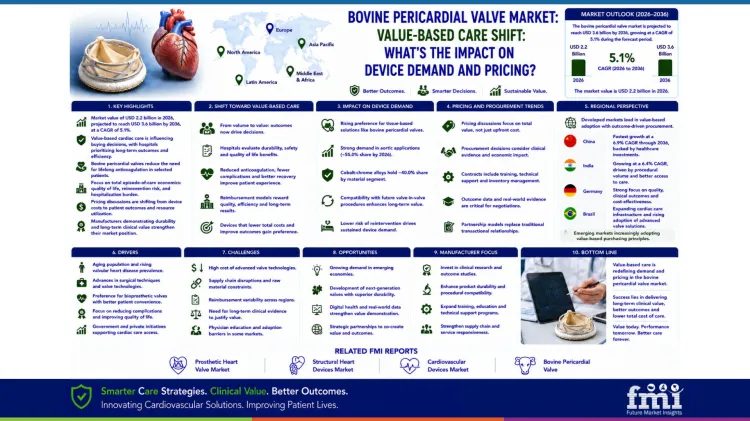
We are in a new era of the bovine pericardial valve market where clinical value and healthcare economics are increasingly converging. The market was valued at USD 2.2 billion in 2026 and is projected to reach USD 3.6 billion by 2036, with constant demand for biological heart valve solutions, with a forecasted CAGR of 5.1% during the forecast period. This growth path is driven by increasing procedural volume, an aging global population and ongoing advances in cardiac care delivery.
Value-based healthcare models are changing the treatment priorities in cardiovascular medicine. In the past, the choice of device for heart valve replacement procedures was mainly determined by short-term procedural factors and purchase price. Healthcare systems are increasingly looking at interventions that are effective in improving patient outcomes and optimizing resource use in the long run.
The use of bovine pericardial valves in this setting has been much considered.
The mechanical options are less attractive as the bovine pericardial valves deliver benefits that are more in line with the larger value-based goals. Continuous anticoagulation therapy can be reduced, which may improve patient convenience and decrease the burden of drug monitoring and bleeding complications. These factors help to better understand the value of the therapy outside of the operating room.
The shift to value-based care has also led providers to consider total episode-of-care costs.
Increasingly important factors in the decision-making process are the duration of hospitalization, the risk of readmission, the potential benefits in quality of life, and the probability of future interventions. While the price of devices is still important, economic impact is becoming a bigger part of the conversation around procurement.
That's why hospitals and cardiac centers are using more sophisticated evaluation frameworks.
Durability, procedural reliability and patient outcomes are becoming increasingly important factors in the purchasing decision, and clinical evidence is becoming more important. Manufacturers are increasingly expected to provide hard data that demonstrates how their technologies result in increased efficiency in healthcare and improved patient satisfaction.
Trends in product segmentation indicate further market opportunities.
Aortic applications are projected to account for about 55.0% of the valve type segment demand by 2026, owing to the large procedural volume associated with aortic valve disease management. In the meantime, cobalt-chrome alloys are projected to account for nearly 40.0% share of material usage, based on their proven performance attributes and broad clinical acceptance.
Regional dynamics also reflect varying degrees of value based adoption.
Mature payment structures in developed healthcare markets are gradually integrating outcome-based considerations into procurement practices. In such situations, hospitals are seeking technologies that deliver clinical effectiveness in a financially sustainable way.
In emerging economies, the picture is different.
The procedural growth continues to be driven by the growing healthcare infrastructure and better access to advanced cardiovascular interventions. Cost sensitivity is still a huge factor, but increasing awareness of treatment quality is gradually raising the profile of value-based purchasing principles.
Growth trends at the country level show these opportunities.
Rising investments in specialized cardiac care capacity and healthcare modernization initiatives are expected to propel China at a 6.9% CAGR through 2036. India is estimated to grow at a CAGR of 6.4%, owing to increasing procedural volumes and better access to healthcare across the board. Germany and Brazil also have big implications for manufacturers.
In a value-based healthcare environment, success is increasingly about showing a measurable difference. Clinical performance, physician confidence, technical support capabilities and evidence generation are increasingly important parts of competitive strategy.
Organizations that can tailor their offerings to provider goals for efficiency, patient outcomes and long-term value creation will likely improve their market position.
The mistake to avoid is to think value-based care is all about downward pressure on pricing.
Indeed, value-based frameworks are intended to incentivize technologies that can potentially provide positive benefits, relative to their aggregate impact on healthcare. Premium positioning might be justified for devices that improve patient experience and optimize resource use in the right clinical settings.
Bottom line
Value-based healthcare is quietly changing procurement priorities in cardiovascular medicine. This evolution is a positive indicator for the bovine pericardial valve market, which will benefit technologies that offer proven long-term value in healthcare with established clinical efficacy. This confirms the need for solutions supporting patient-centered care and health care sustainability economics.

