


- The increasing factor affecting the success of prenatal vitamins is differentiation of ingredients, trusted physicians, and maternal health positioning, not just brand name alone.
- The inclusion of ingredients like DHA, choline, methyl folate, and unique mixes of nutrients is catching on with health-conscious customers.
- Personalized marketing, subscriptions, and maternal health portals are helping new competitors challenge the existing players in the field.
- Doctors’ recommendations still count, but transparency and education about ingredients also play a role in earning consumer trust.
- Large legacy brands are still succeeding because of their economies of scale, while innovative brands tend to grow faster.
- The greatest myth about prenatal vitamins is the assumption that the biggest brands sell the best. Actually, today’s consumers prefer brands addressing the latest nutritional concerns.
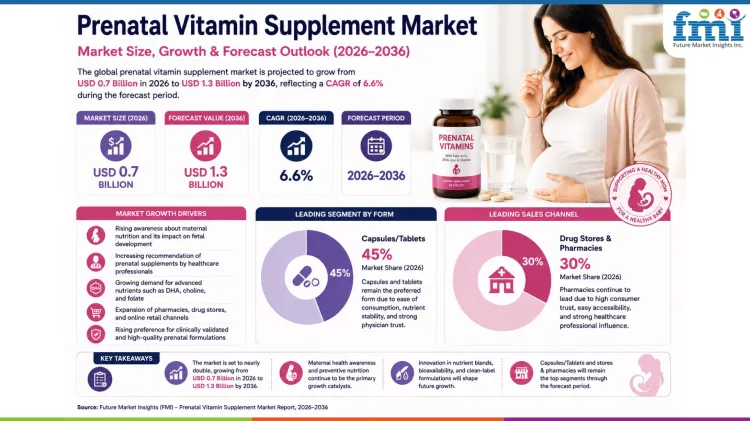
The global Prenatal Vitamin Supplements Market is becoming increasingly competitive as consumers demand more from maternal nutrition products. For many years, the category was relatively straightforward. Most prenatal vitamins contained similar nutrient profiles, physicians influenced purchasing decisions, and consumers often selected products based on familiarity and availability. That landscape is changing rapidly.
The modern-day consumer has become an educated, technology-savvy individual who tends to make thorough research on any nutritional product before buying. In most cases, women who expect a baby do not base their decision on just a popular name; they tend to consider several aspects including quality of ingredients, formulation, and certification, among others.
In light of this scenario, market share growth appears to be favoring companies that differentiate themselves. Even though some long-established firms enjoy a strong presence in the market, the relatively new ones with a good formulation seem to be grabbing disproportionate growth.
This trend reflects broader developments across the Women's Health Supplement Market, where consumers increasingly seek products tailored to specific life stages and health goals. Pregnancy represents one of the most important opportunities within this shift because consumers frequently view maternal nutrition as an area where quality and trust matter more than convenience alone.
The Market Is Moving Beyond Basic Folic Acid Positioning
The modern-day consumer is more informed, more technologically literate, and eager to perform research on nutritional products prior to purchasing. Instead of going for the more popular brands, a large number of expectant mothers evaluate various factors such as quality of ingredients, form of nutrients, certifications, physicians' recommendations, and consumer opinions.
Consequently, the increase in market share is becoming more inclined towards brands that possess an element of differentiation. Although incumbent brands continue to dominate, innovative brands are capturing an outsized share of growth.
This trend reflects developments across the broader Food Supplement Ingredients Market, where innovation increasingly determines product positioning. Manufacturers are no longer competing solely on nutrient quantity. They are competing on ingredient quality, bioavailability, and scientific credibility.
In the cases where brands do so effectively, there is increased customer engagement and retention. Thus, for this reason, ingredients innovation has become one of the major drivers of increased market share.
DHA and Choline Are Creating New Winners
There are few ingredients that have been as important in defining the positioning of prenatal vitamins as DHA and choline.
Awareness of these two ingredients has risen sharply over the past few years. Consumers have started actively looking for products that contain DHA due to their benefits for both the mother and baby. The same applies to choline, where consumer awareness has helped in educating consumers about their need for the ingredient.
Companies that feature these ingredients within their prenatal formula tend to use these ingredients as points of differentiating their product portfolio to offer a superior maternal nutrition product.
Beyond their nutritional benefits, DHA and choline ingredients allow manufacturers to leverage marketing advantages, doctor communications, and even premium positioning.
All of these factors lead directly to brand and market share growth.
Trust Remains a Critical Competitive Advantage
Even though innovation plays an important role, trust still proves to be one of the most crucial factors for success.
The pregnancy stage is very delicate and, thus, more care is taken when choosing products for prenatal care compared to other supplement types. Therefore, the signal of trust is critical in purchase decisions.
A medical recommendation is still considered a powerful factor especially for a first pregnancy. Nonetheless, building trust cannot depend only on the involvement of healthcare practitioners.
This mirrors broader developments within the Nutraceuticals Market, where credibility increasingly determines consumer loyalty. Brands that invest in education and transparency often establish stronger relationships with consumers than those relying exclusively on traditional advertising.
Trust therefore functions as both a marketing asset and a competitive barrier. Once consumers find a prenatal vitamin they trust, switching behavior often becomes less common.
Direct-to-Consumer Models Are Reshaping Competition
The development that is perhaps the most influential structurally in changing market share is the concept of direct-to-consumer distribution.
Traditionally, prenatal vitamins have relied heavily on pharmacies, health care professionals, and distribution through retailers. Although these channels will continue to be relevant, direct consumer engagement has opened up opportunities for newer brands in the digital space.
Through subscription services, educational programs, online consultation, and maternal health-focused communities, brands now have a platform for interacting with customers in ways other than through shelf presence alone.
This trend aligns closely with developments occurring within the Personalized Nutrition Market, where consumers increasingly seek customized health experiences. Prenatal vitamins naturally benefit from this approach because pregnancy creates highly specific nutritional requirements and information needs.
Brands that successfully integrate education, convenience, and supplementation often create stronger consumer relationships than those focused exclusively on product sales.
Gummies Are Expanding Consumer Reach
Gummy growth is also having an impact on brand dynamics.
Tablets and capsules still reign supreme within a number of clinical guidelines due to their ability to ensure effective nutrient delivery. Yet, gummies offer consumers relief from common issues, such as taste and convenience.
Pregnant nausea or general pill fatigue may make supplementation difficult. Gummies offer a potential solution to this issue.
This trend mirrors broader growth within the Gummy Supplements Market, where format innovation increasingly influences consumer preferences. By successfully merging nutritional value with user experience, brands can enter new markets and retain consumers.
While gummies probably will not completely displace conventional forms, there is no denying that some brands use them to set themselves apart in an increasingly crowded marketplace.
Legacy Brands Still Hold Important Advantages
However, even with all the achievements of new firms, the existing strong brands keep their strongholds.
Big producers possess an extensive network of distribution channels, relations with doctors, experience with regulation, and brand awareness.
Additionally, some well-established brands find themselves quite successful. Instead of using only their legacy, the brands use updated formulas, increase their presence on digital platforms, and utilize trending compounds like DHA and methylfolate.
In fact, there is no straightforward shift of market shares from big brands to smaller brands; rather, the winners here are those that combine size with innovation.
The Biggest Misconception
The biggest misconception is that the largest brands automatically capture the most growth.
In reality, growth increasingly favors companies that respond quickly to evolving consumer expectations. Ingredient innovation, transparency, trust, convenience, and education often matter more than brand size alone.
Consumers are not simply purchasing a prenatal vitamin. They are purchasing confidence in a product that supports maternal and fetal health.
Brands that understand this distinction are often better positioned to gain share than those relying solely on recognition and distribution.
Bottom Line
The field of prenatal vitamins is moving into an era where market dominance is becoming a factor of innovation rather than tradition.
Companies that find success in blending DHA, choline, methylfolate, science, doctor approval, digital connectivity, and personalization stand to thrive. Simultaneously, changes in distribution channels and consumer behavior are creating room for new players.
The successful contenders in the Prenatal Vitamin Supplements Market may not be the largest brands but rather those that best match their innovations to changing motherhood requirements.

