


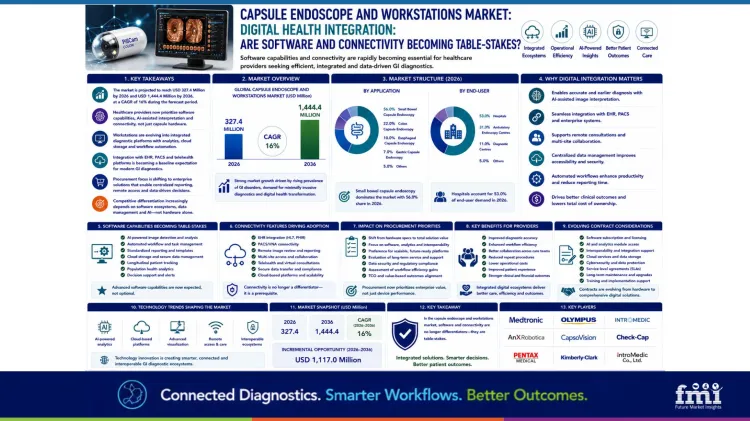
- The capsule endoscope and workstations market size is projected to reach USD 327.4 Million by 2026 and USD 1,444.4 Million by 2036 at a CAGR of 16% during the forecast period Supported by increasing acceptance of digital gastroenterology platforms and minimally invasive diagnostics.
- Increasingly, healthcare providers are considering capsule endoscopy solutions based on software capabilities, AI-assisted image interpretation, and interoperability with enterprise healthcare systems, not just capsule hardware specs.
- Workstations are evolving from basic image review platforms to integrated diagnostic ecosystems that support analytics, cloud storage and longitudinal patient management.
- As hospitals seek to integrate with electronic health records, picture archiving and communication systems, and telehealth platforms, connectivity capabilities are becoming a necessity.
- In procurement, the focus is moving towards enterprise solutions that allow gastroenterology teams to automate workflow, report from a centralized location, and work remotely.
- The competitive edge is increasingly about software ecosystems, data management and integration of artificial intelligence, not imaging devices alone.
Introduction
The digital transformation is changing the world of gastrointestinal diagnostics. Healthcare organizations are increasingly seeking technologies that can improve workflow efficiency, enable data-driven decision-making, and facilitate integrated patient management strategies. In this respect, capsule endoscopy systems are shifting from isolated diagnostic devices to connected components of wider digital health ecosystems.
The market for capsule endoscope and workstations is projected to grow from USD 327.4 Million in 2026 to USD 1,444.4 Million by 2036, at a CAGR of 16%. The market is growing due to the rising prevalence of gastrointestinal diseases, the increasing demand for minimally invasive diagnostic procedures and the increasing investments in healthcare information technologies.
Capsule endoscopy technologies have been primarily assessed in terms of image quality and diagnostic efficacy. But today’s healthcare providers are demanding solutions that include software-enabled analytics, artificial intelligence-assisted interpretation, cloud-based data management, and direct integration with enterprise healthcare infrastructures.
As digital healthcare ecosystems mature, software functionality and connectivity are rapidly becoming table-stakes requirements in the capsule endoscope and workstations market.
Market Context
Gastrointestinal diseases remain a major health care burden worldwide. Diseases such as obscure gastrointestinal bleeding, inflammatory bowel disease, celiac disease and small bowel tumors frequently require complex diagnostic workups and long-term follow-up.
While traditional endoscopic procedures are still an integral part of gastrointestinal diagnostics, they often require sedation, specialized infrastructure and a large amount of procedural resources. Capsule endoscopy technologies offer minimally invasive options that enhance patient comfort and streamline diagnostic processes.
As healthcare providers move to more digital care delivery models, the expectations for diagnostic technologies are changing dramatically.
Hospitals and endoscopy centers are increasingly searching for solutions that can:
- Facilitating real-time information access
- Supporting multidisciplinary collaboration
- Integrating with enterprise healthcare systems
- Enabling remote consultations
- Automating reporting and documentation processes
These evolving expectations are accelerating investments in digitally integrated capsule endoscopy ecosystems.
Thus the market is gradually shifting from a hardware-based competition to a software-based and connectivity-driven value creation.
Software Is Becoming the Core Value Driver
The value proposition of capsule endoscopy technologies is being defined by software functionality.
In the past, workstations were primarily used for image review. Today’s healthcare environments require much broader capabilities.
Healthcare providers increasingly seek software platforms capable of delivering:
- Artificial intelligence-assisted image interpretation
- Automated lesion detection
- Workflow management tools
- Clinical reporting automation
- Longitudinal patient tracking
- Enterprise analytics capabilities
- Decision support functionalities
- Population health insights
Artificial intelligence integration is becoming particularly important.
The large number of images generated by capsule endoscopy may represent a significant interpretative burden for the clinicians. Artificial intelligence algorithms are increasingly used to help identify abnormality, prioritize image review and improve diagnostic efficiency.
The software’s enhanced capabilities also allow for standardized reporting and reduce physician workload.
As healthcare systems are looking for productivity and operational efficiency, software functionality is becoming a key factor in buying decisions.
Connectivity Is Becoming Essential
Connectivity has emerged as another critical market requirement.
Healthcare organizations increasingly require technologies capable of functioning reliably within enterprise information infrastructures. Standalone systems that require manual information transfer and isolated data storage are becoming increasingly difficult to justify.
Connected capsule endoscopy platforms facilitate:
- Electronic health record integration
- Remote image review
- Multi-site collaboration
- Centralized data management
- Teleconsultation capabilities
- Cloud-based information access
- Automated reporting distribution
The ability to connect is especially important for healthcare systems that operate from more than one location. Centralized access to diagnostic information facilitates care coordination and makes specialist consultations easier.
The growth of telemedicine services is further reinforcing the demand for connected diagnostic technologies.
Gastroenterologists are demanding more and more to access patient information and diagnostic images in a secure manner wherever they are. These objectives are supported by connected capsule endoscopy platforms and operational flexibility can be improved.
As healthcare delivery continues to digitize and decentralize, connectivity is emerging as a key element of competitive product portfolios.
Interoperability Is Reshaping Procurement Priorities
Interoperability has become one of the most influential factors shaping procurement decisions.
Healthcare organizations operate increasingly complex information environments comprising electronic health records, picture archiving and communication systems, radiology information systems, enterprise analytics platforms, and telehealth infrastructures.
Capsule endoscopy systems must integrate effectively within these ecosystems to maximize clinical value.
Procurement teams increasingly prioritize solutions capable of:
- Electronic health record interoperability
- Standardized image exchange
- Enterprise reporting integration
- Cloud-based data sharing
- Multi-facility accessibility
- Workflow automation capabilities
- Application programming interface support
Integrated systems improve clinician productivity by embedding diagnostic information within existing workflows and reducing administrative burden.
Healthcare organizations increasingly recognize that fragmented information systems create inefficiencies and limit the value generated by diagnostic technologies.
Consequently, interoperability is becoming a baseline procurement expectation rather than a premium feature.
Workstations Are Becoming Diagnostic Ecosystems
Workstations are undergoing substantial transformation.
Historically, workstations primarily supported image visualization and reporting activities. Today, they increasingly function as comprehensive diagnostic ecosystems.
Modern workstations incorporate:
- Artificial intelligence modules
- Advanced analytics tools
- Cloud-based information management
- Automated reporting functionalities
- Data archiving capabilities
- Collaboration tools
- Longitudinal patient management features
This evolution is fundamentally changing the competitive landscape.
Healthcare providers increasingly view workstation capabilities as equally important as capsule hardware performance.
Manufacturers are therefore investing heavily in software development and digital ecosystem expansion to strengthen competitive positioning.
End-User Insights
Hospitals are still the leading adopters of digitally integrated capsule endoscopy solutions.
Enterprise digital transformation strategies are increasingly being adopted by large healthcare systems that require diagnostic technologies that enable interoperability and centralized information management.
Connected capsule endoscopy platforms streamline workflow efficiency and enable multidisciplinary collaboration between gastroenterologists, surgeons and primary care providers.
Ambulatory endoscopy centers are also investing in digital capabilities to enhance patient experiences and increase productivity.
Academic medical centers are increasingly looking for advanced analytics platforms to support research and complex case management in gastroenterology.
Software integration and connectivity are fast-becoming a critical element in the adoption of technology across all end-user segments.
Procurement and Buyer Behavior
Procurement priorities are evolving rapidly.
Healthcare providers increasingly evaluate capsule endoscopy technologies based on:
- Artificial intelligence capabilities
- Electronic health record integration
- Cloud connectivity
- Cybersecurity protections
- Workflow automation
- Analytics functionality
- Software upgrade pathways
- Long-term digital support services
Capsule endoscopy platforms are becoming part of enterprise information infrastructures, and the role of information technology departments in the purchasing process is increasing.
Healthcare organizations are looking for long-term technology partners to help them with continuous software innovation and digital transformation initiatives.
These changing expectations are changing supplier relationships across the market.
Competitive Implications
The integration of digital health is reshaping competition in the capsule endoscope and workstation market.
Instead of competing on the basis of the performance of capsule hardware alone, manufacturers are increasingly competing on ecosystem capabilities. Companies able to provide integrated software platforms, artificial intelligence capabilities and interoperability support are bolstering competitive positions.
Strategic partnerships between companies developing healthcare information technologies, cloud service providers, and artificial intelligence are becoming increasingly important.
And barriers to entry are rising as it takes significant investment in software engineering, cybersecurity, and regulatory know-how to build secure, scalable, and interoperable digital platforms.
And as the bar for digital expectations rises, software leadership will be a critical differentiator in the market.
Strategic Implications
The capsule endoscope and workstations market is transforming into a digitally integrated diagnostic imaging market in which software functionality and connectivity capabilities are increasingly becoming the basis for value creation.
Healthcare providers are looking for technologies that allow for data-driven decision-making, enterprise integration and effective gastrointestinal management strategies.
As providers’ expectations evolve, manufacturers that stay in a hardware-only innovation mindset will likely find it harder and harder to compete.
Future market leadership will increasingly depend on the ability to deliver integrated digital ecosystems that can improve diagnostic efficiency, support collaborative care delivery, and enable long-term patient management.
Investments in artificial intelligence, cloud infrastructure, interoperability and advanced analytics are therefore becoming essential strategic priorities.
Bottom Line
Software integration and connectivity are quickly becoming table-stakes in the capsule endoscope and workstations market. With further investment in digital transformation and enterprise diagnostic infrastructures, healthcare providers are increasingly making purchasing decisions based on artificial intelligence capabilities, interoperability and ecosystem integration rather than capsule hardware alone. The manufacturers best positioned to bolster competitive positioning and seize long-term growth opportunities in an increasingly connected gastrointestinal care landscape are those that successfully marry minimally invasive diagnostics with scalable digital platforms.

