


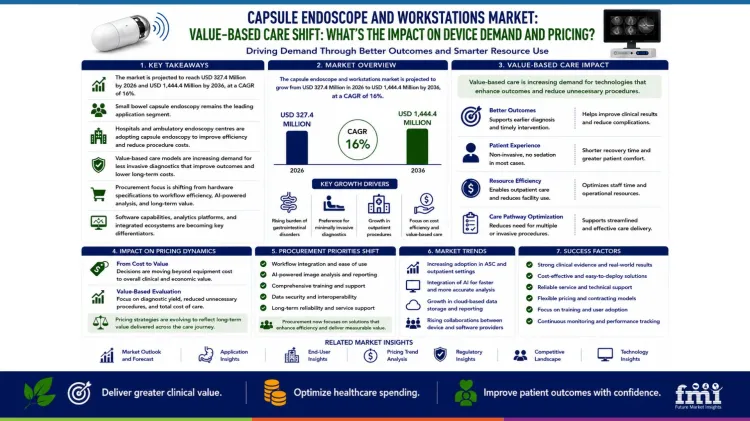
- The capsule endoscope and workstations market is projected to reach USD 327.4 Million by 2026 and USD 1,444.4 Million by 2036, at a CAGR of 16%, driven by increasing demand for minimally invasive gastrointestinal diagnostics and value-based healthcare initiatives.
- The biggest application segment remains small bowel capsule endoscopy, as providers focus more on early detection of disease, fewer procedural complications, and delivery of outpatient care.
- The use of capsule endoscopy technologies is growing in hospitals and ambulatory endoscopy centres because they improve diagnostic efficiency and reduce the use of resources and the cost of procedures.
- Value-based care models are driving demand for technologies that can help eliminate unnecessary invasive procedures, improve the patient experience and allow for earlier clinical intervention.
- Procurement decisions are shifting from hardware evaluation to workflow efficiency, AI-powered image analysis and long-term economic value.
- With hardware specifications for capsules becoming a basic expectation, software capabilities, analytics platforms and integrated diagnostic ecosystems will be more important in setting companies apart from each other.
Introduction
Healthcare systems across the globe are moving to new care models that reward quality outcomes, operational efficiency and long-term cost control. This change is revolutionizing the way diagnostic technologies are assessed and implemented throughout the healthcare systems.
Capsule endoscopy technologies are increasingly being adopted by GI diagnostics to improve patient outcomes and reduce the complexity and resource requirements of procedures. Traditionally, evaluation of the gastrointestinal tract was usually performed with invasive techniques that required sedation, specialized facilities, and significant provider participation. Capsule endoscopy has provided a less invasive alternative and facilitates earlier diagnosis and improved patient experience.
The market for the capsule endoscope and workstation is projected to reach USD 327.4 Million in 2026 and USD 1,444.4 Million in 2036 at a CAGR of 16%. Market growth is increasingly driven by healthcare providers seeking technologies to improve diagnostic accuracy, enable the delivery of outpatient care and align with value-based healthcare objectives.
As healthcare systems place greater emphasis on efficiency and measurable results, capsule endoscopy technologies are transitioning from niche diagnostic tools to strategic resources that enable the delivery of value-based care.
Market Context
Gastrointestinal diseases continue to be a major burden on world health. Many diseases such as inflammatory bowel disease, gastrointestinal bleeding, small bowel tumours and colorectal diseases require extensive diagnostic workup and long-term management.
Conventional endoscopic procedures remain an important part of gastrointestinal diagnostics, but they often require sedation, longer recovery periods, and additional clinical resources compared with capsule endoscopy. But these procedures often require sedation, carry procedural risks, use facility resources, and are more costly to run.
Healthcare providers are increasingly seeking technologies that can reduce these burdens, while still being diagnostically effective.
Capsule endoscopy addresses many of these challenges by providing a non-invasive method of visualising GI structures with minimal disruption to the patient. Its ability to assess patients on an outpatient basis and the increased acceptance by patients means the technology is well positioned to support healthcare systems optimize care delivery.
Value-based care frameworks also promote minimally invasive diagnostic approaches by incentivizing efficient use of resources and improved patient experience.
This is leading to a surge in demand for capsule endoscopy technologies as healthcare providers look to enhance outcomes and cut long-term costs.
Value-Based Care Is Expanding Device Demand
The move to value-based healthcare is creating new demand drivers for capsule endoscopy technologies.
For healthcare organisations, diagnostic pathways are a growing area of focus with earlier intervention and reduction in unnecessary invasive procedures being sought. Capsule endoscopy is better at achieving these goals by improving visualization of hard-to-reach areas of the gastrointestinal tract and reducing procedural complexity.
Small bowel evaluations are a good example of such a value proposition. Common diagnostic approaches often require multiple procedures and heavy utilization of clinical resources. Capsule Endoscopy can increase the effectiveness of diagnosis by providing full visualization with less interferences to the patients and health systems.
Value-based care initiatives are also about patient-centric care. In general, capsule endoscopy techniques improve the patient experience, removing many inconveniences of traditional procedures and decreasing the need for sedation and long recovery times.
Earlier diagnosis and better patient compliance can lead to more effective management of the disease, and therefore lower costs of treatment in the long run.
Healthcare systems are increasingly focusing on preventive intervention and efficient care pathways and the demand for capsule endoscopy technologies is likely to continue to grow.
Impact on Pricing Dynamics
The rise of value-based healthcare is driving new pricing and valuation models for capsule endoscopy technologies.
Historically, the impetus to buy has been related to the cost of equipment and hardware specs. Healthcare today demands technology that delivers measurable clinical and economic value.
Healthcare providers seek solutions capable of:
- Improving diagnostic yield
- Reducing unnecessary invasive procedures
- Supporting outpatient care delivery
- Enhancing patient experiences
- Improving workflow efficiency
- Reducing procedural complications
- Facilitating earlier intervention
- Lowering long-term healthcare expenditures
Technologies that demonstrate tangible gains in these areas are increasingly positioned to command premium pricing.
At the same time, healthcare organizations are being squeezed by tighter budgets and greater accountability for technology investments. Procurement teams are increasingly looking at total cost of ownership and expected economic benefits.
Therefore, it is not surprising that manufacturers are looking at artificial intelligence powered image analysis, workflow automation and integrated software platforms as levers to increase value propositions.
Pricing strategies are moving away from hardware transactions and toward more holistic diagnostic ecosystems that can deliver measurable outcomes and operational efficiencies.
Segment Insights
Among the most significant application segments of the market is small bowel capsule endoscopy.
Historically, the small intestine has been one of the most difficult areas to assess with conventional endoscopic methods. Capsule technologies offer minimally invasive visualization capabilities for earlier diagnosis and more comprehensive evaluations.
Healthcare providers are starting to see the economic value of technologies that can make diagnoses more efficiently and cut the need for repeat procedures.
The increasing incidence of inflammatory bowel diseases and obscure gastrointestinal bleeding is also contributing to the demand for next-generation capsule endoscopy technologies.
Workstations are also expected to be an important segment of the market. Advanced software platforms allow for image management, automated interpretation, and clinical reporting, leading to improved workflow efficiency and decreased physician burden.
With value-based healthcare initiatives increasingly focused on productivity and outcome improvement, integrated workstation capabilities are becoming increasingly important to purchasing decisions.
End-User Insights
The report states that owing to the complexity of gastrointestinal disorders and rising demand for advanced diagnostic services, hospitals are the major adopter of capsule endoscopy technologies.
Many large healthcare systems are adopting capsule endoscopy technologies to broaden diagnostic options and lessen the procedural demands of traditional assessments.
There are also significant growth opportunities in ambulatory endoscopy centres. Value-based care initiatives, which are growing in prominence, are moving care to lower-cost outpatient settings when clinically appropriate.
Capsule endoscopy technologies are well positioned to address these goals as they provide efficient diagnostic workflows and resource minimization.
Academic medical centres continue to invest in sophisticated workstations and analytics platforms that support complex case management and research activities.
Value-based healthcare initiatives are driving the strategic importance of minimally invasive diagnostic technologies across all end-user segments.
Buyer Behaviour and Purchasing
Value-based healthcare systems are dramatically changing procurement strategies.
Healthcare providers are increasingly evaluating capsule endoscopy technologies based on multidimensional criteria rather than on device performance alone.
Purchasing decisions increasingly prioritize:
- Total cost of ownership
- Artificial intelligence-assisted image analysis
- Workflow automation capabilities
- Electronic health record integration
- Reporting functionality
- Data management capabilities
- Scalability and upgrade pathways
- Long-term service support
Active participants in purchasing decisions are clinical leaders, information technology departments and financial stakeholders.
Healthcare organizations are increasingly seeking technology partners that can support long-term digital transformation initiatives and integrated gastrointestinal management strategies.
These changing expectations of procurement are reshaping the competitive landscape across the market.
Competitive Implications
Capsule Endoscope and Workstations Market Altering Competitive Landscape Due to Value Based Care
Competition among manufacturers is increasingly focused on improving diagnostic efficiency and delivering measurable clinical and economic value.
Image analytics platforms, artificial intelligence capabilities and workflow integration tools are becoming a key source of competitive differentiation.
Companies that can integrate capsule technologies with advanced workstations and enterprise information systems are consolidating market positions.
As manufacturers seek to enhance platform capabilities, strategic partnerships between healthcare information technology providers and artificial intelligence companies are becoming increasingly critical.
Competing means you must prove that you can do things better and more efficiently, not just on the hardware side.
Strategic Implications
With the shift to value-based care, capsule endoscopy technologies are evolving from niche diagnostic tools to strategic assets that fuel efficient and patient-centred care in the gastrointestinal space.
Medical providers are seeking technologies that can improve diagnostic accuracy, decrease procedural burden, and provide cost-effective care.
Manufacturers that tailor their product development strategies to value-based care priorities such as analytics, interoperability, workflow automation and patient experience enhancement will be best positioned to leverage future growth opportunities.
As healthcare systems increasingly focus on early diagnosis and resource optimization, capsule endoscopy technologies are set to play increasingly important roles in gastrointestinal diagnostic pathways.
Bottom Line
Value-based care is fundamentally transforming the capsule endoscope and workstations market, linking technology adoption to better diagnostic efficiency, improved patient experiences and longer-term cost savings in healthcare. Today, procurement decisions are driven more by the ability to measure economic value, software features and workflow efficiency than hardware specs. Manufacturers that can show compelling clinical and operational benefits of integrated, outcomes-based diagnostic ecosystems will be best positioned to take advantage of the market's move toward value-based delivery of gastrointestinal care.

