


- Pet milk replacer demand is shaped by caregiver ecosystems, not only by pet ownership growth.
- Shelters, breeders, veterinary clinics, rescues, and pet parents each buy with different urgency, pack-size needs, trust signals, and price sensitivity.
- FMI’s Pet Milk Replacers Market shows that cat milk replacers lead by pet type, which makes shelter, rescue, and kitten-care channels especially important.
- Developed markets tend to reward veterinary trust, breeder protocols, shelter relationships, and premium neonatal care; emerging markets depend more on modern retail access and pet-care education.
- Online channels can help emergency access, but milk replacer still needs professional credibility and clear instructions to avoid misuse.
- The misconception to avoid is that pet milk replacer demand follows general pet food retail behavior. It follows neonatal care needs and channel trust.
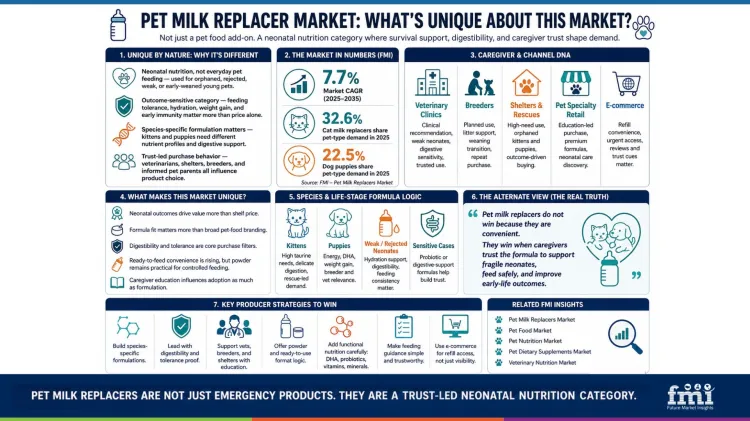
Pet milk replacers are often placed inside the broader pet food and pet care universe, but their demand pattern is different. This is not a category driven only by everyday consumption or flavor preference. It is shaped by caregiver ecosystems: shelters, breeders, veterinarians, rescue groups, pet specialty retailers, online platforms, and first-time pet parents facing urgent neonatal feeding needs.
FMI’s Pet Milk Replacers Market identifies cat milk replacers as the leading pet-type segment and dog puppy milk replacers as another important segment. The segment structure points to a market where neonatal care situations, especially kitten and puppy feeding, define demand. This makes channel behavior more important than normal shelf visibility. Buyers often need the product quickly, but they also need confidence that it is appropriate and safe.
Shelters and rescue organizations are among the most important demand influencers, especially for kittens. Orphaned kittens, abandoned litters, and weak neonatal animals often require immediate feeding support. Shelters need products that are reliable, economical, easy to prepare, and suitable for repeated use by different caregivers. Volunteer turnover can be high, so instruction clarity matters. A shelter-friendly product is not only nutritionally sound; it is operationally easy to use.
Breeders have a different purchase logic. They may use milk replacers to support large litters, supplement weak puppies or kittens, or manage cases where maternal milk is insufficient. Breeders tend to value repeatable results, pack availability, trusted supply, and species-specific performance. They may also influence brand reputation through professional networks. A product that performs consistently across litters can gain strong word-of-mouth within breeder communities.
Veterinary clinics represent a trust channel. Clinics may recommend milk replacers during neonatal care, emergency feeding, or post-whelping and post-queening complications. The Veterinary Therapeutic Diet Market is a useful adjacent reference because it shows how professional recommendation can shape animal nutrition purchases. Pet milk replacers are not therapeutic diets, but the trust pathway is similar: the buyer accepts guidance when the animal’s health situation is sensitive.
Pet parents are a more mixed group. Some are experienced owners who understand neonatal feeding. Others are first-time caregivers dealing with an urgent situation. These buyers need simple directions, smaller pack options, visible species labeling, and reassurance. They may discover products through search, online retail, pet stores, veterinarians, or rescue advice. For this group, the pack and product page must explain the use case quickly.
The Pet Care Market helps explain why specialized products are gaining relevance. Pet owners increasingly view companion animals through a care and wellness lens, not only a feeding lens. This supports willingness to spend on products that appear safer, more specialized, and more professionally credible. However, milk replacer demand remains episodic. A household may buy the product only during a specific neonatal need, so channel presence and trust timing are critical.
Regional maturity changes the channel mix. In North America, Western Europe, Japan, and Australia, pet specialty stores, veterinary clinics, online retail, shelters, and breeder networks create a more developed recommendation environment. Buyers are more likely to recognize milk replacers as a standard neonatal care product. They may also expect detailed feeding instructions, quality certification, and professional-style positioning.
In emerging pet care markets, growth may be faster but more education-dependent. Urban pet ownership, pet humanization, and online retail can expand access, but category understanding may be uneven. Some buyers may not know when to use a milk replacer, how to prepare it, or why cow milk is not an appropriate substitute for newborn pets. In these markets, education and retailer guidance can matter as much as product availability.
The Pet Market is relevant because it captures the wider shift toward premium care participation across households. Yet pet milk replacer demand does not scale simply with the total number of pets. It scales with neonatal events, breeder activity, rescue volumes, shelter practices, veterinary recommendation, and caregiver awareness. This makes the market smaller but more specialized than broad pet food categories.
Online retail creates both opportunity and risk. It can improve access when a product is not available locally, and it can help caregivers compare formulas quickly. But urgent neonatal feeding needs do not always tolerate delivery delays. A product found online may still need immediate availability through pet specialty stores, clinics, or local retailers. Online content must also be accurate because misuse can create serious feeding problems. In this category, digital availability should support care guidance, not replace it.
The Pet Food Market shows how retail formats and pet-type segmentation shape broader pet nutrition, but milk replacers require a different channel strategy. Mainstream pet food can win through recurring purchase, flavor variety, and brand loyalty. Milk replacers win through credibility at the moment of need. Retailers and brands should therefore prioritize searchability, emergency availability, and clear instructions over broad lifestyle positioning.
Functional and supplement-led adjacencies also influence channel trust. The Functional Pet Ingredients Market and Pet Dietary Supplement Market show how pet nutrition is moving toward more specialized health-support claims. For milk replacers, this creates room for digestive, immune, and growth-support positioning, but only when the claim is linked to neonatal use and professional credibility.
For suppliers, channel strategy should be segmented. Shelter and rescue channels need bulk efficiency, training materials, and reliable availability. Breeders need predictable performance and larger formats. Veterinary channels need documentation and product confidence. Pet specialty retailers need clear merchandising and staff education. Online platforms need accurate product pages, species-specific keywords, and urgent-use guidance. Treating all channels the same weakens conversion.
Regional strategy should also reflect product availability and timing. In mature pet-care markets, the challenge is often differentiation among established brands. In developing urban markets, the larger challenge may be category education, retail availability, and caregiver awareness. A premium formula cannot scale if buyers do not know when to use it or cannot access it quickly during a neonatal feeding emergency.
The strongest channel programs therefore combine professional credibility with practical access. A brand should be easy to find in pet specialty retail, credible enough for veterinary recommendation, visible in online search, and understandable for shelter and rescue users. This integrated channel approach is more relevant than a broad consumer campaign because the purchase is highly situation-specific.
The misconception to avoid is that pet milk replacer demand follows normal pet food retail behavior. It does not. The product is purchased during a specific care event, often under time pressure, and often with advice from a breeder, vet, shelter, or online source. This makes trust and channel education more important than broad awareness.
Bottom line: pet milk replacers grow where the caregiver ecosystem is developed enough to recognize neonatal feeding risk and guide buyers toward the right product. The winners will be brands that build trust across shelters, breeders, vets, retailers, and pet parents rather than relying only on pet food shelf presence.

