


- China is one of the fastest growing markets for engine driven endodontic files, due to the development of dental infrastructure and growing awareness of oral health care.
- Local manufacturers fight on price, but the bigger international brands still compete on product quality and clinical validation.
- Nitinol root canal files are anticipated to represent 70.0% of the total global market demand, indicating a strong inclination towards high-performance materials.
- Hospitals are anticipated to hold 50.0% share in the global market creating opportunities for suppliers catering institutional procurement needs.
- The global engine driven endodontic file market is projected to grow from USD 364.5 Million in 2026 to USD 544.7 Million by 2036. Asia is expected to be a major contributor to the growth of the global engine driven endodontic file market in the coming years.
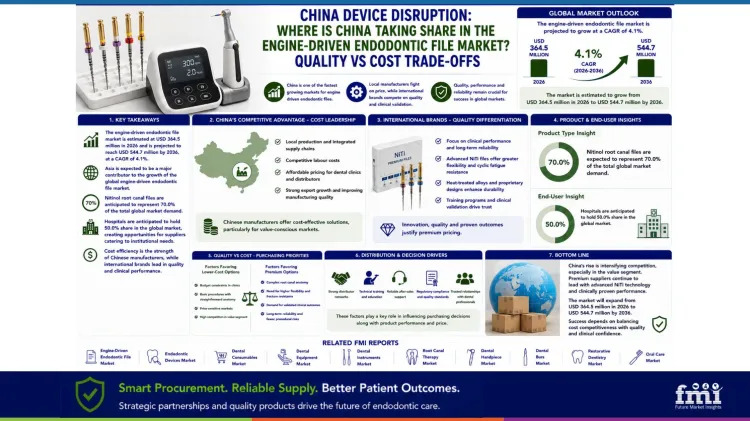
China is emerging as a key player within the engine-driven endodontic file market with continued investment in dental infrastructure, local manufacturing capabilities and access to oral healthcare. Its growing presence is reshaping the competitive environment of regional and global markets.
The Engine-Driven Endodontic File Market is estimated at USD 364.5 Million in 2026 and is projected to reach USD 544.7 Million by 2036 with Asian markets accounting for a larger share of the overall demand.
The Chinese manufacturers’ key competitive advantage is cost efficiency. Domestic manufacturers can supply engine-driven endodontic files at a lower price than many imported alternatives due to local production, integrated supply chains and competitive labor costs. This pricing strategy is attractive for low-cost dental clinics and distributors in developing markets.
By contrast, international manufacturers compete mainly on product quality, clinical performance, and long-term reliability. High-end NiTi file systems focus on increasing flexibility, cyclic fatigue resistance and validated manufacturing techniques to improve the predictability of clinical outcomes.
The estimated market share of 70.0% for nitinol root canal files underscores the continued importance of advanced materials performance to practitioners. Flexibility and resistance to fracture are still important purchasing criteria that can trump price alone when it comes to procedures with complex root canal anatomy.
Hospitals are another important area of competition. Institutional Buyers 50.0% of Demand in Market in addition to purchase price, institutional customers usually have other purchasing criteria that products must meet including regulatory compliance, documented quality standards, supplier reputation and long-term reliability.
Chinese suppliers have ramped up their export activity and continued to improve the quality of their manufacturing. In several regional markets, competition with multinational brands is becoming more even as regulatory standards tighten and production capabilities mature.
For global manufacturers, the issue of staying differentiated is becoming less about competing on price and more about innovation. The heat-treated alloys, proprietary cross-section designs, increased cutting efficiency and training programs for clinicians may warrant premium pricing.
The distributors are also of great importance in this competitive environment. Technical characteristics of the files, dependable after-sales support, educational programs and established relationships with dental professionals can impact purchase decisions.
The quality vs. cost debate is becoming more nuanced. Cheaper pricing will allow for broader market penetration. The clinical performance is still of highest importance for specialists working under demanding endodontic conditions.
Bottom Line
China’s rising manufacturing capabilities are intensifying competition in the engine-driven endodontic file market, particularly in value segments. Premium suppliers, by contrast, continue to benefit from strong demand for validated NiTi technologies and clinically proven performance. The market will expand from USD 364.5 Million in 2026 to USD 544.7 Million by 2036, with success hinging on balancing cost competitiveness, product quality, and clinical confidence.

