


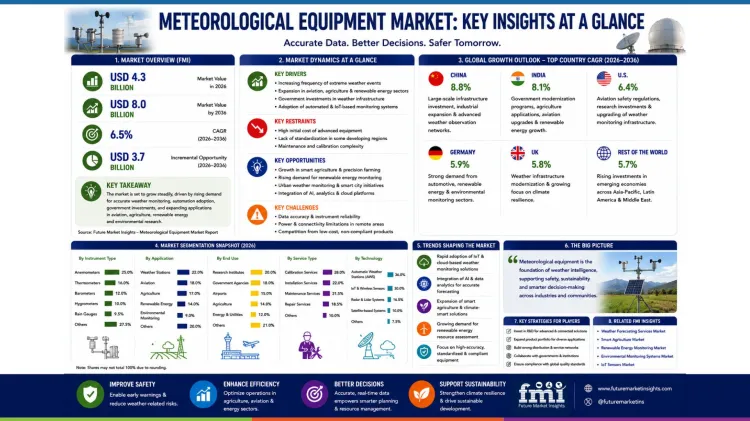
- China leads FMI's country outlook with an 8.8% CAGR through 2036, ahead of India at 8.1%.
- China offers greater scale in observation infrastructure, domestic manufacturing, industrial capacity, and high-volume procurement.
- India offers a strong market-entry case through institutional modernization, expanding distribution, healthcare and industrial investment, weather-risk management, and agricultural applications.
- China's government reported more than 90,000 ground-based automatic meteorological observation stations in its national observation network.
- India's opportunity is likely to be more fragmented but accessible through public procurement, regional distribution, smart agriculture, aviation systems, renewable energy, and climate-resilience programmes.
- The better market depends on supplier capability. China appears stronger for scale and local manufacturing integration, while India appears attractive for flexible, cost-effective, service-led growth.
China and India are the two key growing country markets in FMI's meteorological equipment outlook. Both are expanding institutional procurement. Both are industrialising and modernising weather infrastructure. Both face climate variability, urbanisation, agricultural exposure, infrastructure development, and rising demand for local environmental data.
The difference lies in how demand is likely to be created.
China holds the larger industrial and observation-network scale. India holds a more distributed modernization opportunity that may create room for cost-effective suppliers, system integrators, local distributors, and application-specific equipment providers.
FMI projects China's meteorological equipment market to grow at 8.8% CAGR through 2036, while India is projected at 8.1%. The broader global market is expected to expand at 6.5% CAGR, from USD 4.3 billion in 2026 to USD 8.0 billion by 2036. China and India are therefore both outgrowing the global market, and China holds the numerical growth-rate lead in FMI's published forecast.
This does not automatically make China the better market for every supplier.
China's advantage begins with scale. The Chinese government's 2025 climate action report states that the country had established more than 90,000 ground-based automatic meteorological observation stations, alongside national climate observatories and atmospheric background stations. This is a very large installed base of automatic observation infrastructure.
A large network creates demand in several ways. It supports initial equipment procurement, and it also creates recurring needs for replacement sensors, calibration, communications hardware, data loggers, wind instruments, rain gauges, visibility systems, telemetry upgrades, maintenance, and software integration. A country with a broad installed base does not only buy new stations. It also needs to sustain them.
China's scale is reinforced by manufacturing and policy capacity. FMI attributes China's 8.8% CAGR to large-scale manufacturing capacity, infrastructure investment, government procurement programmes, industrial modernisation, and tightening quality compliance requirements. The report also points to supply-chain concentration and domestic cost advantages.
For meteorological equipment suppliers, this carries two implications.
First, China can support large contracts. National, provincial, municipal, industrial, transport, renewable energy, agricultural, and environmental monitoring programmes can require significant equipment volumes. Suppliers capable of delivering at scale may find strong opportunity in weather stations, anemometers, sensors, telemetry platforms, and industrial monitoring equipment.
Second, China can prove difficult for foreign suppliers to enter through standard products. Local manufacturers can compete on price, delivery time, localisation, certification support, and public procurement relationships. A foreign supplier offering generic weather sensors without clear performance differentiation may face intense competition.
The strongest entry path into China is likely to involve one of four positions.
One is high-performance instrumentation. Advanced wind sensors, precision radiation systems, visibility instruments, aviation weather systems, research-grade equipment, and calibration-sensitive devices can create room for specialist suppliers.
The second is application expertise. Suppliers that understand wind-energy assessment, airport weather systems, semiconductor manufacturing environments, industrial safety, marine monitoring, or high-end research applications may compete more effectively than those selling broad commodity portfolios.
The third is local partnership. Domestic distribution, manufacturing alliances, system-integrator partnerships, and local service capability can reduce entry friction.
The fourth is data integration. A supplier that combines instruments with analytics, cloud platforms, quality control, and remote asset management can create more value than a hardware-only competitor.
China's smart agriculture development adds a further layer. Chinese official information in 2026 describes smart farming systems that connect agricultural machinery with on-site weather stations and pest and disease monitoring equipment. This suggests that agricultural weather monitoring is becoming part of broader farm digitisation rather than an isolated hardware category.
India presents a different opportunity structure.
FMI projects India at 8.1% CAGR through 2036 and links growth to institutional procurement, government-led modernization, healthcare infrastructure investment, expanding industrial capacity, and organised distribution networks. The report highlights improving product accessibility across tier-2 and tier-3 markets as a supporting factor.
India's market may be less concentrated than China's, and that can create openings for suppliers that are agile and locally responsive. Demand may come through multiple channels, including state meteorological programmes, agricultural advisory systems, airports, smart-city initiatives, flood monitoring, industrial facilities, renewable energy projects, universities, research institutes, environmental studies, and private weather-data providers.
The India Meteorological Department provides a useful example of this distributed model. IMD states that dense AWS and automatic rain-gauge networks are being used in major urban cities for real-time rainfall monitoring, rainfall-intensity reporting, nowcasting, and urban-flood warnings. It also notes that network expansion is continuing into more cities.
This creates opportunity not only for full weather stations, but also for rain gauges, telemetry systems, data loggers, urban sensors, forecasting interfaces, and service support. The market may be built through several smaller procurement programmes rather than only a limited number of large national contracts.
India's aviation modernisation also creates targeted demand. ICAO material states that IMD has initiated integrated AWOS installations, including runway visual range systems, at 18 airports with more than 500 weekly flights. These systems monitor wind, temperature, pressure, humidity, cloud cover, and runway visibility conditions.
The airport opportunity in India may prove especially relevant for suppliers of high-specification instruments, communications systems, aviation-grade anemometers, ceilometers, transmissometers, and integrated weather platforms. Such projects tend to carry higher technical barriers than general weather-station procurement.
Renewable energy adds another market pathway. India's renewable energy programmes rely on solar radiation and wind-speed resource data for project planning. MNRE states that solar radiation and wind-speed resource maps are being made available in coordination with the National Institute of Wind Energy and BISAG-N.
This does not mean every renewable project will buy a full meteorological station from the same supplier. It does indicate that site-specific weather and resource data are becoming more valuable across wind, solar, hybrid, storage, and green-hydrogen development. India's renewable buildout can therefore create demand for anemometers, wind vanes, radiation sensors, temperature instruments, data loggers, and remote monitoring platforms.
The supplier economics differ sharply between China and India.
China may offer higher absolute opportunity for companies that can manage scale, local competition, manufacturing partnerships, and high-volume procurement. Domestic supply-chain strength can reduce the attractiveness of imported mid-tier products. The market is likely to favour suppliers with local assembly, certified quality, application specialization, or strong public-sector relationships.
India may offer lower scale per individual contract but more varied demand channels. A supplier can participate through government procurement, agricultural distribution, research institutions, airports, renewable developers, industrial clusters, and private monitoring services. The market may reward flexibility, price-performance balance, rugged equipment, service availability, and local channel partnerships.
Another difference is the role of distribution. FMI describes China's demand as supported by supply-chain concentration and formalised procurement. India's growth is linked to expanding organised distribution and improved accessibility across smaller cities.
That distinction affects go-to-market strategy.
In China, a supplier may need large-account sales, public tender capability, domestic manufacturing, and integration with local standards. In India, a supplier may need a broader channel model that includes system integrators, scientific-equipment distributors, agricultural technology partners, renewable engineering firms, and regional service networks.
China's large observation network also creates a mature replacement market. With more than 90,000 automatic ground stations, a portion of future demand will come from upgrades, calibration, communication refreshes, sensor replacement, and data-platform modernization. India's opportunity is likely to include more first-time deployments in emerging urban, agricultural, industrial, and regional monitoring programmes, alongside upgrades to existing IMD and institutional infrastructure.
There is also a quality question. FMI notes that procurement is shifting toward specification-compliant products, and that tighter quality standards favour certified suppliers. This applies to both markets. Low-cost sensors may grow quickly in distributed applications, but public forecasting, aviation, research, industrial safety, and renewable resource assessment require stronger evidence of accuracy and reliability.
For suppliers, the most useful market segmentation is not simply China versus India. It runs as follows:
- China for scale-led, institutional, industrial, and locally integrated demand
- India for distributed modernization, agriculture, urban monitoring, aviation expansion, renewable projects, and channel-driven growth
A supplier with advanced wind, visibility, aviation, and research instruments may find China attractive through premium project opportunities and local partnerships. A supplier with modular AWS platforms, rugged field sensors, cloud dashboards, and cost-effective service models may find India especially attractive.
The forecasts provide a straightforward headline. China's 8.8% CAGR is higher than India's 8.1%. The commercial interpretation is more nuanced.
China offers the stronger growth-rate signal and the larger observation-network scale. India may offer a more open and fragmented opportunity structure, particularly for suppliers able to build local distribution, offer affordable connected monitoring, and participate in climate, agriculture, airport, renewable, and urban-resilience programmes.
The better market is therefore not determined only by CAGR. China appears stronger for scale and industrial integration. India appears strong for flexible expansion and distributed use cases. The suppliers most likely to succeed will be those that match their product architecture and service model to the procurement realities of each country.

