


- Malt beverages are moving from traditional malt-led drinks toward functional, occasion-led, and moderation-friendly refreshment formats.
- Energy drinks lead product type demand because malt-linked portfolios are increasingly being positioned around stimulation, repeat consumption, and high-velocity retail occasions.
- Clean-label premium in malt beverages is not only about natural ingredients. It is about clearer use cases: energy, wellness, lighter social drinking, alcohol-adjacent occasions, and flavor-led refreshment.
- Individual buyers dominate buyer-type revenue because household penetration and repeat retail purchase are central to category expansion.
- Conventional offerings still anchor category scale, which means premiumization must work without losing broad price access.
- The biggest misconception is that malt beverages grow only as beer-adjacent products. The stronger story is functional refreshment, moderation, and flavor-led occasion expansion.
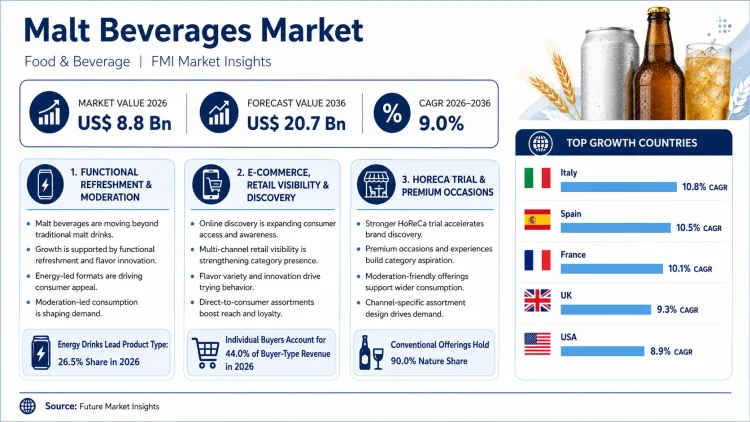
The Malt Beverage Market is increasingly moving away from a narrow traditional malt-drink identity. FMI states that the market is expected to rise from USD 8.8 Bn in 2026 to USD 20.7 Bn by 2036, registering a 9.0% CAGR during the forecast period. This growth is being shaped by demand diversification across energy-led, health-oriented, and alcoholic malt-based lines.
The story of premiumization via clean labeling in malt beverages is unique from the clean labeling story for snack and bakery products. Premiumization in the malt beverage category involves functionality, refreshment, moderation of consumption, flavoring, and occasioning consumption. Consumers aren’t just concerned about whether the malt beverage has a clean label or not; consumers want to know if that beverage satisfies an energy requirement, social situation, wellness preference, or moderate alcohol intake.
FMI identifies energy drinks as the leading product type with 26.5% share in 2026. This is important because it shows that malt beverages are being pulled toward high-velocity stimulation and functional beverage occasions. Consumers increasingly want drinks that deliver refreshment plus a functional cue, whether that cue is energy, vitality, nutrition, hydration, or a lighter alternative to traditional alcohol-led occasions.
The Functional Beverages Market is highly relevant here because malt beverages are increasingly evaluated against broader functional refreshment behavior. A malt beverage brand may compete not only with beer or non-alcoholic malt drinks, but also with energy drinks, RTD wellness beverages, botanical drinks, low-alcohol formats, and flavor-led refreshment products.
Moderation is another important avenue for premiumization. According to FMI, consumption driven by moderation is set to boost interest in alcohol-related and low alcohol malt beverages. This is important since consumers do not necessarily shun social drinking occasions but are now turning to low alcohol, alcohol free, or alcohol related beverages that still seem grown-up and flavorable.
The Non-Alcoholic Malt Beverages Market is relevant when discussing this moderation-led shift. Malt can provide body, cereal depth, sweetness, and a beverage base that supports adult refreshment without relying fully on alcohol content. This gives brands a way to serve social occasions while aligning with wellness and moderation trends.
Individual buyers are projected to account for 44.0% of buyer-type revenue in 2026. This indicates that household penetration and repeat personal consumption are central to market growth. Malt beverage premiumization must therefore work at the individual-consumer level. A brand cannot rely only on institutional buyers, bars, or restaurants. It must win routine retail occasions and personal repeat purchase.
The Energy Drinks Market is useful because energy-led malt beverages must compete in a category where consumers expect strong flavor, quick recognition, pack accessibility, and repeat cadence. Energy drinks do not grow only through functional claims; they grow through habit, visibility, price ladder, and strong brand identity. Malt beverages moving into this space must follow the same discipline.
FMI also states that conventional offerings dominate with 90.0% nature share. This prevents overstatement of organic or niche premium claims. Organic malt beverages may help create a brand halo, but mainstream growth still depends on conventional products with broad price coverage, strong distribution, and high SKU throughput. Clean-label premium must therefore be commercially practical, not boutique-only.
The Organic Beverages Market is relevant for premium positioning, but it should not be treated as the center of the market. Organic and cleaner-label lines can support premium stories, yet the volume engine remains conventional offerings that can scale across retail, direct, HoReCa, liquor stores, specialty stores, and e-commerce.
Another critical element is flavor innovation. Flavor innovation will increasingly be seen in malt beverages as brands revitalize their high-velocity SKUs. This is important because the product positioning of the brand on its own is insufficient. It must taste good, provide refreshment, and appeal to an appropriate situation for repeated consumption. There are many flavors, including citrus, berry, botanical, tropical, coffee, chocolate, caramel, and cereal, which can provide different paths for consumers to try the drink.
The potential for a premium position will be greatest in those brands which combine all four elements: an identifiable consumer occasion, an identifiable malt base, a functional/moderation element, and disciplined pack-price architecture. A premium-priced malt beverage lacking a clearly defined consumer job will suffer from a low potential for repeat consumption. A functional malt beverage lacking taste appeal will run the risk of a trial purchase and then failure.
The misconception to avoid is that malt beverages grow mainly because consumers want malt taste. Malt taste matters, but it is not enough. The market is expanding because brands are using malt as a platform for refreshment, energy, health orientation, and alcohol-adjacent occasions.
Bottom line: Malt beverages can command premium value when functional refreshment, moderation-led positioning, flavor quality, and accessible price ladders work together. The strongest brands will make malt feel relevant to modern beverage occasions without losing mainstream repeat purchase.
FMI Related Links
- Malt Beverage Market: Primary link for market value, CAGR, energy drinks share, buyer-type share, conventional share, and moderation-led positioning
- Functional Beverages Market: Use when discussing functional refreshment, fortified formulations, and wellness-oriented beverage demand
- Energy Drinks Market: Use when discussing stimulation-led consumption, active lifestyles, and repeat-purchase beverage occasions
- Non-Alcoholic Malt Beverages Market: Use when discussing moderation-led drinking, alcohol-adjacent alternatives, and malt-based refreshment
- Organic Beverages Market: Use when discussing organic ingredients, clean-label positioning, and premium beverage trends
- Non-Alcoholic RTD Beverages Market: Use when discussing ready-to-drink formats, convenience, and on-the-go refreshment occasions

