


- Clean-label claims can support premium pricing in native collagen, but only when intact structure, source traceability, and technical documentation are already strong.
- Buyers are willing to pay more for source-verified, marine, non-bovine, non-porcine, halal, kosher, pharmaceutical-grade, and low-temperature processed native collagen, but verified public data does not show one universal native collagen clean-label premium.
- The strongest premium opportunity sits in marine native collagen, undenatured type II collagen, pharmaceutical-grade matrices, wound care, tissue engineering, laboratory-grade products, and premium nutraceutical formats.
- Clean label is more valuable in native collagen when it reduces buyer risk: origin doubts, animal-source concerns, denaturation risk, heavy-metal concerns, regulatory delays, and documentation gaps.
- The biggest risk is treating clean label as a marketing claim only. In native collagen, buyers pay for proof, not language.
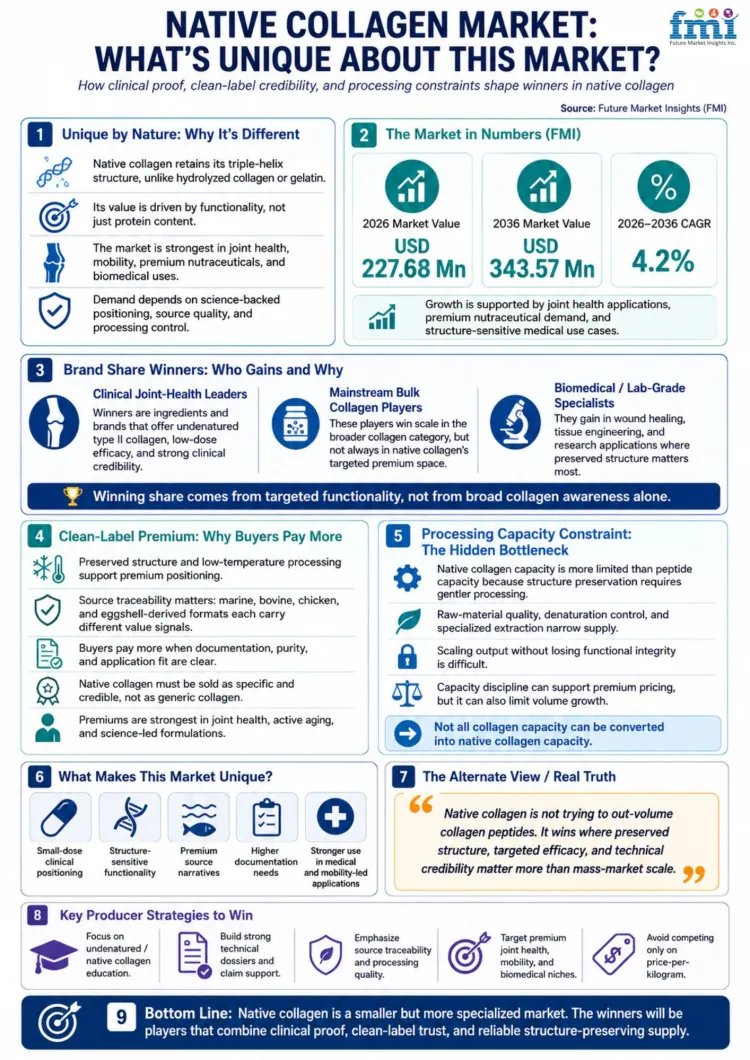
Native collagen has a clean-label opportunity, but it is not the same clean-label story seen in snacks, beverages, or plant-based foods. In native collagen, the premium does not come only from saying “natural,” “clean,” or “sustainable.” It comes from proving that the ingredient is source-verified, structurally intact, carefully processed, and suitable for the specific application where it will be used.
FMI’s Native Collagen Market shows why this matters. FMI estimates the market at USD 227.68 million in 2026 and USD 343.57 million by 2036, reflecting a 4.2% CAGR. The report defines native collagen as commercially purified collagen proteins that retain intact triple-helix quaternary structure, sourced from bovine, porcine, poultry, marine, and other biological sources. FMI also excludes hydrolyzed collagen peptides, collagen hydrolysates, gelatin, recombinant human collagen, and plant-based collagen-boosting botanical extracts from the native collagen scope. This separation is important because clean-label premium in native collagen is tied to structure and source integrity, not just collagen association.
The first premium layer is source transparency. Native collagen buyers increasingly want to know whether the ingredient is marine, bovine, poultry, porcine, or another source. This is not a small procurement detail. Source affects dietary acceptability, regional suitability, religious certification, allergen review, sustainability claims, traceability documents, and formulation positioning. FMI expects marine to lead the source segment with 18.5% share in 2026, supported by demand for non-bovine and non-porcine collagen options.
Marine native collagen can command stronger clean-label interest because it offers a more acceptable story for some premium supplement, beauty, and wellness buyers. Fish skin and scale sourcing can be positioned around by-product utilization and non-mammalian origin. However, the premium is only defensible when suppliers can manage odor, impurities, heavy-metal expectations, species documentation, quality consistency, and processing controls. A marine claim without documentation does not create lasting value.
The second premium layer is processing credibility. Native collagen must retain its structure, so buyers care about extraction, temperature control, denaturation risk, purification route, drying method, and batch handling. A supplier that can show how the collagen remains native has a stronger premium case than a supplier that only lists collagen type. In this market, “less processed” is not automatically better. Controlled processing is better when it protects native structure and supports application performance.
The third premium layer is application grade. Pharmaceutical and healthcare buyers are likely to pay more when native collagen is supported by stronger quality records, because wound dressings, collagen membranes, collagen sponges, tissue engineering scaffolds, and injectable aesthetic formulations carry higher performance and compliance expectations. In these applications, the buyer is not paying for a clean label in the retail sense. The buyer is paying for lower qualification risk, better specification control, and fewer regulatory or technical delays.
The nutraceutical premium works differently. In supplements, native collagen must be explained clearly because consumers already know collagen peptides better. Premium positioning is strongest when the product links native structure to joint health, cartilage support, active aging, sports mobility, women’s mobility, or daily connective tissue support. Clean label strengthens the story when it adds source clarity, certification, non-bovine or non-porcine positioning, and transparent origin. It weakens when it becomes generic language that could apply to any collagen powder.
The comparison with collagen peptides is useful. FMI’s Collagen Peptide Market is projected to grow from USD 2.8 billion in 2026 to USD 7.0 billion by 2036 at a 9.7% CAGR, while the Collagen Hydrolysates Market is projected to reach USD 3.0 billion by 2036. These categories have much larger scale and stronger mainstream consumer familiarity. Native collagen therefore should not try to win the clean-label conversation by behaving like peptides. It should win by proving why structure, grade, and source specificity matter.
The clean-label premium can fail when the product is used in cost-sensitive food and beverage formats where collagen is treated mainly as a protein or wellness add-on. It can also fail when brands use “native collagen” without explaining how it differs from gelatin, hydrolysates, or collagen peptides. Buyers may pay more for clarity, but they are unlikely to keep paying more for confusion.
The misconception to avoid is that clean label alone creates premium pricing in native collagen. Clean label creates permission to charge more. Structure retention, source verification, certifications, quality records, and application fit defend the premium after purchase.
Bottom line: the strongest clean-label premium in native collagen will not come from the cleanest wording. It will come from the clearest proof: verified source, protected structure, credible grade, and documentation strong enough to satisfy nutraceutical, healthcare, pharmaceutical, cosmetic, and laboratory buyers.
FMI Related Reports
- Native Collagen Market: Primary interlink in introduction and conclusion
- Collagen Supplement Market: Use when comparing native collagen with mainstream supplement formats
- Collagen Peptide Market: Use when discussing peptide scale and consumer awareness competition
- Collagen Hydrolysates Market: Use when explaining why hydrolyzed collagen is a separate high-volume category
- Marine Collagen Market: Use when discussing marine source differentiation and non-bovine positioning
- Nutraceuticals Market: Use when linking native collagen to joint health, active aging, and supplement demand

