


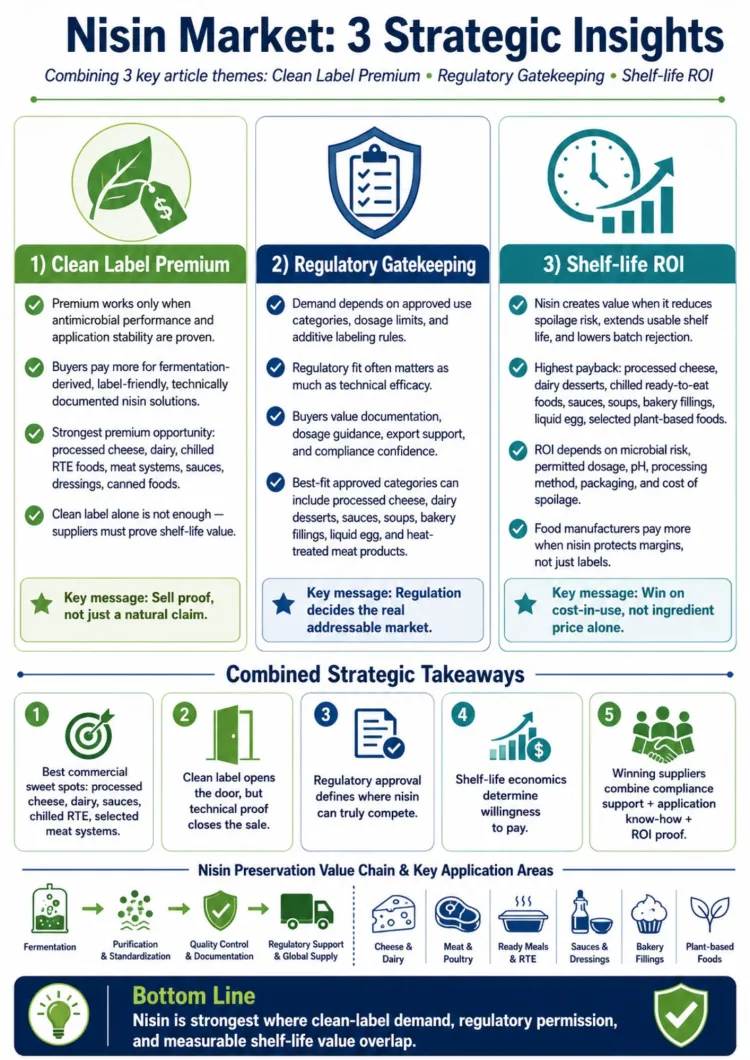
- Clean-label positioning can support premium pricing in nisin, but only when antimicrobial performance, regulatory fit, and application stability are already proven.
- Food manufacturers are willing to pay more for fermentation-derived, label-friendly, low-dosage, heat-stable, and technically documented nisin solutions, but verified public data does not show one universal clean-label premium for nisin.
- The strongest premium opportunity sits in processed cheese, dairy, chilled ready-to-eat foods, meat systems, sauces, dressings, canned foods, and premium clean-label formulations where spoilage risk is costly.
- Nisin is not a simple "natural preservative" story. Its value depends on dosage permission, finished-product pH, heat process, target organism, formulation compatibility, and regulatory acceptance in the selling market.
- The biggest mistake suppliers can make is selling nisin only as a natural ingredient. Buyers pay more when nisin is positioned as a shelf-life protection system that reduces batch risk, supports cleaner labels, and protects product quality.
Clean-label preservation is becoming one of the most important growth themes in the Nisin Market. Food manufacturers are under pressure to reduce synthetic preservatives, simplify ingredient decks, extend shelf life, and maintain food safety across chilled, processed, and export-oriented products. In this environment, nisin occupies a valuable position because it is fermentation-derived, used at low inclusion levels, and recognized as an antimicrobial preservative in selected food applications.
According to Future Market Insights, the Nisin Market is expected to benefit from rising demand for natural antimicrobial systems, clean-label food preservation, and shelf-life extension across dairy, processed cheese, meat, ready-to-eat meals, sauces, and heat-processed foods. However, the commercial opportunity is not evenly distributed across all food categories. Nisin earns its strongest premium where the cost of spoilage, microbial failure, product recall, or short shelf life is higher than the incremental cost of the ingredient.
That is why the real question is not whether buyers like clean-label nisin. The better question is: how much more will food manufacturers pay when nisin solves a technical preservation problem that synthetic preservatives previously handled?
Clean Label Is the Entry Point, Not the Whole Value Proposition
Nisin benefits from the broader movement toward recognizable, fermentation-derived, and label-friendly preservation systems. For brands trying to reduce sorbates, benzoates, propionates, or other synthetic preservative systems, nisin can offer a strong positioning advantage. It allows manufacturers to communicate preservation in a cleaner way, especially in premium dairy, processed cheese, chilled foods, sauces, and selected RTE applications.
But clean label alone does not create a blank-check premium. Food manufacturers rarely pay significantly more for a preservative only because it sounds natural. They pay more when the ingredient protects shelf life, supports safety targets, fits regulatory limits, and performs consistently in the final product.
This is especially important for nisin because it is not a universal antimicrobial. It is most effective against Gram-positive bacteria and sporeformers. Its performance depends on product pH, water activity, heat processing, dosage, formulation matrix, and the target spoilage organism. Therefore, clean-label value must be supported by application science.
In practical terms, nisin earns a premium when it does three things at once: reduces dependence on synthetic preservatives, protects shelf life, and avoids reformulation failure.
Where Buyers Are Most Likely to Pay More
The strongest clean-label premium opportunity is likely to sit in applications where shelf-life protection has direct economic value. Processed cheese and cheese spreads remain highly relevant because nisin has a long history of use in cheese-related preservation. Dairy applications also remain attractive where brands want protection against spoilage while keeping labels simpler.
Ready-to-eat foods, chilled meals, sauces, dressings, and heat-processed foods are also strong candidates because these categories face higher spoilage sensitivity and retail rejection risk. In these cases, the ingredient cost is judged against the cost of lost shelf life, distribution shrinkage, complaints, and batch losses.
Meat and poultry applications may also represent a premium opportunity, but they are more dependent on regional regulatory approval, processing conditions, and compatibility with other hurdles such as salt, organic acids, packaging atmosphere, and thermal treatment.
Plant-based foods create another emerging space. Many plant-based dairy and meat alternatives have complex formulations, high moisture levels, and clean-label consumer expectations. However, adoption depends on whether nisin is allowed in the specific product category and whether the brand’s label strategy accepts it.
Why There Is No Universal Nisin Clean-label Premium
Publicly verified data does not show one single clean-label premium for nisin across all markets and applications. This is because nisin is not priced like a commodity preservative in isolation. The premium varies by form, potency, application support, regulatory documentation, region, supplier reputation, and whether the buyer is purchasing pure nisin, a standardized preparation, or a formulated antimicrobial system.
A dairy processor using nisin in a high-risk processed cheese product may justify a higher premium than a cost-sensitive sauce manufacturer with multiple lower-cost preservative alternatives. Similarly, a multinational food company exporting to regulated markets may value documentation, traceability, technical support, and compliance assurance more than a local processor focused mainly on ingredient cost.
This creates a split market. Some buyers view nisin as a premium clean-label preservation tool. Others view it as expensive unless the supplier can prove cost-in-use benefits.
That distinction matters. Nisin suppliers that sell only on "natural preservative" claims will face price pressure. Suppliers that sell on shelf-life ROI, spoilage reduction, regulatory confidence, and formulation support can defend stronger pricing.
The Premium Ladder: Where Nisin Sits Against Alternatives
In the broader preservation market, synthetic preservatives such as sorbates, benzoates, and propionates often remain cheaper and easier to use. Natamycin has strong relevance in mold and yeast control, especially in cheese and surface applications, but it is not a direct substitute for nisin in every use case. Fermentates, cultured sugar, vinegar-based systems, organic acids, and protective cultures also compete for clean-label preservation budgets.
Nisin’s premium position is strongest when buyers need targeted control of Gram-positive spoilage bacteria and sporeformers, especially in heat-processed or dairy-related systems. It is less compelling where the preservation challenge is mainly mold, yeast, or broad-spectrum microbial control and lower-cost alternatives can meet the same requirement.
This means the market should not be analyzed as "nisin versus synthetic preservatives" in a simple way. The real competitive frame is "which preservation system gives the best technical result, label outcome, and cost-in-use profile for a specific product?"
Supplier Strategy: Sell the System, Not Just the Ingredient
The winners in the Nisin Market will be suppliers that offer more than a powder or antimicrobial active. Buyers increasingly need application support, regulatory guidance, stability data, dosage optimization, and compatibility testing. This is especially true for clean-label brands, where reformulation mistakes can affect taste, texture, label claims, and product safety.
A supplier that can help a food company reduce synthetic preservatives without reducing shelf life becomes more valuable than a supplier that simply offers low-cost nisin. Technical documentation, product consistency, regional regulatory support, and formulation know-how can all justify premium pricing.
This is why branded nisin systems and formulated blends may capture better value than basic commodity-grade products. Food manufacturers often prefer ready-to-use solutions that reduce trial time, simplify procurement, and lower formulation risk.
Where Price Resistance Will Remain High
Despite the clean-label opportunity, price resistance will remain strong in mass-market and cost-sensitive food categories. Many manufacturers will only switch to nisin if the cost can be justified through longer shelf life, reduced returns, export compliance, or premium product positioning.
Price resistance is also likely in categories where synthetic preservatives are still accepted by consumers or where retailers do not strongly penalize conventional ingredient decks. In these categories, nisin may be used selectively rather than across the full portfolio.
Another barrier is regulatory complexity. Even when nisin performs well technically, it cannot be used freely in every food category or region. Export-oriented manufacturers must check permitted use levels and category approvals before reformulating. This limits the addressable premium to approved, technically suitable applications.
The Strategic Misconception
The common misconception is that nisin will automatically benefit from the clean-label trend. The reality is more specific. Nisin benefits when clean-label demand overlaps with a real microbial-control need, regulatory permission, and measurable shelf-life value.
In other words, the premium is not paid for "naturalness" alone. It is paid for confidence.
Food manufacturers want confidence that the product will remain safe, stable, and commercially viable across production, distribution, retail storage, and consumer use. When nisin provides that confidence while supporting a cleaner label, it becomes a premium ingredient. When it does not clearly improve preservation economics, it becomes vulnerable to cheaper alternatives.
Bottom Line
Clean-label demand creates a strong growth platform for the Nisin Market, but the premium opportunity is application-specific. Buyers are most likely to pay more where nisin reduces spoilage risk, protects shelf life, supports regulatory compliance, and enables cleaner product positioning.
The strongest commercial opportunity sits in processed cheese, dairy, chilled RTE foods, sauces, dressings, meat systems, canned foods, and premium clean-label formulations. The weakest opportunity sits in highly cost-sensitive categories where cheaper preservatives already perform well and clean-label pressure is limited.
For suppliers, the winning strategy is clear: do not sell nisin only as a natural preservative. Sell it as a technically supported preservation system with clean-label value, regulatory confidence, and measurable shelf-life ROI.
FMI Related Reports
- Nisin Market: First or second paragraph of the introduction
- Natural Food Preservatives Market: Clean-label preservation discussion
- Food Preservatives Market: Competitive alternatives section
- Dairy Ingredients Market: Dairy and processed cheese opportunity section
- Processed Cheese Market: Application premium opportunity section
- Ready-to-Eat Food Market: Shelf-life and chilled food discussion

