


- Clean-label claims can support premium pricing in omega-3, but only when purity, oxidation control, source traceability, dosage strength, and clinical positioning are already strong.
- Buyers are willing to pay more for traceable fish oil, algae-based omega-3, non-GMO positioning, low-contaminant profiles, pharmaceutical-grade EPA/DHA, and sustainable marine sourcing, but verified public data does not show one universal omega-3 clean-label premium.
- The strongest premium opportunity sits in algae omega, DHA-rich formulations, high-concentration EPA/DHA, prenatal nutrition, infant nutrition, heart-health supplements, cognitive-health products, and pharmaceutical-grade omega-3 applications.
- Clean label is more valuable in omega-3 when it reduces buyer risk: fishy odor, oxidation, heavy-metal concerns, marine sustainability doubts, weak documentation, unclear origin, and inconsistent EPA/DHA potency.
- The biggest risk is treating clean label as a front-label claim only. In omega-3, buyers pay for proof, stability, purity, and verified performance, not just words such as natural, sustainable, or premium.
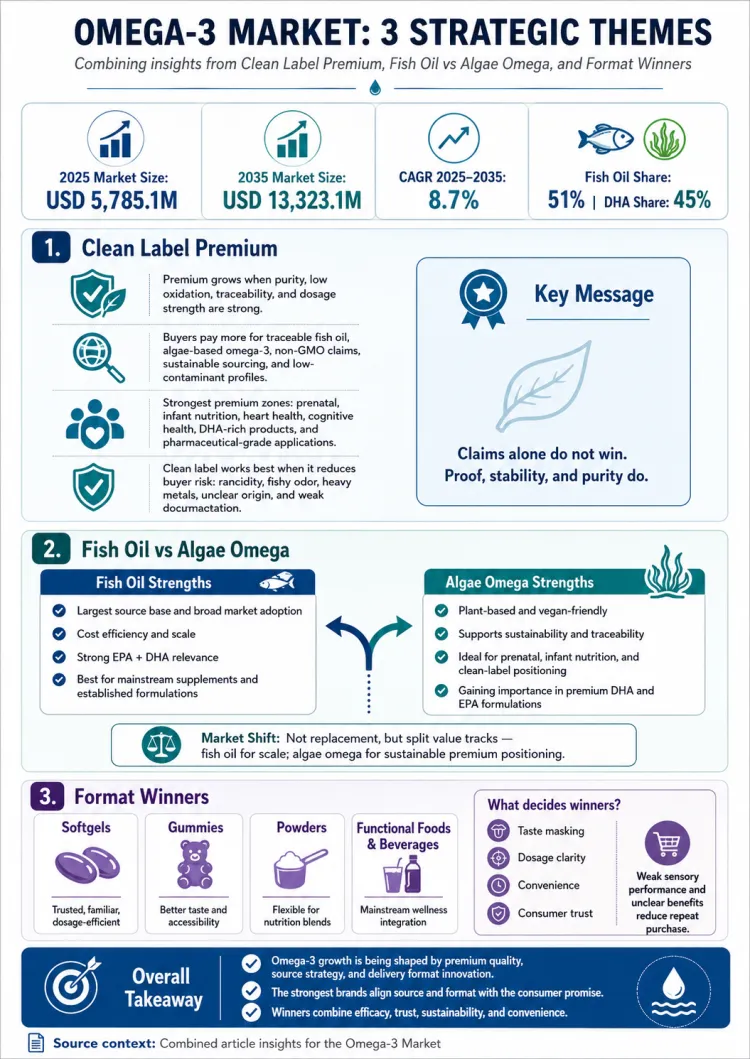
Clean label is becoming a stronger premium lever in the omega-3 market because the category is closely tied to trust. Omega-3 products are consumed for heart health, brain health, eye health, prenatal nutrition, infant development, inflammation support, and general preventive wellness. This makes buyers more sensitive to source, purity, oxidation, heavy metals, sustainability, and dosage transparency than they may be in many ordinary food ingredient categories. According to Future Market Insights, the global omega-3 market is valued at USD 5,785.1 million in 2025 and is projected to reach USD 13,323.1 million by 2035, expanding at an 8.7% CAGR. FMI also notes that fish oil led the source segment with 51% share in 2025, while DHA accounted for 45% of product-type revenue in 2025.
The clean-label premium in omega-3 does not come from one claim alone. A buyer may not pay significantly more just because a product says natural or sustainably sourced. The premium becomes stronger when clean-label positioning is combined with measurable value such as low oxidation, high EPA/DHA concentration, no fishy aftertaste, verified origin, contaminant testing, non-GMO positioning, algae-based sourcing, and reliable documentation. In this market, clean label works as a risk-reduction tool. Supplement brands, infant nutrition companies, functional food manufacturers, and pharmaceutical-grade formulators are not only buying omega-3 oil; they are buying confidence that the ingredient will remain stable, meet label claims, avoid recalls, and support a premium health promise.
This is why the clean-label premium is likely to be strongest in higher-value omega-3 formats rather than mass-market, low-dose products. Premium softgels, prenatal DHA products, children’s nutrition, medical nutrition, heart-health formulations, cognitive-health supplements, and high-concentration EPA/DHA products can support stronger pricing when buyers see clear technical proof. FMI states that the omega-3 market is moving deeper into preventive nutrition and pharmaceutical-grade health formulations, with demand supported by heart health, cognition, infant nutrition, fortified foods, functional beverages, clean-label demand, and sustainable omega-3 sources. This shows that premiumization is not only about consumer-facing claims. It is also about formulation quality and application fit.
Fish oil still holds a major position in omega-3, but clean-label expectations are changing how fish oil suppliers must compete. Traditional fish oil buyers are increasingly looking for cleaner sensory profiles, controlled oxidation, sustainable sourcing, stronger traceability, and evidence of low contaminants. Fish oil can still command a premium when it delivers high EPA/DHA potency, reliable refinement, and strong documentation. However, lower-grade fish oil with weak traceability or poor sensory performance is more exposed to pricing pressure because buyers can compare it directly against better-documented fish oil, krill oil, concentrates, or algae-based alternatives. FMI’s fish oil market coverage also notes that fish oil remains a dominant source within omega-3 ingredients because it is concentrated and bioavailable, especially for EPA and DHA.
Algae omega is one of the clearest clean-label premium opportunities because it answers several buyer concerns at the same time. It is plant-based, vegan-compatible, less dependent on marine fish stocks, and well suited for DHA-focused products. FMI estimates the algae omega market will expand from USD 1.04 billion in 2026 to USD 1.49 billion by 2036, with dietary supplements projected to account for 58.0% share of application demand in 2026. FMI also highlights that algae omega demand is supported by supplement brands replacing fish oil with algae-derived DHA and EPA formulations, along with use in prenatal nutrition, DHA concentrates, and sustainable omega sourcing. This makes algae omega especially important for brands targeting vegetarians, vegans, prenatal consumers, clean-label shoppers, and sustainability-focused buyers.
The question is not whether buyers will pay more for clean-label omega-3. The better question is where the premium is defensible. A premium is easier to defend when the ingredient solves a real commercial problem for the buyer. For example, a prenatal supplement brand may pay more for algae-derived DHA because it supports vegan positioning, avoids fish-related concerns, and fits maternal nutrition messaging. A heart-health supplement brand may pay more for a high-concentration EPA/DHA ingredient if it reduces capsule count and improves dosage clarity. A functional beverage brand may pay more for stable omega-3 technology if it minimizes taste, odor, oxidation, and formulation failure. In each case, the premium comes from performance plus trust, not from clean-label language alone.
Non-GMO positioning can also support premium value, but it is rarely enough by itself. In omega-3, non-GMO is most powerful when paired with algae-based sourcing, clean processing, vegetarian capsules, allergen-conscious positioning, and transparent supply chains. For mass-market fish oil capsules, non-GMO may act more like a baseline expectation than a strong pricing lever. For premium algae DHA, prenatal nutrition, children’s supplements, and functional foods, non-GMO positioning can become part of a broader clean-label bundle that helps justify higher pricing.
Low-oxidation performance is one of the most important hidden premium levers in omega-3. Consumers may not always understand peroxide value, anisidine value, or total oxidation measures, but they do notice fishy smell, unpleasant burps, rancid taste, and poor repeat experience. Brands understand this risk very clearly. An omega-3 ingredient that remains stable, tastes cleaner, and supports a better finished product can command more value because it protects brand reputation. This is especially important in gummies, liquids, emulsions, powders, beverages, and children’s products, where taste and odor problems are harder to hide than in standard capsules.
The premium also differs by application. Dietary supplements remain a key channel because consumers already associate omega-3 with daily health maintenance. Infant nutrition and prenatal nutrition are more sensitive to DHA quality, safety, and documentation. Functional foods and beverages create opportunities for broader usage, but they also raise formulation challenges because omega-3 must remain stable in more complex product environments. Pharmaceutical and medical nutrition applications require stricter specifications, which can support stronger premiums for highly purified, high-concentration, and well-documented omega-3 inputs. FMI’s omega-3 market outlook specifically connects growth with preventive nutrition, pharmaceutical-grade formulations, fortified foods, functional beverages, and sustainable sources.
Clean-label omega-3 pricing is therefore likely to separate the market into tiers. At the lower end, buyers will continue to compare price per dose, capsule count, EPA/DHA content, and basic quality. In the middle, brands will look for a balance between cost, documentation, source claims, and sensory quality. At the premium end, buyers will pay for traceable origin, algae-based positioning, pharmaceutical-grade purity, high-concentration EPA/DHA, low oxidation, strong technical support, and proven application performance. The strongest winners will be suppliers that can explain not only what the omega-3 source is, but why that source reduces risk for the finished product.
The main risk for suppliers is overestimating the value of clean-label claims without supporting proof. Omega-3 buyers are becoming more technical. They want documentation, source transparency, contaminant controls, stability data, and reliable EPA/DHA potency. A vague sustainability claim or natural positioning may attract attention, but it will not protect premium pricing if the product has odor issues, weak specifications, poor oxidation control, or inconsistent quality. In omega-3, the premium is earned through evidence.
For brands, the best clean-label strategy is to match the source to the consumer promise. Fish oil remains relevant where high EPA/DHA concentration, cost efficiency, and established efficacy matter. Algae omega is stronger where vegan, vegetarian, prenatal, sustainability, and DHA-rich positioning are central. Concentrates are stronger where dosage strength and capsule reduction matter. Krill oil may compete where bioavailability and phospholipid positioning are important. The clean-label premium is not the same across all of these options because buyers are not solving the same problem in every application.
Overall, clean label can support a meaningful omega-3 premium, but it works best when connected to measurable buyer value. The market’s growth outlook shows that omega-3 is moving beyond basic supplementation and into more specialized health, nutrition, and functional applications. As that happens, buyers will reward suppliers that provide traceable, stable, low-contaminant, high-potency, and sustainable omega-3 ingredients. The winners will not be the suppliers with the most claims. They will be the suppliers with the strongest proof behind those claims.

