


- Sourdough can support premium pricing because it combines natural fermentation, artisan credibility, digestive-wellness perception, and cleaner bakery positioning.
- Clean-label value in sourdough is not only about removing additives. It is about replacing industrial bread cues with fermentation time, starter culture authenticity, flour quality, and process transparency.
- Traditional sourdough remains the leading product type because consumers associate it with authentic taste, natural leavening, and artisanal bakery quality.
- Organic sourdough is gaining as a clean-label claim because it connects natural fermentation with non-GMO, pesticide-free grain sourcing, and premium bakery trust.
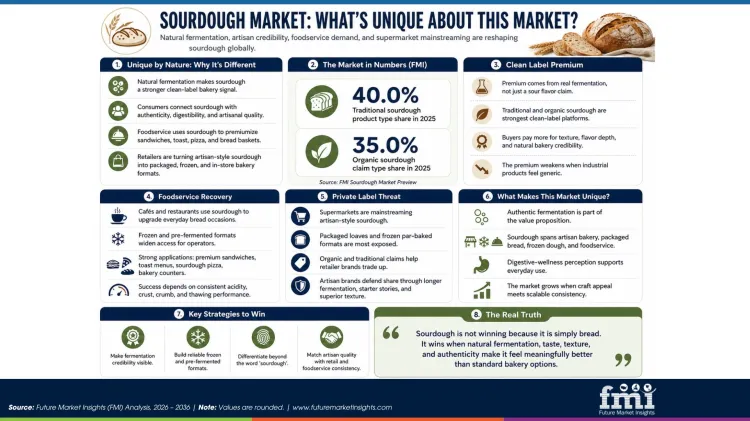
- The premium weakens when sourdough is used only as a flavor claim without long fermentation, real starter culture credibility, or clear texture and digestibility benefits.
- The biggest misconception is that any bread with a sour note can command a sourdough premium. Consumers pay more when sourdough feels authentic, naturally fermented, and better than standard bread.
However, the importance of sourdough is already rapidly becoming one of the most important clean-label indicators within the bakery space, despite the fact that the premium status of the sourdough product is greatly misunderstood. Bakery companies often see sourdough as a taste profile or simply as a trend within marketing, when in fact it means something different entirely.
FMI’s Sourdough Market helps explain why this matters. FMI identifies traditional sourdough as the leading product type with 40.0% share in 2025, while organic sourdough accounts for 35.0% of claim type share. These two figures show that the market is not being driven by novelty alone. It is being shaped by familiar, fermentation-led bread formats and clean-label bakery claims.
The concept of clean label is not "free from ingredients" in the case of sourdough. Rather, it is a perception that the product seems less industrialized. The consumer is reacting to natural fermentation processes, increased duration of fermentation, reduction in the use of synthetic ingredients, visible grains, artisan bread-making techniques, and stories associated with the source.
The classic sourdough bread has one inherent advantage, in that it contains the most powerful authentic signal. It is a sign of natural fermentation rather than fast yeast fermentation. It provides the consumers with the characteristic tangy taste, chewy consistency, open structure, and crust of the bread. As FMI suggests, "traditional sourdough can benefit from its familiarity of taste, artisan nature, and extended fermentation period."
Organic sourdough strengthens the clean-label story further. Organic claims connect sourdough with non-GMO expectations, pesticide-free grain sourcing, and more natural bakery positioning. However, organic alone is not enough. A weak sourdough loaf with poor texture or short fermentation will not defend a premium just because the label says organic. The claim must be supported by eating quality.
Digestive well-being can also aid premiumization. Customers tend to believe that sourdough has better digestive properties than other types of bread and that fewer artificial ingredients are added to it. As FMI’s preview notes, digestive well-being and naturally fermented functional breads will be key themes for the year. This is not to say that all sourdough products should have convincing health benefits.
The strongest premium opportunity is in conventional bread, organic sourdough bread, sourdough high fiber bread, sourdough made from ancient grains, sprouted grains sourdough bread, rye sourdough bread, seeded sourdough bread, and artisan breads for sandwiches. These product formats provide consumers with an obvious justification for purchasing at a higher price than regular packaged bread.
The premium weakens when industrial products borrow the sourdough name without delivering the experience. If the bread lacks crust, chew, acidity balance, aroma, or fermentation depth, the claim becomes fragile. Consumers may try it once, but repeat purchase depends on whether the product feels meaningfully better than ordinary bread.
This is the area where the suppliers and bakeries should be extremely careful. Scale can be an enemy to authenticity if process controls are not in place. For big scale bakeries, consistency in the starter cultures, process controls during fermentation, stable frozen doughs, and proper packaging will have to be considered without compromising the naturalness of the product.
FMI’s Sourdough Ingredients Market is useful here because starter cultures, flour systems, and sourdough bases support the transition from artisan bakery to scalable production. Industrial bakeries need ingredients that reproduce authentic taste and fermentation characteristics without excessive variability. Clean-label premiumization therefore depends on both ingredient quality and process discipline.
The misconception to avoid is that sourdough premiumization comes only from consumer interest in clean labels. It comes from the combination of clean label, authentic fermentation, texture, flavor, and trust.
Bottom line: Sourdough can command a clean-label premium, but only when natural fermentation is real, visible, and supported by eating quality. The winning products will not be the ones that simply say "sourdough." They will be the ones that taste, look, and behave like sourdough.

