

- Market Size (2026)
- USD 650.0 Mn
- Forecast (2036)
- USD 1120.9 Mn
- CAGR (2026 to 2036)
- 5.6%
Sourdough Bakery Premix Market Size, Market Forecast and Outlook By FMI
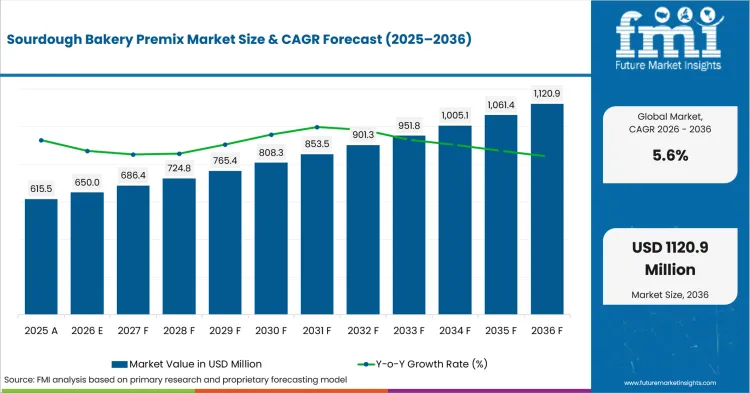
The sourdough bakery premix value is estimated at USD 615.5 million in 2025 and is projected to reach USD 1,120.9 million by 2036 at a 5.6% CAGR. Dry premixes are expected to account for 43.0% share in 2026 as industrial bakeries seek repeatable acidity and predictable handling. Industrial bakeries are forecast to represent 46.0% buyer share in 2026 since large bread plants need controlled fermentation cues without daily starter maintenance.
Key Takeaways, Market Size, and Forecast
- 2026 Market Size: USD 650.0 million.
- 2036 Market Size: USD 1,120.9 million.
- Forecast CAGR: 5.6% from 2026 to 2036.
- Leading Product Type: Dry Premixes.
- Dry Premixes Share in 2026: 43.0%.
- Leading Buyer Type: Industrial Bakeries.
- Industrial Bakeries Share in 2026: 46.0%.
- Fastest-growing Country: Saudi Arabia.
- Saudi Arabia CAGR: 6.2% from 2026 to 2036.
Summary of Sourdough Bakery Premix Market
- Demand and Growth Drivers
- Industrial bakers are using sourdough premixes to translate long fermentation flavor into repeatable production schedules.
- Foodservice bakeries are adding sourdough pizza bases and sandwich breads to raise menu value without maintaining live starters on site.
- Retail private label bread programs are using premixes to keep flavor profiles stable across plants and contract bakers.
- Product and Segment View
- Dry premixes are expected to secure 43.0% share in 2026 due to easy storage and consistent dosing.
- Industrial bakeries are projected to hold 46.0% buyer share in 2026 with higher need for batch control.
- Clean-label positioning is forecast to account for 38.0% share in 2026 as ingredient panels remain a retailer screening point.
- Geography and Competitive Outlook
- Saudi Arabia is projected to record 6.2% CAGR from 2026 to 2036, supported by foodservice bread demand and wheat-based catering channels.
- The United States is expected to expand at 5.9% CAGR from 2026 to 2036 through industrial bakery scale and broad sourdough retail presence.
- Puratos and Lesaffre compete by fermentation science and application centers that help bakeries convert sourdough into controlled production.
- IREKS and Lallemand Baking Solutions focus on culture systems and premix know-how. Angel Yeast and AB Mauri add regional bakery technical support.
- Analyst Opinion
- Nandini Roy Choudhury, Principal Consultant for Food and Beverage at Future Market Insights, observes, "Sourdough premix is not just a shortcut for flavor. It is a production control tool. Suppliers that explain acidity and flour behavior in simple bakery terms are likely to gain repeat business."
- Sourdough Bakery Premix Market Value Analysis
- Market value is supported by premix revenue sold to industrial bakers and artisan bakeries. Foodservice chains and private label bread suppliers add further B2B revenue.
- Pricing reflects culture stability and flour quality before packaging format affects margin by channel.
- Revenue improves when bakers shift from flavor-only sourdough powder into active cultures and controlled starter systems.
- Supplier share is shaped by technical bakery support since customers need recipe conversion and proofing guidance.
The sourdough bakery premix market is gaining value as industrial bakeries and foodservice operators look for consistent sourdough flavor without managing live starter variability in every batch. USDA ERS estimated USA per capita wheat flour use at 126.6 pounds in 2025. This indicates a large flour-based consumption base for bread mixes, pizza bases and artisan-style bakery systems. Premix suppliers benefit when they provide controlled acidity, stable fermentation notes and predictable dough handling for high-throughput bakery lines. In June 2025, Lallemand completed the acquisition of AIT Ingredients to strengthen its global baking solutions platform. AIT Ingredients’ sourdough starter and baking ingredient capabilities make the deal relevant for premix suppliers serving clean-label bread, rolls and specialty baked goods.
Sourdough Bakery Premix Market Definition
The sourdough bakery premix market covers dry and semi-dry ingredient systems positioned for commercial sourdough baking. Scope includes dry premixes, active cultures, paste starters, liquid ferments, enzyme blends, and flavor sourdough systems sold to bakeries. Revenue includes B2B premix and culture sales used in breads, rolls, pizza bases, frozen dough, and sweet bakery products with sourdough flavor or fermentation positioning.
Sourdough Bakery Premix Market Inclusions
Market scope covers commercially supplied sourdough bakery premixes categorized by product type such as dry premixes, active cultures, paste starters, liquid ferments, enzyme blends, and flavor sourdough. Application coverage includes artisan bread, industrial loaves, rolls, pizza bases, sweet bakes, and frozen dough. Buyer type coverage includes industrial bakeries, artisan bakeries, foodservice bakeries, in-store bakeries, and private label producers. Claim positioning includes clean-label, wholegrain, organic, high-fiber, traceable grain, and fermentation-led products. Sales channel coverage includes direct supplier sales, ingredient distributors, ingredient platforms, regional wholesalers, and bakery academies. Format coverage includes powder, blend base, seed culture, frozen concentrate, and liquid concentrate. Revenue scope covers 2026 to 2036. Key stakeholders include sourdough culture suppliers, bakery premix manufacturers, flour millers, ingredient distributors, industrial bakeries, foodservice bakery chains, private label producers, and bakery technical service teams.
Sourdough Bakery Premix Market Exclusions
Scope excludes finished sourdough bread, retail bakery sales, household starter kits, and basic bread mixes without sourdough identity. It excludes standard bakery premixes unless they include sourdough culture, dried sourdough, acidified flavor systems, or controlled fermentation positioning. Bakery equipment revenue is excluded unless bundled pricing clearly assigns value to an eligible premix or culture SKU.
Sourdough Bakery Premix Market Research Methodology
- Primary Research: FMI analysts reviewed sourdough premix supplier portfolios, bakery distributor listings and commercial bakery specification patterns across priority countries.
- Desk Research: Public data from the United States Department of Agriculture and World Bank were checked against sourdough bakery premix evidence. Statistics Canada, Australian Bureau of Statistics and United Kingdom Government sources were reviewed.
- Market Sizing and Forecasting: The market size has been estimated using a bottom-up product-boundary approach. Each category has been defined by eligible sourdough premix SKUs and active culture offerings. Bakery and foodservice revenue pools were separated by channel availability and country-level adoption.
- Data Validation: Standard bakery mixes were excluded unless they clearly matched the category definition. Accepted cases include sourdough flavor positioning and active culture inclusion. Long-fermentation claims and commercial bakery premix format were accepted.
Why is the Sourdough Bakery Premix Market Growing?
- Industrial bakers need sourdough flavor without variable starter handling on every shift.
- Foodservice chains want pizza bases and sandwich breads that carry craft cues while staying easy to specify.
- Retailers are asking for cleaner ingredient panels and repeatable eating quality across private label bread programs.
Growth reflects the broader bakery ingredients base as bakeries translate flavor and texture claims into repeatable industrial recipes. The United States Department of Agriculture National Agricultural Statistics Service reported 419 million hundredweight of United States flour production in May 2026 for 2025. This gives premix suppliers a large flour-processing base where small dosing changes can create sizeable ingredient revenue.
Supplier planning overlaps with sourdough ingredients as culture stability and flavor control now influence premix selection. Puratos opened its Sourdough Institute in Belgium in June 2024 and reported 153 sourdoughs stored with more than 1,500 strains isolated. That signal matters commercially since bakers are buying repeatable fermentation knowledge as much as they are buying premix powder.
Market Segmentation Analysis
Insights into Sourdough Bakery Premix Market by Product Type
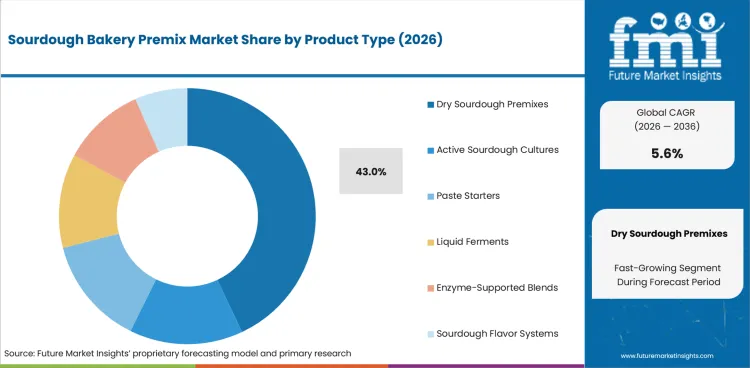
- Dry premixes are projected to account for 43.0% share in 2026 as powder dosing fits automated bakery lines and distributor storage. Active cultures gain space in bakeries that want a fresher sourdough process while reducing the risk of starter drift.
- Paste starters serve bakeries seeking deeper flavor and a shorter route to premium bread positioning. Dry sourdough systems compete with adjacent dough-based premixes where production managers rank handling tolerance before flavor claims.
Insights into Sourdough Bakery Premix Market by Application
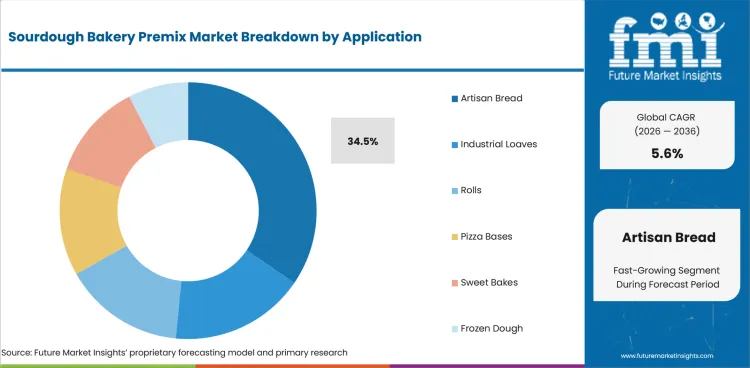
- Artisan bread is forecast to hold 34.5% share in 2026 with sourdough claims easiest to explain in crusty loaves. Pizza bases are gaining supplier attention as foodservice chains use sourdough crust to separate premium menus from basic bases.
- Frozen dough buyers value premixes that keep fermentation character stable after freezing and thawing. Bread texture decisions can affect bread emulsifier choices when manufacturers balance sourdough flavor with crumb softness.
Insights into Sourdough Bakery Premix Market by Buyer Type
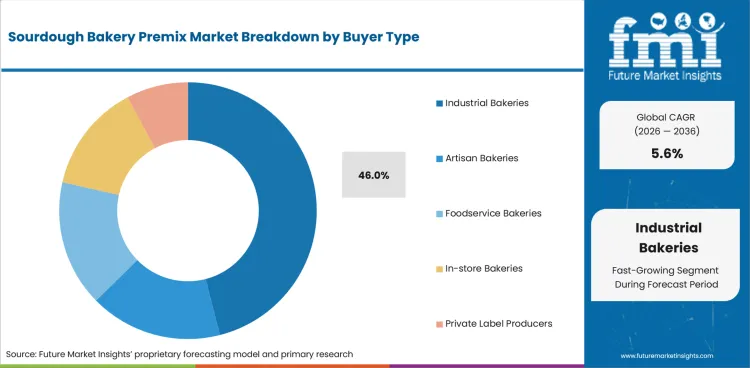
- Industrial bakeries are expected to represent 46.0% share in 2026 due to large-volume bread lines and technical trial capacity.
- Artisan bakeries use premixes more selectively where staffing shortages make daily starter care harder to manage. Private label producers need flavor reproducibility when the same SKU is baked at more than one contracted plant.
Insights into Sourdough Bakery Premix Market by Claim Positioning
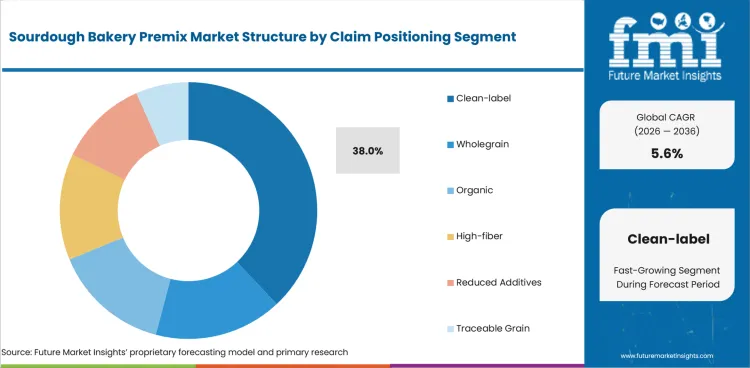
Clean-label positioning is forecast to secure 38.0% share in 2026 as retailers compare ingredient lists before shelf placement. Wholegrain positioning benefits from sourdough flavor as acidity can soften the eating profile of higher-fiber breads.
- Traceable grain claims remain useful for premium bread, although suppliers need written origin evidence to support those claims. Retail screening links sourdough claims with clean-label ingredients as buyers check ingredient lists before authorizing new bread programs.
Insights into Sourdough Bakery Premix Market by Sales Channel
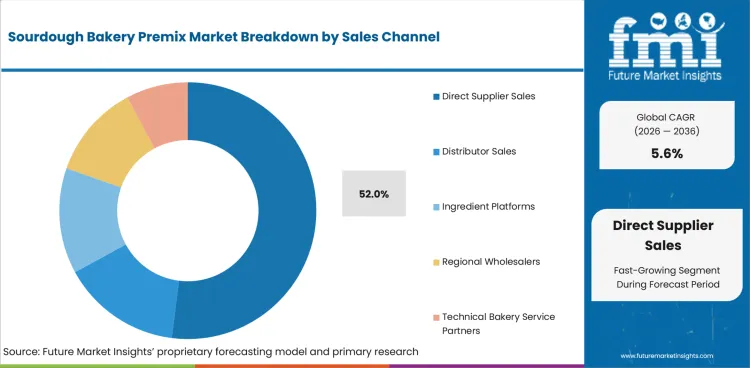
- Direct supplier sales are expected to hold 52.0% share in 2026 because bakeries need plant trials and recipe conversion help. Ingredient distributors are useful for smaller bakeries that need low minimum order quantities and quicker replenishment.
- Bakery academies support sampling and training when new sourdough recipes require process changes.
Insights into Sourdough Bakery Premix Market by Format
- Powder formats are projected to account for 58.0% share in 2026 due to storage convenience and simple production dosing. Liquid concentrates suit large plants that can manage chilled handling and want stronger flavor carry-through.
- Seed cultures fit bakeries that want a living fermentation step without developing a starter library internally.
Sourdough Bakery Premix Market Drivers and Restraints
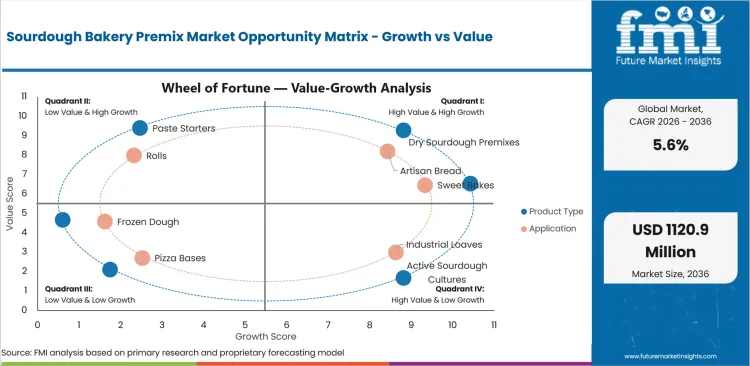
- Foodservice menus are using sourdough crusts and sandwich breads to raise perceived value without adding complex in-store fermentation steps.
- Premium sourdough claims need evidence, so suppliers without strain documentation or application support can lose tenders to larger fermentation specialists.
- Private label bakeries can use sourdough premixes to create store-brand bread tiers with consistent taste across contract plants.
Documented Sourdough Systems Support Industrial Bakery Adoption
Industrial bakeries are moving sourdough from a craft-only process into controlled production systems with defined dosing and proofing rules. The United States Department of Agriculture Economic Research Service estimated United States per capita wheat flour use at 126.6 pounds in 2025. This stable flour base supports bread, pizza bases and wheat-based bakery formats that can adopt sourdough premix without changing the core product architecture. Premix suppliers gain when they deliver repeatable acidity, stable flavor and dough handling guidance for high-throughput bakery lines.
Input Costs and Culture Handling Limit Smaller Bakery Conversion
Input cost pressure and flour regulation can slow adoption when bakeries are already managing reformulation budgets. The Australian Bureau of Statistics reported that bakery product manufacturing output prices increased 7.2% in the December 2024 quarter. This reflected higher raw material costs and reduced discounting across bakery manufacturing. Live culture formats also require handling discipline and technical oversight. That can limit use among smaller bakeries that lack staff for starter control or process troubleshooting.
Premix Suppliers Can Extend Sourdough Beyond Bread
The strongest whitespace is not limited to bread. Sweet baked goods, pizza bases and frozen dough lines can absorb sourdough premix when suppliers show flavor value without process disruption. Supplier opportunity is concentrated in recipe conversion packages that include dosing guidance, proofing windows and acidity targets. Adjacent formulation needs also create cross-selling potential with gluten-free bakery premix. Texture repair and sourdough-style flavor cues can work together when suppliers support formulation trials with clear process documentation.
Competitive Landscape and Strategic Positioning
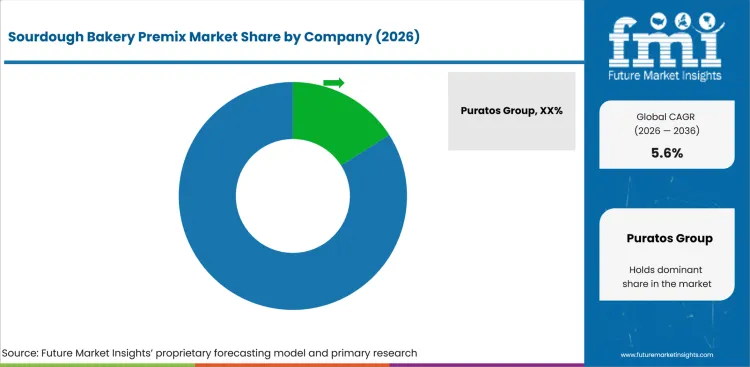
Sourdough bakery premix competition is led by fermentation specialists and bakery ingredient companies. Regional premix producers remain relevant. Buyers compare culture stability and dosing instructions before approving a supplier for plant trials. Application support and documentation are checked.
Puratos competes with a sourdough library and institute model that gives it strain knowledge and training depth. Lesaffre and Lallemand Baking Solutions compete from yeast and fermentation capability, while IREKS and Böcker bring long sourdough process experience into European bakery channels.
Angel Yeast and AB Mauri add scale in yeast and bread improvers. Their bakery ingredient distribution adds local reach. Regional players remain relevant when they offer faster service and local flour knowledge. They can lose larger contracts if they lack culture documentation or trial support.
The best-positioned suppliers convert fermentation knowledge into simple bakery operating instructions. That means a buyer can see acidity range and dosage before switching from an existing improver. Shelf-life handling and finished bread effect need to be visible.
Key Companies in the Sourdough Bakery Premix Market
- Puratos Group
- Lesaffre International
- IREKS GmbH
- Ernst Böcker GmbH & Co. KG
- Lallemand Baking Solutions
- AB Mauri
- Angel Yeast Co., Ltd.
Competitive Benchmarking: Sourdough Bakery Premix Market
| Company | Fermentation Capability | Sourdough Bread Know-how | Premix Scale | Regional Technical Reach |
|---|---|---|---|---|
| Puratos Group | Very High | Very High | Very High | High |
| Lesaffre International | Very High | High | High | Very High |
| IREKS GmbH | High | Very High | High | High |
| Ernst Böcker GmbH & Co. KG | High | Very High | Medium | Medium |
| Lallemand Baking Solutions | High | High | High | Very High |
| AB Mauri | Medium | Medium | High | Very High |
| Angel Yeast Co., Ltd. | Medium | Medium | High | High |
Source: Future Market Insights analysis based on official company product pages, company newsrooms and public supplier evidence.
Key Developments in Sourdough Bakery Premix Market
- In October 2025, Lesaffre published sourdough application guidance covering live durum wheat sourdough. The guidance covered devitalized sourdough in powder, liquid and paste forms for bakery use.
- In February 2026, Lallemand Baking Solutions presented sourdough mixes for Pizza Expo 2026. The presentation linked sourdough mixes with crust quality and shaping tolerance. Frozen stability formed part of the product message.
Key Players in the Sourdough Bakery Premix Market
- Puratos Group
- Lesaffre International
- IREKS GmbH
- Ernst Böcker GmbH & Co. KG
- Lallemand Baking Solutions
- AB Mauri
- Angel Yeast Co., Ltd.
- Zeelandia Group
- Bakels Worldwide
- Dawn Foods
- Backaldrin International
- Stern-Wywiol Gruppe
Analysis of Sourdough Bakery Premix Market by Key Countries
.webp "Top Country Growth Comparison Sourdough Bakery Premix Market Cagr (2026 2036)")
| Country | CAGR from 2026 to 2036 |
|---|---|
| United States | 5.9% |
| Germany | 5.4% |
| United Kingdom | 5.6% |
| Canada | 5.7% |
| Japan | 5.2% |
| Australia | 4.9% |
| Saudi Arabia | 6.2% |
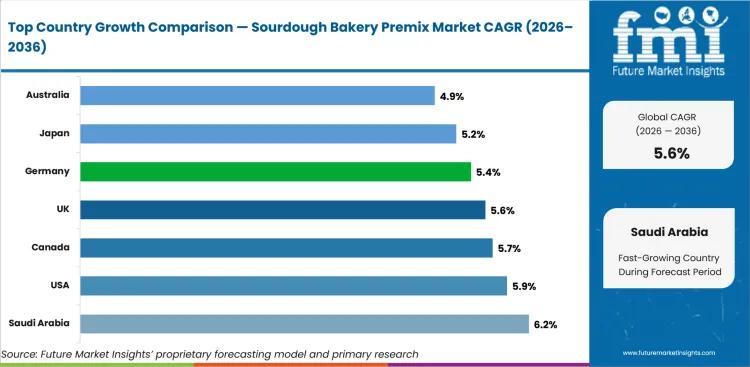
- United States is expected to expand at 5.9% CAGR through 2036, led by industrial bakery scale and national distributor access.
- Germany is projected to rise at 5.4% CAGR through 2036, supported by sourdough familiarity and industrial export strength.
- United Kingdom is expected to advance at 5.6% CAGR through 2036, shaped by bread regulation and retailer ingredient checks.
- Canada is forecast to grow at 5.7% CAGR through 2036, helped by food-processing investment and premium bread programs.
- Japan is forecast at 5.2% CAGR through 2036, driven by wheat-based bakery demand and foodservice substitution from higher rice prices.
- Australia is expected to post 4.9% CAGR through 2036, constrained by bakery input cost pressure but supported by premium bread channels.
- Saudi Arabia is projected to record a 6.2% CAGR through 2036, supported by foodservice bread demand and flour-channel growth.
Demand Outlook for Sourdough Bakery Premix Market in United States
Industrial bread scale and national distribution center, 2026 to 2036
Country Market Snapshot Table
| Parameter | Value |
|---|---|
| Market Size in 2025 (Value) | USD 174.7 million |
| Market Size in 2026 (Value) | USD 185.0 million |
| Market Forecast in 2036 (Value) | USD 328.2 million |
| CAGR (2026 to 2036) | 5.9% |
| Years Considered | 2021 to 2036 |
| Base Year | 2025 |
| Forecast Period | 2026 to 2036 |
| Units Considered | Value (USD million) |
| Leading Sub-Region | National bakery manufacturing corridors |
United States Sourdough Bakery Premix Market Outlook
United States demand is shaped by large bread plants and foodservice bakeries. The country has a large flour milling base. Sourdough can move from premium bakery counters into sliced bread and buns. Frozen pizza crusts give national suppliers another route.
Supplier screening in this country overlaps with United States bakery ingredients as plants evaluate premix functionality alongside broader bread ingredient systems. Buyers often compare premix suppliers on technical trial support and delivery reliability before price. That favors suppliers with application teams that can work across clean-label loaves, frozen dough and high-speed bread lines.
Key Growth Drivers
- National flour output gives premix suppliers a broad base, as the United States Department of Agriculture National Agricultural Statistics Service reported 419 million hundredweight of flour production in May 2026 for 2025.
- Bread and wheat-based food demand remains stable, as the United States Department of Agriculture Economic Research Service estimated per capita wheat flour use at 126.6 pounds in 2025.
- Large bakery chains can test sourdough premixes across multiple plants after one recipe conversion is validated.
- Foodservice pizza and sandwich programs create a route for sourdough crust and bread bases beyond retail loaves.
Key Restraints
- Low-carbohydrate and gluten-free diets can limit premium bread trial among some consumers in national retail channels.
- Supplier switching can be slow when bakery plants require line trials and purchasing approvals before changing premix systems.
- Import competition keeps price pressure visible, as the United States Department of Agriculture Economic Research Service reported wheat flour and product imports averaged around 1.1 million metric tons annually over 2015-16 to 2024-25.
What makes United States unique
The United States stands out for large flour milling capacity and national bakery chains. Broad foodservice testing gives suppliers another route.
Key Companies
- Puratos USA
- Lallemand Baking Solutions
- AB Mauri North America
- Lesaffre Yeast Corporation
- Dawn Foods
- BakeMark USA
- King Arthur Baking Company
Sales & Marketing Channels
- Direct ingredient sales
- Bakery distributors
- Foodservice suppliers
- Private label bakeries
- Industrial bread plants
- In-store bakeries
Country Segment Breakdown Table
| Segment | Sub-Segments |
|---|---|
| By Product Type | Dry Premixes, Active Cultures, Paste Starters, Liquid Ferments, Enzyme Blends, Flavor Sourdough |
| By Application | Artisan Bread, Industrial Loaves, Rolls, Pizza Bases, Sweet Bakes, Frozen Dough |
| By Buyer Type | Industrial Bakeries, Artisan Bakeries, Foodservice Bakeries, In-store Bakeries, Private Label Producers |
| By Claim Positioning | Clean-label, Wholegrain, Organic, Low-waste, High-fiber, Traceable Grain |
| By Sales Channel | Direct Supplier, Distributor, Ingredient Platforms, Regional Wholesalers, Bakery Academies |
| By Format | Powder, Blend Base, Seed Culture, Frozen Concentrate, Liquid Concentrate |
| Key Sub-Regions Covered, Bakery and Foodservice Corridors | Midwest, California, Texas, Northeast, Southeast, Pacific Northwest |
Frequently Asked Questions
How fast is United States sourdough bakery premix market growing?
United States is expected to expand at 5.9% CAGR from 2026 to 2036 through industrial bakery scale and flour output.
Who leads United States sourdough bakery premix market?
Puratos USA and Lallemand Baking Solutions compete through sourdough cultures and distributor reach. AB Mauri North America and Lesaffre Yeast Corporation add high-speed line support.
What is driving adoption in United States sourdough bakery premix market?
Commercial bakeries use premixes to keep sourdough flavor repeatable across large-volume lines.
Sales Outlook for Sourdough Bakery Premix Market in Germany
Sourdough familiarity and technical bakery culture center, 2026 to 2036
Country Market Snapshot Table
| Parameter | Value |
|---|---|
| Market Size in 2025 (Value) | USD 81.6 million |
| Market Size in 2026 (Value) | USD 86.0 million |
| Market Forecast in 2036 (Value) | USD 145.5 million |
| CAGR (2026 to 2036) | 5.4% |
| Years Considered | 2021 to 2036 |
| Base Year | 2025 |
| Forecast Period | 2026 to 2036 |
| Units Considered | Value (USD million) |
| Leading Sub-Region | Bavaria and North Rhine-Westphalia |
Germany Sourdough Bakery Premix Market Outlook
Germany has deep rye and mixed bread traditions that make sourdough flavor easier for buyers to understand. Commercial demand is influenced by craft bakery heritage, industrial bread producers and ingredient suppliers with fermentation know-how.
Pricing discipline still matters since bread and cereals remain part of household grocery budgets. Suppliers that help bakeries hold flavor while controlling process variability should gain stronger acceptance in regional bread lines.
German buyers compare sourdough culture systems with the wider sourdough category as flavor heritage and process control meet in premium bread lines.
Key Growth Drivers
- Export strength supports premix supplier capability, as World Integrated Trade Solution reported Germany exported USD 638.8 million of mixes and doughs for bakers' wares in 2024.
- Sourdough process knowledge is embedded in supplier portfolios, with IREKS describing more than 100 years of sourdough experience and controlled three-stage production.
- Rye and mixed bread habits help industrial bakeries explain sourdough positioning without heavy consumer education.
- Regional bakery chains can use dried sourdough systems to keep taste stable across store networks.
Key Restraints
- Price sensitivity can slow upgrades when bakeries compare sourdough premix against basic bread improvers.
- Ingredient claims need careful labeling where organic, wholegrain or regional grain statements appear on bread packs.
- Retail food inflation limits pass-through room, as the Federal Statistical Office of Germany reported bread and cereals prices increased 0.7% year over year in July 2025.
What makes Germany unique
Germany stands out for sourdough tradition and local ingredient specialists. Export strength in bakers' wares mixes.
Key Companies
- IREKS GmbH
- Ernst Böcker GmbH & Co. KG
- Stern-Wywiol Gruppe
- Backaldrin Germany
- Lesaffre Deutschland
- Puratos Germany
- AB Enzymes GmbH
Sales & Marketing Channels
- Ingredient distributors
- Direct technical sales
- Craft bakery wholesalers
- Industrial bakery trials
- Bakery schools
- Export distributors
Country Segment Breakdown Table
| Segment | Sub-Segments |
|---|---|
| By Product Type | Dry Premixes, Active Cultures, Paste Starters, Liquid Ferments, Enzyme Blends, Flavor Sourdough |
| By Application | Artisan Bread, Industrial Loaves, Rolls, Pizza Bases, Sweet Bakes, Frozen Dough |
| By Buyer Type | Industrial Bakeries, Artisan Bakeries, Foodservice Bakeries, In-store Bakeries, Private Label Producers |
| By Claim Positioning | Clean-label, Wholegrain, Organic, Low-waste, High-fiber, Traceable Grain |
| By Sales Channel | Direct Supplier, Distributor, Ingredient Platforms, Regional Wholesalers, Bakery Academies |
| By Format | Powder, Blend Base, Seed Culture, Frozen Concentrate, Liquid Concentrate |
| Key Sub-Regions Covered, Bakery and Foodservice Corridors | Bavaria, North Rhine-Westphalia, Baden-Württemberg, Lower Saxony, Hamburg, Saxony |
Frequently Asked Questions
How fast is Germany sourdough bakery premix market growing?
Germany is projected to rise at 5.4% CAGR from 2026 to 2036 as rye bread familiarity supports controlled sourdough use.
Who leads Germany sourdough bakery premix market?
IREKS GmbH and Ernst Böcker GmbH & Co. KG compete through controlled sourdough systems and local bakery know-how. Stern-Wywiol Gruppe and Backaldrin Germany add culture documentation.
What is driving adoption in Germany sourdough bakery premix market?
Rye and mixed-bread producers use premixes to keep sourdough character stable across store networks.
Growth Outlook for Sourdough Bakery Premix Market in United Kingdom
Retail bread discipline and flour reformulation center, 2026 to 2036
Country Market Snapshot Table
| Parameter | Value |
|---|---|
| Market Size in 2025 (Value) | USD 60.6 million |
| Market Size in 2026 (Value) | USD 64.0 million |
| Market Forecast in 2036 (Value) | USD 110.4 million |
| CAGR (2026 to 2036) | 5.6% |
| Years Considered | 2021 to 2036 |
| Base Year | 2025 |
| Forecast Period | 2026 to 2036 |
| Units Considered | Value (USD million) |
| Leading Sub-Region | Greater London and Midlands bakery corridors |
United Kingdom Sourdough Bakery Premix Market Outlook
United Kingdom demand is shaped by retailer bread programs and upcoming flour fortification requirements. Premix suppliers need to keep sourdough flavor compatible with label changes and retailer ingredient declarations.
Bakers are likely to treat sourdough premix as a controlled formulation step. That gives an advantage to suppliers that can provide clear ingredient documentation and reformulation support for non-wholemeal flour systems.
Key Growth Drivers
- Flour reformulation creates supplier contact points, as United Kingdom Government guidance states folic acid must be added at 0.25 mg per 100 grams of common wheat flour from 13 December 2026.
- Public health policy keeps flour under close review, as the Department of Health and Social Care reported in November 2024 that fortification could prevent around 200 neural tube defect cases each year.
- Retailer private label bread ranges create a route for sourdough premix when products need consistent taste across different plants.
- Foodservice sandwich and bakery cafes use sourdough as a premium cue for breakfast and lunch menus.
Key Restraints
- Reformulation work can crowd bakery development calendars before December 2026 compliance dates.
- Small mill exemptions create uneven flour supply situations that can complicate premix standardization.
- Added nutrient labeling requirements can lengthen ingredient lists, as United Kingdom Government guidance requires added vitamins and minerals to be declared in flour ingredient lists.
What makes United Kingdom unique
The United Kingdom is defined by retailer bread control and a timed flour fortification change that affects formulation work.
Key Companies
- AB Mauri UK
- Bakels UK
- Dawn Foods UK
- Puratos UK
- Lesaffre UK
- Carrs Flour Mills
- Heygates Ltd
Sales & Marketing Channels
- Retail bakery suppliers
- Industrial bread plants
- Foodservice distributors
- Bakery wholesalers
- In-store bakeries
- Private label producers
Country Segment Breakdown Table
| Segment | Sub-Segments |
|---|---|
| By Product Type | Dry Premixes, Active Cultures, Paste Starters, Liquid Ferments, Enzyme Blends, Flavor Sourdough |
| By Application | Artisan Bread, Industrial Loaves, Rolls, Pizza Bases, Sweet Bakes, Frozen Dough |
| By Buyer Type | Industrial Bakeries, Artisan Bakeries, Foodservice Bakeries, In-store Bakeries, Private Label Producers |
| By Claim Positioning | Clean-label, Wholegrain, Organic, Low-waste, High-fiber, Traceable Grain |
| By Sales Channel | Direct Supplier, Distributor, Ingredient Platforms, Regional Wholesalers, Bakery Academies |
| By Format | Powder, Blend Base, Seed Culture, Frozen Concentrate, Liquid Concentrate |
| Key Sub-Regions Covered, Bakery and Foodservice Corridors | London, Midlands, Yorkshire, Scotland, Wales, Northern Ireland |
Frequently Asked Questions
How fast is United Kingdom sourdough bakery premix market growing?
United Kingdom is forecast to advance at 5.6% CAGR from 2026 to 2036 with retailer checks and flour fortification work shaping supplier choice.
Who leads United Kingdom sourdough bakery premix market?
AB Mauri UK and Bakels UK compete through premix supply and retailer-facing bakery support. Dawn Foods UK and Puratos UK add reformulation support.
What is driving adoption in United Kingdom sourdough bakery premix market?
Retailer bread programs need documented sourdough flavor that fits flour-label changes.
Opportunity Analysis for Sourdough Bakery Premix Market in Canada
Food-processing investment and wheat supply center, 2026 to 2036
Country Market Snapshot Table
| Parameter | Value |
|---|---|
| Market Size in 2025 (Value) | USD 48.2 million |
| Market Size in 2026 (Value) | USD 51.0 million |
| Market Forecast in 2036 (Value) | USD 88.8 million |
| CAGR (2026 to 2036) | 5.7% |
| Years Considered | 2021 to 2036 |
| Base Year | 2025 |
| Forecast Period | 2026 to 2036 |
| Units Considered | Value (USD million) |
| Leading Sub-Region | Ontario and Quebec bakery clusters |
Canada Sourdough Bakery Premix Market Outlook
Canada combines wheat supply strength with a food manufacturing base that continues to invest in product and process changes. Sourdough premix demand is helped by bakeries serving retail, frozen bakery and foodservice accounts.
Canadian buyers often value supplier support that can reduce waste and keep shelf life stable across long distribution routes. Premix systems fit that need when they provide repeatable acidity and handling tolerance.
Key Growth Drivers
- Food manufacturers are actively changing processes, as Statistics Canada reported in December 2024 that 67.7% of food manufacturing businesses introduced at least one innovation from 2021 to 2023.
- Large processors have stronger trial budgets, as Statistics Canada reported 76.5% of businesses with more than CAD 100 million in food production sales introduced at least one innovation from 2021 to 2023.
- Western Canadian wheat supply supports bread formulation trials that depend on stable flour quality.
- Frozen bakery and foodservice channels create a route for premixes that keep sourdough flavor after distribution.
Key Restraints
- Long distances between bakery plants and markets can make shelf-life proof more important before premix adoption.
- Smaller bakeries can remain cautious when suppliers require minimum order volumes or paid application trials.
- Process change capacity is uneven, as Statistics Canada reported process innovation fell to 38.5% in 2021 to 2023 from 48.4% in 2016 to 2018.
What makes Canada unique
Canada differs because wheat supply depth meets food-processing investment. Long bakery routes raise the value of stable premix handling.
Key Companies
- Lallemand Baking Solutions
- Puratos Canada
- Lesaffre Canada
- Bakemark Canada
- Dawn Foods Canada
- Canada Bread Company
- Griffith Foods Canada
Sales & Marketing Channels
- Direct supplier contracts
- Frozen bakery processors
- Bakery distributors
- Foodservice channels
- Retail bakery plants
- Private label suppliers
Country Segment Breakdown Table
| Segment | Sub-Segments |
|---|---|
| By Product Type | Dry Premixes, Active Cultures, Paste Starters, Liquid Ferments, Enzyme Blends, Flavor Sourdough |
| By Application | Artisan Bread, Industrial Loaves, Rolls, Pizza Bases, Sweet Bakes, Frozen Dough |
| By Buyer Type | Industrial Bakeries, Artisan Bakeries, Foodservice Bakeries, In-store Bakeries, Private Label Producers |
| By Claim Positioning | Clean-label, Wholegrain, Organic, Low-waste, High-fiber, Traceable Grain |
| By Sales Channel | Direct Supplier, Distributor, Ingredient Platforms, Regional Wholesalers, Bakery Academies |
| By Format | Powder, Blend Base, Seed Culture, Frozen Concentrate, Liquid Concentrate |
| Key Sub-Regions Covered, Bakery and Foodservice Corridors | Ontario, Quebec, Alberta, British Columbia, Manitoba, Saskatchewan |
Frequently Asked Questions
How fast is Canada sourdough bakery premix market growing?
Canada is estimated to grow at 5.7% CAGR from 2026 to 2036 as food-processing investment supports bakery process changes.
Who leads Canada sourdough bakery premix market?
Lallemand Baking Solutions and Puratos Canada compete through culture systems and bakery distributor coverage. Lesaffre Canada and Bakemark Canada add frozen bakery support.
What is driving adoption in Canada sourdough bakery premix market?
Frozen bakery and foodservice buyers need sourdough flavor that holds through long distribution routes.
Demand Analysis for Sourdough Bakery Premix Market in Japan
Premium bakery culture and wheat substitution center, 2026 to 2036
Country Market Snapshot Table
| Parameter | Value |
|---|---|
| Market Size in 2025 (Value) | USD 55.1 million |
| Market Size in 2026 (Value) | USD 58.0 million |
| Market Forecast in 2036 (Value) | USD 96.3 million |
| CAGR (2026 to 2036) | 5.2% |
| Years Considered | 2021 to 2036 |
| Base Year | 2025 |
| Forecast Period | 2026 to 2036 |
| Units Considered | Value (USD million) |
| Leading Sub-Region | Tokyo, Osaka and Hokkaido bakery channels |
Japan Sourdough Bakery Premix Market Outlook
Japan has a premium bakery culture where texture and flavor consistency shape buyer choices. Sourdough premix adoption is influenced by wheat import systems, convenience retail bakery products and foodservice bread menus.
Rice price movement has helped some consumers shift toward wheat-based foods. Suppliers with mild sourdough profiles and precise application support can fit Japanese bakery expectations for clean taste and controlled texture.
Key Growth Drivers
- Wheat-based foods are gaining support from price substitution. The United States Department of Agriculture Foreign Agricultural Service reported Japan food, seed and industrial wheat consumption at 5.6 million metric tons for MY2025-26.
- Bakery production is rising in the current cycle, as the same report stated bread production increased 2.7% in the first half of MY2025-26.
- Convenience retail bakery programs can use sourdough-style bread to refresh premium shelf sets.
- Mild flavor preferences create room for live durum wheat sourdough and dried sourdough blends with balanced acidity.
Key Restraints
- State-traded wheat prices affect bakery flour costs and can slow experimentation when margin is tight.
- Sharp sourdough flavor can limit trial in sweet or soft bread formats unless suppliers adjust acidity.
- Flour price changes need monitoring, as the United States Department of Agriculture Foreign Agricultural Service reported Japan was raising wheat sales prices by 2.5% for April to September 2026.
What makes Japan unique
Japan differs through strict texture expectations and convenience retail bakery reach. Wheat demand linked to rice prices adds a separate demand trigger.
Key Companies
- Nisshin Seifun Group
- Showa Sangyo Co., Ltd.
- Puratos Japan
- Lesaffre Japan
- Oriental Yeast Co., Ltd.
- Nippn Corporation
- Lallemand Japan
Sales & Marketing Channels
- Bakery wholesalers
- Convenience retail suppliers
- Foodservice distributors
- Industrial bakery plants
- Department store bakeries
- Ingredient importers
Country Segment Breakdown Table
| Segment | Sub-Segments |
|---|---|
| By Product Type | Dry Premixes, Active Cultures, Paste Starters, Liquid Ferments, Enzyme Blends, Flavor Sourdough |
| By Application | Artisan Bread, Industrial Loaves, Rolls, Pizza Bases, Sweet Bakes, Frozen Dough |
| By Buyer Type | Industrial Bakeries, Artisan Bakeries, Foodservice Bakeries, In-store Bakeries, Private Label Producers |
| By Claim Positioning | Clean-label, Wholegrain, Organic, Low-waste, High-fiber, Traceable Grain |
| By Sales Channel | Direct Supplier, Distributor, Ingredient Platforms, Regional Wholesalers, Bakery Academies |
| By Format | Powder, Blend Base, Seed Culture, Frozen Concentrate, Liquid Concentrate |
| Key Sub-Regions Covered, Bakery and Foodservice Corridors | Tokyo, Osaka, Hokkaido, Aichi, Fukuoka, Kanagawa |
Frequently Asked Questions
How fast is Japan sourdough bakery premix market growing?
Japan is forecast at 5.2% CAGR from 2026 to 2036 as wheat-based bakery products gain support from rice price movement.
Who leads Japan sourdough bakery premix market?
Nisshin Seifun Group and Showa Sangyo compete through milling access and bakery formulation support. Puratos Japan and Lesaffre Japan add texture-led formulation support.
What is driving adoption in Japan sourdough bakery premix market?
Convenience bakery programs need mild sourdough profiles with reliable texture.
Opportunity Analysis for Sourdough Bakery Premix Market in Australia
Input cost discipline and premium bakery channel center, 2026 to 2036
Country Market Snapshot Table
| Parameter | Value |
|---|---|
| Market Size in 2025 (Value) | USD 30.5 million |
| Market Size in 2026 (Value) | USD 32.0 million |
| Market Forecast in 2036 (Value) | USD 51.6 million |
| CAGR (2026 to 2036) | 4.9% |
| Years Considered | 2021 to 2036 |
| Base Year | 2025 |
| Forecast Period | 2026 to 2036 |
| Units Considered | Value (USD million) |
| Leading Sub-Region | New South Wales and Victoria bakery networks |
Australia Sourdough Bakery Premix Market Outlook
Australia has an active premium bread culture across urban bakery and cafe channels. Sourdough premix demand is shaped by higher input costs, flour quality expectations and the need to keep bakery labor manageable.
Buyers compare flavor character with the cost of adding a premix to existing bread recipes. Suppliers that lower waste and reduce starter handling can offset part of the input cost pressure.
Key Growth Drivers
- Urban bakery and cafe channels provide trial settings for sourdough bread and pizza bases across breakfast and lunch menus.
- Foodservice bakeries can use dry premixes to handle staff turnover while keeping sourdough flavor consistent.
- Premium retail bread programs create space for powdered sourdough blends when they support clean ingredient communication.
- Bakery product manufacturing still has price pass-through, as the Australian Bureau of Statistics reported bakery product manufacturing output prices rose 7.7% annually in December 2024.
Key Restraints
- High raw material costs can delay premium premix upgrades at independent bakeries.
- Long-distance distribution can make shelf life and moisture management more important before national rollout.
- Cost pressure is visible, as the Australian Bureau of Statistics reported bakery product manufacturing output prices rose 7.2% in the December 2024 quarter.
What makes Australia unique
Australia stands out for cafe-led sourdough culture and cost-aware bakery buyers that require clear process savings.
Key Companies
- Bakels Australia
- Puratos Australia
- Lesaffre Australia Pacific
- MAURI Australia
- Lallemand Australia
- Allied Pinnacle
- Manildra Group
Sales & Marketing Channels
- Bakery wholesalers
- Cafe bakery suppliers
- Industrial bakeries
- Foodservice distributors
- Retail bakery chains
- Ingredient distributors
Country Segment Breakdown Table
| Segment | Sub-Segments |
|---|---|
| By Product Type | Dry Premixes, Active Cultures, Paste Starters, Liquid Ferments, Enzyme Blends, Flavor Sourdough |
| By Application | Artisan Bread, Industrial Loaves, Rolls, Pizza Bases, Sweet Bakes, Frozen Dough |
| By Buyer Type | Industrial Bakeries, Artisan Bakeries, Foodservice Bakeries, In-store Bakeries, Private Label Producers |
| By Claim Positioning | Clean-label, Wholegrain, Organic, Low-waste, High-fiber, Traceable Grain |
| By Sales Channel | Direct Supplier, Distributor, Ingredient Platforms, Regional Wholesalers, Bakery Academies |
| By Format | Powder, Blend Base, Seed Culture, Frozen Concentrate, Liquid Concentrate |
| Key Sub-Regions Covered, Bakery and Foodservice Corridors | Sydney, Melbourne, Brisbane, Perth, Adelaide, Canberra |
Frequently Asked Questions
How fast is Australia sourdough bakery premix market growing?
Australia is expected to post 4.9% CAGR from 2026 to 2036 as premium bakery channels offset input cost pressure.
Who leads Australia sourdough bakery premix market?
Bakels Australia and Puratos Australia compete through premix portfolios and technical bakery service. Lesaffre Australia Pacific and MAURI Australia add local application support.
What is driving adoption in Australia sourdough bakery premix market?
Cafe-led bakery channels use premixes to manage starter care and labor pressure.
Sales Outlook for Sourdough Bakery Premix Market in Saudi Arabia
Fastest-growing country market, 2026 to 2036
Country Market Snapshot Table
| Parameter | Value |
|---|---|
| Market Size in 2025 (Value) | USD 24.5 million |
| Market Size in 2026 (Value) | USD 26.0 million |
| Market Forecast in 2036 (Value) | USD 47.4 million |
| CAGR (2026 to 2036) | 6.2% |
| Years Considered | 2021 to 2036 |
| Base Year | 2025 |
| Forecast Period | 2026 to 2036 |
| Units Considered | Value (USD million) |
| Leading Sub-Region | Riyadh, Jeddah and Red Sea foodservice corridors |
Saudi Arabia Sourdough Bakery Premix Market Outlook
Saudi Arabia demand is tied to wheat-based foodservice and catering. Hotel bakery channels add another route. Bread is a daily staple and sourdough premixes can enter through premium bread. Pizza bases and bakery cafe formats create further scope.
The strongest route is likely to be commercial foodservice rather than artisan retail alone. Suppliers that can provide halal documentation, heat-tolerant handling guidance and Arabic bread application support should see better buyer response.
Key Growth Drivers
- Foodservice demand gives premixes a clear entry point, as the United States Department of Agriculture Foreign Agricultural Service projected Saudi wheat consumption to reach 4.6 million metric tons in MY2025-26.
- Bread use is deeply established, as the same report estimated per capita wheat consumption at 133.14 kilograms and wheat flour use at 106.5 kilograms in MY2024-25.
- Hotel and resort development creates bakery demand for premium breads and sourdough-style pizza bases.
- Centralized catering and labor camp kitchens can use premixes to hold flavor consistency across high-volume bread production.
Key Restraints
- Heat and distribution conditions make shelf stability important for culture-based premixes.
- Price sensitivity in staple bread can keep sourdough premixes focused on premium and foodservice channels.
- Wheat import policy can influence flour availability, as the United States Department of Agriculture Foreign Agricultural Service reported Saudi Arabia purchased 3.569 million metric tons of wheat through eight international tenders in MY2024-25.
What makes Saudi Arabia unique
Saudi Arabia differs through high wheat consumption and centralized foodservice demand. Hospitality corridors add a premium bakery route.
Key Companies
- Modern Mills Company
- First Mills Company
- Arabian Mills for Food Products
- Fourth Milling Company
- Puratos Saudi Arabia
- Bakels Saudi Arabia
- Almarai Bakeries
Sales & Marketing Channels
- Foodservice distributors
- Hotel bakery channels
- Industrial bakeries
- Flour mill networks
- Retail bakery chains
- Catering suppliers
Country Segment Breakdown Table
| Segment | Sub-Segments |
|---|---|
| By Product Type | Dry Premixes, Active Cultures, Paste Starters, Liquid Ferments, Enzyme Blends, Flavor Sourdough |
| By Application | Artisan Bread, Industrial Loaves, Rolls, Pizza Bases, Sweet Bakes, Frozen Dough |
| By Buyer Type | Industrial Bakeries, Artisan Bakeries, Foodservice Bakeries, In-store Bakeries, Private Label Producers |
| By Claim Positioning | Clean-label, Wholegrain, Organic, Low-waste, High-fiber, Traceable Grain |
| By Sales Channel | Direct Supplier, Distributor, Ingredient Platforms, Regional Wholesalers, Bakery Academies |
| By Format | Powder, Blend Base, Seed Culture, Frozen Concentrate, Liquid Concentrate |
| Key Sub-Regions Covered, Bakery and Foodservice Corridors | Riyadh, Jeddah, Makkah, Madinah, Eastern Province, Red Sea tourism zones |
Frequently Asked Questions
How fast is Saudi Arabia sourdough bakery premix market growing?
Saudi Arabia is projected to record 6.2% CAGR from 2026 to 2036 through foodservice bread demand and flour-channel growth.
Who leads Saudi Arabia sourdough bakery premix market?
Modern Mills Company and First Mills Company compete through flour-channel access and local bakery supply. Arabian Mills for Food Products and Fourth Milling Company add mill-linked formulation support.
What is driving adoption in Saudi Arabia sourdough bakery premix market?
Foodservice kitchens use premixes to hold bread flavor across centralized production.
Sourdough Bakery Premix Market - Report Scope
| Parameter | Details |
|---|---|
| Market size by 2036 | USD 790.0 million |
| Growth rate | 6.3% CAGR from 2026 to 2036 |
| Forecast period | 2026 to 2036 |
| Base year value (2025) | USD 405.0 million |
| Market size value (2026) | USD 430.0 million |
| By product type | Dry sourdough premixes, active sourdough cultures, paste starters, liquid ferments, enzyme-supported blends, sourdough flavor systems |
| By application | Artisan bread, industrial loaves, rolls, pizza bases, sweet bakes, frozen dough |
| By buyer type | Industrial bakeries, artisan bakeries, foodservice bakeries, in-store bakeries, private label producers |
| By claim positioning | Clean-label, wholegrain, organic, high-fiber, reduced additives, traceable grain |
| By sales channel | Direct supplier sales, distributor sales, ingredient platforms, regional wholesalers, technical bakery service partners |
| By format | Powder, blend base, seed culture, frozen concentrate, liquid concentrate |
| Regions covered | North America, Europe, East Asia, GCC, Oceania, Middle East and Africa, Rest of World |
| Countries covered | United States, Germany, United Kingdom, Canada, Japan, Australia, Saudi Arabia |
| Key companies profiled | Lallemand, Puratos, IREKS, Lesaffre, AB Mauri, Bakels, Ernst Böcker, Philibert Savours |
| Approach | Bottom-up product-boundary approach using eligible B2B premix revenue, bakery ingredient pricing, sourdough positioning, channel presence, product format depth, technical service access, application fit and country-level bakery adoption |
| Source | Future Market Insights, 2026 |
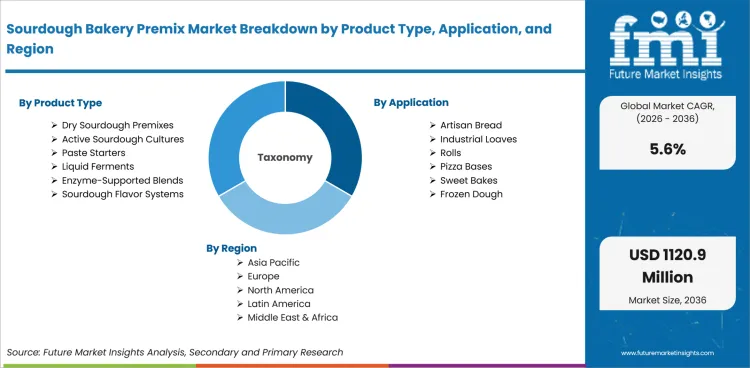
Sourdough Bakery Premix Market Breakdown by Product Type, Application, Buyer Type, Claim Positioning, Sales Channel, Format and Region
By Product Type
- Dry Sourdough Premixes
- Active Sourdough Cultures
- Paste Starters
- Liquid Ferments
- Enzyme-Supported Blends
- Sourdough Flavor Systems
By Application
- Artisan Bread
- Industrial Loaves
- Rolls
- Pizza Bases
- Sweet Bakes
- Frozen Dough
By Buyer Type
- Industrial Bakeries
- Artisan Bakeries
- Foodservice Bakeries
- In-store Bakeries
- Private Label Producers
By Claim Positioning
- Clean-label
- Wholegrain
- Organic
- High-fiber
- Reduced Additives
- Traceable Grain
By Sales Channel
- Direct Supplier Sales
- Distributor Sales
- Ingredient Platforms
- Regional Wholesalers
- Technical Bakery Service Partners
By Format
- Powder
- Blend Base
- Seed Culture
- Frozen Concentrate
- Liquid Concentrate
By Region
- North America
- Europe
- East Asia
- GCC
- Oceania
- Middle East and Africa
- Rest of World
Research Sources and Bibliography
- Australian Bureau of Statistics. (2025, January 31). Producer Price Indexes, Australia, December 2024.
- Department for Environment, Food and Rural Affairs. (2025, April 23). Bread and flour: labelling and composition.
- Department of Health and Social Care. (2024, November 14). Birth defects prevented by fortifying flour with folic acid.
- Federal Statistical Office of Germany. (2025, August 13). Inflation rate at +2.0% in July 2025.
- Lallemand Baking Solutions. (2024, September 30). Lallemand acquires CerealTech.
- Lallemand Baking Solutions. (2026, February 26). Lallemand Baking at Pizza Expo 2026.
- Puratos Group. (2024, May 7). Sapore Lavida launch marks beginning of long-term reg-ag partnerships for Puratos.
- Puratos Group. (2024, June 3). Puratos champions power of sourdough with opening of new Sourdough Institute.
- Statistics Canada. (2024, December 9). Innovation in the food processing industry, 2023.
- United States Department of Agriculture Economic Research Service. (2026, April 8). Wheat Sector at a Glance.
- United States Department of Agriculture Foreign Agricultural Service. (2025, March 20). Grain and Feed Annual: Saudi Arabia.
- United States Department of Agriculture Foreign Agricultural Service. (2026, March 18). Grain and Feed Annual: Japan.
- United States Department of Agriculture National Agricultural Statistics Service. (2026, May). Flour Milling Products 2025 Summary.
- World Integrated Trade Solution. (2024). Mixes and doughs for preparation of bakers' wares exports by country in 2024.
- Angel Yeast Co., Ltd. (2024). Angel Yeast partners with BakeMark launching multiple product lines at Bakery China 2024.
- IREKS GmbH. (2026). Grain by Grain.
- Lesaffre International. (2025, October 24). Sourdough: a ferment at the heart of global baking trends.
This Report Answers
- What is the estimated 2026 value of the sourdough bakery premix market?
- Which product type holds the largest 2026 share in sourdough bakery premixes?
- Why do industrial bakeries buy sourdough premixes instead of maintaining starters internally?
- Which countries offer the clearest commercial routes for sourdough premix suppliers?
- What supplier capabilities matter most in sourdough premix tenders?
- How do flour regulation and raw material costs affect market adoption?
- Which companies are most relevant to sourdough culture and premix supply?
- Where can bakery ingredient suppliers find cross-selling opportunities across premix formats?
Frequently Asked Questions
How big is the sourdough bakery premix market in 2026?
The market is estimated at USD 650.0 million in 2026 and is projected to reach USD 1,120.9 million by 2036.
What is the CAGR for sourdough bakery premix demand?
The market is forecast to expand at 5.6% CAGR from 2026 to 2036 based on bakery premix adoption and foodservice bread use.
Which product type leads the market?
Dry premixes lead the market with 43.0% share in 2026 due to storage stability and simple dosing.
Which buyer group is the largest?
Industrial bakeries are the largest buyer group with 46.0% share in 2026 due to repeatability and scale needs.
Which country grows the fastest?
Saudi Arabia grows fastest at 6.2% CAGR from 2026 to 2036 due to foodservice bread demand and wheat consumption.
Preview the report firsthand - request a free sample
Get SampleGet the brochure for pricing and purchase details.
Get PDFTable of Content
- Executive Summary
- Global Market Outlook
- Demand to side Trends
- Supply to side Trends
- Technology Roadmap Analysis
- Analysis and Recommendations
- Market Overview
- Market Coverage / Taxonomy
- Market Definition / Scope / Limitations
- Research Methodology
- Chapter Orientation
- Analytical Lens and Working Hypotheses
- Market Structure, Signals, and Trend Drivers
- Benchmarking and Cross-market Comparability
- Market Sizing, Forecasting, and Opportunity Mapping
- Research Design and Evidence Framework
- Desk Research Programme (Secondary Evidence)
- Company Annual and Sustainability Reports
- Peer-reviewed Journals and Academic Literature
- Corporate Websites, Product Literature, and Technical Notes
- Earnings Decks and Investor Briefings
- Statutory Filings and Regulatory Disclosures
- Technical White Papers and Standards Notes
- Trade Journals, Industry Magazines, and Analyst Briefs
- Conference Proceedings, Webinars, and Seminar Materials
- Government Statistics Portals and Public Data Releases
- Press Releases and Reputable Media Coverage
- Specialist Newsletters and Curated Briefings
- Sector Databases and Reference Repositories
- FMI Internal Proprietary Databases and Historical Market Datasets
- Subscription Datasets and Paid Sources
- Social Channels, Communities, and Digital Listening Inputs
- Additional Desk Sources
- Expert Input and Fieldwork (Primary Evidence)
- Primary Modes
- Qualitative Interviews and Expert Elicitation
- Quantitative Surveys and Structured Data Capture
- Blended Approach
- Why Primary Evidence is Used
- Field Techniques
- Interviews
- Surveys
- Focus Groups
- Observational and In-context Research
- Social and Community Interactions
- Stakeholder Universe Engaged
- C-suite Leaders
- Board Members
- Presidents and Vice Presidents
- R&D and Innovation Heads
- Technical Specialists
- Domain Subject-matter Experts
- Scientists
- Physicians and Other Healthcare Professionals
- Governance, Ethics, and Data Stewardship
- Research Ethics
- Data Integrity and Handling
- Primary Modes
- Tooling, Models, and Reference Databases
- Desk Research Programme (Secondary Evidence)
- Data Engineering and Model Build
- Data Acquisition and Ingestion
- Cleaning, Normalisation, and Verification
- Synthesis, Triangulation, and Analysis
- Quality Assurance and Audit Trail
- Market Background
- Market Dynamics
- Drivers
- Restraints
- Opportunity
- Trends
- Scenario Forecast
- Demand in Optimistic Scenario
- Demand in Likely Scenario
- Demand in Conservative Scenario
- Opportunity Map Analysis
- Product Life Cycle Analysis
- Supply Chain Analysis
- Investment Feasibility Matrix
- Value Chain Analysis
- PESTLE and Porter’s Analysis
- Regulatory Landscape
- Regional Parent Market Outlook
- Production and Consumption Statistics
- Import and Export Statistics
- Market Dynamics
- Global Market Analysis 2021 to 2025 and Forecast, 2026 to 2036
- Historical Market Size Value (USD Million) Analysis, 2021 to 2025
- Current and Future Market Size Value (USD Million) Projections, 2026 to 2036
- Y to o to Y Growth Trend Analysis
- Absolute $ Opportunity Analysis
- Global Market Pricing Analysis 2021 to 2025 and Forecast 2026 to 2036
- Global Market Analysis 2021 to 2025 and Forecast 2026 to 2036, By Product Type
- Introduction / Key Findings
- Historical Market Size Value (USD Million) Analysis By Product Type , 2021 to 2025
- Current and Future Market Size Value (USD Million) Analysis and Forecast By Product Type , 2026 to 2036
- Dry Sourdough Premixes
- Active Sourdough Cultures
- Paste Starters
- Liquid Ferments
- Enzyme-Supported Blends
- Sourdough Flavor Systems
- Dry Sourdough Premixes
- Y to o to Y Growth Trend Analysis By Product Type , 2021 to 2025
- Absolute $ Opportunity Analysis By Product Type , 2026 to 2036
- Global Market Analysis 2021 to 2025 and Forecast 2026 to 2036, By Application
- Introduction / Key Findings
- Historical Market Size Value (USD Million) Analysis By Application, 2021 to 2025
- Current and Future Market Size Value (USD Million) Analysis and Forecast By Application, 2026 to 2036
- Artisan Bread
- Industrial Loaves
- Rolls
- Pizza Bases
- Sweet Bakes
- Frozen Dough
- Artisan Bread
- Y to o to Y Growth Trend Analysis By Application, 2021 to 2025
- Absolute $ Opportunity Analysis By Application, 2026 to 2036
- Global Market Analysis 2021 to 2025 and Forecast 2026 to 2036, By Buyer Type
- Introduction / Key Findings
- Historical Market Size Value (USD Million) Analysis By Buyer Type, 2021 to 2025
- Current and Future Market Size Value (USD Million) Analysis and Forecast By Buyer Type, 2026 to 2036
- Industrial Bakeries
- Artisan Bakeries
- Foodservice Bakeries
- In-store Bakeries
- Private Label Producers
- Industrial Bakeries
- Y to o to Y Growth Trend Analysis By Buyer Type, 2021 to 2025
- Absolute $ Opportunity Analysis By Buyer Type, 2026 to 2036
- Global Market Analysis 2021 to 2025 and Forecast 2026 to 2036, By Sales Channel
- Introduction / Key Findings
- Historical Market Size Value (USD Million) Analysis By Sales Channel, 2021 to 2025
- Current and Future Market Size Value (USD Million) Analysis and Forecast By Sales Channel, 2026 to 2036
- Direct Supplier Sales
- Distributor Sales
- Ingredient Platforms
- Regional Wholesalers
- Technical Bakery Service Partners
- Direct Supplier Sales
- Y to o to Y Growth Trend Analysis By Sales Channel, 2021 to 2025
- Absolute $ Opportunity Analysis By Sales Channel, 2026 to 2036
- Global Market Analysis 2021 to 2025 and Forecast 2026 to 2036, By Claim Positioning
- Introduction / Key Findings
- Historical Market Size Value (USD Million) Analysis By Claim Positioning, 2021 to 2025
- Current and Future Market Size Value (USD Million) Analysis and Forecast By Claim Positioning, 2026 to 2036
- Clean-label
- Wholegrain
- Organic
- High-fiber
- Reduced Additives
- Traceable Grain
- Clean-label
- Y to o to Y Growth Trend Analysis By Claim Positioning, 2021 to 2025
- Absolute $ Opportunity Analysis By Claim Positioning, 2026 to 2036
- Global Market Analysis 2021 to 2025 and Forecast 2026 to 2036, By Format
- Introduction / Key Findings
- Historical Market Size Value (USD Million) Analysis By Format, 2021 to 2025
- Current and Future Market Size Value (USD Million) Analysis and Forecast By Format, 2026 to 2036
- Powder formats
- Powder formats
- Y to o to Y Growth Trend Analysis By Format, 2021 to 2025
- Absolute $ Opportunity Analysis By Format, 2026 to 2036
- Global Market Analysis 2021 to 2025 and Forecast 2026 to 2036, By Region
- Introduction
- Historical Market Size Value (USD Million) Analysis By Region, 2021 to 2025
- Current Market Size Value (USD Million) Analysis and Forecast By Region, 2026 to 2036
- North America
- Latin America
- Western Europe
- Eastern Europe
- East Asia
- South Asia and Pacific
- Middle East & Africa
- Market Attractiveness Analysis By Region
- North America Market Analysis 2021 to 2025 and Forecast 2026 to 2036, By Country
- Historical Market Size Value (USD Million) Trend Analysis By Market Taxonomy, 2021 to 2025
- Market Size Value (USD Million) Forecast By Market Taxonomy, 2026 to 2036
- By Country
- USA
- Canada
- Mexico
- By Product Type
- By Application
- By Buyer Type
- By Sales Channel
- By Claim Positioning
- By Format
- By Country
- Market Attractiveness Analysis
- By Country
- By Product Type
- By Application
- By Buyer Type
- By Sales Channel
- By Claim Positioning
- By Format
- Key Takeaways
- Latin America Market Analysis 2021 to 2025 and Forecast 2026 to 2036, By Country
- Historical Market Size Value (USD Million) Trend Analysis By Market Taxonomy, 2021 to 2025
- Market Size Value (USD Million) Forecast By Market Taxonomy, 2026 to 2036
- By Country
- Brazil
- Chile
- Rest of Latin America
- By Product Type
- By Application
- By Buyer Type
- By Sales Channel
- By Claim Positioning
- By Format
- By Country
- Market Attractiveness Analysis
- By Country
- By Product Type
- By Application
- By Buyer Type
- By Sales Channel
- By Claim Positioning
- By Format
- Key Takeaways
- Western Europe Market Analysis 2021 to 2025 and Forecast 2026 to 2036, By Country
- Historical Market Size Value (USD Million) Trend Analysis By Market Taxonomy, 2021 to 2025
- Market Size Value (USD Million) Forecast By Market Taxonomy, 2026 to 2036
- By Country
- Germany
- UK
- Italy
- Spain
- France
- Nordic
- BENELUX
- Rest of Western Europe
- By Product Type
- By Application
- By Buyer Type
- By Sales Channel
- By Claim Positioning
- By Format
- By Country
- Market Attractiveness Analysis
- By Country
- By Product Type
- By Application
- By Buyer Type
- By Sales Channel
- By Claim Positioning
- By Format
- Key Takeaways
- Eastern Europe Market Analysis 2021 to 2025 and Forecast 2026 to 2036, By Country
- Historical Market Size Value (USD Million) Trend Analysis By Market Taxonomy, 2021 to 2025
- Market Size Value (USD Million) Forecast By Market Taxonomy, 2026 to 2036
- By Country
- Russia
- Poland
- Hungary
- Balkan & Baltic
- Rest of Eastern Europe
- By Product Type
- By Application
- By Buyer Type
- By Sales Channel
- By Claim Positioning
- By Format
- By Country
- Market Attractiveness Analysis
- By Country
- By Product Type
- By Application
- By Buyer Type
- By Sales Channel
- By Claim Positioning
- By Format
- Key Takeaways
- East Asia Market Analysis 2021 to 2025 and Forecast 2026 to 2036, By Country
- Historical Market Size Value (USD Million) Trend Analysis By Market Taxonomy, 2021 to 2025
- Market Size Value (USD Million) Forecast By Market Taxonomy, 2026 to 2036
- By Country
- China
- Japan
- South Korea
- By Product Type
- By Application
- By Buyer Type
- By Sales Channel
- By Claim Positioning
- By Format
- By Country
- Market Attractiveness Analysis
- By Country
- By Product Type
- By Application
- By Buyer Type
- By Sales Channel
- By Claim Positioning
- By Format
- Key Takeaways
- South Asia and Pacific Market Analysis 2021 to 2025 and Forecast 2026 to 2036, By Country
- Historical Market Size Value (USD Million) Trend Analysis By Market Taxonomy, 2021 to 2025
- Market Size Value (USD Million) Forecast By Market Taxonomy, 2026 to 2036
- By Country
- India
- ASEAN
- Australia & New Zealand
- Rest of South Asia and Pacific
- By Product Type
- By Application
- By Buyer Type
- By Sales Channel
- By Claim Positioning
- By Format
- By Country
- Market Attractiveness Analysis
- By Country
- By Product Type
- By Application
- By Buyer Type
- By Sales Channel
- By Claim Positioning
- By Format
- Key Takeaways
- Middle East & Africa Market Analysis 2021 to 2025 and Forecast 2026 to 2036, By Country
- Historical Market Size Value (USD Million) Trend Analysis By Market Taxonomy, 2021 to 2025
- Market Size Value (USD Million) Forecast By Market Taxonomy, 2026 to 2036
- By Country
- Kingdom of Saudi Arabia
- Other GCC Countries
- Turkiye
- South Africa
- Other African Union
- Rest of Middle East & Africa
- By Product Type
- By Application
- By Buyer Type
- By Sales Channel
- By Claim Positioning
- By Format
- By Country
- Market Attractiveness Analysis
- By Country
- By Product Type
- By Application
- By Buyer Type
- By Sales Channel
- By Claim Positioning
- By Format
- Key Takeaways
- Key Countries Market Analysis
- USA
- Pricing Analysis
- Market Share Analysis, 2025
- By Product Type
- By Application
- By Buyer Type
- By Sales Channel
- By Claim Positioning
- By Format
- Canada
- Pricing Analysis
- Market Share Analysis, 2025
- By Product Type
- By Application
- By Buyer Type
- By Sales Channel
- By Claim Positioning
- By Format
- Mexico
- Pricing Analysis
- Market Share Analysis, 2025
- By Product Type
- By Application
- By Buyer Type
- By Sales Channel
- By Claim Positioning
- By Format
- Brazil
- Pricing Analysis
- Market Share Analysis, 2025
- By Product Type
- By Application
- By Buyer Type
- By Sales Channel
- By Claim Positioning
- By Format
- Chile
- Pricing Analysis
- Market Share Analysis, 2025
- By Product Type
- By Application
- By Buyer Type
- By Sales Channel
- By Claim Positioning
- By Format
- Germany
- Pricing Analysis
- Market Share Analysis, 2025
- By Product Type
- By Application
- By Buyer Type
- By Sales Channel
- By Claim Positioning
- By Format
- UK
- Pricing Analysis
- Market Share Analysis, 2025
- By Product Type
- By Application
- By Buyer Type
- By Sales Channel
- By Claim Positioning
- By Format
- Italy
- Pricing Analysis
- Market Share Analysis, 2025
- By Product Type
- By Application
- By Buyer Type
- By Sales Channel
- By Claim Positioning
- By Format
- Spain
- Pricing Analysis
- Market Share Analysis, 2025
- By Product Type
- By Application
- By Buyer Type
- By Sales Channel
- By Claim Positioning
- By Format
- France
- Pricing Analysis
- Market Share Analysis, 2025
- By Product Type
- By Application
- By Buyer Type
- By Sales Channel
- By Claim Positioning
- By Format
- India
- Pricing Analysis
- Market Share Analysis, 2025
- By Product Type
- By Application
- By Buyer Type
- By Sales Channel
- By Claim Positioning
- By Format
- ASEAN
- Pricing Analysis
- Market Share Analysis, 2025
- By Product Type
- By Application
- By Buyer Type
- By Sales Channel
- By Claim Positioning
- By Format
- Australia & New Zealand
- Pricing Analysis
- Market Share Analysis, 2025
- By Product Type
- By Application
- By Buyer Type
- By Sales Channel
- By Claim Positioning
- By Format
- China
- Pricing Analysis
- Market Share Analysis, 2025
- By Product Type
- By Application
- By Buyer Type
- By Sales Channel
- By Claim Positioning
- By Format
- Japan
- Pricing Analysis
- Market Share Analysis, 2025
- By Product Type
- By Application
- By Buyer Type
- By Sales Channel
- By Claim Positioning
- By Format
- South Korea
- Pricing Analysis
- Market Share Analysis, 2025
- By Product Type
- By Application
- By Buyer Type
- By Sales Channel
- By Claim Positioning
- By Format
- Russia
- Pricing Analysis
- Market Share Analysis, 2025
- By Product Type
- By Application
- By Buyer Type
- By Sales Channel
- By Claim Positioning
- By Format
- Poland
- Pricing Analysis
- Market Share Analysis, 2025
- By Product Type
- By Application
- By Buyer Type
- By Sales Channel
- By Claim Positioning
- By Format
- Hungary
- Pricing Analysis
- Market Share Analysis, 2025
- By Product Type
- By Application
- By Buyer Type
- By Sales Channel
- By Claim Positioning
- By Format
- Kingdom of Saudi Arabia
- Pricing Analysis
- Market Share Analysis, 2025
- By Product Type
- By Application
- By Buyer Type
- By Sales Channel
- By Claim Positioning
- By Format
- Turkiye
- Pricing Analysis
- Market Share Analysis, 2025
- By Product Type
- By Application
- By Buyer Type
- By Sales Channel
- By Claim Positioning
- By Format
- South Africa
- Pricing Analysis
- Market Share Analysis, 2025
- By Product Type
- By Application
- By Buyer Type
- By Sales Channel
- By Claim Positioning
- By Format
- USA
- Market Structure Analysis
- Competition Dashboard
- Competition Benchmarking
- Market Share Analysis of Top Players
- By Regional
- By Product Type
- By Application
- By Buyer Type
- By Sales Channel
- By Claim Positioning
- By Format
- Competition Analysis
- Competition Deep Dive
- Puratos Group
- Overview
- Product Portfolio
- Profitability by Market Segments (Product/Age /Sales Channel/Region)
- Sales Footprint
- Strategy Overview
- Marketing Strategy
- Product Strategy
- Channel Strategy
- Lesaffre International
- IREKS GmbH
- Ernst Böcker GmbH & Co. KG
- Lallemand Baking Solutions
- AB Mauri
- Angel Yeast Co., Ltd.
- Puratos Group
- Competition Deep Dive
- Assumptions & Acronyms Used


