

- Market Size (2026)
- USD 314.6 Mn
- Forecast (2036)
- USD 704.8 Mn
- CAGR (2026 to 2036)
- 8.4%
High-Fiber Mediterranean Snack Coating Ingredients Market Size, Market Forecast and Outlook By FMI
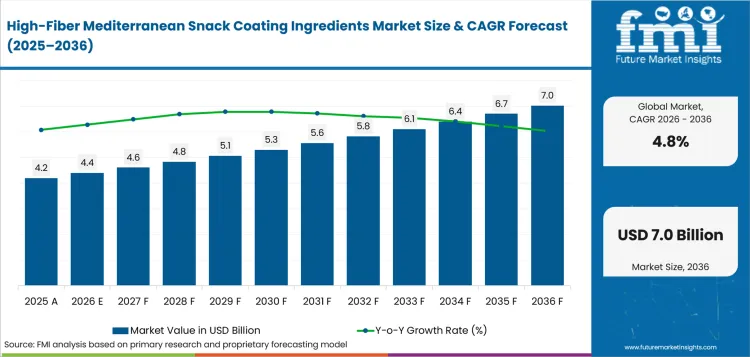
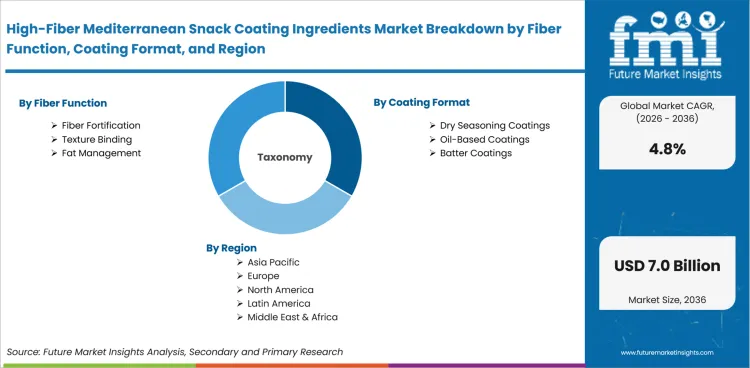
The high-fiber Mediterranean snack coating ingredients market value is expected to rise from USD 290.2 million in 2025 to USD 704.8 million by 2036 at an 8.4% CAGR, propelled by fiber claim needs and Mediterranean savoury snack reformulation with fiber fortification contributing 44.2% share and dry seasoning coatings holding 42.8% share as manufacturers prioritize label-ready nutrition and stable coating performance.
Key Takeaways, Market Size and Forecast
- 2025 Market Size: USD 290.2 million
- 2026 Market Size: USD 314.6 million
- 2036 Market Size: USD 704.8 million
- Forecast CAGR: 4.8% from 2026 to 2036
- Leading Fitment Type: OEM fitment
- OEM Fitment Share in 2026: 66.0%
- Leading System Type: Rear axle systems
- Rear Axle Systems Share in 2026: 48.5%
- Faster-growing Country: India
- Faster-growing Country CAGR: 10.2%
Summary of the High-Fiber Mediterranean Snack Coating Ingredients Market
- Demand and Growth Drivers
- Fiber claim needs increase demand for coating ingredients as snack makers improve nutrition without changing base snack formats.
- Mediterranean flavor positioning boosts coating trials as olive and tomato profiles suit savory snacks.
- Functional coating work benefits from food coating ingredients industry analysis as ingredient suppliers refine coating systems for baked and extruded snacks.
- Product and Segment View
- Label-claim planning places fiber fortification in the leading position, with the segment expected to account for 44.2% share in 2026 across savory snack coating applications.
- Dry seasoning coatings are projected to capture 42.8% of coating format demand in 2026, driven by easier powder handling across tumbling and seasoning lines.
- Grain fiber blends hold better formulation value in pita chips and seeded crackers, since cereal fibers match baked snack texture better in comparison to heavier fiber systems.
- Geography and Competitive Outlook
- India is expected to record a CAGR of 10.2% through 2036, as millet processing and premium snack launches expand.
- China is projected to expand at 9.6% CAGR by 2036, as food retail scale and fiber policy direction strengthen demand.
- Companies combining fiber functionality with flavor masking skill are strengthening market position during the forecast period.
- Analyst Opinion
- Nandini Roy Choudhury, Principal Consultant for Food and Beverage at FMI, says, “High-fiber Mediterranean snack coatings are becoming product design choices across savory snacks. Snack brands need measurable fiber delivery with familiar taste. Specialty fibers and flavor masking raise cost. Particle control and seasoning balance reduce trials while claim thresholds guide recipes.”
- High-Fiber Mediterranean Snack Coating Ingredients Market Value Analysis
- The high-fiber Mediterranean snack coating ingredients market is moving from basic seasoning use into nutrition-focused coating work.
- Adoption is being driven by fiber claim needs across pita chips and legume crisps.
- The market is benefiting from deeper use of dietary fiber market outlook insights across food ingredient planning.
- Demand is supported by coating formats meeting flavor delivery and texture needs. These formats protect eating quality and help product launch timing.
High-fiber Mediterranean snack coatings need to deliver enough fiber for a credible label claim and keep the snack pleasant to eat. FDA lists 28 g as the Daily Value for dietary fiber and treats 20% DV or more per serving as a high level. This means coating formulas need measured fiber levels instead of broad better-for-you claims. Ingredion’s July 2024 FIBERTEX CF 500 and CF 100 launch is relevant because the citrus fibers are positioned for viscosity and texture stability.
This helps snack makers build fiber into coatings without losing seasoning performance. Tate & Lyle’s June 2026 NutraStrong certification for four prebiotic fiber product lines raises the evidence bar for gut-health positioning. PROMITOR Soluble Fibre is backed by over 20 scientific studies. Snack brands are likely to prefer coating ingredients with claim support and proven nutrition evidence.
High-Fiber Mediterranean Snack Coating Ingredients Market Definition
The high-fiber Mediterranean snack coating ingredients market includes fiber-bearing coating ingredients used before or after snack baking and extrusion. These ingredients improve fiber content, texture, flavor carrying, oil management, and seasoning adhesion across savory snack formats. Scope includes grain fiber blends, pulse fiber blends, citrus fiber, olive pomace fiber, dry coatings, oil-based coatings, and adhesion systems. Finished packaged snacks and household seasoning jars are outside the scope.
High-Fiber Mediterranean Snack Coating Ingredients Market Inclusions
Market scope covers all commercially traded high-fiber Mediterranean snack coating ingredients categorized by ingredient type, including grain fiber blends, pulse fiber blends, seed fiber blends, citrus fiber, and olive pomace fiber, coating format, including dry seasoning coatings, oil-based coatings, batter coatings, adhesion slurries, and dusting premixes, snack base, including pita chips, seed crackers, legume crisps, baked nuts, and vegetable chips, fiber function, including fiber fortification, texture binding, fat management, flavor carrying, and moisture control, and buyer type, including snack brands, bakery producers, private labels, foodservice suppliers, and co-packers.
Revenue scope covers 2026 to 2036. The key stakeholders include fiber ingredient suppliers, seasoning houses, coating premix manufacturers, snack brands, bakery snack producers, private label manufacturers, co-packers, foodservice snack suppliers, distributors, formulation labs, and regulatory bodies. A clean-label ingredients market outlook comparison is relevant as coating buyers prioritize ingredient familiarity and claim-friendly formulation, while plant-based snacks demand supports the link between high-fiber coatings and savory plant-based snack development.
High-Fiber Mediterranean Snack Coating Ingredients Market Exclusions
Scope does not include finished snack brands, chocolate coatings, dairy glazes, sweet confectionery toppings, supplement powders, or plain fibers sold without coating use.
High-Fiber Mediterranean Snack Coating Ingredients Market Research Methodology
- Primary Research: FMI analysts spoke to snack manufacturers, ingredient formulators, coating premix suppliers, and seasoning specialists across important markets.
- Desk Research: Combined data from public nutrition sources, ingredient portfolios, coating applications, and adjacent food dietary fibers references.
- Market sizing and forecasting: Added coating use across snack bases and ingredient groups from the bottom up.
- Data validation: Cross-checked every three months against supplier portfolios, fiber functionality, snack coating use rates, and country-level demand patterns.
Why is the High-Fiber Mediterranean Snack Coating Ingredients Market Growing?
- Snack makers are using fiber coatings earlier to reduce nutrition reformulation risk before full recipe redesign begins.
- Coating partners are becoming important as snack formats combine fiber claims with flavor adhesion needs.
- Manufacturers are using specialty premixes from suppliers with higher masking systems and application-ready documentation.
Savory snack reformulation needs practical changes as snack plants avoid costly base product redesign. USDA reported in 2024 multiple snacks are common among United States adults, with 78% consuming two or more snacks on a given day. This consumption base makes coating reformulation useful for manufacturers seeking nutrient improvement through familiar snack occasions. Suppliers with fiber systems and seasoning expertise help brands test claim-bearing snacks without changing equipment.
Packaged food scrutiny gives fiber coatings another reason to move into snack development. CDC reported in August 2025 adults consumed 53.0% of calories from ultra-processed foods during August 2021 to August 2023. This strengthens pressure on snack makers to improve nutrient profiles inside common packaged foods. High-fiber coatings can improve product positioning without removing salty flavor cues or familiar formats.
Market Segmentation Analysis
- Baked chips and crackers keep grain fiber blends in the lead, with the segment forecast at 36.4% of ingredient type demand in 2026.
- Dry seasoning coatings are projected to capture 42.8% share in 2026, mainly through their fit with tumbling and seasoning lines.
- Pita chips are expected to represent 31.6% of snack base sales in 2026 as their baked profile matches olive, herb and sesame coating systems.
- Label claim planning gives fiber fortification the leading role, with a projected 44.2% share of fiber function use in 2026.
- Snack brands are predicted to hold 39.5% of buyer-side value in 2026 since brand owners control claim wording and flavor direction.
The market for high-fiber Mediterranean snack coating ingredients is divided into groups based on ingredient type, coating format, snack base, fiber function, buyer type, and region. By ingredient type, the market includes grain fiber blends, pulse fiber blends, seed fiber blends, citrus fiber, and olive pomace fiber. By coating format, the market covers dry seasoning coatings, oil-based coatings, batter coatings, adhesion slurries, and dusting premixes. A seasoning market outlook comparison is relevant as flavor systems guide the use of herb, olive, tomato, and sesame coating profiles.
By snack base, the market includes pita chips, seed crackers, legume crisps, baked nuts, and vegetable chips. Based on fiber function, it covers fiber fortification, texture binding, fat management, flavor carrying, and moisture control. A food premix demand outlook comparison helps position dry coating blends within broader premix-based food formulation. By buyer type, the market includes snack brands, bakery producers, private labels, foodservice suppliers, and co-packers.
Insights into High-Fiber Mediterranean Snack Coating Ingredients Market by Fiber Function
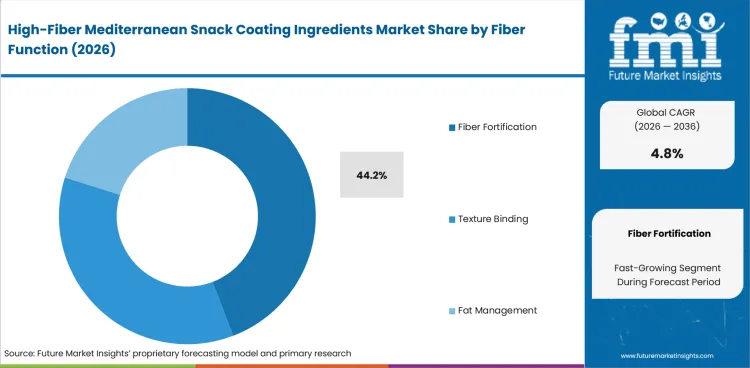
- In 2026, fiber fortification is expected to contribute 44.2% of the fiber function segment. Snack makers use this function to add measurable fiber claims without changing the base savory snack format.
- Texture binding and moisture control address selected formulation needs. Their value improves in baked snacks requiring better seasoning hold and lower powder loss during packing.
Insights into High-Fiber Mediterranean Snack Coating Ingredients Market by Coating Format
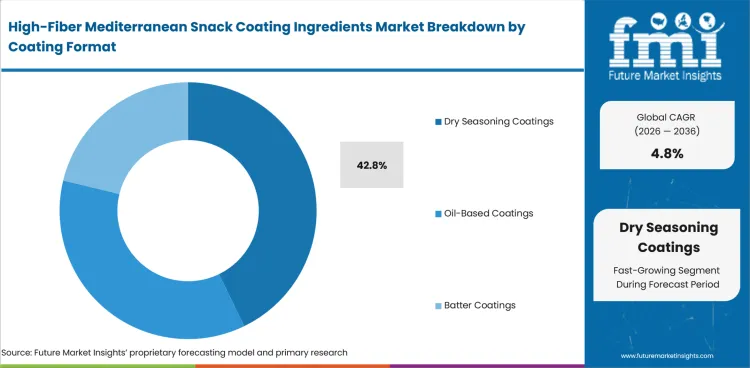
- Dry seasoning coatings are projected to account for 42.8% of the coating format segment in 2026. Powder systems suit industrial tumbling lines and help manufacturers reduce oil handling during snack coating.
- Oil-based coatings and adhesion slurries support products needing higher surface hold. Their use improves in nuts and snacks with uneven surfaces.
Insights into High-Fiber Mediterranean Snack Coating Ingredients Market by Ingredient Type
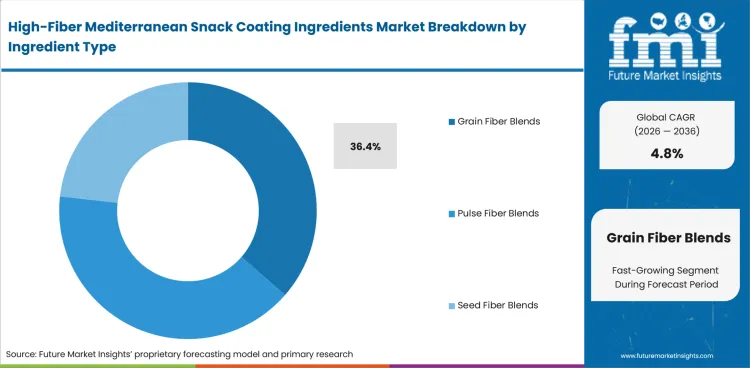
- Grain fiber blends are forecast to hold 36.4% of the ingredient type segment in 2026. Cereal fibers suit pita chips and seeded crackers as they match baked texture better as compared to heavier fiber systems.
- Pulse fiber blends and citrus fiber serve more specific formulation needs. Their value increases in legume crisps and clean-label coatings requiring better texture control.
Insights into High-Fiber Mediterranean Snack Coating Ingredients Market by Snack Base
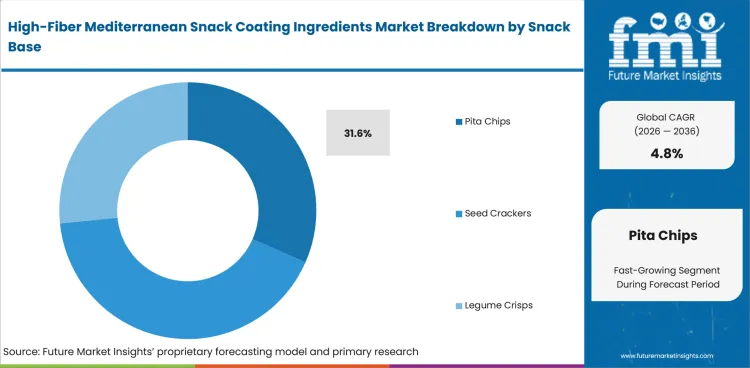
- Pita chips are projected to account for 31.6% of the snack base segment in 2026. The format works well with olive oil and sesame coating profiles.
- Seed crackers and legume crisps support premium snack development. Their appeal improves in recipes requiring visible grains and stronger nutrition cues.
Insights into High-Fiber Mediterranean Snack Coating Ingredients Market by Buyer Type
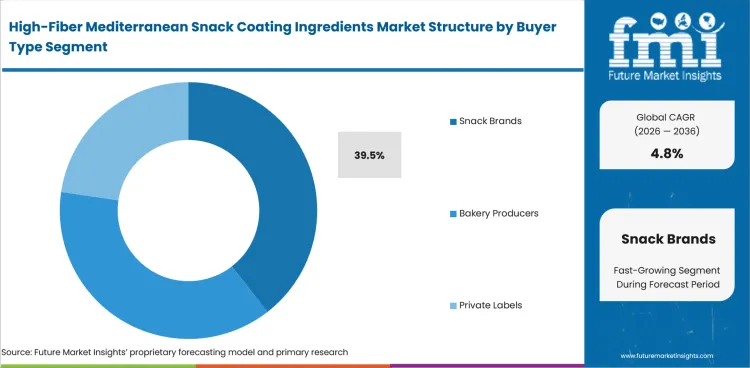
- Snack brands are expected to hold 39.5% of the buyer type segment in 2026. Brand owners control claim wording and flavor direction, making them key buyers for tailored coating systems.
- Private labels and co-packers support scale-up demand after successful product trials. Their role improves when retailers need consistent fiber delivery across repeat production batches.
High-Fiber Mediterranean Snack Coating Ingredients Market Drivers, Restraints and Opportunities
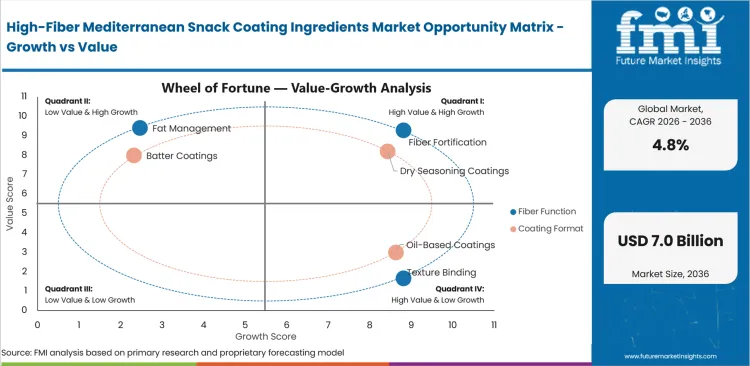
- Driver: Softer olive oil and pulse flour pricing keeps high-fiber Mediterranean coating trials active across baked chips and snack mixes.
- Restraint: Origin-specific olive oil pricing can complicate contracts as Spanish, Italian and Greek price corrections are moving unevenly.
- Opportunity: Lower pulse flour prices make space for higher-fiber coating blends before export demand tightens ingredient availability.
Premium Mediterranean coating bases are gaining better cost visibility after olive oil prices eased from drought-driven peaks. International Olive Council reported in January 2026 on extra virgin olive oil producer prices across key Mediterranean origins. For the week of December 8 to 14 the Jaén Spain price stood at €433 per 100 kg. This represented an 11% year over year decline for Spanish origin supply. Bari Italy stood at €665 per 100 kg for the same week.
This represented a 30% year over year decline for Italian origin supply. Chania Greece stood at €465 per 100 kg during the same period. This represented a 6% year over year decline for Greek origin supply. Lower oil pressure improves trial economics for baked chips and pulse puffs. The same cost relief helps crispbread and nut coating formulations. Buyers now compare Mediterranean origin cost with flavor quality and supply reliability. Suppliers with origin-specific buying options can protect formulation value during price swings.
Pulse Flour Reformulation and Inclusion Cost Analysis
Application demand is most flexible when pulse flour costs allow formulators to raise fiber content without weakening margins. USDA ERS reported in April 2025, all-chickpea nominal monthly grower prices averaged $30.87 per cwt for the 2024/25 marketing year through February 2025, 16% below the same September to February period in 2023/24. Dry pea and lentil prices averaged 10% lower, while lentil prices were 5% lower. Lower pulse costs do not remove sensory risk, but they improve room for coating trials. Formulators can test chickpea and lentil flour blends with less immediate gross margin pressure. Dry pea and bean flour systems can be evaluated separately for cost and texture balance.
Ingredient Sourcing and Contract Planning Analysis
Sourcing exposure gives high-fiber Mediterranean snack coatings a different risk profile from standard seasoning systems. Olive oil cost relief varies by origin, while pulse flour softness relies on crop cycles and export demand. This means ingredient contracts need separate pricing views for oil-based binders and pulse-based coating solids. Buyers favor suppliers with dual sourcing and clear origin records. Application support helps buyers manage recipe changes during cost swings. Coating manufacturers with flexible recipes can switch between citrus fiber and pulse flour systems. Grain fiber systems can be used separately when cost or texture needs change.
Analysis of High-Fiber Mediterranean Snack Coating Ingredients Market By Key Countries
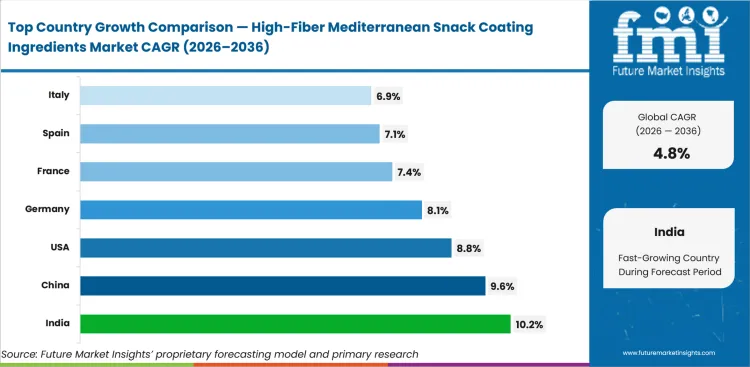
.webp "Top Country Growth Comparison High-Fiber Mediterranean Snack Coating Ingredients Market Cagr (2026 2036)")
| Country | CAGR |
|---|---|
| India | 10.2% |
| China | 9.6% |
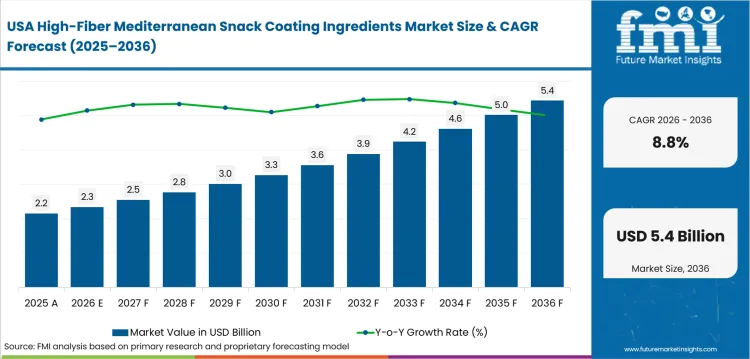
| USA | 8.8% |
| Germany | 8.1% |
| France | 7.4% |
| Spain | 7.1% |
| Italy | 6.9% |
Source: Future Market Insights, 2026.
Demand Outlook for High-Fiber Mediterranean Snack Coating Ingredients Industry in India
Faster-growing country market • 2026 to 2036
Country Market Snapshot Table
| Parameter | Value |
|---|---|
| Market Size in 2025 | USD 18.5 million |
| Market Forecast in 2036 | USD 53.8 million |
| CAGR (2026-2036) | 10.2% |
| Years Considered | 2016-2036 |
| Base Year | 2025 |
| Forecast Period | 2026-2036 |
| Units Considered | Value (USD Million) |
| Leading Sub-Region | West India |
India Market Outlook
West India and South India make India commercially important for high-fiber Mediterranean snack coating ingredients through processed snack capacity and millet-based product work. PIB reported in March 2026 PMFME had approved 4,612 micro food processing enterprises with subsidy of Rs. 91.20 crore for millet processing units. This processing base improves demand for fiber-rich coatings used in baked chips and savory premixes. Mumbai and Pune are important for branded snack launches connected to premium retail. Bengaluru and Hyderabad are important for millet snack testing and private label production.
Food processing support strengthens India’s manufacturing base as large firms and micro units expand value-added snack formats. Demand will expand faster in clusters with ingredient testing capacity and organized retail access.
Key Growth Drivers
- Maharashtra snack producers increase coating ingredient buying as baked chip and namkeen premiumization grows across Mumbai and Pune.
- Karnataka millet processors create demand for fiber coatings across Bengaluru healthy snack launches and export-oriented recipes.
- PMFME support improves small unit capacity for millet-based snacks and functional coating adoption.
- Gujarat snack manufacturers favor suppliers with stable dry premixes and quick distributor access across Ahmedabad and Surat.
Key Restraints
- Price-sensitive packs reduce use of premium citrus fiber and olive pomace fiber across mass-market savory snacks.
- Sensory variation in millet snacks can slow high-fiber coating adoption outside larger branded plants.
- Imported specialty fiber reliance can raise recipe cost during currency and freight pressure.
What makes India unique
India combines millet processing support with fast premium snack development, making local coating trials central to supplier selection.
Key Companies
- Ingredion India
- Tate & Lyle India
- Cargill India
- Kerry Ingredients India
- ADM India
Sales and Marketing Channels
- Direct manufacturer supply
- Ingredient distributor networks
- Private label contracts
- Retail snack brand programs
- Pilot formulation partnerships
Country Segment Breakdown Table
| Segment | Sub-Segments |
|---|---|
| By Ingredient Type | Grain Fiber Blends, Pulse Fiber Blends, Seed Fiber Blends, Citrus Fiber, Olive Pomace Fiber |
| By Coating Format | Dry Seasoning Coatings, Oil-Based Coatings, Batter Coatings, Adhesion Slurries, Dusting Premixes |
| By Snack Base | Pita Chips, Seed Crackers, Legume Crisps, Baked Nuts, Vegetable Chips |
| By Fiber Function | Fiber Fortification, Texture Binding, Fat Management, Flavor Carrying, Moisture Control |
| By Buyer Type | Snack Brands, Bakery Producers, Private Labels, Foodservice Suppliers, Co-packers |
Market Taxonomy and Sub-Regions Covered
| Key Sub-Regions Covered | States / Cities |
|---|---|
| India | Maharashtra, Gujarat, Karnataka, Telangana, Delhi NCR, Tamil Nadu, Rajasthan, Uttar Pradesh |
Frequently Asked Questions
How fast is India’s high-fiber Mediterranean snack coating ingredients industry growing?
India is projected to expand at a 10.2% CAGR from 2026 to 2036, ranking first among listed countries.
Who leads India high-fiber Mediterranean snack coating ingredients demand?
Ingredion India, Kerry Ingredients India, and Cargill India lead through formulation access and food manufacturer relationships.
What is driving industry outlook in India?
Millet processing support and premium snack launches are driving demand for fiber-rich Mediterranean coating systems across organized snack producers.
Sales Analysis of High-Fiber Mediterranean Snack Coating Ingredients Industry in China
Large food retail base • 2026 to 2036
Country Market Snapshot Table
| Parameter | Value |
|---|---|
| Market Size in 2025 | USD 38.8 million |
| Market Forecast in 2036 | USD 106.4 million |
| CAGR (2026-2036) | 9.6% |
| Years Considered | 2016-2036 |
| Base Year | 2025 |
| Forecast Period | 2026-2036 |
| Units Considered | Value (USD Million) |
| Leading Sub-Region | East China |
China Market Outlook
East China gives China a firm demand base through food retail scale and large snack manufacturing clusters. USDA FAS reported in July 2025 China’s food processing industry reached USD 1.3 trillion in 2024 after 2.2% annual growth. This industrial base favors coating ingredient trials across premium savory snacks and baked product lines. Shanghai and Jiangsu are important purchasing zones for imported fibers and seasoning systems. Guangdong and Zhejiang are important for snack export production and retail brand development.
Nutrition policy direction strengthens China’s reformulation pathway across processed foods. China’s National Health Commission stated in March 2025 daily dietary fiber intake is expected to rise to 25 to 30 grams under national food and nutrition guidance. Suppliers must work through local distributors and manufacturer test kitchens.
Key Growth Drivers
- Shanghai food manufacturers increase use of high-fiber coatings across premium baked snack programs.
- Jiangsu processing clusters strengthen demand for dry premixes with stable powder flow and flavor release.
- Guangdong snack exporters require fiber systems with consistent labeling and sensory acceptance.
- National nutrition guidance improves the case for fiber-bearing coatings across processed food categories.
Key Restraints
- Price review by large snack groups reduces flexibility for specialty fiber use in mainstream packs.
- Local flavor preferences can limit Mediterranean profiles outside top-tier urban retail shelves.
- Imported ingredient approvals and distributor lead times extend reformulation cycles.
What makes China unique
China combines huge food processing scale with national fiber intake direction, making manufacturer access and local trial support decisive.
Key Companies
- Ingredion China
- Tate & Lyle China
- Cargill China
- Kerry China
- IFF China
Sales and Marketing Channels
- Direct food manufacturer supply
- Ingredient distributor networks
- Snack plant trials
- Retail brand formulation programs
- Foodservice snack supply
Country Segment Breakdown Table
| Segment | Sub-Segments |
|---|---|
| By Ingredient Type | Grain Fiber Blends, Pulse Fiber Blends, Seed Fiber Blends, Citrus Fiber, Olive Pomace Fiber |
| By Coating Format | Dry Seasoning Coatings, Oil-Based Coatings, Batter Coatings, Adhesion Slurries, Dusting Premixes |
| By Snack Base | Pita Chips, Seed Crackers, Legume Crisps, Baked Nuts, Vegetable Chips |
| By Fiber Function | Fiber Fortification, Texture Binding, Fat Management, Flavor Carrying, Moisture Control |
| By Buyer Type | Snack Brands, Bakery Producers, Private Labels, Foodservice Suppliers, Co-packers |
Market Taxonomy and Sub-Regions Covered
| Key Sub-Regions Covered | Provinces / Municipalities |
|---|---|
| China | Shanghai, Jiangsu, Zhejiang, Guangdong, Beijing, Shandong, Sichuan, Hubei |
Frequently Asked Questions
How fast is China’s high-fiber Mediterranean snack coating ingredients industry growing?
China is projected to expand at a 9.6% CAGR from 2026 to 2036, ranking second among listed countries.
Who leads China high-fiber Mediterranean snack coating ingredients demand?
Ingredion China, Cargill China, and Kerry China lead through ingredient portfolios and food plant access.
What is driving industry outlook in China?
Food retail scale and national fiber intake guidance are driving coating ingredient trials across premium snack formats.
Demand Analysis of High-Fiber Mediterranean Snack Coating Ingredients Industry in the USA
Large mature snack base • 2026 to 2036
Country Market Snapshot Table
| Parameter | Value |
|---|---|
| Market Size in 2025 | USD 70.2 million |
| Market Forecast in 2036 | USD 177.5 million |
| CAGR (2026-2036) | 8.8% |
| Years Considered | 2016-2036 |
| Base Year | 2025 |
| Forecast Period | 2026-2036 |
| Units Considered | Value (USD Million) |
| Leading Sub-Region | West Coast USA |
USA Market Outlook
West Coast and Northeast retail channels make the USA important through premium snack shelves and high fiber claim awareness. CDC reported in August 2025 savory snacks contributed 3.4% of total adult calories from ultra-processed foods during August 2021 to August 2023. This snack exposure keeps reformulation inside brand planning for better nutrition profiles. California and New York are important launch zones for Mediterranean snack products. Illinois and Pennsylvania are important for production and distribution access.
Key Growth Drivers
- California snack brands increase coating trials across pita chips and seed crackers in premium retail channels.
- New York specialty food retailers raise demand for Mediterranean flavors and front-pack fiber positioning.
- Illinois processing networks strengthen demand for scalable dry coating premixes and seasoning systems.
- USDA dietary data keeps snacking visible inside nutrition discussions for adults and households.
Key Restraints
- Mature retail competition raises failure risk for coatings with gritty texture or muted flavor release.
- Higher specialty fiber costs limit broad use in value-priced savory snack packs.
- Retailer claim review can slow launch timing across national branded snack programs.
What makes USA unique
The USA combines high snack frequency with mature retail testing, making flavor acceptance and claim compliance central to competition.
Key Companies
- Ingredion Incorporated
- Tate & Lyle PLC
- Cargill Incorporated
- Kerry Group
- IFF
Sales and Marketing Channels
- Direct brand supply
- National distributor programs
- Co-manufacturer supply
- Retail private label contracts
- Application lab trials
Country Segment Breakdown Table
| Segment | Sub-Segments |
|---|---|
| By Ingredient Type | Grain Fiber Blends, Pulse Fiber Blends, Seed Fiber Blends, Citrus Fiber, Olive Pomace Fiber |
| By Coating Format | Dry Seasoning Coatings, Oil-Based Coatings, Batter Coatings, Adhesion Slurries, Dusting Premixes |
| By Snack Base | Pita Chips, Seed Crackers, Legume Crisps, Baked Nuts, Vegetable Chips |
| By Fiber Function | Fiber Fortification, Texture Binding, Fat Management, Flavor Carrying, Moisture Control |
| By Buyer Type | Snack Brands, Bakery Producers, Private Labels, Foodservice Suppliers, Co-packers |
Market Taxonomy and Sub-Regions Covered
| Key Sub-Regions Covered | States / Cities |
|---|---|
| USA | California, New York, Illinois, Pennsylvania, Texas, Florida, New Jersey, Washington |
Frequently Asked Questions
How fast is the USA high-fiber Mediterranean snack coating ingredients industry growing?
The USA is projected to expand at an 8.8% CAGR from 2026 to 2036, due to mature snack reformulation.
Who leads USA high-fiber Mediterranean snack coating ingredients demand?
Ingredion, Cargill, and Kerry Group lead through technical centers and national food manufacturer access.
What is driving industry outlook in the USA?
Frequent snacking and retail demand for better nutrition are driving fiber coating trials across premium savory snacks.
Opportunity Analysis of High-Fiber Mediterranean Snack Coating Ingredients Market in Germany
Health-focused retail market • 2026 to 2036
Country Market Snapshot Table
| Parameter | Value |
|---|---|
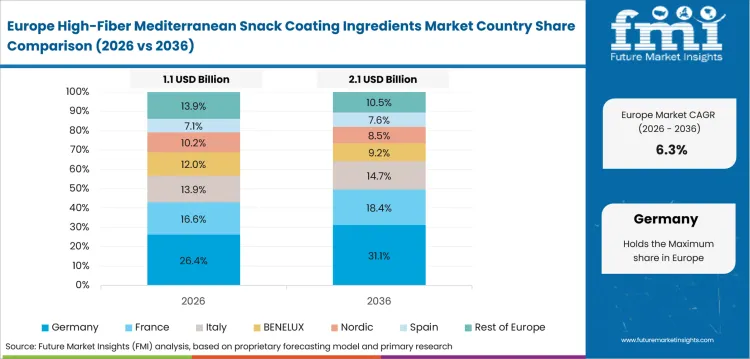
| Market Size in 2025 | USD 21.6 million |
| Market Forecast in 2036 | USD 50.9 million |
| CAGR (2026-2036) | 8.1% |
| Years Considered | 2016-2036 |
| Base Year | 2025 |
| Forecast Period | 2026-2036 |
| Units Considered | Value (USD Million) |
| Leading Sub-Region | North Rhine-Westphalia |
Germany Market Outlook
North Rhine-Westphalia and Bavaria make Germany important through food manufacturing depth and strong retail standards. BMEL’s Food and Nutrition Strategy was adopted on 17 January 2024, giving manufacturers a clear policy frame around healthier food choices. This supports reformulation of salty snacks and baked snack products. Cologne and Düsseldorf are important for food retail testing. Munich and Hamburg are important for premium snack distribution and ingredient buying.
German manufacturers prefer coating systems with clean labels and reliable texture across baked snack applications. Suppliers need firm technical documentation and EU-compliant ingredient support.
Key Growth Drivers
- North Rhine-Westphalia food processors increase coating use across baked crackers and premium savory snacks.
- Bavaria retail channels support Mediterranean flavors through premium grocery and natural food shelves.
- BMEL nutrition policy direction strengthens demand for snack reformulation with better nutrient profiles.
- Hamburg distribution networks improve ingredient access for national snack brands and private labels.
Key Restraints
- Strict retail quality checks reduce tolerance for gritty coating texture and inconsistent seasoning adhesion.
- Premium ingredient pricing limits rapid rollout across discount retailer snack ranges.
- EU labeling review increases documentation needs for fiber claims and ingredient positioning.
What makes Germany unique
Germany combines efficient food manufacturing with health-focused retail scrutiny, making technical proof and label clarity central to supplier success.
Key Companies
- Ingredion Germany
- BENEO
- Tate & Lyle Germany
- Kerry Germany
- Cargill Germany
Sales and Marketing Channels
- Direct manufacturer supply
- Natural food retail programs
- Ingredient distributor networks
- Private label contracts
- Application center trials
Country Segment Breakdown Table
| Segment | Sub-Segments |
|---|---|
| By Ingredient Type | Grain Fiber Blends, Pulse Fiber Blends, Seed Fiber Blends, Citrus Fiber, Olive Pomace Fiber |
| By Coating Format | Dry Seasoning Coatings, Oil-Based Coatings, Batter Coatings, Adhesion Slurries, Dusting Premixes |
| By Snack Base | Pita Chips, Seed Crackers, Legume Crisps, Baked Nuts, Vegetable Chips |
| By Fiber Function | Fiber Fortification, Texture Binding, Fat Management, Flavor Carrying, Moisture Control |
| By Buyer Type | Snack Brands, Bakery Producers, Private Labels, Foodservice Suppliers, Co-packers |
Market Taxonomy and Sub-Regions Covered
| Key Sub-Regions Covered | States / Cities |
|---|---|
| Germany | North Rhine-Westphalia, Bavaria, Baden-Württemberg, Hamburg, Hesse, Lower Saxony, Berlin, Saxony |
Frequently Asked Questions
How fast is Germany’s high-fiber Mediterranean snack coating ingredients industry growing?
Germany is projected to expand at an 8.1% CAGR from 2026 to 2036, reflecting health-focused retail reformulation.
Who leads Germany high-fiber Mediterranean snack coating ingredients demand?
BENEO, Ingredion Germany, and Tate & Lyle Germany lead through fiber systems and food ingredient access.
What is driving industry outlook in Germany?
Health-focused retail standards and food manufacturing depth are driving demand for label-ready fiber coating systems.
Future Outlook for High-Fiber Mediterranean Snack Coating Ingredients Industry in France
Mature food processing base • 2026 to 2036
Country Market Snapshot Table
| Parameter | Value |
|---|---|
| Market Size in 2025 | USD 20.4 million |
| Market Forecast in 2036 | USD 44.7 million |
| CAGR (2026-2036) | 7.4% |
| Years Considered | 2016-2036 |
| Base Year | 2025 |
| Forecast Period | 2026-2036 |
| Units Considered | Value (USD Million) |
| Leading Sub-Region | Île-de-France |
France Market Outlook
Île-de-France and Auvergne-Rhône-Alpes make France important through premium grocery channels and advanced food processing. USDA FAS reported in April 2025 France’s food processing sector included about 19,000 companies with annual sales exceeding USD 176.7 billion. This supplier and buyer base favors ingredient trials across coated snacks and baked savory formats. Paris and Lyon are important for retail testing and premium snack launches. Brittany and Hauts-de-France add food manufacturing depth for private label production.
French snack reformulation is influenced by front-of-pack nutrition scoring and premium ingredient expectations. A functional food ingredients comparison helps position fiber coatings inside better-for-you food development. Suppliers must combine texture performance with clear labeling.
Key Growth Drivers
- Paris premium retail shelves increase demand for Mediterranean snack flavors with fiber claim positioning.
- Lyon food manufacturers boost demand for clean-label coating systems across baked snack applications.
- Nutri-Score influence encourages reformulation across salty snacks and baked savory products.
- Brittany processing clusters support private label snacks needing stable dry coating premixes.
Key Restraints
- Mature retail channels reduce tolerance for unproven ingredient stories and weak sensory results.
- Public nutrition scrutiny can slow claims if fiber delivery is not clear per serving.
- Smaller manufacturers may avoid premium fibers if coating costs compress margins.
What makes France unique
France combines high food processing depth with front-pack nutrition review, making label claim credibility central to coating ingredient demand.
Key Companies
- Ingredion France
- Cargill France
- Kerry France
- Tate & Lyle France
- BENEO France
Sales and Marketing Channels
- Direct food processor supply
- Premium retail brand programs
- Private label contracts
- Ingredient distributor networks
- Application lab partnerships
Country Segment Breakdown Table
| Segment | Sub-Segments |
|---|---|
| By Ingredient Type | Grain Fiber Blends, Pulse Fiber Blends, Seed Fiber Blends, Citrus Fiber, Olive Pomace Fiber |
| By Coating Format | Dry Seasoning Coatings, Oil-Based Coatings, Batter Coatings, Adhesion Slurries, Dusting Premixes |
| By Snack Base | Pita Chips, Seed Crackers, Legume Crisps, Baked Nuts, Vegetable Chips |
| By Fiber Function | Fiber Fortification, Texture Binding, Fat Management, Flavor Carrying, Moisture Control |
| By Buyer Type | Snack Brands, Bakery Producers, Private Labels, Foodservice Suppliers, Co-packers |
Market Taxonomy and Sub-Regions Covered
| Key Sub-Regions Covered | Regions / Cities |
|---|---|
| France | Île-de-France, Auvergne-Rhône-Alpes, Brittany, Hauts-de-France, Provence-Alpes-Côte d’Azur, Occitanie, Grand Est, Nouvelle-Aquitaine |
Frequently Asked Questions
How fast is France’s high-fiber Mediterranean snack coating ingredients industry growing?
France is projected to expand at a 7.4% CAGR from 2026 to 2036, due to mature food reformulation activity.
Who leads France high-fiber Mediterranean snack coating ingredients demand?
Ingredion France, Cargill France, and Kerry France lead through food processor access and coating formulation support.
What is driving industry outlook in France?
Nutri-Score influence and premium grocery demand are driving fiber coating work across baked savory snacks.
Sales Analysis of High-Fiber Mediterranean Snack Coating Ingredients Industry in Spain
Mediterranean ingredient base • 2026 to 2036
Country Market Snapshot Table
| Parameter | Value |
|---|---|
| Market Size in 2025 | USD 12.8 million |
| Market Forecast in 2036 | USD 27.2 million |
| CAGR (2026-2036) | 7.1% |
| Years Considered | 2016-2036 |
| Base Year | 2025 |
| Forecast Period | 2026-2036 |
| Units Considered | Value (USD Million) |
| Leading Sub-Region | Catalonia |
Spain Market Outlook
Catalonia and Andalusia make Spain important through snack manufacturing and olive ingredient access. International Olive Council data released in January 2026 estimated global 2024/25 olive oil production at 3,572,000 tonnes, with Spain central to Mediterranean supply. This strengthens olive-flavored snack coating credibility and enhances olive pomace fiber discussions. Barcelona and Valencia are important for snack manufacturing and private label development. Andalusia is important for olive-based ingredient supply and regional food identity.
Key Growth Drivers
- Catalonia snack producers increase trials for Mediterranean dry coatings across crackers and baked chips.
- Andalusia olive processing strengthens access to olive-based flavor systems and pomace fiber concepts.
- Valencia food exporters require stable coating systems for premium retail and tourism snack formats.
- Madrid retail channels increase demand for fiber claims across better-for-you savory snack lines.
Key Restraints
- Price sensitivity limits premium fiber use across mainstream snack packs and discount retail lines.
- Olive oil price volatility can affect flavor platform cost for oil-based coating systems.
- Smaller snack producers may lack application labs for high-fiber coating trials.
What makes Spain unique
Spain combines Mediterranean ingredient credibility with high olive supply, making flavor authenticity important for high-fiber coating adoption.
Key Companies
- Ingredion Spain
- Kerry Spain
- Cargill Spain
- Tate & Lyle Spain
- IFF Spain
Sales and Marketing Channels
- Ingredient distributor supply
- Private label snack contracts
- Olive ingredient networks
- Retail brand programs
- Export snack manufacturer supply
Country Segment Breakdown Table
| Segment | Sub-Segments |
|---|---|
| By Ingredient Type | Grain Fiber Blends, Pulse Fiber Blends, Seed Fiber Blends, Citrus Fiber, Olive Pomace Fiber |
| By Coating Format | Dry Seasoning Coatings, Oil-Based Coatings, Batter Coatings, Adhesion Slurries, Dusting Premixes |
| By Snack Base | Pita Chips, Seed Crackers, Legume Crisps, Baked Nuts, Vegetable Chips |
| By Fiber Function | Fiber Fortification, Texture Binding, Fat Management, Flavor Carrying, Moisture Control |
| By Buyer Type | Snack Brands, Bakery Producers, Private Labels, Foodservice Suppliers, Co-packers |
Market Taxonomy and Sub-Regions Covered
| Key Sub-Regions Covered | Regions / Cities |
|---|---|
| Spain | Catalonia, Andalusia, Valencia, Madrid, Murcia, Castilla-La Mancha, Aragon, Basque Country |
Frequently Asked Questions
How fast is Spain’s high-fiber Mediterranean snack coating ingredients industry growing?
Spain is projected to expand at a 7.1% CAGR from 2026 to 2036, as a consequence of Mediterranean ingredient access.
Who leads Spain high-fiber Mediterranean snack coating ingredients demand?
Kerry Spain, Ingredion Spain, and Cargill Spain lead through snack coating and ingredient distribution access.
What is driving industry outlook in Spain?
Olive-based flavor credibility and private label snack production are driving demand for high-fiber Mediterranean coatings.
Demand Outlook for High-Fiber Mediterranean Snack Coating Ingredients Industry in Italy
Premium Mediterranean snack market • 2026 to 2036
Country Market Snapshot Table
| Parameter | Value |
|---|---|
| Market Size in 2025 | USD 15.1 million |
| Market Forecast in 2036 | USD 31.5 million |
| CAGR (2026-2036) | 6.9% |
| Years Considered | 2016-2036 |
| Base Year | 2025 |
| Forecast Period | 2026-2036 |
| Units Considered | Value (USD Million) |
| Leading Sub-Region | Lombardy |
Italy Market Outlook
Lombardy and Emilia-Romagna make Italy important through food manufacturing and premium snack positioning. The European Commission states Italy and Spain are the dominant olive oil consumers in the EU, with annual consumption of around 500,000 tonnes each. This gives Italian consumers strong familiarity with olive-based flavor platforms used in savory coatings. Milan and Bologna are important for food innovation and ingredient buying. Tuscany and Puglia strengthen Mediterranean food identity linked with olive and herb profiles.
Key Growth Drivers
- Lombardy food manufacturers create demand for premium dry coatings across crackers and baked snack lines.
- Emilia-Romagna processors support recipe trials for fiber coatings across bakery-adjacent savory snacks.
- Puglia olive identity strengthens consumer acceptance for olive-based coating flavors and pomace fiber concepts.
- Tuscany premium retail channels favor herb-rich Mediterranean snack coatings with balanced texture.
Key Restraints
- High culinary expectations reduce tolerance for masking errors or rough fiber mouthfeel.
- Smaller premium brands may face higher minimum order quantities for specialty fiber systems.
- Established flavor traditions can slow acceptance of unfamiliar fiber sources in coating blends.
What makes Italy unique
Italy combines deep Mediterranean food identity with premium snack expectations, making sensory quality essential for supplier acceptance.
Key Companies
- Ingredion Italy
- Kerry Italy
- Cargill Italy
- IFF Italy
- Tate & Lyle Italy
Sales and Marketing Channels
- Direct food manufacturer supply
- Premium retail brand programs
- Ingredient distributor networks
- Bakery producer contracts
- Export snack partnerships
Country Segment Breakdown Table
| Segment | Sub-Segments |
|---|---|
| By Ingredient Type | Grain Fiber Blends, Pulse Fiber Blends, Seed Fiber Blends, Citrus Fiber, Olive Pomace Fiber |
| By Coating Format | Dry Seasoning Coatings, Oil-Based Coatings, Batter Coatings, Adhesion Slurries, Dusting Premixes |
| By Snack Base | Pita Chips, Seed Crackers, Legume Crisps, Baked Nuts, Vegetable Chips |
| By Fiber Function | Fiber Fortification, Texture Binding, Fat Management, Flavor Carrying, Moisture Control |
| By Buyer Type | Snack Brands, Bakery Producers, Private Labels, Foodservice Suppliers, Co-packers |
Market Taxonomy and Sub-Regions Covered
| Key Sub-Regions Covered | Regions / Cities |
|---|---|
| Italy | Lombardy, Emilia-Romagna, Tuscany, Puglia, Veneto, Piedmont, Lazio, Campania |
Frequently Asked Questions
How fast is Italy’s high-fiber Mediterranean snack coating ingredients industry growing?
Italy is projected to expand at a 6.9% CAGR from 2026 to 2036, reflecting premium snack renovation.
Who leads Italy high-fiber Mediterranean snack coating ingredients demand?
Ingredion Italy, Kerry Italy, and Cargill Italy lead through ingredient access and technical formulation support.
What is driving industry outlook in Italy?
Olive-based flavor familiarity and premium snack positioning are driving demand for high-fiber Mediterranean coating ingredients.
Competitive Landscape and Strategic Positioning
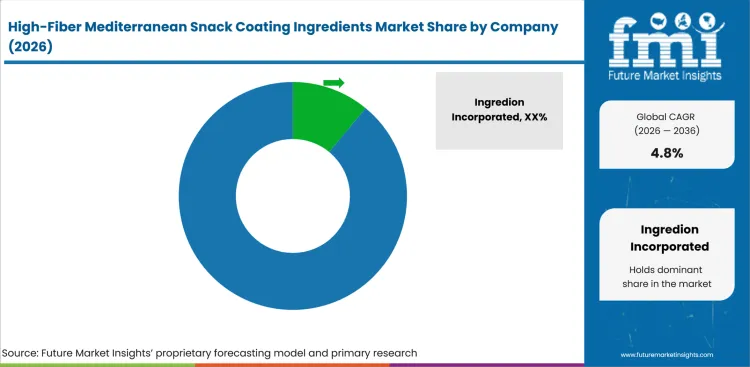
- Ingredion holds a high position through citrus fiber systems for clean-label snack texture.
- Tate & Lyle and BENEO compete on fiber portfolios suited to nutrition claims.
- Kerry Group and Cargill compete over seasoning knowledge for industrial snack manufacturers.
Competition in high-fiber Mediterranean snack coatings is shifting toward proof of performance inside real snack lines. Suppliers must prove fiber delivery without making the coating gritty or dull. Ingredion holds strength in citrus fiber systems for texture-focused clean-label recipes. Tate & Lyle brings fiber range depth for nutrition-led food formulation. BENEO adds inulin and prebiotic fiber strength for claim-bearing snack concepts. Kerry Group competes through seasoning design for Mediterranean taste system programs. Cargill adds ingredient reach for large-scale snack manufacturers.
Specialty fiber cost and sensory limits create the main hurdles across high-fiber coating development. Snack manufacturers need fine particle control and reliable flavor release across dry premixes. Buyers prefer suppliers able to deliver fiber function and Mediterranean taste within one development cycle. Application teams and dependable supply access help ingredient partners reduce launch risk for manufacturers. The top competitors will make fiber claims feel natural in everyday savory snacks.
Key Companies in the High-Fiber Mediterranean Snack Coating Ingredients Market
Key global companies leading the high-fiber Mediterranean snack coating ingredients market include:
- Ingredion, Tate & Lyle, and BENEO have strong fiber ingredient infrastructure for coating formulation and clean-label nutrition work.
- Cargill, Kerry Group, and IFF serve snack manufacturers through seasoning systems and application-ready ingredient coverage.
- ADM, Fiberstar, Herbafood Ingredients, and Limagrain Ingredients hold specialist positions across grain fiber, citrus fiber, and plant-based ingredient systems.
Competitive Benchmarking: High-Fiber Mediterranean Snack Coating Ingredients Market
| Company | Fiber Functionality Depth | Coating Application Skill | Mediterranean Flavor Access |
|---|---|---|---|
| Ingredion | High | High | Medium |
| Tate & Lyle | High | Medium | Medium |
| BENEO | High | Medium | Low |
| Cargill | Medium | High | Medium |
| Kerry Group | Medium | High | Strong |
| IFF | Medium | Medium | Strong |
| ADM | Medium | Medium | Medium |
| Fiberstar | High | Medium | Low |
| Herbafood Ingredients | Medium | Medium | Low |
| Limagrain Ingredients | Medium | Medium | Medium |
Source: Future Market Insights, 2026.
Key Developments in High-Fiber Mediterranean Snack Coating Ingredients Market
- In June 2025, Satoria Nutrisentials published a company application note on using Digestive Resistant Dextrin for fiber fortification in baked, roasted, and coated snack formats. The company specifically lists roasted and coated snacks such as nuts, legumes, and cereals, and names snack coatings for nuts and cereals to retain color and crunch as a practical application.
- In July, 2024, Ingredion introduced the citrus fiber range first in EMEA, with availability planned for Asia-Pacific in August 2024 and the United States and Canada by year-end. The ingredients are positioned for texture, viscosity, gelling, emulsion stability, and “source of/high in dietary fiber” claims.
Key Players in the High-Fiber Mediterranean Snack Coating Ingredients Market
Major Global Players:
- Ingredion Incorporated
- Tate & Lyle PLC
- BENEO
- Cargill Incorporated
- Kerry Group
- IFF
- ADM
Specialist Players:
- Fiberstar
- Herbafood Ingredients
- Limagrain Ingredients
- Meelunie
- Interfiber
Report Scope and Coverage
| Parameter | Details |
|---|---|
| Market Size by 2036 | USD 704.8 million |
| Growth Rate | 8.4% CAGR from 2026 to 2036 |
| Forecast Period | 2026 to 2036 |
| Market Size in 2026 | USD 314.6 million |
| By Ingredient Type | Grain Fiber Blends, Pulse Fiber Blends, Seed Fiber Blends, Citrus Fiber, Olive Pomace Fiber |
| By Coating Format | Dry Seasoning Coatings, Oil-Based Coatings, Batter Coatings, Adhesion Slurries, Dusting Premixes |
| By Snack Base | Pita Chips, Seed Crackers, Legume Crisps, Baked Nuts, Vegetable Chips |
| By Fiber Function | Fiber Fortification, Texture Binding, Fat Management, Flavor Carrying, Moisture Control |
| By Buyer Type | Snack Brands, Bakery Producers, Private Labels, Foodservice Suppliers, Co-packers |
| Regions Covered | North America, Latin America, Europe, East Asia, South Asia and Pacific, Middle East & Africa |
| Countries Covered | USA, China, India, Germany, France, Spain, Italy, and 30 plus countries |
| Key Companies Profiled | Ingredion Incorporated, Tate & Lyle PLC, BENEO, Cargill Incorporated, Kerry Group, IFF, ADM, Fiberstar, Herbafood Ingredients, Limagrain Ingredients |
| Approach | Hybrid bottom-up and top-down methodology starting with coating use across savory snack formats, then projecting adoption across ingredient types, coating formats, buyer groups, and regions. |
High-Fiber Mediterranean Snack Coating Ingredients Market Breakdown By Ingredient Type, Coating Format, Snack Base, Fiber Function, Buyer Type, and Region
High-Fiber Mediterranean Snack Coating Ingredients Market Segmented by Ingredient Type:
- Grain Fiber Blends
- Pulse Fiber Blends
- Seed Fiber Blends
- Citrus Fiber
- Olive Pomace Fiber
High-Fiber Mediterranean Snack Coating Ingredients Market Segmented by Coating Format:
- Dry Seasoning Coatings
- Oil-Based Coatings
- Batter Coatings
- Adhesion Slurries
- Dusting Premixes
High-Fiber Mediterranean Snack Coating Ingredients Market Segmented by Snack Base:
- Pita Chips
- Seed Crackers
- Legume Crisps
- Baked Nuts
- Vegetable Chips
High-Fiber Mediterranean Snack Coating Ingredients Market Segmented by Fiber Function:
- Fiber Fortification
- Texture Binding
- Fat Management
- Flavor Carrying
- Moisture Control
High-Fiber Mediterranean Snack Coating Ingredients Market Segmented by Buyer Type:
- Snack Brands
- Bakery Producers
- Private Labels
- Foodservice Suppliers
- Co-packers
High-Fiber Mediterranean Snack Coating Ingredients Market by Region:
- North America
- USA
- Canada
- Mexico
- Latin America
- Brazil
- Chile
- Rest of Latin America
- Europe
- Germany
- UK
- Italy
- Spain
- France
- Rest of Europe
- East Asia
- China
- Japan
- South Korea
- South Asia and Pacific
- India
- ASEAN
- Australia & New Zealand
- Rest of South Asia and Pacific
- Middle East & Africa
- Saudi Arabia
- Other GCC Countries
- South Africa
- Rest of Middle East & Africa
Research Sources and Bibliography
- Ingredion Incorporated. (2024, July). Ingredion expands FIBERTEX citrus fiber range for clean-label food applications.
- BENEO. (2024, November). BENEO helps achieve faster and cost-effective plant-based market launches.
- Cargill Incorporated. (2025, March). Cargill showcases full range of innovative food solutions at AAHAR 2025.
- Tate & Lyle PLC. (2026, June). Tate & Lyle fibre portfolio receives NutraStrong Prebiotic Verified certification.
- United States Department of Agriculture. (2024, August). Snack consumption by USA adults.
- Centers for Disease Control and Prevention. (2025, August). Ultra-processed food consumption in the United States.
- International Olive Council. (2026, January). Olive sector statistics December 2025 and forecasts.
- Press Information Bureau. (2026, March). Government boosts millet processing.
- United States Department of Agriculture Foreign Agricultural Service. (2025, July). China exporter guide annual.
- National Health Commission of China. (2025, March). Guideline aims to promote balanced nutrition and healthier lifestyles.
- United States Department of Agriculture Foreign Agricultural Service. (2025, April). France food processing ingredients annual.
- Federal Ministry of Food and Agriculture. (2025, May). Good Food for Germany and the Food and Nutrition Strategy.
- European Commission. (2026). Olive oil agriculture and rural development.
- Satoria Nutrisentials. (2025, June 2). Fiber fortification that doesn’t affect browning or Maillard reactions. Satoria Nutrisentials.
- Ingredion Incorporated. (2024, July 23). Ingredion expands multi-benefit, naturally sourced, clean label citrus fiber ingredients. Ingredion.
- Davis, W. V., Weber, C., Wakefield, H., & Wechsler, S. (2025, April 24). Vegetables and pulses outlook: April 2025 (Report No. VGS-375). USA Department of Agriculture, Economic Research Service.
- International Olive Council. (2026, January 12). Olive sector statistics - December 2025 and forecasts.
This bibliography is provided for reader reference and is not exhaustive. The full report contains the complete reference list and detailed citations.
This Report Answers
- What is the current and future size of the high-fiber Mediterranean snack coating ingredients market?
- How fast is the high-fiber Mediterranean snack coating ingredients market expected to expand between 2026 and 2036?
- Which fiber function segment is expected to lead the market by 2026?
- Which coating format segment is expected to account for the leading demand by 2026?
- What factors are driving demand for high-fiber Mediterranean snack coating ingredients globally?
- How are fiber claims influencing adoption of dry seasoning coatings?
- Why are snack brands the main demand base for coating ingredient systems?
- How are Mediterranean flavor profiles creating demand for specialty coating ingredients?
- Which countries are projected to record faster expansion through 2036?
- What is driving market expansion in India and China?
- Who are the key companies active in the high-fiber Mediterranean snack coating ingredients market?
- How does FMI estimate and validate the market forecast?
Frequently Asked Questions
What is the global market demand for High-Fiber Mediterranean Snack Coating Ingredients in 2026?
In 2026, the global market for high-fiber Mediterranean snack coating ingredients is expected to be worth USD 314.6 million.
How big will the market for High-Fiber Mediterranean Snack Coating Ingredients be in 2036?
By 2036, the market for high-fiber Mediterranean snack coating ingredients is expected to be worth USD 704.8 million.
How much is demand for High-Fiber Mediterranean Snack Coating Ingredients expected to expand between 2026 and 2036?
Between 2026 and 2036, demand for high-fiber Mediterranean snack coating ingredients is expected to expand at a CAGR of 8.4%.
Which fiber function segment is likely to be the leading seller globally by 2026?
Fiber Fortification will contribute 44.2% of the fiber function segment in 2026.
What is causing demand to rise in India?
The India high-fiber Mediterranean snack coating ingredients market is projected to record 10.2% CAGR through 2036, supported by millet processing and premium snack launches.
What is causing demand to rise in China?
The China high-fiber Mediterranean snack coating ingredients market is projected to expand at 9.6% CAGR through 2036, supported by food retail scale and national fiber intake guidance.
What does this report mean by High-Fiber Mediterranean Snack Coating Ingredients Market definition?
The market includes fiber-bearing coating ingredients used to improve nutrition, texture, seasoning adhesion, and Mediterranean flavor delivery in savory snack formats.
How does FMI make the High-Fiber Mediterranean Snack Coating Ingredients forecast and check it?
Forecasting models use a hybrid bottom-up and top-down approach, starting with coating demand and checking it against ingredient use patterns.
Preview the report firsthand - request a free sample
Get SampleGet the brochure for pricing and purchase details.
Get PDFTable of Content
- Executive Summary
- Global Market Outlook
- Demand-side Trends
- Supply-side Trends
- Technology Roadmap Analysis
- Analysis and Recommendations
- Market Overview
- Market Coverage / Taxonomy
- Market Definition / Scope / Limitations
- Research Methodology
- Chapter Orientation
- Analytical Lens and Working Hypotheses
- Market Structure, Signals, and Trend Drivers
- Benchmarking and Cross-market Comparability
- Market Sizing, Forecasting, and Opportunity Mapping
- Research Design and Evidence Framework
- Desk Research Programme (Secondary Evidence)
- Company Annual and Sustainability Reports
- Peer-reviewed Journals and Academic Literature
- Corporate Websites, Product Literature, and Technical Notes
- Earnings Decks and Investor Briefings
- Statutory Filings and Regulatory Disclosures
- Technical White Papers and Standards Notes
- Trade Journals, Industry Magazines, and Analyst Briefs
- Conference Proceedings, Webinars, and Seminar Materials
- Government Statistics Portals and Public Data Releases
- Press Releases and Reputable Media Coverage
- Specialist Newsletters and Curated Briefings
- Sector Databases and Reference Repositories
- FMI Internal Proprietary Databases and Historical Market Datasets
- Subscription Datasets and Paid Sources
- Social Channels, Communities, and Digital Listening Inputs
- Additional Desk Sources
- Expert Input and Fieldwork (Primary Evidence)
- Primary Modes
- Qualitative Interviews and Expert Elicitation
- Quantitative Surveys and Structured Data Capture
- Blended Approach
- Why Primary Evidence is Used
- Field Techniques
- Interviews
- Surveys
- Focus Groups
- Observational and In-context Research
- Social and Community Interactions
- Stakeholder Universe Engaged
- C-suite Leaders
- Board Members
- Presidents and Vice Presidents
- R&D and Innovation Heads
- Technical Specialists
- Domain Subject-matter Experts
- Scientists
- Snack Product Developers and Ingredient Procurement Specialists
- Governance, Ethics, and Data Stewardship
- Research Ethics
- Data Integrity and Handling
- Primary Modes
- Tooling, Models, and Reference Databases
- Desk Research Programme (Secondary Evidence)
- Data Engineering and Model Build
- Data Acquisition and Ingestion
- Cleaning, Normalisation, and Verification
- Synthesis, Triangulation, and Analysis
- Quality Assurance and Audit Trail
- Market Background
- Market Dynamics
- Drivers
- Restraints
- Opportunity
- Trends
- Scenario Forecast
- Demand in Optimistic Scenario
- Demand in Likely Scenario
- Demand in Conservative Scenario
- Opportunity Map Analysis
- Product Life Cycle Analysis
- Supply Chain Analysis
- Investment Feasibility Matrix
- Value Chain Analysis
- PESTLE and Porter’s Analysis
- Regulatory Landscape
- Regional Parent Market Outlook
- Production and Consumption Statistics
- Import and Export Statistics
- Market Dynamics
- Global Market Analysis 2016 to 2025 and Forecast, 2026 to 2036
- Historical Market Size Value (USD Million) Analysis, 2016 to 2025
- Current and Future Market Size Value (USD Million) Projections, 2026 to 2036
- Y-o-Y Growth Trend Analysis
- Absolute $ Opportunity Analysis
- Global Market Pricing Analysis 2016 to 2025 and Forecast 2026 to 2036
- Global Market Analysis 2016 to 2025 and Forecast 2026 to 2036, By Fiber Function
- Introduction / Key Findings
- Historical Market Size Value (USD Million) Analysis By Fiber Function, 2016 to 2025
- Current and Future Market Size Value (USD Million) Analysis and Forecast By Fiber Function, 2026 to 2036
- Fiber Fortification
- Texture Binding
- Fat Management
- Fiber Fortification
- Y-o-Y Growth Trend Analysis By Fiber Function, 2016 to 2025
- Absolute $ Opportunity Analysis By Fiber Function, 2026 to 2036
- Global Market Analysis 2016 to 2025 and Forecast 2026 to 2036, By Coating Format
- Introduction / Key Findings
- Historical Market Size Value (USD Million) Analysis By Coating Format, 2016 to 2025
- Current and Future Market Size Value (USD Million) Analysis and Forecast By Coating Format, 2026 to 2036
- Dry Seasoning Coatings
- Oil-Based Coatings
- Batter Coatings
- Dry Seasoning Coatings
- Y-o-Y Growth Trend Analysis By Coating Format, 2016 to 2025
- Absolute $ Opportunity Analysis By Coating Format, 2026 to 2036
- Global Market Analysis 2016 to 2025 and Forecast 2026 to 2036, By Ingredient Type
- Introduction / Key Findings
- Historical Market Size Value (USD Million) Analysis By Ingredient Type, 2016 to 2025
- Current and Future Market Size Value (USD Million) Analysis and Forecast By Ingredient Type, 2026 to 2036
- Grain Fiber Blends
- Pulse Fiber Blends
- Seed Fiber Blends
- Grain Fiber Blends
- Y-o-Y Growth Trend Analysis By Ingredient Type, 2016 to 2025
- Absolute $ Opportunity Analysis By Ingredient Type, 2026 to 2036
- Global Market Analysis 2016 to 2025 and Forecast 2026 to 2036, By Snack Base
- Introduction / Key Findings
- Historical Market Size Value (USD Million) Analysis By Snack Base, 2016 to 2025
- Current and Future Market Size Value (USD Million) Analysis and Forecast By Snack Base, 2026 to 2036
- Pita Chips
- Seed Crackers
- Legume Crisps
- Pita Chips
- Y-o-Y Growth Trend Analysis By Snack Base, 2016 to 2025
- Absolute $ Opportunity Analysis By Snack Base, 2026 to 2036
- Global Market Analysis 2016 to 2025 and Forecast 2026 to 2036, By Buyer Type
- Introduction / Key Findings
- Historical Market Size Value (USD Million) Analysis By Buyer Type, 2016 to 2025
- Current and Future Market Size Value (USD Million) Analysis and Forecast By Buyer Type, 2026 to 2036
- Snack Brands
- Bakery Producers
- Private Labels
- Snack Brands
- Y-o-Y Growth Trend Analysis By Buyer Type, 2016 to 2025
- Absolute $ Opportunity Analysis By Buyer Type, 2026 to 2036
- Global Market Analysis 2016 to 2025 and Forecast 2026 to 2036, By Region
- Introduction
- Historical Market Size Value (USD Million) Analysis By Region, 2016 to 2025
- Current Market Size Value (USD Million) Analysis and Forecast By Region, 2026 to 2036
- North America
- Latin America
- Western Europe
- Eastern Europe
- East Asia
- South Asia and Pacific
- Middle East & Africa
- Market Attractiveness Analysis By Region
- North America Market Analysis 2016 to 2025 and Forecast 2026 to 2036, By Country
- Historical Market Size Value (USD Million) Trend Analysis By Market Taxonomy, 2016 to 2025
- Market Size Value (USD Million) Forecast By Market Taxonomy, 2026 to 2036
- By Country
- USA
- Canada
- Mexico
- By Fiber Function
- By Coating Format
- By Ingredient Type
- By Snack Base
- By Buyer Type
- By Country
- Market Attractiveness Analysis
- By Country
- By Fiber Function
- By Coating Format
- By Ingredient Type
- By Snack Base
- By Buyer Type
- Key Takeaways
- Latin America Market Analysis 2016 to 2025 and Forecast 2026 to 2036, By Country
- Historical Market Size Value (USD Million) Trend Analysis By Market Taxonomy, 2016 to 2025
- Market Size Value (USD Million) Forecast By Market Taxonomy, 2026 to 2036
- By Country
- Brazil
- Chile
- Rest of Latin America
- By Fiber Function
- By Coating Format
- By Ingredient Type
- By Snack Base
- By Buyer Type
- By Country
- Market Attractiveness Analysis
- By Country
- By Fiber Function
- By Coating Format
- By Ingredient Type
- By Snack Base
- By Buyer Type
- Key Takeaways
- Western Europe Market Analysis 2016 to 2025 and Forecast 2026 to 2036, By Country
- Historical Market Size Value (USD Million) Trend Analysis By Market Taxonomy, 2016 to 2025
- Market Size Value (USD Million) Forecast By Market Taxonomy, 2026 to 2036
- By Country
- Germany
- UK
- Italy
- Spain
- France
- Nordic
- BENELUX
- Rest of Western Europe
- By Fiber Function
- By Coating Format
- By Ingredient Type
- By Snack Base
- By Buyer Type
- By Country
- Market Attractiveness Analysis
- By Country
- By Fiber Function
- By Coating Format
- By Ingredient Type
- By Snack Base
- By Buyer Type
- Key Takeaways
- Eastern Europe Market Analysis 2016 to 2025 and Forecast 2026 to 2036, By Country
- Historical Market Size Value (USD Million) Trend Analysis By Market Taxonomy, 2016 to 2025
- Market Size Value (USD Million) Forecast By Market Taxonomy, 2026 to 2036
- By Country
- Russia
- Poland
- Hungary
- Balkan & Baltic
- Rest of Eastern Europe
- By Fiber Function
- By Coating Format
- By Ingredient Type
- By Snack Base
- By Buyer Type
- By Country
- Market Attractiveness Analysis
- By Country
- By Fiber Function
- By Coating Format
- By Ingredient Type
- By Snack Base
- By Buyer Type
- Key Takeaways
- East Asia Market Analysis 2016 to 2025 and Forecast 2026 to 2036, By Country
- Historical Market Size Value (USD Million) Trend Analysis By Market Taxonomy, 2016 to 2025
- Market Size Value (USD Million) Forecast By Market Taxonomy, 2026 to 2036
- By Country
- China
- Japan
- South Korea
- By Fiber Function
- By Coating Format
- By Ingredient Type
- By Snack Base
- By Buyer Type
- By Country
- Market Attractiveness Analysis
- By Country
- By Fiber Function
- By Coating Format
- By Ingredient Type
- By Snack Base
- By Buyer Type
- Key Takeaways
- South Asia and Pacific Market Analysis 2016 to 2025 and Forecast 2026 to 2036, By Country
- Historical Market Size Value (USD Million) Trend Analysis By Market Taxonomy, 2016 to 2025
- Market Size Value (USD Million) Forecast By Market Taxonomy, 2026 to 2036
- By Country
- India
- ASEAN
- Australia & New Zealand
- Rest of South Asia and Pacific
- By Fiber Function
- By Coating Format
- By Ingredient Type
- By Snack Base
- By Buyer Type
- By Country
- Market Attractiveness Analysis
- By Country
- By Fiber Function
- By Coating Format
- By Ingredient Type
- By Snack Base
- By Buyer Type
- Key Takeaways
- Middle East & Africa Market Analysis 2016 to 2025 and Forecast 2026 to 2036, By Country
- Historical Market Size Value (USD Million) Trend Analysis By Market Taxonomy, 2016 to 2025
- Market Size Value (USD Million) Forecast By Market Taxonomy, 2026 to 2036
- By Country
- Kingdom of Saudi Arabia
- Other GCC Countries
- Turkiye
- South Africa
- Other African Union
- Rest of Middle East & Africa
- By Fiber Function
- By Coating Format
- By Ingredient Type
- By Snack Base
- By Buyer Type
- By Country
- Market Attractiveness Analysis
- By Country
- By Fiber Function
- By Coating Format
- By Ingredient Type
- By Snack Base
- By Buyer Type
- Key Takeaways
- Key Countries Market Analysis
- USA
- Pricing Analysis
- Market Share Analysis, 2025
- By Fiber Function
- By Coating Format
- By Ingredient Type
- By Snack Base
- By Buyer Type
- Canada
- Pricing Analysis
- Market Share Analysis, 2025
- By Fiber Function
- By Coating Format
- By Ingredient Type
- By Snack Base
- By Buyer Type
- Mexico
- Pricing Analysis
- Market Share Analysis, 2025
- By Fiber Function
- By Coating Format
- By Ingredient Type
- By Snack Base
- By Buyer Type
- Brazil
- Pricing Analysis
- Market Share Analysis, 2025
- By Fiber Function
- By Coating Format
- By Ingredient Type
- By Snack Base
- By Buyer Type
- Chile
- Pricing Analysis
- Market Share Analysis, 2025
- By Fiber Function
- By Coating Format
- By Ingredient Type
- By Snack Base
- By Buyer Type
- Germany
- Pricing Analysis
- Market Share Analysis, 2025
- By Fiber Function
- By Coating Format
- By Ingredient Type
- By Snack Base
- By Buyer Type
- UK
- Pricing Analysis
- Market Share Analysis, 2025
- By Fiber Function
- By Coating Format
- By Ingredient Type
- By Snack Base
- By Buyer Type
- Italy
- Pricing Analysis
- Market Share Analysis, 2025
- By Fiber Function
- By Coating Format
- By Ingredient Type
- By Snack Base
- By Buyer Type
- Spain
- Pricing Analysis
- Market Share Analysis, 2025
- By Fiber Function
- By Coating Format
- By Ingredient Type
- By Snack Base
- By Buyer Type
- France
- Pricing Analysis
- Market Share Analysis, 2025
- By Fiber Function
- By Coating Format
- By Ingredient Type
- By Snack Base
- By Buyer Type
- India
- Pricing Analysis
- Market Share Analysis, 2025
- By Fiber Function
- By Coating Format
- By Ingredient Type
- By Snack Base
- By Buyer Type
- ASEAN
- Pricing Analysis
- Market Share Analysis, 2025
- By Fiber Function
- By Coating Format
- By Ingredient Type
- By Snack Base
- By Buyer Type
- Australia & New Zealand
- Pricing Analysis
- Market Share Analysis, 2025
- By Fiber Function
- By Coating Format
- By Ingredient Type
- By Snack Base
- By Buyer Type
- China
- Pricing Analysis
- Market Share Analysis, 2025
- By Fiber Function
- By Coating Format
- By Ingredient Type
- By Snack Base
- By Buyer Type
- Japan
- Pricing Analysis
- Market Share Analysis, 2025
- By Fiber Function
- By Coating Format
- By Ingredient Type
- By Snack Base
- By Buyer Type
- South Korea
- Pricing Analysis
- Market Share Analysis, 2025
- By Fiber Function
- By Coating Format
- By Ingredient Type
- By Snack Base
- By Buyer Type
- Russia
- Pricing Analysis
- Market Share Analysis, 2025
- By Fiber Function
- By Coating Format
- By Ingredient Type
- By Snack Base
- By Buyer Type
- Poland
- Pricing Analysis
- Market Share Analysis, 2025
- By Fiber Function
- By Coating Format
- By Ingredient Type
- By Snack Base
- By Buyer Type
- Hungary
- Pricing Analysis
- Market Share Analysis, 2025
- By Fiber Function
- By Coating Format
- By Ingredient Type
- By Snack Base
- By Buyer Type
- Kingdom of Saudi Arabia
- Pricing Analysis
- Market Share Analysis, 2025
- By Fiber Function
- By Coating Format
- By Ingredient Type
- By Snack Base
- By Buyer Type
- Turkiye
- Pricing Analysis
- Market Share Analysis, 2025
- By Fiber Function
- By Coating Format
- By Ingredient Type
- By Snack Base
- By Buyer Type
- South Africa
- Pricing Analysis
- Market Share Analysis, 2025
- By Fiber Function
- By Coating Format
- By Ingredient Type
- By Snack Base
- By Buyer Type
- USA
- Market Structure Analysis
- Competition Dashboard
- Competition Benchmarking
- Market Share Analysis of Top Players
- By Region
- By Fiber Function
- By Coating Format
- By Ingredient Type
- By Snack Base
- By Buyer Type
- Competition Analysis
- Competition Deep Dive
- Ingredion Incorporated
- Overview
- Product Portfolio
- Profitability by Market Segments (Ingredient Type/Coating Format/Snack Base/Fiber Function/Buyer Type/Region)
- Sales Footprint
- Strategy Overview
- Marketing Strategy
- Product Strategy
- Channel Strategy
- Tate & Lyle PLC
- BENEO
- Cargill Incorporated
- Kerry Group
- Ingredion Incorporated
- Competition Deep Dive
- Assumptions & Acronyms Used


