


- Clean-label starch derivatives can support premium pricing, but only when they deliver the same texture, stability, viscosity, shelf-life, and processing performance that buyers expect from conventional modified starches.
- Buyers are willing to pay more for native starch, physically modified starch, enzyme-treated starch, non-GMO starch, organic starch, source-verified corn starch, potato starch, tapioca starch, cassava starch, and clean-label resistant starch, but verified public data does not show one universal clean-label premium across all starch derivatives.
- The strongest premium opportunity sits in processed foods, sauces, dairy alternatives, bakery, plant-based products, sports nutrition, low-glycemic foods, functional foods, pharmaceutical excipients, and sustainable packaging applications.
- Clean label is more valuable in starch derivatives when it reduces buyer risk: synthetic additive concerns, chemical modification concerns, GMO concerns, inconsistent viscosity, texture failure, reformulation risk, regulatory hesitation, and unclear raw material sourcing.
- The biggest risk is treating clean label as a label claim only. In starch derivatives, buyers pay for proof, performance, documentation, and formulation reliability, not just for “natural” wording.
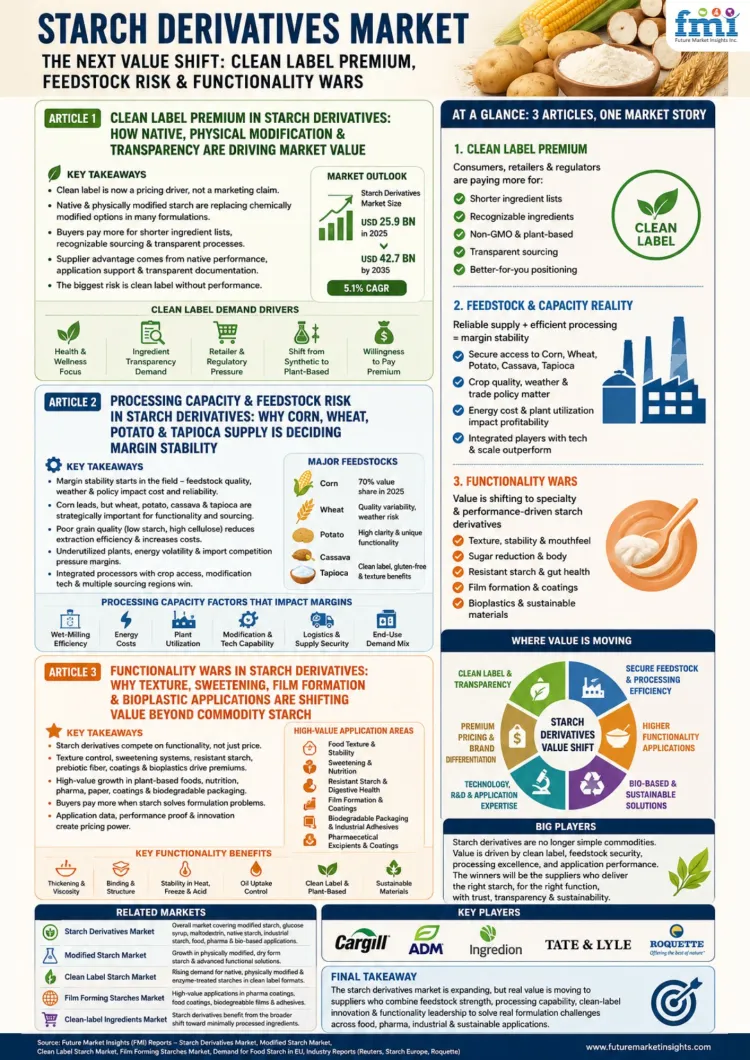
Clean label is becoming a more important premium lever in the starch derivatives market because starch-based ingredients are no longer used only as commodity thickeners or sweeteners. Food, beverage, pharmaceutical, personal care, and industrial buyers are increasingly asking whether the starch ingredient can deliver functionality while also supporting simpler labels, cleaner sourcing, and more transparent product positioning. FMI projects the starch derivatives market to grow from USD 25.9 billion in 2025 to USD 42.7 billion by 2035 at a 5.1% CAGR, supported by expanding use in food and drinks, biotechnology, bioplastics, and industrial markets.
The clean-label opportunity is sharper than the broader market because clean-label starch sits directly at the intersection of consumer trust and manufacturing performance. FMI estimates the clean-label starch market at USD 1.3 billion in 2026 and projects it to reach USD 2.4 billion by 2036 at a 6.5% CAGR. Native starch is expected to dominate with a 50.0% share, while powder starch is expected to lead with a 70.0% share. This means the clean-label part of the starch ecosystem is growing faster than the wider starch derivatives market, creating room for suppliers that can prove both natural positioning and reliable technical performance.
The premium question in starch derivatives is not simply “Will buyers pay more for clean label?” The better question is “Will buyers pay more when clean label removes a formulation or consumer risk?” In sauces, dressings, soups, dairy alternatives, bakery fillings, frozen foods, and plant-based foods, starch derivatives must hold texture under heat, acid, shear, freezing, thawing, and shelf-life stress. A clean-label starch that fails in viscosity, mouthfeel, freeze-thaw stability, or processing tolerance will not hold a premium for long. However, a clean-label starch that allows a brand to remove chemical-sounding additives while maintaining product quality can justify a higher price.
Native starch carries strong clean-label appeal because it is easier for consumers and food manufacturers to understand. It supports simple ingredient lists and can be positioned as closer to the original crop source. This matters in applications where ingredient transparency is important, especially in premium sauces, organic foods, baby food, plant-based meals, bakery, and health-focused packaged foods. However, native starch is not automatically premium in every use case. Its value rises when it can replace chemically modified starch without causing processing failures.
Physically modified starch is another important premium area because it offers a bridge between functionality and clean-label demand. FMI notes that physically modified starch is projected to hold 52.1% share of the modified starch market in 2026, as food makers seek texture control with cleaner label wording. The broader modified starch market is expected to grow from USD 9.4 billion in 2025 to USD 14.2 billion by 2036 at a 3.8% CAGR, showing that functionality remains essential even as label expectations become stricter.
Source verification also influences premium potential. Corn remains the leading source of starch derivatives, with FMI assigning it a 70% value share in 2025 due to high starch yield, cost-effectiveness, and functional versatility. However, not all corn-based starch carries the same buyer value. Non-GMO corn starch, identity-preserved corn starch, organic corn starch, and regionally traceable corn starch can command stronger interest from buyers serving clean-label, premium, or export-oriented brands. Potato, tapioca, cassava, rice, and green banana starches may also gain premium traction where brands want allergen-friendly, gluten-free, grain-free, or differentiated botanical positioning.
Resistant starch adds another layer to the clean-label premium because it connects starch derivatives with digestive health, prebiotic fiber, low-glycemic formulation, and sports nutrition. FMI highlights rising use of resistant starch in bakery products, cereals, snacks, bars, protein bars, and recovery drinks, with producers using corn, potato, and green banana sources to support clean-label positioning. This makes resistant starch more than a texture ingredient; it becomes a functional nutrition ingredient. Buyers may pay more when resistant starch helps them support fiber enrichment, digestive wellness, blood sugar management positioning, or sustained energy claims.
The strongest clean-label premium is likely to appear in applications where the cost of failure is high. In premium dairy alternatives, for example, poor starch performance can create thin texture, graininess, syneresis, or poor mouthfeel. In bakery fillings and sauces, weak starch performance can create separation, loss of body, or inconsistent appearance. In plant-based meats and meals, starch must support binding, juiciness, structure, and reheating stability. In these applications, buyers are not only paying for a cleaner label. They are paying for fewer production issues, fewer consumer complaints, lower reformulation risk, and stronger brand trust.
In pharmaceutical and nutraceutical applications, clean label works differently. Buyers are less focused on consumer-facing “natural” language and more focused on compliance, purity, consistency, documentation, excipient performance, and supplier reliability. Starch derivatives used in tablet disintegration, encapsulation, coating, and nutrient stabilization must meet tighter quality expectations. A clean-label or source-verified starch solution can attract premium value when it supports regulatory acceptance, improves formulation stability, or reduces concerns around synthetic excipients.
Packaging and industrial applications create another premium path, especially as starch derivatives move into biodegradable films, adhesives, coatings, paper bonding, and bio-based materials. FMI states that future demand is expected to accelerate in starch-based adhesives for sustainable packaging and fermentation-based applications. This is important because clean label in industrial starch is less about front-of-pack claims and more about sustainability, renewable sourcing, biodegradability, and lower dependence on petroleum-based binders.
Film-forming starches show how clean-label starch can move into higher-value functionality. FMI estimates the film-forming starches market at USD 1.17 billion in 2026 and USD 2.13 billion by 2036 at a 6.2% CAGR. The market covers native and modified starches from potato, wheat, corn, cassava, tapioca, maize, and rice sources engineered for pharmaceutical tablet coating, capsule coating, food coating, biodegradable flexible packaging, and industrial adhesive film applications. This shows that starch value is shifting from basic thickening to technical performance in specialized applications.
For suppliers, the clean-label premium depends on proof. Buyers need technical data sheets, non-GMO documentation, allergen statements, source traceability, organic certification where applicable, stability data, viscosity profiles, processing guidance, and application support. A starch supplier that only claims “clean label” without formulation support will struggle to defend premium pricing. A supplier that helps buyers replace chemically modified starch while maintaining texture, yield, shelf life, and line efficiency has a stronger premium argument.
Large starch derivative companies are already positioned around this shift. FMI identifies Cargill, ADM, Ingredion, Tate & Lyle, and Roquette as key multinational players with strong supply chain networks, R&D capabilities, and diversified starch portfolios. FMI also notes that companies are emphasizing clean-label starches, resistant starches for digestive health, and bio-based applications for green packaging. This suggests that competitive advantage is moving toward suppliers that combine scale, functionality, clean-label credibility, and application-specific innovation.
The premium is weakest in highly cost-sensitive applications where starch derivatives are purchased mainly as bulk thickeners, sweeteners, binders, or commodity inputs. In these cases, buyers may prefer low-cost corn-based starch, glucose syrup, maltodextrin, or standard modified starch unless clean-label requirements are tied to a specific customer, retailer, export market, or brand promise. Family-size packaged foods, value sauces, low-cost bakery products, and bulk industrial uses may resist higher pricing unless the clean-label starch also improves yield, processing efficiency, or shelf-life performance.
The premium is strongest where clean label protects brand value. Premium packaged food brands, organic food producers, plant-based food manufacturers, functional nutrition companies, infant and child nutrition brands, nutraceutical companies, pharmaceutical buyers, and sustainable packaging developers have more reason to pay for verified starch derivatives. These buyers are not just buying starch. They are buying reduced risk, easier claims, cleaner ingredient decks, and stronger alignment with consumer and regulatory expectations.
For the starch derivatives market, clean label should therefore be treated as a value amplifier, not a standalone value driver. It improves pricing power only when paired with functionality, supply security, source verification, and documentation. The winning suppliers will be those that can prove that clean-label starch derivatives perform under real manufacturing conditions. The losing suppliers will be those that treat clean label as a marketing phrase while leaving buyers to solve texture, stability, and processing problems alone.
Related Markets
- Starch Derivative Market: Directly supports the clean-label premium angle, with FMI projecting faster growth than the broader starch derivatives market.
- Clean Label Starch Market: Shows how functionality and cleaner label wording are converging, especially through physically modified starch.
- Modified Starch Market: Shows higher-value applications in pharmaceutical coatings, food coatings, biodegradable packaging, and industrial films.
- Film Forming Starches Market: Main parent market covering modified starch, sweeteners, native starch, cationic starch, corn, potato, cassava, food, paper, feed, pharma, and textile uses.

