


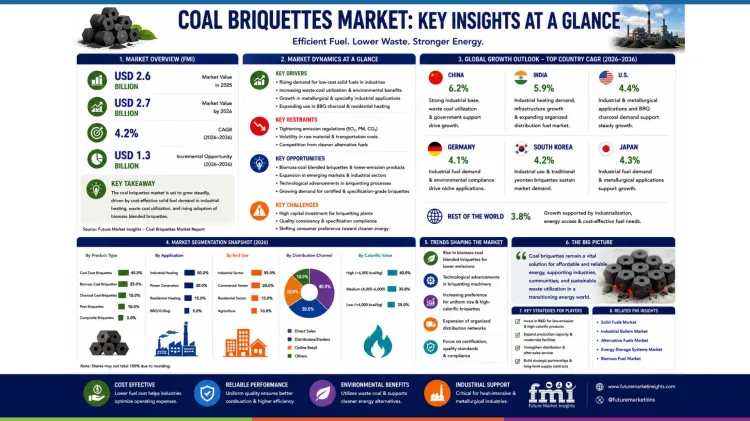
- Coal dust briquettes appear to hold the stronger industrial adoption signal because FMI identifies them as the leading product type with 45.0% share in 2026.
- Their adoption is linked to practical waste-coal economics, as mining and processing fines can be converted into uniform solid fuel products.
- Lignite briquettes can remain relevant in regions with brown-coal availability and legacy household or industrial heating use, and their industrial competitiveness is more region-specific.
- Industrial buyers usually evaluate briquettes on calorific value, moisture, ash, sulfur, mechanical strength, size uniformity, handling performance, and price per useful heat output.
- The FMI market scope highlights coal dust, biomass coal, charcoal coal, peat, and composite briquettes rather than positioning lignite briquettes as the dominant global growth category.
- The market observation is that coal dust briquettes are gaining stronger industrial adoption where waste-fine recovery, low-cost fuel needs, and established solid-fuel handling systems overlap.
Coal briquettes are not one uniform fuel product. Their commercial use depends heavily on feedstock, ash content, energy value, binder system, shape, mechanical strength, emissions profile, and end-use equipment. A coal dust briquette used in a metallurgical or industrial heating application behaves differently from a household lignite briquette or a blended biomass-coal briquette.
The comparison between coal dust briquettes and lignite briquettes is therefore best understood through industrial adoption rather than fuel identity alone. Industrial users usually do not buy a briquette because of its name. They buy it because it provides predictable heat, manageable handling, acceptable emissions, and a lower delivered fuel cost than alternatives.
The FMI Coal Briquettes Market places the market at USD 2.6 billion in 2025, USD 2.7 billion in 2026, and USD 4.0 billion by 2036, reflecting a 4.2% CAGR from 2026 to 2036. Coal dust briquettes are expected to dominate with a 45.0% product share in 2026. Industrial heating leads applications with 50.0% share, while industrial sector procurement accounts for 55.0% of end-use demand. These figures point toward a market led by industrial fuel economics rather than only residential heating or retail charcoal consumption.
Coal dust briquettes have a clear industrial logic. Coal mining, screening, washing, and processing generate fine particles that can be difficult to use efficiently in loose form. Fines may create dusting, handling losses, inconsistent combustion, storage problems, and lower market value. Briquetting converts these fines into solid, uniform pieces that can be transported, stored, fed, and combusted more predictably.
FMI notes that coal dust briquettes are produced by pressing coal fines with binders such as starch, molasses, or pitch under high pressure. The product gains mechanical strength for handling and transport while maintaining combustion performance. The same FMI page states that briquetting improves uniform sizing, moisture control, and calorific consistency compared with loose fines.
That improvement matters in industrial procurement. A buyer using solid fuel in metals, chemicals, cement, ceramics, or heat-treatment operations needs dependable feed behavior. If the fuel breaks during handling or produces too much dust, the plant faces process inefficiency, housekeeping problems, and possible safety concerns. A well-made coal dust briquette can reduce those problems while allowing the producer to monetize a lower-value coal byproduct.
Lignite briquettes occupy a different space. Lignite is a lower-rank coal with relatively high moisture content and lower energy density compared with bituminous coal or anthracite. Briquetting can make lignite easier to handle and use, and it has historically supported residential heating and localized industrial applications in countries with brown-coal resources. Its competitiveness depends heavily on local mine access, drying cost, transport distance, emissions policy, and equipment compatibility.
For industrial users, lignite briquettes may face a disadvantage where higher moisture or lower calorific value raises the cost per unit of useful heat. Transport economics can also work against lignite because lower energy density makes long-distance movement less attractive. In regions close to lignite resources, the calculation can be different. A local user with suitable boilers or furnaces may accept lignite briquettes if delivered cost is low and compliance requirements can be met.
The stronger global adoption signal still appears to favour coal dust briquettes because they fit the waste-utilization and industrial-fuel story more directly. FMI explicitly names coal dust briquettes as the leading product segment at 45.0%, while the report product taxonomy covers coal dust briquettes, biomass coal briquettes, charcoal coal briquettes, peat and composite briquettes. Lignite briquettes are not presented as the lead product category on the visible FMI page.
FMI's Coal Briquettes Market taxonomy does not break out lignite briquettes as a separate visible product segment; this article treats lignite briquettes as a feedstock and use-case comparison within coal-based briquette adoption.
A second reason coal dust briquettes look stronger is the circular-economy angle inside the coal value chain. Coal fines are already generated in mining and processing. Briquetting creates a commercial route for material that might otherwise be underused or disposed of. FMI identifies waste-coal utilization as a key market driver and states that briquetting of coal fines addresses environmental remediation objectives while creating marketable fuel products from legacy coal-processing sites in the USA.
That does not make coal dust briquettes a low-emission product by default. They remain coal-based fuels. Their advantage is primarily resource recovery, handling quality, and cost. Emission performance depends on coal quality, binder choice, ash, sulfur, combustion system, pollution-control equipment, and whether biomass blending is used.
This is where product quality becomes decisive. Industrial buyers usually specify or test several parameters before adopting a briquette. They may look at fixed carbon, volatile matter, ash, sulfur, moisture, calorific value, shatter strength, abrasion resistance, ignition behavior, combustion duration, slagging tendency, and size distribution. Metallurgical buyers may add chemical composition, carbon content, compressive strength, and reactivity requirements.
FMI identifies metallurgical-grade briquettes for blast furnaces, foundries, and specialty metals processing as a premium niche with specific chemical and physical specifications. This supports a broader point that industrial adoption is strongest where briquettes are engineered for the process, not merely pressed into shape as cheap fuel.
Coal dust briquettes can serve this engineered-fuel direction if the feedstock and binder system are controlled. A briquette made from high-ash, inconsistent fines may struggle. A briquette produced from selected coal fines with consistent binder and strength can become a more predictable industrial fuel. Suppliers that can document quality, calorific value, and strength are more likely to move beyond spot commodity sales.
Lignite briquettes may still have durable demand in some residential and regional heating applications. FMI notes that South Korea's traditional yeontan market sustains a distinct coal briquette segment linked to ondol heating in some settings. In the UK, FMI notes that smokeless fuel briquettes serve residential heating markets where Clean Air Act rules require low-emission solid fuels. These are important markets, and they are not necessarily proof of broader industrial lignite-briquette adoption.
The UK example also shows the compliance challenge. GOV.UK states that in smoke control areas, households can burn only authorised fuels or use exempt appliances, and lists certain smokeless fuels such as anthracite, semi-anthracite, gas, and low-volatile steam coal among permitted options. The Defra authorised-fuel list covers manufactured solid fuels certified under Clean Air Act and domestic solid fuel standards. This pushes residential briquette markets toward certified low-smoke products rather than generic coal briquettes.
For industrial adoption, the more relevant comparison is not lignite versus coal dust in isolation. It is whether the briquette can compete against raw coal, coke breeze, petroleum coke, biomass pellets, natural gas, fuel oil, electricity, and process-specific alternatives. Coal dust briquettes are better positioned when coal fines are cheap, local, and available in volume. Lignite briquettes are better positioned when lignite resources are local and the user can manage moisture, emissions, and combustion characteristics.
The energy-transition context adds pressure to both. The IEA Global Energy Review 2025 states that EU coal demand continued declining in 2024 as more countries closed coal power plants, with EU coal power generation down 15% and total coal demand down by over 10%. The European Commission also states that EU coal production and consumption fell to their lowest recorded levels in 2024. This is a clear signal that broad coal-based fuel demand faces structural pressure in some advanced markets.
That pressure does not affect every briquette equally. Coal dust briquettes may remain relevant where they reduce waste and serve industrial heating or metallurgical applications without easy near-term fuel substitution. Lignite briquettes may face more pressure where they are tied to residential heating or higher-emission brown-coal use. Biomass-coal blends may gain as suppliers try to maintain handling advantages while reducing net emissions.
The supplier implication is straightforward. A company producing coal dust briquettes should focus on consistency, feedstock control, binder quality, calorific value, strength, and industrial customer qualification. A lignite-briquette supplier needs to defend its position through local cost, controlled moisture, certified low-smoke formulations where needed, and targeted heating markets.
Coal dust briquettes appear to be gaining stronger industrial adoption because they solve a practical industrial problem, namely how to turn coal fines into a usable, uniform, lower-cost fuel. Lignite briquettes remain relevant in certain geographies and heating traditions, and their adoption is more tied to local fuel availability and regulatory tolerance. For industrial buyers, the winning product is not the one with the lowest nominal price. It is the briquette that delivers the lowest reliable cost per useful heat unit while meeting handling and compliance needs.

