


By Sabyasachi Ghosh
Elective and trauma neurosurgery keeps climbing, and closure hardware rides that tide. New materials and fresh FDA clearances are tightening competition and pricing power in 2026.
- Procedure demand remains durable because brain and CNS cancer incidence continues to create a steady baseline for post-craniotomy closure needs.
- US trauma volume also supports demand, since TBI-related hospitalizations and deaths continue to feed into craniotomy and cranial reconstruction workflows where fixation hardware is standard
Procedure drivers are durable. The Global Cancer Observatory reported 321,731 new brain and CNS cancer cases worldwide in 2022, with projections that cases will rise about 33% by 2050 if current rates. That baseline ensures steady post-craniotomy closure demand.
US trauma adds volume. The CDC logged about 214,110 TBI-related hospitalizations in 2020 and 69,473 TBI-related deaths in 2021, excluding large numbers treated only in emergency departments. These patients move into craniotomies and reconstructions where plates, screws, and meshes are standard of care.
Where Demand Is Expanding in the Cranial Closure and Fixation Devices Market
- Oncology and adolescent and young adult epidemiology continue to sustain case flow, especially in tertiary centers handling brain and CNS tumor treatment.
- Material science remains central to product choice, with titanium benefiting from lower MRI artifact and better imaging compatibility in follow-up care.
Oncology and AYA epidemiology keep case flow high. The Central Brain Tumor Registry of the United States published 2017-2021 incidence data and, with ABTA in May 2024, highlighted brain and other CNS tumors as a leading. That mix sustains hardware pull-through in tertiary centers.
Material science underpins product choice. Titanium components reduce MRI artifact versus stainless steel, preserving follow-up imaging quality. Clinical and radiology studies show lower susceptibility artifacts with titanium and outline techniques that further cut distortion, which supports its premium share.
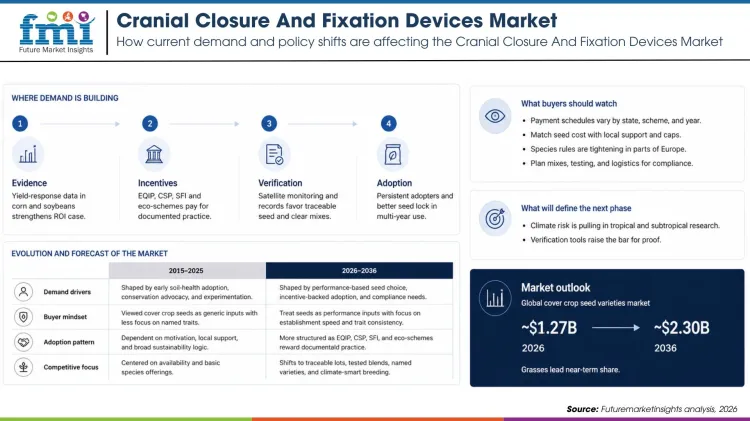
Evolution and Forecast of the Cranial Closure and Fixation Devices Market
| 2015-2025 | 2026-2036 |
|---|---|
| Demand was shaped mainly by baseline neurosurgical volumes, trauma reconstruction needs, and the routine use of plates, screws, and meshes in cranial closure. | Demand is likely to be shaped more directly by sustained oncology burden, continued trauma incidence, and a stronger shift toward advanced fixation systems with imaging and workflow advantages. |
| Buyers focused largely on reliable fixation performance, standard implant availability, and surgeon familiarity with established systems. | Buyers are likely to focus more on material choice, imaging compatibility, and product sets that fit guided navigation and patient-specific reconstruction workflows. |
| Titanium already held an important place, but competition still depended strongly on conventional fixation platforms and established hospital preferences. | Titanium-heavy portfolios are likely to strengthen further, while patient-specific meshes and imaging-friendly systems gain more value in premium segments. |
| Pediatric fixation decisions balanced safety and surgical practicality, with resorbables used selectively based on clinical judgment and center preference. | Resorbable systems are likely to gain more support in pediatric settings where avoiding second surgeries and repeat anesthesia exposure becomes a stronger value driver. |
What should market players focus on in the Cranial Closure And Fixation Devices Market
- Regulatory activity remains active, with fresh FDA clearances showing ongoing iteration in cranial and craniofacial fixation systems.
- Pediatric practice continues to support resorbable systems because they can reduce the need for second removal surgeries and lower repeat anesthesia exposure.
Regulatory cadence is active. On January 14, 2026, FDA cleared a craniofacial titanium plate and screw system intended for cranial and craniofacial surgery and reconstruction, a sign that. Comparable 2024-2025 510(k) updates in fixation systems signal ongoing iteration on alloys, geometries, and workflows.
Pediatric practices steer toward resorbables. Large cohorts and modern series report favorable safety profiles for resorbable PLLA-PGA or related copolymer systems in craniosynostosis, with the operational benefit of avoiding second removal surgeries. That outcome reduces anesthesia exposure and return-to-OR cost, which shifts value models for children's hospitals.
What will matter most next in the Cranial Closure And Fixation Devices Market
- Long-term case growth remains favorable because projected brain and CNS cancer incidence and continued TBI burden should keep neurosurgical volumes elevated.
- Product mix is likely to move further toward titanium plates, anatomical meshes, and patient-specific systems as imaging compatibility and guided navigation gain importance.
Case growth remains secular. GLOBOCAN's 2022 analysis projects a multidecade rise in brain and CNS cancer counts across all HDI groups through 2050. Combined with steady TBI epidemiology in aging populations, neurosurgical volumes should support mid-single-digit unit growth even without price inflation.
Imaging-friendly metals and guided navigation will keep shifting mix toward titanium plates, anatomic meshes, and patient-specific sets. The FMI study frames a 6.1% CAGR to 2036, with titanium leading share and screws as the anchor SKU. Those findings line up with independent imaging data and regulatory flow, pointing to stable value capture for titanium-heavy portfolios.
Bibliography
- Global Burden of brain and central nervous system cancer in 185 countries, projections to 2050. PubMed: https://pubmed.ncbi.nlm.nih.gov/40720078/
- GLOBOCAN 2022 Brain and CNS cancer fact sheet (2024 update). PDF: https://gco.iarc.who.int/media/globocan/factsheets/cancers/31-brain-central-nervous-system-fact-sheet.pdf
- CDC Traumatic Brain Injury data portal, hospitalization and mortality statistics: https://www.cdc.gov/traumatic-brain-injury/data-research/index.html
- CBTRUS Statistical Report 2017-2021 (Neuro-Oncology, 2023; PMC version): https://pmc.ncbi.nlm.nih.gov/articles/PMC11456825
- ABTA/CBTRUS AYA Statistical Fact Sheet, May 2024: https://www.abta.org/wp-content/uploads/2024/05/2024-CBTRUS-AYA-Statistical-Fact-Sheet_FINAL.pdf
- MRI artifact after spinal and CMF implants, titanium vs stainless steel. PMC: https://pmc.ncbi.nlm.nih.gov/articles/PMC4528609
- Managing hardware-related metal artifacts in MRI, Skeletal Radiology 2024: https://link.springer.com/article/10.1007/s00256-024-04624-4
- FDA 510(k) K252958, Jan 14, 2026, cranial/craniofacial titanium plate system: https://www.accessdata.fda.gov/cdrh_docs/pdf25/K252958.pdf
- FDA 510(k) K230546, June 10, 2024, titanium bone fixation system: https://www.accessdata.fda.gov/cdrh_docs/pdf23/K230546.pdf
- Resorbable fixation in pediatric craniofacial surgery, 1,883-patient experience: https://pubmed.ncbi.nlm.nih.gov/15468389
- Safety of contemporary resorbable systems in pediatric craniofacial reconstruction, 2021: https://pubmed.ncbi.nlm.nih.gov/34398868
- Long-term outcomes of resorbable plating in craniosynostosis, 2016: https://pubmed.ncbi.nlm.nih.gov/27831975

