


By Nandini Roy Choudhury
Dehydrated vegetables are shaped by shelf-life economics, energy costs, and trade policy. The category serves processors that need predictable flavor and waste control. The next decade is likely to be influenced by a combination of factors.
What is shaping the Dehydrated Vegetables Market
- Convenience demand is holding, but energy-intensive drying operations still face margin pressure from elevated gas and industrial energy costs.
- Global trade data continue to show resilient cross-border demand for dried vegetable ingredients used in soups, sauces, snacks, and seasoning systems.
Convenience demand is holding. Input volatility is higher. Europe's gas price shock from 2022 has eased yet remains a competitiveness drag, raising operating costs for energy-intensive dryers and food plants through 2024 and. The IEA links sustained price pressure to curtailed output across energy-intensive segments, including food and beverage, with parts of the demand loss expected to.
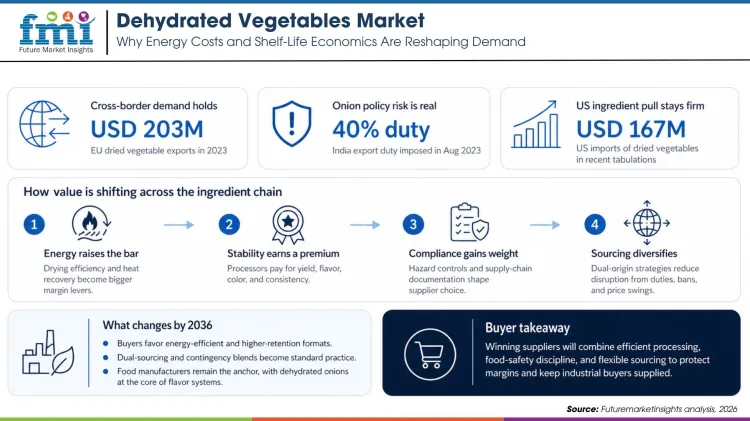
Global trade data confirm steady end-market pull. The European Union exported about 203 million dollars of HS 0712 dried vegetables in 2023. The United States imported roughly 167 million dollars of HS 0712 dried vegetables in recent tabulations, with China a lead source. These figures frame a resilient cross-border ingredient flow that supports soup, sauce, snack, and seasoning lines. (TrendEconomy 2023 EU HS 0712; USITC tables for HS 0712.)
Which demand signals matter most in the Dehydrated Vegetables Market
- Processors continue to pay for stability, yield, and ingredient consistency, which supports premium dehydration technologies that preserve color, flavor, and bioactive retention.
- Food-loss economics are also supporting dehydration upstream, since turning seasonal or surplus output into shelf-stable ingredients reduces spoilage and lowers logistics weight.
Processors pay for stability and yield. Freeze-drying and advanced dehydration preserve color, flavor volatiles, and bioactives better than hot air, which protects taste consistency and reduces. Peer-reviewed reviews from 2021-2022 report higher retention of phenolics, ascorbic acid, and color in freeze-dried vegetables, supporting premium SKUs and clean-label.
Food loss economics push upstream dehydration. FAO's 2019 assessment shows higher loss rates in fruits and vegetables between harvest and retail compared with cereals. Converting surplus or seasonal peaks into dried inputs limits spoilage, smooths supply, and shrinks logistics weight. Regional studies since 2022 echo double-digit loss rates for vegetables along supply chains, reinforcing the case for stabilized, shelf-ready ingredients. (FAO SOFA 2019; Frontiers in Sustainable Food Systems 2022; Frontiers in Horticulture 2025.)
Evolution and Forecast of the Dehydrated Vegetables Market
| 2015-2025 | 2026-2036 |
|---|---|
| Demand was shaped mainly by convenience food growth, shelf-life economics, and the use of dried vegetables as stable industrial ingredients. | Demand is likely to be shaped more directly by energy efficiency, trade-risk management, and the need for more resilient ingredient sourcing. |
| Buyers focused largely on predictable flavor, low logistics weight, and the operational benefits of shelf-stable vegetable inputs. | Buyers are likely to focus more on yield stability, technology choice, regulatory compliance, and the ability to manage origin-specific supply shocks. |
| Product choice was influenced heavily by conventional dehydration economics, with price and basic ingredient functionality carrying much of the decision. | Product choice is likely to shift toward higher-retention formats, differentiated inclusions, and sourcing models that can withstand onion duties, bans, and minimum export-price shifts. |
| Market competition centered on ingredient supply scale and standard industrial demand from soups, sauces, and seasoning applications. | Market competition is likely to center more on processing efficiency, food-safety readiness, dual-sourcing capability, and the ability to support premium formulations with better color and nutrient retention. |
What should buyers watch in the Dehydrated Vegetables Market
- Onion policy risk remains material, especially where export duties, bans, or minimum export prices can quickly disrupt sourcing economics and input planning.
- Regulation is tightening around hazard controls, which means dehydrated vegetable suppliers serving the US market need stronger preventive-control documentation and supply-chain discipline
Onion policy risk is material. India imposed a 40% export duty in August 2023 and a full export ban from December 2023 to March 2024, then shifted to minimum export prices and selective permissions in. Wholesale prices in Maharashtra whipsawed.
Regulation is tightening on hazard controls. US FSMA Preventive Controls requires registered facilities that make, pack, or hold dehydrated vegetables for the US market to implement written hazard analyses and preventive controls, with documented supply-chain programs. Industry guidance for low-moisture spices illustrates FDA expectations on Salmonella controls and kill-step assignments, which apply by analogy across dried vegetable lines and seasoning blends. Non-compliance risks rework and shipment holds. (FDA FSMA Preventive Controls page; FDA Risk Profile on pathogens in spices; ASTA ready-to-eat FAQs.)
What key shifts may appear next in the Dehydrated Vegetables Market
- Energy efficiency is likely to become a stronger margin lever as dryers and food plants invest in thermal upgrades, hybrid systems, and heat-recovery improvements.
- Formulation and sourcing are likely to diversify further as processors seek nutrient-forward products and reduce dependence on a single onion-origin market.
Energy and efficiency will shape margins. European industrial gas demand is not expected to fully recover by 2030, keeping attention on thermal efficiency upgrades, heat-pump integration, and hybrid drying to. Capital allocation to vacuum drying or improved heat recovery should pencil out faster under persistent energy premia.
Formulation and sourcing will diversify. Reviews and trials point to freeze-dried inclusions enabling nutrient-forward snacks and meal components with better color and texture stability. Trade data and recent policy swings argue for dual-sourcing across India, China, and Egypt for onions, while maintaining contingency blends to guard against MEPs, duties, or bans. These shifts align with the growth outlook that places dehydrated onions at the core of industrial flavor systems and keeps food manufacturers as the main volume buyers through the 2026-2036 window. (Cornell eCommons 2022; TrendEconomy 2023 HS 0712; recent India policy coverage.)
Bibliography
- International Energy Agency commentary on European gas market volatility, 2025: https://www.iea.org/commentaries/european-gas-market-volatility-puts-continued-pressure-on-competitiveness-and-cost-of-living
- IEA Gas 2025 coverage on structural industrial gas demand loss, S&P Global, 2025: https://www.spglobal.com/energy/en/news-research/latest-news/lng/102725-oecd-european-gas-demand-forecast-to-fall-up-to-10-from-2024-2030-iea
- Columbia University, CGEP, Anatomy of the European Industrial Gas Demand Drop, 2023: https://www.energypolicy.columbia.edu/publications/anatomy-of-the-european-industrial-gas-demand-drop/
- European Commission, Energy prices and costs in Europe dashboard, accessed 2024: https://energy.ec.europa.eu/data-and-analysis/energy-prices-and-costs-europe/dashboard-energy-costs-eu-industry-and-major-trading-partners_en
- TrendEconomy, EU exports of HS 0712 dried vegetables, 2023: https://trendeconomy.com/data/h2/EuropeanUnion/0712
- USITC tables referencing HS 0712 trade values: https://www.usitc.gov/publications/332/pub4121.pdf
- Food Reviews International 2022, Freeze-drying review: https://www.tandfonline.com/doi/full/10.1080/87559129.2022.2122992
- Cornell eCommons 2022, freeze-drying review: https://ecommons.cornell.edu/items/e163dbc8-d873-4909-be2e-1ee313d459b0
- FAO, The State of Food and Agriculture 2019, food loss rates: https://www.fao.org/interactive/state-of-food-agriculture/2019/en/
- Frontiers in Sustainable Food Systems 2022, vegetable loss economics: https://www.frontiersin.org/articles/10.3389/fsufs.2022.1043591/full
- Frontiers in Horticulture 2025, fruit and vegetable FLW rates review: https://www.frontiersin.org/articles/10.3389/fhort.2025.1529040/full
- India Today 2023, onion export ban effects: https://www.indiatoday.in/business/story/onion-prices-drop-50-percent-in-india-other-asian-nations-see-surge-in-rates-after-export-ban-2478368-2023-12-20
- The Economic Times 2024, duty and ban timeline: https://m.economictimes.com/news/economy/foreign-trade/india-allows-export-of-onions-to-select-nations/amp_articleshow/107802129.cms
- Times of India 2024, export earnings impact: https://timesofindia.indiatimes.com/city/nashik/impact-of-centres-ban-onion-export-41-dip-in-foreign-currency-earnings/articleshow/111046426.cms
- Government of India, press release on onion exports 2024-25: https://consumeraffairs.gov.in/public/upload/admin/cmsfiles/pressRelease/2.60_lakh_tons_of_onion_exported_in_2024-25%2C_till_31st_July%2C_2024_-_07_Aug_2024_press_release.pdf
- FDA FSMA Preventive Controls for Human Food: https://www.fda.gov/food/food-safety-modernization-act-fsma/fsma-final-rule-preventive-controls-human-food
- FDA, Risk Profile on Pathogens and Filth in Spices: https://www.fda.gov/files/food/published/Risk-Profile--Pathogens-and-Filth-in-Spices.pdf
- American Spice Trade Association, Ready-to-Eat

