

- Market Size (2026)
- USD 262 Mn
- Forecast (2036)
- USD 586.9 Mn
- CAGR (2026 to 2036)
- 8.4%
Sprouted Durum Wheat for Pasta Applications Market Size, Market Forecast and Outlook by FMI
The sprouted durum wheat for pasta applications market was valued at USD 241.7 million in 2025. Revenue is projected to reach USD 262 million in 2026 and USD 586.9 million by 2036. The market is forecast to expand at a 8.4% CAGR from 2026 to 2036. The period creates an incremental opportunity of USD 324.9 million.
Summary of Sprouted Durum Wheat for Pasta Applications Market
- The sprouted durum wheat for pasta applications market is forecast to reach USD 586.9 million by 2036.
- The market is expected to grow at a 8.4% CAGR from 2026 to 2036.
- The market was estimated at USD 241.7 million in 2025.
- The forecast period represents an incremental opportunity of USD 324.9 million.
- Organic is expected to account for 37% of the nature segment in 2026.
- Flour is projected to secure 42% of the product form segment in 2026.
- Dry pasta is anticipated to represent 46% of the pasta type segment in 2026.
- Industrial makers are likely to contribute 54% of end-use demand in 2026.
- Direct sales are expected to account for 49% of the sales channel segment in 2026.
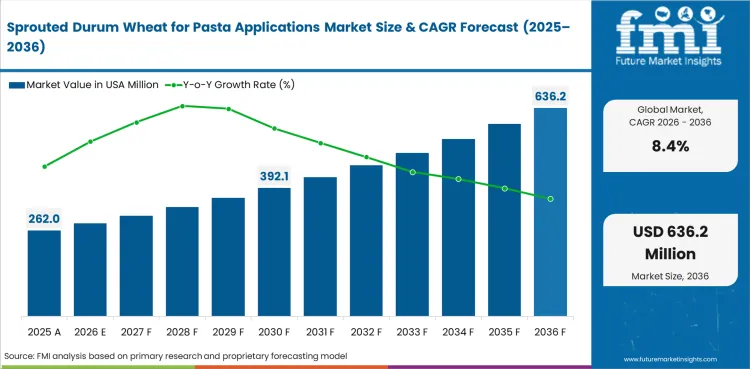
Key Takeaways, Market Size, and Forecast
- Sprouted Durum Wheat for Pasta Applications Market is projected to grow from USD 262 million in 2026 to USD 586.9 million by 2036, at a CAGR of 8.4%.
- The sprouted durum wheat for pasta applications market was valued at USD 241.7 million in 2025.
- By 2036, the Sprouted Durum Wheat for Pasta Applications Market is expected to be worth USD 586.9 million.
- Over the 2026 to 2036 period, the market is likely to advance at a CAGR of 8.4%.
- The market is projected to create an incremental opportunity of USD 324.9 million between 2026 and 2036.
- In 2026, Organic is expected to account for 37.0% of the nature segment.
- India (9.4%) and the United States (9.1%) are two of the fastest growing markets.
Sprouted Durum Wheat for Pasta Applications Market Key Takeaways
| Parameter | Details |
|---|---|
| Market value (2026) | USD 262 million |
| Forecast value (2036) | USD 586.9 million |
| CAGR (2026 to 2036) | 8.4% |
| Estimated market value (2025) | USD 241.7 million |
| Incremental opportunity | USD 324.9 million |
| Leading nature segment | Organic (37% of nature segment) |
| Leading product form | Flour (42% of product form segment) |
| Leading pasta type | Dry pasta (46% of pasta type segment) |
| Leading end use | Industrial makers (54% of end use segment) |
| Leading sales channel | Direct sales (49% of sales channel segment) |
Source: Future Market Insights, 2026
Commercial adoption requires sprouted durum to work reliably in pasta production. Large producers are looking for stronger nutritional positioning and need ingredients that do not slow extrusion, disrupt sheeting, or reduce output consistency. Supplier credibility depends on process control, milling precision, and enzyme balance that stays within a usable operating range. With reliable performance, sprouted durum can move beyond niche trials and support wider product development in pasta and noodles and clean-label ingredients categories.
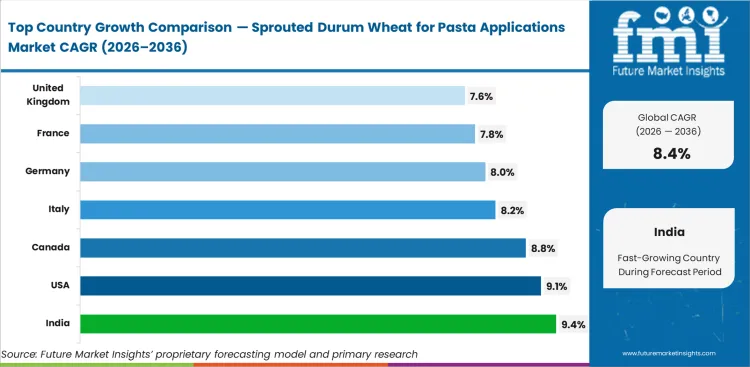
India is expected to remain the fastest-rising market, with the sector projected to advance at a 9.4% CAGR through 2036. The United States follows at 9.1% CAGR. Canada is likely to register 8.8% CAGR. Italy is forecast to post 8.2% CAGR. Germany is set to record 8% CAGR. France is expected to reach 7.8% CAGR. The United Kingdom is anticipated to move ahead at 7.6% CAGR over the study period. Regional differences are shaped by how quickly local milling and extrusion systems can adapt process control to modified starch behavior.
Sprouted Durum Wheat for Pasta Applications Market Definition
The sprouted durum wheat for pasta applications market covers germinated durum wheat ingredients used in pasta manufacturing. These products are processed into flour, semolina, and blend formats for dry pasta, fresh pasta, and specialty pasta applications.
Sprouted Durum Wheat for Pasta Applications Market Inclusions
Market scope includes commercially sold sprouted durum ingredients and finished pasta applications segmented by nature, product form, pasta type, end use, sales channel, and region. Scope covers organic and conventional formats supplied into industrial makers, foodservice channels, and retail-oriented offerings.
Sprouted Durum Wheat for Pasta Applications Market Exclusions
The scope excludes gluten-free pasta, non-wheat sprouted pasta, and bulk commodity durum sold without a sprouting stage. It also excludes grain products that do not enter pasta applications.
Sprouted Durum Wheat for Pasta Applications Market Research Methodology
- Primary Research: FMI assessed the market through discussions with ingredient suppliers, processors, milling participants, and buyers linked to premium pasta applications.
- Desk Research: Review covered grain handling references, pasta quality studies, public trade sources, and technical material relevant to sprouted wheat and durum applications.
- Market Sizing and Forecasting: Forecasting was built around demand by nature, product form, pasta type, end use, and sales channel, then checked against price structure and processing constraints.
- Data Validation and Update Cycle: Forecasts were validated against commercial viability, regional supply capability, and adoption patterns in premium grain ingredients.
Why is the Sprouted Durum Wheat for Pasta Applications Market Growing?
- Organic is projected to account for 37% of the nature segment in 2026, supported by the close fit between sprouted grain positioning and certified premium food demand.
- Flour is expected to secure 42% share of the product form segment in 2026 because it offers wider formulation flexibility and easier dough development.
- Dry pasta is anticipated to represent 46% of the pasta type segment in 2026 because shelf-life economics remain stronger in dried formats.
Sprouted durum supports that need by improving whole-grain and clean-label positioning without pushing products away from durum-based systems. Brand teams want a stronger nutrition story, while production teams need a material that works well in mixing, extrusion, and drying. Similar demand patterns are visible in durum wheat flour, cereal flour, and high protein flour.
Germination can improve market positioning, through unstable enzyme activity can slow lines and weaken dough control. Processors scale ingredients that stay within an acceptable operating range. Supplier value depends on moisture management, kilning precision, and lot consistency.
The market is gaining support from wider interest in healthier grain-based formats. Premium grain-based products are receiving more shelf attention in health-led retail. Broader expansion depends on ingredient systems that fit commercial manufacturing without repeated adjustment at plant level.
Segmental Analysis
Key Facts About Segments
- Organic is expected to account for 37% of the nature segment in 2026, as certified positioning carries stronger pricing power in premium pasta ranges and fits more closely with health-led retail demand.
- Flour is projected to secure 42% of the product form segment in 2026, because it gives processors better flexibility in dough development and supports wider use across different pasta-making conditions.
- Industrial makers are likely to represent 54% of the end-use segment in 2026, reflecting the fact that commercial-scale pasta volumes remain concentrated with large manufacturers that can manage tighter ingredient specifications.
The sprouted durum wheat for pasta applications market is segmented by nature, product form, pasta type, end use, sales channel, and region. By nature, the market is divided into organic and conventional. By product form, it is classified into flour, semolina, and blends. By pasta type, the market includes dry pasta, fresh pasta, and specialty pasta. By end use, the market covers industrial makers, foodservice, and retail kits. By sales channel, it is segmented into direct sales, distributors, and online retail.
Insights into the Organic Nature Segment
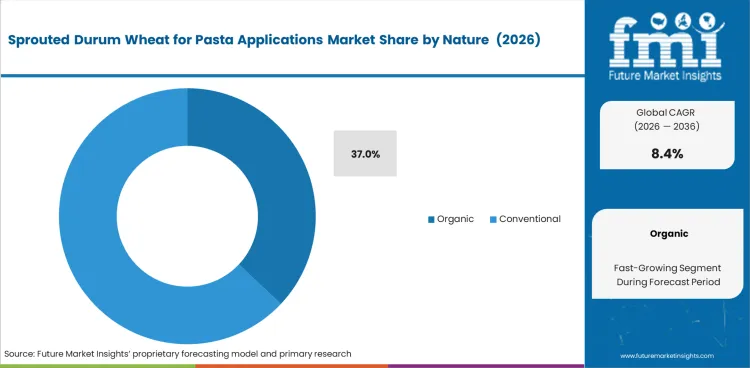
Organic certification leads early adoption because it matches the expectations premium wellness-led grain categories. The Organic segment is expected to account for 37% share in 2026. Shelf placement in this category depends on more than ingredient performance, labeling strength, and fit with premium grocery expectations. Conventional sprouted wheat remains relevant in foodservice and value-led channels, through branded retail gives stronger pricing support to organic formats. Supply strength in this segment depends on tighter traceability and disciplined sourcing. This pattern aligns with demand trends visible in organic foods and clean-labelled food additives.
Insights into the Flour Product Form Segment
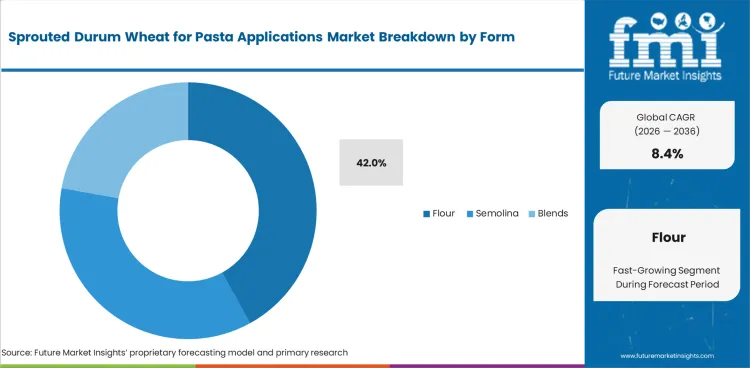
Flour leads because hydration response and dough handling matter more than ingredient familiarity. Flour is projected to secure 42% share of the product form segment in 2026. Plant operations using thin-sheeting systems often prefer finer granulation because it keeps dough more workable under tighter forming conditions. Semolina still has value in extrusion-heavy applications, especially where coarser particles help protect starch integrity. Flour holds the broader advantage because it adapts more easily across multiple product concepts. This logic also aligns with usage patterns seen in functional flours, modified flour, and prepared flour mixes.
Insights into the Dry Pasta Type Segment
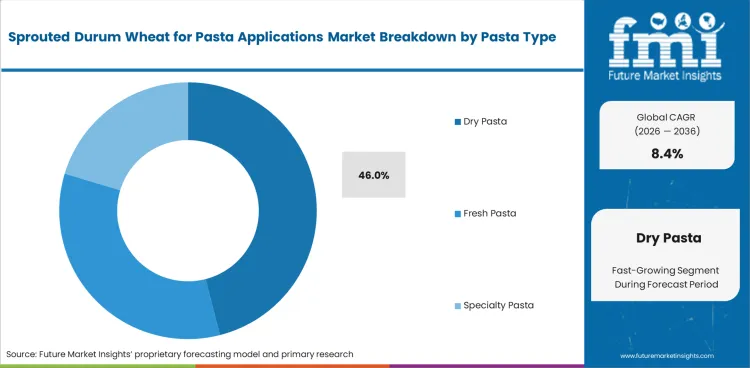
Dry pasta remains the safer commercial route in this category. Dry pasta is forecast to represent 46% share in 2026. Germinated starch systems tend to retain more water, which raises shelf-life pressure in fresh applications. Product developers often favor dried formats because they fit standard distribution and retail storage models more easily. Fresh pasta becomes harder to manage when elevated enzyme activity reduce stability under refrigerated conditions. This supports innovation in dried formats where controlled drying helps protect quality and reduce loss risk. Similar behavior is visible across uncooked pasta and noodles, vegan pasta, and canned pasta.
Insights into the Industrial Makers End-Use Segment
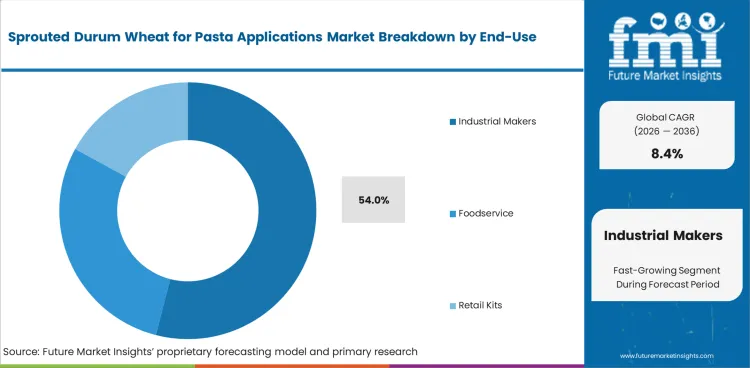
Industrial makers account for the largest share because large-scale producers control most category tonnage. The Industrial makers segment is likely to represent 54% of the market in 2026. Multinational food groups have the purchasing power, formulation resources, and line infrastructure needed to absorb a premium ingredient while protecting output efficiency. Artisan brands helped build early interest, though scale remains with companies that can secure supply contracts and define exact operating specifications. Supplier qualification becomes more demanding at this level.
Insights into the Direct Sales Channel Segment
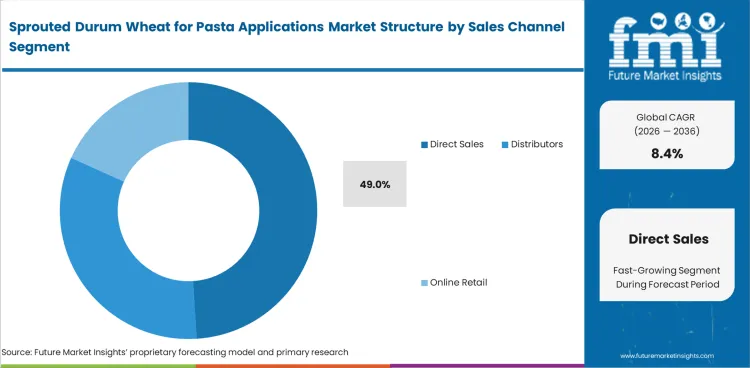
Direct sales lead because ingredient condition affects processing performance before the material even reaches the line. Direct sales are anticipated to emerge with 49% share in 2026. Manufacturers prefer direct relationships when moisture control, storage condition, and technical communication all affect production reliability. General distribution networks add handling points that can weaken consistency. Direct supply reduces that risk and helps mills respond faster when brand teams need adjustments in product behavior.
What are the Drivers, Restraints, and Key Trends of the Sprouted Durum Wheat for Pasta Applications Market?
- Clean-label product development is increasing interest in sprouted durum across premium pasta applications.
- Variable enzyme activity remains the main restraint because it affects dough stability and line efficiency.
- Supplier value is shifting toward process reliability, not simple ingredient novelty.
The market is expanding because pasta producers want a stronger nutrition profile without losing the familiarity of wheat-based products. That goal fits current buyer preference well. It also gives manufacturers a way to improve label quality without changing the category base too sharply. Still, the market does not scale on product claims alone. It scales when those claims can be delivered through a material that runs well inside real production conditions.
Clean-label and Better-for-You Positioning
Clean-label pressure is pushing R&D teams to reduce reliance on synthetic dough conditioners. Sprouted durum supports that effort because germination changes starch behavior in a way that can improve product appeal while keeping the ingredient story simple. Brands that move early can strengthen shelf position in health-led retail.
Process Variability and Enzyme Control
Variable amylase activity remains the main operating restraint. Germination introduces variation across crop years and malting conditions. Manufacturers need to adjust hydration and process settings more often than they do with conventional semolina. This slows output and increases waste. Advanced scanning systems can improve control, though not every processor can justify the extra cost.
Precision Kilning and Blend Management
The market is placing more emphasis on tighter process correction. Manufacturers are giving more importance on kilning precision, blend management, and lot-level scanning because these controls improve sprouted grain performance in commercial lines. Suppliers value depends increasingly on repeatable process behavior and credible ingredient performance. Similar value patterns is visible in functional flours and high protein flour.
Analysis of Sprouted Durum Wheat for Pasta Applications Market by Key Countries
Key Facts About Country
- North America benefits from a strong grain base and established milling infrastructure, with the United States and Canada supporting market expansion through better supply control, specialized flour processing, and stronger premium packaged-food demand.
- India leads tracked countries at a 9.4% CAGR, supported by organized grocery expansion, rising urban demand for health-positioned staples, and improving domestic processing capability.
- The United States follows at a 9.1% CAGR, driven by clean-label product development, stronger demand for premium wheat-based foods, and access to domestic specialty milling capacity.
- Canada at 8.8%, Italy at 8.2%, Germany at 8%, France at 7.8%, and the United Kingdom at 7.6% are supported by their grain-processing base, premium retail channels, and growing interest in nutritionally differentiated pasta products.
.webp "Top Country Growth Comparison Sprouted Durum Wheat For Pasta Applications Market Cagr (2026 2036)")
| Country | CAGR (2026 to 2036) |
|---|---|
| India | 9.4% |
| United States | 9.1% |
| Canada | 8.8% |
| Italy | 8.2% |
| Germany | 8% |
| France | 7.8% |
| United Kingdom | 7.6% |
Source: Future Market Insights, 2026
Demand Outlook for Sprouted Durum Wheat for Pasta Applications Market in the United States
The United States is projected to grow at a 9.1% CAGR through 2036, supported by clean-label product development, premium packaged-food demand, and access to domestic specialty milling capacity. Large food brands are revising pasta formulations to strengthen nutritional positioning without weakening dough performance or plant efficiency. Domestic supply depth also helps manufacturers reduce dependence on imported specialty inputs and maintain tighter control over ingredient quality.
- Clean-label product development supports demand for sprouted grain pasta inputs.
- Domestic specialty milling capacity improves supply control and formulation consistency.
- Premium packaged-food demand strengthens commercial scope for better-for-you pasta lines.
Future Outlook for Sprouted Durum Wheat for Pasta Applications Market in the United Kingdom
The United Kingdom is projected to grow at a 7.6% CAGR through 2036, supported by public health-led food positioning, wider retail acceptance of value-added grain products, and steady interest in healthier staple foods. Retailers are giving more shelf space to pasta products with stronger nutritional appeal, while suppliers that balance price, texture, and ingredient quality are better placed to expand in this market.
- Public health-led food positioning supports adoption of premium grain formats.
- Retail shelf expansion improves visibility for nutritionally differentiated pasta products.
- Buyer interest in healthier staples supports steady category development.
Opportunity Analysis of Sprouted Durum Wheat for Pasta Applications Market in Germany
Germany is expected to grow at an 8% CAGR through 2036, supported by strict organic certification discipline, stronger traceability requirements, and demand for premium grain-based packaged foods. Certified sourcing carries clear commercial importance in this market, which benefits suppliers that can document production standards and maintain consistent ingredient quality. Manufacturers place more value on verified credentials than on low-cost supply.
- Organic certification requirements favor disciplined and traceable sourcing programs.
- Verified production standards support supplier credibility in premium channels.
- Premium grain-based food demand sustains commercial interest in sprouted pasta inputs.
In-depth Analysis of Sprouted Durum Wheat for Pasta Applications Market in Italy
Italy is projected to grow at an 8.2% CAGR from 2026 to 2036, reflecting its strong pasta manufacturing base and the need to improve nutritional positioning without compromising traditional product quality. Producers are adjusting hydration, extrusion, and texture control with care so that sprouted durum can be used in premium pasta lines without weakening product credibility. This balance keeps Italy central to product benchmarking in the category.
- Pasta manufacturing depth supports structured adoption of specialty durum ingredients.
- Texture and processing control remain critical to protect premium product quality.
- Nutritional reformulation is progressing without moving too far from traditional standards.
Sales Analysis of Sprouted Durum Wheat for Pasta Applications Market in France
France is expected to record a 7.8% CAGR through 2036, supported by premium retail channels, growing demand for differentiated carbohydrate products, and stronger interest in specialty flour-based formulations. Product developers are using value-added wheat inputs to justify higher shelf pricing through better eating quality and nutritional positioning. Early traction remains strongest in higher-end grocery environments.
- Premium retail channels support value-added pasta and grain formulations.
- Specialty flour usage strengthens premium product differentiation.
- Nutritional positioning helps brands justify higher shelf pricing.
Future Outlook for Sprouted Durum Wheat for Pasta Applications Market in Canada
Canada is projected to grow at an 8.8% CAGR through 2036, supported by its strong hard wheat base, established grain-handling infrastructure, and reliable supply position in premium milling applications. Domestic raw material strength improves confidence in long-term sourcing and helps processors maintain greater consistency in ingredient performance. This supply stability supports broader commercial use in sprouted pasta inputs.
- Strong hard wheat availability supports reliable specialty grain sourcing.
- Grain-handling infrastructure improves coordination across storage and processing.
- Supply stability strengthens long-term confidence in premium ingredient programs.
In-depth Analysis of Sprouted Durum Wheat for Pasta Applications Market in India
India is projected to grow at a 9.4% CAGR by 2036, supported by organized grocery expansion, rising urban demand for health-positioned staples, and improving domestic processing capability. The market is expanding as premium packaged-food formats gain wider acceptance across urban retail channels. Local milling and processing depth matters because cost control, ingredient availability, and commercial scalability all depend on domestic capability.
- Organized grocery expansion improves access to premium packaged grain products.
- Urban demand for health-positioned staples supports faster category growth.
- Domestic processing capability remains important for cost control and wider market reach.
Competitive Landscape of Sprouted Durum Wheat for Pasta Applications Market
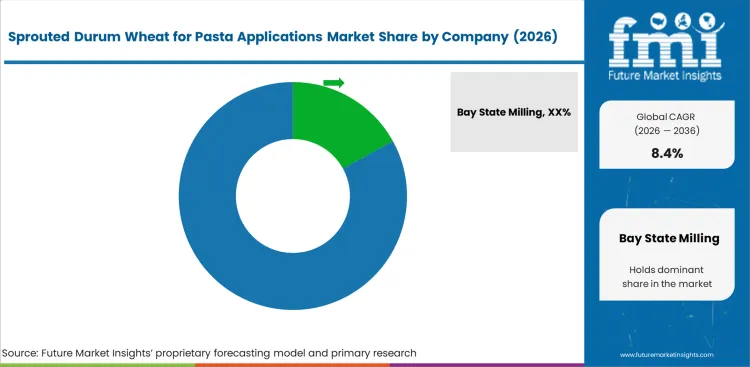
- Competition in this market depends on specialty milling capability, sprouting control, and the ability to deliver stable ingredient performance for commercial pasta production. Suppliers that can manage enzyme balance, moisture control, and granulation consistency hold a stronger position with large pasta manufacturers.
- The market remains fragmented, with no single company controlling global supply. Competitive position varies by organic certification depth, access to premium grain programs, and the ability to serve branded food manufacturers with consistent product quality.
- Direct technical engagement is becoming an important differentiator. Suppliers that can support formulation work, adjust product behavior to line requirements, and maintain tighter quality communication are better placed than those selling grain ingredients through a transactional model.
The sprouted durum wheat for pasta applications market includes specialty grain processors, organic milling companies, and premium flour suppliers serving branded food manufacturers, foodservice users, and health-positioned retail channels. Competitive advantage depends on process discipline as much as scale. Suppliers that control germination, manage thermal deactivation accurately, and produce repeatable milling output are better placed to serve commercial pasta programs.
Bay State Milling, Central Milling, and Anita’s Organic Mill compete through stronger milling credibility, broader grain-processing experience, and closer alignment with premium flour applications. Food For Life and One Degree Organics benefit from stronger natural and health-led product positioning, which helps them remain relevant in channels where certification and consumer-facing ingredient value carry more weight. KoRo and Narmada Agro Industries add pressure through niche positioning and regional supply access, especially where buyers seek differentiated grain formats or cost-managed specialty inputs.
Barriers to entry are moderate at a small scale, though they rise sharply when suppliers try to enter commercial pasta applications with repeatable output requirements. Manufacturers in this market do not evaluate grain inputs on label appeal alone. They assess dough behavior, hydration control, extrusion performance, and supply consistency. This increase the value of technical process control and limits the position of suppliers that cannot deliver stable line performance.
Major Industry Players
Key companies participating in the sprouted durum wheat for pasta applications market include:
- Bay State Milling, Central Milling, Anita’s Organic Mill, and One Degree Organics hold stronger competitive positions through specialty milling capability, premium grain orientation, and the ability to serve buyers that need tighter quality control in value-added wheat applications.
- Food For Life and KoRo compete through stronger brand visibility in health-led and premium retail channels, where sprouted grain positioning supports product differentiation and helps suppliers stay relevant in natural and better-for-you food categories.
- Narmada Agro Industries and other regional participants can build share where buyers prioritize localized sourcing, flexible supply, or access to specialty grain inputs tailored to smaller commercial programs.
Competitive Benchmarking: Sprouted Durum Wheat for Pasta Applications Market
| Company | Sprouting / Milling Capability | Organic / Certification Strength | Distribution Reach | Technical Support / Application Alignment |
|---|---|---|---|---|
| Bay State Milling | High | Medium | Strong | High |
| Central Milling | High | Medium | Strong | High |
| Anita’s Organic Mill | Medium | High | Moderate | Medium |
| One Degree Organics | Medium | High | Moderate | Medium |
| Food For Life | Medium | High | Moderate | Low |
| KoRo | Low | Medium | Strong | Low |
| Narmada Agro Industries | Medium | Low | Moderate | Medium |
Source: Future Market Insights competitive analysis, 2026.
Key Players in the Sprouted Durum Wheat for Pasta Applications Market
Major Global Players:
- Bay State Milling
- Central Milling
- One Degree Organics
- Food For Life
- Anita’s Organic Mill
Emerging Players / Regional Participants:
- KoRo
- Narmada Agro Industries
- other specialty grain and organic milling participants in regional premium pasta ingredient supply
Scope of the Report
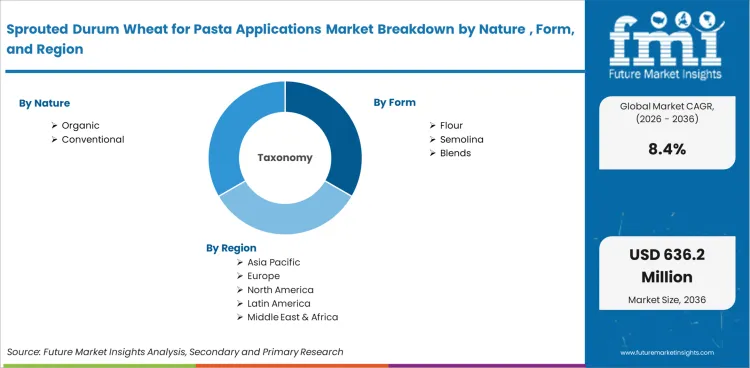
| Metric | Value |
|---|---|
| Quantitative Units | USD 262 million to USD 586.9 million, at a CAGR of 8.4% |
| Market Definition | Germinated durum wheat ingredients processed for extrusion and sheeting form the core of this category. Sprouting initiates enzymatic breakdown, then thermal deactivation stops growth before the grain is milled into usable pasta inputs. |
| Segmentation | Nature, Product form, Pasta type, End use, Sales channel, and Region |
| Regions Covered | North America, Latin America, Western Europe, Eastern Europe, Asia Pacific, and Middle East and Africa |
| Countries Covered | United States, Canada, Italy, Germany, France, United Kingdom, India |
| Key Companies Profiled | Food For Life, Bay State Milling, One Degree Organics, Anita’s Organic Mill, KoRo, Central Milling, Narmada Agro Industries |
| Forecast Period | 2026 to 2036 |
| Approach | Forecasts were developed through analysis of ingredient demand, process constraints, commercial adoption, and supply-side capability across premium pasta applications |
Source: Future Market Insights, 2026
Sprouted Durum Wheat for Pasta Applications Market Segments Analysis
By Nature
- Organic
- Conventional
By Product form
- Flour
- Semolina
- Blends
By Pasta type
- Dry pasta
- Fresh pasta
- Specialty pasta
By End use
- Industrial makers
- Foodservice
- Retail kits
By Sales channel
- Direct sales
- Distributors
- Online retail
By Region
- North America
- Latin America
- Western Europe
- Eastern Europe
- Asia Pacific
- Middle East and Africa
Bibliography
- From Seed to Pasta 5. (2025). From Seed to Pasta 5: A sustainable durum wheat chain for food security and healthy lives. Official conference website.
- Carpentieri, S., Tolve, R., Bonomo, M. G., D’Alessandro, A. G., Mastromatteo, M., Conte, A., & Del Nobile, M. A. (2024, June 7). Influence of semolina characteristics and pasta-making process on the physicochemical, structural and sensorial properties of commercial durum wheat spaghetti. Frontiers in Food Science and Technology, 4, Article 1416654. Frontiers
- Cuomo, F., Tolve, R., Carpentieri, S., Mastromatteo, M., Conte, A., & Del Nobile, M. A. (2024). Durum wheat milling by-products for the production of pasta with high nutritional and cooking quality.
This bibliography is provided for reader reference. The full FMI report contains the complete reference list with primary source documentation.
This Report Addresses
- Market sizing and revenue forecasting for sprouted durum wheat for pasta applications from 2026 to 2036.
- Segment analysis across nature, product form, pasta type, end use, sales channel, and region.
- Country-level demand outlook across major tracked markets.
- Processing realities linked to germination control, moisture handling, dough stability, and line performance.
- Competitive assessment based on specialty milling, certification discipline, process control, and buyer access.
- Supply-side evaluation tied to premium grain positioning and commercial-scale usability in pasta manufacturing.
Frequently Asked Questions
How large is the sprouted durum wheat for pasta applications market in 2026?
The market is expected to be valued at USD 262 million in 2026.
What will the market size be by 2036?
The market is projected to reach USD 586.9 million by 2036.
What is the expected growth rate between 2026 and 2036?
The market is expected to expand at a 8.4% CAGR during the forecast period.
Which nature segment is expected to lead in 2026?
Organic is projected to account for 37% of the nature segment in 2026.
Which product form is expected to lead in 2026?
Flour is expected to secure 42% share of the product form segment in 2026.
Which pasta type is expected to dominate in 2026?
Dry pasta is anticipated to represent 46% of the pasta type segment in 2026.
Preview the report firsthand - request a free sample
Get SampleGet the brochure for pricing and purchase details.
Get PDFTable of Content
- Executive Summary
- Global Market Outlook
- Demand-side Trends
- Supply-side Trends
- Technology Roadmap Analysis
- Analysis and Recommendations
- Market Overview
- Market Coverage / Taxonomy
- Market Definition / Scope / Limitations
- Research Methodology
- Chapter Orientation
- Analytical Lens and Working Hypotheses
- Market Structure, Signals, and Trend Drivers
- Benchmarking and Cross-market Comparability
- Market Sizing, Forecasting, and Opportunity Mapping
- Research Design and Evidence Framework
- Desk Research Programme (Secondary Evidence)
- Company Annual and Sustainability Reports
- Peer-reviewed Journals and Academic Literature
- Corporate Websites, Product Literature, and Technical Notes
- Earnings Decks and Investor Briefings
- Statutory Filings and Regulatory Disclosures
- Technical White Papers and Standards Notes
- Trade Journals, Industry Magazines, and Analyst Briefs
- Conference Proceedings, Webinars, and Seminar Materials
- Government Statistics Portals and Public Data Releases
- Press Releases and Reputable Media Coverage
- Specialist Newsletters and Curated Briefings
- Sector Databases and Reference Repositories
- FMI Internal Proprietary Databases and Historical Market Datasets
- Subscription Datasets and Paid Sources
- Social Channels, Communities, and Digital Listening Inputs
- Additional Desk Sources
- Expert Input and Fieldwork (Primary Evidence)
- Primary Modes
- Qualitative Interviews and Expert Elicitation
- Quantitative Surveys and Structured Data Capture
- Blended Approach
- Why Primary Evidence is Used
- Field Techniques
- Interviews
- Surveys
- Focus Groups
- Observational and In-context Research
- Social and Community Interactions
- Stakeholder Universe Engaged
- C-suite Leaders
- Board Members
- Presidents and Vice Presidents
- R&D and Innovation Heads
- Technical Specialists
- Domain Subject-matter Experts
- Scientists
- Physicians and Other Healthcare Professionals
- Governance, Ethics, and Data Stewardship
- Research Ethics
- Data Integrity and Handling
- Primary Modes
- Tooling, Models, and Reference Databases
- Desk Research Programme (Secondary Evidence)
- Data Engineering and Model Build
- Data Acquisition and Ingestion
- Cleaning, Normalisation, and Verification
- Synthesis, Triangulation, and Analysis
- Quality Assurance and Audit Trail
- Market Background
- Market Dynamics
- Drivers
- Restraints
- Opportunity
- Trends
- Scenario Forecast
- Demand in Optimistic Scenario
- Demand in Likely Scenario
- Demand in Conservative Scenario
- Opportunity Map Analysis
- Product Life Cycle Analysis
- Supply Chain Analysis
- Investment Feasibility Matrix
- Value Chain Analysis
- PESTLE and Porter’s Analysis
- Regulatory Landscape
- Regional Parent Market Outlook
- Production and Consumption Statistics
- Import and Export Statistics
- Market Dynamics
- Global Market Analysis 2021 to 2025 and Forecast, 2026 to 2036
- Historical Market Size Value (USD Million) Analysis, 2021 to 2025
- Current and Future Market Size Value (USD Million) Projections, 2026 to 2036
- Y-o-Y Growth Trend Analysis
- Absolute $ Opportunity Analysis
- Global Market Pricing Analysis 2021 to 2025 and Forecast 2026 to 2036
- Global Market Analysis 2021 to 2025 and Forecast 2026 to 2036, By Nature
- Introduction / Key Findings
- Historical Market Size Value (USD Million) Analysis By Nature , 2021 to 2025
- Current and Future Market Size Value (USD Million) Analysis and Forecast By Nature , 2026 to 2036
- Organic
- Conventional
- Organic
- Y-o-Y Growth Trend Analysis By Nature , 2021 to 2025
- Absolute $ Opportunity Analysis By Nature , 2026 to 2036
- Global Market Analysis 2021 to 2025 and Forecast 2026 to 2036, By Form
- Introduction / Key Findings
- Historical Market Size Value (USD Million) Analysis By Form, 2021 to 2025
- Current and Future Market Size Value (USD Million) Analysis and Forecast By Form, 2026 to 2036
- Flour
- Semolina
- Blends
- Flour
- Y-o-Y Growth Trend Analysis By Form, 2021 to 2025
- Absolute $ Opportunity Analysis By Form, 2026 to 2036
- Global Market Analysis 2021 to 2025 and Forecast 2026 to 2036, By Pasta Type
- Introduction / Key Findings
- Historical Market Size Value (USD Million) Analysis By Pasta Type, 2021 to 2025
- Current and Future Market Size Value (USD Million) Analysis and Forecast By Pasta Type, 2026 to 2036
- Dry Pasta
- Fresh Pasta
- Specialty Pasta
- Dry Pasta
- Y-o-Y Growth Trend Analysis By Pasta Type, 2021 to 2025
- Absolute $ Opportunity Analysis By Pasta Type, 2026 to 2036
- Global Market Analysis 2021 to 2025 and Forecast 2026 to 2036, By End-Use
- Introduction / Key Findings
- Historical Market Size Value (USD Million) Analysis By End-Use, 2021 to 2025
- Current and Future Market Size Value (USD Million) Analysis and Forecast By End-Use, 2026 to 2036
- Industrial Makers
- Foodservice
- Retail Kits
- Industrial Makers
- Y-o-Y Growth Trend Analysis By End-Use, 2021 to 2025
- Absolute $ Opportunity Analysis By End-Use, 2026 to 2036
- Global Market Analysis 2021 to 2025 and Forecast 2026 to 2036, By Sales Channel
- Introduction / Key Findings
- Historical Market Size Value (USD Million) Analysis By Sales Channel, 2021 to 2025
- Current and Future Market Size Value (USD Million) Analysis and Forecast By Sales Channel, 2026 to 2036
- Direct Sales
- Distributors
- Online Retail
- Direct Sales
- Y-o-Y Growth Trend Analysis By Sales Channel, 2021 to 2025
- Absolute $ Opportunity Analysis By Sales Channel, 2026 to 2036
- Global Market Analysis 2021 to 2025 and Forecast 2026 to 2036, By Region
- Introduction
- Historical Market Size Value (USD Million) Analysis By Region, 2021 to 2025
- Current Market Size Value (USD Million) Analysis and Forecast By Region, 2026 to 2036
- North America
- Latin America
- Western Europe
- Eastern Europe
- East Asia
- South Asia and Pacific
- Middle East & Africa
- Market Attractiveness Analysis By Region
- North America Market Analysis 2021 to 2025 and Forecast 2026 to 2036, By Country
- Historical Market Size Value (USD Million) Trend Analysis By Market Taxonomy, 2021 to 2025
- Market Size Value (USD Million) Forecast By Market Taxonomy, 2026 to 2036
- By Country
- USA
- Canada
- Mexico
- By Nature
- By Form
- By Pasta Type
- By End-Use
- By Sales Channel
- By Country
- Market Attractiveness Analysis
- By Country
- By Nature
- By Form
- By Pasta Type
- By End-Use
- By Sales Channel
- Key Takeaways
- Latin America Market Analysis 2021 to 2025 and Forecast 2026 to 2036, By Country
- Historical Market Size Value (USD Million) Trend Analysis By Market Taxonomy, 2021 to 2025
- Market Size Value (USD Million) Forecast By Market Taxonomy, 2026 to 2036
- By Country
- Brazil
- Chile
- Rest of Latin America
- By Nature
- By Form
- By Pasta Type
- By End-Use
- By Sales Channel
- By Country
- Market Attractiveness Analysis
- By Country
- By Nature
- By Form
- By Pasta Type
- By End-Use
- By Sales Channel
- Key Takeaways
- Western Europe Market Analysis 2021 to 2025 and Forecast 2026 to 2036, By Country
- Historical Market Size Value (USD Million) Trend Analysis By Market Taxonomy, 2021 to 2025
- Market Size Value (USD Million) Forecast By Market Taxonomy, 2026 to 2036
- By Country
- Germany
- UK
- Italy
- Spain
- France
- Nordic
- BENELUX
- Rest of Western Europe
- By Nature
- By Form
- By Pasta Type
- By End-Use
- By Sales Channel
- By Country
- Market Attractiveness Analysis
- By Country
- By Nature
- By Form
- By Pasta Type
- By End-Use
- By Sales Channel
- Key Takeaways
- Eastern Europe Market Analysis 2021 to 2025 and Forecast 2026 to 2036, By Country
- Historical Market Size Value (USD Million) Trend Analysis By Market Taxonomy, 2021 to 2025
- Market Size Value (USD Million) Forecast By Market Taxonomy, 2026 to 2036
- By Country
- Russia
- Poland
- Hungary
- Balkan & Baltic
- Rest of Eastern Europe
- By Nature
- By Form
- By Pasta Type
- By End-Use
- By Sales Channel
- By Country
- Market Attractiveness Analysis
- By Country
- By Nature
- By Form
- By Pasta Type
- By End-Use
- By Sales Channel
- Key Takeaways
- East Asia Market Analysis 2021 to 2025 and Forecast 2026 to 2036, By Country
- Historical Market Size Value (USD Million) Trend Analysis By Market Taxonomy, 2021 to 2025
- Market Size Value (USD Million) Forecast By Market Taxonomy, 2026 to 2036
- By Country
- China
- Japan
- South Korea
- By Nature
- By Form
- By Pasta Type
- By End-Use
- By Sales Channel
- By Country
- Market Attractiveness Analysis
- By Country
- By Nature
- By Form
- By Pasta Type
- By End-Use
- By Sales Channel
- Key Takeaways
- South Asia and Pacific Market Analysis 2021 to 2025 and Forecast 2026 to 2036, By Country
- Historical Market Size Value (USD Million) Trend Analysis By Market Taxonomy, 2021 to 2025
- Market Size Value (USD Million) Forecast By Market Taxonomy, 2026 to 2036
- By Country
- India
- ASEAN
- Australia & New Zealand
- Rest of South Asia and Pacific
- By Nature
- By Form
- By Pasta Type
- By End-Use
- By Sales Channel
- By Country
- Market Attractiveness Analysis
- By Country
- By Nature
- By Form
- By Pasta Type
- By End-Use
- By Sales Channel
- Key Takeaways
- Middle East & Africa Market Analysis 2021 to 2025 and Forecast 2026 to 2036, By Country
- Historical Market Size Value (USD Million) Trend Analysis By Market Taxonomy, 2021 to 2025
- Market Size Value (USD Million) Forecast By Market Taxonomy, 2026 to 2036
- By Country
- Kingdom of Saudi Arabia
- Other GCC Countries
- Turkiye
- South Africa
- Other African Union
- Rest of Middle East & Africa
- By Nature
- By Form
- By Pasta Type
- By End-Use
- By Sales Channel
- By Country
- Market Attractiveness Analysis
- By Country
- By Nature
- By Form
- By Pasta Type
- By End-Use
- By Sales Channel
- Key Takeaways
- Key Countries Market Analysis
- USA
- Pricing Analysis
- Market Share Analysis, 2025
- By Nature
- By Form
- By Pasta Type
- By End-Use
- By Sales Channel
- Canada
- Pricing Analysis
- Market Share Analysis, 2025
- By Nature
- By Form
- By Pasta Type
- By End-Use
- By Sales Channel
- Mexico
- Pricing Analysis
- Market Share Analysis, 2025
- By Nature
- By Form
- By Pasta Type
- By End-Use
- By Sales Channel
- Brazil
- Pricing Analysis
- Market Share Analysis, 2025
- By Nature
- By Form
- By Pasta Type
- By End-Use
- By Sales Channel
- Chile
- Pricing Analysis
- Market Share Analysis, 2025
- By Nature
- By Form
- By Pasta Type
- By End-Use
- By Sales Channel
- Germany
- Pricing Analysis
- Market Share Analysis, 2025
- By Nature
- By Form
- By Pasta Type
- By End-Use
- By Sales Channel
- UK
- Pricing Analysis
- Market Share Analysis, 2025
- By Nature
- By Form
- By Pasta Type
- By End-Use
- By Sales Channel
- Italy
- Pricing Analysis
- Market Share Analysis, 2025
- By Nature
- By Form
- By Pasta Type
- By End-Use
- By Sales Channel
- Spain
- Pricing Analysis
- Market Share Analysis, 2025
- By Nature
- By Form
- By Pasta Type
- By End-Use
- By Sales Channel
- France
- Pricing Analysis
- Market Share Analysis, 2025
- By Nature
- By Form
- By Pasta Type
- By End-Use
- By Sales Channel
- India
- Pricing Analysis
- Market Share Analysis, 2025
- By Nature
- By Form
- By Pasta Type
- By End-Use
- By Sales Channel
- ASEAN
- Pricing Analysis
- Market Share Analysis, 2025
- By Nature
- By Form
- By Pasta Type
- By End-Use
- By Sales Channel
- Australia & New Zealand
- Pricing Analysis
- Market Share Analysis, 2025
- By Nature
- By Form
- By Pasta Type
- By End-Use
- By Sales Channel
- China
- Pricing Analysis
- Market Share Analysis, 2025
- By Nature
- By Form
- By Pasta Type
- By End-Use
- By Sales Channel
- Japan
- Pricing Analysis
- Market Share Analysis, 2025
- By Nature
- By Form
- By Pasta Type
- By End-Use
- By Sales Channel
- South Korea
- Pricing Analysis
- Market Share Analysis, 2025
- By Nature
- By Form
- By Pasta Type
- By End-Use
- By Sales Channel
- Russia
- Pricing Analysis
- Market Share Analysis, 2025
- By Nature
- By Form
- By Pasta Type
- By End-Use
- By Sales Channel
- Poland
- Pricing Analysis
- Market Share Analysis, 2025
- By Nature
- By Form
- By Pasta Type
- By End-Use
- By Sales Channel
- Hungary
- Pricing Analysis
- Market Share Analysis, 2025
- By Nature
- By Form
- By Pasta Type
- By End-Use
- By Sales Channel
- Kingdom of Saudi Arabia
- Pricing Analysis
- Market Share Analysis, 2025
- By Nature
- By Form
- By Pasta Type
- By End-Use
- By Sales Channel
- Turkiye
- Pricing Analysis
- Market Share Analysis, 2025
- By Nature
- By Form
- By Pasta Type
- By End-Use
- By Sales Channel
- South Africa
- Pricing Analysis
- Market Share Analysis, 2025
- By Nature
- By Form
- By Pasta Type
- By End-Use
- By Sales Channel
- USA
- Market Structure Analysis
- Competition Dashboard
- Competition Benchmarking
- Market Share Analysis of Top Players
- By Regional
- By Nature
- By Form
- By Pasta Type
- By End-Use
- By Sales Channel
- Competition Analysis
- Competition Deep Dive
- Bay State Milling
- Overview
- Product Portfolio
- Profitability by Market Segments (Product/Age /Sales Channel/Region)
- Sales Footprint
- Strategy Overview
- Marketing Strategy
- Product Strategy
- Channel Strategy
- Central Milling
- One Degree Organics
- Food For Life
- Anita’s Organic Mill
- KoRo
- Narmada Agro Industries
- Bay State Milling
- Competition Deep Dive
- Assumptions & Acronyms Used


