

- Market Size (2026)
- USD 0.7 Bn
- Forecast (2036)
- USD 1.6 Bn
- CAGR (2026 to 2036)
- 8.6%
Pomegranate Peel Polyphenol Complex Market Size, Market Forecast and Outlook by FMI
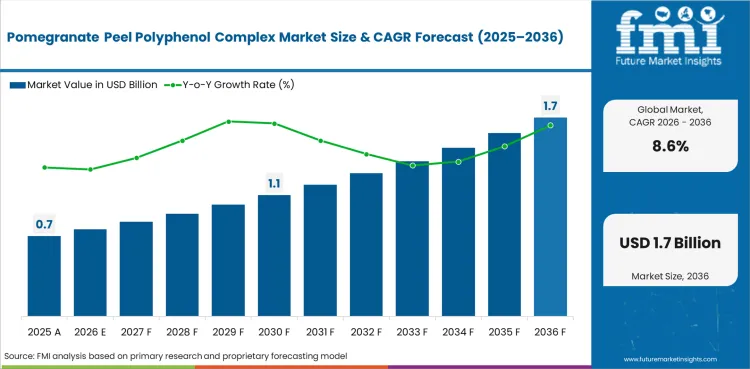
The pomegranate peel polyphenol complex market was valued at USD 0.6 billion in 2025. The market is projected to reach USD 0.7 billion in 2026 and is forecast to expand to USD 1.6 billion by 2036 at a 8.6% CAGR. Based on Future Market Insights analysis, the market is expected to create an incremental opportunity of USD 0.9 billion over the forecast period. Growth depends on how efficiently processors recover punicalagins and related polyphenols from peel while keeping the active profile stable enough for downstream use.
Summary of Pomegranate Peel Polyphenol Complex Market
- The market is forecast to reach USD 1.6 billion by 2036.
- The market is expected to grow at an 8.6% CAGR from 2026 to 2036.
- The market was estimated at USD 0.6 billion in 2025.
- The forecast period represents an incremental opportunity of USD 0.9 billion.
- Powder is expected to account for 41% of the form segment in 2026. Its position reflects easier handling, better storage stability, and stronger fit with large-scale ingredient distribution.
- Punicalagin-rich variants are projected to hold 38% of the polyphenol profile segment in 2026. Their lead comes from stronger commercial focus on recognizable active markers and clearer formulation value.
- Nutraceuticals are expected to contribute 36.5% of the application segment in 2026. Demand remains strongest where concentrated botanical actives can support clear wellness positioning and workable dosage formats.
- Conventional products are estimated to represent 72% of the nature segment in 2026. Mainstream buyers continue to favor scalable supply and tighter cost control over narrower organic availability.
- B2B ingredients are projected to command 68% of the sales channel segment in 2026. Market activity remains concentrated with extract suppliers, standardization specialists, and formulation partners rather than finished-label retail.
Key Takeaways, Market Size, and Forecast
- Pomegranate Peel Polyphenol Complex Market is expected to rise from USD 0.7 billion in 2026 to USD 1.6 billion by 2036, recording a CAGR of 8.6%.
- The pomegranate peel polyphenol complex market was valued at USD 0.6 billion in 2025.
- By 2036, the Pomegranate Peel Polyphenol Complex Market is likely to reach USD 1.6 billion.
- The market is forecast to expand at a CAGR of 8.6% over 2026 to 2036.
- The market is set to generate an incremental opportunity of USD 0.9 billion across the forecast period.
- In 2026, Powder is expected to account for 41.0% of the form segment.
- India (10.2%) and China (9.6%) are two of the fastest growing markets.
Pomegranate Peel Polyphenol Complex Market Key Takeaways
| Parameter | Details |
|---|---|
| Market value (2026) | USD 0.7 billion |
| Forecast value (2036) | USD 1.6 billion |
| CAGR (2026 to 2036) | 8.6% |
| Estimated market value (2025) | USD 0.6 billion |
| Incremental opportunity | USD 0.9 billion |
| Leading form | Powder (41% of form segment) |
| Leading polyphenol profile | Punicalagin-rich (38% of profile segment) |
| Leading application | Nutraceuticals (36.5% of application segment) |
| Leading nature | Conventional (72% of nature segment) |
| Leading sales channel | B2B ingredients (68% of sales channel segment) |
| Key players | Layn Natural Ingredients, Sabinsa, Croda Beauty, Euromed, Arjuna Natural, Botanic Healthcare, Nordmann |
Source: Future Market Insights, 2026
Formulation pressure is moving the sector away from low-concentration fruit inputs and toward standardized extract systems. Buyers need cleaner dosage control. They also need stronger shelf stability and better batch consistency. That requirement is giving standardized powder and profile-led extracts a stronger commercial position than broad fruit derivatives used without tight active control. Similar formulation discipline is visible in the botanical ingredient market, where repeatability and use-case fit carry more weight than ingredient story alone. Peel is gaining value as an upcycled source of concentrated polyphenols. Buyers in supplements and topical formulations are asking for tighter standardization. Extraction control is becoming a competitive filter because formulation performance depends on lot quality, not just on antioxidant claims. These shifts keep the category aligned with broader movement in the food botanicals market and selected parts of the skincare market, where technical acceptability matters before brand story can scale.
India is expected to lead at 8.8% CAGR through 2036. China is projected to follow at 8.4% as digital retail strength and premium skin care demand continue to support oils with a stronger natural image. Demand in the United States is likely to rise at 7.6%, while Brazil is anticipated to grow at 7.2% with support from wellness retail and beauty use. Germany is projected to expand at 7.0%, and France is expected to record 6.8% as both markets continue to favor quality-focused and well-documented ingredient positioning. South Korea is set to grow at 6.0%, followed by Japan at 5.5%
Pomegranate Peel Polyphenol Complex Market Definition
The pomegranate peel polyphenol complex market includes the production, standardization, distribution, and commercial use of concentrated polyphenol ingredients derived specifically from pomegranate peel. These ingredients include punicalagins, ellagic-acid-linked compounds, and broader polyphenol complexes used in nutraceuticals, skincare, functional foods, beverages, oral care, and related formulation systems.
Pomegranate Peel Polyphenol Complex Market Inclusions
Market scope includes commercially traded peel-derived polyphenol complexes segmented by form, polyphenol profile, application, nature, sales channel, and region. It covers powders, liquids, and capsule-ready formats designed for antioxidant support, anti-inflammatory positioning, preservation support, and skin-focused applications.
Pomegranate Peel Polyphenol Complex Market Exclusions
The scope excludes whole fruit juice products, pomegranate seed oil, non-standardized fruit powders, and other pomegranate derivatives that are not based on concentrated peel polyphenol recovery or specification-led extract use. Broad fruit ingredient formats sold without active profile standardization are excluded as well.
Pomegranate Peel Polyphenol Complex Market Research Methodology
- Primary Research: FMI analysts conducted interviews with botanical extract suppliers, formulation teams, nutraceutical ingredient buyers, contract manufacturers, and specialty ingredient distributors across major demand and processing regions.
- Desk Research: The study reviewed scientific literature, botanical ingredient databases, regulatory ingredient references, company technical material, and public information linked to extraction technologies, formulation use, and commercial positioning.
- Market Sizing and Forecasting: Baseline sizing was developed through assessment of peel availability, yield conversion, standardized extract output, application-level demand, and pricing by grade and format.
- Data Validation and Update Cycle: Forecasts were tested against extraction performance, formulation intensity, supply chain capability, and country-level demand patterns, with updates aligned to evolving processing economics and commercial adoption trends.
Why is the Pomegranate Peel Polyphenol Complex Market Growing?
- Nutraceutical demand is expanding because buyers want concentrated botanical actives that fit capsule, tablet, and powder systems without the dosage burden of low-potency fruit ingredients.
- Punicalagin-rich extracts are gaining preference because recognizable active markers make quality positioning easier in a market that depends heavily on specification control.
- Upcycled ingredient positioning is improving the commercial case for peel utilization, especially where processors can convert agricultural residue into standardized higher-value inputs.
Processors are turning a low-value fruit by-product into a formulation-ready ingredient used in supplements, skincare, and selected food systems. Market value depends on recovery quality, active concentration, and downstream usability. Extracts must pass through manufacturing without causing instability, label inconsistency, or excess dosing volume.
Nutraceuticals hold the strongest demand because concentrated extracts solve a real formulation problem. Manufacturers need ingredients that fit more easily into capsules, sachets, and powder systems. Standardized peel polyphenol complexes meet that need better than broad fruit powders. This keeps the category closely linked with the nutraceuticals market and the rising demand seen in the nutricosmetic ingredients market.
Cosmetic formulators prefer botanical ingredients that can be documented and standardized for antioxidant and skin-conditioning systems. Food and beverage use stays more selective because bitterness, solubility, and sediment control need closer work. Product developers are assessing peel-derived actives where they can support the broader functional food ingredients market.
Segmental Analysis
Key Facts About Segments
- Powder is projected to lead the form segment with 41% share in 2026 because it fits large-scale ingredient handling, dry blending, and shelf-stable distribution more effectively than aqueous formats.
- Punicalagin-rich variants are expected to account for 38% of the polyphenol profile segment in 2026 because buyers prefer clearer active identity and stronger specification control.
- Nutraceuticals are forecast to hold 36.5% of the application segment in 2026 because supplement manufacturers continue to prioritize concentrated botanical inputs with better dose efficiency.
The pomegranate peel polyphenol complex market is segmented by form, polyphenol profile, application, nature, sales channel, and region. By form, the market is divided into powder, liquid, and capsules. By polyphenol profile, the market is classified into punicalagin-rich, ellagic acid, and full spectrum. By application, the market covers nutraceuticals, skincare, functional foods, beverages, and oral care. By nature, the market includes conventional and organic products. By sales channel, the market is segmented into B2B ingredients, direct brands, and online retail.
Insights into the Powder Form Segment
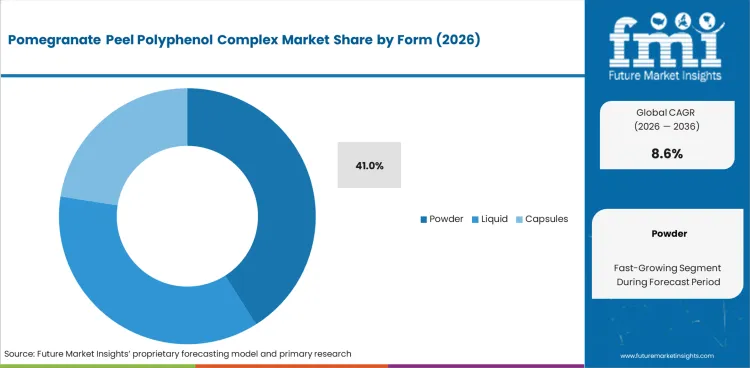
Powder is projected to hold 41% of the form segment in 2026. This lead is supported by practical manufacturing and distribution advantages. Dry inputs are easier to ship and store. They are also easier to dose into capsules, sachets, and dry blends. Powder reduces the water-activity issues that complicate shelf stability and compatibility with adjacent actives. this benefits becomes more relevant in blends shaped by technical demands of the nutraceutical CDMO market.
Insights into the Punicalagin-rich Polyphenol Profile Segment
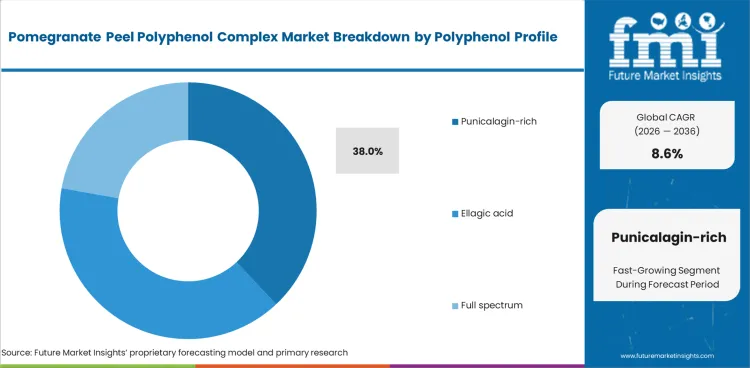
Punicalagin-rich extracts lead this segment because the market values clearer active identity and stronger specification control. They are expected to capture 38% share of the polyphenol profile segment in 2026. Manufacturers and formulators prefer extracts linked to a recognizable marker rather than broad total polyphenol claims. This matters in supplements and topical products where efficacy positioning and batch consistency matter in commercial use.
Insights into the Nutraceuticals Application Segment
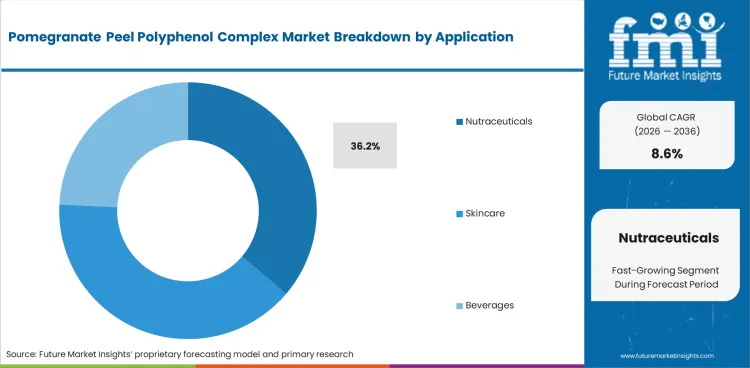
Nutraceuticals are projected to account for 36.5% share of the application segment in 2026. Supplement manufacturers prefer concentrated peel polyphenol complexes because they support strong active loading without creating large dosage formats. Standardized extracts also support cleaner label planning in categories linked to healthy aging, antioxidant support, cardiovascular wellness, and beauty-from-within positioning. This demand pattern aligns with the pro collagen ingredient market, where dose efficiency and functional positioning move together.
Insights into the Conventional Nature Segment
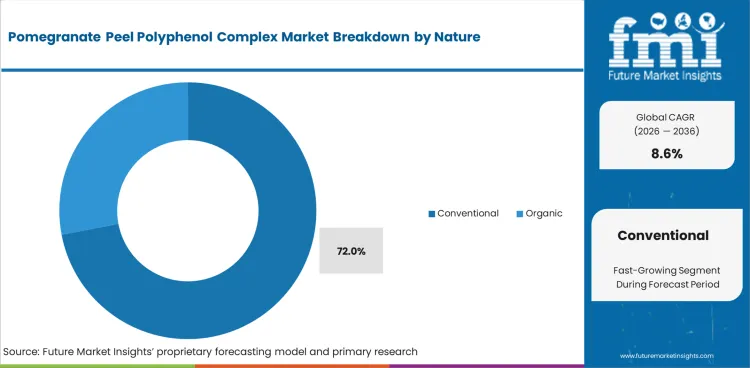
Conventional products are estimated to represent 72% of the nature segment in 2026. Better supply availability, more scalable extraction economics, and tighter cost management support this lead. Large ingredient purchasers usually prioritize specification consistency, monthly volume reliability, and manageable input cost before organic status. Organic options remain relevant in premium niches, though supply limits and higher cost continue to restrict broader adoption.
Insights into the B2B Ingredients Sales Channel Segment
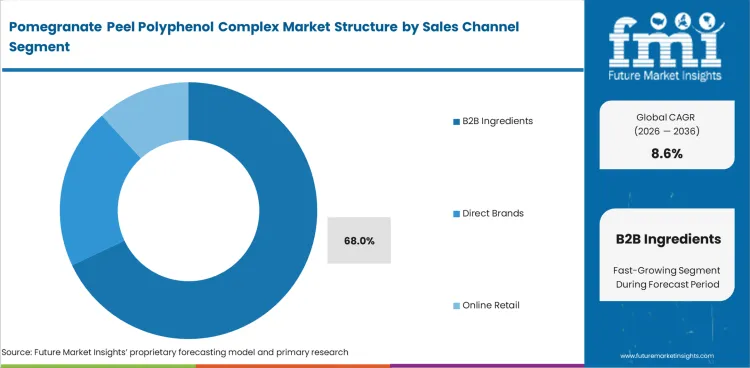
B2B ingredients are expected to command 68% of the sales channel segment in 2026. Most market value remain upstream with extract processors, standardization specialists, ingredient suppliers, and formulation support partners rather than with direct consumer retail. This channel structure reflects the technical nature of the category. Extraction, refinement, documentation, and quality control require capabilities that most finished-brand operators do not maintain internally.
What are the Drivers, Restraints, and Key Trends of the Pomegranate Peel Polyphenol Complex Market?
- Upcycled botanical sourcing is improving demand because peel is being repositioned as a usable active source rather than a low-value processing residue.
- Standardization pressure remains a core restraint because extract quality depends on active retention, solvent control, and profile consistency across batches.
- Market direction is shifting toward concentrated, specification-led ingredients that support nutraceutical, skincare, and premium formulation use more effectively than loosely defined fruit derivatives.
The market is expanding because interest in natural actives, clean-label positioning, and upcycled botanical ingredients is rising. Growth depends on execution across extraction, standardization, and formulation fit. Processors must recover stable active fractions at workable yields. Suppliers must document those fractions clearly and deliver formats that fit real manufacturing requirements. Manufacturers favor suppliers that combine extraction control, analytical support, and lot consistency.
Upcycled Raw Material Utilization and Clean-label Demand
Pomegranate peel is gaining value as a source of antioxidant-rich ingredients that are easier to standardize and dose than whole-fruit formats. This gives processors a stronger commercial route when food-processing residue is converted into nutraceutical and cosmetic inputs. Clean-label reformulation is reinforcing that opportunity, especially in applications where brands are reducing reliance on synthetic additives. This is increasing interest in adjacent areas such as the personal care ingredient market and the broader organic cosmetics market.
Extraction Control, Solvent Limits, and Standardization Pressure
Extraction remains the main technical challenge in this market. Commercial success depends on the ability to isolate punicalagins and related compounds without damaging the active profile or leaving residue levels that restrict downstream use. Solvent restrictions , tannin balance, particle handling and batch repeatability matter. This pressure is stronger in Europe and in premium wellness programs, where analytical review is tight. Suppliers that cannot control these variables consistently face difficulty in larger programs. Similar pressure appears in more refined botanical categories such as the botanical CO2 extracts market.
Higher-value Positioning in Nutraceuticals and Skincare
Market development is shifting toward applications that value standardized actives over broad botanical claims. Nutraceutical manufacturers want ingredients that deliver concentrated dosing in manageable formats. Skincare formulators want well-documented extracts that support antioxidant and skin-conditioning roles without affecting appearance or stability. This trend increases the value of stronger technical files and application support. In topical use, the same logic overlaps with demand seen in the probiotic skincare ingredients market, where performance credibility influences adoption.
Analysis of Pomegranate Peel Polyphenol Complex Market by Key Countries
Key Facts About Country
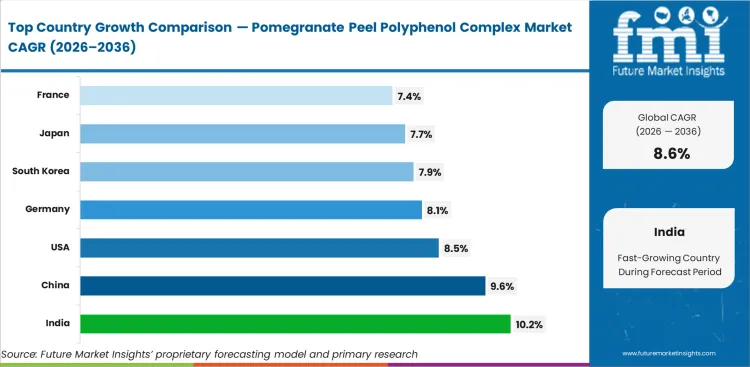
- India leads tracked markets at 10.2% CAGR because raw material access and primary extraction activity remain closely linked.
- China follows at 9.6% CAGR because processing scale, refining depth, and cost control continue to support standardized extract supply.
- The United States records 8.5% CAGR because clean-label reformulation and demand for natural actives continue to widen ingredient evaluation.
- Germany, South Korea, Japan, and France remain important premium markets where compliance discipline, formulation standards, and quality verification shape supplier selection.
.webp "Top Country Growth Comparison Pomegranate Peel Polyphenol Complex Market Cagr (2026 2036)")
| Country | CAGR (2026 to 2036) |
|---|---|
| India | 10.2% |
| China | 9.6% |
| United States | 8.5% |
| Germany | 8.1% |
| South Korea | 7.9% |
| Japan | 7.7% |
| France | 7.4% |
Demand Outlook for Pomegranate Peel Polyphenol Complex Market in India
India is projected to grow at a 10.2% CAGR through 2036. Direct access to peel feedstock, lower freight burden on bulky raw material, and shorter movement between collection and extraction support this growth. These conditions improve recovery and helps preserve active quality before oxidation reduces usable yield. Export readiness is also improving as local processors strengthen documentation and standardization for nutraceutical and cosmetic ingredient buyers.
- Proximity to cultivation belts supports faster primary processing.
- Farm-to-factory integration improves cost control and raw material handling.
- Export-oriented processors are strengthening specification and documentation quality.
Future Outlook for Pomegranate Peel Polyphenol Complex Market in China
China is expected to grow at a 9.6% CAGR through 2036. Large-scale extraction systems, spray-drying depth, and cost discipline continue to support its position in global ingredient supply. Chinese processors are improving consistency and customization, which helps them serve a wider range of specification requirements across mid-tier and increasingly refined applications. Scale remains a major commercial advantage, though quality upgrades are becoming equally important for long-term positioning.
- Large facilities support stronger throughput and lower unit processing cost.
- Refining capability is improving across standardized extract supply.
- Customized particle sizing and production depth strengthen export competitiveness.
Opportunity Analysis of Pomegranate Peel Polyphenol Complex Market in the United States
The United States is projected to record an 8.5% CAGR from 2026 to 2036. Demand is supported by reformulation work in supplements, foods, beverages, and personal care products as brands look for natural alternatives to synthetic additives. Adoption depends heavily on technical documentation, stability review, and formulation compatibility because botanical substitution is rarely straightforward in established product lines. Suppliers with stronger technical files and local inventory support are better placed to win recurring business.
- Clean-label reformulation is widening evaluation of fruit-derived polyphenol systems.
- Contract manufacturing networks require stronger documentation before routine use.
- Local stock coverage and technical support improve buyer confidence.
In-depth Analysis of Pomegranate Peel Polyphenol Complex Market in Germany
Germany is projected to grow at an 8.1% CAGR by 2036. The market supports specification-led, with strong emphasis on analytical verification, impurity control, and downstream suitability for premium applications. Imported lots often undergo closer review before acceptance, which favors suppliers that can support tighter documentation and further refinement. Commercial demand is steady where processors and distributors can meet disciplined quality expectations.
- Secondary review of imported material raises the importance of analytical control.
- Tighter impurity tolerance favors better-funded and better-documented suppliers.
- Premium applications support demand for refined and traceable extracts.
In-depth Analysis of Pomegranate Peel Polyphenol Complex Market in South Korea
South Korea is expected to register a 7.9% CAGR through 2036. The market is shaped more by premium topical and cosmetic use than by bulk ingredient demand. Local processors and formulators focus on purity, solubility, and performance in higher-value beauty applications, where technical quality matters more than commodity-scale output. Imported raw material is often refined further for advanced formulation work.
- Cosmetic-grade refinement supports specialized demand.
- Purity and solubility matter more than bulk processing scale.
- Local beauty-sector standards continue to support higher-value extract use.
Sales Analysis of Pomegranate Peel Polyphenol Complex Market in Japan
Japan is projected to grow at a 7.7% CAGR from 2026 to 2036. The market supports narrow in tolerance and strong in compliance discipline. Heavy metals, pesticide residues, and batch consistency receive close attention, which keeps demand focused on qualified, precision-led supply rather than broad-volume sourcing. Buyers value controlled extraction parameters and dependable finishing quality in supplement and wellness formulations.
- Strict screening protocols favor precision-oriented suppliers.
- Narrow quality tolerance supports premium pricing for qualified extracts.
- Compliance discipline keeps the market focused on consistency over scale.
Demand Outlook for Pomegranate Peel Polyphenol Complex Market in France
France is expected to expand at a 7.4% CAGR through 2036. Demand is supported by premium wellness and cosmetic categories where traceability, purity, and ingredient story remain commercially important. Suppliers that can document origin, processing integrity, and cleaner extraction routes are better placed in this market. Organic and well-documented botanical inputs remain relevant, though they operate within a narrower and more selective demand base than conventional supply.
- Traceability and processing integrity remain central to supplier selection.
- Premium cosmetic and wellness uses support demand for cleaner botanical inputs.
- Documentation strength improves positioning in compliance-led ingredient programs.
Competitive Landscape of Pomegranate Peel Polyphenol Complex Market
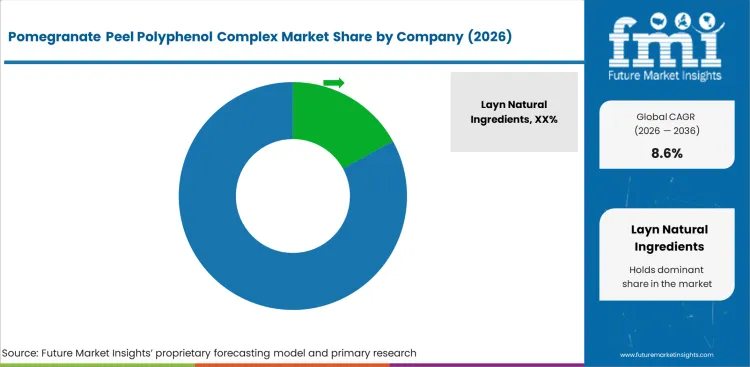
- Competition is shaped more by extraction quality, active profile consistency, and technical documentation than by raw fruit access alone.
- The market remains moderately fragmented, with room for specialized extract suppliers, formulation-focused processors, and regional distributors.
- Established players hold an advantage where clinical support, application validation, and safety documentation strengthen buyer confidence.
The pomegranate peel polyphenol complex market is defined by technical credibility as much as by extract availability. Buyers in supplements, skincare, and premium ingredient channels do not choose suppliers on volume alone. They look for stable active ratios, dependable analytical support, residue control, and a clear ability to deliver repeatable performance across lots. Suppliers that can meet these demands are better placed to secure longer program cycles and larger B2B relationships.
Layn Natural Ingredients and Sabinsa remain well positioned because standardization discipline, formulation support, and route-to-market capability continue to matter at scale. Euromed and Croda Beauty benefit from stronger technical and application-led positioning in higher-value programs, especially where safety support and formulation confidence influence buyer choice. Secondary suppliers such as Arjuna Natural, Botanic Healthcare, and Nordmann remain commercially relevant where continuity of supply and distribution reach matter.
Barriers to entry are moderate at the raw extract level and higher in standardized premium supply. New entrants can participate in basic extraction, though access to larger programs depends on stronger evidence and the ability to support buyer audits.
Major Industry Players
Key global companies leading the pomegranate peel polyphenol complex market include:
- Layn Natural Ingredients, Sabinsa, Croda Beauty, and Euromed are among the leading participants due to their extract standardization capability, technical support depth, and stronger commercial access across nutraceutical and personal care channels.
- Arjuna Natural, Botanic Healthcare, and Nordmann maintain competitive relevance through continuity of supply, regional reach, and ability to serve specialized ingredient requirements across selected buyer programs.
- Smaller and emerging suppliers continue to participate where upcycled sourcing, niche formulation support, or flexible batch economics create openings in a still-fragmented category.
Competitive Benchmarking: Pomegranate Peel Polyphenol Complex Market
| Company | Extract Standardization | Technical Documentation | Distribution Network | Application Support |
|---|---|---|---|---|
| Layn Natural Ingredients | High | High | Strong | Strong |
| Sabinsa | High | High | Strong | Strong |
| Croda Beauty | Medium | High | Strong | High |
| Euromed | High | High | Moderate | Strong |
| Arjuna Natural | Medium | Medium | Moderate | Moderate |
| Botanic Healthcare | Medium | Medium | Moderate | Moderate |
| Nordmann | Medium | Medium | Strong | Moderate |
Source: Future Market Insights competitive analysis, 2026
Key Developments in Pomegranate Peel Polyphenol Complex Market
- In July 2025, POM Wonderful Specialty Ingredients was featured by IFT ahead of IFT FIRST for a session on how pomegranate extract is being used in commercial food innovation.
- In November 2025, Euromed announced new human clinical findings for Pomanox® that support healthy-aging claims.
Key Players in the Pomegranate Peel Polyphenol Complex Market
Major Global Players
- Layn Natural Ingredients
- Sabinsa
- Croda Beauty
- Euromed
- Arjuna Natural
Emerging Players / Specialized Participants
- Botanic Healthcare
- Nordmann
Scope of the Report
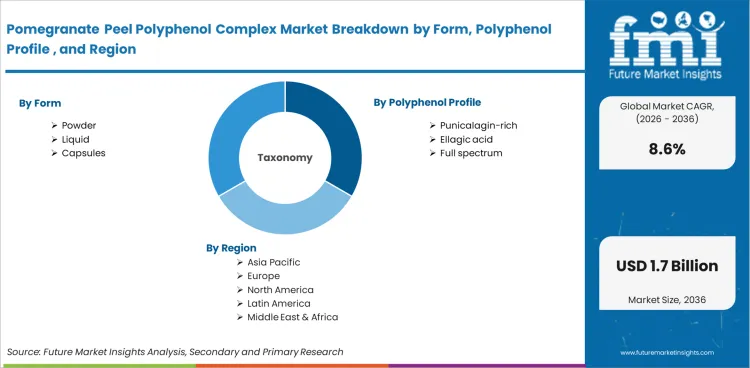
| Metric | Value |
|---|---|
| Quantitative Units | USD 0.7 billion to USD 1.6 billion, at a 8.6% CAGR |
| Market Definition | The market covers functional compounds isolated specifically from pomegranate peel and standardized into ingredient formats suitable for nutraceutical, skincare, food, beverage, oral-care, and related formulation use. |
| Segmentation | Form; Polyphenol profile; Application; Nature; Sales channel; Region |
| Regions Covered | North America, Latin America, Europe, East Asia, South Asia, Oceania, Middle East and Africa |
| Countries Covered | India, China, United States, Germany, South Korea, Japan, France |
| Key Companies Profiled | Layn Natural Ingredients, Sabinsa, Croda Beauty, Euromed, Arjuna Natural, Botanic Healthcare, Nordmann |
| Forecast Period | 2026 to 2036 |
| Approach | Market sizing combines peel availability, extraction yield, refinement capability, application demand, and standardized ingredient pricing to assess commercial growth through the forecast period. |
Pomegranate Peel Polyphenol Complex Market by Segments
Pomegranate Peel Polyphenol Complex Market segmented as Form:
- Powder
- Liquid
- Capsules
Pomegranate Peel Polyphenol Complex Market classified by Polyphenol Profile:
- Punicalagin-rich
- Ellagic acid
- Full spectrum
Pomegranate Peel Polyphenol Complex Market analysed by Application:
- Nutraceuticals
- Skincare
- Functional foods
- Beverages
- Oral care
Pomegranate Peel Polyphenol Complex Market segmented as Nature:
- Conventional
- Organic
Pomegranate Peel Polyphenol Complex Market classified by Sales Channel:
- B2B ingredients
- Direct brands
- Online retail
Pomegranate Peel Polyphenol Complex Market by Region:
- North America
- Latin America
- Europe
- East Asia
- South Asia
- Oceania
- Middle East and Africa
Bibliography
- Institute of Food Technologists. (2025, July 7). Leading food companies to share the science and technology behind their latest innovations at IFT FIRST. Business Wire.
- Euromed, S.A. (2025, November 18). Pomanox® pomegranate extract supports healthy ageing. Euromed.
- Abbas, R., Hussain, S., Khan, M. K. I., Zia, M. A., Shabbir, M. A., Khan, M. R., & Inam-Ur-Raheem, M. (2025, January 24). Development and nutritional evaluation of pomegranate peel enriched bars. PLOS ONE.
- Dimitrijevic, J., Stojanovic, S., Nikolic, I., & Jovanovic, A. (2024, April 7). Phloretamide Protects against Diabetic Kidney Damage and Dysfunction in Diabetic Rats by Attenuating Hyperglycemia and Hyperlipidemia, Suppressing NF-κβ, and Upregulating Nrf2. Pharmaceutics.
- Du, J., Wu, Y., & Zhao, H. (2025, March 26). Bioactivity and biomedical applications of pomegranate peel extract: a comprehensive review.
This bibliography is provided for reader reference. The full FMI report contains the complete reference list with primary source documentation.
This Report Addresses
- Market sizing and revenue forecasting for pomegranate peel polyphenol complex from 2026 to 2036.
- Segment analysis across form, polyphenol profile, application, nature, sales channel, and region.
- Demand evaluation across nutraceutical, skincare, and related formulation uses.
- Extraction-led competitive factors including standardization, yield control, and residue management.
- Country-level growth outlook across key production and demand markets.
- Commercial implications of upcycled sourcing, active profile specification, and formulation compatibility.
- Competitive landscape assessment covering leading botanical extract suppliers and specialized participants.
- Data delivery in PDF and Excel formats with regular forecast review.
Frequently Asked Questions
How large is the demand for pomegranate peel polyphenol complex in the global market in 2026?
Demand for pomegranate peel polyphenol complex in the global market is estimated at USD 0.7 billion in 2026.
What will be the market size by 2036?
The market is projected to reach USD 1.6 billion by 2036.
What is the expected demand growth between 2026 and 2036?
Demand is expected to grow at a 8.6% CAGR between 2026 and 2036.
Which form is poised to lead by 2026?
Powder is expected to account for 41% of the form segment in 2026 because it offers better handling, stronger storage stability, and smoother fit with large-scale dry formulations.
Which polyphenol profile is expected to lead by 2026?
Punicalagin-rich variants are projected to hold 38% of the profile segment in 2026. Their lead reflects stronger demand for standardized active markers and better formulation relevance.
Which application area is expected to remain the largest?
Nutraceuticals are projected to account for 36.5% of the application segment in 2026 because buyers continue to favor concentrated ingestible botanical ingredients.
Preview the report firsthand - request a free sample
Get SampleGet the brochure for pricing and purchase details.
Get PDFTable of Content
- Executive Summary
- Global Market Outlook
- Demand-side Trends
- Supply-side Trends
- Technology Roadmap Analysis
- Analysis and Recommendations
- Market Overview
- Market Coverage / Taxonomy
- Market Definition / Scope / Limitations
- Research Methodology
- Chapter Orientation
- Analytical Lens and Working Hypotheses
- Market Structure, Signals, and Trend Drivers
- Benchmarking and Cross-market Comparability
- Market Sizing, Forecasting, and Opportunity Mapping
- Research Design and Evidence Framework
- Desk Research Programme (Secondary Evidence)
- Company Annual and Sustainability Reports
- Peer-reviewed Journals and Academic Literature
- Corporate Websites, Product Literature, and Technical Notes
- Earnings Decks and Investor Briefings
- Statutory Filings and Regulatory Disclosures
- Technical White Papers and Standards Notes
- Trade Journals, Industry Magazines, and Analyst Briefs
- Conference Proceedings, Webinars, and Seminar Materials
- Government Statistics Portals and Public Data Releases
- Press Releases and Reputable Media Coverage
- Specialist Newsletters and Curated Briefings
- Sector Databases and Reference Repositories
- FMI Internal Proprietary Databases and Historical Market Datasets
- Subscription Datasets and Paid Sources
- Social Channels, Communities, and Digital Listening Inputs
- Additional Desk Sources
- Expert Input and Fieldwork (Primary Evidence)
- Primary Modes
- Qualitative Interviews and Expert Elicitation
- Quantitative Surveys and Structured Data Capture
- Blended Approach
- Why Primary Evidence is Used
- Field Techniques
- Interviews
- Surveys
- Focus Groups
- Observational and In-context Research
- Social and Community Interactions
- Stakeholder Universe Engaged
- C-suite Leaders
- Board Members
- Presidents and Vice Presidents
- R&D and Innovation Heads
- Technical Specialists
- Domain Subject-matter Experts
- Scientists
- Physicians and Other Healthcare Professionals
- Governance, Ethics, and Data Stewardship
- Research Ethics
- Data Integrity and Handling
- Primary Modes
- Tooling, Models, and Reference Databases
- Desk Research Programme (Secondary Evidence)
- Data Engineering and Model Build
- Data Acquisition and Ingestion
- Cleaning, Normalisation, and Verification
- Synthesis, Triangulation, and Analysis
- Quality Assurance and Audit Trail
- Market Background
- Market Dynamics
- Drivers
- Restraints
- Opportunity
- Trends
- Scenario Forecast
- Demand in Optimistic Scenario
- Demand in Likely Scenario
- Demand in Conservative Scenario
- Opportunity Map Analysis
- Product Life Cycle Analysis
- Supply Chain Analysis
- Investment Feasibility Matrix
- Value Chain Analysis
- PESTLE and Porter’s Analysis
- Regulatory Landscape
- Regional Parent Market Outlook
- Production and Consumption Statistics
- Import and Export Statistics
- Market Dynamics
- Global Market Analysis 2021 to 2025 and Forecast, 2026 to 2036
- Historical Market Size Value (USD Million) Analysis, 2021 to 2025
- Current and Future Market Size Value (USD Million) Projections, 2026 to 2036
- Y-o-Y Growth Trend Analysis
- Absolute $ Opportunity Analysis
- Global Market Pricing Analysis 2021 to 2025 and Forecast 2026 to 2036
- Global Market Analysis 2021 to 2025 and Forecast 2026 to 2036, By Form
- Introduction / Key Findings
- Historical Market Size Value (USD Million) Analysis By Form , 2021 to 2025
- Current and Future Market Size Value (USD Million) Analysis and Forecast By Form , 2026 to 2036
- Powder
- Liquid
- Capsules
- Powder
- Y-o-Y Growth Trend Analysis By Form , 2021 to 2025
- Absolute $ Opportunity Analysis By Form , 2026 to 2036
- Global Market Analysis 2021 to 2025 and Forecast 2026 to 2036, By Polyphenol Profile
- Introduction / Key Findings
- Historical Market Size Value (USD Million) Analysis By Polyphenol Profile, 2021 to 2025
- Current and Future Market Size Value (USD Million) Analysis and Forecast By Polyphenol Profile, 2026 to 2036
- Punicalagin-rich
- Ellagic acid
- Full spectrum
- Punicalagin-rich
- Y-o-Y Growth Trend Analysis By Polyphenol Profile, 2021 to 2025
- Absolute $ Opportunity Analysis By Polyphenol Profile, 2026 to 2036
- Global Market Analysis 2021 to 2025 and Forecast 2026 to 2036, By Application
- Introduction / Key Findings
- Historical Market Size Value (USD Million) Analysis By Application, 2021 to 2025
- Current and Future Market Size Value (USD Million) Analysis and Forecast By Application, 2026 to 2036
- Nutraceuticals
- Skincare
- Beverages
- Nutraceuticals
- Y-o-Y Growth Trend Analysis By Application, 2021 to 2025
- Absolute $ Opportunity Analysis By Application, 2026 to 2036
- Global Market Analysis 2021 to 2025 and Forecast 2026 to 2036, By Nature
- Introduction / Key Findings
- Historical Market Size Value (USD Million) Analysis By Nature, 2021 to 2025
- Current and Future Market Size Value (USD Million) Analysis and Forecast By Nature, 2026 to 2036
- Conventional
- Organic
- Conventional
- Y-o-Y Growth Trend Analysis By Nature, 2021 to 2025
- Absolute $ Opportunity Analysis By Nature, 2026 to 2036
- Global Market Analysis 2021 to 2025 and Forecast 2026 to 2036, By Sales Channel
- Introduction / Key Findings
- Historical Market Size Value (USD Million) Analysis By Sales Channel, 2021 to 2025
- Current and Future Market Size Value (USD Million) Analysis and Forecast By Sales Channel, 2026 to 2036
- B2B Ingredients
- Direct Brands
- Online Retail
- B2B Ingredients
- Y-o-Y Growth Trend Analysis By Sales Channel, 2021 to 2025
- Absolute $ Opportunity Analysis By Sales Channel, 2026 to 2036
- Global Market Analysis 2021 to 2025 and Forecast 2026 to 2036, By Region
- Introduction
- Historical Market Size Value (USD Million) Analysis By Region, 2021 to 2025
- Current Market Size Value (USD Million) Analysis and Forecast By Region, 2026 to 2036
- North America
- Latin America
- Western Europe
- Eastern Europe
- East Asia
- South Asia and Pacific
- Middle East & Africa
- Market Attractiveness Analysis By Region
- North America Market Analysis 2021 to 2025 and Forecast 2026 to 2036, By Country
- Historical Market Size Value (USD Million) Trend Analysis By Market Taxonomy, 2021 to 2025
- Market Size Value (USD Million) Forecast By Market Taxonomy, 2026 to 2036
- By Country
- USA
- Canada
- Mexico
- By Form
- By Polyphenol Profile
- By Application
- By Nature
- By Sales Channel
- By Country
- Market Attractiveness Analysis
- By Country
- By Form
- By Polyphenol Profile
- By Application
- By Nature
- By Sales Channel
- Key Takeaways
- Latin America Market Analysis 2021 to 2025 and Forecast 2026 to 2036, By Country
- Historical Market Size Value (USD Million) Trend Analysis By Market Taxonomy, 2021 to 2025
- Market Size Value (USD Million) Forecast By Market Taxonomy, 2026 to 2036
- By Country
- Brazil
- Chile
- Rest of Latin America
- By Form
- By Polyphenol Profile
- By Application
- By Nature
- By Sales Channel
- By Country
- Market Attractiveness Analysis
- By Country
- By Form
- By Polyphenol Profile
- By Application
- By Nature
- By Sales Channel
- Key Takeaways
- Western Europe Market Analysis 2021 to 2025 and Forecast 2026 to 2036, By Country
- Historical Market Size Value (USD Million) Trend Analysis By Market Taxonomy, 2021 to 2025
- Market Size Value (USD Million) Forecast By Market Taxonomy, 2026 to 2036
- By Country
- Germany
- UK
- Italy
- Spain
- France
- Nordic
- BENELUX
- Rest of Western Europe
- By Form
- By Polyphenol Profile
- By Application
- By Nature
- By Sales Channel
- By Country
- Market Attractiveness Analysis
- By Country
- By Form
- By Polyphenol Profile
- By Application
- By Nature
- By Sales Channel
- Key Takeaways
- Eastern Europe Market Analysis 2021 to 2025 and Forecast 2026 to 2036, By Country
- Historical Market Size Value (USD Million) Trend Analysis By Market Taxonomy, 2021 to 2025
- Market Size Value (USD Million) Forecast By Market Taxonomy, 2026 to 2036
- By Country
- Russia
- Poland
- Hungary
- Balkan & Baltic
- Rest of Eastern Europe
- By Form
- By Polyphenol Profile
- By Application
- By Nature
- By Sales Channel
- By Country
- Market Attractiveness Analysis
- By Country
- By Form
- By Polyphenol Profile
- By Application
- By Nature
- By Sales Channel
- Key Takeaways
- East Asia Market Analysis 2021 to 2025 and Forecast 2026 to 2036, By Country
- Historical Market Size Value (USD Million) Trend Analysis By Market Taxonomy, 2021 to 2025
- Market Size Value (USD Million) Forecast By Market Taxonomy, 2026 to 2036
- By Country
- China
- Japan
- South Korea
- By Form
- By Polyphenol Profile
- By Application
- By Nature
- By Sales Channel
- By Country
- Market Attractiveness Analysis
- By Country
- By Form
- By Polyphenol Profile
- By Application
- By Nature
- By Sales Channel
- Key Takeaways
- South Asia and Pacific Market Analysis 2021 to 2025 and Forecast 2026 to 2036, By Country
- Historical Market Size Value (USD Million) Trend Analysis By Market Taxonomy, 2021 to 2025
- Market Size Value (USD Million) Forecast By Market Taxonomy, 2026 to 2036
- By Country
- India
- ASEAN
- Australia & New Zealand
- Rest of South Asia and Pacific
- By Form
- By Polyphenol Profile
- By Application
- By Nature
- By Sales Channel
- By Country
- Market Attractiveness Analysis
- By Country
- By Form
- By Polyphenol Profile
- By Application
- By Nature
- By Sales Channel
- Key Takeaways
- Middle East & Africa Market Analysis 2021 to 2025 and Forecast 2026 to 2036, By Country
- Historical Market Size Value (USD Million) Trend Analysis By Market Taxonomy, 2021 to 2025
- Market Size Value (USD Million) Forecast By Market Taxonomy, 2026 to 2036
- By Country
- Kingdom of Saudi Arabia
- Other GCC Countries
- Turkiye
- South Africa
- Other African Union
- Rest of Middle East & Africa
- By Form
- By Polyphenol Profile
- By Application
- By Nature
- By Sales Channel
- By Country
- Market Attractiveness Analysis
- By Country
- By Form
- By Polyphenol Profile
- By Application
- By Nature
- By Sales Channel
- Key Takeaways
- Key Countries Market Analysis
- USA
- Pricing Analysis
- Market Share Analysis, 2025
- By Form
- By Polyphenol Profile
- By Application
- By Nature
- By Sales Channel
- Canada
- Pricing Analysis
- Market Share Analysis, 2025
- By Form
- By Polyphenol Profile
- By Application
- By Nature
- By Sales Channel
- Mexico
- Pricing Analysis
- Market Share Analysis, 2025
- By Form
- By Polyphenol Profile
- By Application
- By Nature
- By Sales Channel
- Brazil
- Pricing Analysis
- Market Share Analysis, 2025
- By Form
- By Polyphenol Profile
- By Application
- By Nature
- By Sales Channel
- Chile
- Pricing Analysis
- Market Share Analysis, 2025
- By Form
- By Polyphenol Profile
- By Application
- By Nature
- By Sales Channel
- Germany
- Pricing Analysis
- Market Share Analysis, 2025
- By Form
- By Polyphenol Profile
- By Application
- By Nature
- By Sales Channel
- UK
- Pricing Analysis
- Market Share Analysis, 2025
- By Form
- By Polyphenol Profile
- By Application
- By Nature
- By Sales Channel
- Italy
- Pricing Analysis
- Market Share Analysis, 2025
- By Form
- By Polyphenol Profile
- By Application
- By Nature
- By Sales Channel
- Spain
- Pricing Analysis
- Market Share Analysis, 2025
- By Form
- By Polyphenol Profile
- By Application
- By Nature
- By Sales Channel
- France
- Pricing Analysis
- Market Share Analysis, 2025
- By Form
- By Polyphenol Profile
- By Application
- By Nature
- By Sales Channel
- India
- Pricing Analysis
- Market Share Analysis, 2025
- By Form
- By Polyphenol Profile
- By Application
- By Nature
- By Sales Channel
- ASEAN
- Pricing Analysis
- Market Share Analysis, 2025
- By Form
- By Polyphenol Profile
- By Application
- By Nature
- By Sales Channel
- Australia & New Zealand
- Pricing Analysis
- Market Share Analysis, 2025
- By Form
- By Polyphenol Profile
- By Application
- By Nature
- By Sales Channel
- China
- Pricing Analysis
- Market Share Analysis, 2025
- By Form
- By Polyphenol Profile
- By Application
- By Nature
- By Sales Channel
- Japan
- Pricing Analysis
- Market Share Analysis, 2025
- By Form
- By Polyphenol Profile
- By Application
- By Nature
- By Sales Channel
- South Korea
- Pricing Analysis
- Market Share Analysis, 2025
- By Form
- By Polyphenol Profile
- By Application
- By Nature
- By Sales Channel
- Russia
- Pricing Analysis
- Market Share Analysis, 2025
- By Form
- By Polyphenol Profile
- By Application
- By Nature
- By Sales Channel
- Poland
- Pricing Analysis
- Market Share Analysis, 2025
- By Form
- By Polyphenol Profile
- By Application
- By Nature
- By Sales Channel
- Hungary
- Pricing Analysis
- Market Share Analysis, 2025
- By Form
- By Polyphenol Profile
- By Application
- By Nature
- By Sales Channel
- Kingdom of Saudi Arabia
- Pricing Analysis
- Market Share Analysis, 2025
- By Form
- By Polyphenol Profile
- By Application
- By Nature
- By Sales Channel
- Turkiye
- Pricing Analysis
- Market Share Analysis, 2025
- By Form
- By Polyphenol Profile
- By Application
- By Nature
- By Sales Channel
- South Africa
- Pricing Analysis
- Market Share Analysis, 2025
- By Form
- By Polyphenol Profile
- By Application
- By Nature
- By Sales Channel
- USA
- Market Structure Analysis
- Competition Dashboard
- Competition Benchmarking
- Market Share Analysis of Top Players
- By Regional
- By Form
- By Polyphenol Profile
- By Application
- By Nature
- By Sales Channel
- Competition Analysis
- Competition Deep Dive
- Layn Natural Ingredients
- Overview
- Product Portfolio
- Profitability by Market Segments (Product/Age /Sales Channel/Region)
- Sales Footprint
- Strategy Overview
- Marketing Strategy
- Product Strategy
- Channel Strategy
- Sabinsa
- Croda Beauty
- Euromed
- Arjuna Natural
- Botanic Healthcare
- Nordmann
- Layn Natural Ingredients
- Competition Deep Dive
- Assumptions & Acronyms Used


