


- Dehydration monitoring systems market size is projected to reach USD 1,156.4 million by 2036 from USD 639.7 million in 2026 at a CAGR of 6.1% during the forecast period due to rising clinical adoption and demand for preventive healthcare monitoring.
- Demand driver: Installed base replacement is beginning to be a key demand driver as early-generation wearable hydration sensors and mobile monitoring devices are reaching end-of-cycle performance limitations.
- Hospitals and sports medicine centers are reducing refresh cycles to improve the real-time accuracy of hydration and reduce lag in diagnostics for critical care and athletic monitoring.
- Growing adoption of wearable sensor systems is setting up procurement decisions based on continuous monitoring and increasing integration with digital health platforms.
- Procurement strategies are trending toward multi-parameter monitoring ecosystems that combine hydration tracking with larger vital-sign analytics.
- Extended replacement cycles are being experienced across emerging markets, but the aging of the installed base is set to trigger a synchronized upgrade wave across the forecast horizon.
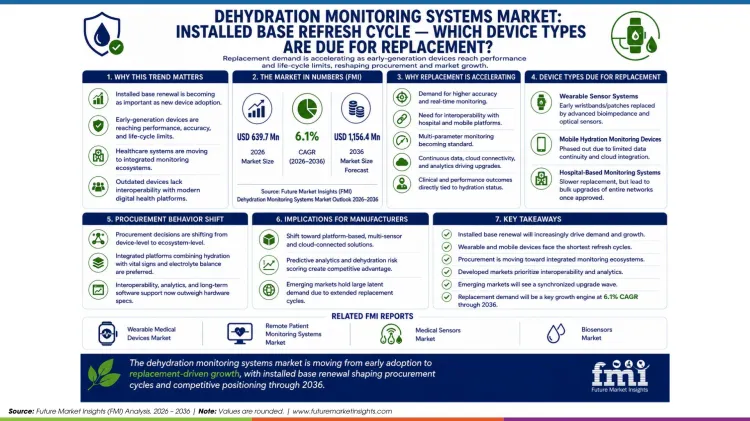
The dehydration monitoring systems market is entering a structurally important transition phase where installed base renewal is becoming as important as new device adoption. As clinical and consumer-grade hydration monitoring technologies mature, first-wave adoption devices deployed in the initial adoption wave are increasingly reaching performance and life-cycle limits.
According to Future Market Insights, the market is expected to increase from USD 639.7 million in 2026 to USD 1,156.4 million by 2036, at a CAGR of 6.1% during the forecast period.
But this constant growth path conceals a changing demand structure. Hospitals, sports organizations and home health providers are now running hybrid fleets of first-generation wearable hydration monitors, adhesive biosensors and early optical-based systems. These devices do work but they are being increasingly outclassed by newer systems in terms of accuracy, connectivity and integration capability.
Aging Installed Base and Replacement Pressure
The initial adoption wave saw the proliferation of simple wearable hydration tracking devices and standalone monitoring tools. These systems offered a basic estimation of fluid balance, but were not interoperable with wider digital health platforms.
As healthcare systems move to integrated patient monitoring ecosystems, older devices are proving increasingly incompatible with modern hospital information systems and mobile health infrastructure. This lack of interoperability is leading to replacement decisions”.
Clinicians are increasingly interested in devices that can track multi-vital parameters along with continuous real-time hydration monitoring. This transition is especially evident in intensive care units, elderly care facilities and athletic performance centres where hydration status has a direct impact on clinical or performance results.
Segment-Level Replacement Dynamics
Wearable sensor systems have the largest installed base and are the most frequently upgraded category. Newer generation systems based on bioimpedance and optical sensors are replacing early generation wristbands and adhesive patches with higher accuracy and longer operational stability.
Mobile hydration monitoring devices are also gradually being phased out in outpatient and homecare settings because of their limitations in data continuity and cloud integration capabilities.
Hospital systems, on the other hand, are slower to replace systems because of higher capital costs and the longer procurement approval timelines. But when decisions are made to replace them, they tend to result in bulk upgrades of entire monitoring networks.
Procurement Behavior Change
Procurement decisions are increasingly being made at the ecosystem level rather than at the device level. Instead of buying individual hydration monitors, healthcare providers are opting for integrated platforms that offer hydration monitoring along with heart rate, temperature and electrolyte balance.
This shift is particularly strong in developed healthcare systems where digital health integration is already well established. In these environments, interoperability, data analytics capability, and long-term software support are becoming more important than hardware specifications alone.
Manufacturer Strategy, Implications for the Market
Manufacturers are responding by turning to platform-based offerings rather than single function devices. Businesses that have cloud-connected hydration analytics, predictive dehydration risk scoring, and multi-sensor integration are gaining a competitive advantage.
Meanwhile, cost-sensitive markets continue to depend on legacy systems, pushing out replacement cycles but creating a large latent demand base. A wave of health infrastructure upgrades is expected to accelerate in these regions.
Bottom Line
Based on the product lifecycle, the dehydration monitoring systems market is moving from early adoption to replacement demand. Renewing the installed base, especially in wearable and mobile monitoring systems, will increasingly drive procurement cycles and the competitive positioning in the industry, as the market grows steadily at 6.1% CAGR through 2036.

