


- There is a tendency in the platelet rich plasma (PRP) market to spend research funds on indication-specific clinical validation instead of on basic product innovation.
- Clinical investment remains focused on orthopedics, sports medicine, chronic wound care and aesthetic medicine.
- Producing companies are investing in research showing reproducible results, standardized ways of preparation and long-term therapeutic advantages.
- Physician education and multicenter trials are increasingly important given the growing demand for evidence-based regenerative medicine.
- Future market growth will be driven by technology improvements and continued investment in high quality clinical research.
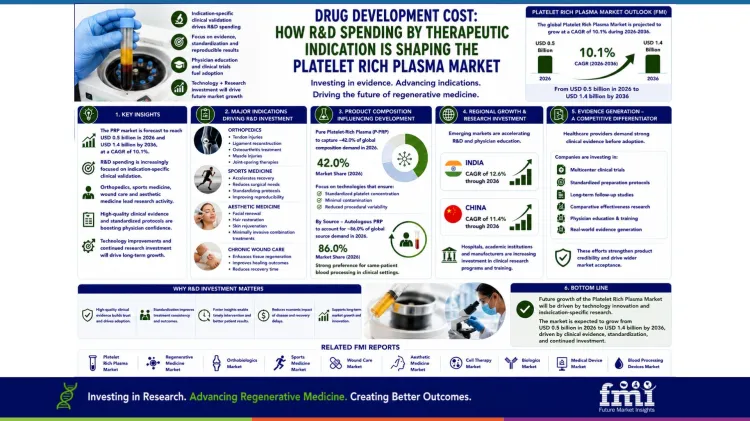
The Platelet Rich Plasma Market has evolved from a niche regenerative therapy to a wider clinical platform with applications from musculoskeletal injuries to cosmetic procedures, dentistry and wound management. With the acceleration of commercialization, we are seeing an increasing focus of investment supporting the growth of the approved indications and the establishment of the clinical evidence for PRP therapy.
The global Platelet Rich Plasma Market is projected to reach around USD 0.5 billion in 2026 and reach a market size of about USD 1.4 billion by 2036, growing at a CAGR of 10.1% during the forecast period. This growth is driven by increased physician adoption, greater patient awareness and expanding research in multiple therapeutic specialties.
Orthopedics Continues to Attract the Largest Research Focus
Orthopedic medicine is still one of the largest recipients of clinical research spending related to PRP among all application areas.
Researchers are still studying PRP for:
- Tendons injury
- Reconstruction of the ligament
- Treatment of osteoarthritis
- Muscle injuries.
- Joint-sparing therapies
There is increasing evidence for minimally invasive regenerative treatments and adoption of PRP into routine care pathways in hospitals and sports medicine centers.
Sports Medicine Is Driving Clinical Validation
For professional athletes and active populations, there remains a high demand for interventions that may accelerate recovery and reduce surgical requirements.
Consequently, manufacturers and healthcare providers are conducting prospective studies to standardize treatment protocols and improve reproducibility for sports injury applications.
More recent studies are increasingly focusing on the consistency of the preparation and the patient-specific optimization of the treatment instead of analyzing only the platelet concentration.
Aesthetic Medicine Expands Commercial Research
Cosmetic dermatology has become a further destination for R&D investment.
PRP is also being investigated in clinical programs for:
- facial renewal
- Hair restoration surgery
- Skin Rejuvenation
- Minimally invasive aesthetic procedures as combination treatments
The growing use of regenerative procedures in outpatient settings supports ongoing investment in evidence generation and physician training.
Product Composition Influences Development Priorities
FMI predicts that in 2026, Pure Platelet-Rich Plasma (P-PRP) will have approximately 42.0% of the worldwide composition demand, becoming the leading product category.
Increasing use of this technology is motivating manufacturers to invest in technologies that can produce standardized platelet concentrations with the least contamination and procedural variability.
Likewise, autologous PRP is expected to make up 86.0% of source demand, highlighting the ongoing preference for same-patient blood processing in the clinical setting.
Regional Growth Encourages Local Research Investment
Growth in regenerative medicine research is being driven by emerging healthcare markets.
FMI says:
- India is set to grow at a CAGR of 12.6% till 2036.
- China is forecast to grow at a CAGR of 11.4% during the same period.
Rapid market growth in these countries is encouraging hospitals, academic institutions and manufacturers to increase participation in clinical research programs and physicians’ education initiatives.
Evidence Generation Is Becoming a Competitive Differentiator
Healthcare providers are increasingly looking for published clinical evidence before embracing new systems of preparing PRP.
The manufacturers are therefore putting money into:
- Multicenter clinical trials
- Standardized preparation protocols
- Follow-up of long-term results
- Comparative effectiveness research
- Physician Education and Training
- Generation of real-world evidence
These initiatives bolster product credibility and help drive broader market acceptance.
Bottom Line
Future growth of Platelet Rich Plasma Market will be driven by technological innovation and clinical evidence. Companies investing in strong indication-specific research in orthopedics, sports medicine, wound care, and aesthetics are likely to improve physician confidence and facilitate long-term adoption. The market is expected to grow from USD 0.5 billion in 2026 to USD 1.4 billion by 2036.

