


- Bubble tea is easily amenable to digital ordering since customers will customize the type of tea base, toppings, sweetness, ice, size, and extras.
- Youth-led demand makes digital ordering, delivery, loyalty programs, and social media marketing particularly relevant.
- Digital ordering assists in controlling the process of repeat ordering, seasonal flavors, and even loyalty offers and delivery.
- Unlike other products, the online channel supplements quick service restaurants, allowing for pickup, delivery, pre-ordering, and customization via the app.
- The main operational issue is maintaining delivered drink quality, including topping consistency, ice dilution, sweetness balance, and sealed-cup performance.
- The main myth about digital commerce is that it is merely an avenue of delivering products. In case of bubble tea, it affects discovery, customization, loyalty, and even experimentation with menu items.
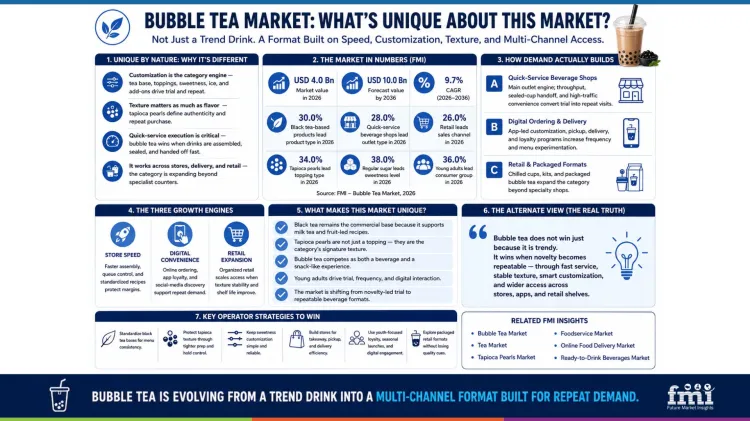
Among food and beverage categories, bubble tea is especially suited to digital ordering because it is highly customizable. It allows the customer to choose from a variety of options including type of tea, milk, toppings, sugar, ice level, size, and flavor.
FMI’s Bubble Tea Market preview shows that young adults are the leading consumer group, with 36.0% share in 2026. This is important because young adults are comfortable moving between physical stores, delivery apps, social media discovery, and online ordering. They do not view digital ordering as separate from the beverage experience. They treat it as part of convenience and personalization.
The Online Food Delivery Market is relevant because bubble tea fits delivery and pickup occasions well when operators manage sealed-cup packaging and preparation timing. A consumer may order bubble tea with snacks, meals, desserts, or café items. The product can travel better than many open-cup beverages if sealed properly, but quality still depends on timing and texture control.
According to FMI, quick-service beverage shops are the dominant outlet type, with a 28.0% share in 2026. Digital ordering can make this outlet type more efficient in operational terms. Quick-service beverage shops can serve walk-in, app-ordered, delivery, and loyalty-program customers from the same operational system.
The Foodservice Market helps frame the operational issue. Digital orders can increase volume, but they also add pressure to labor, batching, and handoff. If stores accept too many online orders during peak windows without adjusting workflow, drink quality and service speed may suffer.
The share of black tea-based products by product type is estimated at 30.0% in 2026, says FMI. This also supports digital ordering. The black tea-based beverages suit milk tea, fruit tea, and toppings-heavy beverages, thus fitting into the menu templates. Through digital menus, one can list the base beverages first and then guide the consumer towards the add-ons.
The Tea Market is useful here because bubble tea operators need tea bases that hold quality across in-store and delivery formats. Tea strength, aroma, bitterness, and dilution all affect customer satisfaction. In digital ordering, the customer may not consume the drink immediately, so recipe control becomes more important.
Tapioca pearls remain the leading topping type with 34.0% share in 2026. Digital ordering can increase topping experimentation, but tapioca pearls remain the anchor. The Tapioca Pearls Market is relevant because delivery creates a specific problem: pearl texture changes over time. If pearls harden, clump, or become too soft before consumption, the customer experience declines.
Regular sugar accounts for 38.0% of the sweetness-level segment in 2026. The digital menu can ease the process of customization of sweetness; however, at the same time, it adds to complexity in operations. The shop will have to offer 0%, 25%, 50%, 75%, and 100% options of sweetness precisely. Inconsistency of sweetness might affect customer confidence.
The Non-Alcoholic Beverages Market provides broader context. Many beverage categories are competing for app-based impulse purchases: iced coffee, smoothies, juices, teas, sodas, and functional drinks. Bubble tea has an advantage because it is visually distinctive and customizable. It also has a disadvantage because preparation complexity is higher.
Another digital element is social media marketing. Bubble tea is very good at appealing visually as colors, layers, toppings, pearls, cups, and even seasonal drinks make for great shareable content. Temporary flavors, celebrity visits, store openings, and loyalty campaigns can help spark trials. However, such viral popularity is meaningless if the product is not replicable.
E-commerce also supports retail extensions. As packaged bubble tea, kits, concentrates, and RTD formats expand, online channels can help brands test demand before wider retail rollout. Consumers may buy DIY bubble tea kits, tapioca pearls, syrups, tea powders, and ready-to-drink cups online. This expands the category beyond shop visits.
The Ready-to-Drink Beverages Market is useful when discussing packaged bubble tea because retail and online channels need shelf-stable or chilled formats that preserve taste and texture. The challenge is that bubble tea is not a simple liquid beverage; toppings and mouthfeel are part of the product.
One should not have the misconception that e-commerce is a delivery platform. For bubble tea, digital plays an integral role in discovery, customization, frequency, loyalty and menu experimentation. The delivery component is only one aspect of digital’s role.
Bottom line: E-commerce is reshaping bubble tea by making customization easier, strengthening youth-led discovery, supporting loyalty programs, and extending shops into delivery and retail-ready formats. The winners will be brands that make digital ordering convenient without sacrificing drink quality.

