

- Market Size (2026)
- USD 93.1 Mn
- Forecast (2036)
- USD 1612.4 Mn
- CAGR (2026 to 2036)
- 33.0%
How big is Ergothioneine (EGT) Market in 2026?
USD 93.1 million in 2026 and USD 1612.4 million by 2036 at a 33.0% CAGR.
Sales of ergothioneine are estimated to rise at 33.0% CAGR through 2036, increasing valuation from USD 93.1 million in 2026 to USD 1612.4 million by 2036. The 2026 valuation advances from USD 70 million in 2025 and reflects broader formulation programs among brands serving the dietary supplements market. Australia's Therapeutic Goods Administration added R21 L-Ergothioneine Capsule to its active register in April 2026 with ergothioneine named as an ingredient. The listing establishes a documented medicine route and strengthens quality expectations for antioxidant ingredients used in finished products. Commercial expansion depends on reliable assays and repeatable supply rather than consumer interest alone across international formulation programs.
National access conditions create different commercial routes even though the profiled forecasts remain closely grouped across the six countries. Companies developing functional food ingredients can use established United States safety dossiers and must assess separate Chinese new-food-raw-material reviews. Japanese developers place greater weight on measured consumer outcomes and careful claim wording during local product assessment. Australia's Therapeutic Goods Administration entered Bioellis L-Ergothioneine on the active medicine register in January 2026. The listing shows that product-specific documentation can establish a national medicine route without creating automatic permission for food applications. Producers must match ingredient specifications with permitted uses and dose conditions across each destination market. Reliable batches reduce repeated validation work and improve the chance of recurring orders across national formulation programs.
-market-value-analysis.webp "Ergothioneine (egt) Market Value Analysis")
Key Takeaways of Ergothioneine (EGT) Market
- Preventive-health formulation programs support demand for differentiated antioxidant ingredients with documented quality and practical daily dosing.
- Nutraceutical and dietary supplements are expected to lead application demand with 48.5% share in 2026, supported by familiar formats for measured daily intake.
- Fermentation is forecast to represent 62.8% share within the production method category in 2026, driven by controlled purity and repeatable commercial batches.
- Specialized processing economics and country-specific access routes remain material barriers for producers planning rapid international expansion.
- Industry value is projected to rise from USD 93.1 million in 2026 to USD 1,612.4 million by 2036 at 33% CAGR.
- Competition includes fermentation specialists and bioactive-ingredient companies with different regulatory records and application support capabilities.
Analyst Perspective
“Ergothioneine creates commercial value through repeatable purity and evidence that supports defined daily doses with responsible healthy-aging claims. Fermentation can expand supply if downstream recovery preserves yield and consistent release specifications across recurring batches. National access rules determine which finished applications can launch and how quickly distributors can secure dependable product flow. Companies that align production economics with regulatory documentation and practical formulation support can build recurring customer programs.”
- Nandini Roy Choudhury, Principal Analyst, Future Market Insights
How is the Ergothioneine (EGT) Market segmented?
The ergothioneine (EGT) industry is segmented by application, production method, and region.
The segmentation framework separates end-use demand from manufacturing route so readers can compare formulation needs with production economics. Application covers nutraceutical and dietary supplements, cosmetics, food and beverage products, and pharmaceuticals with distinct formulation and claim requirements. Each application carries different dose controls, stability requirements, evidence standards, and finished-product documentation across national launch programs. Production method distinguishes fermentation, chemical synthesis, and natural extraction through differences in feedstock control, purification steps, and batch economics. Regional analysis compares how ingredient permissions and channel requirements change commercial access across countries and product categories.
What supports demand for nutraceutical and dietary supplements within the application category?
-market-analysis-by-application.webp "Ergothioneine (egt) Market Analysis By Application")
Supplement formats provide a direct commercial route through defined serving sizes and familiar ingredient panels. Blue California published a human trial in July 2025 that assessed 147 adults aged 55 to 79 at two daily doses for sixteen weeks. The design gives formulators practical guidance for serving-level development without presenting one trial as proof of uniform adoption. Companies developing nutraceutical ingredients can use the findings to plan evidence packages and retain responsible claims across finished supplement programs.
- Nutraceutical and dietary supplements are projected to hold 48.5% share in 2026 owing to defined serving formats and established retail channels. Measured intake and familiar delivery formats shorten formulation work compared with pharmaceutical development, although brands must document specifications and batch records for each finished-product claim across every national launch.
- Supplement brands use ergothioneine in healthy-aging programs that fit capsules and powders without requiring a complete food matrix. Expansion into functional foods requires added stability testing and sensory work for every finished recipe and serving format. Cosmetic antioxidants require separate topical safety and compatibility evidence prior to approving finished-product claims across national launch programs.
How is fermentation positioned within the production method category?
Fermentation gives producers a controlled route for high-purity ergothioneine without relying on low-concentration natural sources. Reactor performance has little commercial value unless laboratories can measure broth concentration and confirm release specifications across batches. China's State Administration for Market Regulation published QB/T 8140-2025 in April 2025 for measuring ergothioneine in fermentation broth through high-performance liquid chromatography. The standard became effective in November 2025 and gives commercial precision fermentation programs a shared testing reference.
- The production method category is forecast to be led by fermentation at 62.8% share in 2026 due to repeatable process control and scalable batch production. Producers adjust strains and downstream steps around required specifications, then monitor yield and release performance across recurring batches without variable extraction feedstocks or repeated screening during customer qualification.
- Ingredient manufacturers favor fermentation as added vessels and process optimization can expand output without requiring larger extraction volumes. Experienced fermentation ingredient companies support production-stage documentation and release testing during recurring national ingredient qualification programs. Chemical synthesis provides another controlled route for specialized supply, whereas natural extraction faces concentration limits that restrict economical scaling.
What are the drivers, restraints, and opportunities in the Ergothioneine (EGT) Market?
Human evidence improves formulation confidence, while specialized production economics and national review timelines constrain scaling. Regulatory progress and research partnerships create commercial openings for differentiated supplement and functional-product programs.
- Driver: Human evidence gives product teams a firmer basis for selecting ergothioneine within documented healthy-aging programs.
- Restraint: National ingredient reviews and specialized fermentation economics can delay launches and increase working-capital requirements for commercial supply.
- Opportunity: Research partnerships and broader application routes can support differentiated ingredients with stronger evidence packages and clearer technical support.
Scientific documentation supports demand by giving product teams defensible reasons to select ergothioneine instead of familiar antioxidants. Blue California published a peer-reviewed review in September 2025 covering cognitive health and healthy-aging evidence for the ingredient. The review does not prove uniform commercial uptake, but it gives formulation and regulatory teams a consolidated assessment base. Producers can convert interest into orders through clear purity specifications and application support matched to the intended finished-product position.
Regulatory timing is one of the key restraints for producers planning food launches across several national markets. An accepted dossier can remain under review and disrupt distributor commitments across planned launch windows. China's National Health Commission issued extension notices in August 2025 for four ergothioneine or L-ergothioneine applications. Producers must carry dossier costs and inventory risk through uncertain review periods that delay commercial planning. Smaller manufacturers face added pressure from fermentation campaigns that require working capital ahead of market access.
Commercial research partnerships create an opening for producers that can connect mechanistic work with practical product development. Formulation programs gain practical value from research that tests stability and biological mechanisms under defined conditions. Companies serving food antioxidants can use validated findings to strengthen technical support for exact product formats. Gene III Biotechnology and Temasek Life Sciences Laboratory signed an ergothioneine research collaboration in May 2025 covering basic science and industrial translation. Commercial value depends on converting research outputs into repeatable specifications that formulation teams can test during finished-product development.
Which country CAGRs are profiled in the Ergothioneine (EGT) Market?
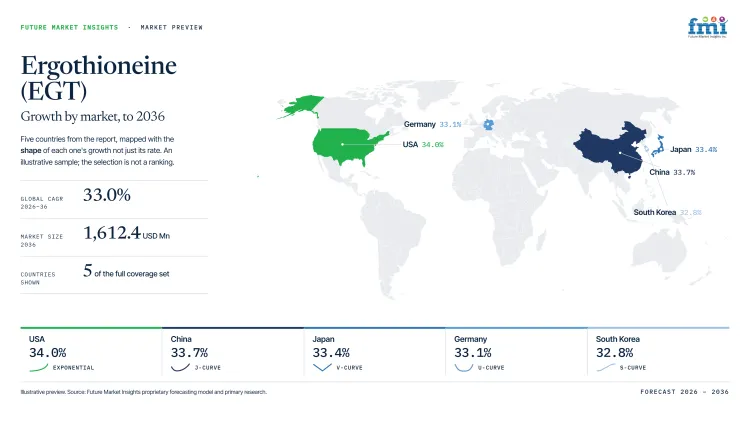
| Country | CAGR |
|---|---|
| United States | 34.0% |
| China | 33.7% |
| Japan | 33.4% |
| Germany | 33.1% |
| South Korea | 32.8% |
| France | 32.5% |
How do country-level CAGRs compare in the Ergothioneine (EGT) Market?
The country forecasts are exceptionally concentrated across the ergothioneine (EGT) market, with only 1.5 percentage points separating the first and last markets in the comparison. Rather than forming distinct growth tiers, the countries follow a near-linear progression, indicating broadly similar expectations for EGT adoption across major nutraceutical, functional food and healthy aging markets. The absence of meaningful gaps suggests that demand drivers are becoming increasingly global rather than region-specific. This pattern reflects growing interest in cellular health, longevity-focused nutrition and scientifically validated antioxidant ingredients across developed consumer health markets.
- The United States benefits from a mature dietary supplement industry where interest in healthy aging, cognitive wellness and premium bioactive ingredients continues to support EGT adoption across multiple product categories.
- China remains closely aligned with the United States as manufacturers expand the use of science-backed functional ingredients in supplements, functional foods and wellness-focused consumer products.
- Japan's position reflects strong consumer familiarity with preventive health concepts and growing demand for ingredients that support healthy aging and long-term wellness outcomes.
- Germany continues to support market development through demand for evidence-based nutraceutical ingredients and increasing incorporation of specialty antioxidants into premium health products.
- South Korea benefits from active innovation in functional nutrition and beauty-from-within formulations where advanced bioactive ingredients are increasingly used for product differentiation.
- France maintains steady momentum through growing interest in wellness, healthy aging and scientifically substantiated nutritional ingredients across both supplement and functional food applications.
The similarity in CAGRs does not imply identical market conditions. Differences in regulatory approval processes, health claim frameworks, ingredient sourcing strategies and consumer purchasing behavior can influence how EGT products are positioned and commercialized. As a result, companies may encounter different routes to market despite the highly aligned growth outlook across these countries. The full report provides country-level CAGR analysis across North America, Latin America, Europe, East Asia, South Asia, Oceania and the Middle East and Africa.
Country-wise Analysis
- United States supplement brands can use an established ingredient-safety route, although finished-product claims remain the marketer's responsibility. Ergothioneine demand in the United States is forecast to rise at 34.0% CAGR over the forecast period supported by established supplement channels and a reviewed food-use route. In May 2018, the United States Food and Drug Administration closed GRN 734 with no questions for defined uses at five milligrams per serving. The decision provides a recognized formulation route without authorizing disease claims or broader therapeutic positioning across consumer products. Domestic technical support can shorten qualification cycles, but dose conditions and claim substantiation remain material constraints for national launches and recurring orders.
- China combines domestic fermentation capacity with a formal new-food-raw-material route that governs access to mainstream food applications. Local production gives formulation teams faster technical responses and shorter iteration cycles across national product programs. Ergothioneine sales in China are forecast to expand at 33.7% CAGR by 2036 underpinned by domestic biomanufacturing and active ingredient review. The National Health Commission accepted L-ergothioneine filing 2025-0032 on September 17, 2025 as a new-food-raw-material application. The filing creates a defined review route without confirming final approval timing for commercial food use. Review extensions create material delays and prevent reliable volume commitments until permitted uses become clear.
- Japanese product development gives substantial weight to measured consumer outcomes and carefully documented ingredient quality. The Ministry of Health, Labour and Welfare updated a completed clinical registry in April 2025 covering sixty healthy women who used an ergothioneine supplement for eight weeks. The registry provides local skin-focused evidence without establishing broad adoption across established domestic supplement and pharmacy channels. Adoption of ergothioneine in Japan is estimated to expand at 33.4% CAGR through 2036 reinforced by evidence-focused product development and local testing capacity. Established testing capability supports measured serving decisions across health-oriented formulations and shortens technical review for local development teams. Japanese-language substantiation remains a material friction and conservative claim review can delay recurring orders across domestic channels.
- German supplement operators must classify ergothioneine formulations correctly to select lawful claims and suitable national sales channels. Germany's ergothioneine market outlook is anticipated to advance at 33.1% CAGR over the assessment period shaped by established supplement distribution and food-medicine classification. Germany's Federal Office of Consumer Protection and Food Safety reconstituted its food-medicine expert commission in March 2025. The commission evaluates substances positioned near the boundary between medicines and foods across national product categories. Established pharmacy and online distribution channels support regional launch planning for supplement brands with complete formulation records. National label review can delay healthy-aging launches for companies that lack complete claim support across German consumer channels.
- South Korean health-functional-food launches depend on recognized ingredient standards and evidence requirements for formal market entry. The Ministry of Food and Drug Safety issued Notice 2025-87 in December 2025 covering recognition procedures for functional ingredients. The notice clarifies dossier requirements without establishing an ergothioneine-specific approval for commercial health functional food products in South Korea. The ergothioneine market in South Korea is estimated to post 32.8% CAGR over the forecast period influenced by sophisticated supplement retail and formal ingredient recognition. Dense national distribution can support broad product availability following completed compliance and local technical review. Recognition costs and Korean-language documentation burden overseas producers that lack experienced domestic regulatory and distribution partners.
- French supplement brands operate under active controls covering composition and consumer-facing claims across physical and online channels. Each formulation requires defensible composition records and carefully reviewed marketing language prior to expansion across national retail and online distribution channels. In France, ergothioneine demand is predicted to advance at 32.5% CAGR through 2036 associated with established supplement and cosmetic channels under active enforcement. France's DGCCRF reported in November 2025 that one-third of 270 inspected establishments showed anomalies during its supplement investigation. The findings included prohibited claims and composition differences that required corrective action from the inspected businesses. Active oversight strengthens release testing, but added compliance costs can restrict smaller brands with limited regulatory staff.
Who are the notable companies in the Ergothioneine (EGT) Market?
Blue California, Shanghai EGT Synbio Group Co., Ltd., Gene III Biotechnology Co., Ltd., Abiochem Biotechnology (Group) Co., Ltd., Bloomage Biotechnology Corporation Limited, Mironova Labs, Nanjing Nutrabuilding Bio-tech Co., Ltd., and Bio-basic Nutrition Pty Ltd are notable companies profiled in this market.
-market-analysis-by-company.webp "Ergothioneine (egt) Market Analysis By Company")
The competitive outlook combines fermentation-led producers with bioactive platforms and specialty ingredient companies serving different application routes. Blue California expanded its ErgoActive technical website in September 2025 to centralize scientific and formulation resources for customers. Australia's Therapeutic Goods Administration listed Bio-Basic L-Ergothioneine Bulk in August 2025 as an active medicine entry sponsored by Bio-basic Nutrition Pty Ltd. Several Chinese manufacturers differentiate through regulator-reviewed food routes and documented self-GRAS positioning across multiple national channels. Commercial selection depends on documented use conditions and practical formulation support rather than corporate scale.
- Shanghai EGT Synbio Group and Gene III Biotechnology provide regulator-reviewed food-use routes for fermentation-derived ergothioneine across several categories. Abiochem Biotechnology adds documented large-scale production and self-GRAS positioning for international food and supplement discussions. Nanjing Nutrabuilding Bio-tech contributes branded nutritional formulations and fermented ingredient supply across several wellness applications. Their reviewed use conditions and production records create materially different commercial routes across national markets.
- Blue California and Bloomage Biotechnology Corporation provide bioactive ingredient platforms with clinical or regulatory activity linked to supplements and selected functional products. Bio-basic Nutrition Pty Ltd adds an Australian medicine route through an active bulk ergothioneine listing. Finished-product manufacturers compare each documented use condition during qualification to prevent unsupported transfer across applications and national serving conditions.
- Mironova Labs adds specialty ingredient manufacturing and formulation support across the profiled ergothioneine competitive set. Its September 2025 company article describes high-purity ergothioneine and analytical documentation for dietary supplement and personal-care development. Smaller formulation teams gain a focused qualification route, although release specifications and national regulatory fit determine whether recurring supply remains practical across target markets.
Competitive Benchmarking: Ergothioneine (EGT) Market
| Company | Commercial EGT Availability | Regulatory Documentation | Multi-Application Support | Geographic Reach |
|---|---|---|---|---|
| Blue California | High | High | High | United States with international ingredient distribution |
| Shanghai EGT Synbio Group Co., Ltd. | High | High | High | China with reviewed United States food uses |
| Gene III Biotechnology Co., Ltd. | High | High | High | China with reviewed United States food uses |
| Abiochem Biotechnology (Group) Co., Ltd. | High | Medium | Medium | China with international commercial outreach |
| Bloomage Biotechnology Corporation Limited | Medium | Medium | High | China with United States self-GRAS and a pending domestic food review |
| Mironova Labs | Medium | Medium | High | United States with European and domestic application support |
| Nanjing Nutrabuilding Bio-tech Co., Ltd. | Medium | Medium | High | China-based nutritional ingredient operations |
| Bio-basic Nutrition Pty Ltd | High | High | Low | Australia with an active national medicine listing |
Key Developments in the Ergothioneine (EGT) Market
- In January 2025, Shanghai EGT Synbio Group received a no-questions response from the United States Food and Drug Administration under GRN 1191. The notice covers fermentation-derived ergothioneine in several food and beverage categories at five milligrams per serving. The reviewed route gives formulators a defined safety basis for selected uses across several food categories. Finished-product companies remain responsible for accurate labeling and compliance with every stated regulatory use condition.
- In November 2025, Abiochem announced self-GRAS certification for its ergothioneine and reported large-scale production capability. The action supports commercial discussions with United States food and supplement companies that require documented safety positioning. The certification does not create an FDA no-questions response or universal permission across food categories. Planned doses and applications must remain consistent with the underlying assessment, so finished-product manufacturers need to review those conditions prior to recurring commercial formulation programs.
- In January 2026, Gene III Biotechnology received a no-questions response from the United States Food and Drug Administration under GRN 1270. The notice covers fermentation-derived ergothioneine in beverages and nutritional powders as well as cereal bars and selected foods. The regulatory closure broadens reviewed supply options, although formulation teams must compare serving conditions and specifications across available commercial ingredient sources during recurring ingredient qualification.
- In April 2026, Bloomage Biotech announced that its fermentation-derived ergothioneine had entered China’s new food ingredient approval process. The filing followed a December 2024 self-GRAS determination for use in food and dietary supplements. Public consultation gives domestic formulators a visible regulatory milestone without confirming final commercial permission for finished food applications. Finished-product planning should remain conditional on the completed review and every stated use specification across national channels.
Ergothioneine (EGT) Market - Report Scope
| Coverage field | Report scope |
|---|---|
| Market breakdown | Application, production method, and region. |
| Quantitative Units | Revenue in USD Million and CAGR in %. |
| Market Definition | Ergothioneine ingredients produced through fermentation, chemical synthesis or natural extraction for use in nutraceuticals, cosmetics, food and beverage products and pharmaceutical development. |
| Regions Covered | North America, Latin America, Western Europe, Eastern Europe, East Asia, South Asia and Pacific, and Middle East and Africa. |
| Countries Covered | United States, China, Japan, Germany, South Korea, and France, with additional regional analysis across more than 30 countries. |
| Key Companies Profiled | Blue California, Shanghai EGT Synbio Group Co., Ltd., Gene III Biotechnology Co., Ltd., Abiochem Biotechnology (Group) Co., Ltd., Bloomage Biotechnology Corporation Limited, Mironova Labs, Nanjing Nutrabuilding Bio-tech Co., Ltd., Bio-basic Nutrition Pty Ltd |
| Forecast Period | 2026 to 2036. |
| Approach | Hybrid bottom-up and top-down market sizing supported by primary interviews and official desk research. |
Ergothioneine (EGT) Market - Research Methodology
| Method | Approach |
|---|---|
| Primary Research | FMI analysts gathered input from manufacturers, service providers, technology developers, distributors, end users, procurement teams, and subject-matter experts. Interviews examined purchasing decisions, product or service evaluation, adoption barriers, approval requirements, pricing considerations, and expectations for technical or commercial support. Respondents were also asked what evidence is required before a trial, pilot, or initial order develops into regular purchasing. |
| Desk Research | Desk research covered government statistics, regulatory publications, trade data, industry associations, technical literature, standards, company filings, product information, and official corporate announcements. Sources were reviewed for relevance, publication date, geographic coverage, and consistency with the defined market scope. Claims relating to performance, applications, approvals, capacity, investment, and commercial activity were retained only when supported by credible public evidence. |
| Market Sizing and Forecasting | The market model combined the baseline value with historical performance, segment structure, pricing and volume indicators, adoption levels, company participation, and country-level demand conditions. Forecast assumptions considered economic activity, investment trends, regulatory developments, technology adoption, purchasing cycles, supply availability, and barriers to wider market use. Segment and regional estimates were reconciled before the final market total was calculated. |
| Data Validation | Estimates were checked against multiple independent indicators, including public data, company activity, trade patterns, industry developments, and findings from primary interviews. Validation also tested whether products, services, applications, and company revenues fell within the defined market boundaries. Adjacent categories, unsupported claims, overlapping revenues, and activities without direct market relevance were excluded to reduce double counting and maintain consistency across segments and countries. |
Ergothioneine (EGT) Market by Segments
Ergothioneine (EGT) Market segmented by Application:
- Nutraceutical & Dietary Supplements
- Cosmetics
- Food & Beverage
- Pharmaceuticals
Ergothioneine (EGT) Market segmented by Production Method:
- Fermentation
- Chemical Synthesis
- Natural Extraction
Ergothioneine (EGT) Market by Region:
- North America
- United States
- Canada
- Latin America
- Brazil
- Mexico
- Argentina
- Chile
- Western Europe
- Germany
- France
- United Kingdom
- Italy
- Spain
- Benelux
- Nordics
- Eastern Europe
- Poland
- Czech Republic
- Romania
- Hungary
- East Asia
- China
- Japan
- South Korea
- South Asia and Pacific
- India
- ASEAN
- Australia and New Zealand
- Middle East and Africa
- GCC Countries
- South Africa
- Türkiye
- Israel
Research Sources and Bibliography
- Therapeutic Goods Administration. (2026, April 10). R21 L-Ergothioneine Capsule (525474).
- Therapeutic Goods Administration. (2026, January 12). Bioellis L-Ergothioneine (522258).
- Blue California. (2025, July 1). Blue California Publishes Peer-Reviewed Human Clinical Trial.
- State Administration for Market Regulation. (2025, April 10). [Determination of ergothioneine in fermentation broth by high-performance liquid chromatography].
- Blue California. (2025, September 19). Blue California Publishes Peer-Reviewed Ergothioneine Review Paper in PNS.
- National Health Commission of the People's Republic of China. (2025, August 6). [Delivery information for new food ingredient extension notices on August 6, 2025].
- Gene III Biotechnology Co., Ltd. (2026, January 13). World's First! GeneIII and Temasek Life Sciences Laboratory Initiate International Research Collaboration on Ergothioneine for Ovarian Anti-Aging.
- USA Food and Drug Administration. (2018, May 7). GRN No. 734: Ergothioneine.
- National Health Commission of the People's Republic of China. (2025, September 17). [Announcement of new food ingredient applications accepted on September 17, 2025].
- Ministry of Health, Labour and Welfare. (2025, April 10). [Effect of continuous intake of an ergothioneine-containing supplement on skin condition].
- Federal Office of Consumer Protection and Food Safety. (2025, March 11). Im Grenzbereich zwischen Arznei- und Lebensmitteln.
- Ministry of Food and Drug Safety. (2025, December 23).
- Direction générale de la concurrence, de la consommation et de la répression des fraudes. (2025, November 3). Compléments alimentaires : des anomalies encore trop nombreuses.
- Mironova Labs. (2025, September 15). L-Ergothioneine: The Longevity Vitamin Revolutionizing Cellular Health.
- Therapeutic Goods Administration. (2025, August 7). Bio-Basic L-Ergothioneine Bulk (508426).
- USA Food and Drug Administration. (2025, January 30). GRN No. 1191: Ergothioneine produced by Escherichia coli BL-21 (DE3) expressing ergothioneine synthases from Schizosaccharomyces pombe.
- Abiochem Biotechnology (Group) Co., Ltd. (2025, November 13). Abiochem's Ergothioneine Obtains Self-GRAS Certification.
- USA Food and Drug Administration. (2026, January 22). GRN No. 1270: L-ergothioneine produced by Escherichia coli K-12 MG1655 expressing enzymes from Neurospora crassa and Mycolicibacterium smegmatis MC2 155.
- Bloomage Biotechnology Corporation Limited. (2026, April 24). Bloomage’s MitoEGT® L-Ergothioneine Enters Public Consultation for New Food Ingredient Approval.
- Blue California. (2025, September 23). Blue California Expands ErgoActive® Website.
- Gene III Biotechnology Co., Ltd. (2026, June 28). How GeneIII Produces L-Ergothioneine Through Whole-Cell Fermentation.
- NNB Nutrition. (2026, January 7). L-Ergothioneine Gains Attention as a Next-Generation Antioxidant in Nutritional Science.
This bibliography is provided for reader reference and is not exhaustive. The full report contains the complete reference list and detailed citations
This Report Answers
- How large is the ergothioneine (EGT) market in 2026 and what valuation is projected for 2036?
- Why do nutraceutical and dietary supplements represent the larger profiled application share?
- How does fermentation influence production economics and analytical control across commercial supply programs?
- Which demand factors support healthy-aging formulations and which constraints limit faster international scaling?
- How do the six country CAGRs compare across North America, East Asia, and Western Europe?
- Which local regulatory and operating conditions influence entry into the United States, China, Japan, Germany, South Korea, and France?
- How do current companies differ in commercial availability, regulatory documentation, application coverage, and geographic reach?
- Which official developments have changed commercial access or company positioning since January 2025?
- What segments, regions, and company roles define the market boundary used throughout the report?
Frequently Asked Questions
How big is the Ergothioneine (EGT) Market in 2026?
The ergothioneine (EGT) market is valued at USD 93.1 million in 2026 and is forecast to reach USD 1,612.4 million by 2036. Growth is supported by broader supplement formulation programs and documented medicine-register listings that strengthen quality expectations for antioxidant ingredients across international formulation programs.
What is the CAGR of the Ergothioneine (EGT) Market from 2026 to 2036?
The ergothioneine (EGT) market grows at a CAGR of 33.0% between 2026 and 2036, supported by scientific documentation that gives product teams defensible reasons to select the ingredient within healthy-aging programs, alongside research partnerships strengthening evidence packages for supplement and functional-product formulations.
Which production method leads the Ergothioneine (EGT) Market?
Fermentation leads the ergothioneine (EGT) market by production method, holding 62.8% share in 2026, driven by repeatable process control and scalable batch production that let manufacturers adjust strains and downstream steps without relying on variable extraction feedstocks or limited natural-source concentrations.
How much will the Ergothioneine (EGT) Market add between 2026 and 2036?
The ergothioneine (EGT) market is set to add USD 1,519.3 million between 2026 and 2036, growing from USD 93.1 million to USD 1,612.4 million as fermentation-based production and documented regulatory routes support broader nutraceutical, cosmetic, and functional-food formulation programs worldwide.
Who are the leading companies in the Ergothioneine (EGT) Market?
Eight companies lead the ergothioneine (EGT) market, including Blue California, Shanghai EGT Synbio Group, Gene III Biotechnology, Abiochem Biotechnology, Bloomage Biotechnology, Mironova Labs, Nanjing Nutrabuilding Bio-tech, and Bio-basic Nutrition, competing through fermentation-derived supply, regulatory documentation, and multi-application formulation support across international ingredient channels.
Preview the report firsthand - request a free sample
Get SampleGet the brochure for pricing and purchase details.
Get PDFTable of Content
- Key Takeaways
- Market Size and CAGR
- Top Growth Driver
- Fastest Growing Segment
- Leading Region
- Key Companies
- Emerging Opportunities
- Executive Summary
- Global Market Outlook
- Demand-side Trends
- Supply-side Trends
- Technology Roadmap Analysis
- Analysis and Recommendations
- Analyst Perspective (What is happening? Why now? What should investors know?)
- Key Questions Answered
- How large is the market?
- What is the CAGR?
- What are key trends?
- Which region dominates?
- Who are the leaders?
- Market Overview
- Market Coverage / Taxonomy
- Market Definition / Scope / Limitations
- Research Methodology
- Chapter Orientation
- Analytical Lens and Working Hypotheses
- Market Structure, Signals, and Trend Drivers
- Benchmarking and Cross-market Comparability
- Market Sizing, Forecasting, and Opportunity Mapping
- Research Design and Evidence Framework
- Desk Research Programme (Secondary Evidence)
- Expert Input and Fieldwork (Primary Evidence)
- Tooling, Models, and Reference Databases
- Data Engineering and Model Build
- Quality Assurance and Audit Trail
- Market Background
- Market Dynamics (Drivers, Restraints, Opportunity, Trends)
- Scenario Forecast (Optimistic, Likely, Conservative)
- Impact Analysis
- AI Impact
- Sustainability Impact
- Regulatory Impact
- Technology Impact
- Consumer / Buyer Analysis
- Purchase Drivers
- Adoption Barriers
- Buyer Journey
- Opportunity Map Analysis
- Product Life Cycle Analysis
- Supply Chain Analysis
- Investment Feasibility Matrix
- Value Chain Analysis
- PESTLE and Porter's Analysis
- Regulatory Landscape
- Regional Parent Market Outlook
- Production and Consumption Statistics
- Import and Export Statistics
- Global Market Analysis and Forecast, 2021 to 2036
- Historical Market Size Value (USD Million) Analysis, 2021 to 2025
- Current and Future Market Size Value (USD Million) Projections, 2026 to 2036
- Y-o-Y Growth Trend Analysis
- Absolute $ Opportunity Analysis
- Global Market Pricing Analysis, 2021 to 2036
- Global Market Analysis and Forecast, By Application, 2021 to 2036
- Introduction / Key Findings
- Historical Market Size Value (USD Million) Analysis By Application, 2021 to 2025
- Current and Future Market Size Value (USD Million) Analysis and Forecast By Application, 2026 to 2036
- Nutraceutical & Dietary Supplements
- Cosmetics
- Food & Beverage
- Pharmaceuticals
- Nutraceutical & Dietary Supplements
- Y-o-Y Growth Trend Analysis By Application, 2021 to 2025
- Absolute $ Opportunity Analysis By Application, 2026 to 2036
- Global Market Analysis and Forecast, By Production Method, 2021 to 2036
- Introduction / Key Findings
- Historical Market Size Value (USD Million) Analysis By Production Method, 2021 to 2025
- Current and Future Market Size Value (USD Million) Analysis and Forecast By Production Method, 2026 to 2036
- Fermentation
- Chemical Synthesis
- Natural Extraction
- Fermentation
- Y-o-Y Growth Trend Analysis By Production Method, 2021 to 2025
- Absolute $ Opportunity Analysis By Production Method, 2026 to 2036
- Global Market Analysis and Forecast, By Region, 2021 to 2036
- Introduction
- Historical Market Size Value (USD Million) Analysis By Region, 2021 to 2025
- Current Market Size Value (USD Million) Analysis and Forecast By Region, 2026 to 2036
- North America
- Latin America
- Western Europe
- Eastern Europe
- East Asia
- South Asia and Pacific
- Middle East & Africa
- Market Attractiveness Analysis By Region
- North America Market Analysis and Forecast, By Country, 2021 to 2036
- Historical Market Size Value (USD Million) Trend Analysis By Market Taxonomy, 2021 to 2025
- Market Size Value (USD Million) Forecast By Market Taxonomy, 2026 to 2036
- By Country
- USA
- Canada
- By Application
- By Production Method
- By Country
- Market Attractiveness Analysis
- By Country
- By Application
- By Production Method
- Key Takeaways
- Latin America Market Analysis and Forecast, By Country
- Historical Market Size Value (USD Million) Trend Analysis By Market Taxonomy, 2021 to 2025
- Market Size Value (USD Million) Forecast By Market Taxonomy, 2026 to 2036
- By Country
- Brazil
- Mexico
- Chile
- Rest of Latin America
- By Application
- By Production Method
- By Country
- Market Attractiveness Analysis
- By Country
- By Application
- By Production Method
- Key Takeaways
- Western Europe Market Analysis and Forecast, By Country
- Historical Market Size Value (USD Million) Trend Analysis By Market Taxonomy, 2021 to 2025
- Market Size Value (USD Million) Forecast By Market Taxonomy, 2026 to 2036
- By Country
- Germany
- UK
- Italy
- Spain
- France
- Nordic
- BENELUX
- Rest of Western Europe
- By Application
- By Production Method
- By Country
- Market Attractiveness Analysis
- By Country
- By Application
- By Production Method
- Key Takeaways
- Eastern Europe Market Analysis and Forecast, By Country
- Historical Market Size Value (USD Million) Trend Analysis By Market Taxonomy, 2021 to 2025
- Market Size Value (USD Million) Forecast By Market Taxonomy, 2026 to 2036
- By Country
- Russia
- Poland
- Hungary
- Balkan & Baltic
- Rest of Eastern Europe
- By Application
- By Production Method
- By Country
- Market Attractiveness Analysis
- By Country
- By Application
- By Production Method
- Key Takeaways
- East Asia Market Analysis and Forecast, By Country
- Historical Market Size Value (USD Million) Trend Analysis By Market Taxonomy, 2021 to 2025
- Market Size Value (USD Million) Forecast By Market Taxonomy, 2026 to 2036
- By Country
- China
- Japan
- South Korea
- By Application
- By Production Method
- By Country
- Market Attractiveness Analysis
- By Country
- By Application
- By Production Method
- Key Takeaways
- South Asia and Pacific Market Analysis and Forecast, By Country
- Historical Market Size Value (USD Million) Trend Analysis By Market Taxonomy, 2021 to 2025
- Market Size Value (USD Million) Forecast By Market Taxonomy, 2026 to 2036
- By Country
- India
- ASEAN
- Australia & New Zealand
- Rest of South Asia and Pacific
- By Application
- By Production Method
- By Country
- Market Attractiveness Analysis
- By Country
- By Application
- By Production Method
- Key Takeaways
- Middle East & Africa Market Analysis and Forecast, By Country
- Historical Market Size Value (USD Million) Trend Analysis By Market Taxonomy, 2021 to 2025
- Market Size Value (USD Million) Forecast By Market Taxonomy, 2026 to 2036
- By Country
- Kingdom of Saudi Arabia
- Other GCC Countries
- Türkiye
- South Africa
- Other African Union
- Rest of Middle East & Africa
- By Application
- By Production Method
- By Country
- Market Attractiveness Analysis
- By Country
- By Application
- By Production Method
- Key Takeaways
- Key Countries Market Analysis
- USA
- Pricing Analysis
- Market Share Analysis, 2025
- By Application
- By Production Method
- Canada
- Pricing Analysis
- Market Share Analysis, 2025
- By Application
- By Production Method
- Mexico
- Pricing Analysis
- Market Share Analysis, 2025
- By Application
- By Production Method
- Brazil
- Pricing Analysis
- Market Share Analysis, 2025
- By Application
- By Production Method
- Chile
- Pricing Analysis
- Market Share Analysis, 2025
- By Application
- By Production Method
- Germany
- Pricing Analysis
- Market Share Analysis, 2025
- By Application
- By Production Method
- UK
- Pricing Analysis
- Market Share Analysis, 2025
- By Application
- By Production Method
- Italy
- Pricing Analysis
- Market Share Analysis, 2025
- By Application
- By Production Method
- Spain
- Pricing Analysis
- Market Share Analysis, 2025
- By Application
- By Production Method
- France
- Pricing Analysis
- Market Share Analysis, 2025
- By Application
- By Production Method
- India
- Pricing Analysis
- Market Share Analysis, 2025
- By Application
- By Production Method
- ASEAN
- Pricing Analysis
- Market Share Analysis, 2025
- By Application
- By Production Method
- Australia & New Zealand
- Pricing Analysis
- Market Share Analysis, 2025
- By Application
- By Production Method
- China
- Pricing Analysis
- Market Share Analysis, 2025
- By Application
- By Production Method
- Japan
- Pricing Analysis
- Market Share Analysis, 2025
- By Application
- By Production Method
- South Korea
- Pricing Analysis
- Market Share Analysis, 2025
- By Application
- By Production Method
- Russia
- Pricing Analysis
- Market Share Analysis, 2025
- By Application
- By Production Method
- Poland
- Pricing Analysis
- Market Share Analysis, 2025
- By Application
- By Production Method
- Hungary
- Pricing Analysis
- Market Share Analysis, 2025
- By Application
- By Production Method
- Kingdom of Saudi Arabia
- Pricing Analysis
- Market Share Analysis, 2025
- By Application
- By Production Method
- Türkiye
- Pricing Analysis
- Market Share Analysis, 2025
- By Application
- By Production Method
- South Africa
- Pricing Analysis
- Market Share Analysis, 2025
- By Application
- By Production Method
- USA
- Market Structure Analysis
- Competition Dashboard
- Competition Benchmarking
- Market Share Analysis of Top Players
- By Regional
- By Application
- By Production Method
- Emerging Startups
- Innovation Benchmarking
- Competition Analysis
- Competition Deep Dive
- Mironova Labs
- Overview
- Product Portfolio
- Profitability by Market Segments
- Sales Footprint
- Strategy Overview
- Marketing Strategy
- Product Strategy
- Channel Strategy
- Tetrahedron
- Blue California
- Bloomage Biotech
- Kyowa Hakko
- Lonza
- Sabinsa
- Aktin Chemicals
- Mironova Labs
- Case Studies
- Success Stories
- Recent Developments
- Competition Deep Dive
- Assumptions & Acronyms Used


