

- Market Size (2026)
- USD 42.4 Mn
- Forecast (2036)
- USD 76.7 Mn
- CAGR (2026 to 2036)
- 6.1%
How big is Urolithin A Market in 2026?
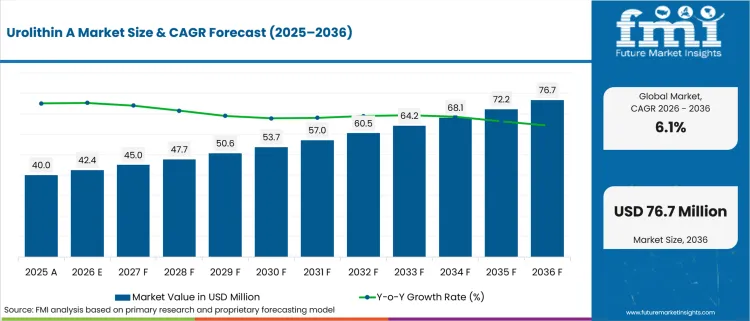
USD 42.4 million in 2026 and USD 76.7 million by 2036 at a 6.1% CAGR.
Demand for urolithin A is projected to expand at 6.1% CAGR between 2026 and 2036, increasing valuation from USD 42.4 million in 2026 to USD 76.7 million by 2036. Efforts to strengthen supply-chain organization and quality assurance are creating a more reliable foundation for commercial ube ingredient development. Timeline launched its first national United States campaign in January 2026 through connected television and outdoor media. The campaign expands public familiarity with urolithin A, yet premium pricing and evidence standards continue to shape regular purchasing. Growth therefore depends on dietary supplement formulations that connect credible science with clear dosing and compliant consumer communication.
European market access depends on novel food authorization for the ingredient, while finished-product claims require separate review within each sales geography. The European Commission lists an Amazentis urolithin A novel food application within its official application summary. The public application record establishes a formal review route but does not establish authorization or interchangeable access across European countries. The regulatory split makes healthy aging supplements easier to scale through sequenced national launches than through one uniform global label. A phased entry strategy also lets brands revise claim language and serving formats without delaying every planned geography. Commercial plans must separate ingredient status from finished-product claims to prevent avoidable delays across priority sales channels.
Key Takeaways of Urolithin A Market
- Human trials support product development around mitochondrial quality, although national food rules continue to limit claim wording and coordinated launch timing.
- By purity grade, the >98% segment is estimated to hold 63.2% share in 2026 owing to tighter composition control across concentrated formulations.
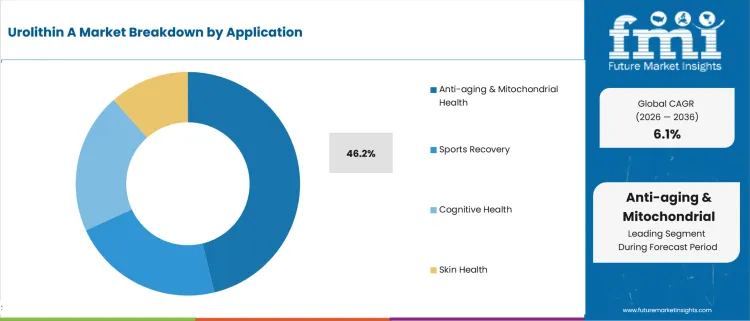
- The anti-aging and mitochondrial health application is likely to capture 46.2% share in 2026 attributable to its direct connection with human mitochondrial research.
- Based on form, capsules are projected to account for 49.1% share in 2026 due to controlled dosing and established supplement routines.
- Novel food assessment and claim substantiation remain material barriers across geographies that require separate evidence and compliant finished-product communication.
- Competition includes Amazentis and Daicel alongside specialist ingredient manufacturers and consumer brands with different science depth and verified channel reach.
Analyst Perspective
"Urolithin A has moved beyond a single longevity claim into a regulated ingredient category with distinct research and delivery routes. Commercial success depends on matching each dose and format with evidence that supports the intended consumer message. Brands that treat approval status and product claims as separate workstreams are better positioned to expand without weakening category trust."
- Nandini Roy Choudhury, Principal Analyst, Future Market Insights.
How is the Urolithin A Market segmented?
The urolithin A market is segmented by purity grade, application, form, and region.
The urolithin A market is segmented by purity grade, application, form, and region to reflect separate decisions across ingredient qualification and consumer use. Purity grade defines specification control for concentrated products, while application identifies the health outcome used to organize research and communication. Form determines dose presentation and convenience, which shape compatibility with established supplement routines across professional and direct consumer channels. Regional analysis captures differences in novel food authorization, claim rules, manufacturing controls, and available distribution channels across anti-aging nutrition market.
What supports anti-aging and mitochondrial health within the application category?
Mitochondrial quality gives urolithin A its clearest commercial application through research that examines muscle and immune outcomes in defined adult populations. A randomized trial published by Nature Aging in October 2025 evaluated 1,000 mg daily across 50 healthy middle-aged adults for four weeks. The study supports scientific relevance for formulation decisions but does not justify unrestricted consumer claims across every population or product format. Application teams must translate measured endpoints into careful sports recovery nutrition and healthy-aging communication across each intended sales geography.
- In 2026, anti-aging and mitochondrial health is expected to lead the application category with 46.2% share because human evidence provides the clearest basis for responsible consumer positioning. Product teams gain a clearer basis for professional education, although finished claims must stay within the tested population and approved label route across mainstream retail and practitioner-led channels.
- Brands extend this application into brain health supplements and muscle-focused routines through evidence that measures specific outcomes across defined populations. Adoption becomes stronger through restrained communication that separates established findings from exploratory endpoints and avoids disease positioning across consumer channels. Restrained communication preserves credibility as companies test related cognitive and exercise claims across new formulations.
Why does >98% purity grade lead the purity grade category?
High-purity material reduces uncertainty during dose setting and stability work across concentrated products that require reproducible active content. FDA closed GRAS Notice 791 in December 2018 without questions for defined food uses and serving levels. The notice provides a documented United States safety reference for the exact ingredient under specified conditions. Formulators also need batch specifications and finished-product controls that match each intended dose and delivery route.
- The >98% segment is projected to hold 63.2% share in 2026, owing to tighter control over active content and batch consistency. Supplement formulators value narrower assay variation across production batches and stability programs that support predictable dose delivery. Consistent active content reduces reformulation work and supports accurate serving instructions across premium daily-use products.
- Analytical certificates and contaminant testing influence adoption across brands that need repeatable material for capsules and other concentrated formats. Lower-purity material serves selected research or processing needs, but broader variability increases qualification work and limits use across tightly specified consumer products. The added documentation also helps contract manufacturers compare storage conditions and expiry targets during recurring production planning.
Why do capsules lead the form category?
Capsules support a measured daily dose without mixing steps or strong flavor-management requirements across premium supplement routines. ClinicalTrials.gov updated the completed NCT06362018 study in April 2025 with 60 healthy participants and five Mitopure formulations. The study compared pharmacokinetics across gummies and capsules instead of assuming equal delivery across every formulation and serving format. Form selection therefore depends on measured exposure and product stability alongside convenience within the intended consumer routine.
- The form category is forecast to be led by capsules at 49.1% share in 2026, supported by familiar use and controlled serving presentation. The format fits established supplement routines and protects a defined serving within a compact package. Capsule packaging also provides space for dosage instructions and required disclaimers across professional and direct consumer channels.
- Powders and gummies broaden adoption through mixing flexibility and a more approachable sensory experience for consumers who avoid conventional capsules. Consumer-friendly gummy supplements support trial across familiar routines, while powders suit users seeking adjustable preparation and serving control. Each alternative requires its own stability and bioavailability evidence rather than relying on capsule performance.
What are the drivers, restraints, and opportunities in the Urolithin A Market?
Human research strengthens product development, while separate approval routes and claim controls limit coordinated launches and create format-specific opportunities.
- Driver: Expanding human research gives formulators clearer endpoints for product design and professional education around mitochondrial quality.
- Restraint: Separate novel food assessments and national claim rules add dossier costs and delay coordinated launches across multiple markets.
- Opportunity: Better label architecture and validated formats create room for clearer consumer communication without weakening evidence standards.
A broader clinical pipeline supports demand by giving product teams defined endpoints for formulation and professional education. ClinicalTrials.gov listed 650 United States adults in the CLARITY study during March 2026 with an eight-week cognitive assessment. The registered design gives cognitive health formulas a measurable research route without proving a commercial outcome. Product developers gain useful trial parameters, although market adoption depends on completed results and compliant interpretation across finished-product communication.
Regulatory review creates a material restraint across countries that do not recognize the same ingredient status or intended use. The United Kingdom ACNFP reported in January 2026 that its assessment required further identity and toxicology information. Additional requests extend dossier work and reduce launch-date certainty across nutrition bars and adult supplement products. Companies must therefore budget regulatory sequencing separately from product manufacturing and broader channel preparation across target markets.
Label design is expected to offer a lucrative opportunity for brands that communicate permitted benefits without crowding every package panel. FDA stated in December 2025 that it would exercise enforcement discretion for repeating the DSHEA disclaimer on every claim-bearing panel. The agency retained the requirement to include the disclaimer and link it to each applicable claim. Clearer softgel capsules and other compact packs gain usable space, while claim substantiation remains unchanged.
Which country CAGRs are profiled in the Urolithin A Market?
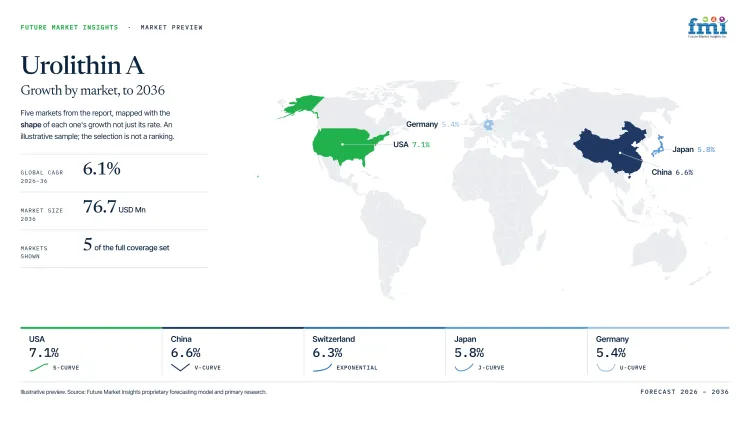
| Country | CAGR |
|---|---|
| United States | 7.1% |
| China | 6.6% |
| Switzerland | 6.3% |
| Japan | 5.8% |
| Germany | 5.4% |
| United Kingdom | 5.0% |
How do country-level CAGRs compare in the Urolithin A Market?
The country forecasts show a clear progression across the urolithin A market, with growth rates gradually declining from one market to the next rather than forming distinct tiers. The United States and China define the upper end of the comparison, reflecting strong commercial activity around healthy aging, cellular health and mitochondrial wellness ingredients. Switzerland forms a bridge between these markets and the lower-growth group represented by Japan, Germany and the United Kingdom. The differences across the comparison remain moderate, suggesting that awareness of urolithin A is expanding across major nutraceutical markets even though adoption pathways vary. This pattern reflects differences in ingredient innovation, scientific commercialization and consumer acceptance of next-generation longevity-focused supplements.
- The United States benefits from a mature supplement industry and strong consumer interest in healthy aging, performance nutrition and science-backed wellness ingredients, supporting broader commercialization of urolithin A products.
- China continues to expand through growing demand for premium nutraceuticals and increasing consumer awareness of ingredients positioned for longevity, vitality and preventive health applications.
- Switzerland's outlook reflects its strength in life sciences, nutritional research and high-value health ingredient development, supporting the adoption of advanced bioactive compounds.
- Japan maintains steady momentum through established healthy aging trends and demand for functional ingredients that support long-term wellness and active lifestyles.
- Germany supports market growth through interest in evidence-based nutraceutical products, with adoption often linked to scientific validation and product efficacy claims.
- The United Kingdom reflects increasing incorporation of specialized longevity and wellness ingredients into premium supplement formulations as consumer focus on proactive health management continues to evolve.
Similar CAGRs do not necessarily translate into identical market opportunities for urolithin A suppliers. Differences in regulatory frameworks, clinical substantiation requirements, consumer education levels and premium supplement positioning can significantly influence commercialization strategies. As a result, companies may pursue different routes to market even when forecast growth rates appear relatively comparable. The full report provides country-level CAGR analysis across North America, Latin America, Europe, East Asia, South Asia, Oceania and the Middle East and Africa.
Country-wise Analysis
- United States commercialization operates through a defined dietary supplement pathway and extensive direct consumer distribution. Adoption of urolithin A in the United States is estimated to expand at 7.1% CAGR through 2036, supported by frequent online discovery and an established claim notification route. FDA requires applicable structure and function claim notifications within thirty days of first marketing across national supplement channels. The route gives supplement brands a clear communication process across national retail and direct consumer channels. Claim substantiation and disclaimer controls remain material frictions for products using premium mitochondrial positioning across crowded longevity categories.
- China combines high-purity ingredient production with export channels that serve overseas supplement manufacturers and private-label formulation programs. The Chinese urolithin A market sector is projected to record 6.6% CAGR during the assessment period, shaped by high-purity manufacturing capacity and expanding OEM access. The National Health Commission continued publishing new food raw-material acceptance notices throughout July 2026 on its official approval portal. Hygieia lists 99% urolithin A powder and several OEM formats for international business customers seeking flexible production options. Its own notice warns that some listed materials lack domestic food or drug raw-material authorization, which separates export supply from local consumer access.
- Switzerland hosts ingredient science activity and recognizes European Union novel food authorizations within its national food system. Urolithin A demand in Switzerland is forecast to rise at 6.3% CAGR over the forecast period, strengthened by specialist wellness channels and a clear authorization pathway. The FSVO classified urolithin A as a novel food in February 2026 through its official market-access documentation. The classification gives companies a clear dossier pathway for Swiss access and recognizes European Union authorizations within Switzerland. Safety documentation and national authorization timing remain material constraints for independent applications seeking direct Swiss commercial access.
- Japan combines fermentation-based ingredient production with detailed manufacturing controls that apply to tablet and capsule food products. Japan's urolithin A market outlook is anticipated to advance at 5.8% CAGR over the assessment period, aided by domestic functional-food expertise and established capsule manufacturing. The Consumer Affairs Agency published GMP guidance and a self-inspection checklist for tablet and capsule foods in May 2025. The guidance supports consistent manufacturing review across finished supplements produced for domestic consumer channels and professional distribution. Local claims and ingredient status require careful evaluation before products enter commercial distribution through pharmacies or online channels.
- Germany applies European novel food rules and national interpretation across supplements positioned near medicinal claims. The urolithin A market in Germany is estimated to post 5.4% CAGR over the forecast period, influenced by mature specialist retail and formal classification review. BVL and BfArM restarted their joint borderline-products commission in March 2025 to support case-specific classification. The commission gives companies a formal route for difficult food-versus-medicine questions across supplements using strong physiological positioning. Classification uncertainty remains a material friction for products using strong mitochondrial or age-related language across German consumer channels.
- United Kingdom market access depends on a national novel food assessment and compliant finished-product communication. Urolithin A sales in the United Kingdom are forecast to expand at 5.0% CAGR by 2036, linked to specialist online channels and proposed uses spanning supplements and nutrition products. The ACNFP discussion paper published in September 2025 confirmed application RP1777 and listed proposed uses across supplements and nutrition products. The application gives companies a defined route for evaluating future access across supplements and specified nutrition products. Requests for additional safety information reduce launch-date certainty and increase dossier requirements for prospective United Kingdom entrants.
Who are the notable companies in the Urolithin A Market?
Amazentis / Timeline ‘Mitopure’, Daicel Corporation, Suzhou Myland Nutraceuticals, Shenzhen Hygieia Biotechnology, Codeage, Pure Encapsulations, Neurogan Health, and Naturecan are notable companies profiled in this market.
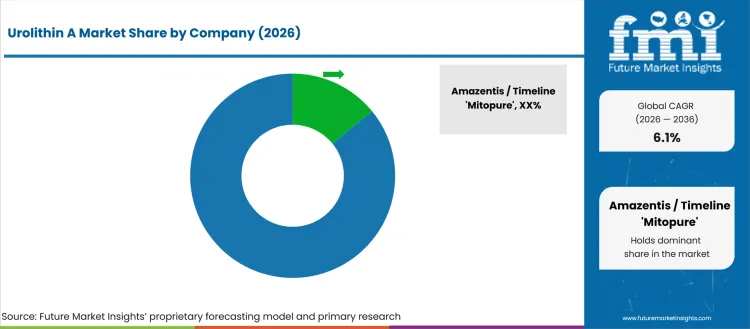
Competition spans proprietary science platforms and fermentation-based ingredient programs alongside high-purity manufacturers and finished supplement brands. Amazentis and Daicel connect urolithin A with research and controlled ingredient production through distinct development programs. Myland and Hygieia focus on material specifications and business supply routes that support private-label formulators and ingredient distributors. Codeage and Pure Encapsulations translate the ingredient into professional and direct consumer products through distinct channels. Neurogan Health and Naturecan add wider format and regional access without matching the research depth of proprietary ingredient platforms. The different roles connect urolithin A with wider nutraceutical ingredients but do not create equal capabilities across research and distribution.
- Science-led platforms: Amazentis develops Mitopure through clinical research and branded consumer products, while Daicel supplies fermentation-derived UAP-10 for several formulation routes. Their commercial strength comes from documented ingredient programs that support product development beyond a single finished capsule. Each company follows a different model for brand ownership and business distribution across its verified commercial geographies.
- Specialist ingredient manufacturers: Suzhou Myland presents 98% urolithin A powder for business customers, while Shenzhen Hygieia lists 99% powder and OEM options. Their role centers on specification control and flexible manufacturing support rather than branded clinical platforms. Supplement formulators and private-label manufacturers must verify legal use and finished-product requirements across every intended sales geography and delivery format.
- Consumer supplement brands: Codeage and Pure Encapsulations serve professional and direct consumer channels through clearly specified finished products. Neurogan Health and Naturecan extend format and regional coverage through separate retail models across several consumer markets. Their commercial strength comes from formulation presentation and channel access rather than proprietary ingredient research. Finished-product marketing does not replace purity documentation or local claim compliance across intended national markets and retail channels.
Competitive Benchmarking: Urolithin A Market
| Company | Ingredient Science & Purity Control | Formulation & Delivery Format Breadth | Brand & Distribution Strength | Geographic Reach |
|---|---|---|---|---|
| Amazentis / Timeline ‘Mitopure’ | High | High | High | Global branded partnerships |
| Daicel Corporation | High | Medium | Medium | Japan and international B2B |
| Suzhou Myland Nutraceuticals | High | Low | Low | China and international B2B |
| Shenzhen Hygieia Biotechnology | High | High | Low | China and international B2B |
| Codeage | Medium | Low | Medium | United States direct-to-consumer |
| Pure Encapsulations | Medium | Low | High | Multi-country professional distribution |
| Neurogan Health | Medium | High | High | United States multichannel |
| Naturecan | Medium | Low | High | Multi-country direct-to-consumer |
Key Developments in the Urolithin A Market
- In April 2025, Timeline launched Mitopure Gummies with a documented 500 mg daily serving and direct availability through its website and Amazon. The launch added a food-like delivery route for consumers who prefer gummies over capsules or powders. Comparable pharmacokinetic results supported the new format, although each finished product retains separate labeling and stability duties.
- In October 2025, Timeline published a clinical trial involving 42 highly trained male endurance athletes during a four-week intensive training block. Participants received 1,000 mg of urolithin A or placebo each day during the controlled training period. The study reported lower creatine kinase and perceived exertion measures, which expanded the research route for sports recovery without establishing universal performance claims.
- In December 2025, Daicel announced that its fermentation-based urolithin A production method received the Tokyo Excellence Award within the regional invention program. The recognized patent covers a microbial production route using ellagic acid as the starting material. The development strengthens Daicel's documented manufacturing position without establishing finished-product approval across every international market. Ingredient customers gain a clearer basis for evaluating production provenance and technical differentiation across competing supply options.
- In February 2026, Timeline announced a global partnership that places Mitopure technology within a new Lancôme skincare range. The agreement extends urolithin A from ingestible supplements into a premium topical application through an established beauty brand. Topical commercialization broadens the application boundary, although skin claims require evidence and controls that differ from dietary supplement positioning.
Urolithin A Market - Report Scope
| Coverage field | Report scope |
|---|---|
| Market breakdown | Purity grade, application, form, and region. |
| Quantitative Units | Revenue in USD million and CAGR in %. |
| Market Definition | Commercial urolithin A ingredient and finished-product demand across the listed purity grades, applications, and delivery forms. |
| Regions Covered | North America, Latin America, Western Europe, Eastern Europe, East Asia, South Asia and Pacific, and Middle East and Africa. |
| Countries Covered | United States, China, Switzerland, Japan, Germany, and United Kingdom. |
| Key Companies Profiled | Amazentis / Timeline ‘Mitopure’, Daicel Corporation, Suzhou Myland Nutraceuticals, Shenzhen Hygieia Biotechnology, Codeage, Pure Encapsulations, Neurogan Health, and Naturecan. |
| Forecast Period | 2026 to 2036 |
| Approach | Hybrid bottom-up and top-down market sizing supported by primary interviews and authoritative desk research. |
Urolithin A Market - Research Methodology
| Method | Approach |
|---|---|
| Primary Research | FMI analysts gathered input from manufacturers, service providers, technology developers, distributors, end users, procurement teams, and subject-matter experts. Interviews examined purchasing decisions, product or service evaluation, adoption barriers, approval requirements, pricing considerations, and expectations for technical or commercial support. Respondents were also asked what evidence is required before a trial, pilot, or initial order develops into regular purchasing. |
| Desk Research | Desk research covered government statistics, regulatory publications, trade data, industry associations, technical literature, standards, company filings, product information, and official corporate announcements. Sources were reviewed for relevance, publication date, geographic coverage, and consistency with the defined market scope. Claims relating to performance, applications, approvals, capacity, investment, and commercial activity were retained only when supported by credible public evidence. |
| Market Sizing and Forecasting | The market model combined the baseline value with historical performance, segment structure, pricing and volume indicators, adoption levels, company participation, and country-level demand conditions. Forecast assumptions considered economic activity, investment trends, regulatory developments, technology adoption, purchasing cycles, supply availability, and barriers to wider market use. Segment and regional estimates were reconciled before the final market total was calculated. |
| Data Validation | Estimates were checked against multiple independent indicators, including public data, company activity, trade patterns, industry developments, and findings from primary interviews. Validation also tested whether products, services, applications, and company revenues fell within the defined market boundaries. Adjacent categories, unsupported claims, overlapping revenues, and activities without direct market relevance were excluded to reduce double counting and maintain consistency across segments and countries. |
Urolithin A Market by Segments
Urolithin A Market segmented by Purity Grade:
- >98%
- <98%
Urolithin A Market segmented by Application:
- Anti-aging & Mitochondrial Health
- Sports Recovery
- Cognitive Health
- Skin Health
Urolithin A Market segmented by Form:
- Capsule
- Powder
- Gummies
Urolithin A Market by Region:
- North America
- United States
- Canada
- Latin America
- Brazil
- Peru
- Rest of Latin America
- Western Europe
- Germany
- United Kingdom
- France
- Rest of Western Europe
- East Asia
- Japan
- China
- South Korea
- Rest of East Asia
- South Asia & Pacific
- India
- Australia & New Zealand
- Rest of South Asia & Pacific
- Middle East & Africa
- GCC Countries
- South Africa
- Rest of Middle East & Africa
Research Sources and Bibliography
- Timeline. (2026, January 8). Timeline launches first national campaign: “It’s About Time”.
- USA Food and Drug Administration. (2025, December 11). Letter to the Dietary Supplement Industry on the DSHEA Disclaimer.
- European Commission. (n.d.). Summary of applications and notifications.
- USA Food and Drug Administration. (2018, December 20). GRAS Notices. GRN No. 791: Urolithin A.
- Denk, D., Singh, A., Kasler, H. G., D’Amico, D., Rey, J., Alcober-Boquet, L., Gorol, J. M., Steup, C., Tiwari, R., Kwok, R., Argüello, R. J., Faitg, J., Sprinzl, K., Zeuzem, S., Nekljudova, V., Loibl, S., Verdin, E., Rinsch, C., & Greten, F. R. (2025, October 31). Effect of the mitophagy inducer urolithin A on age-related immune decline: a randomized, placebo-controlled trial. Nature Aging, 5, 2309-2322.
- ClinicalTrials.gov. (2025, April 10). Bioavailability of Five Mitopure Formulations (NCT06362018).
- ClinicalTrials.gov. (2026, March 6). Impact of a Novel Brain Longevity Supplement Containing the Postbiotic Urolithin A (Mitopure) on Cognitive Function and Related Health Outcomes (NCT07060898).
- Advisory Committee on Novel Foods and Processes. (2026, January 19). 173rd ACNFP Meeting.
- Timeline. (2025, October 24). Timeline Publishes New Study on Elite Athletic Recovery.
- USA Food and Drug Administration. (n.d.). Notifications for Structure/Function and Related Claims in Dietary Supplement Labeling.
- National Health Commission of the People’s Republic of China. (2026, July). [New food raw-material approvals].
- Shenzhen Hygieia Biotechnology Co., Ltd. (n.d.). [Urolithin A].
- Federal Food Safety and Veterinary Office. (2026, February 18). Authorisation of novel foods.
- Consumer Affairs Agency. (2025, May 2). [Health foods (designated ingredients, etc.)].
- Federal Office of Consumer Protection and Food Safety. (2025, March 11). Im Grenzbereich zwischen Arznei- und Lebensmitteln [At the boundary between medicinal products and foods].
- Advisory Committee on Novel Foods and Processes. (2025, September 16). Urolithin A Discussion Paper.
- Amazentis. (n.d.). Amazentis | Amazentis: We pioneered the science of Urolithin A.
- Suzhou Myland Nutraceuticals Inc. (n.d.). 98%|CAS:1143-70-0 [Urolithin A 98%].
- Codeage. (n.d.). Codeage Liposomal Urolithin A Supplement, Resveratrol, CoQ10.
- Pure Encapsulations. (n.d.). Global Partners.
- Neurogan Health. (n.d.). Best Urolithin A Supplements | Capsules, Gummies & Powder.
- Naturecan. (n.d.). Urolithin A Supplement | Vegan Cellular Energy & Longevity.
- Timeline. (2025, April 17). First-of-Its-Kind Longevity Gummy Launched.
- Daicel Corporation. (2025, December 19). [Fermentation-based urolithin A production method receives the Tokyo Excellence Award].
- Timeline. (2026, February 19). Mitopure® technology is launching globally.
This bibliography is provided for reader reference and is not exhaustive. The full report contains the complete reference list and detailed citations.
This Report Answers
- How large is the urolithin A market in 2026 and what valuation is projected for 2036?
- Why does >98% purity grade account for the largest share of demand during 2026?
- How does anti-aging and mitochondrial health shape application demand and evidence-led positioning?
- Why do capsules remain the preferred delivery form despite expansion across powder and gummy formats?
- Which regulatory conditions influence commercialization across the United States and Europe as well as East Asia?
- How do the profiled country CAGRs compare across the 2026 to 2036 forecast period?
- Which companies provide science platforms or high-purity ingredients alongside finished urolithin A supplements?
- What factors limit broader adoption across novel food and dietary supplement channels?
- How are recent studies and partnerships extending the addressable application range for urolithin A?
Frequently Asked Questions
How big is the Urolithin A Market in 2026?
The urolithin A market is valued at USD 42.4 million in 2026 and is forecast to reach USD 76.7 million by 2036. Growth is supported by expanding human clinical research and strengthening supply-chain quality assurance that build a more reliable commercial foundation for premium healthy-aging supplement formulations across established distribution channels.
What is the CAGR of the Urolithin A Market from 2026 to 2036?
The urolithin A market grows at a CAGR of 6.1% between 2026 and 2036, supported by clinical evidence connecting mitochondrial quality research with dietary supplement formulations that require clear dosing and compliant consumer communication across novel food authorization pathways in priority commercial geographies.
Which purity grade leads the Urolithin A Market?
The urolithin A market by purity grade is led by the >98% segment, holding 63.2% share in 2026, driven by tighter composition control and narrower assay variation that support predictable dose delivery across concentrated capsule and powder supplement formulations used in premium daily-use nutraceutical products.
How much will the Urolithin A Market add between 2026 and 2036?
The urolithin A market is set to add USD 34.3 million between 2026 and 2036, growing from USD 42.4 million to USD 76.7 million as human clinical research and regulatory authorization pathways expand adoption of mitochondrial-health positioned supplement formulations across major nutraceutical markets.
Who are the leading companies in the Urolithin A Market?
Eight companies lead the urolithin A market, including Amazentis and Timeline, Daicel Corporation, Suzhou Myland Nutraceuticals, Shenzhen Hygieia Biotechnology, Codeage, Pure Encapsulations, Neurogan Health, and Naturecan, competing through proprietary clinical science, fermentation-based ingredient production, and finished-product formulation across professional and direct-to-consumer supplement channels worldwide.
Preview the report firsthand - request a free sample
Get SampleGet the brochure for pricing and purchase details.
Get PDFTable of Content
- Key Takeaways
- Market Size and CAGR
- Top Growth Driver
- Fastest Growing Segment
- Leading Region
- Key Companies
- Emerging Opportunities
- Executive Summary
- Global Market Outlook
- Demand-side Trends
- Supply-side Trends
- Technology Roadmap Analysis
- Analysis and Recommendations
- Analyst Perspective (What is happening? Why now? What should investors know?)
- Key Questions Answered
- How large is the market?
- What is the CAGR?
- What are key trends?
- Which region dominates?
- Who are the leaders?
- Market Overview
- Market Coverage / Taxonomy
- Market Definition / Scope / Limitations
- Research Methodology
- Chapter Orientation
- Analytical Lens and Working Hypotheses
- Market Structure, Signals, and Trend Drivers
- Benchmarking and Cross-market Comparability
- Market Sizing, Forecasting, and Opportunity Mapping
- Research Design and Evidence Framework
- Desk Research Programme (Secondary Evidence)
- Expert Input and Fieldwork (Primary Evidence)
- Tooling, Models, and Reference Databases
- Data Engineering and Model Build
- Quality Assurance and Audit Trail
- Market Background
- Market Dynamics (Drivers, Restraints, Opportunity, Trends)
- Scenario Forecast (Optimistic, Likely, Conservative)
- Impact Analysis
- AI Impact
- Sustainability Impact
- Regulatory Impact
- Technology Impact
- Consumer / Buyer Analysis
- Purchase Drivers
- Adoption Barriers
- Buyer Journey
- Opportunity Map Analysis
- Product Life Cycle Analysis
- Supply Chain Analysis
- Investment Feasibility Matrix
- Value Chain Analysis
- PESTLE and Porter's Analysis
- Regulatory Landscape
- Regional Parent Market Outlook
- Production and Consumption Statistics
- Import and Export Statistics
- Global Market Analysis and Forecast, 2021 to 2036
- Historical Market Size Value (USD Million) Analysis, 2021 to 2025
- Current and Future Market Size Value (USD Million) Projections, 2026 to 2036
- Y-o-Y Growth Trend Analysis
- Absolute $ Opportunity Analysis
- Global Market Pricing Analysis, 2021 to 2036
- Global Market Analysis and Forecast, By Purity Grade, 2021 to 2036
- Introduction / Key Findings
- Historical Market Size Value (USD Million) Analysis By Purity Grade, 2021 to 2025
- Current and Future Market Size Value (USD Million) Analysis and Forecast By Purity Grade, 2026 to 2036
- >98%
- <98%
- >98%
- Y-o-Y Growth Trend Analysis By Purity Grade, 2021 to 2025
- Absolute $ Opportunity Analysis By Purity Grade, 2026 to 2036
- Global Market Analysis and Forecast, By Application, 2021 to 2036
- Introduction / Key Findings
- Historical Market Size Value (USD Million) Analysis By Application, 2021 to 2025
- Current and Future Market Size Value (USD Million) Analysis and Forecast By Application, 2026 to 2036
- Anti-aging & Mitochondrial Health
- Sports Recovery
- Cognitive Health
- Skin Health
- Anti-aging & Mitochondrial Health
- Y-o-Y Growth Trend Analysis By Application, 2021 to 2025
- Absolute $ Opportunity Analysis By Application, 2026 to 2036
- Global Market Analysis and Forecast, By Form, 2021 to 2036
- Introduction / Key Findings
- Historical Market Size Value (USD Million) Analysis By Form, 2021 to 2025
- Current and Future Market Size Value (USD Million) Analysis and Forecast By Form, 2026 to 2036
- Capsule
- Powder
- Gummies
- Capsule
- Y-o-Y Growth Trend Analysis By Form, 2021 to 2025
- Absolute $ Opportunity Analysis By Form, 2026 to 2036
- Global Market Analysis and Forecast, By Region, 2021 to 2036
- Introduction
- Historical Market Size Value (USD Million) Analysis By Region, 2021 to 2025
- Current Market Size Value (USD Million) Analysis and Forecast By Region, 2026 to 2036
- North America
- Latin America
- Western Europe
- Eastern Europe
- East Asia
- South Asia and Pacific
- Middle East & Africa
- Market Attractiveness Analysis By Region
- North America Market Analysis and Forecast, By Country, 2021 to 2036
- Historical Market Size Value (USD Million) Trend Analysis By Market Taxonomy, 2021 to 2025
- Market Size Value (USD Million) Forecast By Market Taxonomy, 2026 to 2036
- By Country
- USA
- Canada
- By Purity Grade
- By Application
- By Form
- By Country
- Market Attractiveness Analysis
- By Country
- By Purity Grade
- By Application
- By Form
- Key Takeaways
- Latin America Market Analysis and Forecast, By Country
- Historical Market Size Value (USD Million) Trend Analysis By Market Taxonomy, 2021 to 2025
- Market Size Value (USD Million) Forecast By Market Taxonomy, 2026 to 2036
- By Country
- Brazil
- Mexico
- Chile
- Rest of Latin America
- By Purity Grade
- By Application
- By Form
- By Country
- Market Attractiveness Analysis
- By Country
- By Purity Grade
- By Application
- By Form
- Key Takeaways
- Western Europe Market Analysis and Forecast, By Country
- Historical Market Size Value (USD Million) Trend Analysis By Market Taxonomy, 2021 to 2025
- Market Size Value (USD Million) Forecast By Market Taxonomy, 2026 to 2036
- By Country
- Germany
- UK
- Italy
- Spain
- France
- Nordic
- BENELUX
- Rest of Western Europe
- By Purity Grade
- By Application
- By Form
- By Country
- Market Attractiveness Analysis
- By Country
- By Purity Grade
- By Application
- By Form
- Key Takeaways
- Eastern Europe Market Analysis and Forecast, By Country
- Historical Market Size Value (USD Million) Trend Analysis By Market Taxonomy, 2021 to 2025
- Market Size Value (USD Million) Forecast By Market Taxonomy, 2026 to 2036
- By Country
- Russia
- Poland
- Hungary
- Balkan & Baltic
- Rest of Eastern Europe
- By Purity Grade
- By Application
- By Form
- By Country
- Market Attractiveness Analysis
- By Country
- By Purity Grade
- By Application
- By Form
- Key Takeaways
- East Asia Market Analysis and Forecast, By Country
- Historical Market Size Value (USD Million) Trend Analysis By Market Taxonomy, 2021 to 2025
- Market Size Value (USD Million) Forecast By Market Taxonomy, 2026 to 2036
- By Country
- China
- Japan
- South Korea
- By Purity Grade
- By Application
- By Form
- By Country
- Market Attractiveness Analysis
- By Country
- By Purity Grade
- By Application
- By Form
- Key Takeaways
- South Asia and Pacific Market Analysis and Forecast, By Country
- Historical Market Size Value (USD Million) Trend Analysis By Market Taxonomy, 2021 to 2025
- Market Size Value (USD Million) Forecast By Market Taxonomy, 2026 to 2036
- By Country
- India
- ASEAN
- Australia & New Zealand
- Rest of South Asia and Pacific
- By Purity Grade
- By Application
- By Form
- By Country
- Market Attractiveness Analysis
- By Country
- By Purity Grade
- By Application
- By Form
- Key Takeaways
- Middle East & Africa Market Analysis and Forecast, By Country
- Historical Market Size Value (USD Million) Trend Analysis By Market Taxonomy, 2021 to 2025
- Market Size Value (USD Million) Forecast By Market Taxonomy, 2026 to 2036
- By Country
- Kingdom of Saudi Arabia
- Other GCC Countries
- Türkiye
- South Africa
- Other African Union
- Rest of Middle East & Africa
- By Purity Grade
- By Application
- By Form
- By Country
- Market Attractiveness Analysis
- By Country
- By Purity Grade
- By Application
- By Form
- Key Takeaways
- Key Countries Market Analysis
- USA
- Pricing Analysis
- Market Share Analysis, 2025
- By Purity Grade
- By Application
- By Form
- Canada
- Pricing Analysis
- Market Share Analysis, 2025
- By Purity Grade
- By Application
- By Form
- Mexico
- Pricing Analysis
- Market Share Analysis, 2025
- By Purity Grade
- By Application
- By Form
- Brazil
- Pricing Analysis
- Market Share Analysis, 2025
- By Purity Grade
- By Application
- By Form
- Chile
- Pricing Analysis
- Market Share Analysis, 2025
- By Purity Grade
- By Application
- By Form
- Germany
- Pricing Analysis
- Market Share Analysis, 2025
- By Purity Grade
- By Application
- By Form
- UK
- Pricing Analysis
- Market Share Analysis, 2025
- By Purity Grade
- By Application
- By Form
- Italy
- Pricing Analysis
- Market Share Analysis, 2025
- By Purity Grade
- By Application
- By Form
- Spain
- Pricing Analysis
- Market Share Analysis, 2025
- By Purity Grade
- By Application
- By Form
- France
- Pricing Analysis
- Market Share Analysis, 2025
- By Purity Grade
- By Application
- By Form
- India
- Pricing Analysis
- Market Share Analysis, 2025
- By Purity Grade
- By Application
- By Form
- ASEAN
- Pricing Analysis
- Market Share Analysis, 2025
- By Purity Grade
- By Application
- By Form
- Australia & New Zealand
- Pricing Analysis
- Market Share Analysis, 2025
- By Purity Grade
- By Application
- By Form
- China
- Pricing Analysis
- Market Share Analysis, 2025
- By Purity Grade
- By Application
- By Form
- Japan
- Pricing Analysis
- Market Share Analysis, 2025
- By Purity Grade
- By Application
- By Form
- South Korea
- Pricing Analysis
- Market Share Analysis, 2025
- By Purity Grade
- By Application
- By Form
- Russia
- Pricing Analysis
- Market Share Analysis, 2025
- By Purity Grade
- By Application
- By Form
- Poland
- Pricing Analysis
- Market Share Analysis, 2025
- By Purity Grade
- By Application
- By Form
- Hungary
- Pricing Analysis
- Market Share Analysis, 2025
- By Purity Grade
- By Application
- By Form
- Kingdom of Saudi Arabia
- Pricing Analysis
- Market Share Analysis, 2025
- By Purity Grade
- By Application
- By Form
- Türkiye
- Pricing Analysis
- Market Share Analysis, 2025
- By Purity Grade
- By Application
- By Form
- South Africa
- Pricing Analysis
- Market Share Analysis, 2025
- By Purity Grade
- By Application
- By Form
- USA
- Market Structure Analysis
- Competition Dashboard
- Competition Benchmarking
- Market Share Analysis of Top Players
- By Regional
- By Purity Grade
- By Application
- By Form
- Emerging Startups
- Innovation Benchmarking
- Competition Analysis
- Competition Deep Dive
- Amazentis / Timeline 'Mitopure'
- Overview
- Product Portfolio
- Profitability by Market Segments
- Sales Footprint
- Strategy Overview
- Marketing Strategy
- Product Strategy
- Channel Strategy
- dsm-firmenich
- Daicel
- Suzhou Myland
- Shenzhen Hygieia
- Codeage
- Pure Encapsulations
- NOW Foods
- Amazentis / Timeline 'Mitopure'
- Case Studies
- Success Stories
- Recent Developments
- Competition Deep Dive
- Assumptions & Acronyms Used


