

- Market Size (2026)
- USD 1255.7 Mn
- Forecast (2036)
- USD 5444.7 Mn
- CAGR (2026 to 2036)
- 15.8%
How big is Ashwagandha & Adaptogen Extracts Market in 2026?
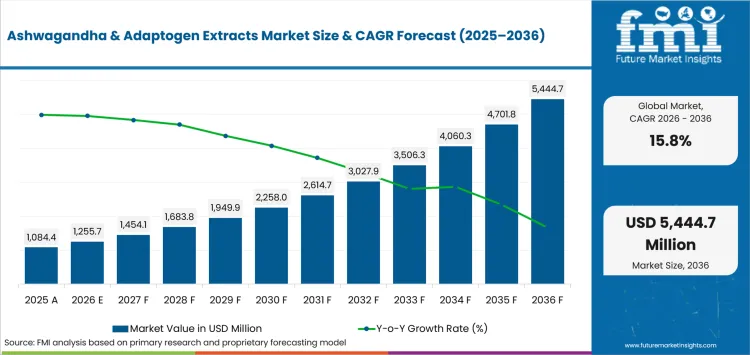
USD 1,255.7 million in 2026 and USD 5,444.7 million by 2036 at a 15.8% CAGR.
Ashwagandha & adaptogen extracts sales are projected to expand at 15.8% CAGR from 2026 to 2036, pushing valuation from USD 1,255.7 million in 2026 to USD 5,444.7 million by 2036 due to wider use of verified botanical specifications. The NIH Office of Dietary Supplements reported in May 2025 that commercial ashwagandha products use root extracts or combined root-and-leaf extracts. The agency also described meaningful differences across commercial preparation types and daily dose levels used in studies. Preparation differences make plant-part disclosure and marker testing essential for botanical extracts programs that compare branded ingredients.
India provides cultivation and extraction depth through established botanical supply networks across several production regions. The United States supports a large supplement channel through established contract manufacturing and specialist retail distribution. Australia applies active safety monitoring to listed complementary medicines across several finished-product formats and national retail channels. The Therapeutic Goods Administration reported in July 2026 that it had received four further possible liver-injury reports following its 2024 advisory. The update makes plant-part and safety documentation commercially decisive across national channels and finished-product formats. Formulation teams must align extract ratios with dosage and claim language across herbal supplements launches. Manufacturers are expected to gain preference through traceable inputs and contaminant testing supported by country-ready documentation.
Key Takeaways of Ashwagandha & Adaptogen Extracts Market
- Demand is driven by stress and sleep applications that require standardized extracts with reproducible withanolide or rosavin profiles.
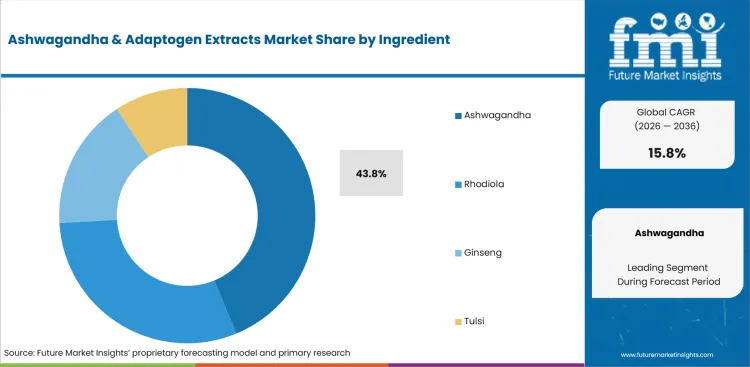
- Ashwagandha is expected to lead the ingredient category with 43.8% share in 2026 through established extraction capacity and broader clinical study coverage.
- By application, stress is projected to account for 37.5% in 2026 owing to product development focused on daily cognitive and emotional support.
- Powder is estimated to capture 46.2% share in 2026 owing to efficient shipping and flexible use across capsules and tablets.
- Variable plant parts and inconsistent marker specifications create testing burdens, and contaminant exposure with restricted claim language limits repeat purchasing.
- Competition centers on Ixoreal Biomed and Kerry Group through branded ashwagandha extracts with documented application evidence. Arjuna Natural and Sabinsa Corporation compete alongside Nutriventia and Nektium Pharma through specification control and differentiated delivery systems.
Analyst Perspective
“Commercial growth in this market depends on proof that a branded extract retains its declared plant part and marker profile across routine production. Ashwagandha programs must connect withanolide specifications with the exact dose used for stress or sleep formulations. Rhodiola programs require equally clear rosavin and salidroside controls across cognitive and sports applications sold through regulated supplement channels. Powder manufacturers gain repeat business through batch consistency and country-ready safety documentation rather than broad adaptogen claims.”
- Nandini Roy Choudhury, Principal Analyst, Future Market Insights
How is the Ashwagandha & Adaptogen Extracts Market segmented?
The Ashwagandha & Adaptogen Extracts Market is segmented by ingredient, application, form, and region.
Ingredient analysis covers ashwagandha and rhodiola alongside ginseng and tulsi extracts with different marker compounds and plant-part requirements. Application analysis separates stress and sleep from energy and sports formulations through dose design and supporting evidence. Form analysis compares powder and liquid products with granules and paste products through stability and processing needs. Regional assessment considers ingredient status and supplement rules alongside manufacturing depth and route-to-market conditions for commercial access. Broader adaptogen ingredients market activity provides context for demand that extends beyond ashwagandha into rhodiola and ginseng formulations.
How does ashwagandha shape the ingredient category?
Ashwagandha receives the dominant ingredient allocation through branded extracts that define plant part and withanolide specifications. Sabinsa announced in February 2025 that it would feature Shagandha as an ashwagandha root extract standardized to 2.5% USP-grade withanolides. The announcement connects a named commercial extract with a measurable release specification across ashwagandha root extracts market qualification. Formulators compare the declared plant part and marker method with dose evidence during early commercial qualification and then review price or delivery terms.
- Ashwagandha is projected to hold 43.8% share in 2026 owing to established branded extracts and broader evidence across stress and sleep applications. Its position depends on specifications that identify botanical part and quantify withanolides through repeatable release methods. Rhodiola and ginseng remain credible alternatives for energy or fatigue formulations that use different marker systems.
- Supplement developers begin with plant authentication and contaminant limits, then assess commercial dose evidence for each intended finished product. Technical teams compare extraction solvent and marker profile with the intended application evidence across each finished format. Batch consistency and country-ready documentation make repeat orders more likely across the intended national sales route and finished-product format.
What supports stress within the application category?
Stress formulations give standardized extracts a defined commercial use through daily dosing and validated outcome measures. Kerry reported in March 2025 that Sensoril had support from fifteen clinical studies across stress and cognitive-health applications. The company also described an eight-week study of three daily doses through a stress scale. The dose comparison requires formulators to match each commercial serving with the exact branded evidence and intended claim. Demand across ashwagandha extracts market programs therefore depends on evidence that applies to the offered extract rather than the botanical name alone.
- The stress segment is likely to capture 37.5% share in 2026 attributable to daily wellness formulas that use defined doses and validated stress measures. The segment benefits from established outcome scales that assess perceived stress and related changes in sleep quality. Consumer claims remain narrower than clinical endpoints and must follow each country’s permitted communication route.
- Brand owners prioritize stress applications that support repeat daily use instead of brief seasonal programs. Product teams evaluate dose size and delivery format alongside sensory impact and likely consumer adherence. Extract manufacturers strengthen adoption by explaining which study applies to the offered composition and which outcomes cannot enter consumer-facing claims.
What drives powder’s position in the form category?
Powder remains the primary commercial form through efficient bulk handling and broad compatibility with capsules or tablets. The Food Standards Agency reported in July 2026 that 85% of forty tested ashwagandha supplements were unsatisfactory across contaminant or labeling assessments. Six samples met every assessment criterion and thirty-three products presented labeling issues that require commercial correction. The findings make release controls central to powder supply across several contract manufacturers and finished-product routes. Related botanical ingredients market activity reinforces batch-level specification control across outsourced manufacturing programs and regional sales channels.
- By form, powder is forecast to represent 46.2% share in 2026 driven by efficient shipping and flexible conversion into capsules or tablets. Standardized powders let finished-product manufacturers adjust serving size without changing the validated extraction process or marker specification. Commercial performance weakens if moisture uptake or strong taste restricts the intended finished format and consumer experience.
- Contract manufacturers process powder extracts through established dry-blending equipment for capsules and compressed tablets at commercial scale. Liquid and paste formats support beverage systems but require stronger stability and preservation controls during storage. Granules improve flow and dosing accuracy across high-speed filling equipment without changing the validated extract specification.
What are the drivers, restraints, and opportunities in the Ashwagandha & Adaptogen Extracts Market?
Standardized stress-support formulations strengthen demand; specification gaps and claim restrictions limit adoption, and country-ready formulation support creates a practical route for verified extracts.
- Driver: Standardized extracts give formulators a defined composition that links dose design with application evidence.
- Restraint: Variable plant material and weak finished-product specifications increase testing costs and expose brands to regulatory action.
- Opportunity: Technical support translates validated extracts into compliant capsules and powders alongside beverage systems for several regional channels.
Stress-focused formulations support category expansion by giving standardized extracts a measurable proposition for consistent daily use. ClinicalTrials.gov registered NCT06793891 in January 2025 to compare proprietary root and combined root-and-leaf extracts across stress and sleep outcomes. The study design treats preparation type as a material variable instead of assuming every ashwagandha extract performs alike. Product developers therefore need evidence that matches the offered composition and intended commercial dose across finished formats. The food botanicals market offers a wider comparison for firms extending validated botanical evidence into finished products.
Specification failure creates a restraint across finished products that must confirm identity and composition rather than depend on appearance or flavor. FDA reported in September 2025 that Eniva had not established adequate finished-batch specifications for Ashwagandha Gummies. The letter described gaps across identity and purity controls alongside strength and composition requirements for finished batches. Ingredient manufacturers do not control every finished-product operation but provide validated methods and reference standards. Brands lacking these controls face delayed product release and higher corrective costs across regulated supplement channels.
Country-ready formulation packages create an opportunity for extract manufacturers that combine technical evidence with regulatory boundaries. Health Canada revised an active ashwagandha product licence in September 2025 for a 12:1 dry extract standardized to 5.0% withanolides. The regulator record shows how exact extraction ratios and marker specifications anchor a national submission. Extract companies prepare differentiated dossiers for root material and combined root-and-leaf material across regulated sales channels. Extract manufacturers that explain safe-use limits without overstating disease-treatment outcomes are expected to secure more repeat formulation projects.
Which country CAGRs are profiled in the Ashwagandha & Adaptogen Extracts Market?
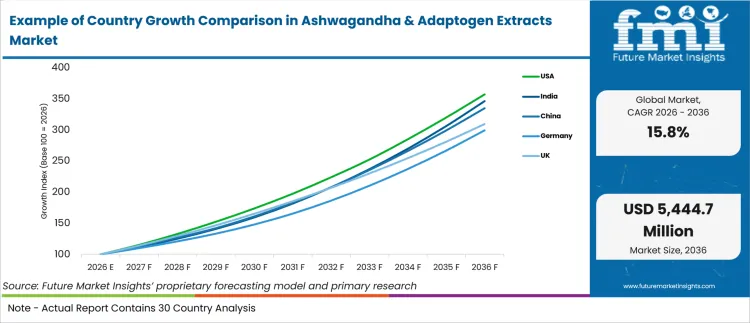
| Country | CAGR |
|---|---|
| USA | 12.4% |
| India | 13.2% |
| China | 12.8% |
| Germany | 11.6% |
| UK | 12.0% |
How do country-level CAGRs compare in the ashwagandha & adaptogen extracts market?
The profiled rates span 1.6 percentage points across five materially different operating environments with distinct regulatory and sourcing conditions. India and China form the upper group through cultivation depth and established regional extraction capacity. The USA occupies the middle position through established supplement channels and demanding finished-product claim controls. The UK and Germany form the lower group as safety reviews influence launch timing across the botanical supplements market.
- India benefits from cultivation knowledge and domestic extraction infrastructure across standardized root-based ingredients used in local and export formulations. Tighter plant-part interpretation creates friction through documentation requirements that govern Ayurvedic and food applications in commercial formulations.
- China requires functional ingredient companies to evaluate traditional materials through national food and health-product pathways. Market access depends on ingredient classification and supporting safety documentation across every intended national product route.
- The USA combines a developed supplement channel with active enforcement of manufacturing and claim requirements. Finished-product controls remain central to commercial conversion across regulated supplement and functional-product channels during national launches.
- The UK supports online supplement demand but applies close surveillance to labels and contaminants across national retail channels. The ongoing risk review introduces commercial uncertainty for broader food applications and future retail positioning.
- Germany retains a specialist supplement channel supported by established technical distribution across national retail networks. Federal risk communication encourages cautious product selection and increases documentation burdens for extract manufacturers and retailers.
Local classification and evidence expectations determine the cost of each launch, so comparable CAGRs produce different entry plans. Extract manufacturers need one global specification supported by country-specific claim and testing modules for each launch. The full report covers North America and Latin America alongside Europe and East Asia through country-level analysis. The report also evaluates South Asia and Oceania together with the Middle East and Africa through regional comparisons.
Country-wise Analysis
- The United States supports a large dietary-supplement channel but separates supplement claims from disease-treatment claims through active federal enforcement. Ashwagandha and adaptogen extract sales in the USA are forecast to expand at 12.4% CAGR by 2036, supported by established contract manufacturing and specialist retail distribution. FDA cited an Ashwagandha Root Extract among products promoted with disease claims in an August 2025 advisory letter. The advisory creates direct commercial friction for brands that use broad therapeutic language across consumer-facing product communication. Manufacturers gain an operating enabler through defined supplement rules and accessible third-party testing laboratories across major production regions. Commercial plans should separate ingredient evidence from permitted finished-product claims throughout distributor and retailer review.
- India combines ashwagandha cultivation knowledge with extraction plants serving domestic and export customers of herbs and spices. India’s ashwagandha and adaptogen extracts market outlook is anticipated to advance at 13.2% CAGR over the assessment period, aided by local raw-material access and Ayurvedic familiarity. The Ministry of Ayush directed Ayush drug manufacturers in April 2026 to use ashwagandha roots and exclude leaves from those products. The directive creates a clear root-based operating route but requires plant-part segregation throughout sourcing and processing. Export programs face additional friction from destination-specific claims and contaminant limits across major overseas sales channels. Investment plans should prioritize authenticated root supply and auditable conversion records across every contracted extraction facility.
- China applies list-based controls to materials used as foods and requires safety review for new food ingredients. Traditional use in other countries does not establish automatic food status under China’s national approval framework for ingredients. Adoption of standardized adaptogen extracts in China is estimated to expand at 12.8% CAGR through 2036, influenced by functional-product development and regional ingredient processing. The National Health Commission reported in September 2025 that 106 substances were included in the national food-medicine directory. The national directory provides an operating reference but does not confirm Ashwagandha eligibility for every product route. Health-product channels provide a commercial enabler although documentation must connect botanical identity with each permitted pathway.
- Germany has an established supplement channel and a public risk-assessment system that shapes retailer acceptance. The German ashwagandha and adaptogen extracts sector is projected to record 11.6% CAGR during the assessment period, shaped by demand for stress and sleep products. The German Federal Institute for Risk Assessment reported in September 2024 that available data could not support a health-based guidance value for safe intake. The warning creates commercial friction for broad positioning and products intended for sensitive consumer groups. Specialist distribution provides an operating enabler for extracts supported by detailed identity and dose documentation. Manufacturers should provide conservative dose information and traceable plant-part specifications throughout national retail and distributor reviews.
- The United Kingdom combines online supplement availability with targeted official surveillance and a four-country risk-management process. In the United Kingdom, ashwagandha and adaptogen extract demand is predicted to advance at 12.0% CAGR through 2036 owing to stress-support product development. The government reported in June 2026 that the ashwagandha call for evidence received nineteen responses. Centralized surveillance creates material friction for businesses that use weak labels or incomplete contaminant controls. The assessment gives compliant businesses a structured regulatory route for submitting formulation and safety data across all four countries. Online distribution provides an enabler although evolving advice creates uncertainty across specific extracts and intended applications.
Who are the notable companies in the Ashwagandha & Adaptogen Extracts Market?
Ixoreal Biomed, Kerry Group, Arjuna Natural, Sabinsa Corporation, Nutriventia, and Nektium Pharma are the notable companies shaping this market.
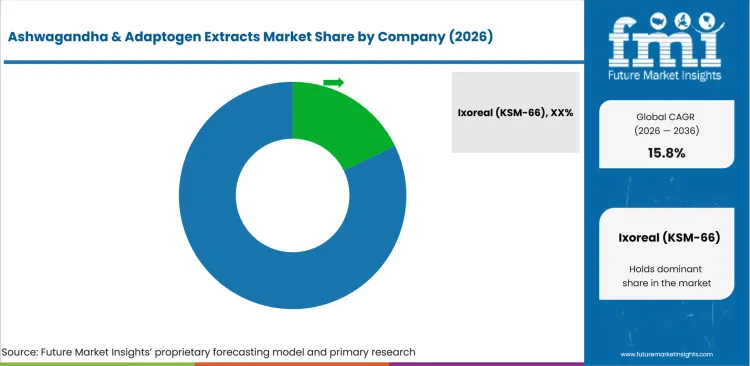
The competitive field combines ashwagandha specialists with diversified botanical extract manufacturers that compete through exact specifications and product-development support. Ixoreal Biomed and Arjuna Natural emphasize KSM-66 and Shoden through defined root composition and application evidence. Kerry Group and Sabinsa Corporation connect Sensoril and Shagandha through broader ingredient operations and international technical support. Nutriventia differentiates Prolanza through sustained-release delivery, and Nektium Pharma extends competition into standardized rhodiola through Rhodiolife. The adaptogen drinks provides a useful comparison for companies evaluating beverage-ready delivery and soluble adaptogen grades.
- Ixoreal Biomed and Arjuna Natural focus on tightly defined ashwagandha specifications supported by application evidence. Their commercial position depends on whether branded research supports the exact extract and dose used by each finished-product manufacturer. Both companies must also document plant-part controls and marker release criteria across every regional channel.
- Kerry Group and Sabinsa Corporation combine branded ashwagandha extracts with wider ingredient operations and international customer support. Their advantage depends on formulation service and regional documentation rather than corporate scale alone during commercial launches. Each company must connect its branded evidence with the exact customer formula and permitted national claims.
- Nutriventia and Nektium Pharma compete through delivery technology and specialist botanical processing across differentiated adaptogen applications. Prolanza emphasizes controlled release, whereas Rhodiolife extends the category into standardized rhodiola for cognitive and sports formulations. Commercial adoption requires stability evidence and marker control across the final delivery system used by customers.
Competitive Benchmarking: Ashwagandha & Adaptogen Extracts Market
| Company | Extraction and Specification Control | Application Evidence Support | Formulation and Scale Support | Geographic Reach |
|---|---|---|---|---|
| Ixoreal Biomed (KSM-66) | High | High | Medium | Global |
| Kerry Group (Sensoril) | Medium | High | High | Global |
| Arjuna Natural (Shoden) | High | Medium | Medium | Multi-region |
| Sabinsa Corporation (Shagandha) | Medium | Medium | High | Global |
| Nutriventia (Prolanza) | High | Medium | High | Multi-region |
| Nektium Pharma (Rhodiolife) | High | Medium | High | Multi-region |
Key Developments in the Ashwagandha & Adaptogen Extracts Market
- In April 2025, Kerry Group published Sensoril research focused on post-menopausal quality-of-life measures across four reported domains. The company described a 250 mg daily dose and reported outcomes covering vasomotor and psychosocial measures alongside physical and sexual measures. The development broadens application evidence considered by formulators without removing the need for country-specific claim review. Product teams gain a defined low-dose reference but must confirm that commercial formulas match the tested Sensoril composition.
- In September 2025, Arjuna Natural published a bioavailability comparison covering Shoden Ashwagandha and other commercial extracts. The company reported that withanolide glycoside composition influenced absorption and systemic exposure across the evaluated materials. The development directs formulation teams toward marker type rather than total withanolides as the primary comparison.
- In March 2025, Nutriventia detailed Prolanza as a sustained-release root extract designed for a single daily consumer dose. The company linked its delivery system with extended withanolide release and lower-dose formulation options for customers. The development provides another route for tablets and capsules alongside selected beverage systems that tolerate the delivery profile.
- In May 2026, Sabinsa Corporation announced that Shagandha earned the Alkemist Assured seal through independent identity and marker testing. The company stated that the extract uses root material and meets USP-NF monograph requirements for ashwagandha identity and withanolide measurement. The development gives formulators a clearer external verification route for incoming ingredient qualification and manufacturer review.
Key Players in the Ashwagandha & Adaptogen Extracts Market
Ashwagandha Specification Specialists
- Ixoreal Biomed (KSM-66)
- Arjuna Natural (Shoden)
Global Botanical Ingredient Platforms
- Kerry Group (Sensoril)
- Sabinsa Corporation (Shagandha)
Delivery and Adaptogen Specialists
- Nutriventia (Prolanza)
- Nektium Pharma (Rhodiolife)
Ashwagandha & Adaptogen Extracts Market - Report Scope
| Coverage field | Report scope |
|---|---|
| Market breakdown | Ingredient, application, form, and region. |
| Quantitative Units | Revenue in USD Million and CAGR in %. |
| Market Definition | Standardized extracts of ashwagandha, rhodiola, ginseng, tulsi, and related adaptogenic botanicals sold for commercial formulation in supplements and permitted functional products. |
| Regions Covered | North America, Latin America, Europe, East Asia, South Asia, Oceania, and Middle East and Africa. |
| Countries Covered | USA, India, China, Germany, and UK, with more than 30 countries covered in the full report. |
| Key Companies Profiled | Ixoreal Biomed, Kerry Group, Arjuna Natural, Sabinsa Corporation, Nutriventia, and Nektium Pharma. |
| Forecast Period | 2026 to 2036. |
| Approach | Hybrid bottom-up and top-down market sizing supported by primary interviews and official desk research. |
Ashwagandha & Adaptogen Extracts Market - Research Methodology
| Method | Approach |
|---|---|
| Primary Research | FMI analysts gathered input from manufacturers, service providers, technology developers, distributors, end users, procurement teams, and subject-matter experts. Interviews examined purchasing decisions, product or service evaluation, adoption barriers, approval requirements, pricing considerations, and expectations for technical or commercial support. Respondents were also asked what evidence is required before a trial, pilot, or initial order develops into regular purchasing. |
| Desk Research | Desk research covered government statistics, regulatory publications, trade data, industry associations, technical literature, standards, company filings, product information, and official corporate announcements. Sources were reviewed for relevance, publication date, geographic coverage, and consistency with the defined market scope. Claims relating to performance, applications, approvals, capacity, investment, and commercial activity were retained only when supported by credible public evidence. |
| Market Sizing and Forecasting | The market model combined the baseline value with historical performance, segment structure, pricing and volume indicators, adoption levels, company participation, and country-level demand conditions. Forecast assumptions considered economic activity, investment trends, regulatory developments, technology adoption, purchasing cycles, supply availability, and barriers to wider market use. Segment and regional estimates were reconciled before the final market total was calculated. |
| Data Validation | Estimates were checked against multiple independent indicators, including public data, company activity, trade patterns, industry developments, and findings from primary interviews. Validation also tested whether products, services, applications, and company revenues fell within the defined market boundaries. Adjacent categories, unsupported claims, overlapping revenues, and activities without direct market relevance were excluded to reduce double counting and maintain consistency across segments and countries. |
Ashwagandha & Adaptogen Extracts Market by Segments
Ashwagandha & Adaptogen Extracts Market segmented by Ingredient:
- Ashwagandha
- Rhodiola
- Ginseng
- Tulsi
Ashwagandha & Adaptogen Extracts Market segmented by Application:
- Stress
- Sleep
- Energy
- Sports
Ashwagandha & Adaptogen Extracts Market segmented by Form:
- Powder
- Liquid
- Granules
- Paste
Ashwagandha & Adaptogen Extracts Market by Region:
- North America
- United States
- Canada
- Latin America
- Brazil
- Mexico
- Argentina
- Chile
- Western Europe
- Germany
- France
- United Kingdom
- Italy
- Spain
- Benelux
- Nordics
- Eastern Europe
- Poland
- Czech Republic
- Romania
- Hungary
- East Asia
- China
- Japan
- South Korea
- South Asia and Pacific
- India
- ASEAN
- Australia and New Zealand
- Middle East and Africa
- GCC Countries
- South Africa
- Türkiye
- Israel
Research Sources and Bibliography
- National Institutes of Health, Office of Dietary Supplements. (2025, May 2). Ashwagandha: Is it helpful for stress, anxiety, or sleep? Health professional fact sheet.
- USA Food and Drug Administration. (2025, September 10). Eniva USA, Inc. - 706565 - 09/10/2025.
- USA Food and Drug Administration. (2025, August 1). Four Hearts Creations LLC - Online Advisory Letter.
- Therapeutic Goods Administration. (2026, July 7). Herbal preparations containing Withania somnifera (Withania, Ashwagandha).
- Health Canada. (2025, September 2). Product information.
- Ministry of Ayush, Government of India. (2026, April 15). Mandatory use of Ashwagandha (Withania somnifera) roots in Ayush products - reg.
- National Health Commission of the People’s Republic of China. (2025, September 4). 对十四届全国人大三次会议第2643号建议的答复 [Reply to Recommendation No. 2643 of the Third Session of the 14th National People’s Congress].
- German Federal Institute for Risk Assessment. (2024, September 10). Ashwagandha: Food supplements with potential health risks.
- Food Standards Agency. (2026, June 25). Summary of responses to call for evidence on Ashwagandha.
- Food Standards Agency, Scarrett, A., Cooke, S., & Bachelor, J. (2026, July). Retail Surveillance Survey Sampling Programme 2025/26. FSA Research and Evidence.
- ClinicalTrials.gov. (2025, January 27). Effects of Ashwagandha Extract on Stress Levels (NCT06793891).
- Kerry Group. (2025, March 3). Managing the effects of stress in 2025: How Sensoril supports cognitive health.
- Kerry Group. (2025, April 7). Redefining menopause symptom management with Sensoril.
- Arjuna Natural. (2025, September 19). Enhanced bioavailability in Shoden Ashwagandha.
- Nutriventia. (2025, March 3). Prolanza: The science-backed Ashwagandha for sustained stress and sleep.
- Sabinsa Corporation. (2026, May 18). Sabinsa’s Shagandha® Earns Alkemist Assured™ Seal, Setting a New Benchmark for Ashwagandha Quality and Transparency.
- Salve, J., Kale, S., Prajapati, B. L., Sparavigna, A., Savant, M., Ademola, J., & Langade, D. (2025, October 8). Safety of 12-Months Administration of Ashwagandha (Withania somnifera) Standardized Root Extract in Healthy Adults: A Prospective, Observational Study. Phytotherapy Research.
- Sabinsa Corporation. (2025, February 19). Sabinsa to feature portfolio of science-supported ingredients at Expo West and showcase Ayurvedic brand Nature’s Formulary products.
- Nektium Pharma. (2024, February 20). Studies deliver scientific evidence for Rhodiola rosea and Ashwagandha’s stress-reducing properties.
- Nektium Pharma. (2026, May 28). Nektium certified as a B Corp™! A new standard in sustainability.
This bibliography provides the public references supporting the article. The full report contains the complete reference list and detailed market citations.
This Report Answers
- What is the Ashwagandha & Adaptogen Extracts Market size in 2026?
- What valuation is forecast for the market by 2036?
- What CAGR is projected from 2026 to 2036?
- Which ingredient category holds the leading 2026 share?
- Which application represents the dominant 2026 share?
- Which form captures the significant 2026 share?
- Which countries are included in the country CAGR comparison?
- Which companies are profiled in the competitive analysis?
- What regulatory and quality factors influence commercial adoption?
Frequently Asked Questions
How big is the Ashwagandha & Adaptogen Extracts Market in 2026?
The ashwagandha & adaptogen extracts market is valued at USD 1255.7 million in 2026 and is forecast to reach USD 5444.7 million by 2036, supported by wider adoption of verified botanical specifications and growing demand for standardized extracts with reproducible withanolide and rosavin profiles across stress, sleep, and cognitive supplement applications.
What is the CAGR of the Ashwagandha & Adaptogen Extracts Market from 2026 to 2036?
The ashwagandha & adaptogen extracts market is projected to grow at a CAGR of 15.8% between 2026 and 2036, supported by expanding stress-support formulation programs, increasing finished-product claim controls driving demand for traceable botanical inputs, and growing country-ready documentation requirements strengthening preference for branded standardized extracts.
Which ingredient leads the Ashwagandha & Adaptogen Extracts Market?
Ashwagandha accounts for 43.8% of the ashwagandha & adaptogen extracts market by ingredient in 2026, driven by established branded extracts with defined plant-part specifications and broader clinical study coverage across stress and sleep applications compared with rhodiola and ginseng alternatives.
How much will the Ashwagandha & Adaptogen Extracts Market add between 2026 and 2036?
The ashwagandha & adaptogen extracts market is set to add USD 4189.0 million between 2026 and 2036, growing from USD 1255.7 million to USD 5444.7 million as standardized stress-support formulations, expanding country-ready regulatory dossiers, and growing supplement channel depth across India, China, and the United States accelerate branded adaptogen extract adoption globally.
Who are the leading companies in the Ashwagandha & Adaptogen Extracts Market?
Leading companies in the ashwagandha & adaptogen extracts market include Ixoreal Biomed (KSM-66), Arjuna Natural (Shoden), Kerry Group (Sensoril), Sabinsa Corporation (Shagandha), Nutriventia (Prolanza), and Nektium Pharma (Rhodiolife), competing across ashwagandha specification control, global botanical ingredient platforms, and delivery and adaptogen specialist systems with multi-region and global reach.
Preview the report firsthand - request a free sample
Get SampleGet the brochure for pricing and purchase details.
Get PDFTable of Content
- Key Takeaways
- Market Size and CAGR
- Top Growth Driver
- Fastest Growing Segment
- Leading Region
- Key Companies
- Emerging Opportunities
- Executive Summary
- Global Market Outlook
- Demand-side Trends
- Supply-side Trends
- Technology Roadmap Analysis
- Analysis and Recommendations
- Analyst Perspective (What is happening? Why now? What should investors know?)
- Key Questions Answered
- How large is the market?
- What is the CAGR?
- What are key trends?
- Which region dominates?
- Who are the leaders?
- Market Overview
- Market Coverage / Taxonomy
- Market Definition / Scope / Limitations
- Research Methodology
- Chapter Orientation
- Analytical Lens and Working Hypotheses
- Market Structure, Signals, and Trend Drivers
- Benchmarking and Cross-market Comparability
- Market Sizing, Forecasting, and Opportunity Mapping
- Research Design and Evidence Framework
- Desk Research Programme (Secondary Evidence)
- Expert Input and Fieldwork (Primary Evidence)
- Tooling, Models, and Reference Databases
- Data Engineering and Model Build
- Quality Assurance and Audit Trail
- Market Background
- Market Dynamics (Drivers, Restraints, Opportunity, Trends)
- Scenario Forecast (Optimistic, Likely, Conservative)
- Impact Analysis
- AI Impact
- Sustainability Impact
- Regulatory Impact
- Technology Impact
- Consumer / Buyer Analysis
- Purchase Drivers
- Adoption Barriers
- Buyer Journey
- Opportunity Map Analysis
- Product Life Cycle Analysis
- Supply Chain Analysis
- Investment Feasibility Matrix
- Value Chain Analysis
- PESTLE and Porter's Analysis
- Regulatory Landscape
- Regional Parent Market Outlook
- Production and Consumption Statistics
- Import and Export Statistics
- Global Market Analysis and Forecast, 2021 to 2036
- Historical Market Size Value (USD Million) Analysis, 2021 to 2025
- Current and Future Market Size Value (USD Million) Projections, 2026 to 2036
- Y-o-Y Growth Trend Analysis
- Absolute $ Opportunity Analysis
- Global Market Pricing Analysis, 2021 to 2036
- Global Market Analysis and Forecast, By Ingredient, 2021 to 2036
- Introduction / Key Findings
- Historical Market Size Value (USD Million) Analysis By Ingredient, 2021 to 2025
- Current and Future Market Size Value (USD Million) Analysis and Forecast By Ingredient, 2026 to 2036
- Ashwagandha
- Rhodiola
- Ginseng
- Tulsi
- Ashwagandha
- Y-o-Y Growth Trend Analysis By Ingredient, 2021 to 2025
- Absolute $ Opportunity Analysis By Ingredient, 2026 to 2036
- Global Market Analysis and Forecast, By Application, 2021 to 2036
- Introduction / Key Findings
- Historical Market Size Value (USD Million) Analysis By Application, 2021 to 2025
- Current and Future Market Size Value (USD Million) Analysis and Forecast By Application, 2026 to 2036
- Stress
- Sleep
- Energy
- Sports
- Stress
- Y-o-Y Growth Trend Analysis By Application, 2021 to 2025
- Absolute $ Opportunity Analysis By Application, 2026 to 2036
- Global Market Analysis and Forecast, By Form, 2021 to 2036
- Introduction / Key Findings
- Historical Market Size Value (USD Million) Analysis By Form, 2021 to 2025
- Current and Future Market Size Value (USD Million) Analysis and Forecast By Form, 2026 to 2036
- Powder
- Liquid
- Granules
- Paste
- Powder
- Y-o-Y Growth Trend Analysis By Form, 2021 to 2025
- Absolute $ Opportunity Analysis By Form, 2026 to 2036
- Global Market Analysis and Forecast, By Region, 2021 to 2036
- Introduction
- Historical Market Size Value (USD Million) Analysis By Region, 2021 to 2025
- Current Market Size Value (USD Million) Analysis and Forecast By Region, 2026 to 2036
- North America
- Latin America
- Western Europe
- Eastern Europe
- East Asia
- South Asia and Pacific
- Middle East & Africa
- Market Attractiveness Analysis By Region
- North America Market Analysis and Forecast, By Country, 2021 to 2036
- Historical Market Size Value (USD Million) Trend Analysis By Market Taxonomy, 2021 to 2025
- Market Size Value (USD Million) Forecast By Market Taxonomy, 2026 to 2036
- By Country
- USA
- Canada
- By Ingredient
- By Application
- By Form
- By Country
- Market Attractiveness Analysis
- By Country
- By Ingredient
- By Application
- By Form
- Key Takeaways
- Latin America Market Analysis and Forecast, By Country
- Historical Market Size Value (USD Million) Trend Analysis By Market Taxonomy, 2021 to 2025
- Market Size Value (USD Million) Forecast By Market Taxonomy, 2026 to 2036
- By Country
- Brazil
- Mexico
- Chile
- Rest of Latin America
- By Ingredient
- By Application
- By Form
- By Country
- Market Attractiveness Analysis
- By Country
- By Ingredient
- By Application
- By Form
- Key Takeaways
- Western Europe Market Analysis and Forecast, By Country
- Historical Market Size Value (USD Million) Trend Analysis By Market Taxonomy, 2021 to 2025
- Market Size Value (USD Million) Forecast By Market Taxonomy, 2026 to 2036
- By Country
- Germany
- UK
- Italy
- Spain
- France
- Nordic
- BENELUX
- Rest of Western Europe
- By Ingredient
- By Application
- By Form
- By Country
- Market Attractiveness Analysis
- By Country
- By Ingredient
- By Application
- By Form
- Key Takeaways
- Eastern Europe Market Analysis and Forecast, By Country
- Historical Market Size Value (USD Million) Trend Analysis By Market Taxonomy, 2021 to 2025
- Market Size Value (USD Million) Forecast By Market Taxonomy, 2026 to 2036
- By Country
- Russia
- Poland
- Hungary
- Balkan & Baltic
- Rest of Eastern Europe
- By Ingredient
- By Application
- By Form
- By Country
- Market Attractiveness Analysis
- By Country
- By Ingredient
- By Application
- By Form
- Key Takeaways
- East Asia Market Analysis and Forecast, By Country
- Historical Market Size Value (USD Million) Trend Analysis By Market Taxonomy, 2021 to 2025
- Market Size Value (USD Million) Forecast By Market Taxonomy, 2026 to 2036
- By Country
- China
- Japan
- South Korea
- By Ingredient
- By Application
- By Form
- By Country
- Market Attractiveness Analysis
- By Country
- By Ingredient
- By Application
- By Form
- Key Takeaways
- South Asia and Pacific Market Analysis and Forecast, By Country
- Historical Market Size Value (USD Million) Trend Analysis By Market Taxonomy, 2021 to 2025
- Market Size Value (USD Million) Forecast By Market Taxonomy, 2026 to 2036
- By Country
- India
- ASEAN
- Australia & New Zealand
- Rest of South Asia and Pacific
- By Ingredient
- By Application
- By Form
- By Country
- Market Attractiveness Analysis
- By Country
- By Ingredient
- By Application
- By Form
- Key Takeaways
- Middle East & Africa Market Analysis and Forecast, By Country
- Historical Market Size Value (USD Million) Trend Analysis By Market Taxonomy, 2021 to 2025
- Market Size Value (USD Million) Forecast By Market Taxonomy, 2026 to 2036
- By Country
- Kingdom of Saudi Arabia
- Other GCC Countries
- Türkiye
- South Africa
- Other African Union
- Rest of Middle East & Africa
- By Ingredient
- By Application
- By Form
- By Country
- Market Attractiveness Analysis
- By Country
- By Ingredient
- By Application
- By Form
- Key Takeaways
- Key Countries Market Analysis
- USA
- Pricing Analysis
- Market Share Analysis, 2025
- By Ingredient
- By Application
- By Form
- Canada
- Pricing Analysis
- Market Share Analysis, 2025
- By Ingredient
- By Application
- By Form
- Mexico
- Pricing Analysis
- Market Share Analysis, 2025
- By Ingredient
- By Application
- By Form
- Brazil
- Pricing Analysis
- Market Share Analysis, 2025
- By Ingredient
- By Application
- By Form
- Chile
- Pricing Analysis
- Market Share Analysis, 2025
- By Ingredient
- By Application
- By Form
- Germany
- Pricing Analysis
- Market Share Analysis, 2025
- By Ingredient
- By Application
- By Form
- UK
- Pricing Analysis
- Market Share Analysis, 2025
- By Ingredient
- By Application
- By Form
- Italy
- Pricing Analysis
- Market Share Analysis, 2025
- By Ingredient
- By Application
- By Form
- Spain
- Pricing Analysis
- Market Share Analysis, 2025
- By Ingredient
- By Application
- By Form
- France
- Pricing Analysis
- Market Share Analysis, 2025
- By Ingredient
- By Application
- By Form
- India
- Pricing Analysis
- Market Share Analysis, 2025
- By Ingredient
- By Application
- By Form
- ASEAN
- Pricing Analysis
- Market Share Analysis, 2025
- By Ingredient
- By Application
- By Form
- Australia & New Zealand
- Pricing Analysis
- Market Share Analysis, 2025
- By Ingredient
- By Application
- By Form
- China
- Pricing Analysis
- Market Share Analysis, 2025
- By Ingredient
- By Application
- By Form
- Japan
- Pricing Analysis
- Market Share Analysis, 2025
- By Ingredient
- By Application
- By Form
- South Korea
- Pricing Analysis
- Market Share Analysis, 2025
- By Ingredient
- By Application
- By Form
- Russia
- Pricing Analysis
- Market Share Analysis, 2025
- By Ingredient
- By Application
- By Form
- Poland
- Pricing Analysis
- Market Share Analysis, 2025
- By Ingredient
- By Application
- By Form
- Hungary
- Pricing Analysis
- Market Share Analysis, 2025
- By Ingredient
- By Application
- By Form
- Kingdom of Saudi Arabia
- Pricing Analysis
- Market Share Analysis, 2025
- By Ingredient
- By Application
- By Form
- Türkiye
- Pricing Analysis
- Market Share Analysis, 2025
- By Ingredient
- By Application
- By Form
- South Africa
- Pricing Analysis
- Market Share Analysis, 2025
- By Ingredient
- By Application
- By Form
- USA
- Market Structure Analysis
- Competition Dashboard
- Competition Benchmarking
- Market Share Analysis of Top Players
- By Regional
- By Ingredient
- By Application
- By Form
- Emerging Startups
- Innovation Benchmarking
- Competition Analysis
- Competition Deep Dive
- Ixoreal (KSM-66)
- Overview
- Product Portfolio
- Profitability by Market Segments
- Sales Footprint
- Strategy Overview
- Marketing Strategy
- Product Strategy
- Channel Strategy
- Natreon
- Sabinsa
- Arjuna (Shoden)
- Gencor
- NutriScience
- Ixoreal (KSM-66)
- Case Studies
- Success Stories
- Recent Developments
- Competition Deep Dive
- Assumptions & Acronyms Used


