

- Market Size (2026)
- USD 67.3 Mn
- Forecast (2036)
- USD 205.3 Mn
- CAGR (2026 to 2036)
- 11.8%
How big is Adaptive Athlete Nutrition Market in 2026?
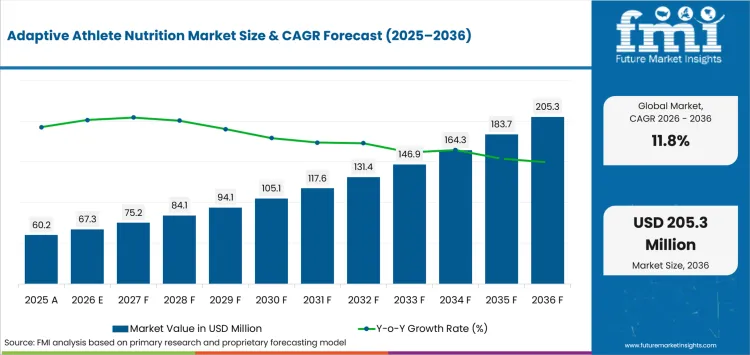
USD 67.3 million in 2026 and USD 205.3 million by 2036 at an 11.8% CAGR.
Demand for adaptive athlete nutrition is projected to expand at 11.8% CAGR between 2026 and 2036, increasing valuation from USD 67.3 million in 2026 to USD 205.3 million by 2036. The USOPC recognized dietetics as a distinct support-staff category in June 2026 and described individualized fueling and hydration work inside elite programs. That practitioner model lets established sports nutrition formats serve variable energy needs through adjustable portions instead of separate delivery systems. Personalized nutrition models can narrow dosing choices through clearer instructions without multiplying formulas for every athlete profile.
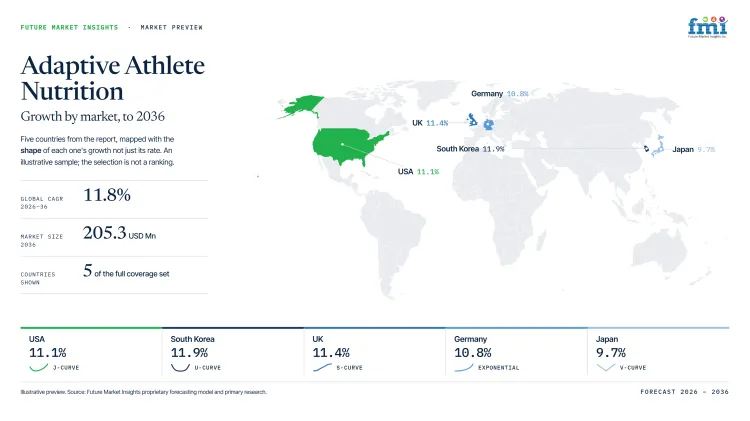
National conversion depends on how closely elite programs place nutrition practitioners beside athletes during repeated training cycles. The UK is projected at 11.4% CAGR compared with Japan at 9.7% during the forecast period. UK Sport stated in July 2025 that it supports more than 1,000 Olympic and Paralympic athletes. That service depth gives British brands more routine practitioner contact than Japanese specialists receive outside major training centers.
Key Takeaways of Adaptive Athlete Nutrition Market
- Performance teams are formalizing impairment-aware fueling since para-athletes may require different energy and hydration plans from mainstream sport templates.
- By product type, energy-balanced fuels (adjusted expenditure) are estimated to hold 39.9% in 2026 owing to controllable session-level energy delivery.
- In 2026, wheelchair sports is expected to lead athlete group with 44.3% share because repeated fueling decisions accompany varied mobility and event demands.
- By level, paralympic & elite is forecast to represent 48.3% in 2026 driven by professional nutrition support that formalizes product selection and dosing.
- Limited para-athlete nutrition evidence and supplement contamination risk increase qualification work during routine entry into elite programs.
- Some of the key players in this market include Klean Athlete, Thorne, Momentous, Optimum Nutrition (Glanbia), Nuun (Nestle Health Science), GU Energy, Abbott, and PepsiCo (Gatorade).
Analyst Perspective
"Dietitians need enough dose flexibility to alter energy or fluid intake without changing an athlete's broader competition plan. Brands that place clean-sport evidence beside dosing instructions reduce verification time ahead of camps and sanctioned events."
- Nandini Roy Choudhury, Principal Consultant, Future Market Insights
How is the Adaptive Athlete Nutrition Market segmented?
The market is segmented by product type, athlete group, level, form, and sales channel.
Product type covers energy-balanced fuels (adjusted expenditure), bowel / bladder-considerate hydration, pressure-injury prevention nutrition, upper-body recovery proteins, and others. Athlete group includes wheelchair sports, amputee athletes, visually impaired & others, and para-endurance. Level comprises paralympic & elite, competitive club, and recreational participation. Form includes powders, RTD, gels & bars, and others. Sales channels include online / DTC, specialty sports stores, supermarkets & hypermarkets, pharmacies, and others. Region completes the taxonomy used for geographic analysis.
Why do Energy-balanced fuels (adjusted expenditure) lead the Product type category?
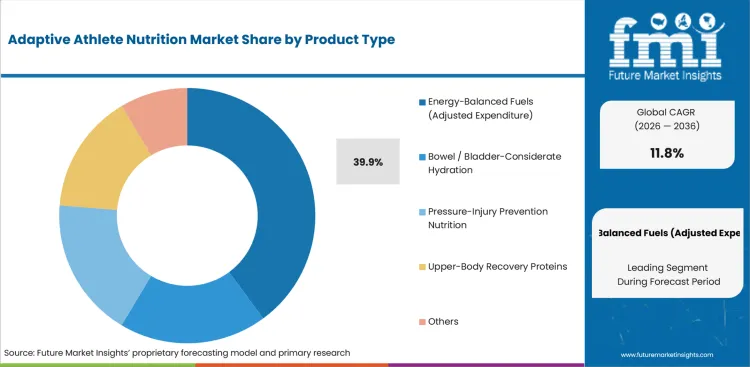
Energy-balanced fuels let practitioners match carbohydrate exposure to training demand without assuming able-bodied energy expenditure during routine planning. Existing sports nutrition ingredients give formulators familiar carbohydrate and electrolyte routes that can be portioned independently for individualized athlete plans.
- By product type, energy-balanced fuels (adjusted expenditure) are estimated to hold 39.9% in 2026 owing to controllable energy delivery for individualized plans.
- PepsiCo launched Gatorade Lower Sugar in March 2026 with 75% less sugar than Gatorade Thirst Quencher and kept its electrolyte-science proposition. The launch gives formulators a current commercial example of changing carbohydrate exposure inside a familiar hydration format.
Why does Wheelchair sports lead the Athlete group category?
Wheelchair sports concentrates upper-body work and impairment-related energy planning inside the same commercial nutrition brief. Institutional B2B sports nutrition programs must therefore support repeated fueling during team travel and competition. The June 2025 IWBF U23 World Championship brought 12 national teams from all four IWBF zones to São Paulo.
- Wheelchair sports is set to lead the athlete group with 44.3% share in 2026 due to repeated fueling and recovery decisions spanning court and endurance disciplines.
- Tournament schedules required repeated fueling and recovery between games, so portable servings gained value during short coach preparation windows between sessions.
Why does Paralympic & elite lead the Level category?
Elite para-sport places product choice inside a professional performance system with dietetics and medical oversight at high-stakes sanctioned events. Certified protein supplements become easier to evaluate once ingredient disclosure and athlete-safety checks are formalized inside team operating protocols.
- Paralympic & elite is projected to hold 48.3% share in 2026 owing to professional support that makes product selection structured and repeatable. In May 2026, Thorne renewed its USA Artistic Swimming partnership and committed NSF Certified for Sport products to elite athletes.
- The agreement places verified supplements inside a governed training environment that gives practitioners control over selection and recovery routines during repeated competition preparation.
Why do Powders lead the Form category?
Powders give sports dietitians direct control over serving size and fluid concentration without forcing a fixed ready-to-drink dose. The same flexibility fits electrolyte drinks used during sessions requiring different fluid volumes or carbohydrate concentrations.
- The powders segment is likely to capture 39.4% share in 2026 attributable to adjustable concentration and lower transport burden during team travel.
- Thorne launched an on-the-go sports performance suite in April 2025 with Daily Electrolytes and other NSF Certified for Sport formats. Single-serve sticks give practitioners portable dose units without committing every athlete to one prepared beverage size during travel.
What are the drivers, restraints and opportunities in the Adaptive Athlete Nutrition Market?
Individualized para-sport nutrition expands product requirements as hidden-ingredient risk raises qualification cost and certified modular formats provide the clearest route to repeat purchase.
- Driver: Performance programs increasingly require nutrition plans that account for impairment-specific energy expenditure and hydration needs during sanctioned competition.
- Restraint: Hidden ingredients and thin para-athlete evidence increase the time practitioners spend qualifying supplements for routine use.
- Opportunity: Modular formulations with recognized clean-sport certification let practitioners adjust energy and hydration without multiplying narrow product inventories.
A significant industry growth driver is practitioner control over fueling that must change with disability type and event demands. In April 2026, the IPC reported that its 2025 Sport for Mobility program funded 164 para-athletes from 39 nations in 12 sports. Wider competition access expands structured training environments for individualized sports food, provided serving instructions fit practitioner-set session targets during preparation and recovery.
Qualification risk slows adoption as practitioners remain responsible for ingredients that may not appear clearly on a product label. The FDA warned in June 2026 that PRE-FORMANCE BLACK contained undeclared DMAA despite being promoted for energy and performance. Elite programs therefore require stronger product records for routine use, and smaller adaptive-nutrition brands face longer listing cycles for formulas needing additional verification.
Modular ranges offer the clearest revenue route by letting dietitians separate fueling from hydration without forcing fixed combinations. NSF announced in January 2025 that IM8 Daily Ultimate Essentials earned Certified for Sport status with testing for more than 280 banned substances. Certified testing reduces qualification work and gives functional beverage formats a clearer route into travel-heavy hydration routines during competition schedules.
Which country CAGRs are profiled in the Adaptive Athlete Nutrition Market?
| Country | CAGR |
|---|---|
| South Korea | 11.9% |
| UK | 11.4% |
| USA | 11.1% |
| Germany | 10.8% |
| Japan | 9.7% |
How do country-level CAGRs compare in the Adaptive Athlete Nutrition Market?
The 2.2 percentage-point range separates South Korea at 11.9% from Japan at 9.7% during the forecast period. South Korea leads a compact upper group with the UK and USA. Germany follows closely at 10.8%, then Japan forms the lower-growth step as practitioner access and qualification speed differ materially by country.
- South Korea concentrates para-sport education in organized programs near major training hubs.
- The UK keeps specialist retail access available between centralized camps and competitions.
- The USA pairs broad online access with strict athlete responsibility for supplement selection.
- Germany routes specialist nutrition education through clubs and pharmacy-linked health channels nationwide.
- Japan favors compact formats that fit familiar routines until repeat purchasing develops.
Verification time and practitioner access can produce different launch economics even at similar CAGRs.
The full report provides country-level CAGR analysis across North America, Latin America, Europe, East Asia, South Asia, Oceania and the Middle East and Africa.
Country-wise Analysis
- Team USA athletes purchase specialist nutrition within high-performance programs in which dietitians manage fueling plans and personal costs can constrain repeated product use during demanding training and competition blocks. In January 2026 the USOPC quoted Paralympic swimmer Ali Truwit saying roughly 57% of Team USA athletes make under USD 50,000 a year, keeping price visible beside certification evidence during routine product review. Adaptive athlete nutrition demand in the USA is forecast to rise at 11.1% CAGR over the forecast period because direct digital access lets dietitians compare ingredients and replenish specialist formats, so brands entering USA sports nutrition channels need transparent dosing and reliable online supply.
- British elite sport routes nutrition decisions through funded World Class Programs that place practitioners close to Olympic and Paralympic athletes during camps, travel periods and competition blocks. The UK adaptive athlete nutrition outlook is anticipated to advance at 11.4% CAGR over the assessment period aided by funded high-performance support, but portable products require ingredient evidence that practitioners can review quickly during product selection. UK Sport confirmed in March 2025 that the Los Angeles-cycle Athlete Performance Award budget is projected to rise 12% from the Paris cycle, giving brands a funded practitioner channel for compact formats during preparations for Los Angeles 2028.
- German elite programs use a cautious supplement culture that places ingredient records and banned-substance evidence ahead of broad performance messaging during recurring club, medical-team and federation product review. Germany is estimated to post 10.8% CAGR over the forecast period tied to demand for clear ingredients and documented quality controls, and incomplete records can lengthen approval for specialized formulations serving defined athlete needs. NADA Germany stated in September 2025 that newly prohibited stimulant examples for 2026 had been found in supplements, keeping complete formula records and independent screening central to repeated use under strict-liability rules in national sanctioned competition programs.
- Japan's high-performance network uses specialist support teams to standardize nutrition services for national squads entering major events, centralized training camps and recovery programs coordinated through sports-science staff. HPSC reported in March 2026 that 25 of its 89 registered nutrition support specialists attended the first nutrition information-sharing meeting, giving unfamiliar formats a direct route into domestic practitioner discussion and formal knowledge exchange. Adaptive athlete nutrition sales in Japan are forecast to expand at 9.7% CAGR by 2036 given practitioner-led education, but limited availability beyond major training centers can delay repeat orders for Japanese-language specialist products in smaller regional para-sport programs.
- South Korea is widening the active base for disability sport through organized programs that give para-athletes more regular contact with coaches, trainers and support staff during scheduled participation. Adaptive athlete nutrition demand in South Korea is projected to record 11.9% CAGR during the assessment period propelled by broader participation and stronger visibility for organized para-sport, but specialist purchasing is concentrated in major cities and well-supported programs. The Ministry of Culture Sports and Tourism reported in January 2026 that regular sports participation among people with disabilities reached 34.8% in 2025, favoring partnership-led entry through performance practitioners over broad consumer fitness positioning at this development stage.
Who are the notable companies in the Adaptive Athlete Nutrition Market?
Klean Athlete, Thorne, Momentous, Optimum Nutrition (Glanbia), Nuun (Nestle Health Science), GU Energy, Abbott, and PepsiCo (Gatorade) are the notable companies serving this market.
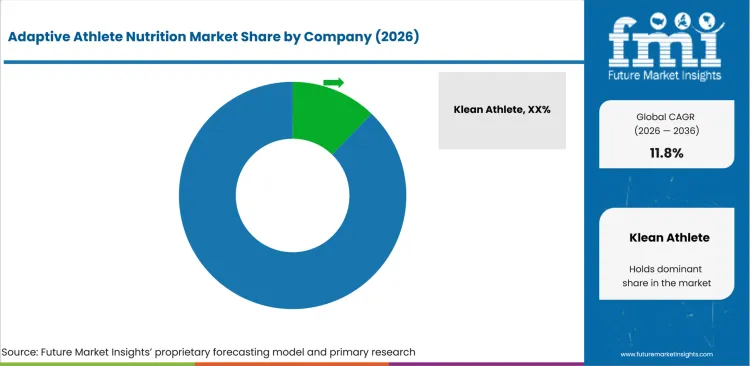
Competition is fragmented by qualification route and use case instead of controlled by one adaptive-athlete specialist. Sports nutrition share analysis provides broader category context without proving leadership inside this niche. Here clean-sport evidence and practitioner usability shape entry barriers by requiring each product to solve a defined dosing problem without multiplying verification work.
- Klean Athlete, Thorne, and Momentous emphasize certified performance supplementation with strong practitioner-facing quality assurance programs.
- Optimum Nutrition (Glanbia), Nuun (Nestle Health Science), and GU Energy cover protein, hydration, and endurance-fueling formats through mature sports-nutrition channels.
- Abbott and PepsiCo (Gatorade) extend competition into medical nutrition, team hydration, and large-scale institutional sports programs.
Competitive Benchmarking: Adaptive Athlete Nutrition Market
| Company | Performance Format Breadth | Athlete Program Integration | Qualification / Quality Evidence | Geographic Reach |
|---|---|---|---|---|
| Klean Athlete | High | High | High | North America |
| Thorne | High | High | High | North America and international team programs |
| Momentous | High | High | High | United States and international shipping |
| Optimum Nutrition (Glanbia) | High | High | Medium | More than 100 countries |
| Nuun (Nestle Health Science) | Medium | Medium | Medium | North America and international online sales |
| GU Energy | High | High | Medium | North America and international endurance channels |
| Abbott | Medium | High | Low | Global |
| PepsiCo (Gatorade) | High | High | High | Global |
Scoring basis: High format breadth requires at least three documented performance-nutrition formats, Medium requires two and Low identifies one. High athlete-program integration requires multiple documented team or federation programs, Medium requires one verified institutional partnership and Low identifies no documented program beyond general consumer sales. High qualification depth requires portfolio-wide sport certification or a dedicated multi-setting sports-science program, Medium requires selected certification and Low identifies documented general product-quality controls only.
Key Developments in the Adaptive Athlete Nutrition Market
- In June 2026, Optimum Nutrition (Glanbia) launched Clear Whey Protein in the UK with 20 grams of whey protein isolate per serving.
- In March 2026, Nuun (Nestle Health Science) introduced a reformulated Nuun Energy tablet with five electrolytes and 80 milligrams of plant-based caffeine.
- In May 2025, GU Energy launched Fruit Punch Energy Chews and committed a portion of sales to the Running Industry Diversity Coalition through 2027.
Key Players in the Adaptive Athlete Nutrition Market
Clean-Sport Performance Specialists
- Klean Athlete
- Thorne
- Momentous
Sports-Nutrition and Endurance Brands
- Optimum Nutrition (Glanbia)
- Nuun (Nestle Health Science)
- GU Energy
Medical Nutrition and Global Hydration Platforms
- Abbott
- PepsiCo (Gatorade)
Adaptive Athlete Nutrition Market - Report Scope
| Coverage field | Report scope |
|---|---|
| Market breakdown | By product type, athlete group, level, form, sales channel and region. |
| Quantitative Units | USD Million. |
| Market Definition | Commercial nutrition products for adaptive and para-athletes covering impairment-aware fueling, hydration, recovery, pressure-injury prevention, and related sport-performance nutrition needs. |
| Regions Covered | North America, Latin America, Europe, East Asia, South Asia and Pacific, and Middle East and Africa. |
| Countries Covered | USA, UK, Germany, Japan, South Korea, and 20+ countries included in the full report. |
| Key Companies Profiled | Klean Athlete, Thorne, Momentous, Optimum Nutrition (Glanbia), Nuun (Nestle Health Science), GU Energy, Abbott, and PepsiCo (Gatorade). |
| Forecast Period | Base 2026 to 2036. |
| Approach | Primary and secondary research with market triangulation. |
Adaptive Athlete Nutrition Market - Research Methodology
| Method | Approach |
|---|---|
| Primary Research | FMI analysts gathered input from manufacturers, service providers, technology developers, distributors, end users, procurement teams, and subject-matter experts. Interviews examined purchasing decisions, product or service evaluation, adoption barriers, approval requirements, pricing considerations, and expectations for technical or commercial support. Respondents were also asked what evidence is required before a trial, pilot, or initial order develops into regular purchasing. |
| Desk Research | Desk research covered government statistics, regulatory publications, trade data, industry associations, technical literature, standards, company filings, product information, and official corporate announcements. Sources were reviewed for relevance, publication date, geographic coverage, and consistency with the defined market scope. Claims relating to performance, applications, approvals, capacity, investment, and commercial activity were retained only when supported by credible public evidence. |
| Market Sizing and Forecasting | The market model combined the baseline value with historical performance, segment structure, pricing and volume indicators, adoption levels, company participation, and country-level demand conditions. Forecast assumptions considered economic activity, investment trends, regulatory developments, technology adoption, purchasing cycles, supply availability, and barriers to wider market use. Segment and regional estimates were reconciled before the final market total was calculated. |
| Data Validation | Estimates were checked against multiple independent indicators, including public data, company activity, trade patterns, industry developments, and findings from primary interviews. Validation also tested whether products, services, applications, and company revenues fell within the defined market boundaries. Adjacent categories, unsupported claims, overlapping revenues, and activities without direct market relevance were excluded to reduce double counting and maintain consistency across segments and countries. |
Adaptive Athlete Nutrition Market by Segments
Adaptive Athlete Nutrition Market segmented by Product Type:
- Energy-Balanced Fuels (Adjusted Expenditure)
- Bowel / Bladder-Considerate Hydration
- Pressure-Injury Prevention Nutrition
- Upper-Body Recovery Proteins
- Others
Adaptive Athlete Nutrition Market segmented by Athlete Group:
- Wheelchair Sports
- Amputee Athletes
- Visually Impaired & Others
- Para-Endurance
Adaptive Athlete Nutrition Market segmented by Level:
- Paralympic & Elite
- Competitive Club
- Recreational
Adaptive Athlete Nutrition Market segmented by Form:
- Powders
- RTD
- Gels & Bars
- Others
Adaptive Athlete Nutrition Market segmented by Sales Channel:
- Online / DTC
- Specialty Sports Stores
- Supermarkets & Hypermarkets
- Pharmacies
- Others
Adaptive Athlete Nutrition Market by Region:
- North America
- United States
- Canada
- Latin America
- Brazil
- Mexico
- Argentina
- Chile
- Western Europe
- Germany
- France
- United Kingdom
- Italy
- Spain
- Benelux
- Nordics
- Eastern Europe
- Poland
- Czech Republic
- Romania
- Hungary
- East Asia
- China
- Japan
- South Korea
- South Asia and Pacific
- India
- ASEAN
- Australia and New Zealand
- Middle East and Africa
- GCC Countries
- South Africa
- Türkiye
- Israel
Research Sources and Bibliography
- Thorne. (2026, May 21). USA Artistic Swimming and Thorne Renew Partnership to Support Athlete Health, Performance, and Recovery.
- UK Sport. (2025, July 3). Transforming athlete reach and relevance: UK Sport introduces new Athlete Creator Club for Olympic and Paralympic athletes.
- PepsiCo. (2026, March 4). Gatorade Lower Sugar brings a new era of hydration with no artificial flavors, sweeteners or colors and 75% less sugar than Gatorade Thirst Quencher.
- International Wheelchair Basketball Federation. (2025, June 12-20). 2025 IWBF U23 World Championship.
- USA Olympic & Paralympic Committee. (2026, June 2). USA Olympic & Paralympic Committee Honors Coaches and Support Staff of the Year for 2025.
- Thorne. (2025, April 14). THORNE LAUNCHES ON-THE-GO SPORTS PERFORMANCE PRODUCT LINE VIA NEW CAMPAIGN WITH TENNIS STAR BEN SHELTON.
- International Paralympic Committee. (2026, April 28). First year of Sport for Mobility makes a tremendous difference.
- USA Food and Drug Administration. (2026, June 24). PRE-FORMANCE BLACK may be harmful due to hidden ingredient.
- NSF. (2025, January 21). David Beckham Co-Founded Supplements Brand IM8 Earns NSF Certified for Sport®.
- USA Olympic & Paralympic Committee. (2026, January 21). Paying It Forward: Ali Truwit Champions Team USA Paralympic Swimming.
- UK Sport. (2025, March 14). Increased Athlete Performance Award budget confirmed.
- NADA Germany. (2025, September 25). WADA publishes Prohibited List 2026.
- High Performance Sport Center Network. (2026, March 16). 2025
- Ministry of Culture, Sports and Tourism, Republic of Korea. (2026, January 28).
- Glanbia. (2026, June 9). Optimum Nutrition launches new Clear Whey Protein.
- Nuun Hydration. (2026, March 23). Introducing Energy Caffeine + B-Vitamins.
- GU Energy Labs. (2025, May 6). New Chews Flavor Supports the Running Industry Diversity Coalition.
- Klean Athlete. Frequently Asked Questions. Retrieved August 26, 2026.
- Momentous. (2025, December 23). The Momentous Standard™: Another Year of Setting the Bar in the Supplement Industry.
- Thorne. (2025, September 4). Thorne Reignites Partnership With USA Triathlon.
- Momentous. (2026, February 12). Momentous x The Vitamin Shoppe: Partners with Purpose.
- Glanbia. (2025, October 22). Optimum Nutrition partners with IRFU.
- PepsiCo. (2025, December 2). PepsiCo® announces landmark global partnership with Mercedes-AMG PETRONAS F1 Team for 2026.
- GU Energy Labs. (2025, June 25). GU ENERGY EXTENDS WESTERN STATES SPONSORSHIP TO 2029.
- Abbott. (2026, March 11). Abbott and Real Madrid launch nationwide effort to build the next 'Abbott Dream Team'.
- NSF. (2025, April 11). BioSteel Reaffirms Commitment to Quality and Safety by Continuing NSF Certification Under New Ownership.
- England Hockey. (2026, July 14). England and GB Hockey teams up with Science in Sport.
- Informed Sport. Nuun Sport (EU). Retrieved August 26, 2026.
- Informed Choice. GU Energy Gel. Retrieved August 26, 2026.
- Thorne. (2026, July 21). THORNE TEAMS UP WITH WNBA STAR AND UNRIVALED CO-FOUNDER NAPHEESA COLLIER.
- Momentous. (2025, May 6). Fuel Your Purpose: Momentous x Maui Nui Mission Partnership.
- Glanbia. (2025, March 27). Optimum Nutrition partners with Royal Challengers Bengaluru.
- PepsiCo. (2025, June 12). Gatorade and F1 ACADEMY launch groundbreaking partnership to fuel the future of women's racing.
- BioSteel. (2026, January 14). BioSteel Announces Multi-Year Partnership with BC Hockey, Expanding Support Across Elite Pathways in British Columbia.
- Klean Athlete. Klean Partners. Retrieved August 26, 2026.
- Informed Choice. Optimum Nutrition Tested Supplements. Retrieved August 26, 2026.
- Abbott. (2026, June). Global Sustainability Report 2025.
This bibliography is provided for reader reference and is not exhaustive. The full report contains the complete reference list and detailed citations.
This Report Answers
- What is the adaptive athlete nutrition market size in 2026 and what is it forecast to reach by 2036?
- Which impairment-related nutrition conditions explain demand for individualized fueling and hydration products?
- Why do energy-balanced fuels hold the leading product type share in 2026?
- Why does wheelchair sports account for the largest athlete group share in 2026?
- How does paralympic & elite participation influence qualification and repeat purchasing?
- Which conditions support powder adoption for adaptive athlete nutrition programs?
- How do CAGRs compare in South Korea, the UK, the USA, Germany, and Japan?
- Which companies are active in adaptive athlete nutrition and how do their roles differ?
- What qualification risks and modular-product opportunities shape commercial entry during the forecast period?
Frequently Asked Questions
How big is the adaptive athlete nutrition market in 2026?
The adaptive athlete nutrition market is valued at USD 67.3 million in 2026 and is projected to reach USD 205.3 million by 2036. Growth is supported by impairment-aware fueling plans that convert specialized energy and hydration needs into repeat practitioner-led purchasing.
What is the CAGR of the adaptive athlete nutrition market from 2026 to 2036?
The adaptive athlete nutrition market is projected to grow at a CAGR of 11.8% between 2026 and 2036. Expansion is supported by individualized performance nutrition and stronger institutional support for Olympic and Paralympic athletes.
Which product type leads the adaptive athlete nutrition market?
The energy-balanced fuels (adjusted expenditure) segment is expected to hold 39.9% of the adaptive athlete nutrition market in 2026, driven by controllable session-level energy delivery. Dietitians can adjust carbohydrate exposure without assuming able-bodied energy expenditure for every athlete.
Which athlete group leads the adaptive athlete nutrition market?
The wheelchair sports segment is expected to hold 44.3% of the adaptive athlete nutrition market in 2026, supported by repeated fueling and recovery decisions. Upper-body training load and varied impairment profiles increase the need for adjustable nutrition plans.
Which companies are active in the adaptive athlete nutrition market?
Key companies operating in the adaptive athlete nutrition market include Klean Athlete, Thorne, Momentous, Optimum Nutrition (Glanbia), Nuun (Nestle Health Science), GU Energy, Abbott, and PepsiCo (Gatorade). These companies compete through clean-sport assurance, hydration formats, protein systems, and athlete-support programs during commercial selection.
Preview the report firsthand - request a free sample
Get SampleGet the brochure for pricing and purchase details.
Get PDFTable of Content
- Key Takeaways
- Market Size and CAGR
- Top Growth Driver
- Fastest Growing Segment
- Leading Region
- Key Companies
- Emerging Opportunities
- Executive Summary
- Global Market Outlook
- Demand-side Trends
- Supply-side Trends
- Technology Roadmap Analysis
- Analysis and Recommendations
- Analyst Perspective (What is happening? Why now? What should investors know?)
- Key Questions Answered
- How large is the market?
- What is the CAGR?
- What are key trends?
- Which region dominates?
- Who are the leaders?
- Market Overview
- Market Coverage / Taxonomy
- Market Definition / Scope / Limitations
- Research Methodology
- Chapter Orientation
- Analytical Lens and Working Hypotheses
- Market Structure, Signals, and Trend Drivers
- Benchmarking and Cross-market Comparability
- Market Sizing, Forecasting, and Opportunity Mapping
- Research Design and Evidence Framework
- Desk Research Programme (Secondary Evidence)
- Expert Input and Fieldwork (Primary Evidence)
- Tooling, Models, and Reference Databases
- Data Engineering and Model Build
- Quality Assurance and Audit Trail
- Market Background
- Market Dynamics (Drivers, Restraints, Opportunity, Trends)
- Scenario Forecast (Optimistic, Likely, Conservative)
- Impact Analysis
- AI Impact
- Sustainability Impact
- Regulatory Impact
- Technology Impact
- Consumer / Buyer Analysis
- Purchase Drivers
- Adoption Barriers
- Buyer Journey
- Opportunity Map Analysis
- Product Life Cycle Analysis
- Supply Chain Analysis
- Investment Feasibility Matrix
- Value Chain Analysis
- PESTLE and Porter's Analysis
- Regulatory Landscape
- Regional Parent Market Outlook
- Production and Consumption Statistics
- Import and Export Statistics
- Global Market Analysis and Forecast, 2021 to 2036
- Historical Market Size Value (USD Million) Analysis, 2021 to 2025
- Current and Future Market Size Value (USD Million) Projections, 2026 to 2036
- Y-o-Y Growth Trend Analysis
- Absolute $ Opportunity Analysis
- Global Market Pricing Analysis, 2021 to 2036
- Global Market Analysis and Forecast, By Product Type, 2021 to 2036
- Introduction / Key Findings
- Historical Market Size Value (USD Million) Analysis By Product Type, 2021 to 2025
- Current and Future Market Size Value (USD Million) Analysis and Forecast By Product Type, 2026 to 2036
- Energy-Balanced Fuels (Adjusted Expenditure)
- Bowel / Bladder-Considerate Hydration
- Pressure-Injury Prevention Nutrition
- Upper-Body Recovery Proteins
- Others
- Energy-Balanced Fuels (Adjusted Expenditure)
- Y-o-Y Growth Trend Analysis By Product Type, 2021 to 2025
- Absolute $ Opportunity Analysis By Product Type, 2026 to 2036
- Global Market Analysis and Forecast, By Athlete Group, 2021 to 2036
- Introduction / Key Findings
- Historical Market Size Value (USD Million) Analysis By Athlete Group, 2021 to 2025
- Current and Future Market Size Value (USD Million) Analysis and Forecast By Athlete Group, 2026 to 2036
- Wheelchair Sports
- Amputee Athletes
- Visually Impaired & Others
- Para-Endurance
- Wheelchair Sports
- Y-o-Y Growth Trend Analysis By Athlete Group, 2021 to 2025
- Absolute $ Opportunity Analysis By Athlete Group, 2026 to 2036
- Global Market Analysis and Forecast, By Level, 2021 to 2036
- Introduction / Key Findings
- Historical Market Size Value (USD Million) Analysis By Level, 2021 to 2025
- Current and Future Market Size Value (USD Million) Analysis and Forecast By Level, 2026 to 2036
- Paralympic & Elite
- Competitive Club
- Recreational
- Paralympic & Elite
- Y-o-Y Growth Trend Analysis By Level, 2021 to 2025
- Absolute $ Opportunity Analysis By Level, 2026 to 2036
- Global Market Analysis and Forecast, By Form, 2021 to 2036
- Introduction / Key Findings
- Historical Market Size Value (USD Million) Analysis By Form, 2021 to 2025
- Current and Future Market Size Value (USD Million) Analysis and Forecast By Form, 2026 to 2036
- Powders
- RTD
- Gels & Bars
- Others
- Powders
- Y-o-Y Growth Trend Analysis By Form, 2021 to 2025
- Absolute $ Opportunity Analysis By Form, 2026 to 2036
- Global Market Analysis and Forecast, By Sales Channel, 2021 to 2036
- Introduction / Key Findings
- Historical Market Size Value (USD Million) Analysis By Sales Channel, 2021 to 2025
- Current and Future Market Size Value (USD Million) Analysis and Forecast By Sales Channel, 2026 to 2036
- Online / DTC
- Specialty Sports Stores
- Supermarkets & Hypermarkets
- Pharmacies
- Others
- Online / DTC
- Y-o-Y Growth Trend Analysis By Sales Channel, 2021 to 2025
- Absolute $ Opportunity Analysis By Sales Channel, 2026 to 2036
- Global Market Analysis and Forecast, By Region, 2021 to 2036
- Introduction
- Historical Market Size Value (USD Million) Analysis By Region, 2021 to 2025
- Current Market Size Value (USD Million) Analysis and Forecast By Region, 2026 to 2036
- North America
- Latin America
- Western Europe
- Eastern Europe
- East Asia
- South Asia and Pacific
- Middle East & Africa
- Market Attractiveness Analysis By Region
- North America Market Analysis and Forecast, By Country, 2021 to 2036
- Historical Market Size Value (USD Million) Trend Analysis By Market Taxonomy, 2021 to 2025
- Market Size Value (USD Million) Forecast By Market Taxonomy, 2026 to 2036
- By Country
- USA
- Canada
- By Product Type
- By Athlete Group
- By Level
- By Form
- By Sales Channel
- By Country
- Market Attractiveness Analysis
- By Country
- By Product Type
- By Athlete Group
- By Level
- By Form
- By Sales Channel
- Key Takeaways
- Latin America Market Analysis and Forecast, By Country
- Historical Market Size Value (USD Million) Trend Analysis By Market Taxonomy, 2021 to 2025
- Market Size Value (USD Million) Forecast By Market Taxonomy, 2026 to 2036
- By Country
- Brazil
- Mexico
- Chile
- Rest of Latin America
- By Product Type
- By Athlete Group
- By Level
- By Form
- By Sales Channel
- By Country
- Market Attractiveness Analysis
- By Country
- By Product Type
- By Athlete Group
- By Level
- By Form
- By Sales Channel
- Key Takeaways
- Western Europe Market Analysis and Forecast, By Country
- Historical Market Size Value (USD Million) Trend Analysis By Market Taxonomy, 2021 to 2025
- Market Size Value (USD Million) Forecast By Market Taxonomy, 2026 to 2036
- By Country
- Germany
- UK
- Italy
- Spain
- France
- Nordic
- BENELUX
- Rest of Western Europe
- By Product Type
- By Athlete Group
- By Level
- By Form
- By Sales Channel
- By Country
- Market Attractiveness Analysis
- By Country
- By Product Type
- By Athlete Group
- By Level
- By Form
- By Sales Channel
- Key Takeaways
- Eastern Europe Market Analysis and Forecast, By Country
- Historical Market Size Value (USD Million) Trend Analysis By Market Taxonomy, 2021 to 2025
- Market Size Value (USD Million) Forecast By Market Taxonomy, 2026 to 2036
- By Country
- Russia
- Poland
- Hungary
- Balkan & Baltic
- Rest of Eastern Europe
- By Product Type
- By Athlete Group
- By Level
- By Form
- By Sales Channel
- By Country
- Market Attractiveness Analysis
- By Country
- By Product Type
- By Athlete Group
- By Level
- By Form
- By Sales Channel
- Key Takeaways
- East Asia Market Analysis and Forecast, By Country
- Historical Market Size Value (USD Million) Trend Analysis By Market Taxonomy, 2021 to 2025
- Market Size Value (USD Million) Forecast By Market Taxonomy, 2026 to 2036
- By Country
- China
- Japan
- South Korea
- By Product Type
- By Athlete Group
- By Level
- By Form
- By Sales Channel
- By Country
- Market Attractiveness Analysis
- By Country
- By Product Type
- By Athlete Group
- By Level
- By Form
- By Sales Channel
- Key Takeaways
- South Asia and Pacific Market Analysis and Forecast, By Country
- Historical Market Size Value (USD Million) Trend Analysis By Market Taxonomy, 2021 to 2025
- Market Size Value (USD Million) Forecast By Market Taxonomy, 2026 to 2036
- By Country
- India
- ASEAN
- Australia & New Zealand
- Rest of South Asia and Pacific
- By Product Type
- By Athlete Group
- By Level
- By Form
- By Sales Channel
- By Country
- Market Attractiveness Analysis
- By Country
- By Product Type
- By Athlete Group
- By Level
- By Form
- By Sales Channel
- Key Takeaways
- Middle East & Africa Market Analysis and Forecast, By Country
- Historical Market Size Value (USD Million) Trend Analysis By Market Taxonomy, 2021 to 2025
- Market Size Value (USD Million) Forecast By Market Taxonomy, 2026 to 2036
- By Country
- Kingdom of Saudi Arabia
- Other GCC Countries
- Türkiye
- South Africa
- Other African Union
- Rest of Middle East & Africa
- By Product Type
- By Athlete Group
- By Level
- By Form
- By Sales Channel
- By Country
- Market Attractiveness Analysis
- By Country
- By Product Type
- By Athlete Group
- By Level
- By Form
- By Sales Channel
- Key Takeaways
- Key Countries Market Analysis
- USA
- Pricing Analysis
- Market Share Analysis, 2025
- By Product Type
- By Athlete Group
- By Level
- By Form
- By Sales Channel
- Canada
- Pricing Analysis
- Market Share Analysis, 2025
- By Product Type
- By Athlete Group
- By Level
- By Form
- By Sales Channel
- Mexico
- Pricing Analysis
- Market Share Analysis, 2025
- By Product Type
- By Athlete Group
- By Level
- By Form
- By Sales Channel
- Brazil
- Pricing Analysis
- Market Share Analysis, 2025
- By Product Type
- By Athlete Group
- By Level
- By Form
- By Sales Channel
- Chile
- Pricing Analysis
- Market Share Analysis, 2025
- By Product Type
- By Athlete Group
- By Level
- By Form
- By Sales Channel
- Germany
- Pricing Analysis
- Market Share Analysis, 2025
- By Product Type
- By Athlete Group
- By Level
- By Form
- By Sales Channel
- UK
- Pricing Analysis
- Market Share Analysis, 2025
- By Product Type
- By Athlete Group
- By Level
- By Form
- By Sales Channel
- Italy
- Pricing Analysis
- Market Share Analysis, 2025
- By Product Type
- By Athlete Group
- By Level
- By Form
- By Sales Channel
- Spain
- Pricing Analysis
- Market Share Analysis, 2025
- By Product Type
- By Athlete Group
- By Level
- By Form
- By Sales Channel
- France
- Pricing Analysis
- Market Share Analysis, 2025
- By Product Type
- By Athlete Group
- By Level
- By Form
- By Sales Channel
- India
- Pricing Analysis
- Market Share Analysis, 2025
- By Product Type
- By Athlete Group
- By Level
- By Form
- By Sales Channel
- ASEAN
- Pricing Analysis
- Market Share Analysis, 2025
- By Product Type
- By Athlete Group
- By Level
- By Form
- By Sales Channel
- Australia & New Zealand
- Pricing Analysis
- Market Share Analysis, 2025
- By Product Type
- By Athlete Group
- By Level
- By Form
- By Sales Channel
- China
- Pricing Analysis
- Market Share Analysis, 2025
- By Product Type
- By Athlete Group
- By Level
- By Form
- By Sales Channel
- Japan
- Pricing Analysis
- Market Share Analysis, 2025
- By Product Type
- By Athlete Group
- By Level
- By Form
- By Sales Channel
- South Korea
- Pricing Analysis
- Market Share Analysis, 2025
- By Product Type
- By Athlete Group
- By Level
- By Form
- By Sales Channel
- Russia
- Pricing Analysis
- Market Share Analysis, 2025
- By Product Type
- By Athlete Group
- By Level
- By Form
- By Sales Channel
- Poland
- Pricing Analysis
- Market Share Analysis, 2025
- By Product Type
- By Athlete Group
- By Level
- By Form
- By Sales Channel
- Hungary
- Pricing Analysis
- Market Share Analysis, 2025
- By Product Type
- By Athlete Group
- By Level
- By Form
- By Sales Channel
- Kingdom of Saudi Arabia
- Pricing Analysis
- Market Share Analysis, 2025
- By Product Type
- By Athlete Group
- By Level
- By Form
- By Sales Channel
- Türkiye
- Pricing Analysis
- Market Share Analysis, 2025
- By Product Type
- By Athlete Group
- By Level
- By Form
- By Sales Channel
- South Africa
- Pricing Analysis
- Market Share Analysis, 2025
- By Product Type
- By Athlete Group
- By Level
- By Form
- By Sales Channel
- USA
- Market Structure Analysis
- Competition Dashboard
- Competition Benchmarking
- Market Share Analysis of Top Players
- By Regional
- By Product Type
- By Athlete Group
- By Level
- By Form
- By Sales Channel
- Emerging Startups
- Innovation Benchmarking
- Competition Analysis
- Competition Deep Dive
- Klean Athlete
- Overview
- Product Portfolio
- Profitability by Market Segments
- Sales Footprint
- Strategy Overview
- Marketing Strategy
- Product Strategy
- Channel Strategy
- Thorne
- Momentous
- Optimum Nutrition (Glanbia)
- Nuun (Nestle Health Science)
- GU Energy
- Abbott
- PepsiCo (Gatorade)
- Klean Athlete
- Case Studies
- Success Stories
- Recent Developments
- Competition Deep Dive
- Assumptions & Acronyms Used


