

- Market Size (2026)
- USD 520.3 Mn
- Forecast (2036)
- USD 1014 Mn
- CAGR (2026 to 2036)
- 6.9%
How big is Ube (Purple Yam) Market in 2026?
USD 520.3 million in 2026 and USD 1014 million by 2036 at a 6.9% CAGR.
Demand for Ube (purple yam) ingredients are estimated to rise at 6.9% CAGR through 2036, increasing valuation from USD 520.3 million in 2026 to USD 1014 million by 2036. Sustained market growth is influenced by rising demand for natural color and flavor ingredients and improvements in supply consistency and product standardization. In Philippine for instance, the Philippine Department of Agriculture reported in July 2026 that fragmented supply chains and inconsistent quality standards were limiting export development. Its roadmap prioritizes certified planting materials and a national color classification system for commercial ube. Those measures address the crop identity and shade consistency required across natural food colors applications. Processors can negotiate larger contracts through comparable acceptance specifications shared by farming groups and ingredient plants. Stable specifications also reduce rejected batches across export orders that depend on repeat color performance.
United States foodservice chains use national menu systems that standardize ingredients and preparation across participating stores. Philippine processors depend on export-ready powders and documented crop identity for distant commercial customers and distributors. Starbucks introduced the Iced Ube Coconut Macchiato across United States coffeehouses in March 2026 through a limited spring program. The launch placed ube inside a standardized espresso platform with repeat preparation across participating stores. Origin-country manufacturers need shelf-stable formats and clear product specifications to serve distant commercial customers reliably. Powder and concentrate formats reduce preparation work across longer supply routes and protect dosing consistency within bakery ingredients systems. Commercial expansion therefore depends on matching authentic yam inputs with the controls expected by each destination channel.
-market-value-analysis.webp "Ube (purple Yam) Market Value Analysis")
Key Takeaways of Ube (Purple Yam) Market
- Ube demand reflects a combined flavor contribution and recognizable purple appearance across bakery or dessert products serving regional and international menus.
- Based on application, bakery & dessert is projected to account for 29.6% in 2026 due to broad use across cakes and frozen desserts. Measured fillings or powders fit familiar sweet bases without requiring manufacturers to replace established production equipment.
- By form, fresh - whole is estimated to hold 53.5% in 2026 owing to traditional preparation and direct control over cooked texture. Seasonal output and cleaning losses limit continuous industrial use across fixed manufacturing schedules that require dependable weekly volume.
- In 2026, natural color & flavor is expected to lead nature with 67.0% share due to demand for authentic yam identity. Commercial approval requires verified origin and comparable shade performance across repeated batches serving standardized recipes and finished-product specifications.
- Agricultural variability and incomplete product standardization raise qualification costs for processing programs that require dependable color strength across successive crop periods.
- Competition spans beverage preparation companies and Philippine processors alongside frozen-dessert producers that convert ube into measured formats for repeat commercial distribution.
Analyst Perspective
"Ube becomes a durable ingredient category through processing systems that preserve Filipino identity without unpredictable color or preparation results. Fresh tubers remain valuable for traditional recipes but larger food programs need powders or concentrates with defined crop origin and dosing guidance. Strong commercial positions connect farm coordination with application testing that protects flavor and purple appearance across repeated production."
- Nandini Roy Choudhury, Principal Analyst, Future Market Insights
How is the Ube (Purple Yam) Market segmented?
The ube (purple yam) industry is segmented by form, application, nature, and region.
Form separates fresh - whole ube from powder, puree, and extract according to storage life, preparation labor, and dosing control. Application distinguishes bakery & dessert from beverage, confectionery, and frozen dessert uses according to recipe conditions and finished-product handling. Nature separates natural color & flavor from synthetic-blend alternatives according to declared composition and commercial positioning. Regional analysis compares origin-country supply with imported processed demand across international distribution routes and destination manufacturing systems. Form choices affect packaging and storage requirements across the same food colors workflow used by commercial processors, whereas application choices determine heat exposure and dosing accuracy throughout repeated commercial production programs.
Why does bakery & dessert command the largest application share?
-market-analysis-by-application.webp "Ube (purple Yam) Market Analysis By Application")
Bakery and dessert production gives ube a defined role in flavor delivery and finished-product appearance across cakes or frozen treats. Shelf-stable inputs reduce fresh-root preparation across bakery mixes and support measured recipe development during planned production schedules. The Philippine FDA registered Ube Halaya Sweet Purple Yam Jam from YS Commercial Enterprises in October 2025. The registration confirms documented product identity for commercial recipes that need longer storage and predictable ingredient handling.
- In 2026, bakery & dessert is expected to lead application with 29.6% share due to broad use across cakes and sweet fillings. The category combines visible differentiation with established Filipino dessert recognition across several commercial product formats. Familiar sweet bases also shorten concept testing for seasonal products and regional launches using existing equipment.
- Commercial bakeries favor processed ube formats for measured portions and predictable batch timing across repeated schedules. Product developers must test heat exposure to measure purple intensity across dough and frozen dessert bases. Standardized inputs reduce preparation work and protect output consistency across several retail or foodservice accounts during recurring production cycles.
Why does fresh - whole remain central within the form category?
Fresh tubers give processors direct control over washing and cooking steps that shape texture and flavor intensity. The Philippine Department of Agriculture reported in June 2026 that more than 60,000 planting materials reached 900 farmers across Leyte and Bohol. Expanded planting access can improve availability across participating production areas and nearby commercial processing facilities. Harvest timing and post-harvest losses remain material constraints across plant-based food colors programs that rely on fresh roots.
- By form, fresh - whole is estimated to hold 53.5% in 2026 owing to direct control over tuber quality and traditional preparation. Processors absorb cleaning losses and variable cooking yields across repeated batches serving planned commercial schedules. Fresh sourcing therefore suits operations that can adjust preparation volumes without disrupting product specifications or delivery commitments.
- Artisanal bakeries favor fresh ube for recipes that depend on cooked texture and recognizable yam character. Larger plants often select puree or powder for longer storage and measured dosing across scheduled programs. Format choice therefore reflects available preparation labor and delivery frequency rather than flavor preference alone across recurring commercial orders.
How is natural color & flavor positioned within the nature category?
Ube provides recognizable purple color and mild earthy flavor through one plant-derived input across suitable commercial recipes. The Philippine FDA registered Astoria’s 100% purple yam ube powder as a raw material in February 2025. The registration confirms a measured commercial format with documented identity rather than a synthetic flavor-only alternative. The format supports clean-label ingredients programs, although product teams must test shade and flavor through heating or storage before repeated production.
- The nature category is forecast to be led by natural color & flavor at 67.0% share in 2026 attributable to recognizable plant origin and combined sensory performance. Commercial approval depends on accurate ingredient declarations and comparable appearance across every validated production condition. The segment strengthens as manufacturers document source identity and maintain color performance across repeated batches.
- Food manufacturers favor natural ube formats that reduce separate flavor and color additions across suitable recipes. Synthetic-blend alternatives remain useful for precise shade control but cannot deliver the same ingredient identity across product claims. Product teams may compare ube with annatto food colors during formulation trials that assess heat and storage conditions. Final selection depends on declared composition and proven performance across the intended process and finished-product shelf life.
What are the drivers, restraints, and opportunities in the Ube (Purple Yam) Market?
Menu commercialization supports demand, uneven crop coordination constrains reliable supply, and standardized processed formats create the clearest commercial opening.
- Driver: International menu launches convert ube’s Filipino identity into measured beverage and dessert preparation across wider foodservice channels.
- Restraint: Seasonal crop output and uneven specifications raise qualification costs for manufacturers that require dependable color across larger production programs.
- Opportunity: Shelf-stable powders and concentrates connect Philippine crop output with distant packaged-food and foodservice channels through controlled dosing.
International menu development expands demand by translating a familiar Filipino ingredient into repeatable beverage formats. Starbucks introduced an Ube Vanilla range across Europe in March 2026 through coffee and matcha drinks beside Frappuccino options. The platform gave operators several measured preparation routes through one seasonal flavor identity across different service formats. Comparable coloring foodstuffs programs show why application flexibility supports wider café use across varied equipment and service patterns. Menu exposure becomes commercially useful once ingredient formats preserve consistent flavor and appearance across each preparation method.
Uneven crop coordination restricts processors that need agreed color and quality ranges for repeated production. Concentrated growing areas can also expose commercial programs to local harvest disruption during fixed delivery schedules. The Philippine Statistics Authority reported in April 2026 that ubi covered 21.82 hectares in Cavite during the fourth quarter of 2025. The limited production footprint shows why larger contracts need several growing areas and documented acceptance standards. Manufacturers otherwise face costly reformulation if moisture or purple intensity changes substantially between successive crop lots.
Value-added processing creates an opening for farming groups that need longer storage life and controlled dosing across distant channels. The Department of Agriculture’s SAAD program reported in July 2026 that 23 Bohol farmers completed practical training in ube processing and commercial packaging. The sessions also covered labeling methods needed for marketable products serving wider regional distribution routes. Powders and purees can convert seasonal harvests into inputs with predictable handling across packaged-food orders. Commercial gains depend on shared specifications that protect consistency across recurring programs and documented customer requirements.
Which country CAGRs are profiled in the Ube (Purple Yam) Market?
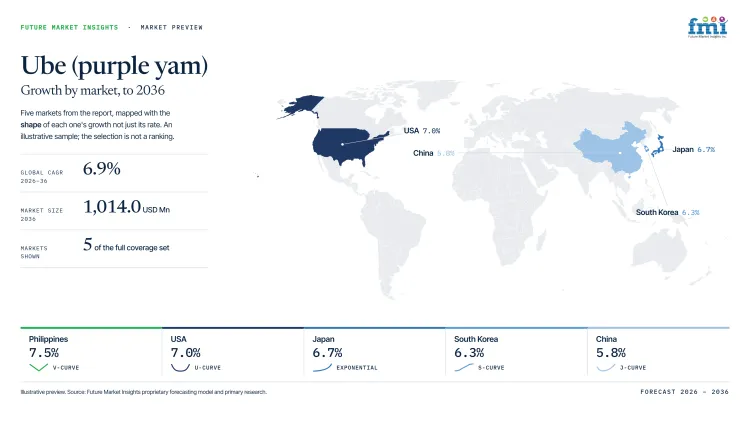
| Country | CAGR |
|---|---|
| Philippines | 7.5% |
| United States | 7.0% |
| Japan | 6.7% |
| South Korea | 6.3% |
| China | 5.8% |
| Australia | 5.4% |
How do country-level CAGRs compare in the Ube (Purple Yam) Market?
The country forecasts show a gradual progression across the ube (purple yam) market, reflecting differences in consumer familiarity, cultural consumption patterns and the commercialization of ube-based products. The Philippines and the United States form an upper group, supported by strong demand for ube in traditional and contemporary food applications. This pattern suggests that market expansion is influenced by agricultural supply and processing capabilities plus the extent to which ube has been incorporated into mainstream bakery, dairy, confectionery and beverage products.
- The Philippines benefits from its role as the traditional production and consumption center for ube, where the ingredient remains deeply integrated into local food culture and a growing range of value-added food products.
- The United States reflects strong momentum driven by the popularity of globally inspired foods and increasing incorporation of ube into desserts, beverages, bakery products and specialty retail offerings.
- Japan supports market growth through consumer interest in premium ingredients, seasonal flavors and visually distinctive food products that align well with ube's color and flavor profile.
- South Korea continues to expand demand through innovation in bakery, café and dessert categories where unique ingredients and product differentiation are important market drivers.
- China's outlook is influenced by growing exposure to international food trends and increasing adoption of specialty ingredients across modern retail and foodservice channels.
- Australia maintains steady development as multicultural food influences and demand for natural ingredients encourage the introduction of ube across premium food and beverage applications.
Similar CAGRs do not necessarily create identical market opportunities across countries. Differences in consumer awareness, supply chain access, food manufacturing capabilities and product positioning strategies can significantly influence how ube ingredients and finished products are commercialized. As a result, market entry requirements may vary considerably despite broadly comparable growth trajectories. The full report provides country-level CAGR analysis across North America, Latin America, Europe, East Asia, South Asia, Oceania and the Middle East and Africa.
Country-wise Analysis
- Philippine processors operate close to established crop knowledge and household preparation methods across domestic channels. The Philippine ube ingredient outlook is anticipated to advance at 7.5% CAGR over the assessment period, reinforced by export-ready powder production. The Philippine Information Agency reported in August 2025 that a Quirino association shipped its first one-ton ube powder order to the United States. The shipment confirms a practical export route for standardized powder beyond domestic retail and local foodservice demand. Uneven raw-material access remains a material friction across contracts that cover several crop harvest periods. Processors need agreements that define crop rejection and replacement responsibilities across farming groups and ingredient plants.
- United States foodservice chains commercialize ube through national beverage systems and centralized ingredient specifications across extensive store networks. Starbucks introduced an Iced Ube Coconut Cream Shaken Espresso across United States stores in April 2026. Ube ingredient sales in the United States are forecast to expand at 7.0% CAGR by 2036, sustained by national menu exposure. The launch created another national preparation route and broadened consumer familiarity during the spring season. Imported inputs must meet identity and storage requirements across United States natural food color applications serving commercial chains. Distributors need dependable batch records and storage guidance for recurring national orders across several seasons.
- Japanese distributors rely on processed ube to protect storage life and preparation consistency during long-distance delivery. Adoption of ube ingredients in Japan is estimated to expand at 6.7% CAGR through 2036, supported by premium seasonal applications. Commercial programs favor measured powder formats that fit seasonal recipes without fresh-root preparation across importing facilities. The Philippine Information Agency reported in April 2026 that Quirino processors shipped 1.2 tons of ube powder to Japan. Seven completed shipments and more than four tons of cumulative volume establish a repeat route for Japan natural food color programs. Importers need experienced partners that resolve storage and specification questions throughout qualification and repeat ordering.
- South Korean packaged-food companies require Korean labeling that identifies product details and raw materials across commercial packs. South Korea’s ube ingredient market is estimated to post 6.3% CAGR over the forecast period, driven by café product development. The Ministry of Food and Drug Safety amended food labeling standards in April 2025 for domestic and exported food products. The amendment permits Korean stickers for certain foreign-language export packages and clarifies detailed raw-material information. Small order volumes can raise translation and distributor costs across regional seasonal product trials and early menu programs. Commercial distributors need accurate Korean specifications that answer formulation questions without making smaller orders uneconomic.
- Chinese food manufacturers need labels that describe imported ingredients accurately across packaged products and online listings. China’s State Administration for Market Regulation issued food-labeling measures in March 2025 with effect from March 2027. The Chinese ube ingredient sector is projected to record 5.8% CAGR during the assessment period, shaped by bakery experimentation. The measures require ingredient and storage information across prepacked food labels and online sales pages. Imported ube must distinguish purple yam from familiar purple sweet potato preparations used in local recipes. Local distributors need precise Chinese ingredient names that prevent category confusion during formulation and label review.
- Australian café operators can introduce ube through established espresso and blended-drink preparation across national stores. Ube ingredient demand in Australia is forecast to rise at 5.4% CAGR over the forecast period, influenced by multicultural food demand. Long import routes favor powder or concentrate formats over fresh tubers across recurring commercial programs. Starbucks Australia introduced a multi-drink ube range from July 2025 with hot and iced macchiato or Frappuccino formats across national stores. The launch created several visible preparation routes through one standardized syrup and a common store-training system. Importers need local warehousing that protects stored products from moisture and delivery delays throughout seasonal menu cycles.
- European café programs operate across several languages and store systems that require consistent preparation instructions. Ube ingredient demand in the European Union is predicted to advance at 31.6% CAGR through 2036, aided by menu experimentation from a smaller commercial base. Fonte Drinks launched an ube specialty concentrate for European coffee bars during June 2025 for commercial café applications. The concentrate provided a measured route for lattes and other café drinks through an internationally distributed format. Regional expansion requires clear composition records and dependable distributor coverage across diverse European member-state markets. Menu developers need one formula that preserves shade and flavor across local milk choices and service equipment.
Who are the notable companies in the Ube (Purple Yam) Market?
Fonte Drinks AG, Starbucks Coffee Company, Foremost Blue Seal Co., Ltd., Top Creamery Food Manufacturing Corporation, Astoria Culinary Expert Services Corporation, KLT Fruits, Inc., Magnolia, Inc., and Aice Philippines Ice Cream Inc. are notable companies shaping this market.
-market-analysis-by-company.webp "Ube (purple Yam) Market Analysis By Company")
The competitive set spans beverage systems and processed ingredients beside finished frozen products across different commercial routes. Fonte Drinks AG and Starbucks Coffee Company place ube inside measured beverage systems that reach foodservice channels. Top Creamery and Philippine processors provide registered powders for commercial preparation and larger institutional production programs. Foremost Blue Seal Co., Ltd., Magnolia, Inc., and Aice Philippines Ice Cream Inc. convert ube into packaged frozen products. Companies therefore compete through different combinations of format control and application reach beside documented distribution access.
- Beverage systems: Fonte Drinks AG provides measured ube preparations for professional service across hot or cold menu formats. Starbucks Coffee Company validates ube through standardized seasonal drinks operating across several regional store networks. Their commercial advantage rests on preparation repeatability and visible menu exposure rather than direct control of Philippine crop supply.
- Processed ingredients: Top Creamery Food Manufacturing Corporation supports measured soft-serve preparation through a registered powder format. Astoria Culinary Expert Services Corporation and KLT Fruits, Inc. hold current registrations for institutional purple yam powders. Their formats reduce fresh-root preparation and give food manufacturers defined product identity with storage records for qualification.
- Frozen products: Foremost Blue Seal Co., Ltd. sells ube through several packaged and scoop ice cream formats in Japan. Magnolia, Inc. and Aice Philippines Ice Cream Inc. hold Philippine registrations for packaged ube ice cream. Their commercial position depends on finished-product manufacturing and retail distribution rather than ingredient support for outside processors.
Competitive Benchmarking: Ube (Purple Yam) Market
| Company | Ube Product Depth | Application Support | Commercial Format Control | Geographic Reach |
|---|---|---|---|---|
| Fonte Drinks AG | Medium | High | High | Europe and international distribution |
| Starbucks Coffee Company | High | High | High | United States, Europe, Asia Pacific, and Australia |
| Foremost Blue Seal Co., Ltd. | High | Medium | High | Japan |
| Top Creamery Food Manufacturing Corporation | Low | Medium | High | Philippines |
| Astoria Culinary Expert Services Corporation | Low | Low | Medium | Philippines |
| KLT Fruits, Inc. | Low | Low | Medium | Philippines |
| Magnolia, Inc. | Low | Low | High | Philippines and export markets |
| Aice Philippines Ice Cream Inc. | Low | Low | High | Philippines |
Key Developments in the Ube (Purple Yam) Market
- In October 2025, Foremost Blue Seal Co., Ltd. launched a limited-edition Ube Cup across supermarkets and convenience stores beside other Okinawa retailers. The packaged cup converted the company’s established ube flavor into a defined retail format outside its directly operated shops. The launch demonstrates current Japanese demand through a portioned frozen product that needs stable color and flavor during manufacturing and cold-chain distribution.
- In June 2025, Starbucks Coffee Company introduced the Crunchy Ube Oatmilk Macchiato across selected Asia Pacific markets. The beverage supported hot or iced preparation beside blended formats through one regional flavor platform and common store instructions. The launch showed that ube can serve several service styles within one campaign and standardized syrup specifications protect appearance across participating countries and retail channels.
- In July 2025, KLT Fruits, Inc. secured Philippine FDA registration for purple yam powder intended for institutional use. The raw-material registration remains valid through July 2031 and confirms a current commercial route for measured ube input. Food manufacturers can qualify the powder through defined product identity and storage records instead of relying on fresh-root preparation across scheduled production programs and recurring orders.
- In October 2025, Top Creamery Food Manufacturing Corporation secured Philippine FDA registration for Ube Flavor Soft Serve Ice Cream Powder under the Top Mix brand. The registration remains valid through October 2030 and covers a measured preparation format for commercial frozen dessert service. The powder gives operators a repeatable dosing route and limits fresh-root preparation or batch variation across soft-serve programs.
Ube (purple yam) Market - Report Scope
| Coverage field | Report scope |
|---|---|
| Market breakdown | Form, application, nature, and region. |
| Quantitative Units | Revenue in USD Million and CAGR in %. |
| Market Definition | Ube tubers and processed ube ingredients used for flavor, color, texture, or finished-product preparation across food and beverage applications. |
| Regions Covered | North America, Latin America, Western Europe, Eastern Europe, East Asia, South Asia and Pacific, and Middle East and Africa. |
| Countries Covered | Philippines, United States, Japan, South Korea, China, and Australia, with the European Union included as a regional benchmark. |
| Key Companies Profiled | Fonte Drinks AG, Starbucks Coffee Company, Foremost Blue Seal Co., Ltd., Top Creamery Food Manufacturing Corporation, Astoria Culinary Expert Services Corporation, KLT Fruits, Inc., Magnolia, Inc., and Aice Philippines Ice Cream Inc. |
| Forecast Period | 2026 to 2036. |
| Approach | Hybrid bottom-up and top-down market sizing supported by primary interviews and official desk research. |
Ube (purple yam) Market - Research Methodology
| Method | Approach |
|---|---|
| Primary Research | FMI analysts gathered input from manufacturers, service providers, technology developers, distributors, end users, procurement teams, and subject-matter experts. Interviews examined purchasing decisions, product or service evaluation, adoption barriers, approval requirements, pricing considerations, and expectations for technical or commercial support. Respondents were also asked what evidence is required before a trial, pilot, or initial order develops into regular purchasing. |
| Desk Research | Desk research covered government statistics, regulatory publications, trade data, industry associations, technical literature, standards, company filings, product information, and official corporate announcements. Sources were reviewed for relevance, publication date, geographic coverage, and consistency with the defined market scope. Claims relating to performance, applications, approvals, capacity, investment, and commercial activity were retained only when supported by credible public evidence. |
| Market Sizing and Forecasting | The market model combined the baseline value with historical performance, segment structure, pricing and volume indicators, adoption levels, company participation, and country-level demand conditions. Forecast assumptions considered economic activity, investment trends, regulatory developments, technology adoption, purchasing cycles, supply availability, and barriers to wider market use. Segment and regional estimates were reconciled before the final market total was calculated. |
| Data Validation | Estimates were checked against multiple independent indicators, including public data, company activity, trade patterns, industry developments, and findings from primary interviews. Validation also tested whether products, services, applications, and company revenues fell within the defined market boundaries. Adjacent categories, unsupported claims, overlapping revenues, and activities without direct market relevance were excluded to reduce double counting and maintain consistency across segments and countries. |
Ube (Purple Yam) Market by Segments
Ube (Purple Yam) Market segmented by Form:
- Fresh - Whole
- Powder
- Puree
- Extract
Ube (Purple Yam) Market segmented by Application:
- Bakery & Dessert
- Beverage
- Confectionery
- Frozen Dessert
Ube (Purple Yam) Market segmented by Nature:
- Natural Color & Flavor
- Synthetic-blend Alternatives
Ube (Purple Yam) Market by Region:
- North America
- United States
- Canada
- Latin America
- Brazil
- Mexico
- Argentina
- Chile
- Western Europe
- Germany
- France
- United Kingdom
- Italy
- Spain
- Benelux
- Nordics
- Eastern Europe
- Poland
- Czech Republic
- Romania
- Hungary
- East Asia
- China
- Japan
- South Korea
- South Asia and Pacific
- India
- ASEAN
- Australia and New Zealand
- Middle East and Africa
- GCC Countries
- South Africa
- Türkiye
- Israel
Research Sources and Bibliography
- Department of Agriculture. (2026, July 5). DA maps export-driven roadmap for Philippine ube industry growth.
- Starbucks Coffee Company. (2026, March 2). Starbucks spring menu arrives with new chai, ube and coconut drinks plus the return of lavender favorites.
- Department of Agriculture. (2026, June 23). Ube industry gets boost as DA-BPI distributes 60,000 planting materials.
- Philippine Food and Drug Administration. (2025, October 22). Ube halaya sweet purple yam jam (FR-4000015215668).
- Philippine Food and Drug Administration. (2025, February 3). 100% purple yam ube powder (FR-4000014055014).
- Starbucks Coffee Company. (2026, March 6). Purple Reign: Ube is this year’s taste (and colour) of spring.
- Philippine Statistics Authority CALABARZON. (2026, April 27). Vegetable and Root Crops Production Statistics in Cavite: 4th Quarter 2025.
- Department of Agriculture - Special Area for Agricultural Development. (2026, July 14). DA-SAAD, LGU Alburquerque hold value-adding training, strengthens ube industry.
- Philippine Information Agency. (2025, August 21). Quirino province’s ube powder hits USA market.
- Starbucks Coffee Company. (2026, April 6). Starbucks introduces new Energy Refreshers nationwide on Apr. 7.
- Philippine Information Agency. (2026, April 22). DTI: Quirino’s latest ube powder exports to Japan hit 1.2 tons.
- Ministry of Food and Drug Safety. (2025, April 21). [Partial amendment to food labeling standards].
- State Administration for Market Regulation. (2025, March 26). [Measures for Supervision and Administration of Food Labeling].
- Starbucks Australia. (2025, July 1). Ube: What is it and why is everyone so obsessed?
- Fonte Drinks AG. (2025, June 18). Fonte Drinks Launches First-Ever Ube Specialty Concentrate for Coffee Bars Across Europe.
- Foremost Blue Seal Co., Ltd. (2025, October 10). [Limited-edition Blue Seal Cup Ube].
- Starbucks Coffee Company. (2025, June 3). Keep the good times rolling with Starbucks brand new summer beverages.
- Philippine Food and Drug Administration. (2025, July 11). Purple yam powder (ube powder) for institutional use (FR-4000014714050).
- Philippine Food and Drug Administration. (2025, October 9). Ube flavor soft serve ice cream powder (FR-4000015048547).
- Philippine Food and Drug Administration. (2025, February 26). Ube Classic ube flavored ice cream (FR-4000013681793).
- Philippine Food and Drug Administration. (2025, August 29). Ube Keso ice cream for export (FR-4000015047300).
This bibliography is provided for reader reference and is not exhaustive. The full report contains the complete reference list and detailed citations
This Report Answers
- How large is the ube (purple yam) market in 2026 and 2036?
- Which operating conditions support demand for ube across bakery and dessert applications?
- Why does bakery & dessert account for the largest application share in 2026?
- How do fresh - whole and processed ube formats differ across commercial handling routes?
- Why does natural color & flavor remain central to ube ingredient positioning?
- How do country growth rates differ across the Philippines, United States, East Asia, Australia, and the European Union?
- Which companies provide ube powders, concentrates, frozen desserts, or regional foodservice products?
- What limits dependable color and flavor performance across crop seasons and processing methods?
- How can standardized powders and concentrates support longer international distribution routes?
Frequently Asked Questions
How big is the Ube (Purple Yam) Market in 2026?
The ube (purple yam) market is valued at USD 520.3 million in 2026 and is forecast to reach USD 1,014.0 million by 2036. Growth is supported by rising demand for natural color and flavor ingredients, expanding international menu adoption across foodservice channels, and improvements in supply consistency and product standardization across Philippine export programs.
What is the CAGR of the Ube (Purple Yam) Market from 2026 to 2036?
The ube (purple yam) market grows at a CAGR of 6.9% between 2026 and 2036, supported by international foodservice menu launches, shelf-stable powder and concentrate development, and growing demand for plant-derived color and flavor ingredients across bakery, dessert, beverage, and frozen dessert applications in key commercial markets.
Which application segment leads the Ube (Purple Yam) Market?
Bakery and dessert applications account for 29.6% of the ube (purple yam) market by application in 2026, driven by broad use across cakes, sweet fillings, and frozen desserts. Shelf-stable processed formats reduce fresh-root preparation, support measured recipe development, and protect batch consistency across recurring commercial production schedules using existing equipment.
Which nature segment leads the Ube (Purple Yam) Market?
Natural color and flavor accounts for 67.0% of the ube (purple yam) market by nature in 2026, attributable to demand for recognizable plant origin and combined sensory performance across commercial recipes. Commercial approval depends on verified ingredient declarations and comparable purple appearance across every validated production condition and finished-product shelf life.
Who are the leading companies in the Ube (Purple Yam) Market?
Eight companies shape the ube (purple yam) market, including Fonte Drinks AG, Starbucks Coffee Company, Foremost Blue Seal Co., Ltd., Top Creamery Food Manufacturing Corporation, Astoria Culinary Expert Services Corporation, KLT Fruits, Inc., Magnolia, Inc., and Aice Philippines Ice Cream Inc., competing through beverage systems, registered ingredient powders, and packaged frozen desserts across foodservice and retail channels worldwide.
Preview the report firsthand - request a free sample
Get SampleGet the brochure for pricing and purchase details.
Get PDFTable of Content
- Key Takeaways
- Market Size and CAGR
- Top Growth Driver
- Fastest Growing Segment
- Leading Region
- Key Companies
- Emerging Opportunities
- Executive Summary
- Global Market Outlook
- Demand-side Trends
- Supply-side Trends
- Technology Roadmap Analysis
- Analysis and Recommendations
- Analyst Perspective (What is happening? Why now? What should investors know?)
- Key Questions Answered
- How large is the market?
- What is the CAGR?
- What are key trends?
- Which region dominates?
- Who are the leaders?
- Market Overview
- Market Coverage / Taxonomy
- Market Definition / Scope / Limitations
- Research Methodology
- Chapter Orientation
- Analytical Lens and Working Hypotheses
- Market Structure, Signals, and Trend Drivers
- Benchmarking and Cross-market Comparability
- Market Sizing, Forecasting, and Opportunity Mapping
- Research Design and Evidence Framework
- Desk Research Programme (Secondary Evidence)
- Expert Input and Fieldwork (Primary Evidence)
- Tooling, Models, and Reference Databases
- Data Engineering and Model Build
- Quality Assurance and Audit Trail
- Market Background
- Market Dynamics (Drivers, Restraints, Opportunity, Trends)
- Scenario Forecast (Optimistic, Likely, Conservative)
- Impact Analysis
- AI Impact
- Sustainability Impact
- Regulatory Impact
- Technology Impact
- Consumer / Buyer Analysis
- Purchase Drivers
- Adoption Barriers
- Buyer Journey
- Opportunity Map Analysis
- Product Life Cycle Analysis
- Supply Chain Analysis
- Investment Feasibility Matrix
- Value Chain Analysis
- PESTLE and Porter's Analysis
- Regulatory Landscape
- Regional Parent Market Outlook
- Production and Consumption Statistics
- Import and Export Statistics
- Global Market Analysis and Forecast, 2021 to 2036
- Historical Market Size Value (USD Million) Analysis, 2021 to 2025
- Current and Future Market Size Value (USD Million) Projections, 2026 to 2036
- Y-o-Y Growth Trend Analysis
- Absolute $ Opportunity Analysis
- Global Market Pricing Analysis, 2021 to 2036
- Global Market Analysis and Forecast, By Form, 2021 to 2036
- Introduction / Key Findings
- Historical Market Size Value (USD Million) Analysis By Form, 2021 to 2025
- Current and Future Market Size Value (USD Million) Analysis and Forecast By Form, 2026 to 2036
- Fresh / Whole
- Powder
- Puree
- Extract
- Fresh / Whole
- Y-o-Y Growth Trend Analysis By Form, 2021 to 2025
- Absolute $ Opportunity Analysis By Form, 2026 to 2036
- Global Market Analysis and Forecast, By Application, 2021 to 2036
- Introduction / Key Findings
- Historical Market Size Value (USD Million) Analysis By Application, 2021 to 2025
- Current and Future Market Size Value (USD Million) Analysis and Forecast By Application, 2026 to 2036
- Bakery & Dessert
- Beverage
- Confectionery
- Frozen Dessert
- Bakery & Dessert
- Y-o-Y Growth Trend Analysis By Application, 2021 to 2025
- Absolute $ Opportunity Analysis By Application, 2026 to 2036
- Global Market Analysis and Forecast, By Nature, 2021 to 2036
- Introduction / Key Findings
- Historical Market Size Value (USD Million) Analysis By Nature, 2021 to 2025
- Current and Future Market Size Value (USD Million) Analysis and Forecast By Nature, 2026 to 2036
- Natural Colour & Flavour
- Synthetic-blend Alternatives
- Natural Colour & Flavour
- Y-o-Y Growth Trend Analysis By Nature, 2021 to 2025
- Absolute $ Opportunity Analysis By Nature, 2026 to 2036
- Global Market Analysis and Forecast, By Region, 2021 to 2036
- Introduction
- Historical Market Size Value (USD Million) Analysis By Region, 2021 to 2025
- Current Market Size Value (USD Million) Analysis and Forecast By Region, 2026 to 2036
- North America
- Latin America
- Western Europe
- Eastern Europe
- East Asia
- South Asia and Pacific
- Middle East & Africa
- Market Attractiveness Analysis By Region
- North America Market Analysis and Forecast, By Country, 2021 to 2036
- Historical Market Size Value (USD Million) Trend Analysis By Market Taxonomy, 2021 to 2025
- Market Size Value (USD Million) Forecast By Market Taxonomy, 2026 to 2036
- By Country
- USA
- Canada
- By Form
- By Application
- By Nature
- By Country
- Market Attractiveness Analysis
- By Country
- By Form
- By Application
- By Nature
- Key Takeaways
- Latin America Market Analysis and Forecast, By Country
- Historical Market Size Value (USD Million) Trend Analysis By Market Taxonomy, 2021 to 2025
- Market Size Value (USD Million) Forecast By Market Taxonomy, 2026 to 2036
- By Country
- Brazil
- Mexico
- Chile
- Rest of Latin America
- By Form
- By Application
- By Nature
- By Country
- Market Attractiveness Analysis
- By Country
- By Form
- By Application
- By Nature
- Key Takeaways
- Western Europe Market Analysis and Forecast, By Country
- Historical Market Size Value (USD Million) Trend Analysis By Market Taxonomy, 2021 to 2025
- Market Size Value (USD Million) Forecast By Market Taxonomy, 2026 to 2036
- By Country
- Germany
- UK
- Italy
- Spain
- France
- Nordic
- BENELUX
- Rest of Western Europe
- By Form
- By Application
- By Nature
- By Country
- Market Attractiveness Analysis
- By Country
- By Form
- By Application
- By Nature
- Key Takeaways
- Eastern Europe Market Analysis and Forecast, By Country
- Historical Market Size Value (USD Million) Trend Analysis By Market Taxonomy, 2021 to 2025
- Market Size Value (USD Million) Forecast By Market Taxonomy, 2026 to 2036
- By Country
- Russia
- Poland
- Hungary
- Balkan & Baltic
- Rest of Eastern Europe
- By Form
- By Application
- By Nature
- By Country
- Market Attractiveness Analysis
- By Country
- By Form
- By Application
- By Nature
- Key Takeaways
- East Asia Market Analysis and Forecast, By Country
- Historical Market Size Value (USD Million) Trend Analysis By Market Taxonomy, 2021 to 2025
- Market Size Value (USD Million) Forecast By Market Taxonomy, 2026 to 2036
- By Country
- China
- Japan
- South Korea
- By Form
- By Application
- By Nature
- By Country
- Market Attractiveness Analysis
- By Country
- By Form
- By Application
- By Nature
- Key Takeaways
- South Asia and Pacific Market Analysis and Forecast, By Country
- Historical Market Size Value (USD Million) Trend Analysis By Market Taxonomy, 2021 to 2025
- Market Size Value (USD Million) Forecast By Market Taxonomy, 2026 to 2036
- By Country
- India
- ASEAN
- Australia & New Zealand
- Rest of South Asia and Pacific
- By Form
- By Application
- By Nature
- By Country
- Market Attractiveness Analysis
- By Country
- By Form
- By Application
- By Nature
- Key Takeaways
- Middle East & Africa Market Analysis and Forecast, By Country
- Historical Market Size Value (USD Million) Trend Analysis By Market Taxonomy, 2021 to 2025
- Market Size Value (USD Million) Forecast By Market Taxonomy, 2026 to 2036
- By Country
- Kingdom of Saudi Arabia
- Other GCC Countries
- Türkiye
- South Africa
- Other African Union
- Rest of Middle East & Africa
- By Form
- By Application
- By Nature
- By Country
- Market Attractiveness Analysis
- By Country
- By Form
- By Application
- By Nature
- Key Takeaways
- Key Countries Market Analysis
- USA
- Pricing Analysis
- Market Share Analysis, 2025
- By Form
- By Application
- By Nature
- Canada
- Pricing Analysis
- Market Share Analysis, 2025
- By Form
- By Application
- By Nature
- Mexico
- Pricing Analysis
- Market Share Analysis, 2025
- By Form
- By Application
- By Nature
- Brazil
- Pricing Analysis
- Market Share Analysis, 2025
- By Form
- By Application
- By Nature
- Chile
- Pricing Analysis
- Market Share Analysis, 2025
- By Form
- By Application
- By Nature
- Germany
- Pricing Analysis
- Market Share Analysis, 2025
- By Form
- By Application
- By Nature
- UK
- Pricing Analysis
- Market Share Analysis, 2025
- By Form
- By Application
- By Nature
- Italy
- Pricing Analysis
- Market Share Analysis, 2025
- By Form
- By Application
- By Nature
- Spain
- Pricing Analysis
- Market Share Analysis, 2025
- By Form
- By Application
- By Nature
- France
- Pricing Analysis
- Market Share Analysis, 2025
- By Form
- By Application
- By Nature
- India
- Pricing Analysis
- Market Share Analysis, 2025
- By Form
- By Application
- By Nature
- ASEAN
- Pricing Analysis
- Market Share Analysis, 2025
- By Form
- By Application
- By Nature
- Australia & New Zealand
- Pricing Analysis
- Market Share Analysis, 2025
- By Form
- By Application
- By Nature
- China
- Pricing Analysis
- Market Share Analysis, 2025
- By Form
- By Application
- By Nature
- Japan
- Pricing Analysis
- Market Share Analysis, 2025
- By Form
- By Application
- By Nature
- South Korea
- Pricing Analysis
- Market Share Analysis, 2025
- By Form
- By Application
- By Nature
- Russia
- Pricing Analysis
- Market Share Analysis, 2025
- By Form
- By Application
- By Nature
- Poland
- Pricing Analysis
- Market Share Analysis, 2025
- By Form
- By Application
- By Nature
- Hungary
- Pricing Analysis
- Market Share Analysis, 2025
- By Form
- By Application
- By Nature
- Kingdom of Saudi Arabia
- Pricing Analysis
- Market Share Analysis, 2025
- By Form
- By Application
- By Nature
- Türkiye
- Pricing Analysis
- Market Share Analysis, 2025
- By Form
- By Application
- By Nature
- South Africa
- Pricing Analysis
- Market Share Analysis, 2025
- By Form
- By Application
- By Nature
- USA
- Market Structure Analysis
- Competition Dashboard
- Competition Benchmarking
- Market Share Analysis of Top Players
- By Regional
- By Form
- By Application
- By Nature
- Emerging Startups
- Innovation Benchmarking
- Competition Analysis
- Competition Deep Dive
- Monin
- Overview
- Product Portfolio
- Profitability by Market Segments
- Sales Footprint
- Strategy Overview
- Marketing Strategy
- Product Strategy
- Channel Strategy
- McCormick & Company
- Gem Foods International
- Hamburg Trading Corporation
- Conti's
- Suncore Foods
- Monin
- Case Studies
- Success Stories
- Recent Developments
- Competition Deep Dive
- Assumptions & Acronyms Used


