

- Market Size (2026)
- USD 61.1 Mn
- Forecast (2036)
- USD 165.8 Mn
- CAGR (2026 to 2036)
- 10.5%
How big is Yacon (syrup) Market in 2026?
USD 61.1 million in 2026 and USD 165.8 million by 2036 at a 10.5% CAGR.
Demand for yacon syrup is projected to expand at 10.5% CAGR between 2026 and 2036, increasing valuation from USD 61.1 million in 2026 to USD 165.8 million by 2036. Commercial interest centers on formulations that combine botanical sweetness with measurable prebiotic ingredients and controlled serving quantities. An August 2025 Clinical Nutrition Open Science trial administered yacon syrup with meals through a defined intervention schedule. The study supports repeatable dosing analysis but does not establish commercial adoption or permitted finished-product claims. Food developers comparing naturally derived sweeteners therefore need composition specifications and regulatory review before consumer positioning reaches packaging or promotional materials.
United States brands enter a large certified-organic channel but must justify yacon syrup against products with broader distribution and lower landed costs. Japanese formulation teams place greater weight on documented import status and controlled lot consistency across premium functional foods. The Organic Trade Association reported in March 2026 that United States certified-organic sales reached USD 76.6 billion during 2025. The channel provides shelf access for low-calorie sweeteners without proving automatic demand for a less familiar Andean syrup. Smaller Japanese orders can raise freight and documentation costs per unit across specialist distribution routes. Expansion in both countries depends on local inventory and application support that reduces qualification risk for food manufacturers.
-market-value-analysis.webp "Yacon (syrup) Market Value Analysis")
Key Takeaways of Yacon (syrup) Market
- Food manufacturers evaluate yacon syrup for botanical sweetness and fructooligosaccharide content across products that can absorb its distinct flavor and ingredient cost.
- By nature, organic is expected to account for 40.0% in 2026 through documented sourcing that supports certified product ranges and retailer reviews.
- Liquid - syrup is projected to represent 49.5% in 2026 due to direct dosing within beverages and prepared food systems.
- Food and beverage applications are estimated to account for 65.4% share in 2026, reflecting wider formulation coverage than supplement or pharmaceutical uses.
- Harvest concentration and certification requirements restrict substitution across large orders that require predictable delivery and consistent lot specifications.
- RCT FOOD SAS, Peruvian Nature, The Yacon Company, Abbott Blackstone International, AcanChia UG & Co. KG, VehGro B.V., Andean Roots, and ECOANDINO S.A.C. compete through different combinations of origin control and format support.
Analyst Perspective
"Yacon syrup can differentiate premium foods through botanical sweetness and a prebiotic ingredient story, yet its commercial case depends on more than consumer positioning. Manufacturers need lot-level composition data and dependable organic documentation before they scale a formulation commercially. Processors that combine rapid root handling with practical application support are better placed to turn small trials into repeat orders without weakening label accuracy or production consistency."
- Nandini Roy Choudhury, Principal Analyst, Future Market Insights
How is the Yacon (syrup) Market segmented?
The yacon (syrup) market is segmented by nature, form, application, and region.
The yacon syrup market is segmented by nature, form, application, and region to separate four distinct commercial decisions. Nature distinguishes certified organic sourcing from conventional supply through documentation requirements and the pricing attached to verified agricultural practices. Form compares liquid syrup with powder and capsules according to dosing methods, storage needs, production handling, and finished-product delivery. Application analysis separates food and beverage formulations from nutraceutical and pharmaceutical uses through different quality controls, dosage formats, and claim requirements. Regional analysis examines cultivation access and import controls alongside distributor coverage for sugar-free syrups entering distant manufacturing markets. The structure places prebiotic fiber within specific application needs and avoids treating one functional property as a separate commercial segment.
What supports food and beverage demand within the application category?
-market-analysis-by-application.webp "Yacon (syrup) Market Analysis By Application")
Food and beverage applications give yacon several commercial entry points across bakery products and snack bars alongside selected beverages. Manufacturers can test sweetness and binding performance through familiar processing equipment without creating a separate production line. Commercial evaluation must separate technical feasibility from consumer acceptance and permitted nutrition claims across each intended product. Yacon composition and flavor interact differently with moisture and heat, so each formulation needs a separate shelf-life study.
- Food and beverage is projected to hold 65.4% share in 2026 owing to wider formulation coverage than nutraceutical or pharmaceutical uses. A November 2025 Applied Food Research study evaluated yacon in an oatmeal energy bar and identified a preferred oats-to-yacon powder ratio. The result supports product-development feasibility but does not establish retail demand or equivalent syrup performance across every recipe.
- Product developers introduce yacon through controlled bakery and snack trials that use existing processing equipment. Early tests compare sweetness and texture with ingredient cost before a wider product range receives approval. Stable lots and practical guidance from nutritive sweeteners specialists improve the likelihood of commercial approval. Successful trials must preserve the intended sensory profile across the stated shelf life under realistic packaging and storage conditions.
Why does organic lead the nature category?
Organic yacon requires an auditable chain from Peruvian cultivation through importer release and final distribution. The European Commission confirmed in January 2025 that selected organic imports faced additional controls during that year. Every imported organic product also requires an electronic certificate of inspection through the European Union TRACES system. The documentation protects certified positioning but adds work across smaller consignments and multi-party distribution routes.
- By nature, organic is estimated to hold 40.0% in 2026 owing to certified origin records that support label and retailer requirements. The position reflects the commercial value of traceable sourcing across premium ranges rather than proof that certification creates consumer demand. Manufacturers must retain certificate continuity across recurring orders and any change in packer or importer.
- Premium food brands use organic yacon syrup to align ingredient sourcing with wider certified product ranges. Importers must verify each consignment and maintain records that connect the processor with the final packed product. Reliable documentation therefore shapes repeat purchasing separately from sweetness and texture performance during formulation trials. Limited certified supply can extend replacement approval whenever large formulation programs need alternative origins or packers.
How is liquid - syrup positioned within the form category?
Liquid yacon enters mixers and dosing systems without milling or capsule-filling equipment during food production. The format supports direct dispersion across beverages and prepared foods through established wet-processing routines at commercial production scale. Manufacturers must control solids content and storage conditions so the selected dose remains consistent across production batches. Teams comparing low-intensity sweeteners assess handling convenience alongside composition controls and shelf stability during supplier qualification.
- The form category is forecast to be led by liquid - syrup at 49.5% in 2026 due to direct dosing across wet formulations. The format reduces preparation steps compared with powder rehydration or capsule filling across food plants. Its commercial position depends on handling convenience and dependable storage performance rather than a universal advantage across every application.
- A December 2025 Journal of Food Composition and Analysis study found that processing concentrated fructooligosaccharides in yacon syrup. The research also showed that environmental and postharvest conditions changed composition across products from two Peruvian regions. Beverage and bakery teams therefore need detailed lot specifications before they use syrup in repeat production. Powder and capsule formats remain useful for dry blending or portioned supplements with separate equipment needs.
What are the drivers, restraints, and opportunities in the Yacon (syrup) Market?
Sugar-reduction formulation supports demand, postharvest composition restricts consistency, and technical standards create a clearer commercial qualification route.
- Driver: Food manufacturers need botanical sweeteners that combine useful processing performance with a differentiated fructooligosaccharide profile.
- Restraint: Delayed root processing changes fructooligosaccharide composition and raises specification risk across imported syrup lots.
- Opportunity: Clear technical standards can reduce specification disputes and improve qualification between Peruvian processors and overseas food manufacturers.
Food manufacturers drive demand through products that need differentiated sugar substitutes with a measurable fructooligosaccharide profile. The ingredient earns further attention across premium foods that can accommodate its flavor and higher landed cost. A March 2025 Nutrients review assessed recent human evidence on yacon syrup and identified a defined research base across metabolic and intestinal outcomes. The review does not prove commercial adoption, but it gives product teams a stronger basis for deciding which claims and serving levels require further validation.
Fructooligosaccharides begin changing soon following harvest, which makes postharvest handling a material restraint for processors. International Potato Center research found that storage and sun exposure reduced fructooligosaccharide concentrations as free sugars increased. The foundational evidence explains why processors need rapid conversion and controlled storage near cultivation areas. Importers should require production dates and detailed lot testing so commercial functional specifications remain defensible across repeated purchases and extended international distribution routes.
Technical standards create a practical opening for processors that can document composition and handling in a consistent commercial specification. The route helps overseas manufacturers compare yacon with agave syrup through defined tests instead of broad substitution claims. Peru’s National Institute of Quality reported in June 2025 that national standards covered yacon syrup specifications alongside root classification and dried leaves. Commercial gains depend on processors converting those standards into current certificates and responsive technical support for each customer application.
Which country CAGRs are profiled in the Yacon (syrup) Market?
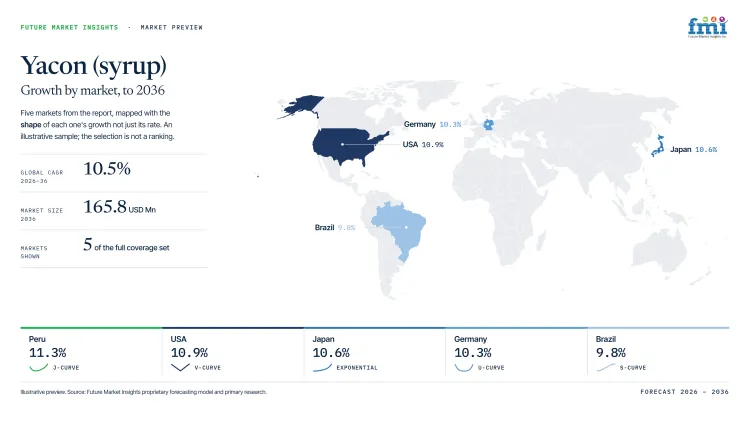
| Country | CAGR |
|---|---|
| Peru | 11.3% |
| United States | 10.9% |
| Japan | 10.6% |
| Germany | 10.3% |
| Brazil | 9.8% |
| United Kingdom | 9.5% |
How do country-level CAGRs compare in the Yacon (syrup) Market?
The country forecasts remain closely grouped across the yacon (syrup) market, indicating that demand is being supported by similar health and wellness trends across both producer and consumer markets. Peru, the United States, Japan and Germany are separated by only modest differences, suggesting relatively broad alignment in the adoption of natural sweetening ingredients. Brazil and the United Kingdom follow within the same overall range, creating a gradual progression rather than distinct growth tiers. The limited spread across the comparison points to expanding interest in low-glycemic sweeteners and functional food ingredients rather than a market concentrated in a few geographies.
- Peru benefits from its position as a primary source of yacon cultivation, supporting ingredient availability and continued development of value-added yacon syrup products for domestic and export markets.
- The United States reflects growing demand for natural sweeteners and functional ingredients as food manufacturers expand clean-label and better-for-you product offerings.
- Japan continues to support market growth through established consumer interest in digestive wellness ingredients and foods positioned around health and nutritional functionality.
- Germany's outlook is influenced by demand for natural sugar alternatives and increasing incorporation of specialty ingredients into functional food and nutritional product formulations.
- Brazil benefits from rising awareness of healthier sweetening options and growing use of plant-derived ingredients across food and beverage applications.
- The United Kingdom maintains steady momentum as consumers increasingly seek products with reduced sugar content and naturally derived ingredient profiles.
Similar CAGRs do not necessarily translate into identical market opportunities. Differences in consumer awareness, regulatory treatment of health claims, distribution networks and product positioning strategies can significantly influence how yacon syrup is commercialized across countries. The full report provides country-level CAGR analysis across North America, Latin America, Europe, East Asia, South Asia, Oceania and the Middle East and Africa.
Country-wise Analysis
- Peruvian processors work near the crop base and can shorten the interval between harvest and root conversion. Peru's yacon syrup outlook is anticipated to advance at 11.3% CAGR over the assessment period, supported by local crop access and processing knowledge. An August 2025 INIA repository record documented 214 Peruvian yacon accessions with measurable phenotypic differences. The diversity gives processors a broad agricultural base but also increases the need for cultivar and lot controls. Fragmented farm supply remains a material friction for plants that require predictable harvest volumes and consistent postharvest handling. Commercial expansion depends on coordinated farm collection and rapid root processing near the main cultivation areas.
- United States importers must connect each certified organic shipment with an electronic NOP Import Certificate for commercial entry. Adoption of yacon syrup in the United States is estimated to expand at 10.9% CAGR through 2036, reinforced by specialist organic channels and established import infrastructure. The certificate route preserves traceability across every exporter and importer relationship throughout the commercial supply chain. USDA confirmed in June 2026 that every certified organic shipment entering the country requires an electronic import certificate. Landed cost and low consumer familiarity remain material frictions outside premium food or specialist wellness channels. Distributors need sufficient local inventory to absorb customs delays across recurring food-manufacturing schedules without interrupting production.
- Japanese organic food channels combine strict certification with small-lot distribution across premium retail and functional product categories. The Ministry of Agriculture reported in December 2025 that more than 150 municipalities were developing organic production areas. In Japan yacon syrup demand is predicted to advance at 10.6% CAGR through 2036, influenced by premium positioning and organized retail access. The same ministry stated that organic JAS-certified farmland had more than doubled during the preceding ten years. Importers can improve access through consolidated orders and clear Japanese-language technical documents for local formulation teams. Small shipment economics and limited consumer familiarity restrict broader placement across value-oriented packaged food retail.
- German ingredient channels benefit from established organic retailers and specialist wholesalers serving major food-manufacturing regions nationwide. The German yacon syrup sector is projected to record 10.3% CAGR during the assessment period, underpinned by certified demand and importer experience. BÖLW reported in February 2026 that German organic food sales increased by 6.7% during 2025. The association also described constrained domestic supply across several parts of the certified organic sector during the same period. Importers can place documented botanical sweeteners within premium product ranges through local wholesale coverage and technical support. Competition from familiar syrups and limited yacon awareness restrict broader use across mainstream formulations that carry strict cost targets.
- Brazilian organic trade uses a national register to identify certified producers and participating control organisations across the country. The agriculture ministry updated the registry history in July 2026 and retained public access to annual operator records. Yacon syrup sales in Brazil are forecast to expand at 9.8% CAGR by 2036, shaped by traceability infrastructure and selective health-food demand. The register gives distributors a formal starting point for checking current organic status across domestic relationships. Long internal transport distances and uneven specialist retail coverage restrict access outside Brazil's largest urban markets. Regional inventory and dependable storage practices become necessary for repeat orders across distant manufacturing locations.
- United Kingdom retailers provide a recognized certified route through supermarkets and specialist stores serving premium food categories. Yacon syrup demand in the United Kingdom is forecast to rise at 9.5% CAGR over the forecast period, supported by organic retail growth and imported ingredient availability. The channel gives differentiated sweeteners a defined shelf route across premium food and wellness products. Soil Association Certification reported in July 2025 that United Kingdom organic value sales increased 7.3% during 2024. Import dependence and limited consumer familiarity restrict broader use across mainstream products with strict cost targets. Distributors should offer pack sizes and application support that fit smaller recurring manufacturing orders efficiently.
Who are the notable companies in the Yacon (syrup) Market?
RCT FOOD SAS, Peruvian Nature, The Yacon Company, Abbott Blackstone International, AcanChia UG & Co. KG, VehGro B.V., Andean Roots, and ECOANDINO S.A.C. are notable companies profiled in this market.
-market-analysis-by-company.webp "Yacon (syrup) Market Analysis By Company")
Competition combines Peruvian processors with European importers and specialist formulation partners that serve different qualification needs. RCT FOOD SAS connects Yacon&co products with Peruvian production and French packing for branded retail distribution. Peruvian Nature offers yacon ingredients with certification, traceability, and application services for international food manufacturers. The Yacon Company coordinates more than 100 certified farmers with its own processing facility and trained distributor network. Abbott Blackstone International and VehGro B.V. provide European bulk access, while AcanChia UG & Co. KG adds multiple formats and private-label support. Andean Roots and ECOANDINO S.A.C. retain direct Peruvian cultivation or processing links within the broader sweetener category.
- RCT FOOD SAS and Peruvian Nature connect Peruvian production with branded or business-to-business channels across importing countries. RCT FOOD SAS controls Yacon&co syrup production through its Peruvian factory and French packing route. Peruvian Nature offers syrup and powder formats with traceability and technical services for international formulation programs. Their distinction separates branded retail reach from broader ingredient processing and application-service capabilities across international accounts.
- Andean Roots and ECOANDINO S.A.C. combine cultivation relationships with established Peruvian processing infrastructure for commercial yacon products. Andean Roots operates yacon acreage in Huánuco and offers finished syrup through retail and export channels. ECOANDINO S.A.C. processes certified organic yacon products through its Junín facility for national and international customers. Both companies offer stronger origin proximity than import-led wholesalers serving distant European food-manufacturing and retail customers.
- Abbott Blackstone International and VehGro B.V. focus on European bulk access across certified ingredient channels. AcanChia UG & Co. KG combines yacon syrup with powder and private-label routes across several countries. The Yacon Company adds vertically integrated sourcing and formulation support through a trained distributor network. Company selection depends on certification continuity and verified format availability along with technical response times.
Competitive Benchmarking: Yacon (syrup) Market
| Company | Sourcing & Origin Access | Organic Certification Depth | Channel & Format Breadth | Geographic Reach |
|---|---|---|---|---|
| RCT FOOD SAS | High | Medium | High | Peru and Europe |
| Peruvian Nature | High | High | High | Peru and international markets |
| The Yacon Company | High | High | High | Peru and international markets |
| Abbott Blackstone International | Medium | High | Medium | Europe |
| AcanChia UG & Co. KG | High | High | High | Europe and Asia |
| VehGro B.V. | Medium | High | Medium | Europe |
| Andean Roots | High | High | Medium | Peru and export markets |
| ECOANDINO S.A.C. | High | High | Medium | Peru and international markets |
Key Developments in the Yacon (syrup) Market
- In March 2025, Abbott Blackstone International added organic yacon syrup through a long-standing Peruvian producer relationship. The company documented 5-litre jugs along with 25-kilogram canisters and 200-kilogram barrels for different customer volumes. The expansion improved European bulk access and gave manufacturers several order sizes for trials or repeat production. The announcement did not establish ownership of cultivation or processing assets within the Peruvian supply chain.
- In April 2025, Peruvian Nature presented yacon syrup at Natural Products Expo West with ingredient samples and customized formulation support. The company positioned the syrup for food and beverage products alongside supplements and functional nutrition. The event created a direct sample route for North American product-development teams evaluating new formulations. Purchase decisions remain subject to customer testing for dosage and texture alongside documented shelf-life performance.
- In April 2025, Peruvian Nature showcased certified yacon powder at Biofach with full traceability and technical support for European brands and distributors. The presentation extended its yacon route beyond liquid syrup through a format suited to dry blends and supplements. Commercial value came from combining recognized certification with direct application guidance for overseas formulation teams. European customers must compare powder and syrup through separate requirements for dosage and handling across storage conditions.
- In November 2025, Peruvian Nature described investments in spray drying and standardized processing for ready-to-formulate Peruvian superfood ingredients including yacon powder. The company connected the program with traceability and technical documentation for international food and supplement manufacturers. The development improved commercial readiness for stable dry formats without proving demand across every application. Manufacturers must validate composition and processing performance within each intended finished-product formulation before commercial approval.
Yacon (syrup) Market - Report Scope
| Coverage field | Report scope |
|---|---|
| Market breakdown | Nature, form, application, and region. |
| Quantitative Units | Revene in USD Million and CAGR in %. |
| Market Definition | Commercial yacon syrup and related powder or capsule formats sold for food, nutraceutical, and pharmaceutical applications. |
| Regions Covered | North America, Latin America, Western Europe, East Asia, South Asia and Pacific, and Middle East and Africa. |
| Countries Covered | Peru, United States, Japan, Germany, Brazil, and United Kingdom. |
| Key Companies Profiled | RCT FOOD SAS, Peruvian Nature, The Yacon Company, Abbott Blackstone International, AcanChia UG & Co. KG, VehGro B.V., Andean Roots, and ECOANDINO S.A.C. |
| Forecast Period | 2026 to 2036, with 2025 as the base year. |
| Approach | Hybrid bottom-up and top-down market sizing based on completed primary and desk research. |
Yacon (syrup) Market - Research Methodology
| Method | Approach |
|---|---|
| Primary Research | FMI analysts gathered input from manufacturers, service providers, technology developers, distributors, end users, procurement teams, and subject-matter experts. Interviews examined purchasing decisions, product or service evaluation, adoption barriers, approval requirements, pricing considerations, and expectations for technical or commercial support. Respondents were also asked what evidence is required before a trial, pilot, or initial order develops into regular purchasing. |
| Desk Research | Desk research covered government statistics, regulatory publications, trade data, industry associations, technical literature, standards, company filings, product information, and official corporate announcements. Sources were reviewed for relevance, publication date, geographic coverage, and consistency with the defined market scope. Claims relating to performance, applications, approvals, capacity, investment, and commercial activity were retained only when supported by credible public evidence. |
| Market Sizing and Forecasting | The market model combined the baseline value with historical performance, segment structure, pricing and volume indicators, adoption levels, company participation, and country-level demand conditions. Forecast assumptions considered economic activity, investment trends, regulatory developments, technology adoption, purchasing cycles, supply availability, and barriers to wider market use. Segment and regional estimates were reconciled before the final market total was calculated. |
| Data Validation | Estimates were checked against multiple independent indicators, including public data, company activity, trade patterns, industry developments, and findings from primary interviews. Validation also tested whether products, services, applications, and company revenues fell within the defined market boundaries. Adjacent categories, unsupported claims, overlapping revenues, and activities without direct market relevance were excluded to reduce double counting and maintain consistency across segments and countries. |
Yacon (syrup) Market by Segments
Yacon (syrup) Market segmented by Nature:
- Organic
- Conventional
Yacon (syrup) Market segmented by Form:
- Liquid - Syrup
- Powder
- Capsules
Yacon (syrup) Market segmented by Application:
- Food & Beverage
- Nutraceuticals
- Pharmaceuticals
Yacon (syrup) Market by Region:
- North America
- United States
- Canada
- Latin America
- Brazil
- Peru
- Rest of Latin America
- Western Europe
- Germany
- United Kingdom
- France
- Rest of Western Europe
- East Asia
- Japan
- China
- South Korea
- Rest of East Asia
- South Asia & Pacific
- India
- Australia & New Zealand
- Rest of South Asia & Pacific
- Middle East & Africa
- GCC Countries
- South Africa
- Rest of Middle East & Africa
Research Sources and Bibliography
- Pereira, F. F., Lourenço, M. V., Pizo, G. V., Siqueira, B. G., Moraes, R. M., Cantrell, C. L., Wang, M., dos Reis, R. M., & Navarro, A. M. (2025, August). Effects of yacon syrup on postprandial blood glucose in women with polycystic ovary syndrome: A double-blind randomized clinical trial.
- Organic Trade Association. (2026, March 4). USA organic marketplace achieved significant growth in 2025.
- European Commission. (2025, January 17). Trade in organics.
- Mascco Rosales, J. L., Jorge-Montalvo, P., Mansilla-Samaniego, R., Haro-Reyes, J. A., Flores del Pino, L. V., & Tellez, L. (2025, December). Determination of fructooligosaccharides and inulin in yacon (Smallanthus sonchifolius) products from two Peruvian regions exhibiting genetic similarity.
- Miringa, G. N., Mburu, M., & Ronoh, A. K. (2025, November 19). Physico-chemical, sensory and microbial qualities of yacon (Smallanthus sonchifolius)-based oatmeal energy bar.
- Pereira, M. F., Soares, I. C., Cabral, M. M., de Freitas, P. A., Sousa, G. M. A., Magalhães, S. C., Carioca, A. A. F., de Oliveira, M. R. C., Magalhães, F. E. A., de Oliveira, A. C., Farias-Pereira, R., & de Oliveira, K. A. (2025, March 1). Impacts of yacon syrup (Smallanthus sonchifolius) on human health: A systematic review of scientific evidence from the last decade.
- Graefe, S., Hermann, M., Manrique, I., Golombek, S., & Buerkert, A. (2004, March 10). Effects of post-harvest treatments on the carbohydrate composition of yacon roots in the Peruvian Andes.
- Instituto Nacional de Calidad. (2025, June 27). Inacal impulsa normas técnicas para la granadilla y el yacón como motor de las agroexportaciones peruanas.
- Instituto Nacional de Innovación Agraria. (2025, August 18). Phenotypic variability of Smallanthus sonchifolius germplasm of Peru.
- Agricultural Marketing Service, USA Department of Agriculture. (2026, June). Strengthening Organic Enforcement frequently asked questions.
- Ministry of Agriculture, Forestry and Fisheries. (2025, December 23).
- Bund Ökologische Lebensmittelwirtschaft. (2026, February 10). Umsatz, Absatz, Importe.
- Ministério da Agricultura e Pecuária. (2026, July 2). Histórico do por ano Cadastro Nacional de Produtores Orgânicos.
- Soil Association Certification. (2025, July 4). Organic sector reaffirms commitment to accelerating organic market growth trajectory.
- Abbott Blackstone International. (2025, March). Market update - March 2025.
- Peruvian Nature. (2025, April 2). Peruvian Nature at Expo West 2025: Peruvian innovation on natural ingredients and superfoods.
- Peruvian Nature. (2025, April 1). Peruvian Nature at Biofach 2025: Peruvian organic ingredients that inspire the world.
- Peruvian Nature. (2025, November 24). The future of Peruvian superfoods in the global ingredients industry.
- Yacon&co. (n.d.). Frequently asked questions.
- Peruvian Nature. (n.d.). Organic yacon.
- The Yacon Company. (n.d.). The Yacon Company.
- The Yacon Company. (n.d.). Global distribution network.
- AcanChia UG & Co. KG. (n.d.). Unsere Produkte - vegane Lebensmittel im DACH-Raum.
- VehGro B.V. (n.d.). Yacon syrup organic wholesale and bulk.
This bibliography is provided for reader reference and is not exhaustive. The full report contains the complete reference list and detailed citations
This Report Answers
- How large is the yacon syrup market in 2026 and what valuation is forecast for 2036?
- Which formulation requirements support yacon syrup demand across food and beverage applications?
- Why is organic estimated to hold its approved share within the nature category?
- How does liquid - syrup support wider use than powder and capsule formats?
- Which postharvest and certification constraints restrict consistent commercial supply?
- How do country conditions differ across Peru, the United States, Japan, Germany, Brazil and the United Kingdom?
- Which companies combine origin access with organic certification or multi-format distribution?
- Which standards and company advances affect yacon syrup commercialization?
- How should manufacturers assess composition and distributor support during supplier qualification?
Frequently Asked Questions
How big is the Yacon (syrup) Market in 2026?
The yacon syrup market is valued at USD 61.1 million in 2026 and is forecast to reach USD 165.8 million by 2036. Growth is supported by food manufacturers formulating botanical sweeteners with measurable fructooligosaccharide content across bakery, snack, and beverage products requiring composition specifications and regulatory review.
What is the CAGR of the Yacon (syrup) Market from 2026 to 2036?
The current profiled company group combines Peruvian processors with European importers and vertically integrated specialists. Their operating capabilities differ through origin control and certification alongside format breadth and local support.
Which application leads the Yacon (syrup) Market?
Food and beverage applications lead the yacon syrup market, holding 65.4% share in 2026, reflecting wider formulation coverage than nutraceutical or pharmaceutical uses across bakery products, snack bars, and beverages that use existing processing equipment for sweetness and binding trials.
How much will the Yacon (syrup) Market add between 2026 and 2036?
The yacon syrup market is set to add USD 104.7 million between 2026 and 2036, growing from USD 61.1 million to USD 165.8 million as certified-organic sourcing and technical standards support broader commercialization of botanical sweeteners across food-manufacturing regions worldwide.
Who are the leading companies in the Yacon (syrup) Market?
Eight companies lead the yacon syrup market, including RCT FOOD SAS, Peruvian Nature, The Yacon Company, Abbott Blackstone International, AcanChia UG & Co. KG, VehGro B.V., Andean Roots, and ECOANDINO S.A.C., competing through Peruvian origin access, organic certification depth, and multi-format distribution across international food-manufacturing channels.
Preview the report firsthand - request a free sample
Get SampleGet the brochure for pricing and purchase details.
Get PDFTable of Content
- Key Takeaways
- Market Size and CAGR
- Top Growth Driver
- Fastest Growing Segment
- Leading Region
- Key Companies
- Emerging Opportunities
- Executive Summary
- Global Market Outlook
- Demand-side Trends
- Supply-side Trends
- Technology Roadmap Analysis
- Analysis and Recommendations
- Analyst Perspective (What is happening? Why now? What should investors know?)
- Key Questions Answered
- How large is the market?
- What is the CAGR?
- What are key trends?
- Which region dominates?
- Who are the leaders?
- Market Overview
- Market Coverage / Taxonomy
- Market Definition / Scope / Limitations
- Research Methodology
- Chapter Orientation
- Analytical Lens and Working Hypotheses
- Market Structure, Signals, and Trend Drivers
- Benchmarking and Cross-market Comparability
- Market Sizing, Forecasting, and Opportunity Mapping
- Research Design and Evidence Framework
- Desk Research Programme (Secondary Evidence)
- Expert Input and Fieldwork (Primary Evidence)
- Tooling, Models, and Reference Databases
- Data Engineering and Model Build
- Quality Assurance and Audit Trail
- Market Background
- Market Dynamics (Drivers, Restraints, Opportunity, Trends)
- Scenario Forecast (Optimistic, Likely, Conservative)
- Impact Analysis
- AI Impact
- Sustainability Impact
- Regulatory Impact
- Technology Impact
- Consumer / Buyer Analysis
- Purchase Drivers
- Adoption Barriers
- Buyer Journey
- Opportunity Map Analysis
- Product Life Cycle Analysis
- Supply Chain Analysis
- Investment Feasibility Matrix
- Value Chain Analysis
- PESTLE and Porter's Analysis
- Regulatory Landscape
- Regional Parent Market Outlook
- Production and Consumption Statistics
- Import and Export Statistics
- Global Market Analysis and Forecast, 2021 to 2036
- Historical Market Size Value (USD Million) Analysis, 2021 to 2025
- Current and Future Market Size Value (USD Million) Projections, 2026 to 2036
- Y-o-Y Growth Trend Analysis
- Absolute $ Opportunity Analysis
- Global Market Pricing Analysis, 2021 to 2036
- Global Market Analysis and Forecast, By Nature, 2021 to 2036
- Introduction / Key Findings
- Historical Market Size Value (USD Million) Analysis By Nature, 2021 to 2025
- Current and Future Market Size Value (USD Million) Analysis and Forecast By Nature, 2026 to 2036
- Organic
- Conventional
- Organic
- Y-o-Y Growth Trend Analysis By Nature, 2021 to 2025
- Absolute $ Opportunity Analysis By Nature, 2026 to 2036
- Global Market Analysis and Forecast, By Form, 2021 to 2036
- Introduction / Key Findings
- Historical Market Size Value (USD Million) Analysis By Form, 2021 to 2025
- Current and Future Market Size Value (USD Million) Analysis and Forecast By Form, 2026 to 2036
- Liquid / Syrup
- Powder
- Capsules
- Liquid / Syrup
- Y-o-Y Growth Trend Analysis By Form, 2021 to 2025
- Absolute $ Opportunity Analysis By Form, 2026 to 2036
- Global Market Analysis and Forecast, By Application, 2021 to 2036
- Introduction / Key Findings
- Historical Market Size Value (USD Million) Analysis By Application, 2021 to 2025
- Current and Future Market Size Value (USD Million) Analysis and Forecast By Application, 2026 to 2036
- Food & Beverage
- Nutraceuticals
- Pharmaceuticals
- Food & Beverage
- Y-o-Y Growth Trend Analysis By Application, 2021 to 2025
- Absolute $ Opportunity Analysis By Application, 2026 to 2036
- Global Market Analysis and Forecast, By Region, 2021 to 2036
- Introduction
- Historical Market Size Value (USD Million) Analysis By Region, 2021 to 2025
- Current Market Size Value (USD Million) Analysis and Forecast By Region, 2026 to 2036
- North America
- Latin America
- Western Europe
- Eastern Europe
- East Asia
- South Asia and Pacific
- Middle East & Africa
- Market Attractiveness Analysis By Region
- North America Market Analysis and Forecast, By Country, 2021 to 2036
- Historical Market Size Value (USD Million) Trend Analysis By Market Taxonomy, 2021 to 2025
- Market Size Value (USD Million) Forecast By Market Taxonomy, 2026 to 2036
- By Country
- USA
- Canada
- By Nature
- By Form
- By Application
- By Country
- Market Attractiveness Analysis
- By Country
- By Nature
- By Form
- By Application
- Key Takeaways
- Latin America Market Analysis and Forecast, By Country
- Historical Market Size Value (USD Million) Trend Analysis By Market Taxonomy, 2021 to 2025
- Market Size Value (USD Million) Forecast By Market Taxonomy, 2026 to 2036
- By Country
- Brazil
- Mexico
- Chile
- Rest of Latin America
- By Nature
- By Form
- By Application
- By Country
- Market Attractiveness Analysis
- By Country
- By Nature
- By Form
- By Application
- Key Takeaways
- Western Europe Market Analysis and Forecast, By Country
- Historical Market Size Value (USD Million) Trend Analysis By Market Taxonomy, 2021 to 2025
- Market Size Value (USD Million) Forecast By Market Taxonomy, 2026 to 2036
- By Country
- Germany
- UK
- Italy
- Spain
- France
- Nordic
- BENELUX
- Rest of Western Europe
- By Nature
- By Form
- By Application
- By Country
- Market Attractiveness Analysis
- By Country
- By Nature
- By Form
- By Application
- Key Takeaways
- Eastern Europe Market Analysis and Forecast, By Country
- Historical Market Size Value (USD Million) Trend Analysis By Market Taxonomy, 2021 to 2025
- Market Size Value (USD Million) Forecast By Market Taxonomy, 2026 to 2036
- By Country
- Russia
- Poland
- Hungary
- Balkan & Baltic
- Rest of Eastern Europe
- By Nature
- By Form
- By Application
- By Country
- Market Attractiveness Analysis
- By Country
- By Nature
- By Form
- By Application
- Key Takeaways
- East Asia Market Analysis and Forecast, By Country
- Historical Market Size Value (USD Million) Trend Analysis By Market Taxonomy, 2021 to 2025
- Market Size Value (USD Million) Forecast By Market Taxonomy, 2026 to 2036
- By Country
- China
- Japan
- South Korea
- By Nature
- By Form
- By Application
- By Country
- Market Attractiveness Analysis
- By Country
- By Nature
- By Form
- By Application
- Key Takeaways
- South Asia and Pacific Market Analysis and Forecast, By Country
- Historical Market Size Value (USD Million) Trend Analysis By Market Taxonomy, 2021 to 2025
- Market Size Value (USD Million) Forecast By Market Taxonomy, 2026 to 2036
- By Country
- India
- ASEAN
- Australia & New Zealand
- Rest of South Asia and Pacific
- By Nature
- By Form
- By Application
- By Country
- Market Attractiveness Analysis
- By Country
- By Nature
- By Form
- By Application
- Key Takeaways
- Middle East & Africa Market Analysis and Forecast, By Country
- Historical Market Size Value (USD Million) Trend Analysis By Market Taxonomy, 2021 to 2025
- Market Size Value (USD Million) Forecast By Market Taxonomy, 2026 to 2036
- By Country
- Kingdom of Saudi Arabia
- Other GCC Countries
- Türkiye
- South Africa
- Other African Union
- Rest of Middle East & Africa
- By Nature
- By Form
- By Application
- By Country
- Market Attractiveness Analysis
- By Country
- By Nature
- By Form
- By Application
- Key Takeaways
- Key Countries Market Analysis
- USA
- Pricing Analysis
- Market Share Analysis, 2025
- By Nature
- By Form
- By Application
- Canada
- Pricing Analysis
- Market Share Analysis, 2025
- By Nature
- By Form
- By Application
- Mexico
- Pricing Analysis
- Market Share Analysis, 2025
- By Nature
- By Form
- By Application
- Brazil
- Pricing Analysis
- Market Share Analysis, 2025
- By Nature
- By Form
- By Application
- Chile
- Pricing Analysis
- Market Share Analysis, 2025
- By Nature
- By Form
- By Application
- Germany
- Pricing Analysis
- Market Share Analysis, 2025
- By Nature
- By Form
- By Application
- UK
- Pricing Analysis
- Market Share Analysis, 2025
- By Nature
- By Form
- By Application
- Italy
- Pricing Analysis
- Market Share Analysis, 2025
- By Nature
- By Form
- By Application
- Spain
- Pricing Analysis
- Market Share Analysis, 2025
- By Nature
- By Form
- By Application
- France
- Pricing Analysis
- Market Share Analysis, 2025
- By Nature
- By Form
- By Application
- India
- Pricing Analysis
- Market Share Analysis, 2025
- By Nature
- By Form
- By Application
- ASEAN
- Pricing Analysis
- Market Share Analysis, 2025
- By Nature
- By Form
- By Application
- Australia & New Zealand
- Pricing Analysis
- Market Share Analysis, 2025
- By Nature
- By Form
- By Application
- China
- Pricing Analysis
- Market Share Analysis, 2025
- By Nature
- By Form
- By Application
- Japan
- Pricing Analysis
- Market Share Analysis, 2025
- By Nature
- By Form
- By Application
- South Korea
- Pricing Analysis
- Market Share Analysis, 2025
- By Nature
- By Form
- By Application
- Russia
- Pricing Analysis
- Market Share Analysis, 2025
- By Nature
- By Form
- By Application
- Poland
- Pricing Analysis
- Market Share Analysis, 2025
- By Nature
- By Form
- By Application
- Hungary
- Pricing Analysis
- Market Share Analysis, 2025
- By Nature
- By Form
- By Application
- Kingdom of Saudi Arabia
- Pricing Analysis
- Market Share Analysis, 2025
- By Nature
- By Form
- By Application
- Türkiye
- Pricing Analysis
- Market Share Analysis, 2025
- By Nature
- By Form
- By Application
- South Africa
- Pricing Analysis
- Market Share Analysis, 2025
- By Nature
- By Form
- By Application
- USA
- Market Structure Analysis
- Competition Dashboard
- Competition Benchmarking
- Market Share Analysis of Top Players
- By Regional
- By Nature
- By Form
- By Application
- Emerging Startups
- Innovation Benchmarking
- Competition Analysis
- Competition Deep Dive
- Nature's Way
- Overview
- Product Portfolio
- Profitability by Market Segments
- Sales Footprint
- Strategy Overview
- Marketing Strategy
- Product Strategy
- Channel Strategy
- Sunfood Superfoods
- Yacon&Co
- Nature's Way
- Case Studies
- Success Stories
- Recent Developments
- Competition Deep Dive
- Assumptions & Acronyms Used


