

- Market Size (2026)
- USD 165.4 million
- Forecast (2036)
- USD 380.9 million
- CAGR (2026 to 2036)
- 8.7%
How big is Spermidine Market in 2026?
USD 165.4 million in 2026 and USD 380.9 million by 2036 at an 8.7% CAGR.
Sales in the spermidine supplement market are estimated to rise at 8.7% CAGR through 2036, increasing valuation from USD 165.4 million in 2026 to USD 380.9 million by 2036. Rising awareness of the relationship between dietary polyamines and healthy aging is encouraging further interest in spermidine-containing products. For instance, Chrysea Labs reported in April 2025 that its dietary analysis included 8,965 United States adults and found median spermidine intake of 15.8 milligrams daily. These findings highlight growing awareness of spermidine consumption and underscore the potential for continued market development, supported by increasing consumer interest and expanding product availability.
United States brands can scale through direct subscriptions, whereas Japanese entrants must prepare detailed functional-claim filings under a different operating route. Austrian supplement sellers also face active monitoring across pharmacies and professional channels rather than depending on retailer screening alone. AGES reported in December 2025 that 27 of 92 sampled products from pharmacies and healthcare providers received objections across Austria. Five objections concerned health-claim rules and demonstrate why local review must shape labels for specialist channels. Broader nutraceutical demand supports category discovery, but each geography converts interest through different evidence and distribution requirements. Commercial plans should separate digital reach from the legal work needed to sustain repeat sales in each country.
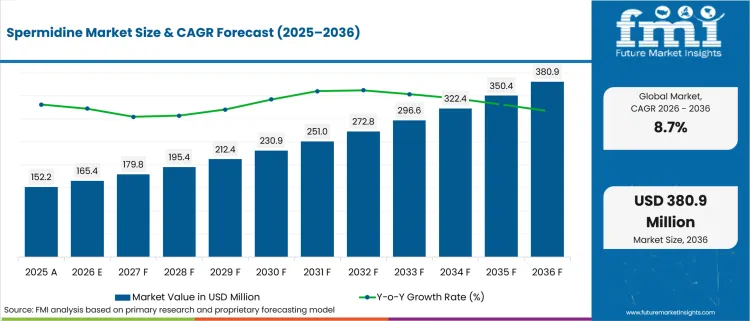
Key Takeaways of Spermidine Market
- Emerging human dose research and cellular-renewal interest expand responsible category education, helping specialist brands support repeat routines without relying on medicinal claims.
- Wheat-germ derived spermidine is expected to represent 63.1% share in 2026 supported by established extraction capacity and familiar food-based positioning.
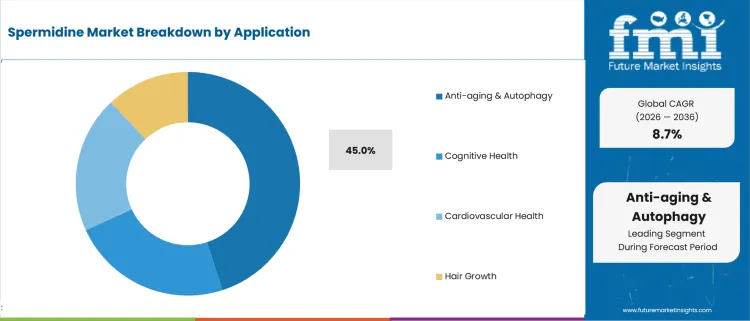
- Anti-aging and autophagy applications are projected to capture 45% share in 2026 driven by focused cellular-renewal positioning across longevity programs.
- Capsules are forecast to account for 52.6% share in 2026 reflecting precise dosing and familiar routines that simplify recurring consumer use.
- Restricted medicinal claims and uneven human evidence raise legal review costs and limit promotional flexibility across regulated supplement channels.
- Food-derived options distinguish Longevity Labs+ and Oxford Healthspan; fermentation or purified formulations differentiate Chrysea Labs and dosage-focused brands.
Analyst Perspective
"Wheat-germ sourcing gives spermidine a familiar commercial base, but source recognition cannot replace verified concentration and careful claim language. Capsules support dependable daily routines across mainstream channels, and gluten-free or fermentation-derived options widen access for people avoiding wheat-based products. Stronger human dose research and public quality records help specialist brands convert scientific interest into responsible repeat use across regulated channels."
- Nandini Roy Choudhury, Principal Analyst, Future Market Insights
How is the Spermidine Market segmented?
The spermidine industry is segmented by source, application, form, and region.
The spermidine market is segmented by source, application, form, and region to reflect distinct commercial decisions. Source separates wheat-germ, fermentation-derived, synthetic, and rice-germ routes according to production consistency, allergen exposure, and ingredient positioning. Application divides anti-aging and autophagy, cognitive health, cardiovascular health, and hair growth according to the consumer need addressed. Form compares capsules, powders, and tablets through dosing convenience, preparation requirements, and stability across recurring use. Regional analysis evaluates claim rules, notification routes, distribution maturity, and specialist retail access across national supplement systems.
Why do anti-aging and autophagy applications shape the application category?
Anti-aging and autophagy positioning gives spermidine a clear role within cellular health products and specialist longevity programs. Available human evidence remains early, so commercial communication must separate cellular-renewal education from unsupported treatment promises across consumer channels. A University of Oxford placebo-controlled pilot, published in Aging Cell in June 2026, gave six milligrams daily to 40 adults aged 65 and older for 13 weeks. The company described the work as a small pilot that requires confirmation through larger trials. The study strengthens dosage discussion without proving widespread adoption or established health outcomes across commercial products.
- Anti-aging and autophagy applications are set to lead the application category with 45% share in 2026 driven by focused cellular-renewal positioning across longevity programs. The positioning gives brands a focused message for longevity consumers and specialist practitioners across carefully controlled channels. Early human research cannot establish disease benefits or guarantee commercial adoption, making responsible communication essential across supplement programs.
- Specialist brands build adoption through mechanism education and repeat routines instead of condition-specific promises across carefully controlled wellness channels. Evidence associated with cognitive health supplements broadens practitioner discussion across defined wellness goals and complementary routines. Haircare supplements create another pathway through appearance-focused use, but each extension needs distinct evidence and carefully limited benefit language.
Why does wheat-germ derived spermidine lead the source category?
Wheat-germ extraction gives brands a recognizable food origin and a production route used by established specialists. Oxford Healthspan explained in April 2025 that food-derived spermidine occurs with other polyamines and differs from isolated synthetic material. The comparison supports source education within herbal nutraceutical products but does not establish superior clinical performance or higher demand. Wheat germ reduces first-purchase explanation, but gluten exposure and variable extract concentration preserve openings for fermentation and rice-germ alternatives.
- By source, wheat-germ derived spermidine is estimated to hold 63.1% in 2026 supported by established extraction capacity and familiar food-based positioning. The source gives manufacturers a familiar ingredient story across capsule and powder programs with established handling requirements. Existing production knowledge reduces formulation risk, although allergen controls and extract-standardization costs remain material commercial considerations.
- Longevity brands use wheat-germ extracts in recurring routines that emphasize traceable origin and independently verified concentration. Contract manufacturers can apply familiar handling methods without redesigning production around an unfamiliar active ingredient. Fermentation and rice-germ routes attract gluten-sensitive users, yet retailer acceptance across regulated supplement channels depends on dependable potency and contaminant records.
Why do capsules lead the form category?
Capsules fit established supplement habits and protect measured daily dosing across plant extracts or purified compounds. Purovitalis stated in October 2025 that renaming Spermidine Fusion preserved the existing product formulation for its direct customers. The change shows how format continuity can protect subscription routines during a branding update without proving capsule leadership. Powders support mixable routines, whereas tablets provide another stable format for consumers who prefer unit dosing.
- By form, capsules are forecast to represent 52.6% in 2026 reflecting precise dosing and familiar daily supplement routines. Standard bottles support subscription replenishment without adding preparation steps or specialized storage for consumers during recurring daily use. Measured fill weights also simplify quality comparisons between plant extracts and purified formulations across recurring production batches.
- Consumers favor capsules for portable routines and limited preparation across older adult supplements and related healthy-aging programs. Powder formats suit people who mix supplements into beverages, although serving accuracy requires clear tools and instructions. Tablets provide stable storage and unit dosing for customers who prefer a solid format without capsule shells.
What are the drivers, restraints, and opportunities in the Spermidine Market?
Structured human studies support responsible education, but medicinal-claim rSpermidine Marketestrictions create an opening for documented formulations in practitioner and pharmacy channels.
- Driver: Structured human studies give practitioners clearer dosage context and improve responsible education across specialist supplement channels.
- Restraint: Medicinal-claim restrictions and uneven human evidence raise legal review costs across labels and digital content.
- Opportunity: Practitioner and pharmacy channels can commercialize well-documented formulations through controlled education and defined quality records.
Structured human studies strengthen demand by giving practitioners clearer dosage and outcome frameworks for responsible category discussion. ClinicalTrials.gov first posted a recruiting study in February 2026 that assigns 76 adults aged 55 to 70 to six milligrams of spermidine or placebo for twelve weeks. Researchers will measure sleep and memory outcomes, so the protocol cannot establish demand across cognitive health supplements or wider commercial channels. The defined protocol gives brands useful dosage context and preserves clear limits around unproven benefits. Responsible education can convert research interest into repeat routines without presenting an active trial as established efficacy.
Autophagy language can easily drift into treatment promises, making medicinal-claim rules a material constraint on spermidine promotion. The Food Standards Agency stated in June 2026 that supplements should not be sold with claims to prevent or treat medical conditions. Companies must separate normal physiological support from disease language across labels and digital promotions throughout the complete sales cycle. Each new application message therefore requires legal review that increases launch costs and slows broad retail campaigns. Careful wording cannot replace the supporting science that regulators expect from commercial health claims during promotional review.
Practitioner-led commercialization creates a credible opening for formulations that require careful dosage education and direct professional support. Chrysea Labs announced an exclusive United States supply and distribution agreement with nuBioAge in April 2026 for practitioner and pharmacy channels. The agreement gives a fermentation-derived formulation a defined commercial route without assuming immediate mass-retail acceptance. Clinical settings can collect practical dosage questions and maintain communication within a controlled professional framework. Wider gains depend on transparent safety records and channel economics that support repeat purchasing beyond initial professional interest.
Which country CAGRs are profiled in the Spermidine Market?
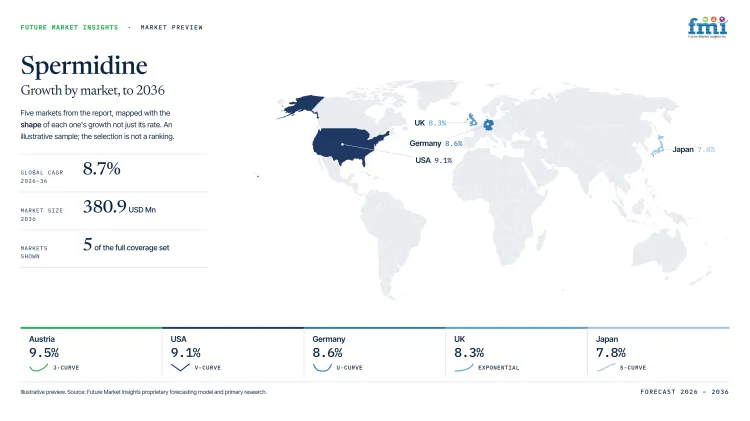
| Country | CAGR |
|---|---|
| Austria | 9.5% |
| United States | 9.1% |
| Germany | 8.6% |
| United Kingdom | 8.3% |
| Japan | 7.8% |
| China | 7.5% |
How do country-level CAGRs compare in the Spermidine Market?
The country forecasts remain relatively close across the spermidine market, indicating that demand for longevity-focused and healthy aging ingredients is expanding across multiple consumer health markets. Austria, the United States and Germany form a closely connected upper group, supported by strong interest in cellular health, nutritional science and preventive wellness products. The United Kingdom follows within a narrow range, while Japan and China create a second group with limited separation between them. The differences across the comparison are moderate rather than pronounced, suggesting that market development is being driven by shared interest in age-related health optimization rather than by isolated regional trends.
- Austria benefits from its strong association with spermidine research and product development, which has helped establish awareness of the ingredient within healthy aging and longevity-focused nutrition categories.
- The United States reflects growing consumer interest in science-backed wellness supplements, supporting the incorporation of spermidine into healthy aging, cognitive wellness and preventive health formulations.
- Germany continues to support market expansion through demand for evidence-based nutraceutical products and increasing interest in ingredients associated with cellular health and longevity.
- The United Kingdom benefits from an expanding preventive wellness market, where consumers are showing greater interest in specialized bioactive ingredients supported by scientific research.
- Japan's outlook is influenced by long-standing consumer interest in healthy aging and functional nutrition, creating opportunities for ingredients positioned around long-term wellness and quality of life.
- China maintains steady growth as awareness of premium nutraceutical ingredients increases and manufacturers expand product offerings focused on healthy aging and proactive health management.
Similar CAGRs do not necessarily create identical market opportunities for spermidine suppliers. Differences in regulatory frameworks, scientific substantiation requirements, consumer education and supplement positioning strategies can significantly influence commercialization pathways. As a result, companies may face distinct market entry and product development considerations even where growth forecasts appear broadly comparable. The full report provides country-level CAGR analysis across North America, Latin America, Europe, East Asia, South Asia, Oceania and the Middle East and Africa.
Country-wise Analysis
- Austria combines a domestic spermidine producer with compact pharmacy and direct-commerce routes across a small national geography. Spermidine demand in Austria is forecast to rise at 9.5% CAGR over the forecast period, supported by short replenishment distances and established wheat-germ expertise. AGES reported in February 2025 that 22 of 35 sampled supplements from direct sales and webshops received objections across Austria. Eight objections involved health-claim rules, and two concerned novel-food requirements across products sold through online channels. Local production supports retailer education and faster issue resolution through nearby specialist channels and pharmacies. Label scrutiny and source-specific allergen concerns create the main friction by increasing documentation needs for wider distribution. Companies also need German-language support that explains dosage without converting cellular mechanisms into medical promises.
- United States dietary supplements can enter commerce without FDA preapproval, but companies remain responsible for safety and truthful structure-function claims. The FDA stated in December 2025 that the DSHEA disclaimer must remain on labels and connect with every applicable structure-function claim. Adoption of spermidine supplements in the United States is estimated to expand at 9.1% CAGR through 2036, shaped by national direct-commerce reach and specialist retail access. The agency considered reducing repeated placement across label panels instead of removing the disclaimer from commercial packaging. Subscription fulfillment creates a direct commercial enabler across North American supplements without requiring immediate store coverage in every state. Enforcement exposure remains the main friction if autophagy research is presented as an established disease benefit.
- German supplement companies must submit a BVL notification for products entering the national market, although notification does not constitute approval. The spermidine market in Germany is estimated to post 8.6% CAGR over the forecast period, driven by pharmacy access and established healthy-aging channels. Verbraucherzentrale explained in October 2025 that the BVL notice confirms receipt but does not verify safety or efficacy. Legal compliance remains with the company introducing each product; state food-control authorities conduct later oversight. Pharmacy distribution provides a practical enabler for education and repeat purchasing across established supplement routines. Continuing responsibility for ingredient safety and compliant German-language communication creates the main commercial friction following notification.
- United Kingdom food supplements remain within food law and cannot carry claims to prevent or treat medical conditions. The Department of Health and Social Care updated the Great Britain nutrition and health claims register in May 2026. The register permits authorized claims in commercial communication across England and Scotland alongside Wales under the national framework. The spermidine market in the United Kingdom is projected to record 8.3% CAGR during the assessment period, enabled by direct subscriptions and established specialist brands. Oxford Healthspan gives the country a domestic specialist with several food-derived formats and dedicated customer support. The main friction comes from translating autophagy research into compliant language that remains distinct from medicinal promises.
- Japan offers a functional-food route that allows company-submitted evidence under defined notification requirements for commercial products. Japanese wheat-germ and chlorella supply routes provide a practical enabler for differentiated food-derived offers in specialist channels. Spermidine supplement sales in Japan are forecast to expand at 7.8% CAGR by 2036, influenced by functional-food channels and food-derived ingredient expertise. The Consumer Affairs Agency began using revised notification forms in April 2025 for new Foods with Function Claims submissions. The forms separate safety and manufacturing information from function evidence and product labeling required for each commercial product. Documentation depth creates the main friction across function-led positioning and coordinated safety records for each formulation. International entrants need local support that can maintain filings through later updates and self-inspection reports.
- China requires registration for health foods using ingredients outside the approved catalogue and for most first-time imports. China's spermidine market outlook is anticipated to advance at 7.5% CAGR over the assessment period, attributable to concentrated urban distribution and specialist digital channels. The State Administration for Market Regulation reported in June 2025 that 13,000 health-food registration certificates remained active at the end of March. The authority also confirmed registration requirements for unfamiliar products using ingredients outside the approved national catalogue. Compliant local partners provide the main commercial enabler through registration planning and controlled channel entry. The evidence burden and permitted-function framework create the main friction by extending commercial timelines for unfamiliar ingredients.
Who are the notable companies in the Spermidine Market?
Longevity Labs+ (spermidineLIFE), Oxford Healthspan, Chrysea Labs, DoNotAge.org, Solaray, Purovitalis, Double Wood Supplements, and Decode Age are notable companies profiled in this market.
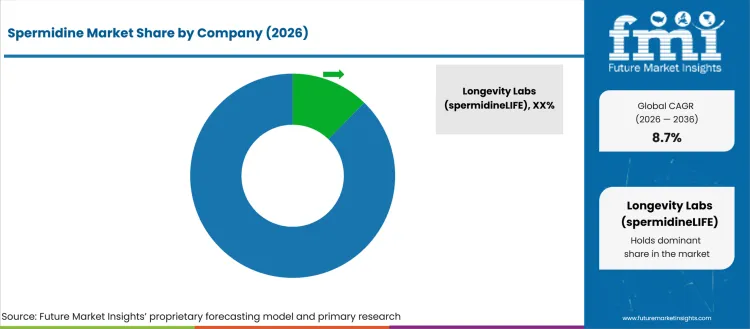
Food-derived brands focus on fermentation and defined-dose products through sourcing disclosure and formulation differences across specialist commercial channels. Longevity Labs+ sells wheat-germ capsules through spermidineLIFE, and Oxford Healthspan offers wheat-germ and chlorella formulations. Chrysea Labs positions Sprevive through fermentation and dose research alongside defined-dose capsules from DoNotAge.org and Double Wood. Solaray offers rice-germ extract and Purovitalis uses a liposomal formulation for direct customers in European channels. Decode Age sells spermidine trihydrochloride through direct online channels with dosage information and customer support. Competitive value rests on verifiable source details and dosage clarity across regulated commercial channels for each product. Public quality records also support responsible communication across consumer and practitioner audiences during recurring promotional activity.
- Longevity Labs+ and Oxford Healthspan use plant-based matrices with detailed sourcing explanations across food-derived portfolios. Solaray adds a rice-germ route with documented testing and established natural-product retail access across several channels. Plant-based specialists must preserve source credibility without converting food-origin narratives into unsupported therapeutic claims during promotion.
- Chrysea Labs uses fermentation to provide purified spermidine with a structured human dose research program. DoNotAge.org and Double Wood Supplements emphasize defined milligram delivery with documented testing for dosage-focused consumers. Their commercial case depends on transparent safety information and practical guidance across practitioner or direct channels.
- Purovitalis combines spermidine with supporting vitamins through a liposomal presentation for European direct customers and subscription routines. Decode Age supplies a synthetic capsule through direct channels with dosage information and digital customer support. Both brands require disciplined benefit language and dependable support across distinct regulatory environments and fulfillment models.
Competitive Benchmarking: Spermidine Market
| Company | Exact-Market Portfolio Depth | Source or Delivery Differentiation | Scientific and Quality Support | Geographic Reach |
|---|---|---|---|---|
| Longevity Labs+ (spermidineLIFE) | High | Medium | Medium | Multi-country direct sales |
| Oxford Healthspan | High | High | High | Multi-region stockists |
| Chrysea Labs | Low | Medium | High | Selected distributors |
| DoNotAge.org | Low | Medium | Medium | Multi-region direct sales |
| Solaray | Low | Medium | Medium | United States retail |
| Purovitalis | Low | Medium | High | Europe-focused direct sales |
| Double Wood Supplements | Low | Medium | High | United States direct sales |
| Decode Age | Low | Medium | Medium | Direct online sales |
Key Developments in the Spermidine Market
- In June 2025, Oxford Healthspan introduced Primeadine GF across all Erewhon locations in Southern California through its first physical retail launch. The chlorella-based formulation added a gluten-free food-derived option beside wheat-germ and purified alternatives for gluten-sensitive consumers. The premium store network created a practical test for source education and replenishment across several locations. Retail performance can guide wider distribution without treating one regional rollout as evidence of national adoption.
- In July 2025, Chrysea Labs published additional dietary-intake findings and confirmed selected-distributor shipments for Sprevive. The announcement connected research communication with active United States availability for a distinct fermentation-derived formulation across specialist channels. Selected distribution gives commercial teams a controlled route for dosage education and practical channel feedback across early sales. The development does not establish broad demand or clinical efficacy across other formulations or wider retail channels.
- In January 2026, Chrysea Labs announced a Mount Sinai collaboration for an early dose-escalation study of Sprevive in humans. Researchers are evaluating dose-response relationships across immune and metabolic biomarkers through a defined clinical protocol. Later results can improve dosage education without supporting treatment claims or immediate retail adoption across specialist commercial channels. The collaboration strengthens differentiation among practitioners who require clearer human dose evidence for fermentation-derived products.
- In February 2026, Oxford Healthspan previewed Primeadine GF Powder in Los Angeles ahead of planned public availability later that year. The new powder added a mixable format beside the company’s existing food-derived supplement for flexible daily routines. The preview tested preparation routines and consumer explanation without replacing established capsules or tablets during normal daily use.
Spermidine Market - Report Scope
| Coverage field | Report scope |
|---|---|
| Market breakdown | Source, application, form, and region. |
| Quantitative Units | Revenue in USD Million and CAGR in %. |
| Market Definition | Spermidine supplements and ingredient formulations sold for measured dietary intake across food-derived, fermentation-derived, and synthetic source routes. |
| Regions Covered | North America, Latin America, Europe, East Asia, South Asia, Oceania, and Middle East and Africa. |
| Countries Covered | Austria, United States, Germany, United Kingdom, Japan, and China. |
| Key Companies Profiled | Longevity Labs+ (spermidineLIFE), Oxford Healthspan, Chrysea Labs, DoNotAge.org, Solaray, Purovitalis, Double Wood Supplements, and Decode Age |
| Forecast Period | 2026 to 2036. |
| Approach | Hybrid bottom-up and top-down market sizing supported by primary interviews and official desk research. |
Spermidine Market - Research Methodology
| Method | Approach |
|---|---|
| Primary Research | FMI analysts gathered input from manufacturers, service providers, technology developers, distributors, end users, procurement teams, and subject-matter experts. Interviews examined purchasing decisions, product or service evaluation, adoption barriers, approval requirements, pricing considerations, and expectations for technical or commercial support. Respondents were also asked what evidence is required before a trial, pilot, or initial order develops into regular purchasing. |
| Desk Research | Desk research covered government statistics, regulatory publications, trade data, industry associations, technical literature, standards, company filings, product information, and official corporate announcements. Sources were reviewed for relevance, publication date, geographic coverage, and consistency with the defined market scope. Claims relating to performance, applications, approvals, capacity, investment, and commercial activity were retained only when supported by credible public evidence. |
| Market Sizing and Forecasting | The market model combined the baseline value with historical performance, segment structure, pricing and volume indicators, adoption levels, company participation, and country-level demand conditions. Forecast assumptions considered economic activity, investment trends, regulatory developments, technology adoption, purchasing cycles, supply availability, and barriers to wider market use. Segment and regional estimates were reconciled before the final market total was calculated. |
| Data Validation | Estimates were checked against multiple independent indicators, including public data, company activity, trade patterns, industry developments, and findings from primary interviews. Validation also tested whether products, services, applications, and company revenues fell within the defined market boundaries. Adjacent categories, unsupported claims, overlapping revenues, and activities without direct market relevance were excluded to reduce double counting and maintain consistency across segments and countries. |
Spermidine Market by Segments
Spermidine Market segmented by Source:
- Wheat-germ Derived
- Fermentation-derived
- Synthetic
- Rice-germ Derived
Spermidine Market segmented by Application:
- Anti-aging & Autophagy
- Cognitive Health
- Cardiovascular Health
- Hair Growth
Spermidine Market segmented by Form:
- Capsule
- Powder
- Tablets
Spermidine Market by Region:
- North America
- United States
- Canada
- Latin America
- Brazil
- Mexico
- Argentina
- Chile
- Western Europe
- Germany
- France
- United Kingdom
- Italy
- Spain
- Benelux
- Nordics
- Eastern Europe
- Poland
- Czech Republic
- Romania
- Hungary
- East Asia
- China
- Japan
- South Korea
- South Asia and Pacific
- India
- ASEAN
- Australia and New Zealand
- Middle East and Africa
- GCC Countries
- South Africa
- Türkiye
- Israel
Research Sources and Bibliography
- Chrysea Labs. (2025, April 10). Chrysea Unveils Groundbreaking Findings on Spermidine Dietary Intake and Cardiovascular Health at American Physiological Society (APS) Summit.
- AGES. (2025, December 17). Food supplements and foods for special medical purposes from pharmacies, doctors' surgeries and other healthcare providers
- Pilling, G. (2025, April 2). Food-Derived vs Synthetic Spermidine: What is the Difference?
- Pilling, G. (2026, July 2). New research from Oxford University: Evidence for spermidine and immune cell renewal
- Pilling, G. (2026, February 11). Primeadine GF Powder Introduced Through a ‘Longevity Shot’ Experience During Grammy's Week in Los Angeles
- National Library of Medicine. (2026, July 2). Autophagy-Enhancers to Reduce Sleep Disturbances (SpSleep) (NCT07383311)
- Food Standards Agency. (2026, June 25). Food supplements guidance
- Invernizzi, A. (2025, October 21). Has Spermidine Fusion been relabeled, and is the formula the same?
- AGES. (2025, February 25). Food supplements from direct sales and online shops
- USA Food and Drug Administration. (2025, December 11). Letter to the dietary supplement industry on the DSHEA disclaimer
- Verbraucherzentrale. (2025, October 10). Wie sind Nahrungsergänzungsmittel geregelt?
- Department of Health and Social Care. (2026, May 19). Great Britain nutrition and health claims register
- Consumer Affairs Agency. (n.d.).
- State Administration for Market Regulation. (2025, June 24).
- Longevity Labs+. (n.d.). spermidineLIFE® - natürliche Nahrungsergänzungsmittel mit Spermidin.
- Longevity Labs+. (n.d.). spermidineLIFE® Original 365+.
- Oxford Healthspan. (n.d.). Stockists.
- DoNotAge.org. (n.d.). Pure Spermidine Supplement.
- Purovitalis. (n.d.). Liposomal Spermidine.
- Double Wood Supplements. (n.d.). Spermidine Supplement.
- Decode Age. (n.d.). Spermidine Trihydrochloride.
- Pilling, G. (2025, June 17). A New Chapter: Primeadine® GF, Now Available at Erewhon!
- Chrysea Labs. (2025, July 18). Chrysea presents additional study results on Spermidine Dietary Intake, BMI and Obesity at Benjamin Frankin Lafayette Seminar (BFLS), and significant association with reduced Cardiovascular risk markers at Gordon Research Conference (GRC).
- Chrysea Labs. (2026, January 11). Chrysea Announces Collaboration with Mount Sinai to Study Sprevive® Dose Levels in Humans.
- Chrysea Labs. (2026, April 30). Chrysea Labs and nuBioAge enter into a USA Supply & Commercialization Agreement for Sprevive® Spermidine Complex.
This bibliography is provided for reader reference and is not exhaustive. The full report contains the complete reference list and detailed citations.
This Report Answers
- How large is the spermidine market in 2026 and what value is projected by 2036?
- Why does wheat-germ derived spermidine account for the dominant source share in 2026?
- How do anti-aging and autophagy applications concentrate demand within the application category?
- Why do capsules represent the largest form share during the 2026 forecast starting year?
- Which drivers, restraints, and opportunities influence commercial expansion across the spermidine market?
- How do approved country CAGRs compare across Austria, the United States, Germany, the United Kingdom, Japan, and China?
- Which country-specific rules and channel conditions shape product entry across the profiled geographies?
- Which companies compete through food-derived sourcing, purified fermentation, precise dosing, or differentiated delivery?
- Which recent company developments could influence evidence quality, retail access, and positioning across the category?
Frequently Asked Questions
How big is the Spermidine Market in 2026?
The spermidine market is valued at USD 165.4 million in 2026 and is forecast to reach USD 380.9 million by 2036. Growth is supported by rising consumer awareness of dietary polyamines and healthy aging, expanding product availability across specialist retail channels, and increasing interest in cellular-renewal supplement routines among longevity-focused consumer segments.
What is the CAGR of the Spermidine Market from 2026 to 2036?
The spermidine market grows at a CAGR of 8.7% between 2026 and 2036, supported by structured human dose research, expanding practitioner and pharmacy channel access, and growing consumer interest in science-backed cellular health ingredients across direct-commerce and specialist supplement retail platforms in key national markets.
Which source segment leads the Spermidine Market?
Wheat-germ derived spermidine accounts for 63.1% of the spermidine market by source in 2026, supported by established extraction capacity and familiar food-based positioning that reduces first-purchase explanation costs while giving manufacturers a recognizable ingredient story across capsule and powder programs with established handling requirements.
Which application segment leads the Spermidine Market?
Anti-aging and autophagy applications account for 45% of the spermidine market by application in 2026, driven by focused cellular-renewal positioning across longevity programs. The segment allows specialist brands to build repeat consumer routines through mechanism education without relying on condition-specific treatment claims across regulated supplement channels.
Who are the leading companies in the Spermidine Market?
Eight companies shape the spermidine market, including Longevity Labs+, Oxford Healthspan, Chrysea Labs, DoNotAge.org, Solaray, Purovitalis, Double Wood Supplements, and Decode Age, competing through food-derived sourcing, fermentation-derived purification, defined milligram dosing, and differentiated delivery formats across direct, practitioner, and specialist retail channels worldwide.
Preview the report firsthand - request a free sample
Get SampleGet the brochure for pricing and purchase details.
Get PDFTable of Content
- Key Takeaways
- Market Size and CAGR
- Top Growth Driver
- Fastest Growing Segment
- Leading Region
- Key Companies
- Emerging Opportunities
- Executive Summary
- Global Market Outlook
- Demand-side Trends
- Supply-side Trends
- Technology Roadmap Analysis
- Analysis and Recommendations
- Analyst Perspective (What is happening? Why now? What should investors know?)
- Key Questions Answered
- How large is the market?
- What is the CAGR?
- What are key trends?
- Which region dominates?
- Who are the leaders?
- Market Overview
- Market Coverage / Taxonomy
- Market Definition / Scope / Limitations
- Research Methodology
- Chapter Orientation
- Analytical Lens and Working Hypotheses
- Market Structure, Signals, and Trend Drivers
- Benchmarking and Cross-market Comparability
- Market Sizing, Forecasting, and Opportunity Mapping
- Research Design and Evidence Framework
- Desk Research Programme (Secondary Evidence)
- Expert Input and Fieldwork (Primary Evidence)
- Tooling, Models, and Reference Databases
- Data Engineering and Model Build
- Quality Assurance and Audit Trail
- Market Background
- Market Dynamics (Drivers, Restraints, Opportunity, Trends)
- Scenario Forecast (Optimistic, Likely, Conservative)
- Impact Analysis
- AI Impact
- Sustainability Impact
- Regulatory Impact
- Technology Impact
- Consumer / Buyer Analysis
- Purchase Drivers
- Adoption Barriers
- Buyer Journey
- Opportunity Map Analysis
- Product Life Cycle Analysis
- Supply Chain Analysis
- Investment Feasibility Matrix
- Value Chain Analysis
- PESTLE and Porter's Analysis
- Regulatory Landscape
- Regional Parent Market Outlook
- Production and Consumption Statistics
- Import and Export Statistics
- Global Market Analysis and Forecast, 2021 to 2036
- Historical Market Size Value (USD Million) Analysis, 2021 to 2025
- Current and Future Market Size Value (USD Million) Projections, 2026 to 2036
- Y-o-Y Growth Trend Analysis
- Absolute $ Opportunity Analysis
- Global Market Pricing Analysis, 2021 to 2036
- Global Market Analysis and Forecast, By Source, 2021 to 2036
- Introduction / Key Findings
- Historical Market Size Value (USD Million) Analysis By Source, 2021 to 2025
- Current and Future Market Size Value (USD Million) Analysis and Forecast By Source, 2026 to 2036
- Wheat-germ Derived
- Fermentation-derived
- Synthetic
- Rice-germ Derived
- Wheat-germ Derived
- Y-o-Y Growth Trend Analysis By Source, 2021 to 2025
- Absolute $ Opportunity Analysis By Source, 2026 to 2036
- Global Market Analysis and Forecast, By Application, 2021 to 2036
- Introduction / Key Findings
- Historical Market Size Value (USD Million) Analysis By Application, 2021 to 2025
- Current and Future Market Size Value (USD Million) Analysis and Forecast By Application, 2026 to 2036
- Anti-aging & Autophagy
- Cognitive Health
- Cardiovascular Health
- Hair Growth
- Anti-aging & Autophagy
- Y-o-Y Growth Trend Analysis By Application, 2021 to 2025
- Absolute $ Opportunity Analysis By Application, 2026 to 2036
- Global Market Analysis and Forecast, By Form, 2021 to 2036
- Introduction / Key Findings
- Historical Market Size Value (USD Million) Analysis By Form, 2021 to 2025
- Current and Future Market Size Value (USD Million) Analysis and Forecast By Form, 2026 to 2036
- Capsule
- Powder
- Tablets
- Capsule
- Y-o-Y Growth Trend Analysis By Form, 2021 to 2025
- Absolute $ Opportunity Analysis By Form, 2026 to 2036
- Global Market Analysis and Forecast, By Region, 2021 to 2036
- Introduction
- Historical Market Size Value (USD Million) Analysis By Region, 2021 to 2025
- Current Market Size Value (USD Million) Analysis and Forecast By Region, 2026 to 2036
- North America
- Latin America
- Western Europe
- Eastern Europe
- East Asia
- South Asia and Pacific
- Middle East & Africa
- Market Attractiveness Analysis By Region
- North America Market Analysis and Forecast, By Country, 2021 to 2036
- Historical Market Size Value (USD Million) Trend Analysis By Market Taxonomy, 2021 to 2025
- Market Size Value (USD Million) Forecast By Market Taxonomy, 2026 to 2036
- By Country
- USA
- Canada
- By Source
- By Application
- By Form
- By Country
- Market Attractiveness Analysis
- By Country
- By Source
- By Application
- By Form
- Key Takeaways
- Latin America Market Analysis and Forecast, By Country
- Historical Market Size Value (USD Million) Trend Analysis By Market Taxonomy, 2021 to 2025
- Market Size Value (USD Million) Forecast By Market Taxonomy, 2026 to 2036
- By Country
- Brazil
- Mexico
- Chile
- Rest of Latin America
- By Source
- By Application
- By Form
- By Country
- Market Attractiveness Analysis
- By Country
- By Source
- By Application
- By Form
- Key Takeaways
- Western Europe Market Analysis and Forecast, By Country
- Historical Market Size Value (USD Million) Trend Analysis By Market Taxonomy, 2021 to 2025
- Market Size Value (USD Million) Forecast By Market Taxonomy, 2026 to 2036
- By Country
- Germany
- UK
- Italy
- Spain
- France
- Nordic
- BENELUX
- Rest of Western Europe
- By Source
- By Application
- By Form
- By Country
- Market Attractiveness Analysis
- By Country
- By Source
- By Application
- By Form
- Key Takeaways
- Eastern Europe Market Analysis and Forecast, By Country
- Historical Market Size Value (USD Million) Trend Analysis By Market Taxonomy, 2021 to 2025
- Market Size Value (USD Million) Forecast By Market Taxonomy, 2026 to 2036
- By Country
- Russia
- Poland
- Hungary
- Balkan & Baltic
- Rest of Eastern Europe
- By Source
- By Application
- By Form
- By Country
- Market Attractiveness Analysis
- By Country
- By Source
- By Application
- By Form
- Key Takeaways
- East Asia Market Analysis and Forecast, By Country
- Historical Market Size Value (USD Million) Trend Analysis By Market Taxonomy, 2021 to 2025
- Market Size Value (USD Million) Forecast By Market Taxonomy, 2026 to 2036
- By Country
- China
- Japan
- South Korea
- By Source
- By Application
- By Form
- By Country
- Market Attractiveness Analysis
- By Country
- By Source
- By Application
- By Form
- Key Takeaways
- South Asia and Pacific Market Analysis and Forecast, By Country
- Historical Market Size Value (USD Million) Trend Analysis By Market Taxonomy, 2021 to 2025
- Market Size Value (USD Million) Forecast By Market Taxonomy, 2026 to 2036
- By Country
- India
- ASEAN
- Australia & New Zealand
- Rest of South Asia and Pacific
- By Source
- By Application
- By Form
- By Country
- Market Attractiveness Analysis
- By Country
- By Source
- By Application
- By Form
- Key Takeaways
- Middle East & Africa Market Analysis and Forecast, By Country
- Historical Market Size Value (USD Million) Trend Analysis By Market Taxonomy, 2021 to 2025
- Market Size Value (USD Million) Forecast By Market Taxonomy, 2026 to 2036
- By Country
- Kingdom of Saudi Arabia
- Other GCC Countries
- Türkiye
- South Africa
- Other African Union
- Rest of Middle East & Africa
- By Source
- By Application
- By Form
- By Country
- Market Attractiveness Analysis
- By Country
- By Source
- By Application
- By Form
- Key Takeaways
- Key Countries Market Analysis
- USA
- Pricing Analysis
- Market Share Analysis, 2025
- By Source
- By Application
- By Form
- Canada
- Pricing Analysis
- Market Share Analysis, 2025
- By Source
- By Application
- By Form
- Mexico
- Pricing Analysis
- Market Share Analysis, 2025
- By Source
- By Application
- By Form
- Brazil
- Pricing Analysis
- Market Share Analysis, 2025
- By Source
- By Application
- By Form
- Chile
- Pricing Analysis
- Market Share Analysis, 2025
- By Source
- By Application
- By Form
- Germany
- Pricing Analysis
- Market Share Analysis, 2025
- By Source
- By Application
- By Form
- UK
- Pricing Analysis
- Market Share Analysis, 2025
- By Source
- By Application
- By Form
- Italy
- Pricing Analysis
- Market Share Analysis, 2025
- By Source
- By Application
- By Form
- Spain
- Pricing Analysis
- Market Share Analysis, 2025
- By Source
- By Application
- By Form
- France
- Pricing Analysis
- Market Share Analysis, 2025
- By Source
- By Application
- By Form
- India
- Pricing Analysis
- Market Share Analysis, 2025
- By Source
- By Application
- By Form
- ASEAN
- Pricing Analysis
- Market Share Analysis, 2025
- By Source
- By Application
- By Form
- Australia & New Zealand
- Pricing Analysis
- Market Share Analysis, 2025
- By Source
- By Application
- By Form
- China
- Pricing Analysis
- Market Share Analysis, 2025
- By Source
- By Application
- By Form
- Japan
- Pricing Analysis
- Market Share Analysis, 2025
- By Source
- By Application
- By Form
- South Korea
- Pricing Analysis
- Market Share Analysis, 2025
- By Source
- By Application
- By Form
- Russia
- Pricing Analysis
- Market Share Analysis, 2025
- By Source
- By Application
- By Form
- Poland
- Pricing Analysis
- Market Share Analysis, 2025
- By Source
- By Application
- By Form
- Hungary
- Pricing Analysis
- Market Share Analysis, 2025
- By Source
- By Application
- By Form
- Kingdom of Saudi Arabia
- Pricing Analysis
- Market Share Analysis, 2025
- By Source
- By Application
- By Form
- Türkiye
- Pricing Analysis
- Market Share Analysis, 2025
- By Source
- By Application
- By Form
- South Africa
- Pricing Analysis
- Market Share Analysis, 2025
- By Source
- By Application
- By Form
- USA
- Market Structure Analysis
- Competition Dashboard
- Competition Benchmarking
- Market Share Analysis of Top Players
- By Regional
- By Source
- By Application
- By Form
- Emerging Startups
- Innovation Benchmarking
- Competition Analysis
- Competition Deep Dive
- Longevity Labs (spermidineLIFE)
- Overview
- Product Portfolio
- Profitability by Market Segments
- Sales Footprint
- Strategy Overview
- Marketing Strategy
- Product Strategy
- Channel Strategy
- DoNotAge
- Oxford Healthspan
- Longevity Labs (spermidineLIFE)
- Case Studies
- Success Stories
- Recent Developments
- Competition Deep Dive
- Assumptions & Acronyms Used


