


- Frozen ready meals are benefiting from digital grocery, quick commerce, and online replenishment, but online access alone does not create repeat demand.
- Convenience creates trial; repeat purchase depends on taste, texture, portion value, nutritional trust, and cold-chain reliability.
- Frozen meals compete with chilled ready meals, food delivery, restaurant takeout, meal kits, workplace dining, and batch cooking, not only home cooking.
- FMI identifies dinner entrées as the leading product type and retail supermarkets as the leading distribution channel in the Frozen Ready Meals Market.
- E-commerce works best when it improves discovery and replenishment without weakening consumer confidence in frozen product quality.
- The biggest misconception is that frozen ready meals grow simply because consumers are busier. They grow when they become the preferred solution for a specific meal occasion.
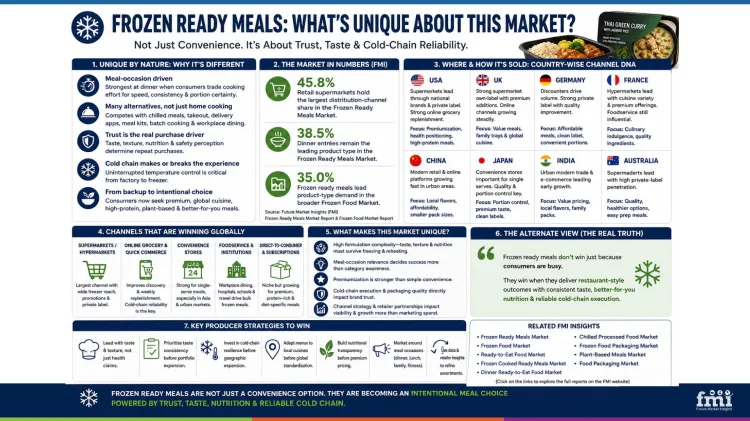
Frozen ready meals are often explained through one simple narrative: consumers are busy, cooking time is shrinking, and frozen meals provide a fast solution. That explanation is directionally correct, but it is not enough to explain where the category succeeds and where it stalls.
Consumers are not debating whether they need convenience. What matters more is which convenience solution they ultimately choose when faced with multiple competing options. A frozen ready meal is not only competing against home cooking. It is competing against chilled processed food, restaurant takeout, app-based food delivery, meal kits, workplace cafeterias, fresh prepared foods, leftovers, and batch cooking.
This is where the e-commerce opportunity becomes more relevant. Online grocery platforms, digital retail channels, and quick-commerce services can enhance product visibility and improve consumer discovery. These channels make it easier for shoppers to find cuisine-specific entrées, high-protein bowls, plant-based meals, portion-controlled formats, family trays, and premium frozen options that may otherwise get overlooked in crowded freezer aisles. However, digital visibility does not remove the core requirement of the Frozen Ready Meals Market: the consumer must trust that the meal will arrive properly frozen, heat correctly, and taste consistent.
FMI’s view of the Frozen Ready Meals Market provides useful category context. FMI identifies dinner entrées as the leading product type and retail supermarkets as the leading sales channel. This is important because it shows that the category remains strongly linked to planned household consumption, rather than being driven only by impulse-led digital ordering. While consumers may discover frozen meals online, the category’s core use case continues to be the practical dinner occasion: quick, filling, predictable, and easy to prepare after work.
Dinner remains the strongest occasion for frozen ready meals because the consumer need is clear. Shoppers are often tired, time-constrained, and looking for a meal that reduces effort without compromising satisfaction. Breakfast and lunch formats still have room to grow, but they face stronger competition from fresh bakery items, sandwiches, cafés, workplace meals, chilled bowls, and quick-service restaurants. This is why the Dinner Ready-to-Eat Food Market is an important adjacent reference when assessing how frozen meals compete for evening consumption occasions.
E-commerce is particularly powerful for repeat replenishment. Once consumers trust a frozen meal brand, they may routinely add the same SKU to their weekly grocery basket. Over time, subscription-like behavior can develop even without a formal subscription, especially when the product becomes part of regular household freezer planning. However, the reverse is also true. A weak online grocery experience can hurt the category. If a meal arrives partially thawed, is poorly substituted, or does not match its digital image, the problem goes beyond one failed purchase. It can weaken consumer confidence in buying frozen meals online.
Cold-chain execution therefore becomes a critical growth gate. Frozen meals depend on reliable freezer storage, temperature-controlled transportation, and disciplined last-mile delivery. These requirements are more demanding than those for ambient packaged foods and offer less flexibility than many chilled food categories. The broader Frozen Food Market reinforces why frozen ready meals sit inside a category where storage, packaging, and temperature control directly influence consumer acceptance.
The fastest-growing opportunities are not always the cheapest meals. Premium frozen meals are gaining relevance because consumers increasingly expect restaurant-style outcomes at home. This is why global cuisine entrées, high-protein bowls, plant-based meals, better-for-you recipes, and richer sauces or side dishes are gaining more attention. These meals are no longer seen only as backup options for busy days. In many households, they are becoming planned meal choices.
However, premiumization raises expectations. A consumer may try a Thai curry, Indian entrée, Korean rice bowl, Mexican dish, Mediterranean protein bowl, or plant-based pasta because it looks attractive online. Repeat purchase depends on whether the meal delivers the promised aroma, texture, portion size, and flavor. Frozen ready meals fail when the online image suggests restaurant quality but the eating experience feels small, watery, bland, or processed.
Packaging also becomes more important in online-led frozen meal sales. The pack has to communicate cuisine, portion, nutrition, preparation method, and appetite appeal quickly. At the same time, it must withstand freezer storage and reheating requirements. This is why the Frozen Food Packaging Market is closely linked to frozen ready meal performance, especially as brands compete through digital shelves and freezer-door visibility.
Geography also plays a big role in how fast frozen ready meals can grow online. In markets such as North America, Europe, Japan, India, and Australia, consumers are already familiar with frozen meals and have more trust in the category. In emerging markets, online demand can grow quickly in large cities, but adoption still depends on practical factors such as freezer ownership, modern retail access, cold-chain strength, and local food habits. A product may perform well in premium urban stores, but it may not scale nationally unless it is adapted to regional tastes and supported by reliable distribution.
The practical lesson for producers is to build around the meal occasion, not simply the online channel. A dinner entrée should solve evening fatigue. A lunch bowl should solve workplace convenience. A family tray should solve portioning and value. A premium cuisine meal should solve restaurant-style craving at home. E-commerce can accelerate each of these, but only when the product promise is clear and the cold-chain experience is reliable.
The misconception to avoid is that digital access automatically expands frozen ready meal adoption. It does not. Online access can make the product easier to find, but repeat demand depends on trust, taste, temperature integrity, and whether the meal fits a real consumer need.
Bottom line: frozen ready meals win online when convenience is supported by cold-chain reliability and a satisfying meal experience. The category does not grow just because consumers are busy. It grows when frozen meals become a trusted solution for specific meal occasions.
Related FMI Reports
- Frozen Ready Meals Market
- Frozen Food Market
- Ready-to-Eat Food Market
- Frozen Cooked Ready Meals Market
- Dinner Ready-to-Eat Food Market
- Chilled Processed Food Market
- Frozen Food Packaging Market

